


Driver’s Desk
A Guide to the Modern Anti Theft Alarm for Vehicles
The traditional car alarm is often pictured as a wailing siren on a street that passersby have learned to ignore. While this perception has roots in the technology of the past, a modern anti theft alarm for vehicles operates on an entirely different level. It has evolved from a simple noisemaker into a sophisticated, multi-layered digital security system, providing owners with a constant connection to their vehicle and unparalleled peace of mind.
Beyond the Siren: Understanding Modern Vehicle Protection
The era of relying solely on audible alarms to deter theft is over. Contemporary vehicle security has matured into an intelligent, integrated ecosystem that combines multiple technologies to create a proactive shield. This evolution is critical, as vehicle theft remains a significant global issue. According to the National Insurance Crime Bureau (NICB), over one million vehicles were stolen in the U.S. in 2023, representing a loss of billions of dollars and causing immense stress for vehicle owners.
Today's advanced systems function as a digital guardian, monitoring a vehicle 24/7, regardless of its location. This guide will provide a detailed analysis of how these technologies work in synergy not only to deter thieves but also to provide owners with an unprecedented level of control over their vehicle's security.
The Evolution of Car Security
Early car alarms were rudimentary, consisting of simple circuits designed to trigger a loud siren. While a notable first step, their effectiveness was limited; experienced thieves quickly learned to disable them, and the high rate of false alarms led to public apathy. The modern approach is far more intelligent, prioritizing silent alerts sent directly to the owner's smartphone, real-time tracking, and remote intervention capabilities.
This technological leap is driven by several key innovations:
- GPS Tracking: Instead of a generic alert, owners can now view their vehicle's precise location on a map in real-time, a crucial development for law enforcement and recovery efforts.
- Smartphone Integration: The owner's smartphone now serves as the central command center, receiving instant push notifications for suspicious events like unauthorized vibrations, engine ignition, or vehicle movement, enabling an immediate response.
- Remote Control: Advanced systems empower owners to take decisive action from anywhere, such as remotely disabling the engine once law enforcement has been engaged.
A truly effective anti theft alarm for vehicles combines deterrence with actionable intelligence. The objective is not merely to create noise but to provide the owner with the tools to track, monitor, and assist in the recovery of their asset.
These advancements signify a paradigm shift from passive to active security. The best vehicle protection today extends beyond a conventional alarm, incorporating technologies like advanced GPS tracking systems for vehicle security to locate and recover a stolen asset. This integrated strategy ensures that even if a thief bypasses initial deterrents, the vehicle remains connected and traceable.
Ultimately, investing in a robust system is about regaining a sense of security. For a deeper examination of how these components form a formidable defense, explore our guide on the elements of a complete car security system. We will detail why this layered defense is essential for protecting one of your most valuable possessions.
How a Modern Vehicle Anti Theft Alarm Works
To fully comprehend a modern anti theft alarm for vehicles, it is essential to view it not as a single device but as a complete security ecosystem. This system functions like a vehicle's central nervous system, continuously aware of its surroundings and prepared to respond to any threat. It comprises a smart network of sensors, a central processing unit, and a direct communication link to the owner.
The first line of defense is the sensor network. These are the "nerve endings" of the system, each designed to detect a specific type of interference. They serve as the eyes and ears of the vehicle, maintaining constant vigilance.
The Role of Smart Sensors
The intelligence of an alarm system is rooted in its ability to differentiate between a genuine threat and a false alarm. Whereas older systems were notoriously prone to being triggered by ambient noise, today's sensors are far more sophisticated and precisely calibrated to recognize legitimate dangers.
Several key sensor types work in concert:
- Shock Sensors: These detect physical impacts, such as a window being broken or a door being forced open. Advanced versions can distinguish between minor contact and a genuine break-in attempt.
- Tilt Sensors: Crucial for preventing theft by tow truck, these sensors detect any change in the vehicle's inclination. If a thief attempts to lift the car onto a flatbed, the system is immediately alerted.
- Proximity Sensors: These establish an invisible perimeter around the vehicle. If an individual lingers too close for an extended period or reaches into an open window, the sensor is tripped, often triggering a warning chirp before activating the main siren.
- Door and Trunk Contacts: These simple yet highly effective magnetic sensors detect when a door, trunk, or hood is opened without the authorized key or fob.
When any of these sensors detect a potential threat, they transmit an immediate signal to the system's "brain"—the central control unit.
From Detection to Action: The System's Brain
The control unit processes the incoming sensor data and, within milliseconds, determines the appropriate response. This is where modern systems significantly outperform their predecessors, moving beyond audible alerts to provide real, actionable information.
This process initiates a multi-layered response designed to deter the thief and alert the owner instantly. The infographic below illustrates this modern security workflow, showing how the system escalates from deterrence to tracking and owner empowerment.

This streamlined process demonstrates that an effective alarm does more than generate noise; it equips the owner with real-time intelligence and tracking capabilities, dramatically increasing the probability of vehicle recovery.
At its core, a modern alarm transforms a theft attempt from a potentially quiet, anonymous crime into a high-risk, traceable event for the criminal. The objective is to render the vehicle an unattractive and difficult target.
This technological advancement is a direct response to the global rise in vehicle theft. The demand for enhanced protection has fueled significant market growth. The global vehicle anti-theft system market was valued at USD 14.1 billion in 2023 and is projected to reach USD 26.3 billion by 2032, reflecting a compound annual growth rate (CAGR) of 6.5%. This is not merely a trend; it is a clear indicator that consumers recognize the necessity for superior security.
The Power of GPS and GSM Modules
The final and most powerful layer of a modern system is its communication capability. Integrated GPS (Global Positioning System) and GSM (Global System for Mobiles) modules work in tandem to deliver the two most critical pieces of information during a theft: location and alerts.
- GPS Module: This component pinpoints the vehicle's exact geographical coordinates with remarkable accuracy.
- GSM Module: This functions as the system's communication line, utilizing cellular networks to send push notifications, SMS messages, or even automated calls directly to the owner's smartphone the instant a sensor is triggered.
Combined, these technologies mean that even if a thief succeeds in driving the vehicle away, the owner has a live feed of its movement. This provides law enforcement with the precise data needed for rapid recovery. To understand the real-world application of this, review our detailed guide on car tracking technology. This critical feature can turn a potential total loss into a recoverable incident, offering ultimate control and peace of mind.
What Makes a Top-Tier Car Alarm System?
When evaluating options for an anti theft alarm for vehicles, the technical specifications can be overwhelming. However, a top-tier system is defined by more than just an audible siren. The best modern alarms are built around a core set of intelligent, proactive features designed to put the owner in complete control.
These features are not superfluous; they transform a vehicle's security from a passive deterrent into an active, intelligent shield. They are centered on providing real-time information and the ability to act on it—the single most critical factor in preventing theft or facilitating a rapid recovery.
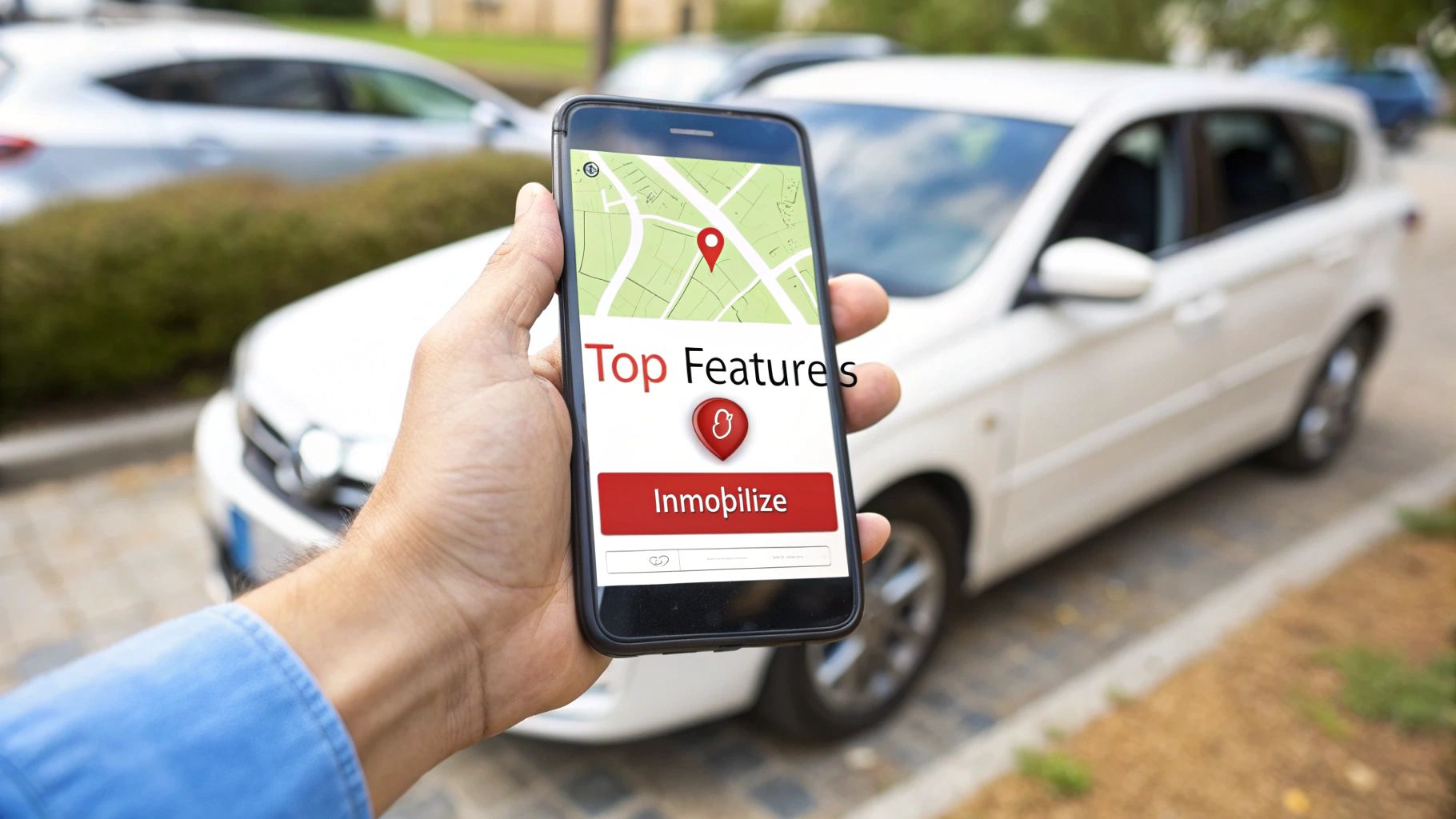
Real-Time GPS Tracking
If one feature defines a modern alarm system, it is real-time GPS tracking. Whereas traditional alarms could only indicate that something was wrong, a GPS-enabled system specifies exactly where the vehicle is at any given moment. This is not a static data point but a live view of the vehicle's location, speed, and direction of travel.
Consider a scenario where you receive a notification that your vehicle's engine has started, despite you being nowhere near it. Instead of helplessness, you can open a mobile application and track the vehicle's movement in real-time. This provides the precise, actionable intelligence that law enforcement agencies require, drastically improving the odds of a swift recovery. Data from the National Insurance Crime Bureau (NICB) consistently shows that vehicles equipped with tracking devices have a significantly higher recovery rate, often within hours of the theft.
Geofencing: Your Car's Invisible Boundaries
Another transformative feature is geofencing. This technology allows you to establish virtual perimeters around any geographical location on a map. These geofences can be set for your home, workplace, or a child's school. The moment the vehicle crosses this boundary—either entering or leaving—an instant alert is sent to your phone.
The practical applications are extensive:
- Workplace Security: Set a geofence around your office parking facility. If your vehicle leaves during work hours without your authorization, you will be notified immediately.
- Monitoring New Drivers: Establish a boundary around your town to receive an alert if a teen driver ventures beyond a pre-approved area.
- Service and Valet Integrity: When leaving your car for service, a tight geofence around the repair shop ensures it is not used for unauthorized trips.
This feature provides proactive control, turning your smartphone into a virtual watchdog that monitors your vehicle's adherence to defined geographical limits.
A top-tier alarm doesn't just react to threats; it allows you to define what constitutes a threat in the first place. Geofencing puts you in the driver's seat of your car's security protocols.
Remote Engine Immobilization
This is arguably the most direct method for halting a theft in progress. In the event your vehicle is stolen, remote engine immobilization grants you the power to disable it via your smartphone. Once the vehicle comes to a stop, a command can be sent to prevent the engine from being restarted.
This feature is a significant deterrent to thieves, as it effectively renders the vehicle inoperable, leaving them stranded until you or law enforcement can arrive. It is a powerful tool that cannot be easily circumvented on the road.
To fully appreciate the advancement in vehicle security, it is useful to compare features directly.
Comparing Modern vs Traditional Vehicle Alarm Features
| Feature | Traditional Alarm System | Modern Anti-Theft System |
|---|---|---|
| Primary Function | Make a loud noise to scare off thieves and alert bystanders. | Provide real-time data, tracking, and remote control to the owner. |
| Location Tracking | None. | Live GPS tracking shows exact location, speed, and direction. |
| Alerts | Loud siren only. Relies on others to notice and intervene. | Instant push notifications, SMS, and calls sent directly to your phone. |
| Geofencing | Not available. | Create custom virtual boundaries and get alerts when your car enters or exits them. |
| Remote Control | Limited to arming/disarming with a key fob. | Remotely immobilize the engine, monitor vehicle health, and review trip history. |
| User Interface | Key fob. | A comprehensive and intuitive mobile app for total system control. |
| Effectiveness | Often ignored due to frequent false alarms. | Highly effective, with a significantly higher vehicle recovery rate. |
This table clearly illustrates that while traditional alarms were a foundational technology, they cannot compete with the proactive, data-driven security offered by modern systems.
A Seamless and Intuitive Mobile App
These advanced features are only as effective as the interface used to control them. A well-designed, reliable mobile application is the command center for the entire security system. It must be intuitive, responsive, and, above all, dependable. During a potential theft, a malfunctioning application is a critical point of failure.
A quality application is your lifeline and should provide:
- Instant Push Notifications: For vibrations, engine starts, and geofence breaches.
- Clear Location Mapping: An easy-to-read map displaying the vehicle's live position.
- Historical Trip Data: The ability to review past routes, stops, and alerts.
- Effortless Configuration: Simple controls for arming/disarming the system and setting up geofences.
The user interface is as critical as the hardware itself. You can explore the full suite of capabilities that a modern car alarm feature set should include to see how a well-designed system integrates all elements for total protection and true peace of mind.
What Do You Really Get From a Vehicle Alarm?
When considering the installation of an anti theft alarm for vehicles, the primary focus is often theft prevention. However, the benefits of a modern system extend far beyond this core function. A contemporary alarm is an intelligent investment that yields returns in multiple, often unexpected, ways.
While the most significant benefit is robust theft prevention and an increased likelihood of recovery, the true value encompasses financial advantages and a profound improvement in your daily sense of security. It is less of an expense and more of an investment in your property and well-being.
Direct Financial Savings and Incentives
One of the most immediate returns on this investment can be seen financially. Many insurance providers recognize the risk-mitigating value of proactive security measures. Consequently, they often offer substantial discounts on annual premiums for vehicles equipped with approved anti-theft and tracking devices—discounts that can offset the cost of the system over time.
This financial incentive is a key driver behind the growth of the car security market. Research from MarketsandMarkets indicates the automotive security market is projected to grow from USD 8.5 billion in 2023 to USD 15.6 billion by 2034, at a CAGR of 5.7%. This growth is fueled by consumer awareness and the tangible financial benefits, making these systems a logical choice.
Furthermore, a vehicle with a documented history of advanced security protection can command a higher resale value, signaling to potential buyers that the asset has been diligently maintained and protected.
The Invaluable Benefit of Peace of Mind
While difficult to quantify, peace of mind is one of the most significant benefits a modern vehicle alarm provides. The low-level anxiety associated with parking a vehicle in an unfamiliar area or leaving it for an extended period in a large public lot can be a persistent source of stress.
A system that maintains a 24/7 connection via instant smartphone alerts fundamentally changes this dynamic. It replaces worry with confidence and control.
- Constant Connection: The ability to check your vehicle's precise location and status at any time, from anywhere, is profoundly reassuring.
- Immediate Alerts: Instead of discovering a theft hours after it has occurred, you are notified the moment suspicious activity is detected, empowering you to take immediate action.
- Reduced Anxiety: Proactive monitoring eliminates the "what if" scenarios that cause stress, allowing you to focus on your day.
The real value of an advanced alarm system is its ability to turn a reactive fear into proactive control. It provides the assurance that your vehicle is not just an isolated asset but a connected part of your personal security network.
This constant vigilance is transformative. A comprehensive car security approach is what provides this level of reassurance and control.
Practical Applications Beyond Theft Prevention
While theft prevention is the primary objective, the features integrated into a modern anti theft alarm for vehicles offer numerous practical, everyday benefits. The security device doubles as a powerful vehicle management tool for families and businesses.
For parents of new drivers, these systems are particularly valuable.
- Monitor Teen Driver Location: Receive a discreet notification when a teen arrives safely at their destination, providing reassurance without being intrusive.
- Set Speed Alerts: Configure notifications for when the vehicle exceeds a pre-set speed limit, creating opportunities for constructive conversations about safe driving habits.
- Establish Geofences: Create "safe zones" on a map and receive an alert if the vehicle travels outside this area, adding an additional layer of safety.
Similarly, small business owners can leverage these systems to manage company vehicles. They can track routes for efficiency, monitor driver behavior to promote safety, and ensure company assets are used appropriately—all from a single mobile application. The security investment thus evolves into a tool for enhancing business operations.
How to Choose the Right Anti Theft Alarm for Your Car
Once you have decided to enhance your vehicle's security, the next step is selecting the appropriate system. Choosing the right anti theft alarm for vehicles requires more than a superficial comparison of features. The optimal system for a new vehicle parked in a high-risk urban environment will differ significantly from that needed for an older car kept in a secure garage.
A sound decision requires a careful assessment of several key factors. A suitable solution must align with your specific vehicle, lifestyle, and security concerns. This section will guide you through the critical considerations to help you select a system that provides reliable and effective protection.
Start With Your Real-World Security Needs
Before evaluating products, conduct a personal security assessment. Your individual circumstances are the most significant determinant of the level of protection required. Answering the following questions will help clarify your risk profile.
- Where is the vehicle parked? A vehicle parked on a public street in a high-theft area requires a more robust defense than one secured in a locked, private garage.
- What type of vehicle do you own? High-value vehicles or models frequently targeted by thieves, such as certain trucks and SUVs, warrant advanced features like real-time GPS tracking and remote immobilization.
- What are your primary concerns? Are you primarily concerned with the theft of the entire vehicle, or are you more focused on preventing break-ins and property theft from within the car? Perhaps your main goal is to monitor its use by family members.
The answers to these questions will guide your decision, helping you determine whether a basic alarm is sufficient or if a comprehensive tracking and recovery system is necessary.
Compare the Different Flavors of Car Alarms
With a clear understanding of your needs, you can begin to explore the primary categories of vehicle alarms available.
- Basic Deterrent Alarms: These are traditional alarms that activate a loud siren in response to sensor triggers like impact or door entry. While they offer a minimal level of deterrence, their effectiveness is often diminished in urban environments where false alarms are common.
- Immobilizer Systems: Standard in most modern vehicles, these systems prevent the engine from starting without the correct electronically coded key or fob. They are effective against amateur thieves but can be bypassed by more sophisticated criminals.
- GPS Tracking Systems: This is the pinnacle of modern vehicle security. Systems like CarLock provide real-time location tracking and send instant smartphone alerts for events such as unauthorized movement, vibration, or engine start. This technology is the single most effective tool for recovering a stolen vehicle.
For maximum security, a system that integrates the features of an immobilizer with a GPS tracker offers a layered defense—it helps prevent the theft initially and provides the means for recovery if it occurs.
The demand for this level of security is exploding for a reason. The global vehicle anti-theft system market was valued at USD 12.47 billion in 2023 and is projected to reach USD 30.24 billion by 2035, according to a report from Spherical Insights. This significant growth is driven by rising vehicle sales and new government regulations mandating improved security features, indicating a clear market shift toward smarter, connected solutions. You can dig into more details about this growing market on Spherical Insights.
Don't Forget About the User Experience
An advanced alarm system is ineffective if it is difficult to manage on a daily basis. A frustrating user experience can lead to the system being disabled, negating its protective value. Focus on three key aspects.
First, ease of installation. Some systems require complex wiring and professional installation, which can be costly and time-consuming. In contrast, plug-and-play devices that connect directly to the vehicle's OBD (On-Board Diagnostics) port, such as CarLock, can be installed by the owner in seconds.
Second, evaluate the mobile application. This is your primary interface with the system. Look for an application that is intuitive, provides immediate alerts, and is stable. A poorly designed interface or delayed notifications can render the system useless in a critical situation.
Finally, consider alert reliability. The system must be calibrated to detect genuine threats without generating excessive false alarms. When you receive a notification, you need to have confidence that it warrants your attention.
Your Top Questions About Vehicle Alarms, Answered
Even with a clear understanding of the benefits, it is natural to have questions before investing in an anti theft alarm for vehicles. This section addresses some of the most common queries from vehicle owners to provide clear, factual answers and build confidence in your security decision.
We will cover practical concerns, from potential battery drain and installation complexity to the system's resilience against modern theft techniques. Addressing these real-world issues is key to selecting a system that provides genuine security, not additional complications.
Will an Advanced Car Alarm Drain My Car's Battery?
This is a valid and frequent concern. A poorly engineered alarm system can indeed create a "parasitic drain" on the vehicle's battery.
However, top-tier systems are specifically designed to prevent this issue. Modern GPS trackers and alarms are engineered for ultra-low power consumption. When the vehicle is parked, the device enters a low-power "sleep" mode, consuming a minimal amount of energy—often less than the vehicle's own onboard computers. It only draws slightly more power for the brief moments it is transmitting an alert or updating its location.
A quality vehicle alarm must protect the car without compromising its primary function: starting reliably. Look for systems that explicitly state low power consumption as a feature. This ensures the battery's integrity, even if the vehicle remains parked for extended periods.
For vehicles driven daily or several times a week, the impact on the battery is negligible, as the alternator replenishes far more power than the device consumes.
How Hard Is It to Install a Modern Vehicle Alarm?
Installation has become significantly simpler with modern technology. Traditional hardwired alarms often necessitate professional installation, involving the splicing of wires into the vehicle's electrical system, which can be expensive and time-consuming.
Fortunately, a much more accessible solution is now standard: the OBD (On-Board Diagnostics) plug-and-play device.
This method is the most straightforward available today.
- Locate the OBD Port: Every vehicle manufactured since 1996 is equipped with an OBD-II port, typically located under the dashboard near the steering column.
- Plug in the Device: The alarm unit plugs directly into this port. No tools or wiring are required.
- Synchronize the App: Download the companion mobile app, create an account, and pair it with the device. The entire process is typically completed in under a minute.
This approach eliminates the need for professional installation, making advanced security accessible to any vehicle owner.
Can Thieves Just Unplug or Disable the Alarm?
This is a critical consideration, as thieves often seek to disable security systems. If an alarm is plugged into the OBD port, a thief could potentially remove it. This is precisely why a layered security approach is essential.
A well-designed system will immediately send a "Device Disconnected" alert to your smartphone the moment it is unplugged. This is a crucial feature. You are not left uninformed; you are notified of tampering as it occurs, providing a critical window to respond. While live tracking may be interrupted, you will have the exact time and last known location of the breach.
For enhanced security, many users employ an OBD extension cable to conceal the device further within the dashboard, making it significantly more difficult for a thief to quickly locate and remove.
While we have addressed the most common questions, more information is always available. For a more comprehensive overview, please review our complete car tracker FAQ section. This resource covers a wide range of topics and further clarifies how a modern system provides robust, multi-layered protection.
Protecting your vehicle should not be a complex endeavor. With CarLock, you get an advanced, real-time GPS tracker and alarm that installs in seconds and delivers instant alerts directly to your smartphone. It’s time to achieve true peace of mind, knowing your vehicle is always connected and protected.