


Driver’s Desk
Finding the Best Car Trackers for Vehicle Security
Selecting the best car tracker for your vehicle is a critical decision that extends far beyond simple location monitoring. It's about implementing a robust security system that provides actionable intelligence and peace of mind. A superior tracking system doesn't just react to theft; it proactively alerts you to suspicious activity in real-time, maintains detailed logs for every trip, and offers a powerful suite of anti-theft capabilities. It transforms your vehicle from a vulnerable target into a connected, protected asset.
Why a Car Tracker Is an Essential Component of Modern Vehicle Security
The prospect of vehicle theft is a significant concern for any car owner. Modern technology, however, provides a powerful countermeasure. A GPS car tracker is not merely an accessory; it's a critical layer in a comprehensive security strategy, moving beyond the reactive approach of post-theft recovery. For anyone who has made a significant financial investment in a vehicle, these devices represent a logical and necessary safeguard.
The increasing concern among vehicle owners has fueled substantial growth in the vehicle security market. According to market analysis, the global vehicle tracking market is projected to reach a valuation between $2.5 billion and $7 billion USD by 2025. Furthermore, industry forecasts predict a compound annual growth rate (CAGR) of 12-15% through 2033, underscoring the rising consumer demand for advanced vehicle protection solutions.
More Than Just Theft Recovery: A Multifunctional Tool
While the ability to recover a stolen vehicle is a primary benefit, the best car trackers offer a much broader range of functionalities. They establish a direct data link to your vehicle, delivering crucial updates and alerts directly to your smartphone. This connectivity provides immense practical value in numerous everyday scenarios.
- Monitoring Novice Drivers: You can configure speed alerts and establish digital perimeters (geofences) to ensure a teenage driver is operating the vehicle safely and staying within approved areas.
- Managing Business Vehicles: Small business owners can leverage trackers to monitor vehicle locations, analyze usage patterns, and optimize routes for improved efficiency and accountability.
- Protecting High-Value Assets: Owners of classic or collector cars can receive immediate notifications if their vehicle is moved or disturbed while in storage, protecting their investment.
The most significant advantage of a modern car tracker lies in its proactive alert system. Instead of discovering an empty parking space hours after a theft has occurred, you receive an immediate notification for suspicious vibrations, unauthorized engine starts, or if the tracking device itself is unplugged. This early warning is the key to preventing a successful theft.
Beyond theft prevention, installing a GPS tracker can have financial benefits. When reviewing the terms of comprehensive auto insurance, you will often find that insurance providers offer premium discounts for vehicles equipped with certified anti-theft devices.
Our guide on https://www.carlock.co/car-tracking provides further detail on these benefits. Our goal is to help you navigate the market and select the most effective system by focusing on the features that provide tangible security value.
Choosing Your Tracker Type: Plug-In vs Hardwired
Before comparing specific brands and models, the first critical decision is selecting the tracker hardware type that best suits your needs. This choice depends on your comfort level with vehicle electronics, your specific security requirements, and the intended application. The three primary categories are plug-in, hardwired, and battery-powered magnetic trackers, each with distinct advantages.
Plug-in trackers are overwhelmingly the most popular choice for consumer vehicles due to their simplicity. These devices connect directly to a vehicle's On-Board Diagnostics (OBD-II) port, which has been a standard feature on all cars and light trucks manufactured since 1996. Installation is completed in seconds without any tools or wiring required.
The CarLock device is a prime example of a plug-in OBD-II tracker that provides a seamless user experience.
The application interface demonstrates this simplicity—users can immediately view their vehicle's location and status from their smartphone. This proves that high-level security does not require complex installation; a simple plug-in device can deliver comprehensive protection immediately.
Hardwired Trackers for Permanent Security
For users seeking a more permanent and covert installation, a hardwired tracker is the ideal solution. These units are wired directly into the vehicle's electrical system and battery, making them virtually invisible to a potential thief. Because they draw power directly from the vehicle, there is no need to worry about recharging the device.
Installation, however, is more involved and typically requires a professional automotive technician or an individual with extensive knowledge of vehicle wiring systems to connect it properly to the fuse box or battery. This makes them less portable but significantly more tamper-resistant than their plug-in counterparts.
The primary advantage of a hardwired unit is stealth. While an OBD-II device can be located and removed by a knowledgeable thief, a professionally installed hardwired tracker is concealed within the vehicle's dashboard or engine bay, providing a much more robust layer of anti-theft security.
Battery-Powered Trackers for Maximum Flexibility
Finally, battery-powered magnetic trackers offer the highest degree of flexibility. These are self-contained units equipped with powerful magnets, allowing them to be attached to nearly any metal surface on a vehicle—from the chassis frame to inside a body panel. Their primary appeal is the ability to be deployed anywhere without any wiring.
The main consideration for these devices is battery life. Depending on the model and the frequency of its location reporting, a battery-powered tracker can last from several weeks to several months before requiring a recharge. This makes them an excellent choice for temporary monitoring or for assets without a dedicated power source, such as trailers or classic cars in long-term storage.
To better understand how different features impact performance, you can review this analysis of GPS car tracker capabilities.
Diving Deep: A Feature-by-Feature Look at the Best Car Trackers
Once you have determined the appropriate hardware type, a detailed comparison of features is necessary. It is easy to become overwhelmed by extensive feature lists, but the best car trackers are defined by the intelligence and reliability of their functions, not merely the quantity. A cohesive security shield is created by how these features integrate and work together.
Let’s move beyond surface-level specifications and examine the features that provide real-world value. This includes the accuracy of real-time location data, the sophistication of the alert system, and the practical applications of historical trip logs. These are the elements that distinguish a simple location device from a proactive security partner.
The infographic below provides a visual summary of the main tracker types, which serves as a foundation for the feature analysis to follow.
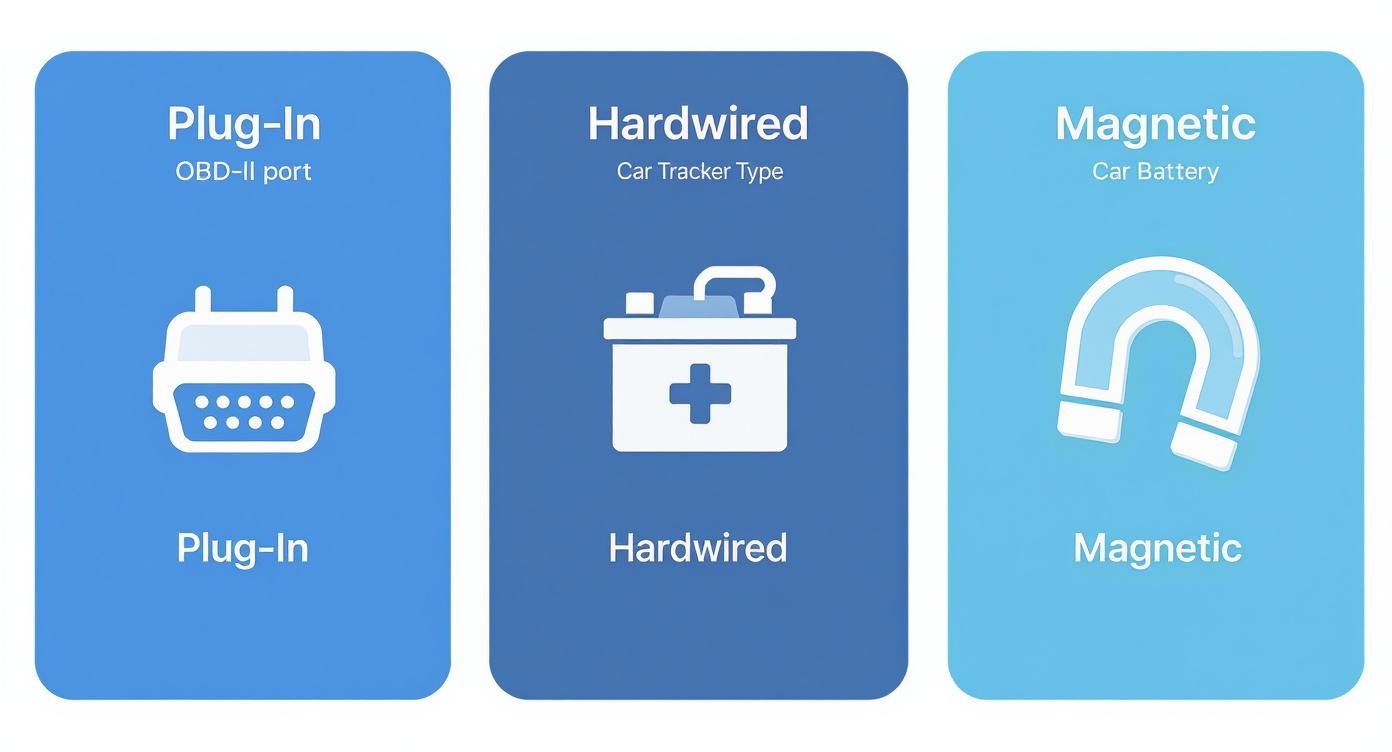
This breakdown simplifies the initial hardware choice, allowing you to focus on the features that are most critical for your specific security needs.
Real-Time Tracking and Alert Systems
The core function of any GPS tracker is to report your vehicle's current location. However, the true value is derived from the intelligent alerts triggered by that location data. A basic tracker might inform you that your car is no longer where you parked it, but a top-tier system will provide context as to why it might have moved and whether you should be concerned.
The most critical security alerts include:
- Engine Start Notifications: Receive an immediate notification the moment the engine is turned on. This is often the first definitive sign of unauthorized use or theft.
- Vibration Detection: This functions as an early warning system, detecting subtle events such as a window being broken, a tire being removed, or a tow truck hooking up, often before the vehicle is moved.
- Device Disconnection Alert: If a thief locates and removes an OBD-II tracker, a system like CarLock sends an immediate alert to your phone, notifying you of the tampering attempt and giving you crucial time to react.
- Geofencing: This feature allows you to create virtual perimeters on a map. You receive an alert if your vehicle enters or exits these predefined "safe zones" without authorization.
These features work in concert to provide a complete security picture. A vibration alert might be the initial warning, followed moments later by an engine start notification, confirming a theft is in progress. You can explore a detailed breakdown of these and other advanced security notifications to see how a multi-alert system provides truly robust protection.
A common misconception is that all real-time tracking is of equal quality. The best systems update their location every few seconds and integrate this data with an intelligent alert engine. This transforms passive location monitoring into an active security system capable of preventing theft.
Feature Comparison of Leading Car Tracker Models
To illustrate how these features perform in a real-world context, let’s compare CarLock with typical competitors. This side-by-side analysis highlights the critical security and usability features that provide a tangible advantage.
| Feature | CarLock | Competitor A (Basic GPS) | Competitor B (Fleet Tracker) | Practical Security Benefit |
|---|---|---|---|---|
| Engine Start Alert | Yes, instant push notification | No | Yes, often email or delayed SMS | Provides the earliest possible warning of unauthorized use, allowing for an immediate response. |
| Vibration Detection | Yes, sensitivity adjustable | No | Rarely | Alerts you to break-in attempts or towing before the car is stolen, not after. |
| Device Disconnect Alert | Yes, immediate alert | No | No | Thwarts a common thief tactic. If they find the tracker and unplug it, you know instantly. |
| Harsh Driving Monitoring | Yes (Braking, Acceleration, Cornering) | No | Yes, detailed logs | Detects joyriding or unusual driving behavior that could indicate theft. |
| Geofencing | Yes, multiple zones | Yes, single zone | Yes, extensive & complex | Ensures a vehicle stays within a designated safe area, like a home, office, or school. |
| Driver Scoring | Yes, simple 0-100 score | No | Yes, detailed metrics | Offers a quick, at-a-glance way to monitor teen drivers or employees for safety. |
| Low Battery Alert | Yes, monitors car battery health | No | Yes, often as part of vehicle diagnostics | Prevents you from being stranded and alerts you to potential electrical issues. |
As the data in the table indicates, a dedicated security tracker like CarLock is engineered around a suite of proactive alerts. While basic GPS trackers only provide location and fleet systems focus on logistics, CarLock delivers a layered defense system designed specifically to protect personal vehicles from theft and misuse.
Historical Data and Driver Behavior Monitoring
Beyond real-time security, the ability to review historical data provides significant value. The best car trackers log every trip, storing detailed route histories that can be accessed at any time. This functionality has practical applications beyond emergency situations.
For example, parents can review a teen's driving routes to ensure they are adhering to agreed-upon boundaries. Small business owners can utilize trip logs to verify mileage for expense reports or identify more efficient delivery routes based on historical data.
More advanced systems analyze this data further to monitor driver behavior, flagging events such as harsh acceleration, hard braking, and sharp cornering. While this serves as an excellent tool for coaching new drivers, it also has a security application. A sudden pattern of aggressive driving could be an indicator that the vehicle is being operated by an unauthorized individual. It provides another layer of data to help you understand what is happening with your vehicle at all times.
Matching a Car Tracker to Your Real-World Needs
The best car tracker is not necessarily the one with the most features, but the one that effectively solves your specific security challenges and integrates seamlessly into your life. A generic device rarely provides the genuine peace of mind that a tailored solution can offer.
To achieve effective protection, you must align the device's capabilities with your real-world scenarios. Let's examine a few common use cases to see how different features address specific needs, making the selection process more logical.
The Worried Parent with a Teen Driver
For a parent with a newly licensed driver, the primary objective is twofold: protecting the vehicle and ensuring the safety of the person behind the wheel. This requires a tracker that moves beyond simple location monitoring to include features that encourage responsible driving habits.
In this scenario, key features to prioritize are:
- Speed Alerts: Receive an instant notification on your smartphone when your teen exceeds a predefined speed limit, providing a timely opportunity for a constructive conversation about safe driving.
- Geofencing: Establish virtual boundaries around key locations like home, school, and work. Alerts for entering or leaving these zones provide confirmation that the driver is where they are supposed to be.
- Harsh Driving Monitoring: Notifications for events like sudden braking, aggressive cornering, or rapid acceleration can highlight risky driving behaviors that require correction.
An easy-to-install OBD-II tracker with an intuitive mobile application is the ideal solution here. The emphasis is on supervision and safety, making detailed, real-time behavioral data an essential requirement.
The Urban Commuter in a High-Theft Area
If you frequently park on the street or in public garages, your primary concern is theft. In urban environments, vehicle break-ins and thefts occur rapidly. Your tracker must function as an immediate, multi-layered alarm system.
When a vehicle is parked on a public street, the first few seconds of a theft attempt are critical. A tracker that only notifies you after the vehicle has been moved is too slow. You require a system that detects the attempt itself, providing a crucial window of opportunity to intervene before the car is gone.
For the urban commuter, essential features include vibration detection, which can alert you to a window being smashed or the vehicle being lifted for towing, and an engine start notification. A device disconnection alert is also non-negotiable, as experienced thieves often search for and remove OBD-II trackers as their first step. These alerts elevate your tracker from a passive location device into an active, real-time security system.
The Classic Car Enthusiast
Owners of classic, restored, or high-value vehicles face a unique set of challenges. These cars are often stored for extended periods, making vehicle battery drain a significant concern. They also represent a substantial investment that demands discreet yet constant monitoring.
A hardwired tracker is often the optimal choice, as it can be concealed deep within the car's wiring, making it extremely difficult to find and tamper with. The critical features for this use case are a low-power "sleep mode" to minimize battery consumption during storage and a highly sensitive vibration sensor. This ensures that even the slightest disturbance—such as an attempt to open a door in your garage—triggers an immediate alert. For occasions when the car leaves storage for a show or service, the ability to review a detailed vehicle route history is invaluable.
Unpacking the True Cost of Vehicle Tracking
The initial purchase price of a car tracker is only part of the overall financial picture. To accurately assess the investment, you must consider the total cost of ownership, which includes both the hardware and the ongoing subscription fee that powers its security features. Overlooking this recurring cost can lead to unexpected expenses.
The initial hardware for most quality trackers ranges from $30 to over $100, which is a one-time purchase. The determining factor for long-term cost is the monthly or annual service fee. This subscription covers the cellular data connection the device uses to communicate with your phone, access to the mobile app, and the server infrastructure required to deliver real-time alerts.
Deconstructing Subscription Tiers
The structure of these subscription plans is where significant differences between trackers become apparent. A low-cost, basic plan may only update your car's location every few minutes, which severely limits its effectiveness in an active theft scenario. More robust plans, while carrying a higher fee, are what unlock the critical, real-time security alerts that make these devices a worthwhile investment.
A typical tiered structure includes:
- Basic Tier: Often provides location updates every 5-10 minutes. It typically excludes instant alerts for events like vibration or engine starts.
- Mid-Tier: This is the optimal tier for genuine security. It usually includes real-time tracking (updates every 30 seconds or less), geofencing, and the full suite of security alerts.
- Premium Tier: These plans may add value-added services like detailed driver behavior reports, extended trip history storage, or multi-user family sharing plans.
A common purchasing error is selecting a tracker based on a low hardware price, only to discover that essential security features are locked behind an expensive premium subscription. The best car trackers offer transparent, all-inclusive plans that do not charge extra for the core alerts that protect your vehicle.
The Long-Term Value Proposition
When you properly weigh the costs against the potential loss, the value of a dedicated security system becomes evident. With the average cost of a new vehicle now exceeding $48,000 according to Kelley Blue Book, a modest monthly fee for a reliable tracker is a minor expense to protect a significant asset. It is an investment in proactive defense.
This growing understanding of value is what's fueling a huge expansion in the market. The vehicle tracking system market was valued at $21.54 billion USD in 2022 and is projected to rocket to $60.89 billion by 2030. You can dig into the details on the growth of the vehicle tracking market on Grandview Research. This boom is being driven by everyday consumers and businesses who get the financial and practical upside of advanced tracking.
Ultimately, the best value is not found in the cheapest device, but in the one that delivers reliable, multi-layered alerts without hidden fees. A simple location-pinging gadget may seem like a bargain but offers a false sense of security. A comprehensive service with proactive alerts, in contrast, provides genuine peace of mind—the real return on investment. You can see what real users think about this by checking out customer reviews of comprehensive systems.
When it comes to securing your car, it’s about more than just finding it after it’s gone. True security is about building a proactive shield around your vehicle—one that gives you real-time intelligence the moment something is wrong. This means finding a system that balances serious protection with everyday convenience and value.
After looking at everything on the market, a system like CarLock really nails this balance. It’s built from the ground up for personal car owners, giving you powerful security features without the headache or high cost of a professional fleet system. It hits that perfect sweet spot.
The Power of Proactive, Multi-Layered Alerts
The real muscle of a top-tier tracker is its alert system. While basic GPS can tell you where your car is, a proactive system tells you what’s happening to it, right now. This is where CarLock shines by layering its notifications.
- Vibration Detection: Think of this as your first line of defense. It alerts you to a potential break-in or someone trying to tow your car before the engine even turns over.
- Engine Start Notification: The second your ignition is fired up without your permission, you get an instant push alert.
- Device Disconnect Alert: This is a crucial one for OBD-II trackers. If a thief finds the device and yanks it out, you get an immediate notification. Their attempt to disable the system actually gives them away.
This stack of alerts goes way beyond simple location pings. It provides context, letting you react instantly when every second is critical.
The magic is in how these alerts work together. A vibration alert followed by an engine start notification is a confirmed theft in progress. That’s the critical info you need to give law enforcement right away. It’s the difference between active prevention and passive recovery.
Balancing Simplicity with Security
Let’s be honest, nobody wants to deal with a complicated installation or confusing app. CarLock’s simple OBD-II plug-and-play design completely removes that barrier. It takes just seconds to install, requires zero tools, and makes advanced security accessible to anyone, no matter how tech-savvy you are.
This simplicity carries over to the pricing, too. The subscription is straightforward, bundling all the essential security features into one clear plan. You get the full suite of alerts without getting nickel-and-dimed for the features that actually keep your car safe. It’s a complete, powerful, and refreshingly simple solution for today’s car owner.
For a system that delivers a robust, multi-layered defense with unmatched ease of use, CarLock is our top pick. It gives you the proactive alerts and real-time intelligence you need to effectively protect your vehicle.