

Driver’s Desk
Best Car Theft Prevention Devices: A Data-Driven Guide for 2026
The best car theft prevention devices are not a single gadget but a comprehensive strategy. The goal is to create layers of defense for your vehicle, combining visible deterrents, electronic immobilizers, and real-time GPS trackers. This multi-layered approach is critical because a modern thief can bypass a car's factory-installed system in under 60 seconds.
Why Modern Cars Are More Vulnerable Than You Think
The classic image of a car thief smashing a window and hotwiring an engine is largely a relic of the past. Today’s criminals are tech-savvy operators who exploit the very convenience features built into modern vehicles. That keyless entry fob you rely on is constantly broadcasting a signal that thieves can intercept, amplify, and replicate with alarming ease.
This vulnerability has led to a surge in silent, high-tech thefts. According to the National Insurance Crime Bureau (NICB), over one million vehicles were stolen in the United States in 2022, amounting to a staggering $8.9 billion in losses. Thieves no longer need brute force; they use sophisticated electronic tools to fool your car into thinking the genuine key is present.
The New Age of High-Tech Car Theft
Modern car theft has gone digital, primarily relying on two methods: relay attacks and key fob cloning. These techniques circumvent standard security measures without triggering alarms or leaving any visible signs of forced entry.
-
Relay Attacks: This is the most common form of keyless theft. One thief stands near your home with a relay box that captures the low-frequency signal from your key fob (even through walls). This signal is then amplified and transmitted to a second device held by an accomplice next to your car. The vehicle is tricked into believing the key is nearby, allowing it to be unlocked and started. The entire process can take less than a minute.
-
Key Fob Cloning: Criminals can also capture your fob's signal in public places—like a shopping mall parking lot—using a device called a "code grabber." This device records the radio frequency identification (RFID) signal and creates a functional clone of your key. This new "key" grants them complete access to your vehicle at their leisure.
The process is disturbingly simple for a prepared thief, as this flow illustrates.
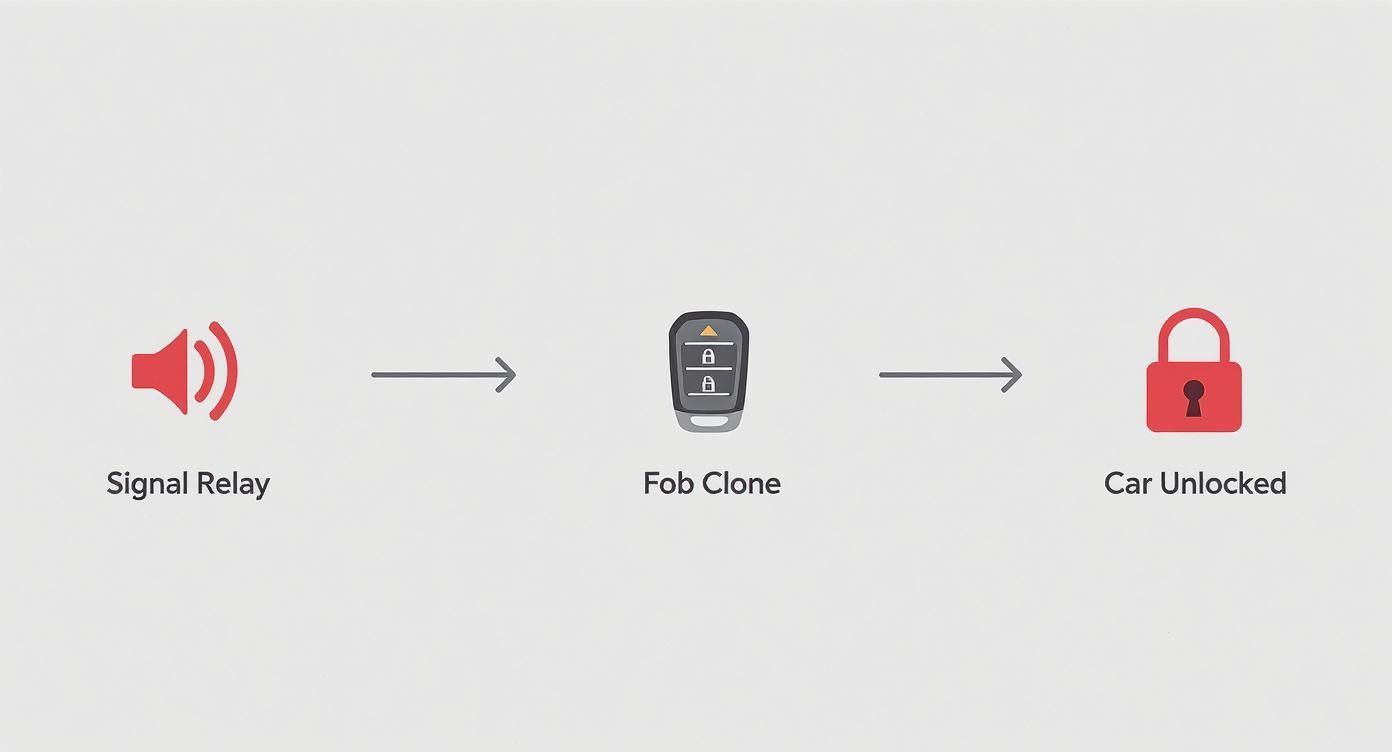
It’s no longer about defeating mechanical locks. Modern vehicle theft is a game of capturing and replaying digital data.
A Growing Problem and a Booming Market
The proliferation of these high-tech methods has created a significant challenge for car owners, law enforcement, and manufacturers. The first step to protecting yourself is simply understanding how to improve your vehicle's security awareness. In response, the security industry has developed more advanced countermeasures.
The global vehicle anti-theft system market is exploding, valued at USD 12.4 billion in 2025 and projected to skyrocket to USD 21.6 billion by 2035.
This massive growth underscores a critical truth: the security system that came with your car is likely insufficient. As thieves evolve, our defenses must evolve as well. Adding independent, aftermarket layers of security is the only robust method for protecting your vehicle from these invisible threats.
Building a Fortress on Wheels with Layered Security
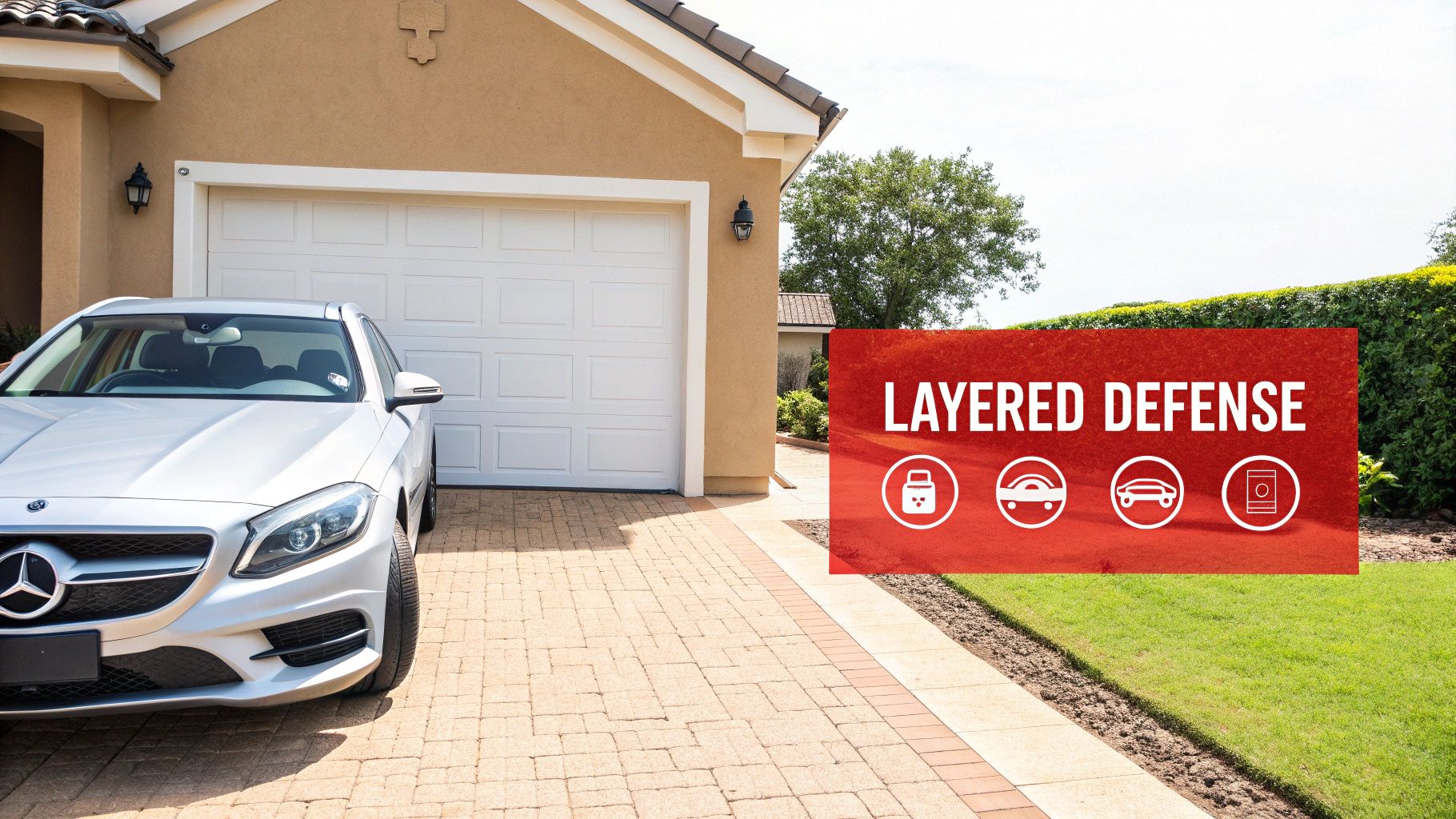
No single device can make a car completely theft-proof. The most effective strategy for securing your vehicle is to adopt a layered defense model, similar to how a fortress is protected. You wouldn't rely on a single gate; you'd have a moat, high walls, and guards. Each additional layer exponentially increases the difficulty for an intruder.
This is the core principle behind the best car theft prevention strategies. By combining different types of security, you create multiple hurdles for a thief to overcome. Most criminals are opportunistic and seek an easy target. A vehicle with several layers of protection presents too much work and too high a risk of getting caught, compelling them to move on.
The Three Essential Layers of Vehicle Protection
A truly robust security plan integrates three distinct layers, each serving a specific function. When used in concert, they form a formidable barrier against theft. Understanding how these layers work will empower you to make informed decisions about protecting your vehicle.
Here's the breakdown:
-
Layer 1: Visual Deterrents – These are the overt, physical devices like a steering wheel lock or a blinking LED light. Their primary purpose is psychological. They act as a clear warning sign, signaling that the vehicle is protected and will require significant effort to compromise.
-
Layer 2: Immobilizing Devices – This is your covert line of defense. Even if a thief gains entry, these systems prevent them from driving away. Electronic immobilizers or hidden kill switches cut power to the engine or fuel pump, rendering the car inoperable.
-
Layer 3: Tracking and Recovery Systems – This is your ultimate safety net. Should a highly skilled and determined thief bypass the first two layers, a real-time GPS tracker provides the exact location of your vehicle, enabling rapid recovery.
By combining these three elements, you create a security system that is far greater than the sum of its parts. Each layer compensates for the weaknesses of the others, building a formidable defense.
Security also extends beyond the devices on your vehicle. Where you park is a critical factor. Whenever possible, opting for well-lit areas or indoor and gated parking with 24/7 security adds another powerful layer of protection. This layered approach is validated by countless real-world success stories, which you can see in these CarLock reviews from satisfied users.
In the following sections, we'll delve into the specific devices that constitute each of these crucial layers.
The Power of Visible Deterrents and Physical Locks
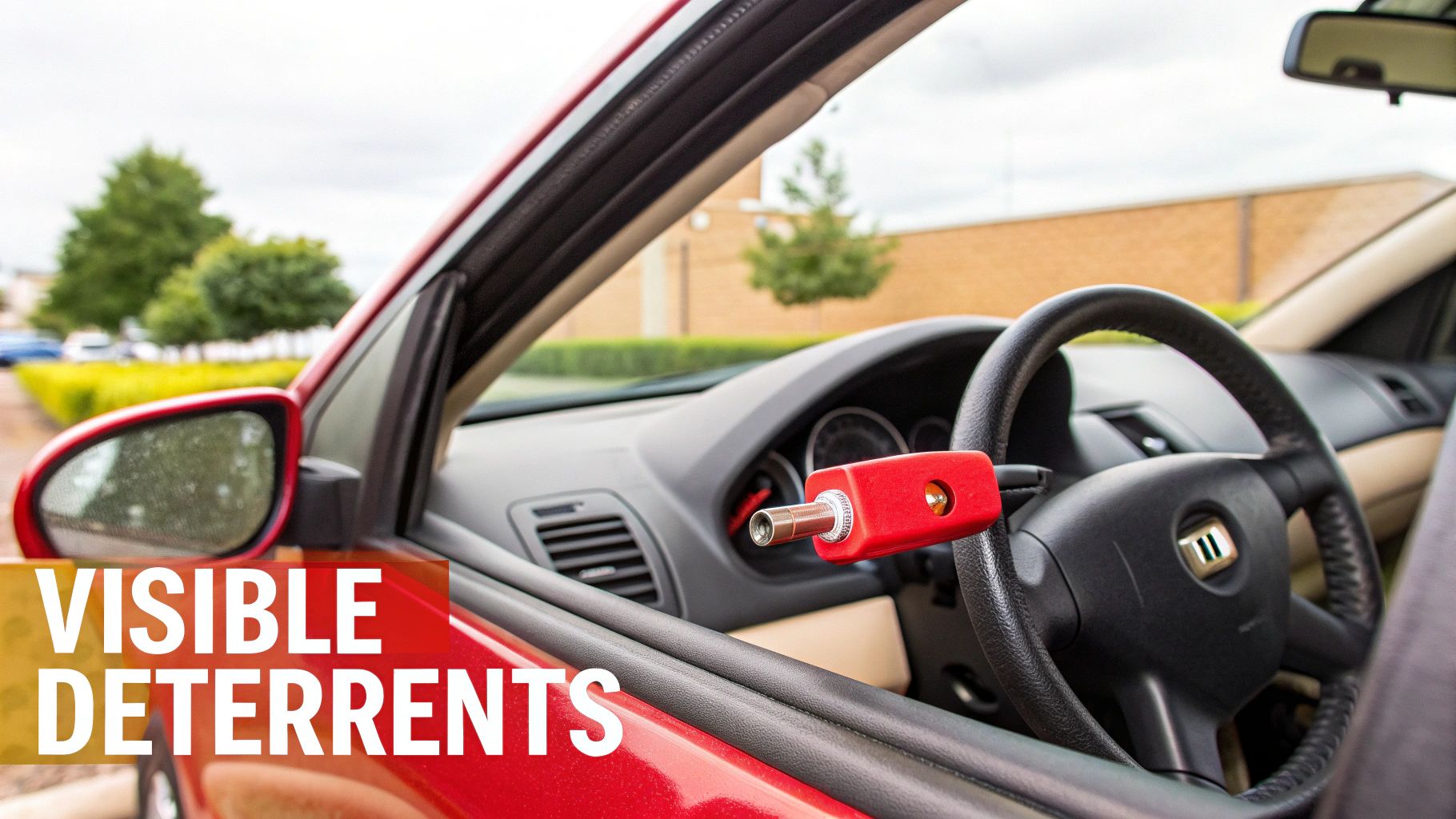
Sometimes, the most effective defense is the one a thief can see from 50 feet away. Physical locks serve as a bold, visual "Keep Out" sign for your car. Their primary function isn't necessarily to be unbreakable, but to make a potential theft as difficult, noisy, and time-consuming as possible.
For the common criminal seeking a low-risk target, the sight of a brightly colored steering wheel lock is often enough to deter them. This simple, visual warning is a surprisingly effective first layer of security, often preventing a break-in before it even begins.
Classic Tools With Modern Relevance
Some of the most reliable anti-theft tools have been in use for decades for one simple reason: they still work. These mechanical devices create a physical barrier that cannot be hacked or bypassed with a signal relay attack. They force a thief to engage in a physical, time-consuming struggle.
Steering wheel locks are the most iconic example. They are simple, highly visible, and make driving the car impossible without considerable effort and noise. Other effective mechanical options include:
-
Pedal Jacks: These devices lock the brake or clutch pedal to the floor, rendering the car undrivable.
-
Wheel Clamps: Commonly known as "boots," these are impossible to miss and physically prevent a wheel from rotating, stopping a thief from even rolling the car away.
-
Gearshift Locks: This device locks the gearstick in "Park" or "Neutral," preventing the transmission from being engaged.
The primary goal of a visible deterrent is to increase the thief's "work time." The longer it takes to steal a car, the higher the risk of being caught. Most criminals will abandon an attempt that takes more than 60 seconds.
While all these physical devices serve a similar purpose, they vary in application and visibility.
Comparing Physical Anti-Theft Devices
| Device Type | Primary Function | Average Cost | Effectiveness Rating |
|---|---|---|---|
| Steering Wheel Lock | Immobilizes the steering wheel | $30 – $100 | High |
| Pedal Jack/Lock | Prevents brake or clutch pedal operation | $50 – $150 | High |
| Wheel Clamp (Boot) | Prevents wheel rotation | $80 – $250 | Very High |
| Gearshift Lock | Locks the gearshift in Park or Neutral | $40 – $120 | Moderate to High |
| Catalytic Converter Shield | Prevents access and removal of the catalytic converter | $150 – $500 | Very High |
Each of these devices adds a crucial layer of difficulty for a thief, turning a quick theft into a risky and prolonged ordeal.
Combating Specific Modern Threats
While classic locks protect the entire vehicle, some of today's most prevalent threats are more targeted. The theft of catalytic converters, for instance, remains a significant issue due to the high value of the precious metals they contain. A single stolen converter can cost over $2,000 to replace.
This is where a catalytic converter shield proves invaluable. It's a heavy-duty metal plate that bolts over the converter, making it extremely difficult for a thief to access it with a cutting tool. It's a modern physical solution to a very modern problem. While not a traditional alarm, it's a perfect example of how physical security complements a high-tech system. You can learn more about creating a complete security net by reading our guide on how a modern car alarm system works.
Ultimately, physical locks are your frontline defense. They send a clear message that your vehicle is protected, forcing thieves to weigh whether the risk is worth the potential reward. Most of the time, they will simply move on.
Electronic Immobilizers and Kill Switches
While visible locks form an excellent first line of defense, a robust security strategy must include a covert second layer. This is the role of electronic immobilizers and kill switches. Think of them as silent guardians that prevent a thief from starting the engine, even after gaining access to the cabin.
The concept is simple yet powerful: a physical lock secures the door, but an immobilizer secures the engine itself. A thief may bypass the door, but they aren't going anywhere if the vehicle refuses to start. These systems operate by interrupting a critical circuit required for the engine to run.
How These Hidden Defenses Work
Electronic security systems are designed to be invisible hurdles. They don't rely on audible alarms but instead disable the vehicle's core systems, turning a potential getaway car into an immobile block of metal. This is an essential component of any modern car security system, as it directly counters high-tech theft methods.
Here's a breakdown of the most common types:
-
Engine Immobilizers: Most vehicles manufactured after 1998 are equipped with a factory immobilizer. A small transponder chip in the key fob communicates with the engine control unit (ECU). If the correct code is not received, the ECU will not allow the engine to start.
-
Kill Switches: This is an aftermarket solution involving a hidden switch that interrupts the power flow to an essential component like the fuel pump or ignition system. A strategically placed switch can completely confound a thief who cannot diagnose why the car is dead.
-
Remote Battery Disconnects: These devices allow you to remotely sever all power from the battery via a wireless fob. This makes it impossible for a thief to start the car or use its electronics to bypass other security systems.
The core principle behind these devices is to make the vehicle mechanically impossible to operate without authorization. Even if a thief has a cloned key, they will be left with an engine that will not start.
Aftermarket Solutions Versus Factory Systems
Factory-installed immobilizers provide a baseline level of security, but they have a significant vulnerability: standardization. Professional thieves extensively research these systems and often know the specific bypass methods for popular makes and models.
This is where aftermarket kill switches and immobilizers offer a superior advantage. Since they can be installed in unique, customized locations, they are far more difficult for a criminal to find and disable under pressure. This element of unpredictability gives you a massive defensive edge.
Of course, these electronic defenses primarily stop the vehicle from being driven away. It's crucial to remember that thieves also target valuable components. For instance, in 2023, while catalytic converter thefts decreased from their peak, tens of thousands were still stolen in the United States. The average replacement cost remains high, typically between $1,500 and $3,000, making physical shields for these parts a wise investment.
GPS Trackers: The Ultimate Recovery Tool
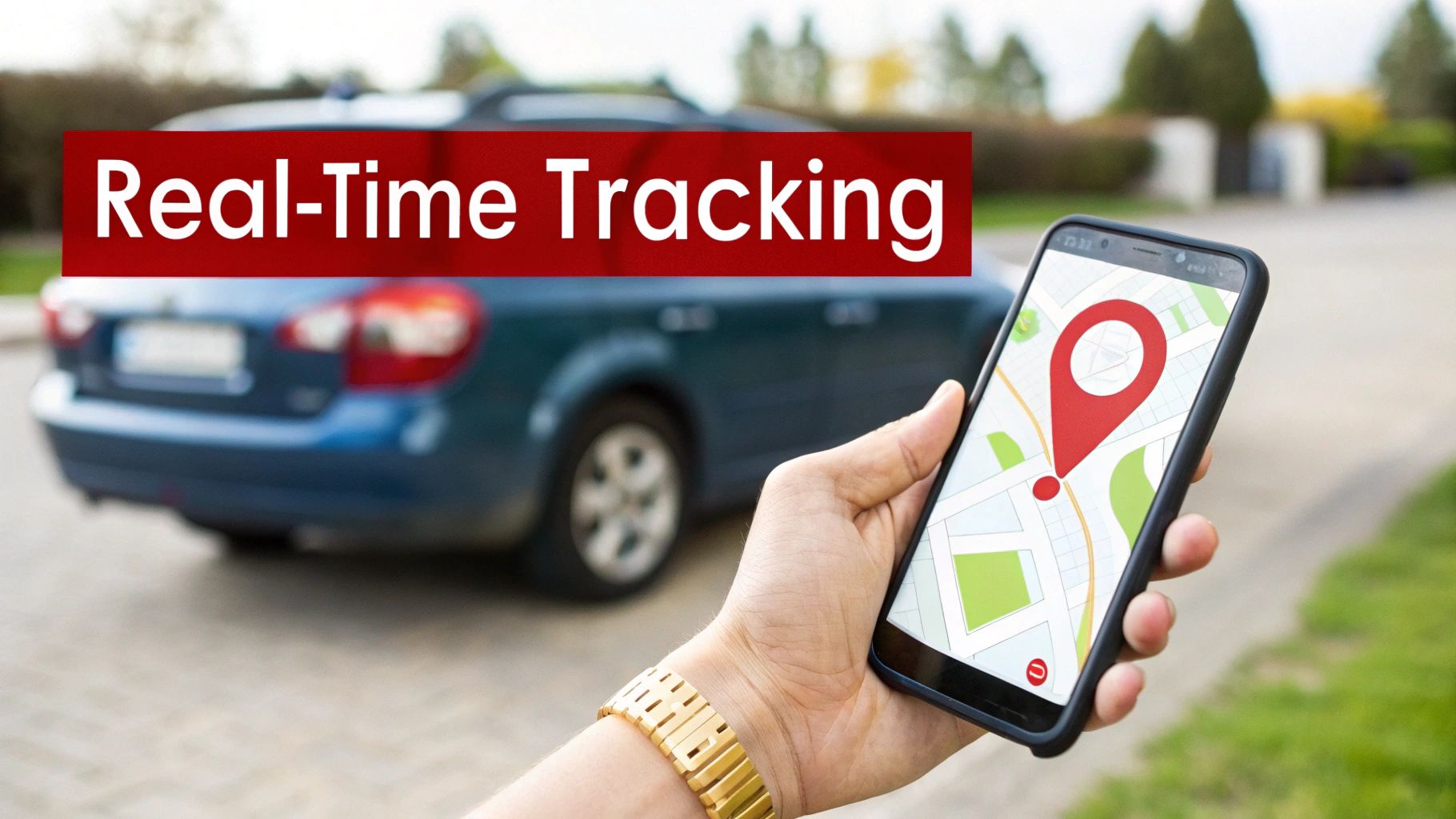
Physical locks act as a deterrent and electronic immobilizers stop a thief in their tracks, but what happens if a determined professional circumvents both? This is where your final layer of security—a real-time GPS tracker—becomes your most valuable asset. It's the ultimate safety net, transforming a potential total loss into a recoverable event.
Think of it as a homing beacon for your car. If your vehicle is stolen, you are not left helpless. A GPS tracker empowers you with your car's exact location, updated in real-time and displayed on your smartphone. This technology is a game-changer for vehicle recovery.
Law enforcement data consistently shows that vehicles equipped with tracking systems are recovered at a significantly higher rate and in a fraction of the time. In fact, a tracker provides the critical, actionable intelligence that can lead police directly to your stolen vehicle, often within hours.
More Than Just a Dot on a Map
Modern GPS trackers have evolved far beyond simple location finders. They are now comprehensive security hubs that actively monitor your vehicle, alerting you to potential threats the moment they occur. This proactive monitoring provides the critical head start needed to stop a theft in progress.
These systems establish a constant, direct link between you and your car, sending instant notifications for a wide range of suspicious activities. This effectively turns your smartphone into a virtual watchdog that is always on guard.
A GPS tracker is one of the most powerful tools in preventing and recovering from car theft. Real-time location data, combined with instant movement alerts, dramatically increases the chances of law enforcement recovering a stolen vehicle quickly.
This immediate information is precisely what makes GPS trackers one of the best car theft prevention devices on the market. It closes the critical time gap between the moment a theft occurs and the moment you become aware of it.
Key Features of Advanced Tracking Systems
The best GPS solutions, like CarLock, are equipped with multiple sensors that provide a complete, 360-degree view of your car's security. These features work in tandem to detect different types of threats, from subtle tampering to the vehicle being driven away without authorization.
Here are the key capabilities to look for:
-
Real-Time Location Tracking: Pinpoint accuracy of your vehicle’s live position on a map. No guesswork.
-
Unauthorized Movement Alerts: Notifies you immediately if your car is moved, towed, or driven without your permission.
-
Geofencing Capabilities: Lets you set up virtual boundaries (e.g., around your home or workplace) and sends an alert if your car crosses them.
-
Vibration Detection: Sends an alert if the device senses unusual vibrations, such as those from power tools, a window being smashed, or the car being jacked up.
-
Engine Start Alerts: Instantly notifies you the moment your car’s engine is started—the earliest possible warning that a theft is in progress.
These intelligent alerts are what distinguish a premium tracker from a basic one. You can see a full list of these advanced GPS car tracker features and device specifications to understand how they build a complete security shield around your vehicle.
Some systems even monitor your car's health, alerting you to a low battery before it leaves you stranded. This blend of security and practicality makes a GPS tracker an essential tool for any modern car owner. It doesn't just give you the power to recover your car; it delivers true peace of mind.
Common Questions About Car Security Answered
Navigating the world of vehicle security can be complex. Let's clarify some of the most common questions car owners have when choosing the right protection.
Are Factory-Installed Car Alarms Really Enough to Stop a Thief?
In short, no. While a factory alarm is a basic deterrent, it is far from sufficient. Car manufacturers install the same standardized system across thousands of vehicles, making them a known quantity for professional thieves who have ample opportunity to learn how to disable them quickly.
Most factory alarms are designed merely to create noise, which is often ignored in urban environments. They offer zero protection against modern high-tech methods like relay attacks or key fob cloning. A truly secure vehicle requires layered defenses, such as combining a physical lock with a modern GPS tracker that provides instant alerts directly to your phone.
Will Adding an Anti-Theft Device Actually Lower My Car Insurance?
Yes, in many cases it will. Most insurance companies offer discounts for installing approved anti-theft devices. The amount of savings varies, but devices that arm automatically—like an immobilizer or an active GPS tracking system—are often viewed most favorably.
Insurers particularly value devices that increase the probability of vehicle recovery. A real-time GPS tracker like CarLock makes recovery highly likely, which can lead to significant premium reductions—often between 5% and 25%, depending on your provider and policy.
It is always advisable to contact your insurance agent to inquire about their specific list of approved devices. Providing proof of installation is typically all that is needed to apply the discount.
What Is the Single Most Effective Car Theft Prevention Device?
This is a common question, but it's based on a flawed premise. There is no single "magic bullet" for car security. The most effective strategy is always a layered approach. The more obstacles you place in a thief's path, the higher the likelihood they will abandon the attempt and seek an easier target.
However, if forced to choose one device that provides the most comprehensive value, a real-time GPS tracker offers the best return on investment. Physical locks can be broken, and audible alarms are frequently ignored. A GPS tracker, conversely, serves as your ultimate safety net. It alerts you to a problem the second it happens and provides law enforcement with a live map to follow for rapid recovery, even after all other defenses have been breached.
Do I Have to Buy an Expensive System to Get Good Protection?
Absolutely not. A device's effectiveness is not directly correlated with its price tag. A simple, highly visible steering wheel lock can be a more powerful deterrent against an opportunistic thief than an expensive, hidden alarm system.
The objective is not to purchase the most expensive gadget but to make stealing your car a difficult, time-consuming, and high-risk endeavor. A smart combination of affordable devices will almost always outperform a single, high-cost system. Your focus should be on creating a well-rounded, multi-layered defense that includes:
-
A visible deterrent to make a thief think twice before targeting your car.
-
An electronic immobilizer to prevent the engine from starting.
-
A reliable GPS tracker for instant alerts and a recovery plan.
This comprehensive strategy protects your vehicle from multiple angles, providing robust security and genuine peace of mind.
Ready to secure your vehicle with the ultimate safety net? CarLock provides real-time GPS tracking, instant theft alerts, and vehicle health monitoring, all from your smartphone. Don't wait until it's too late—give your car the protection it deserves. Learn more and get your CarLock today.