

Driver’s Desk
Understanding GPS Tracking Cost for Your Car
When exploring GPS tracking solutions for a vehicle, the primary question is often centered on cost. A comprehensive understanding requires breaking down the total gps tracking cost into two distinct components: the initial hardware purchase and the ongoing subscription service that enables its functionality.
Typically, this investment involves a one-time hardware fee, which can range from $30 to over $200, and a recurring monthly subscription fee that generally falls between $15 and $30 per vehicle. This dual-cost structure is analogous to purchasing a smartphone; the device itself is a one-time expense, but its full capabilities are only unlocked through a continuous data service plan.
Understanding the True Investment in Vehicle Security
Securing a vehicle with GPS technology is not merely about installing a device; it is an investment in a continuous monitoring and alert service that provides critical peace of mind. The initial hardware purchase equips you with the necessary tool, but the subscription is what activates its protective capabilities.
This monthly fee covers the essential cellular network connection. Without this link, the tracker is functionally inert, unable to transmit real-time alerts or location data. This renders it useless in a theft scenario. The global GPS device market is projected to reach an estimated $4.9 billion by 2027, a statistic that underscores the growing recognition among vehicle owners of this technology as an essential layer of security.
What Your Money Really Buys
Let's dissect the two core components of the gps tracking cost to clarify what each part of the investment delivers.
To provide a clear financial overview, the following table outlines the expected costs for both the physical device and the essential service plan.
GPS Tracking Cost At a Glance
| Cost Component | Typical Price Range (One-Time) | Typical Price Range (Monthly) | What It Covers |
|---|---|---|---|
| GPS Hardware | $30 – $200 | N/A | The physical tracking device. Price depends on features like battery life, durability, and installation type. |
| Subscription Plan | N/A | $15 – $30 | Cellular data, mobile app access, real-time alerts, location history storage, and customer support. |
This table illustrates that the hardware is the foundational expense, while the ongoing service provides the system's operational power.
- Upfront Hardware Cost: This is the one-time payment for the physical tracker. The price is influenced by factors such as the device's durability, its feature set (e.g., vibration sensors, accelerometers), and its installation method (e.g., plug-and-play vs. hardwired).
- Monthly Service Fee: This recurring payment covers the complete operational ecosystem, including the cellular data connection, access to a dedicated mobile app, cloud storage for route history, and professional customer support.
A robust vehicle security strategy integrates reliable hardware with a consistent, active service plan. An advanced device is ineffective without the network and software infrastructure to support it, making the subscription an indispensable part of your vehicle's protection.
Understanding this two-part cost structure is the first step toward making an informed security decision. To delve deeper into how these systems provide comprehensive protection, you can explore more about integrated car tracking solutions that combine hardware and software seamlessly.
Breaking Down the Upfront Hardware Cost
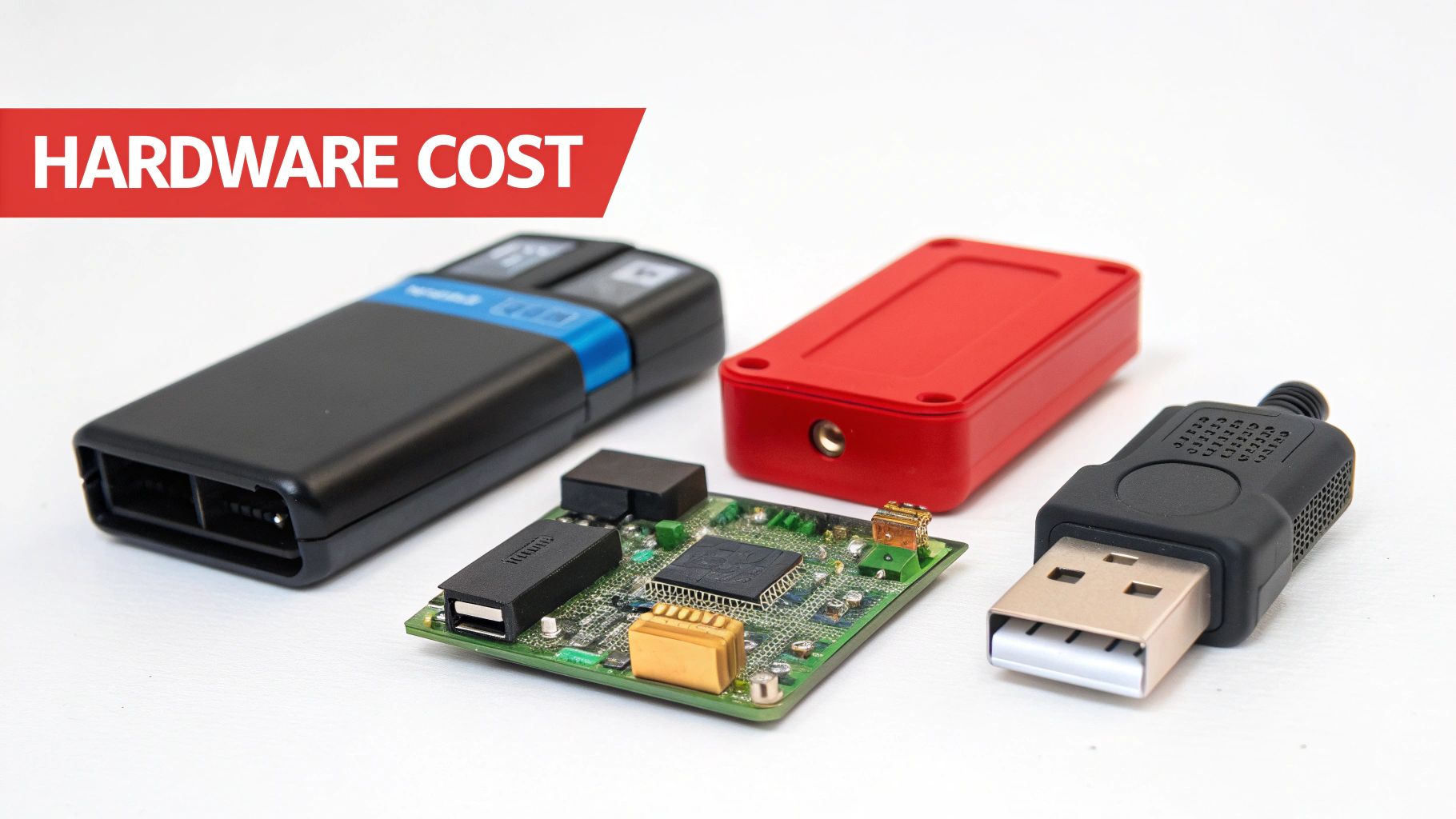
The initial expenditure for a GPS tracking system is the physical device. This upfront investment can vary significantly, from approximately $30 for a basic plug-in unit to $200 or more for a sophisticated hardwired device. Understanding the factors that influence this price range is crucial for making a well-informed purchase.
Simply put, the price reflects the device's capabilities and construction. In 2015, a standard tracker might have cost over $100. Today, technological advancements have made entry-level models more accessible, reserving the higher price points for advanced trackers with premium features. You can explore this market evolution in greater detail through Straits Research's market analysis.
This price evolution is directly linked to the specific type of tracker, as each is engineered for a different use case and offers a distinct level of security.
Common Types of GPS Hardware
GPS trackers generally fall into three primary categories, each presenting a unique balance of cost, installation complexity, and security benefits.
-
OBD-II Plug-and-Play Trackers: These are typically the most affordable and simplest to install. They connect directly to the vehicle's On-Board Diagnostics (OBD) port, drawing power from the car's battery. Their ease of use makes them a popular choice for personal vehicle owners.
-
Hardwired Trackers: For a more permanent and covert installation, hardwired units are the superior option. They are integrated directly into the vehicle's electrical system, making them extremely difficult for a thief to locate and disable—a significant advantage for theft recovery. This type of installation often involves a higher upfront hardware cost and may require professional assistance.
-
Battery-Powered Trackers: These devices offer maximum installation flexibility. Operating on their own internal battery, they can be placed discreetly almost anywhere within a vehicle. Their cost is often determined by battery longevity and durability, with high-end models capable of functioning for several years between charges.
The hardware cost is fundamentally a function of its features. A more expensive device often includes advanced components such as accelerometers to detect harsh driving events, or a rugged, waterproof casing for enhanced durability in various environments.
The key is to align the hardware's capabilities with your specific security requirements to avoid overspending on features you will not use. For a comprehensive overview of essential capabilities, review the key features of a modern GPS device.
What Your Monthly Subscription Fee Actually Covers
While the one-time hardware cost is the initial focus, the ongoing subscription fee is what truly empowers your vehicle's security system. This is often the most misunderstood aspect of the total GPS tracking cost, yet it is the component that transforms a passive device into an active, 24/7 guardian.
This subscription can be thought of as a dedicated cellular plan for your tracker. The device requires a constant data connection to transmit its location and status back to the user. Without it, the tracker cannot send real-time notifications to your smartphone in the event of unauthorized activity, such as a break-in or tow attempt.
The monthly fee bundles several critical services into a single, predictable cost, ensuring the system is always operational and ready to respond when needed.
Core Services Funded By Your Subscription
This recurring fee is an investment in a complete security ecosystem. It funds a suite of services working in concert to protect your vehicle.
- Cellular Data Connection: This is the operational lifeline of the tracker. It covers the cost of utilizing cellular networks (like 4G LTE) to transmit location data from your vehicle to the tracking servers, enabling you to view its real-time position.
- Software and App Access: Your subscription grants access to a secure mobile application and web-based platform. This is where you monitor your vehicle’s location, configure alerts, and review trip histories. The fee also covers ongoing software development, including updates and security patches to maintain system integrity.
- Cloud Data Storage: Every location point, alert, and trip is securely stored in the cloud. The subscription ensures this data is archived and accessible, which is invaluable for theft recovery investigations or simple route reviews.
- Customer and Technical Support: A subscription provides a direct line to a dedicated support team with expert knowledge of the hardware and software, ready to assist with any issues or inquiries.
The subscription transforms a piece of hardware into a dynamic security service. You are not merely paying for data; you are investing in the platform, data storage, and the assurance that comes with a professionally managed system.
These components ensure your tracker provides comprehensive security intelligence, not just a dot on a map. For a deeper analysis of how these elements integrate, you can learn more about the crucial role of cloud services in GPS tracking. Ultimately, the right subscription plan balances performance and price to meet your security needs.
The Real Factors Driving Your Total GPS Tracking Cost
When calculating the true cost of a GPS tracker, it is easy to focus solely on the hardware price and the standard monthly fee. However, several other variables can significantly impact the final expense. A thorough understanding of these factors is essential to avoid unforeseen costs.
The total investment is largely determined by your specific usage patterns and the level of data granularity required.
A primary cost driver is the "ping rate," or data update frequency. This term refers to how often the tracker reports its location. A device pinging every 30 seconds will consume substantially more cellular data than one updating every five minutes. This difference in data consumption is directly reflected in the subscription price. A higher ping rate provides a more precise, real-time view of your vehicle's location and movement, which is critical for effective stolen vehicle recovery.
Another key factor is the number of vehicles being tracked. A single-car owner will typically pay a standard per-vehicle rate. In contrast, businesses managing fleets can often negotiate volume discounts. Despite potential discounts, the total monthly expenditure will scale with each additional vehicle added to the system.
Beyond the Basics: Advanced Features and Hidden Fees
The software features you select also play a significant role in the overall cost. While basic real-time location tracking is standard, more advanced capabilities typically increase the monthly fee.
- Geofencing: This feature allows you to create virtual perimeters on a map and receive alerts whenever your vehicle enters or exits these designated zones.
- Driver Behavior Monitoring: This functionality tracks metrics such as harsh braking, rapid acceleration, and excessive speeding, providing valuable insights for monitoring teen drivers or commercial fleet operators.
- Detailed Route History: This allows for the storage and retrieval of extensive trip logs. Understanding the benefits of reviewing your vehicle's route history can demonstrate why this is a feature worth the additional investment.
It is also crucial to be aware of potential hidden costs that may not be advertised upfront. These can include one-time activation fees, charges for professional installation (particularly for hardwired units), and early termination penalties for canceling a contract prematurely.
For commercial fleets, these factors contribute to a total cost of ownership that can range from $200 to $500 per vehicle, per year. Geolocation also matters; subscription fees in the Asia-Pacific market, for example, can be as low as $5 per month, according to market data. You can delve deeper into these trends in this industry report. By considering all these variables, you can develop a much more accurate projection of your total GPS tracking cost.
Comparing No-Fee vs. Subscription GPS Trackers
When researching GPS trackers, you will encounter two primary models: devices marketed as having "no monthly fees" and those that are transparent about their subscription-based structure. This decision point goes beyond the simple gps tracking cost; it involves a trade-off between upfront payment, convenience, reliability, and the level of security you receive.
The appeal of "no-fee" trackers is undeniable. The concept of a single, one-time payment is attractive. However, this marketing claim can be misleading. In nearly all cases, these devices require the user to independently source, purchase, and manage a SIM card and data plan. This effectively shifts the user's role from vehicle owner to IT manager for the tracking device. You become responsible for setup, SIM activation, and ensuring the data plan remains active. If the data plan lapses, the tracker becomes a non-functional piece of hardware.
The All-in-One Service Model
Subscription-based trackers adopt a fundamentally different, all-inclusive service approach. The monthly fee bundles all necessary components: the SIM card, cellular data, software access, cloud storage for route history, and professional customer support.
This model eliminates the technical complexities for the end-user. It provides a true plug-and-play solution that is operational immediately. While there is a recurring cost, what you are paying for is a fully managed service that is perpetually on guard. This is comparable to a home security system, where the hardware is one component, but the professional monitoring service is what provides genuine safety.
The core difference lies in responsibility. With no-fee models, the burden of maintaining the tracker's connectivity and functionality rests entirely on the user. Subscription services consolidate this into a single, predictable fee, guaranteeing the system is always online and ready to protect your vehicle.
For most individuals, particularly those who view a tracker as a critical theft recovery tool, the reliability of a subscription model is non-negotiable. There is significant value in knowing that a team of experts is managing the technical infrastructure behind the scenes. To better understand this, you can learn how a real-time car locator function relies entirely on this seamless, managed connectivity.
To help you evaluate the options, here is a side-by-side comparison of the two models.
No-Fee vs. Subscription GPS Trackers
Choosing between a no-fee and a subscription tracker depends on whether you prioritize a lower initial cost with hands-on management or a predictable fee for a seamless, fully supported experience. This table breaks down the key differences to aid your decision.
| Feature | No-Fee Trackers | Subscription-Based Trackers |
|---|---|---|
| Ongoing Cost | None (but you pay for a separate SIM data plan) | Predictable Monthly Fee (typically $15-$30) |
| Setup | Complex (requires sourcing and managing your own SIM) | Simple (plug-and-play, activated and ready to use) |
| Software | Often basic with limited features and infrequent updates | Robust with real-time alerts, history, and regular updates |
| Support | Usually non-existent or relies on community forums | Dedicated customer and technical support included |
| Reliability | Variable; depends on your SIM plan and technical skill | High; professionally managed service with guaranteed uptime |
Ultimately, while the one-time payment of a no-fee tracker is appealing, the consistent performance and peace of mind offered by a subscription service often provide far greater value in the long run, especially when your car's security is on the line.
How to Choose the Right GPS Tracker for Your Budget
Having analyzed the cost components, you are now better equipped to select a GPS tracker that aligns with your needs and budget. The most critical first step is to define your primary objective. What is the specific problem you are trying to solve?
Is your main concern theft recovery? Are you aiming to monitor the driving habits of a new teen driver? Or are you managing a small fleet of commercial vehicles? Your primary use case should dictate your feature requirements.
For example, if theft recovery is the priority, then real-time tracking and instant alerts are non-negotiable features. However, if monitoring a young driver is the goal, features that track driver behavior, such as harsh braking and speeding, provide greater value. It is easy to be tempted by premium plans with extensive feature lists, but it is fiscally prudent to avoid paying for capabilities you will never use.
Evaluate Your Needs and Compare Plans
Once you have a clear understanding of your requirements, you can compare plans more effectively. Look beyond the monthly price tag and consider the total long-term value.
A slightly higher monthly fee may be justified if it includes a lifetime hardware warranty or superior customer support. Access to expert assistance can be invaluable during an emergency situation.
Finding the right solution is a balance between affordability and functionality. The optimal tracker is not necessarily the cheapest one upfront, but the one that delivers reliable security and peace of mind over its operational lifespan.
This decision tree infographic provides a visual guide to help you determine whether a low-cost, self-managed approach or a full-service subscription model is better suited for you.
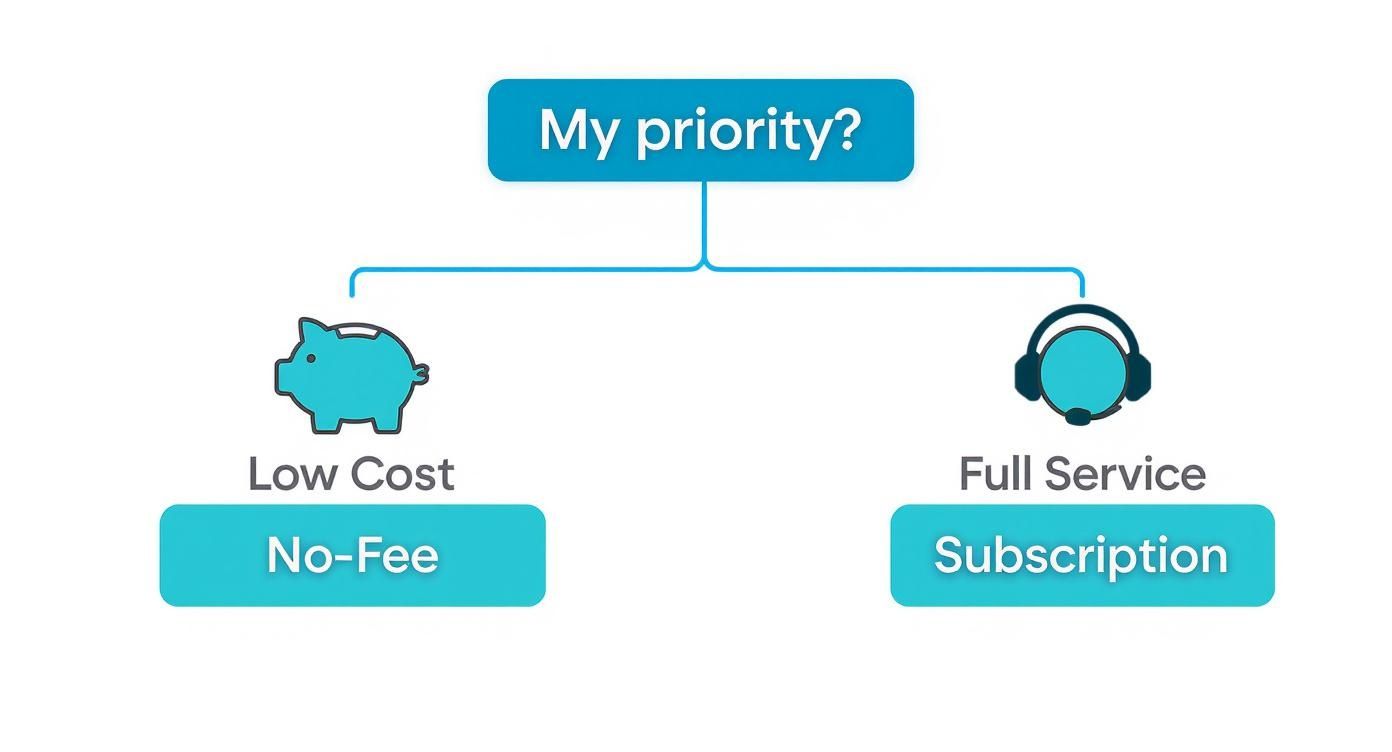
As illustrated, if the absolute lowest possible cost is your top priority, a no-fee tracker may be the path. However, for those who value the convenience, reliability, and support of a comprehensive solution, a subscription model is the superior choice. Ultimately, making a smart investment in your gps tracking cost means choosing a system that provides consistent, dependable protection tailored to your specific circumstances.
Still Have Questions About GPS Tracking Costs?
Let's address some frequently asked questions about GPS trackers to further clarify your options and help you make a confident decision.
While the details can seem complex, the fundamental differences between models are straightforward once broken down.
Why Do Most GPS Trackers Have a Subscription Fee?
The subscription model is analogous to that of a mobile phone. The hardware is a single component; its true capability is enabled by the service that keeps it connected. This monthly fee activates the tracker, transforming it into a functional security tool.
Here is what that subscription covers:
- A Live Cellular Connection: This is the data plan the tracker uses to send you real-time location updates, 24/7.
- Software & App Access: You gain access to the mobile app and web platform to monitor your vehicle's location, review its history, and receive alerts.
- Secure Cloud Storage: Your subscription covers the cost of securely storing all trip logs and alert data, which is critical for evidence in a theft recovery scenario.
- Real Human Support: It ensures a team of technical experts is available to assist with any issues or questions.
Can You Really Get a Tracker Without a Monthly Fee?
Yes, "no-fee" trackers are available, but the term can be misleading. These devices almost invariably require the user to purchase and manage a separate SIM card and data plan from a cellular provider.
Therefore, while you are not paying a monthly fee to the tracking company, you are still paying a mobile carrier. This approach also places all technical responsibility—from setup to troubleshooting—on you, without the backing of a dedicated support team.
Is a GPS Tracker Without Any Data Plan Useful?
A device without a live data connection is not a real-time tracker; it is a GPS logger. This type of device records location data to its internal memory but has no capability to transmit that information to you in real time.
To access the location data, you must physically retrieve the logger from the vehicle and connect it to a computer. This makes it completely ineffective for live theft recovery or instant security alerts. Its utility is limited to post-trip route analysis.
For true peace of mind and the ability to react the moment an incident occurs, a fully managed, subscription-based system is the only viable solution. CarLock delivers a seamless, powerful tracking solution that keeps you constantly connected to your vehicle, all for a predictable and affordable cost.