

Driver’s Desk
How a Motion Detector Car System Guards Your Vehicle
Think of a digital watchdog, one that’s always on guard, protecting your car from any unauthorized touch or movement. That’s the core function of a motion detector car system. It’s a vital layer of security that goes far beyond traditional car alarms, providing instant alerts if someone tampers with, tries to tow, or even just bumps your vehicle. According to the National Insurance Crime Bureau (NICB), a vehicle is stolen every 32 seconds in the United States, making advanced security measures more critical than ever.
Your Car’s Invisible Sentry Explained
A motion detector car system essentially gives your vehicle a nervous system, allowing it to sense disturbances that a simple door alarm would completely miss. Instead of only reacting when a door is forced open, it’s constantly monitoring for the subtle physical shifts that signal a potential threat. It’s a shift from reactive to proactive security, giving you a critical head start.
The primary objective is to deliver peace of mind by turning your car into a smart, connected asset. Forget that sinking feeling of returning to a shattered window or an empty parking spot. Instead, you get a real-time notification on your phone the second a potential threat is detected.
The Modern Approach to Vehicle Security
That immediate communication is what truly separates modern systems from the blaring, and often-ignored, alarms of the past. The alerts are personal, quiet, and empower you to act. They're driven by a combination of sophisticated sensors working in concert to create a protective bubble around your car. These typically include:
- Vibration Sensors (Accelerometers): These detect impacts or the tell-tale signs of a forced entry attempt.
- Tilt Sensors (Gyroscopes): These can determine if your car is being jacked up or hooked to a tow truck.
- GPS Tracking: This alerts you the moment your vehicle moves from its parked location.
This multi-sensor approach is what eliminates the dreaded "car alarm that cried wolf" problem. As we dig into how a motion detector acts as an invisible sentry, it’s interesting to see how other security tech is evolving, like a smart biometric fingerprint padlock for protecting other valuable assets.
The Growing Importance of Motion Sensors
The technology powering these devices isn't just a niche security feature; it’s part of a massive technological shift in the automotive industry. The global motion sensor market was valued at approximately $8.7 billion in the mid-2020s and is projected to reach nearly $14 billion by 2030. This expansion is fueled by consumer demand for smarter, safer vehicles that can perceive and react to their environment.
An effective motion detection system isn't just about making noise; it's about delivering timely, accurate intelligence straight to the owner. This allows for an immediate response, whether that means checking on your vehicle or contacting law enforcement.
Platforms like CarLock integrate all these alerts into a single, user-friendly mobile app. You can get a better sense of how our system provides a complete security solution in our guide on the modern CarLock car alarm.
Getting to Know Car Motion Detection Technologies
Think of a motion detector system as your car's dedicated security guard. But how does it actually know when something's wrong? It's not a single gadget, but a team of specialized sensors working together. Each is designed to spot a different kind of threat, and their combined data creates a highly effective security shield.
Let's break down the three core technologies that form the backbone of modern vehicle motion detection. Consider them your car’s senses, each one finely tuned to pick up a specific type of disturbance.
This diagram helps visualize how different sensors protect against specific threats, from a thief tampering with a door to a tow truck trying to haul your car away.
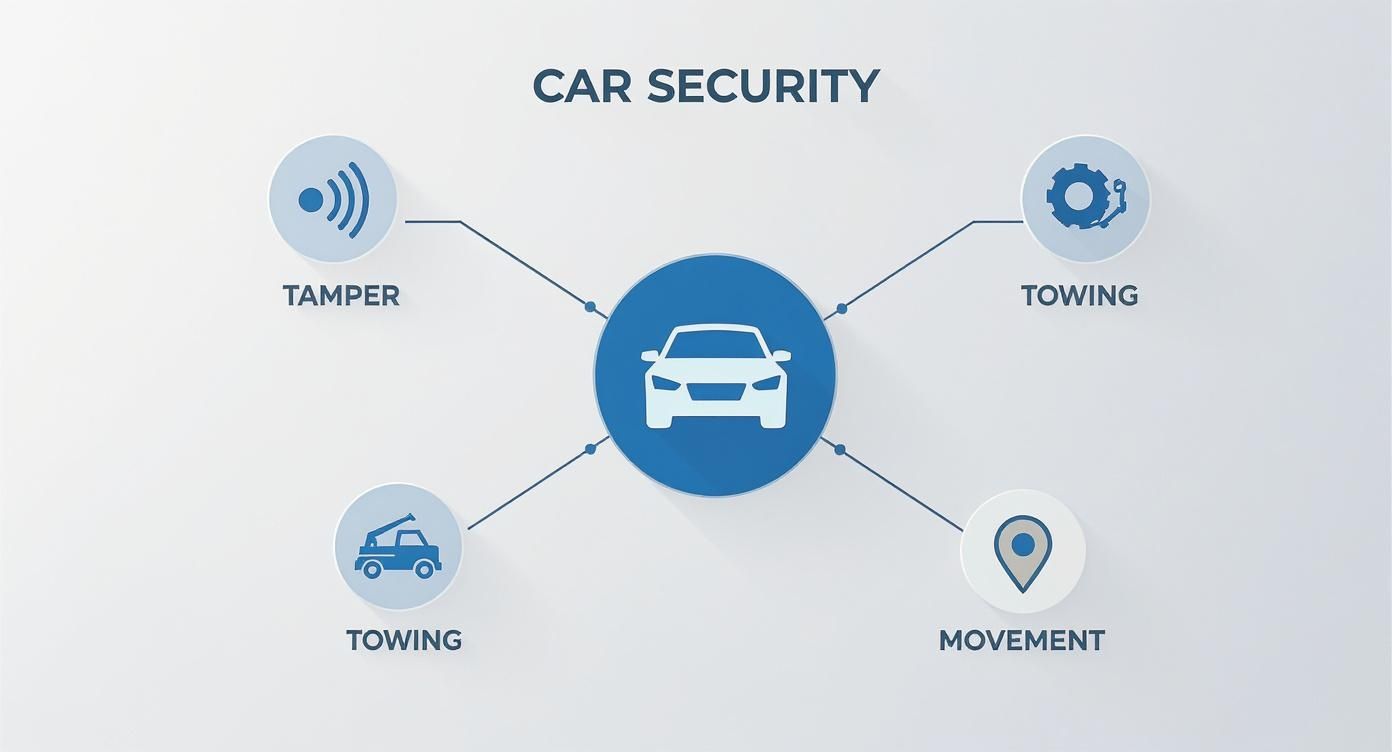
It’s clear that a layered approach, using multiple detection methods, leaves no blind spots for a potential thief to exploit.
Vibration Sensors for Immediate Impact Alerts
Your first line of defense is the vibration sensor, technically known as an accelerometer. This sensor is like your car's sense of touch, feeling for sudden, sharp movements. If a thief tries to smash a window, pry open a door, or even just aggressively jostles the vehicle, the accelerometer picks up those vibrations instantly.
It functions much like the sensor in your smartphone that rotates the screen when you turn it. By measuring acceleration, it can distinguish between a gentle gust of wind and the sharp, violent impact of a break-in attempt. This immediate feedback is crucial for stopping a theft before it progresses.
Tilt Sensors to Stop Towing in Its Tracks
Next up is the tilt sensor, or gyroscope. This piece of tech acts like your car’s inner ear, providing a constant sense of balance and orientation. Its sole purpose is to monitor your car's angle relative to the ground.
So, if a thief tries to jack up your car to steal the wheels or a tow truck hooks it up to haul it away, the gyroscope immediately senses that change in incline. This triggers an alert long before your car is actually moved from its parking spot.
This technology is absolutely critical for preventing "hook and roll" thefts, where criminals can tow a vehicle away in less than a minute. A standard car alarm would stay completely silent, but a tilt sensor ensures you're notified the second it happens.
GPS for True Movement Detection
Finally, GPS-based movement detection is the ultimate confirmation that your car is on the move when it shouldn't be. While vibration and tilt sensors catch tampering while the car is parked, GPS tracking alerts you the moment its geographic location changes.
This is your last and most powerful line of defense. If a thief somehow bypasses the other sensors and starts the car or tows it away quietly, the GPS will trigger an alert as soon as the vehicle leaves its designated spot.
Comparing Key Car Motion Sensor Technologies
To see how these technologies stack up, here’s a quick breakdown of what each one does and the specific threats they're designed to counter.
| Sensor Technology | Primary Function | Detects | Ideal for Preventing |
|---|---|---|---|
| Vibration (Accelerometer) | Senses sudden impacts | Window breaks, forced entry, bumps | Vandalism, break-ins |
| Tilt (Gyroscope) | Monitors the car's angle | Jacking up, towing attempts | Towing, wheel theft |
| GPS Tracking | Tracks geographic location | Unauthorized vehicle movement | Full vehicle theft |
Each sensor plays a unique and vital role in a comprehensive security strategy, covering different stages of a potential theft.
A system like CarLock intelligently combines the data from all of these sensors to paint a complete picture of your vehicle's status. To see exactly how these technologies work together in a real-world application, you can explore the full range of CarLock's device and security features. This smart integration is what turns a few separate sensors into a powerful, multi-layered security net that eliminates blind spots and gives you genuine peace of mind.
Tuning Your System to Avoid False Alarms
We’ve all experienced it—the persistent car alarm down the street that just won't quit. An alarm that cries wolf is worse than useless; it’s a nuisance. A high-quality motion detector car system isn’t just about sending alerts. It's about sending the right alerts. When your phone buzzes, you need to trust that it’s for a real reason.
The secret to that trust lies in engineering a system smart enough to differentiate between a genuine threat and everyday environmental noise. Without that intelligence, you'd get a notification every time a garbage truck rumbled by or a strong gust of wind shook your car.
Understanding Common False Alarm Triggers
A sensitive device is a good thing, but an overly sensitive one becomes a massive headache. There are a ton of environmental factors that can trick a basic system into sending a false positive, creating a stream of unnecessary anxiety.
These "triggers" are everywhere, and a poorly designed system can't distinguish them from a real threat:
- Heavy Vehicles: The deep, low-frequency vibrations from a passing semi-truck or city bus can easily be mistaken for a direct impact on your car.
- Strong Weather: High winds, pounding rain, or even hail can create enough movement to set off a less sophisticated vibration sensor.
- Loud Ambient Noise: Consider the booming bass from a nearby concert or even a loud motorcycle revving its engine—that can generate enough vibration to trigger an alert.
- Parking Garages: These are a minefield of false alarms. The vibrations from other cars parking, doors slamming shut, and heavy security gates create a noisy environment for any motion sensor.
These scenarios perfectly illustrate why a simple, one-size-fits-all approach to motion detection is ineffective. True security demands an adaptive system.
The Power of Adjustable Sensitivity
This is where adjustable sensitivity settings become your best friend. Premium motion detector systems let you fine-tune how responsive your device is, matching it to where you typically park. It’s a lot like adjusting the sensitivity on a microphone—you want to pick up the important sounds, not all the background chatter.
When your car is parked in a quiet, secure garage overnight, you can set the sensitivity to high. But if you’re parked on a busy city street with constant traffic, you can dial it back to filter out the normal bumps and rumbles of urban life. This simple customization drastically cuts down on false positives and builds your confidence in the alerts you do get.
A well-tuned system provides reliable intelligence, not just noise. By adjusting sensitivity, you teach your motion detector what is "normal" for its environment, allowing it to focus on truly abnormal events.
Sensor Fusion: The Smart Solution to False Positives
Beyond manual adjustments, the most effective systems use a technique called sensor fusion. This is an intelligent process where the system's software analyzes and cross-references data from multiple sensors simultaneously before deciding to send an alert. Think of it as the system requiring a second opinion before bothering you.
Instead of just reacting to a single data point—like a minor vibration—the system looks for a logical combination of events. A real towing attempt, for example, involves two distinct actions happening in sequence:
- The vehicle is tilted as it's hooked up (detected by the gyroscope).
- The vehicle is vibrated by the towing equipment (detected by the accelerometer).
A system using sensor fusion will require input from both the tilt and vibration sensors to confirm a towing threat. A simple vibration from a passing truck won't be enough to trigger the alert on its own. This intelligent verification is a core feature in advanced systems like CarLock, ensuring the notifications you receive are highly accurate and actionable. You can explore more about how our system intelligently manages these alerts in the CarLock features app guide. This smart filtering is what separates a truly effective security tool from a simple noisemaker.
Installing Your Motion Detector for Peak Performance
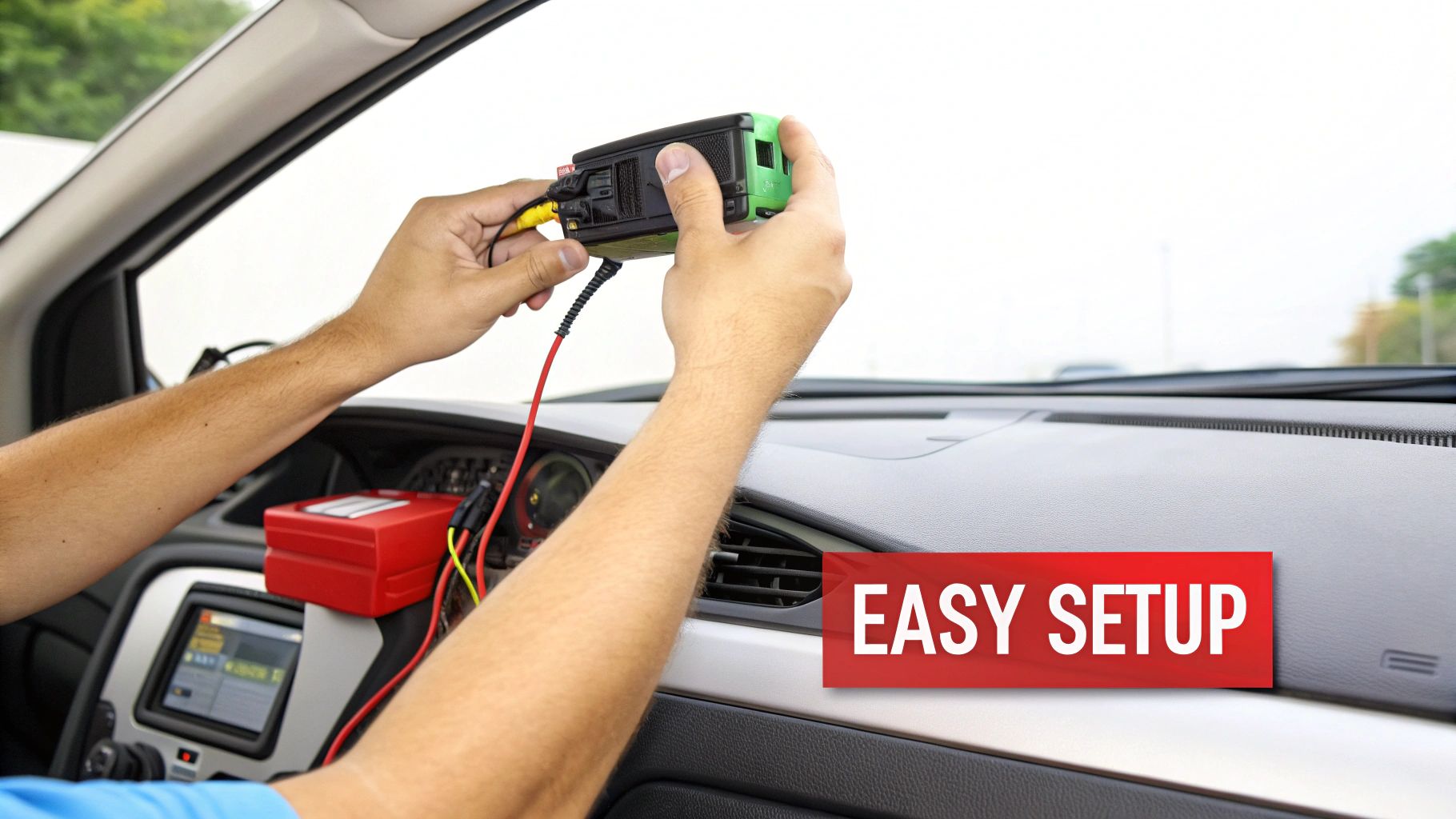
An advanced motion detector car system is only as good as its installation. No matter how sophisticated the sensors are, they can't perform their job if they aren't properly placed and securely connected. The good news is that modern technology has made setting up top-tier vehicle security easier than ever.
The days of needing a professional installer and complex wiring are largely over. While you can still find traditional hardwired systems that require splicing into your car’s electrical grid, a new generation of plug-and-play devices has brought powerful security to the masses.
The Simplicity of OBD-II Installation
By far, the easiest and most popular method to install a modern motion detector is through your car’s On-Board Diagnostics (OBD-II) port. This port is a standard feature on virtually all cars manufactured since 1996 and serves as a direct source of data and power for your device.
Devices like CarLock are designed for anyone to install in minutes, no tools needed. The whole process is incredibly straightforward:
- Locate the Port: It's usually tucked under the dashboard on the driver's side, often near the steering column.
- Plug in the Device: Push the device firmly into the port. It's as simple as plugging a lamp into a wall outlet.
- Confirm Connection: Indicator lights on the device will blink, confirming it's powered up and connecting to the network.
This plug-and-play setup not only saves you time and money on professional installation but also places the device exactly where it needs to be for optimal performance.
Best Practices for Device Placement
Even with an easy OBD-II setup, where and how you place the device matters. Inside that small housing are sensitive accelerometers and gyroscopes that need a stable base to accurately detect vibrations and changes in angle. A loose or dangling device can transmit flawed data and trigger false alarms.
Ensure the device is pushed all the way into the OBD-II port for a snug, firm fit. This prevents it from wiggling with normal road vibrations, which helps the motion sensors establish a stable baseline for what’s "normal" for your vehicle.
For most cars, the standard under-dash location is perfectly fine. If your port is in an awkward spot or you want a more discreet placement, an OBD-II extension cable offers the flexibility to mount the device somewhere more stable. This simple setup is the foundation of a rock-solid vehicle security system. To see how this fits into a bigger picture, check out our guide on the modern CarLock car security system.
The Role of Advanced Sensor Components
Beneath the simple plastic casing of these devices is a network of highly precise components. Automotive reed sensors, key players in motion and proximity detection, are a huge part of what makes modern systems work. The growing demand for tiny, durable, surface-mount reed sensors shows how the industry is packing more power into smaller packages. Their long lifespan and low power draw make them ideal for the always-on nature of a car security system.
You can dive deeper into the trends of the automotive sensor market on GlobeNewswire, but the takeaway is clear: the technology is continuously improving and shrinking in size.
This is precisely why firm installation is so important. It allows all these sensitive internal components to function without interference, giving you confidence that your system is online, accurate, and ready to protect your vehicle from day one.
Putting Motion Detection to the Test in the Real World
The technical specifications behind accelerometers and gyroscopes are interesting, but what truly matters is how a motion detector car system behaves when you actually need it. Let's set the theory aside and walk through a few real-life situations where this technology can save you from significant headaches, financial loss, and stress.
These are not hypothetical scenarios; they are the kinds of events that happen to car owners every single day. The only difference is whether you have a system in place that allows you to react in the moment.
The Parking Lot Bump and Run
Picture this: you're in a grocery store, and your phone buzzes with an alert: "Vibration Detected." A quick glance at the app confirms your car is right where you left it in the parking lot. It’s not being stolen, but something definitely just happened.
You head outside and find a brand-new dent on your rear bumper, complete with a fresh paint scrape. A few rows away, you see another driver trying to make a quick exit. Because you were notified the instant the impact occurred, you have a chance to take action. You can record their license plate number, provide a description to security, and potentially stop them before they disappear.
Without that immediate vibration alert, you’d return to a damaged car with no clues, no witnesses, and no one to hold responsible. That one notification transforms a frustrating mystery into an actionable event, potentially saving you hundreds of dollars on your insurance deductible. It’s a perfect example of how motion detection secures your car against more than just outright theft.
Stopping an Illegal Tow in Its Tracks
Here’s another frustratingly common scenario. You’re parked somewhere with confusing signage, and a tow truck driver hooks up your car. Before you know it, your vehicle is on its way to an impound lot, a trip that could easily cost you $300 or more, not to mention a wasted afternoon and a massive spike in your blood pressure.
But as soon as the truck's lift starts to tilt your vehicle, the gyroscope in your motion detector senses the change in angle. Your phone lights up instantly: "Vehicle Is Being Towed."
This isn't just an alarm; it's a critical, time-sensitive piece of intelligence. An illegal tow can happen in less than two minutes, and a traditional car alarm would remain completely silent. The tilt sensor is your only defense against this specific type of threat.
You can race outside, talk to the driver, and resolve the situation on the spot. That simple alert can save you a trip to the impound lot and a hefty, unexpected bill. It gives you the power to intervene before your car even leaves the ground.
Gaining Peace of Mind with a Teen Driver
When you hand the car keys to a new teen driver, your worries extend beyond theft. You're trusting them to be safe and responsible on the road. A car motion detector with a quality accelerometer can offer incredible insight into their driving habits without feeling like an invasion of privacy.
The system can be configured to log and alert you to specific, teachable moments, such as:
- Harsh Acceleration: Is your teen flooring it from every stoplight?
- Hard Braking: Are they tailgating and constantly slamming on the brakes?
- Sharp Cornering: Are they taking turns too fast for conditions?
These alerts are not about playing "gotcha." They are about coaching. They provide real data you can use to start a constructive conversation about safe driving. Knowing your child is building good habits is a different kind of security, but it's just as important.
Protecting Your Business with Fleet Monitoring
Finally, consider a small business owner with work vans full of expensive tools and equipment. These vehicles are the lifeblood of the company, and keeping them secure is non-negotiable. Here, a motion detector system becomes an indispensable tool for managing and protecting the fleet.
The business owner can get crucial alerts for a range of issues:
- Unauthorized Use: A notification for movement after hours could mean an employee is using a company van for personal errands, burning fuel and creating liability.
- Potential Theft: A vibration alert from a van parked at a job site could be the first sign of a break-in, giving the owner time to call the police and protect thousands of dollars in tools.
- Towing or Tampering: If a vehicle is being tampered with or towed from a work site, an immediate notification can prevent the loss of a vital business asset.
In a business setting, the motion detector car system is more than just a security gadget. It's a management tool that protects assets, helps ensure employee compliance, and ultimately secures the company's bottom line. Each of these scenarios shows how the right technology delivers real, tangible value that a simple car alarm just can't match.
Integrating Motion Alerts with Real-Time GPS Tracking

A vibration or tilt alert is a fantastic first line of defense. It's the digital tap on the shoulder that tells you something is wrong. But it only tells you what is happening, not where.
The real power of a modern motion detector car system comes alive when those instant alerts are fused with real-time GPS tracking. This combination closes the loop, turning a simple notification into actionable intelligence.
It’s one thing to know your car is being tampered with; it’s another to watch its exact location on a map. An alert without a location is just a warning. An alert with live coordinates is a game-changer.
From Alert to Action in Seconds
Imagine you get a "Vibration Detected" notification on your phone. With an integrated system like CarLock, there’s no guesswork. You can immediately open the app and see your car’s precise location. This is absolutely critical, especially when a theft is in progress.
If that alert escalates to "Vehicle Moved," the GPS tracking becomes your single most valuable asset. You can follow your car’s every turn in real time, giving law enforcement the exact data they need to recover your property. That direct line from motion alert to location tracking is what makes today’s systems so effective.
With over one million vehicles stolen in the U.S. in 2022, representing over $8 billion in losses, the ability to track a vehicle's live location dramatically boosts the chances of recovery—often within hours instead of days.
Building a Complete Security Ecosystem
A standalone motion sensor is a one-trick pony. But when it’s part of a connected platform, it becomes the trigger for an entire suite of security features. The GPS data makes every other function smarter, creating a complete vehicle management ecosystem.
This integration unlocks powerful secondary features, all tied to your car's location and status:
- Trip History Logs: See every route your car has taken, complete with timestamps and mileage. It's perfect for monitoring a teen driver or double-checking business travel.
- Engine Start Notifications: Get an alert the second the ignition turns on, paired with a map pinpointing exactly where it happened.
- Battery Health Alerts: Receive a heads-up if your car’s battery is getting low, helping you avoid being stranded somewhere.
This connected approach gives you a much deeper understanding of your vehicle’s safety and how it’s being used. If you're looking for this level of control, learning more about a complete CarLock car tracking solution is the logical next step. It's not just about stopping theft; it's about staying connected to your car, no matter where you are.
Common Questions About Car Motion Detectors
When considering adding a smart security layer to your car, a few practical questions always arise. It's one thing to read about features, but it's another to know how a motion detector car system will actually perform day-to-day. Let's tackle some of the most common concerns we hear from car owners.
Will a Motion Detector Drain My Car Battery?
This is perhaps the most frequent question. After all, the last thing you want is a security device that leaves you stranded. It’s a completely valid concern.
Modern OBD-II devices like CarLock, however, are specifically engineered for low power consumption. They sip power, drawing an incredibly small amount of energy to stay alert. More importantly, they're intelligent. The system constantly monitors your car's battery voltage and will push a "Low Battery" notification to your phone long before it becomes a real problem, giving you ample time to address the issue.
Can I Trust the Alerts Aren’t Just False Alarms?
What good is a security system if you learn to ignore its alerts? Building trust is essential. The best systems attack the false alarm issue from two angles: smart technology and user control.
First, you can adjust the sensitivity. This lets you calibrate the device’s responsiveness to your typical parking environment. A quiet private garage requires a different setting than a busy city street with trucks rumbling by.
Second, the most intelligent feature is 'sensor fusion.' This is a smart algorithm that doesn't rely on a single trigger. Instead, it cross-references data from multiple sensors—like vibration and GPS—to confirm a real threat before notifying you. This is how it filters out the background noise of daily life.
What if a Thief Unplugs the Device?
This is a classic "what if" scenario, and it's something any serious security system has an answer for. It's a critical feature.
The moment a thief yanks the device from the OBD-II port, its own internal backup battery kicks in instantly, ensuring continuous operation.
At the exact same time, it fires off a "Device Disconnected" alert straight to your phone. This tells you someone is tampering with your vehicle right now, turning the thief's first move into their biggest mistake and giving you a crucial head start to take action.
Ready to give your vehicle the 24/7 watchdog it deserves? CarLock offers real-time motion detection, GPS tracking, and instant alerts that you can trust, all managed from a simple app on your phone. See exactly how CarLock works to protect your vehicle.