

Driver’s Desk
A Complete Guide to Car GPS Tracking Technology
Car GPS tracking is, without a doubt, the most effective technology we have for modern vehicle security. It provides a direct, live feed of your vehicle's location and status at any given moment, transforming your smartphone into a real-time security hub.
Think of it as a dedicated digital guardian for your car. A small, simple device connects you directly to your vehicle, offering a level of peace of mind and proactive defense that wasn't possible a decade ago. It’s your first line of defense against theft—a crime that continues to rise, with vehicle thefts in the U.S. surpassing one million in 2022, a 7% increase from the previous year. This technology is a powerful way to stay connected and secure, no matter where you are.
What Is Car GPS Tracking?
At its core, a car GPS tracker is a compact device that uses the Global Positioning System (GPS) to determine your vehicle's precise location. However, today's advanced systems go far beyond simply showing a dot on a map. They have evolved into a multi-layered security solution, giving you a proactive way to stop theft before it happens and monitor how your vehicle is being used.
The market data underscores this shift. The global GPS tracker market was valued at USD 4.04 billion and is projected to more than double to USD 9.83 billion by 2030. This explosive growth, detailed in reports from firms like Grand View Research, demonstrates how many people now consider GPS tracking a non-negotiable component of car ownership.
It's More Than Just Navigation
It is crucial to differentiate a dedicated car GPS tracking device from the navigation system built into your car's dashboard. Your dashboard GPS is designed to get you from point A to point B. A security-focused tracker, on the other hand, operates independently and is engineered specifically for monitoring and protection. It communicates its location and other critical alerts directly to you via a mobile app, creating a secure, private link between you and your vehicle.
Here's what that means in practice:
- Theft Prevention: You receive instant alerts for suspicious activity. If someone starts the engine without authorization, or if the vehicle is bumped or towed, you will know immediately and can react.
- Rapid Vehicle Recovery: In the event your car is stolen, you can provide law enforcement with its exact, real-time location. This dramatically increases the chances of recovery—according to the National Insurance Crime Bureau (NICB), vehicles with tracking devices have a recovery rate exceeding 90%.
- Driver Monitoring: You can observe how your car is being driven. This is invaluable for parents of new drivers who want to monitor behaviors like speeding or harsh braking, and it's equally useful for small business owners who need to oversee their vehicle assets.
Who Benefits Most From Car GPS Tracking?
This technology isn't for one specific user; it solves critical real-world problems for a wide range of individuals. Whether you're a concerned parent, a daily commuter worried about urban car theft, or a business manager tracking company vehicles, the applications are incredibly practical. Ultimately, having a reliable car locator can be the single factor that separates a stolen vehicle from a recovered one.
Take a look at how different user profiles leverage this technology.
| User Type | Primary Concern | How GPS Tracking Helps |
|---|---|---|
| The Everyday Car Owner | Vehicle theft and break-ins | Provides real-time alerts for tampering and unauthorized movement. |
| Parent of a New Driver | Safe driving habits and location | Offers speed alerts, harsh driving notifications, and location history. |
| Small Business Manager | Asset protection and efficiency | Monitors vehicle usage, optimizes routes, and prevents unauthorized trips. |
As you can see, the core function—knowing where your car is and what it's doing—provides tailored benefits that bring genuine peace of mind and security to all kinds of vehicle owners.
How a GPS Tracker Actually Finds Your Car
Ever wonder how a small device can pinpoint your car's exact location anywhere on the planet? It's not magic, but a brilliant application of physics and engineering. Essentially, your car's GPS tracker is in constant communication with a network of satellites orbiting thousands of miles above the Earth.
Think of it as a high-tech game of Marco Polo. The satellites are continuously broadcasting signals, and the tracker in your vehicle listens, using those signals to triangulate its precise position. That information is then transmitted straight to an app on your phone, giving you a real-time view. Let's break down this process into three simple steps.
Step 1: Listening for Signals from Space
It all begins with the Global Positioning System (GPS), a U.S.-owned utility that consists of a constellation of at least 24 operational satellites circling the Earth. Each one constantly broadcasts a signal containing two key pieces of information: its exact orbital position and the precise time the message was sent.
The GPS module inside your car's tracker is designed to receive these signals. To calculate an accurate location, it needs to "hear" from at least four different satellites simultaneously. The more satellites it can connect with, the more precise its location calculation becomes. This is why tracking works exceptionally well in open areas but can experience a slight delay in dense urban centers or deep underground garages where the line-of-sight signals can be obstructed.
When a theft occurs, this technology becomes the first line of defense, as shown in the process below.
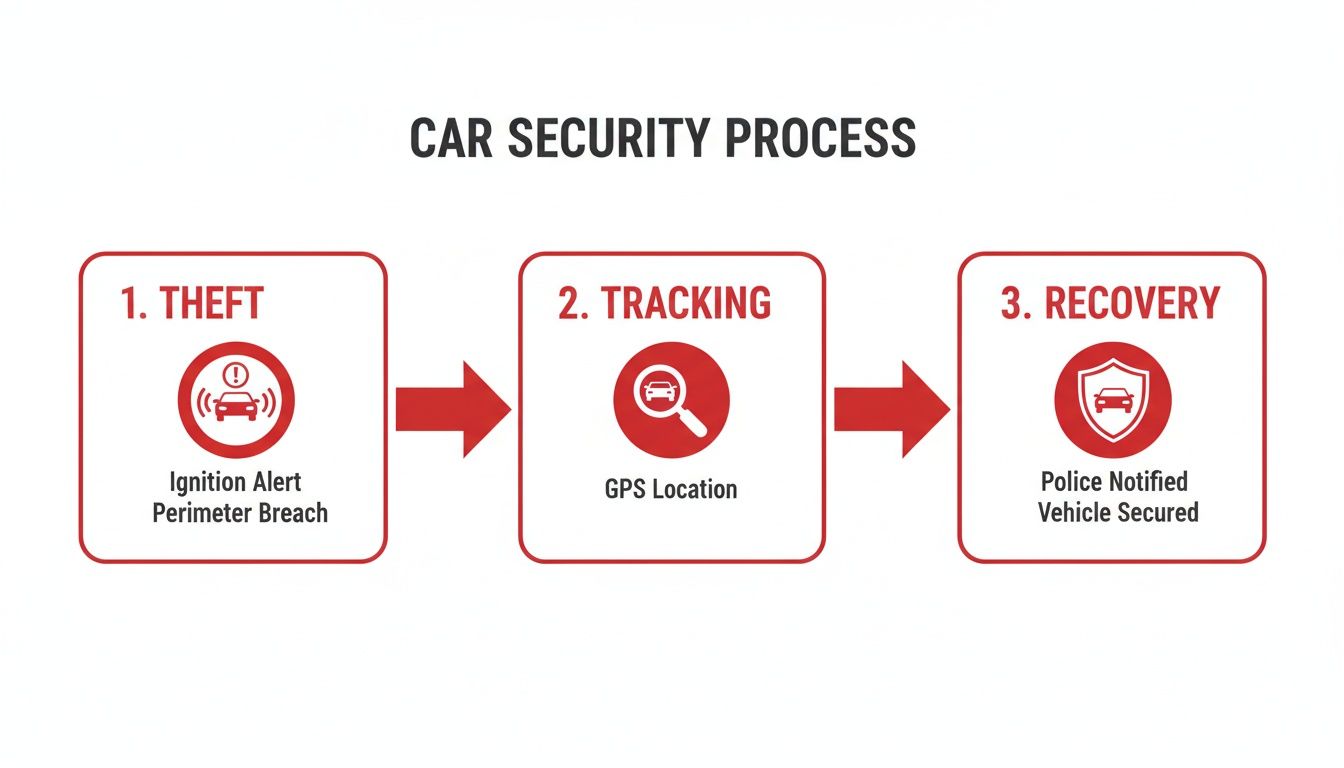
As you can see, the instant a tracker detects theft, it begins broadcasting its location, which is the critical piece of intelligence law enforcement needs to recover your vehicle.
Step 2: Calculating the Precise Location
Once the tracker has locked onto signals from multiple satellites, it performs a series of rapid calculations using a method called trilateration. It measures the minuscule time difference between when each signal was sent and when it was received. Since radio waves travel at the speed of light (approximately 299,792 kilometers per second), this time difference allows the tracker to calculate its exact distance from each of those satellites.
By comparing its distance from at least three satellites, the tracker can pinpoint its location on a 2D map. A fourth satellite signal locks in the calculation and adds the third dimension—altitude—providing a highly accurate set of geographic coordinates.
This entire calculation happens in a fraction of a second, typically pinpointing your vehicle's location to within a few meters.
Step 3: Sending That Location to Your Phone
Knowing the car's location is useless if that information remains with the device. This is where the other half of the technology—telematics—comes into play to get that data directly to you.
- Cellular Connection: The tracker contains its own built-in cellular modem and SIM card, much like a smartphone. It uses this to connect to the nearest cell tower and send its location data over the mobile network to a secure server.
- The Server: Think of this as the mission control hub. It receives the encrypted location data from your car, processes it, and instantly forwards it to your app. This is what enables you to see the car icon moving across the map on your phone in real time.
- Movement Sensors: Most modern trackers also include an accelerometer, a sensor that detects vibration and G-force changes. If your parked car is bumped, jostled, or towed, this sensor wakes the device from its low-power state and instructs it to send an immediate alert—often before a thief even starts the engine.
This entire sequence—from satellite to tracker to your phone—happens in the blink of an eye. And it's clear people want this kind of straightforward security. The market for Standalone GPS devices, the kind of easy-to-install trackers car owners use, is expected to make up over 43.4% of the market share by 2035.
The tracker doesn't just send a single location point, either. It sends a continuous stream of data. This allows for powerful features like reviewing precisely where your car has been. You can see how this information creates a complete travel log by learning more about how GPS trackers document your car's route history. It's this constant, real-time communication that makes modern GPS tracking such a game-changer for car security.
What Can a Modern GPS Tracker Actually Do?
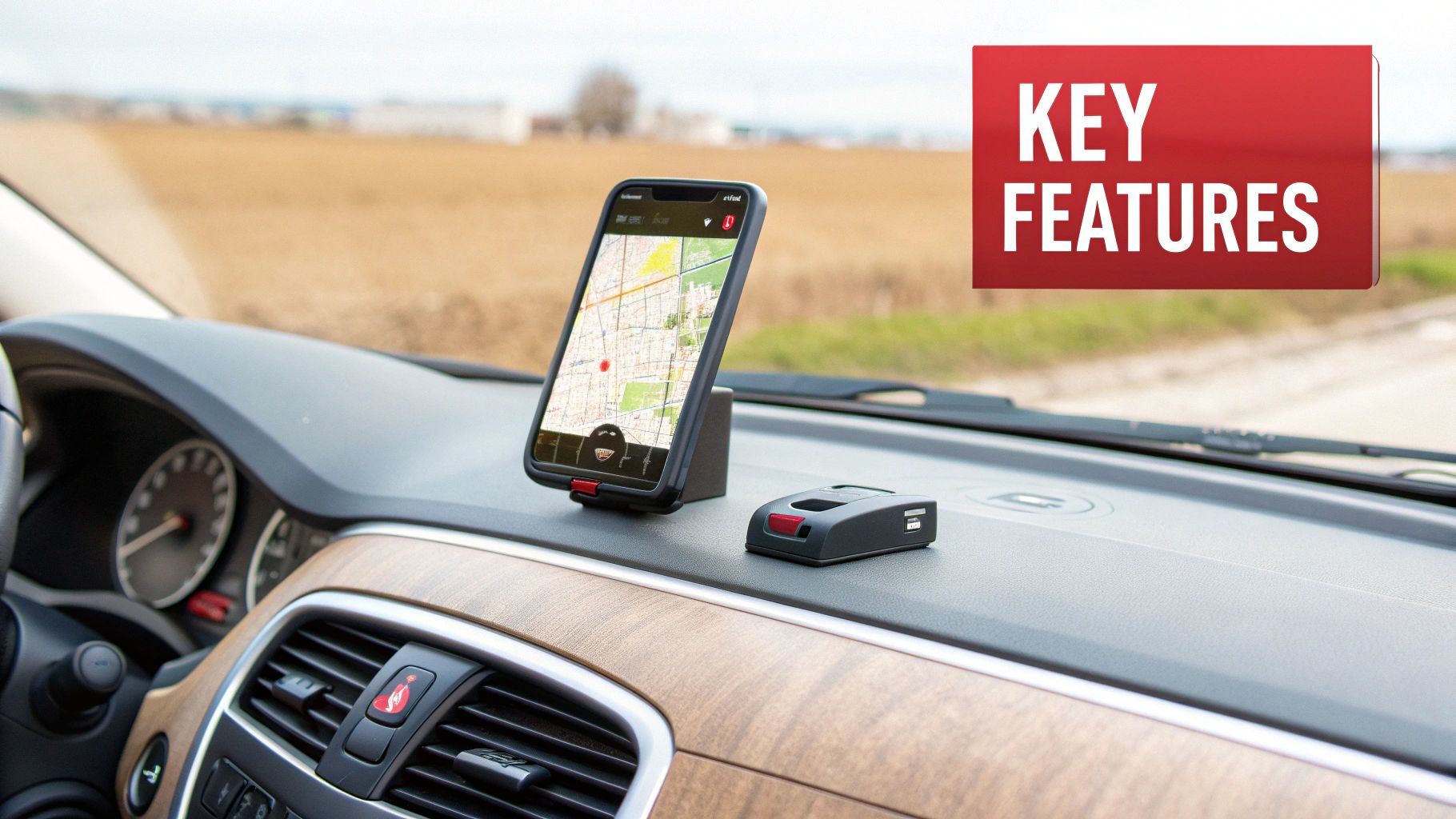
Understanding the science behind GPS is interesting, but what truly matters is what a tracker can do for you. A modern car GPS system is not just about locating a vehicle on a map. It's a full-fledged security toolkit that provides real-time information and a sense of control over your vehicle. The best systems translate raw location data into simple, actionable alerts that keep your car safe.
Each feature is designed to serve a specific purpose, whether it’s stopping a theft in progress or encouraging safer driving habits. It is this blend of capabilities that elevates a simple tracking device into a comprehensive security system.
Real-Time Location Tracking
At its core, every car GPS tracker must offer real-time tracking. This doesn't mean a report of where your car was ten minutes ago. We're talking about a live, continuous data feed showing your vehicle's exact location, updated every few seconds.
Let's say the worst happens and your car is stolen. With real-time tracking, you can open your phone and monitor its every move. This is the kind of live intelligence that law enforcement can use to intercept the vehicle, dramatically boosting the chances of recovering it quickly and with minimal damage.
Geofencing: Your Virtual Boundaries
Beyond just tracking movement, you can create virtual perimeters around important locations. This feature is called geofencing, and it allows you to draw an invisible boundary on a map around your home, office, or your child's school.
If your car crosses that line—either entering or leaving the designated zone—you receive an instant alert on your phone. For example, you could set a geofence around your work parking lot. If your vehicle leaves that area during the day while you are in a meeting, you'll know immediately that something is amiss.
Advanced Security Alerts
This is where a high-quality GPS system truly proves its value. A traditional car alarm is reactive; it blares after a break-in has already occurred. Modern trackers are proactive, warning you of a potential threat the second it begins. Systems like CarLock are engineered to sense a whole range of suspicious activities.
The most effective security systems don't just tell you a theft has already happened—they alert you to the warning signs. This early detection is often the key to preventing the theft altogether.
Here are a few of the crucial alerts you should look for:
- Vibration Detected: The tracker's internal accelerometer can sense unusual vibrations. Think of someone attempting to smash a window, pry open a door, or even jack up the car to steal wheels. You get an alert before they even gain entry.
- Engine Started: The moment your car's ignition turns over without you present, you will receive a notification. This is a critical red flag that an unauthorized person has control of your vehicle.
- Device Disconnected: Thieves are becoming more sophisticated, and a common tactic is to find and unplug the tracker. The best systems anticipate this, sending you a "Device Disconnected" alert the instant it’s removed from the OBD-II port. It's your last-chance warning.
These intelligent notifications are what make a security setup truly complete. You can see a full breakdown of these alerts by checking out the CarLock app and its features.
Driver Behavior Monitoring
Today's GPS trackers offer valuable insights that extend beyond theft prevention. For parents with a new driver in the family or a business owner managing company vehicles, knowing how a vehicle is being driven is just as important as knowing where it is.
Speed Alerts will notify you if the car exceeds a speed limit you've set, a useful tool for discouraging reckless driving. In the same vein, harsh driving notifications can detect and report aggressive habits like rapid acceleration, hard braking, or sharp cornering.
On top of that, a detailed trip history log records every single journey. This provides a complete timeline of routes taken, stop locations and durations, and the total distance traveled. For a parent, it's peace of mind. For a manager, it’s invaluable data for optimizing business operations.
Putting GPS Tracking Into Action
It's one thing to read about the features of a car GPS tracker, but it’s another to see how they solve real problems. That's where the technology truly shines. These devices are not just gadgets; they are powerful tools for everything from recovering a stolen vehicle to keeping your family safe and making a business run more efficiently.
Let’s walk through a few real-world scenarios. Each one demonstrates how instant alerts and live location data can turn a potential nightmare into a situation you can actively manage.
Theft Prevention and Swift Recovery
Picture this: you walk outside in the morning, coffee in hand, only to find an empty space where your car should be. It’s a gut-wrenching moment. But if you have a GPS tracker, the story doesn’t have to end there.
You pull out your phone, open the app, and immediately see what happened. An alert from 3:15 AM reads "Vibration Detected," quickly followed by "Engine Started." The map shows your car is on the move, miles away. Instead of feeling helpless, you have an action plan. You call the police and provide them with a live tracking link.
The officers can now see your car's exact location, speed, and direction in real time. They coordinate an interception and, just 30 minutes after you reported it stolen, they’ve recovered your vehicle with minimal damage. This isn't a movie script; it's a common reality for people who use car GPS tracking as part of a proactive car security system.
Monitoring and Coaching New Drivers
Handing the car keys to your newly licensed teenager is a classic mix of pride and sheer terror. A GPS tracker acts as a silent co-pilot, giving you the tools to guide them toward safer habits, even when you are not in the passenger seat.
For example, you could set up a geofence around your teen's school and a speed alert for anything over 75 mph. One afternoon, your phone buzzes—your son has left the school grounds. A few minutes later, another alert: "Harsh Acceleration," followed by a "Speeding" notification.
Instead of just getting angry, these alerts create a teaching moment. That evening, you can sit down and calmly talk about what happened, review the trip log together, and explain why aggressive driving is so dangerous. The tracker becomes less of a "gotcha" device and more of a constructive coaching tool.
This data-driven approach helps build responsible driving habits that last a lifetime, keeping not only your child but everyone else on the road safer.
Streamlining Small Business Operations
If you run a small business with a few vehicles, you know that efficiency and accountability are paramount. Whether you are a plumber, a florist, or a landscaper, knowing the location and status of your assets is crucial for success.
A local catering business owner, for instance, uses GPS trackers in her three delivery vans. When a last-minute order comes in, she doesn’t have to guess. She glances at her map, sees which van is closest, and dispatches it immediately. That means faster service and happier clients.
She also uses the trip logs to verify timesheets and ensure company vehicles aren't being used for personal errands, which helps control fuel costs. For any company with vehicles, understanding how GPS fits into modern fleet management is a game-changer, unlocking significant savings and operational improvements.
Choosing and Installing Your GPS Tracker
Alright, you've seen what a GPS tracker can do. Now for the practical part: selecting the right one and getting it set up in your car. This isn't just about grabbing the first box you see online. It's about matching a device to your specific needs, your budget, and your comfort level with installation.
The goal is to find a system that provides robust security without being a headache to manage. The best tracker in the world is useless if it’s too confusing to use when your car is actually missing.
Key Criteria for Selecting a Tracker
When comparing different car GPS tracking systems, a few key factors truly matter. Focusing on these will help you sort through the marketing noise and find a device that delivers on its promises.
- Installation Method: You have two main choices: plug-and-play or hardwired. Plug-and-play devices, like CarLock, simply plug into your car's On-Board Diagnostics (OBD-II) port. It's incredibly simple. Hardwired units connect directly to your car’s electrical system, making them more covert but usually requiring professional installation.
- Alert Quality and Speed: When an incident occurs, how quickly are you notified? Instant, reliable notifications are what give you a critical head start on a thief. You want a system that alerts you to everything from a slight vibration to the engine starting without authorization.
- Mobile App Experience: The app is your command center. It must be clean, simple, and intuitive. The last thing you want in a panic is to be fumbling through a confusing interface.
- Subscription Fees: Most real-time trackers require a subscription to cover the cellular data they use. Get a clear picture of these costs and what's included to avoid any surprises down the road.
Your Guide to OBD-II Tracker Installation
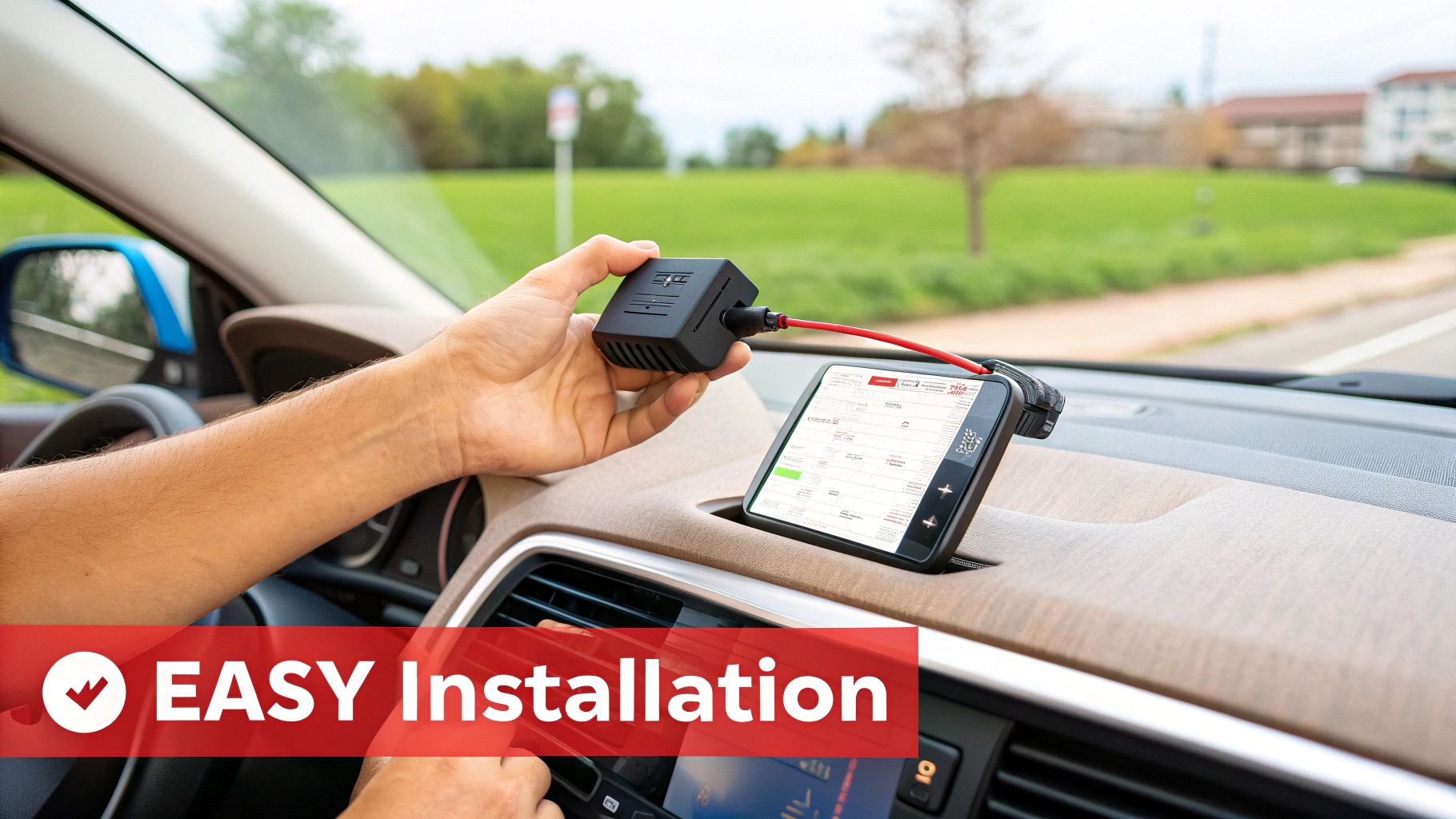
For most car owners, an OBD-II tracker is the perfect fit. It is incredibly simple, effective, and can be installed in under five minutes without any tools.
- Locate the OBD-II Port: This port has been a standard feature on every car manufactured since 1996. Look under the dashboard on the driver's side, typically near your knees or the steering column.
- Plug In the Device: Once located, simply push the tracker into the port until it clicks securely into place. It draws power directly from the car, so you never have to worry about batteries.
- Download the Companion App: Go to your smartphone's app store, find the tracker’s official app (such as the CarLock app), and download it.
- Create and Sync Your Account: Open the app and follow the simple on-screen instructions to set up your account and link it to the device you just installed.
And that's it. Your car is now protected. This straightforward setup is a major reason why OBD-II trackers have become so popular with consumers.
Hardwired Trackers and Maintenance Tips
While plug-and-play is fantastic for everyday use, a hardwired tracker has its place. It's an excellent option for commercial fleets or anyone seeking a more permanent, covert installation that is much harder for an unauthorized driver to find and remove.
A quick pro tip: To ensure your tracker is always ready, open the companion app every couple of weeks. Simply confirm it is online and reporting its location correctly. This simple check guarantees your digital watchdog is always on duty.
If you’re curious about other tracking technologies, some people explore alternative AirTag tracking solutions, which take a different, more passive approach. However, by choosing a dedicated car tracker, you can tap into the full range of CarLock device features and get a security solution built specifically for your vehicle.
Your Top Questions About Car GPS Tracking, Answered
Jumping into the world of GPS tracking can bring up a lot of questions. It's a significant upgrade for vehicle security, and you want to get it right. Let's walk through some of the most common questions we hear from drivers, with clear, no-nonsense answers.
Will a GPS Tracker Kill My Car's Battery?
This is probably the number one concern we hear, and it's a valid one. Thankfully, with a quality device, it’s not an issue. Modern trackers, including CarLock, are engineered with a low-power "sleep" mode.
When your car is parked, the tracker sips a minuscule amount of power—typically less than 10 milliamps. It only wakes up and draws more energy when it detects a significant event, like the engine starting or a strong vibration. This intelligent power management provides 24/7 protection without the headache of a dead battery.
How Accurate Is the Location, Really?
Modern GPS technology is impressively accurate. A good tracker will pinpoint your car's location to within 5 to 10 meters (that's about 16 to 32 feet) in optimal conditions. For law enforcement trying to recover a stolen vehicle, that’s more than precise enough to locate it.
While environmental factors like deep underground garages or "urban canyons" between skyscrapers can temporarily weaken the satellite signal, the overall reliability for tracking and recovery is exceptionally high.
Can't a Thief Just Unplug It?
Thieves are becoming more aware, and they know to look for tracking devices. That's precisely why top-tier systems have a built-in countermeasure. If a thief finds an OBD-II tracker like CarLock and removes it, you will receive an instant "Device Disconnected" alert sent straight to your phone.
This is a game-changing feature. It warns you about tampering the second it happens, giving you a critical head start to take action, often before your car has even been moved.
Why Do I Need to Pay for a Subscription?
Think of the subscription as the live data connection between your car and your phone. Every real-time GPS tracker has a SIM card inside, just like a cell phone, that uses a cellular network to transmit data.
That small monthly fee covers the cost of that mobile data, access to the secure cloud servers that process the information, and the ongoing development and maintenance of the app on your phone. It's what keeps the communication line open so you can get those crucial, real-time alerts anytime, anywhere.
Ready to secure your vehicle with a smart, user-friendly GPS tracking system? CarLock delivers the real-time alerts and peace of mind you've been looking for. Protect your car today by visiting the official CarLock website.