

Driver’s Desk
Anti Theft Devices for Cars: Top Picks to Safeguard Your Vehicle
That sinking feeling you get when you stare at an empty parking spot where your car should be is something no one wants to go through. Choosing the right anti-theft devices for cars is how you turn that fear into proactive protection, layering old-school physical roadblocks with smart, real-time alerts. Modern security isn't just about making a racket anymore; it's about staying connected to your vehicle, no matter where you are.
Understanding Today's Car Theft Landscape
Gone are the days when car theft was all about jimmying a lock and hot-wiring an engine. Today's thieves are often tech-savvy, using sophisticated gadgets like relay attack devices to clone key fobs or exploiting vulnerabilities in a car's onboard computer. This evolution means your vehicle's factory-installed defenses, while a good start, often aren't enough to stand alone against a determined thief.
But it's not all bad news. The security industry has kept pace with intelligent solutions. While car thefts reached a concerning high in recent years, with over one million vehicles stolen in the U.S. in 2022 according to the National Insurance Crime Bureau (NICB), effective technology is a proven countermeasure.
In fact, the NICB reported that in 2023, the national vehicle recovery rate was an impressive 85%. This statistic highlights a crucial point: proactive devices work. A standard car alarm just makes noise, but a modern GPS tracker can instantly detect a slight vibration, an engine start, or any movement and send an alert straight to your phone, significantly increasing the odds of a swift recovery. You can find more details on this encouraging trend over on KBB.com.
Passive vs. Active Security
To pick the right gear for your car, you first need to understand the difference between passive and active security. Think of it as the difference between a "Beware of Dog" sign and an actual guard dog.
Passive Deterrents: These are the visual roadblocks. A big, yellow steering wheel lock or a simple blinking LED on the dash tells a thief, "This car is going to be a hassle. Move on." They're a fantastic first line of defense against the casual, opportunistic criminal looking for an easy score.
Active Security Systems: These systems are your digital lookouts. They actively monitor your car and notify you the second something is wrong. This is where you get real-time information and the power to react immediately.
Active systems are what bridge the gap between just scaring a thief off and actually recovering your car. Instead of hoping the alarm makes them run, you get an immediate tap on the shoulder—an alert on your phone—the moment trouble starts. This gives you the critical window to take action.
This guide will walk you through the whole spectrum of anti-theft devices for cars, from the tried-and-true physical locks to advanced GPS trackers that put you in the driver's seat. We will analyze the data, compare technologies, and provide the clarity you need to build a security setup that protects your ride and gives you genuine peace of mind.
Your Complete Guide to Car Anti Theft Devices
Securing your car is a lot like protecting your home. You wouldn't rely on just a single lock on the front door; you'd have deadbolts, a security system, and maybe even cameras. The same logic applies to your vehicle. The best defense is a layered one, combining old-school physical barriers with modern electronic smarts to create a formidable anti-theft strategy.
Each type of device serves a specific function. A large, bright steering wheel lock is a clear visual deterrent that tells a would-be thief to move along. A hidden engine immobilizer, on the other hand, is the silent guardian that prevents the car from starting without the right key. Understanding the role of each component is the first step to building a security setup that works.
The First Line of Defense: Visual and Physical Deterrents
Sometimes, the simplest methods are the most effective, especially against thieves looking for an easy target. The primary purpose of these devices is to be seen. They are a clear, physical warning that your car is not the low-hanging fruit they're looking for.
- Steering Wheel Locks: That classic, brightly colored bar locked across the steering wheel is impossible to miss. It makes turning the wheel impossible and signals that the car is protected, which is often enough to make a thief look elsewhere.
- Brake and Clutch Locks: Working on the same principle, these devices clamp onto the brake or clutch pedal, rendering them useless. They add another physical hurdle that takes time and effort to bypass.
- Wheel Clamps: You've probably seen these used by parking enforcement, and for good reason. A giant, heavy-duty clamp on your wheel is the ultimate visual stop sign. It makes driving away physically impossible without causing a major scene.
- VIN Etching: This is a more subtle approach. By permanently etching your car's Vehicle Identification Number (VIN) on all the windows, you're not stopping the initial theft. Instead, you're making the car a nightmare for thieves to profit from. Stamped parts are easily traced by law enforcement, drastically reducing the car's value on the black market.
These physical tools are the foundation of your car's security. They are affordable, easy to use, and a crucial starting point for any car owner.
The Second Layer: Electronic Security Systems
Once you've handled the visual deterrents, it's time to add intelligence to your defense. Electronic systems are the brains of the operation, working quietly in the background to monitor, alert, and actively stop a car from being stolen.
Most people are familiar with factory car alarms that just make a lot of noise, which are now largely ignored due to "alarm fatigue." Modern aftermarket systems go way beyond just honking. A cutting-edge smart anti-theft system can offer a much more robust and responsive defense for your vehicle.
According to a study from the National Highway Traffic Safety Administration (NHTSA), vehicles with immobilizers had theft rates 40% lower than those without. This data proves how powerful it is to prevent the engine from ever starting in the first place.
Here are the key players in the electronic world:
- Car Alarms: Today's alarms are much smarter. They can have shock sensors, tilt sensors, and motion detectors. The best ones will send a notification to your smartphone the second they're triggered.
- Engine Immobilizers: This is arguably one of the most effective anti-theft tools ever invented. A tiny transponder chip in your key fob communicates with your car's computer. If the correct code isn't received, the engine simply refuses to start. No key, no ignition.
- Kill Switches: A kill switch is a stealthy, manual override. It's a hidden switch that cuts power to an essential system, like the fuel pump or ignition. If a thief can't find the switch, they can't start the car. Period.
Comparing Popular Anti Theft Device Types
To make sense of it all, it helps to see how these different options stack up against each other. The table below gives you a quick snapshot of what each device does, its cost-effectiveness, and its primary purpose.
| Device Type | How It Works | Best For | Effectiveness Level |
|---|---|---|---|
| Steering Wheel Lock | A physical bar that locks the steering wheel in place, preventing it from being turned. | A highly visible, low-cost deterrent against opportunistic thieves. | Medium: Deters casual thieves but can be defeated by pros. |
| Engine Immobilizer | An electronic system that prevents the engine from starting without the correct key fob. | Standard, highly effective protection against hot-wiring. | High: Very effective against most theft methods. |
| GPS Tracker | Uses satellite signals to pinpoint and track the vehicle's location in real-time. | Recovering a vehicle after it has been stolen. | High: Dramatically increases the chances of recovery. |
| Kill Switch | A hidden switch that disrupts a key electrical circuit, like the fuel pump or ignition. | Adding a stealthy, custom layer of security. | High: Very effective if the switch is well-hidden. |
| Wheel Clamp | A large, heavy-duty clamp that physically prevents a wheel from rotating. | The ultimate visual deterrent for long-term parking. | Very High: Extremely difficult and noisy to remove. |
| OBD Blocker | A physical lock that blocks access to the car's OBD-II port, preventing key cloning. | Protecting modern vehicles from sophisticated electronic theft. | High: Stops thieves from exploiting the car's computer. |
Ultimately, the most secure vehicles use a combination of these devices, creating multiple obstacles that make stealing the car too risky and time-consuming.
The Ultimate Layer: Real-Time Tracking and Control
The final and most advanced layer of protection connects you directly to your vehicle, no matter where it is. These systems don't just react to a break-in; they give you 24/7 oversight and the power to track your car's every move.
GPS Trackers are the star players here. These tiny devices are hidden in your car and use satellites to report its precise location. If the unthinkable happens and your car is stolen, you can give police its live location, which boosts recovery chances to over 90% in many cases. Understanding how modern car tracking technology works is key to appreciating the peace of mind it offers.
Other powerful tools in this category include:
- OBD Port Blockers: Your car's On-Board Diagnostics (OBD) port is a direct line to its computer system. Tech-savvy thieves can plug into it to clone a key or bypass security. An OBD lock is a simple but brilliant physical shield that denies them access.
- Geofencing: This feature, common in GPS trackers, lets you draw virtual perimeters on a map. You can set one around your home or workplace, and if your car ever crosses that line without your permission, you get an instant alert on your phone.
By weaving together these three layers—strong physical deterrents, smart electronic systems, and live tracking—you build a web of security that even the most dedicated car thief will struggle to beat.
Why Some Cars Are Stolen More Than Others
Ever wonder why some car models are practically thief-magnets while others get a pass? It's not just bad luck. Car thieves are opportunistic, always weighing the risk against the potential reward. They’re looking for the path of least resistance—vehicles that are easy to grab, valuable to chop for parts, or both.
Knowing what makes a particular car an easy target is the first step in protecting it. For a thief, every second counts. A car with a well-known security loophole is a much easier score than one that requires special tools, makes a racket, or draws unwanted attention.
This is where a layered security approach comes in. Think of it in three main categories: things a thief can see, things a thief has to bypass, and ways you can track the car if they succeed.
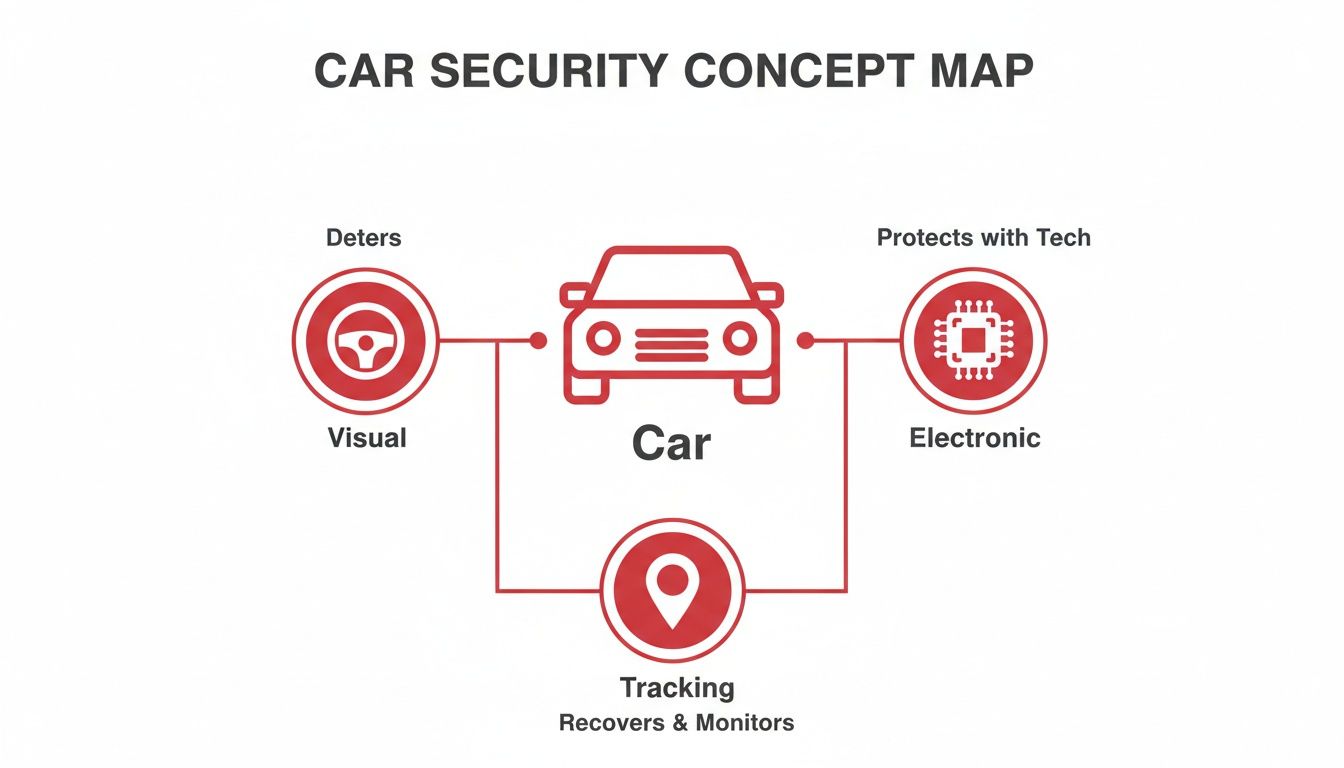
As this breakdown shows, combining visual, electronic, and tracking systems gives you the strongest defense, especially if your car falls into a high-risk category.
The Most Targeted Vehicles and Their Weak Spots
Some cars just can't seem to shake their spot on the "most stolen" lists. There's a reason for that. Sometimes, a vulnerability gets exposed—often through viral social media challenges—and suddenly, thousands of cars become easy pickings overnight.
A perfect example of this happened recently with certain Hyundai and Kia models. According to the NICB, in 2023, thefts of Hyundai and Kia vehicles surged by over 1,000% compared to 2020. The Hyundai Elantra (48,445 thefts) and Sonata (42,813) were among the most stolen vehicles in the nation, with the Kia Optima (30,204) not far behind. This wasn't a coincidence. The thefts were tied directly to the lack of standard engine immobilizers in those vehicles, which allowed thieves to start them with nothing more than a USB cable.
With the average loss per stolen vehicle in the U.S. hitting $9,907 in 2022, according to the FBI, that single flaw turned into a massive financial headache for owners.
This trend was a major wake-up call. It proves how a single security oversight in a popular car model can be exploited on a huge scale, putting countless owners at risk. It’s a stark reminder that factory security isn't always foolproof.
Why Value and Parts Matter to Thieves
Beyond specific security flaws, a car's appeal to a thief often boils down to two things: its street value and the demand for its parts.
High Resale Value: Luxury and high-performance cars are often stolen to order. They might be given a new identity through VIN cloning or quickly shipped overseas to be sold on foreign markets. The higher the price tag, the bigger the incentive. Knowing how much your car is truly worth can help you gauge just how tempting it might be to a professional thief.
High Demand for Parts: This is a major factor. It's why older, incredibly common models like the Honda Accord or Ford F-150 are always at the top of theft lists. With millions of them on the road, there's a constant, massive black market for replacement parts like catalytic converters, airbags, and wheels. These cars are often driven straight to a "chop shop," dismantled in hours, and their parts are sold off piece by piece.
If your car fits any of these descriptions—a model with a known weakness, a high-value vehicle, or a common model with parts in high demand—you're automatically at a higher risk. In that case, adding extra anti theft devices for cars isn't just a good idea; it's a necessity.
Essential Features of a Modern Car Security System
Knowing the difference between car alarms, immobilizers, and GPS trackers is a great start. But what really separates a basic gadget from a security system that actually works? It’s not about just making noise anymore; it’s about getting immediate, useful information right when you need it.
To select the right device, you must look past the flashy marketing and focus on the features that provide real security and peace of mind. These are the elements that turn a passive noisemaker into an active defense system, putting you back in control. A loud siren might spook a teenager, but a silent alert sent straight to your phone is what stops a professional.
Real-Time Smartphone Notifications
If there’s one non-negotiable feature for any modern car security system, it’s real-time alerts sent directly to your phone. Let’s be honest, traditional car alarms have a massive flaw: nobody pays attention to them anymore due to alarm fatigue. We've all become numb to the sound, assuming it's just another false alarm.
A smart system sidesteps that whole problem. Instead of a blaring siren that everyone ignores, you get a quiet, personal notification that something is wrong.
- Vibration Alerts: Get a push notification the second your car is bumped or a window is smashed.
- Engine Start Alerts: You’ll know the instant someone turns the ignition, often before they’ve even had a chance to put the car in drive.
- Device Disconnected Alerts: If a thief finds and unplugs your security device, you get an alert. Their attempt to disable your security actually triggers another alarm.
These instant updates give you the critical head start you need to call the police and stop a theft while it's happening. You can learn more about how a modern connected car alarm puts this power directly in your hands.
Geofencing and Location Tracking
Another absolute game-changer is geofencing. Think of it like drawing an invisible fence around a specific location on a map—your driveway, the office parking garage, or your kid's school. It’s a brilliantly simple concept that automates your car's security.
Setting up a geofence takes just a few seconds in an app. Once it's active, the system watches over your car for you. If your vehicle crosses that invisible line without you knowing, you get an instant alert.
Geofencing is like having a virtual security guard for your parking spot. It doesn't wait for a break-in; it tells you the moment your car moves from where it's supposed to be—often the very first sign of trouble.
This feature is a lifesaver in so many scenarios. It can confirm your car is safely parked for the night or alert you if a valet driver decides to take it for a little joyride.
Tamper Detection and Power Source
A security device can't protect you if it's turned off. That’s why tamper detection and a reliable power source are so important. Smart thieves know to look for aftermarket security systems and their first move is often to cut the power.
A good system is one step ahead. The best GPS trackers and alarms come with a small internal backup battery. If the device is unplugged from your car's main battery, its own power kicks in, and it immediately sends you that "Device Disconnected" alert.
Look for devices that plug into your car’s OBD-II port. They are incredibly easy to install and draw a minimal amount of power, so they won't drain your main battery. This means your security system is always on, always watchful, and always ready to report back to you.
How to Choose the Right Protection for Your Needs
Picking the right anti-theft device from a sea of options can feel like a chore. But here’s the secret: there's no single "best" gadget. The real goal is to build a security strategy that fits your life, your car, and your parking situation. What works for a vintage muscle car tucked away in a garage is going to be totally different from what a parent needs for their teen's first car.
Your perfect setup really boils down to your daily routine. Once you think through the specifics, you can stop looking for a generic fix and start building a personalized security plan that actually delivers peace of mind.
Security Blueprints for Real-World Scenarios
Let's walk through how different needs shape the ideal security solution. Here are a few practical examples for common types of car owners.
For the Parent of a New Teen Driver
- Primary Concern: This is less about theft and more about safety and awareness. You want to know they're where they're supposed to be and driving responsibly.
- Ideal Combination: A real-time GPS tracker with geofencing is your best friend here. You can set up "safe zones" around home or school, get an alert if the car is used late at night, and even be notified about aggressive driving like harsh braking or speeding. It’s all about responsible oversight.
For the Small Business Fleet Manager
- Primary Concern: You need to protect your assets, make sure drivers are efficient, and keep tabs on multiple vehicles at once.
- Ideal Combination: A solid GPS tracking system is absolutely essential. Look for features like route history, idle time tracking, and geofencing to ensure your vehicles and drivers stay on track. For an extra layer of security against tech-savvy thieves, consider adding OBD port blockers to prevent anyone from tampering with the vehicle’s computer.
Protecting High-Value and High-Risk Vehicles
When you have a highly sought-after classic or you live in a place where car theft is common, the stakes are much higher. In these cases, your security strategy needs to be more robust and layered.
Think about this: a car was stolen every 32 seconds in the US in 2022. That's faster than it takes to brew a cup of coffee. This means your defenses have to be faster than a thief. Old-school alarms are often ignored, but a modern GPS system that sends an instant vibration alert to your phone can catch them in the act.
Getting your car back quickly is everything. In 2023, U.S. vehicle recovery rates hit over 85%, and a third of those cars were found in less than 24 hours. A good GPS tracker is the single most important tool to make sure your car is one of the success stories.
Here’s how you can build a virtual fortress around a high-risk vehicle:
For the Classic Car Enthusiast
- Primary Concern: Protecting a unique, often irreplaceable, asset from being stolen.
- Ideal Combination: Start with a hidden kill switch to make hot-wiring a non-starter. Add a heavy-duty steering wheel lock as a strong visual deterrent, and top it off with a discreet, battery-powered GPS tracker that will keep working even if a thief disconnects the car's main battery.
For the City Dweller in a High-Theft Area
- Primary Concern: Fending off everyone from opportunistic joyriders to professional car thieves.
- Ideal Combination: Layers are your best defense. A visible wheel clamp or steering lock can scare off the casual thief. Back that up with a modern alarm connected to a GPS tracker for instant alerts, and finish it off with an OBD port blocker to prevent digital key-cloning attacks. For this situation, looking into a complete car security system is a very smart move.
Getting It Set Up and Keeping It Running
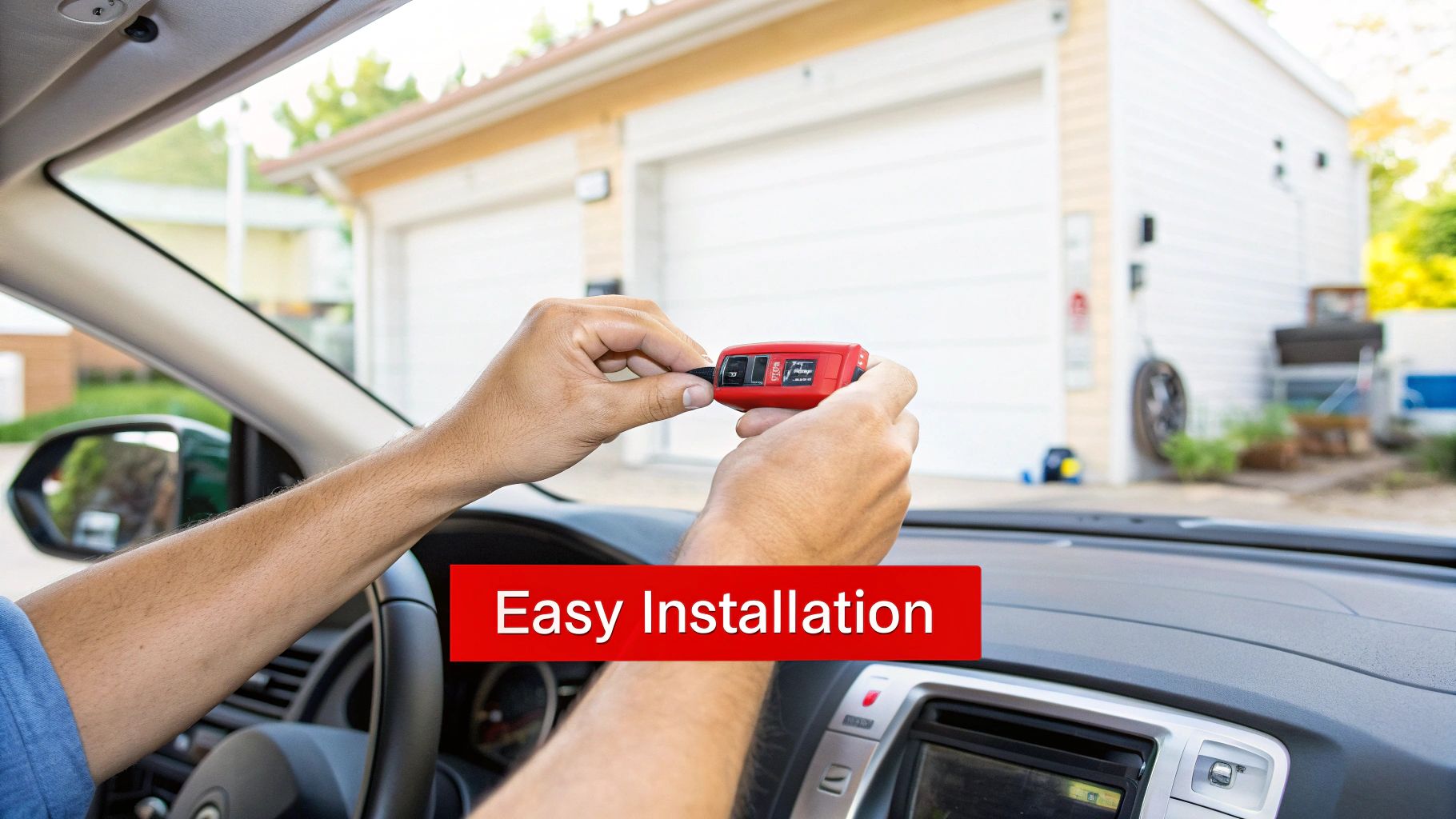
So, you've selected an anti-theft device. The next step is getting it installed and ensuring it remains effective, and that process can look very different depending on what you bought. Some are incredibly simple, while others are best left to the pros.
Many of the best modern GPS trackers and alarms are pure plug-and-play. They connect right into your car’s OBD-II port, which is the diagnostic connector usually located under the steering wheel. You can have it up and running in less than a minute—no tools, no wiring, no fuss.
When to Call in a Professional
Then you have the more involved systems, like kill switches or hardwired alarms. These aren't just plug-in gadgets; they tap directly into your vehicle's core electrical system, like the ignition wiring or the fuel pump.
This is not a DIY job for a Saturday afternoon unless you're a seasoned mechanic. A single wrong move—a snipped wire, a bad connection—could leave you with a car that won't start or, worse, a fried electrical system and a voided warranty. For these complex anti theft devices for cars, it’s always worth the investment to have a certified technician do the job right.
A good professional installer does more than just connect wires. They make the installation discreet, hiding the device where a thief would never think to look. The harder it is to find, the harder it is to defeat.
A Few Simple Checks to Stay Protected
Once your device is installed, it doesn't need much attention, but a little preventative maintenance goes a long way. Think of it as a quick check-up to make sure your car's security is in top shape.
Here are a few things to do periodically:
- Test Your Alerts: Once a month or so, give your car a gentle shake or start the ignition to make sure the alerts pop up on your phone as expected. You want to know it works before you actually need it.
- Check the Power Source: If your device has a backup battery, peek at its status in the app. For plug-in devices, just make sure the connection is still firm in the OBD-II port.
- Keep Your App Updated: When the companion app for your device asks to update, do it. These updates often include important security patches and new features, like the ones you’d find in an advanced car locator.
The Bonus: Saving Money on Insurance
Protecting your car from thieves has another perk: protecting your wallet. Most insurance companies love to see that you've installed a certified anti-theft device, especially one with active GPS tracking.
They often reward you with a nice discount on your premium—sometimes as much as 15-20%. Over a year or two, that discount can easily cover the cost of the device itself. Just make sure to call your insurance agent, tell them about your new system, and send over any proof they need. It’s a simple call that pays off.
Your Car Security Questions, Answered
When you start looking into anti-theft devices for cars, a few key questions always pop up. It's natural to wonder if these gadgets can really stop a determined thief or if installing one might mess with your car's warranty. Let's tackle these common concerns with factual, practical answers.
Can Thieves Actually Disable Modern Anti-Theft Devices?
It's a valid question. While a highly skilled professional can try to get around almost any security system, today's devices are built with countermeasures. Many GPS trackers, for instance, come with their own backup batteries. If a thief disconnects the tracker from your car's power, it immediately sends a tamper alert to your phone and keeps on tracking.
Another great example is an OBD port lock. It's a simple physical shield that blocks the one port thieves love to use for hacking your car's computer to create a new key.
The best defense is a layered one. Think of it this way: a big, visible steering wheel lock might scare off an opportunistic thief. But a silent, hidden GPS tracker is your ace in the hole, helping you find your car even if the thief gets past the first line of defense. No single device is invincible, but using a few together makes your car a much, much harder target.
Will Installing an Aftermarket Device Void My Car's Warranty?
This is probably the biggest worry for most car owners, but you can relax. In the United States, the Magnuson-Moss Warranty Act protects consumers. An automaker cannot void your warranty just because you installed an aftermarket part.
Devices designed to be "plug-and-play" simply connect to your car's existing OBD-II port. Since you're not cutting or changing any of the car's original wiring, your factory warranty remains intact. These are made for easy, non-invasive installation.
Where you need to be careful is with systems that must be hardwired into your car’s electrical system. If these are installed incorrectly and directly cause a failure, that specific repair may not be covered. The golden rule here is to always have a certified, trusted professional handle that kind of installation.
Is It Legal to Put a GPS Tracker on My Own Car?
Absolutely. It is 100% legal to install and use a GPS tracker on a vehicle that you own. It’s a common and incredibly effective way to recover a stolen vehicle, keep an eye on a new teen driver, or manage company cars.
The only time legality becomes an issue is if someone places a tracker on a vehicle without the owner's permission. But for your own car, you have every right to know where it is for security and peace of mind. If you want to get into the nitty-gritty, you can find more answers about how GPS car trackers work on our dedicated page.
For a complete security solution that combines real-time alerts, GPS tracking, and driver monitoring, trust CarLock to keep you connected to your vehicle 24/7. Learn more about how CarLock can protect your car today.