

Driver’s Desk
Real Time Tracking The Ultimate Guide to Vehicle Security
Real time tracking is a direct, 24/7 connection to your vehicle's precise location and status. This technology utilizes a combination of GPS and cellular networks to provide instant notifications regarding any suspicious activity, making it a highly effective tool for preventing theft or aiding in the rapid recovery of a stolen vehicle.
Your Instant Answer to Modern Vehicle Threats
The sudden realization that your car is missing from its parking space is a uniquely distressing experience. In the modern era, traditional car alarms are largely insufficient; their audible alerts are frequently ignored by the public, and professional thieves can often disable them in a matter of seconds. This is where real time tracking fundamentally changes vehicle security, shifting control from the thief back to the owner.
Instead of merely generating noise, a real time tracking system provides constant, actionable intelligence. It establishes a direct link between your vehicle and your smartphone. If your car experiences an unusual vibration, if the engine is started, or if it is moved without your authorization, you receive an immediate alert. A potential theft is transformed from an unknown event into a preventable incident you can address in the moment.
The Growing Need for Proactive Security
Vehicle crime is not a diminishing problem; statistics indicate a clear upward trend, necessitating a more sophisticated and proactive security approach. The data underscores this reality. According to Fortune Business Insights, the global market for GPS tracking devices was valued at USD 4.17 billion in 2023 and is projected to grow at a compound annual growth rate (CAGR) of 12.73% through 2032. This growth is directly correlated with rising theft rates. In the UK, for instance, data from the Office for National Statistics shows over 130,389 vehicles were stolen in 2023, a significant increase from previous years. Similarly, major U.S. cities like Los Angeles have reported annual spikes in vehicle theft, with some years seeing increases of over 15%.
A real time tracker doesn't just report your car's last known location—it provides its current position continuously. This immediate, actionable data is the single most critical factor in successful vehicle recovery and theft prevention.
More Than Just a Dot on a Map
The true value of this technology extends far beyond simple location plotting. It is about providing tangible control and a genuine sense of security across a variety of scenarios.
- Theft Prevention: Receive immediate notifications if your car is vibrated, moved, or towed, allowing for swift intervention.
- Teen Driver Monitoring: Supervise new drivers by receiving alerts for harsh braking, sharp acceleration, or exceeding predefined speed limits, fostering safer driving habits.
- Peace of Mind: Whether you are on vacation thousands of miles away or simply in another room, you can verify your car's status with a quick check on your smartphone.
Ultimately, modern threats demand modern solutions. A top-tier car security system provides layers of defense that a conventional car alarm cannot match. By integrating real time tracking, you are not merely installing a device; you are equipping one of your most valuable assets with a dedicated, round-the-clock security detail.
Key Benefits of Real Time Tracking at a Glance
A real-time tracker offers immediate, practical advantages that extend well beyond locating a stolen car. The table below details the core benefits and their day-to-day implications.
| Benefit | What It Means For You | Primary Use Case |
|---|---|---|
| Instant Theft Alerts | Get a notification the moment suspicious activity is detected, like vibrations or unauthorized movement. | Theft Prevention & Recovery |
| Live Location Updates | See your car's exact position on a map in real-time, refreshed every few seconds. | Stolen Vehicle Recovery |
| Driver Behavior Monitoring | Receive alerts for harsh driving, speeding, or rapid acceleration. | Monitoring Teen/New Drivers |
| 24/7 Peace of Mind | Check your vehicle’s location and status anytime, from anywhere, right from your smartphone. | Everyday Security |
| Trip History Logs | Review past routes, stops, and driving times, all stored automatically. | Business Mileage & Route Tracking |
These features function synergistically to create a robust safety net, delivering a level of awareness and control previously unattainable. It's about ensuring your vehicle is secure, whether it's parked on your street or in a different city.
How Real-Time Tracking Technology Actually Works
Understanding the mechanics of real-time tracking does not require an engineering background. The technology is based on three established components working in concert to create a live, direct connection between your vehicle and your smartphone. It is an active security system designed to report any irregularities the moment they occur.
At its core, the system operates on a simple three-step process, leveraging the same reliable technologies that power many everyday devices. Each component has a specific function, and their integration forms a formidable security shield for your vehicle.
The Three Pillars of Vehicle Tracking
The entire system's efficacy relies on three essential elements operating in perfect synchronization. This technological triad ensures that you are the first to know the instant an incident affects your vehicle.
- GPS Receiver: This is the system's positioning component. The tracking device installed in your car contains a high-sensitivity GPS receiver that constantly communicates with a network of satellites orbiting the Earth. By triangulating signals from multiple satellites, it calculates your vehicle's precise latitude and longitude with an accuracy often within a few meters.
- Cellular Modem: Once the GPS receiver has determined the vehicle's location, that data must be transmitted to you. A built-in cellular modem functions as a data transmitter, sending the location information over a mobile network, much like a smartphone sends data. This guarantees a continuous and reliable stream of information, provided a cellular signal is available.
- User-Friendly App: The final component is the application on your smartphone, which serves as your command center. It receives the data from the cellular modem and renders it on an easy-to-read map, displaying your car’s exact location. Crucially, this is the interface through which you receive the instant alerts that make real-time tracking an indispensable security tool.
This flowchart illustrates how quickly the system responds upon detecting a threat.
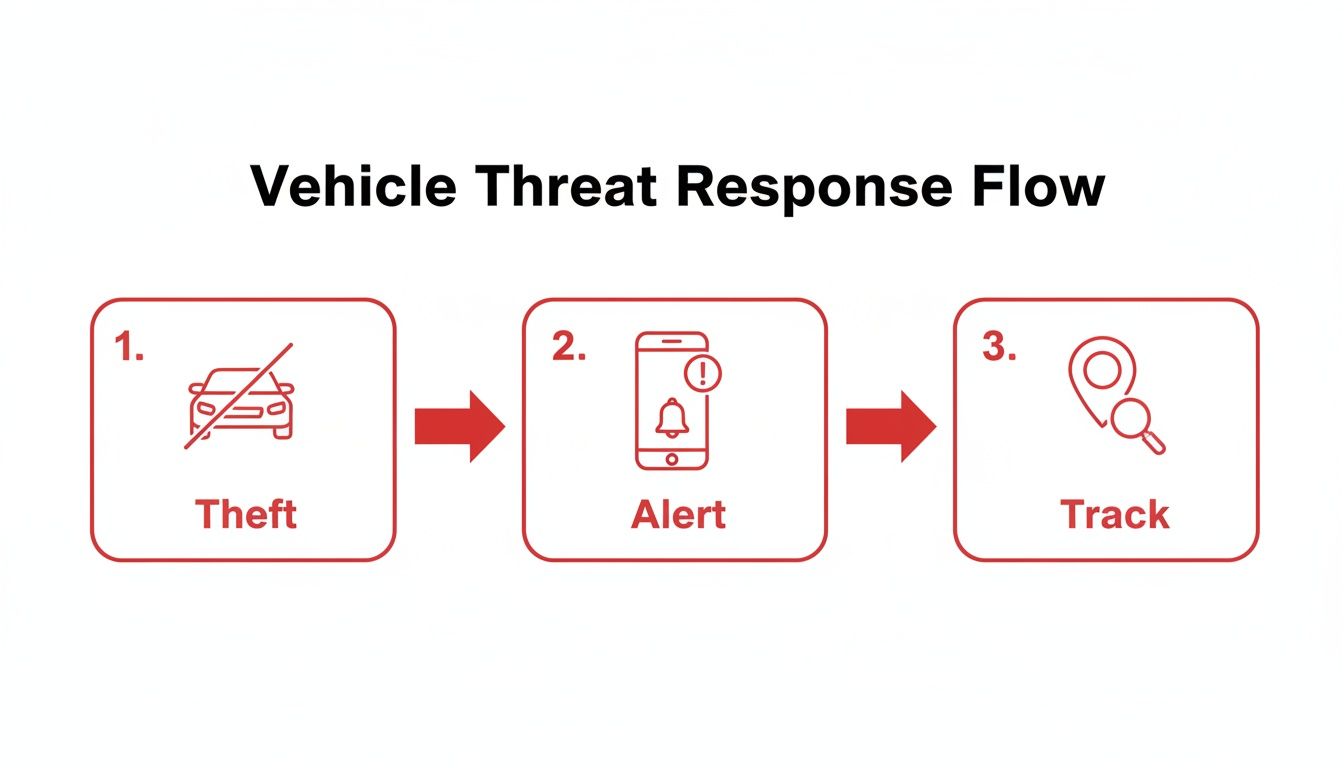
As shown, the entire process is engineered for speed, minimizing the delay between a security event and your ability to respond.
From Detection to Notification in Seconds
The system's intelligence lies in its ability to determine when to send an alert. This goes beyond simple movement tracking. Advanced functionality is enabled by built-in sensors, such as an accelerometer—the same technology your smartphone uses to detect orientation changes.
Consider a scenario where a thief attempts to break into your car. The moment they force the door handle or shatter a window, the device’s sensitive accelerometer detects the anomalous vibration. This event triggers an immediate signal, which is transmitted through the cellular network and delivered to your phone as a push notification.
The same principle applies to an engine start alert. The device is designed to recognize the distinct electrical signature or vibration profile of the engine turning over and instantly notifies you. This transforms a passive car alarm—which is often ignored—into an active security system that empowers you to take action. You are no longer a passive victim but the first line of defense.
You can explore the specific features of an advanced device that enable this rapid response. This seamless process can turn a potential disaster into a preventable one, providing genuine peace of mind.
The Everyday Wins of Having a Real-Time Tracker
While the technology behind real-time tracking is impressive, its practical applications are what truly matter. The system is not merely about viewing a location on a map; it's about having a silent guardian for your vehicle that provides security, peace of mind, and valuable insights into its use when you're not behind the wheel.
This technology elevates your car from a simple mode of transport to a smart, connected asset. Whether for a parent of a new driver, a small business owner reliant on a company vehicle, or any car owner, a tracker delivers tangible, daily benefits.
Unmatched Theft Prevention and Recovery
This is the system's primary and most critical function. A conventional car alarm creates an audible deterrent that experienced thieves often bypass. A real-time tracker, in contrast, is an active defense mechanism. You receive an instant smartphone alert if your vehicle is vibrated, if the engine starts without authorization, or if it moves from its parked location. This provides a crucial window to react, notify authorities, and potentially thwart a theft in progress.
In the event of a successful theft, the tracker becomes your most powerful tool for recovery. The data is compelling: statistics from law enforcement and insurance agencies consistently show that vehicles equipped with live tracking systems have a recovery rate exceeding 90%. For vehicles without such systems, the recovery rate can fall below 50%. This stark difference is almost entirely attributable to the availability of live, accurate location data for law enforcement.
Peace of Mind for Parents of Teen Drivers
Entrusting a new driver with the family car is a significant milestone for any parent. A real-time tracker can serve as a digital co-pilot, helping you encourage safe driving habits without being intrusive.
Modern trackers provide a detailed overview of driving behavior. You can receive alerts for specific actions, such as:
- Excessive Speeding: Set a speed threshold and receive a notification if it is surpassed.
- Harsh Braking: Be alerted to sudden stops, which can indicate tailgating or distracted driving.
- Rapid Acceleration: Monitor aggressive driving habits from stops.
This is not about surveillance but about safety and coaching. In fact, research from institutions like the Insurance Institute for Highway Safety (IIHS) indicates that parental monitoring can significantly reduce risky driving behaviors. A study found that teens in vehicles with monitoring devices engaged in 60% fewer instances of speeding and risky maneuvers.
A tracker provides objective data, transforming a potential confrontation ("You were speeding!") into a constructive, fact-based conversation. It is a powerful tool for teaching road safety.
Asset Protection for Small Businesses
For a small business, a vehicle is more than just transportation—it is a critical operational asset. Whether it's a single delivery van or a small fleet of service trucks, ensuring the security and efficient use of these assets is vital to the bottom line.
A real-time tracker provides the necessary oversight. You can monitor vehicle locations during work hours, confirm adherence to routes and schedules, and improve dispatching efficiency. Detailed trip logs simplify mileage tracking for tax purposes and help identify inefficient routes that waste fuel and time. Furthermore, many insurance providers offer discounts of 10-25% for commercial vehicles equipped with anti-theft tracking devices.
You can learn more about how tracking can help maintain your vehicles' operational health by reading our guide on vehicle health monitoring.
From protecting a family vehicle to managing a business fleet, the benefits are clear and measurable. A real-time tracker is an investment in control, confidence, and security.
Choosing the Right Vehicle Tracking System
It is critical to understand that not all systems offering real-time tracking are equivalent. A basic GPS device may only provide location data, whereas a true security system integrates multiple layers of protection. This distinction can be the difference between a prevented theft and a total loss.
The market offers a wide spectrum of options, broadly categorized as simple location loggers versus advanced security solutions. A standard logger may suffice for basic mileage tracking, but it provides no active defense against theft. For genuine security, you require a system that actively monitors for threats and provides immediate notifications.
Mission-Critical Security Features to Demand
For serious vehicle protection, certain features are non-negotiable. These are the functionalities that elevate a simple tracker into an active security system.
- Instant Mobile Push Notifications: This is paramount. Email or SMS alerts can be delayed or overlooked. A push notification commands immediate attention, and in the context of a theft, these seconds are invaluable.
- Engine-Start Alerts: A thief's primary objective is to start the vehicle and drive away. A system that alerts you the moment the engine turns over without authorization is a powerful deterrent.
- Vibration and Movement Detection: Before starting the engine, a thief will likely cause a physical disturbance, such as breaking glass, forcing a door, or attempting to tow the vehicle. A tracker with a sensitive accelerometer detects these vibrations and sends an alert, often deterring the thief before significant damage occurs.
- Detailed Trip History Logs: Beyond immediate security, comprehensive trip logs are a powerful tool. They can help police reconstruct a thief's path, allow you to review a teen driver's route, or simply serve as a record of vehicle usage.
These core features define the difference between a simple tracker and a comprehensive security system. You can gain a deeper understanding by exploring the full capabilities of an advanced tracking app and how these elements work together.
For example, the CarLock mobile app is designed to serve as a central hub for all these critical alerts.
As illustrated, alerts are clearly categorized, allowing you to instantly understand the nature of the threat to your vehicle.
Installation Types: Plug-and-Play vs. Hardwired
Another key consideration is the device's installation method. There are two primary approaches, each with distinct advantages and disadvantages.
Plug-and-play OBD-II devices are the most common choice for consumers. They connect directly to the vehicle’s On-Board Diagnostics port—the same port used by mechanics for diagnostics. Installation takes seconds, requires no tools, and allows the device to be easily transferred between vehicles.
Hardwired units, conversely, are connected directly to the vehicle’s electrical system. This makes them more discreet and resistant to tampering, but installation is more complex and typically requires a professional. For the majority of users seeking a combination of robust security and simple setup, the OBD-II solution is the optimal choice.
The most effective real-time tracking system is one that can be installed in minutes and trusted immediately. For over 99% of consumers, an OBD-II device provides enterprise-level security without the complexity and cost of a professional installation.
To better visualize the difference, a direct comparison is useful.
Feature Comparison: Basic vs. Advanced Trackers
Selecting a tracker involves shifting from a passive to an active security posture. The table below contrasts the features of a standard GPS device with those of a dedicated security system like CarLock.
| Feature | Basic GPS Tracker | Advanced System (like CarLock) |
|---|---|---|
| Location Updates | Often delayed (every 1-5 minutes) | Live updates (every 15-30 seconds) |
| Security Alerts | Limited to geofence breaches | Engine start, vibration, and movement alerts |
| Notification Type | Email or SMS (potential delays) | Instant mobile push notifications |
| Installation | Varies (can be complex) | Simple plug-and-play (OBD-II) |
| Driver Monitoring | None or very basic | Harsh driving, speeding, and trip logs |
| Battery Drain | Can be a concern with some models | Low-power mode to protect car battery |
Ultimately, the choice depends on your security priorities: passively reviewing where your car has been, or proactively protecting it where it is now. An advanced tracker provides the tools for the latter.
Addressing Privacy and Data Security Concerns
Transmitting location data, even for security purposes, is a significant consideration. Any discussion about real-time tracking must address legitimate concerns regarding privacy and data security. Installing a tracker creates a digital record of your movements, making it reasonable to ask, "Who has access to this data, and how is it protected?"
A reputable company builds its system on a foundation of robust security. The entire data pipeline—from the vehicle to the smartphone—must be secured at every point. This is not an optional feature; it is a fundamental requirement. The goal is to provide complete transparency and user control, ensuring that your data is used exclusively for the purpose of securing your vehicle.
How Reputable Companies Safeguard Your Data
Protecting your location history is a multi-layered process. It is analogous to shipping a valuable item: you would use a secure container, a tamper-evident seal, and a trusted courier. Your personal data warrants at least this level of protection.
Here is what that protection entails in a high-quality tracking system:
- End-to-End Encryption: From the moment location data is transmitted from the tracker, it is encrypted using strong cryptographic standards (e.g., AES-256). This renders the data unreadable to any unauthorized party attempting to intercept it during transmission over the cellular network.
- Secure Cloud Storage: The data is stored in a secure cloud infrastructure (e.g., AWS, Azure, Google Cloud) that employs advanced digital and physical security measures, including firewalls, intrusion detection systems, and restricted access protocols.
- Strict Access Policies: This is a critical component. You, the user, should be the sole controller of who can view your vehicle's location. A trustworthy provider will have stringent internal policies that prohibit employees from accessing specific user location data without explicit consent or a legally binding order.
You can find more detailed information by reviewing our commitment to user privacy, which outlines the specific measures we take to ensure your data remains confidential and secure.
Ethical Use Versus Illegal Misuse
It is essential to distinguish between the legitimate security use of a real-time tracker and its illegal misuse. You are legally entitled to install a tracking device on any vehicle you own. This includes personal cars, vehicles used by family members (such as a teen driver), or a fleet of company vehicles.
The legal and ethical line is crossed when a device is placed on a vehicle without the owner's knowledge and consent. Using a GPS tracker to monitor someone else's vehicle without their permission constitutes a severe invasion of privacy and is illegal in most jurisdictions. Ethical tracking is always predicated on ownership and consent.
As urbanization increases—the UN projects that 68% of the world's population will live in urban areas by 2050—the density of vehicles will grow, heightening the need for reliable security. This trend makes robust data privacy and secure systems essential for building and maintaining user trust. You can find more market analysis from the growing GPS tracking device market on fortunebusinessinsights.com.
Ultimately, a trustworthy real-time tracking provider will be transparent about its security protocols. This transparency is key to giving you the confidence that your privacy is a top priority.
Getting Started with Your Real Time Tracker
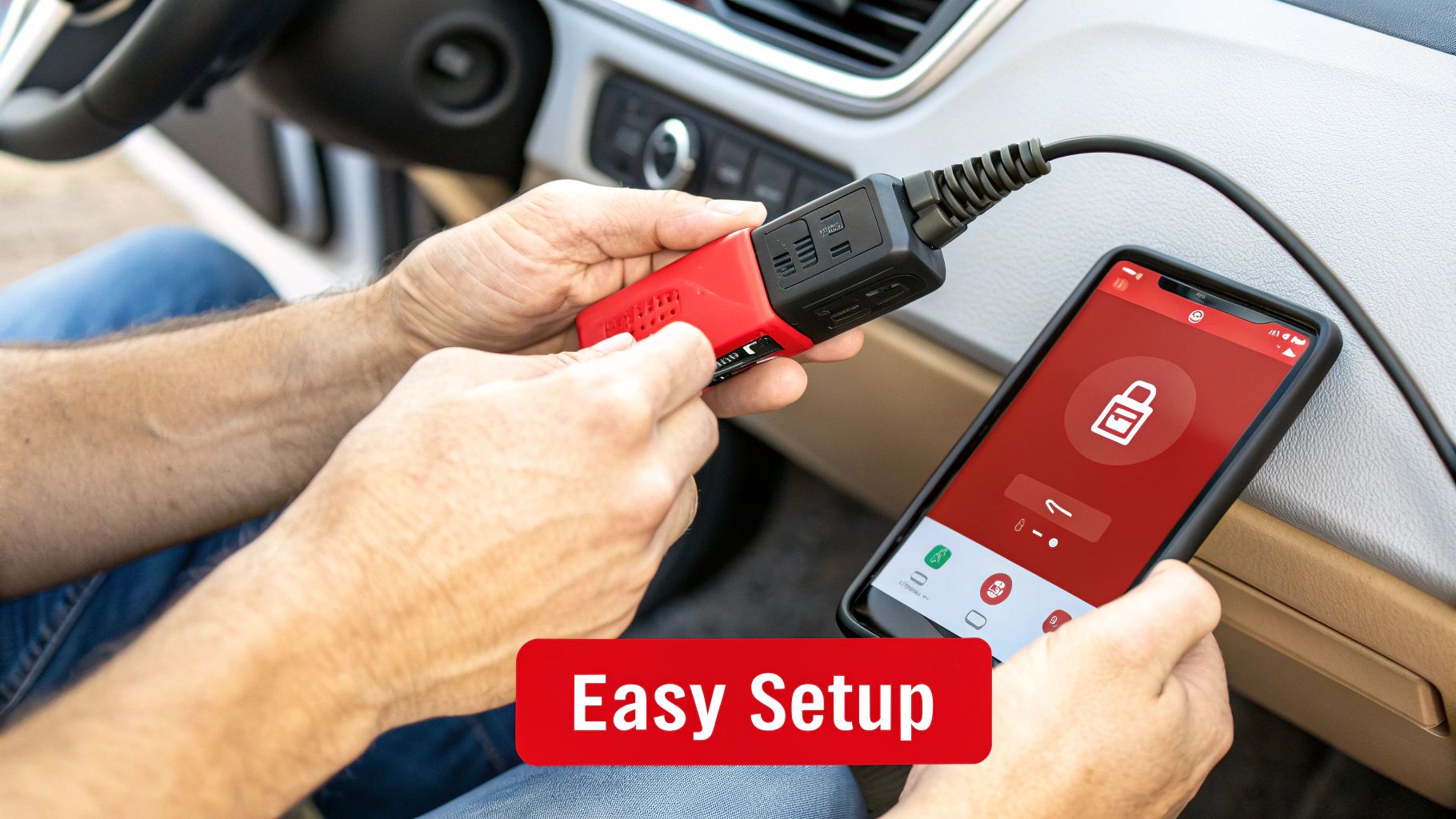
Transforming your car into a smart, connected vehicle is far simpler than most people imagine. Modern real time tracking systems are designed for ease of use, eliminating the need for complex wiring diagrams or professional installation services. You can have a complete system operational in minutes.
This section provides a step-by-step guide to the entire process, from unboxing the device to configuring personalized alerts, making top-tier security an accessible and seamless part of your daily life.
Installing Your OBD-II Device in Seconds
The first step is connecting the tracker to your vehicle. With an OBD-II device, this is a straightforward process. The On-Board Diagnostics (OBD-II) port has been a standard feature on nearly every passenger vehicle manufactured since 1996. It is the same port used by automotive technicians to diagnose engine and electronic issues.
The installation process is as follows:
- Locate the Port: The OBD-II port is typically located under the dashboard on the driver's side, often near the steering column or pedals. If it is not immediately visible, a quick online search for your vehicle's make and model plus "OBD port location" will provide its exact position.
- Plug in the Device: Once located, simply plug the tracker firmly into the port. No tools or wiring are required. A status light on the device will typically illuminate or flash, indicating it has power and is establishing a connection.
That's it—the physical installation is complete. This plug-and-play design democratizes vehicle security, enabling any owner to set up their own advanced tracking system.
Syncing the App and Customizing Alerts
With the hardware installed, the next step is to connect it to your smartphone. The companion app serves as your command center for viewing real-time location, receiving alerts, and managing all security settings.
Begin by downloading the official application from the iOS App Store or Google Play Store. After creating an account, the app will guide you through a brief synchronization process, which typically involves scanning a QR code on the device or manually entering its unique ID number.
The moment your smartphone is synced with the device, it becomes the digital key to your vehicle's security. This direct link enables the system to deliver immediate notifications, providing a critical head start in responding to a potential threat.
Now you can customize the system to your specific needs. Key features to configure immediately include:
- Geofencing: This feature allows you to create virtual perimeters on a map. You can establish geofences around your home, workplace, or a child's school. The system will then send an alert whenever your vehicle enters or exits these designated zones.
- Alert Preferences: You have granular control over which notifications you receive. You can enable or disable alerts for events such as engine starts, unusual vibrations, speeding, or even low device battery. This customization ensures you receive relevant information without being inundated with unnecessary notifications.
- Trip History: Review the trip log, which automatically records every drive. It provides data on the route, duration, and distance. This is an invaluable tool for applications ranging from monitoring a new driver's habits to logging business mileage for expense reports.
By investing a few minutes in the app's settings, you can tailor the system to deliver precisely the information you need, when you need it most.
Got Questions About Real-Time Tracking? We've Got Answers.
Even with a clear understanding of the benefits, it is prudent to have questions before selecting a real-time tracking system. We have compiled factual answers to the most common inquiries we receive from vehicle owners.
Let's address final considerations regarding data consumption, battery impact, and performance in areas with poor cellular coverage.
How Much Mobile Data Does a Tracker Actually Use?
This is a common concern, but modern trackers are engineered for extreme data efficiency. They transmit small packets of location information, not high-bandwidth streams like video.
A typical GPS tracker consumes between 5MB and 20MB of data per month. For comparison, this is a minuscule fraction of the data used by a few minutes of social media browsing or streaming a single song. This low data usage is a key design feature, enabling affordable subscription plans while maintaining a constant connection to your vehicle.
Will a Plug-In GPS Tracker Kill My Car Battery?
No, a high-quality device is specifically designed to prevent battery drain. Advanced OBD-II trackers incorporate intelligent power management features.
When your vehicle is parked with the engine off, the tracker enters a low-power "sleep" mode. In this state, its power consumption is minimal—often less than 2 milliamps (mA).
To put this in perspective, this level of current draw is so low that it would take many weeks, or even months, for a vehicle sitting completely idle to experience any noticeable impact on a healthy battery. The tracker only draws more power when necessary—for instance, when it detects movement or transmits a critical alert. Your vehicle's starting ability will not be compromised.
What if My Car Is Stolen and Driven Out of Cell Range?
This scenario highlights the resilience of a well-designed tracking system. While a cellular connection is required for transmitting live updates, the device does not cease to function when it loses signal.
Here is the operational sequence if your vehicle enters an area with no cellular service:
- Internal Data Logging: The tracker continues to acquire its GPS position and stores this location data in its onboard memory buffer.
- Last Known Location: Your application will display the vehicle's last reported location before it lost its connection, providing law enforcement with a critical last-seen point and direction of travel.
- Data Upload Upon Reconnection: The moment the vehicle re-enters an area with cellular service, the tracker automatically uploads its entire stored history from the internal memory. This action creates a detailed, chronological map of the vehicle's movements while it was offline, filling in any gaps in the route and significantly increasing the probability of recovery.
This combination of onboard memory and auto-sync functionality ensures that even in challenging signal environments, a real-time tracking system remains your most effective asset for recovering your vehicle.
Ready to secure your vehicle with the most advanced real-time tracking system? CarLock offers instant alerts for theft, driver monitoring, and complete peace of mind, all in a simple plug-and-play device. Protect your car today by visiting https://www.carlock.co.