


Driver’s Desk
Your Guide to a Real Time Location Tracker for Your Car
A real time location tracker is a compact electronic device that utilizes the Global Positioning System (GPS) to determine its precise coordinates and transmit this information via a cellular network. This process allows you to monitor your vehicle's live position on a map, providing a continuous, up-to-the-minute data feed directly to your smartphone or computer.
Your Car's Digital Guardian Angel
Consider it a silent guardian for your vehicle—one that is perpetually on duty and alerts you the moment an anomaly is detected. That is the fundamental purpose of a real time location tracker. It is far more than a static icon on a map; it is a live security feed for your vehicle, constantly monitoring its location, movement, and overall status.
This technology is not merely a passive system awaiting your query; it is an active security framework designed to put you in control. By integrating the precision of GPS with the persistent connectivity of a cellular network, these devices deliver immediate alerts regarding potential threats. This instantaneous communication is what distinguishes a modern tracker from older, less effective security tools.
More Than Just a Map Pin
A high-quality real time location tracker serves as the command center for your vehicle's security, offering insights that extend well beyond simple geographic coordinates. The entire system is built upon two key technologies working in seamless concert:
- Global Positioning System (GPS): The device receives signals from a network of satellites orbiting the Earth. By triangulating signals from multiple satellites simultaneously, the device calculates its exact location with a high degree of precision, often within a few meters.
- Cellular Connectivity: Once its position is determined, the tracker employs an integrated SIM card and modem—similar to a smartphone—to transmit this location data to a secure server. From there, the information is pushed to your application as a real-time update.
This dual-technology system ensures you receive fast, accurate information, whether your vehicle is parked on your street or located across the city. You can learn more about how CarLock’s advanced system works as a dedicated car locator to keep your vehicle safe 24/7.
A modern GPS device can pull signals from six or more satellites at any given time. While it only needs three to get a 2D location, a fourth signal adds altitude and corrects for timing errors, which is what makes the pin on your app so incredibly accurate.
Addressing Modern Car Ownership Anxieties
Modern car ownership is accompanied by a new set of anxieties. Concerns about theft, break-ins, and the safety of newly licensed family members are commonplace. A real time location tracker confronts these fears directly by providing actionable intelligence. It represents the difference between discovering a vehicle theft hours after the fact and receiving an alert the second an unauthorized attempt is made to move it.
This level of proactive monitoring fundamentally changes the approach to car security. The paradigm shifts from a reactive posture to a preventive one, empowering you to respond at the most critical moments.
How Real Time Vehicle Tracking Technology Works
To fully appreciate why a real time location tracker is a transformative tool for vehicle security, it is necessary to examine the sophisticated technology operating behind the scenes. It is a precise combination of systems working in concert to link your vehicle directly to your smartphone. This process can be broken down into a few key steps that convert invisible satellite signals into actionable information.
At its core is the Global Positioning System. The U.S. government maintains a constellation of at least 24 operational GPS satellites orbiting the planet, with the system engineered to have up to 31 satellites active at any given time. Each satellite transmits a steady, precisely timed signal.
The primary function of your tracker is to listen for these signals. Whether the vehicle is stationary or in motion, the device is constantly receiving transmissions from multiple satellites. It measures the minuscule differences in the arrival time of each signal and utilizes a calculation known as trilateration to pinpoint its exact location on the map, often to within a few feet.
From Space to Your Screen
Knowing the location is the first step, but that information is useless unless it is communicated to you. This is where cellular connectivity becomes critical, acting as the bridge between your vehicle and the application on your phone.
Similar to a smartphone, every reputable real time location tracker contains a small SIM card and modem. This enables it to connect to cellular networks (such as 4G or specialized IoT networks) to transmit the collected GPS data. This data packet is sent to a secure cloud server, which then instantly pushes it to your app, plotting your vehicle's position on a map for your review.
This diagram provides a simplified visual representation of how the tracker, satellites, and your phone communicate to deliver real-time updates.

As illustrated, it is a seamless flow of information designed to keep you constantly connected to your vehicle's status.
To further clarify, let's break down the essential hardware that makes this technology possible.
Core Components of a Real Time Location Tracker
This table outlines the key technologies inside a tracker and the specific benefit each provides to a car owner.
| Component | Function | Benefit for Car Owners |
|---|---|---|
| GPS Receiver | Listens for signals from multiple GPS satellites to calculate the vehicle's precise coordinates (latitude and longitude). | Provides the core location data needed to see your car on a map with pinpoint accuracy. |
| Cellular Modem/SIM | Transmits the collected GPS data over a mobile network (e.g., 4G) to a central server. | Acts as the communication link, ensuring location updates are sent from the car to your app. |
| Accelerometer | A motion sensor that detects physical vibrations, impacts, and changes in orientation or speed. | Triggers instant alerts for unauthorized movement like towing, break-ins, or tampering, often before the car even moves. |
| Internal Power Source | A small, rechargeable battery that keeps the tracker running even if the car's battery is disconnected. | Ensures the device continues to report its location, providing a critical safety net during a theft attempt. |
Each of these components plays a vital role in creating a robust security system that you can rely on.
The Importance of Update Frequency
The speed at which this data is transmitted is what separates a good tracker from a great one. The update frequency—how often the tracker reports its location—has a massive impact on its effectiveness. A device that only updates every five minutes may be adequate for fleet logistics but is nearly useless for recovering a stolen vehicle.
Consider the scenario: if a thief is driving away at high speed, a five-minute delay means your vehicle could be miles from its last reported position. This significantly complicates recovery efforts. In contrast, a security-focused tracker that updates every 30 seconds (or even faster when it detects movement) leaves a live, breadcrumb trail for you and law enforcement to follow. For true vehicle protection, this high-frequency reporting is non-negotiable.
Beyond GPS Location
While GPS tells you where your car is, other sensors are needed to tell you what's happening to it. The most critical of these is the accelerometer. This tiny sensor is incredibly sensitive to physical movement and vibrations.
An accelerometer’s function is to detect disturbances that GPS alone cannot. It can differentiate between the vehicle gently rocking in the wind and the sharp, distinct vibration of a window being smashed, a wheel being stolen, or a tow truck connecting to the chassis.
This is the technology that powers immediate alerts like "Vibration Detected," providing the first crucial warning that a theft is in progress. These sensors add the extra layers of defense necessary for complete peace of mind. You can explore more about the specific device features that create this complete security shield for your vehicle.
Essential Features for Total Vehicle Protection
A truly effective real time location tracker is much more than a moving dot on a map. It is a proactive security system that anticipates threats and gives you the power to respond instantly. While live location is the foundation, it is the intelligent alerts and advanced features that create a complete shield of protection around your vehicle. These functions transform your smartphone into a central command for your car's safety.
This is not passive tracking; it is active security. The evolution of the GPS industry reflects this shift toward smarter, more connected technology. The global GPS market was valued at a staggering $119.47 billion in 2024 and is projected to climb to $402.43 billion by 2032, with the automotive sector leading this expansion. This incredible growth demonstrates how integral GPS technology has become in vehicles, paving the way for advanced security applications. You can find more insights on the expanding role of GPS in the automotive sector.
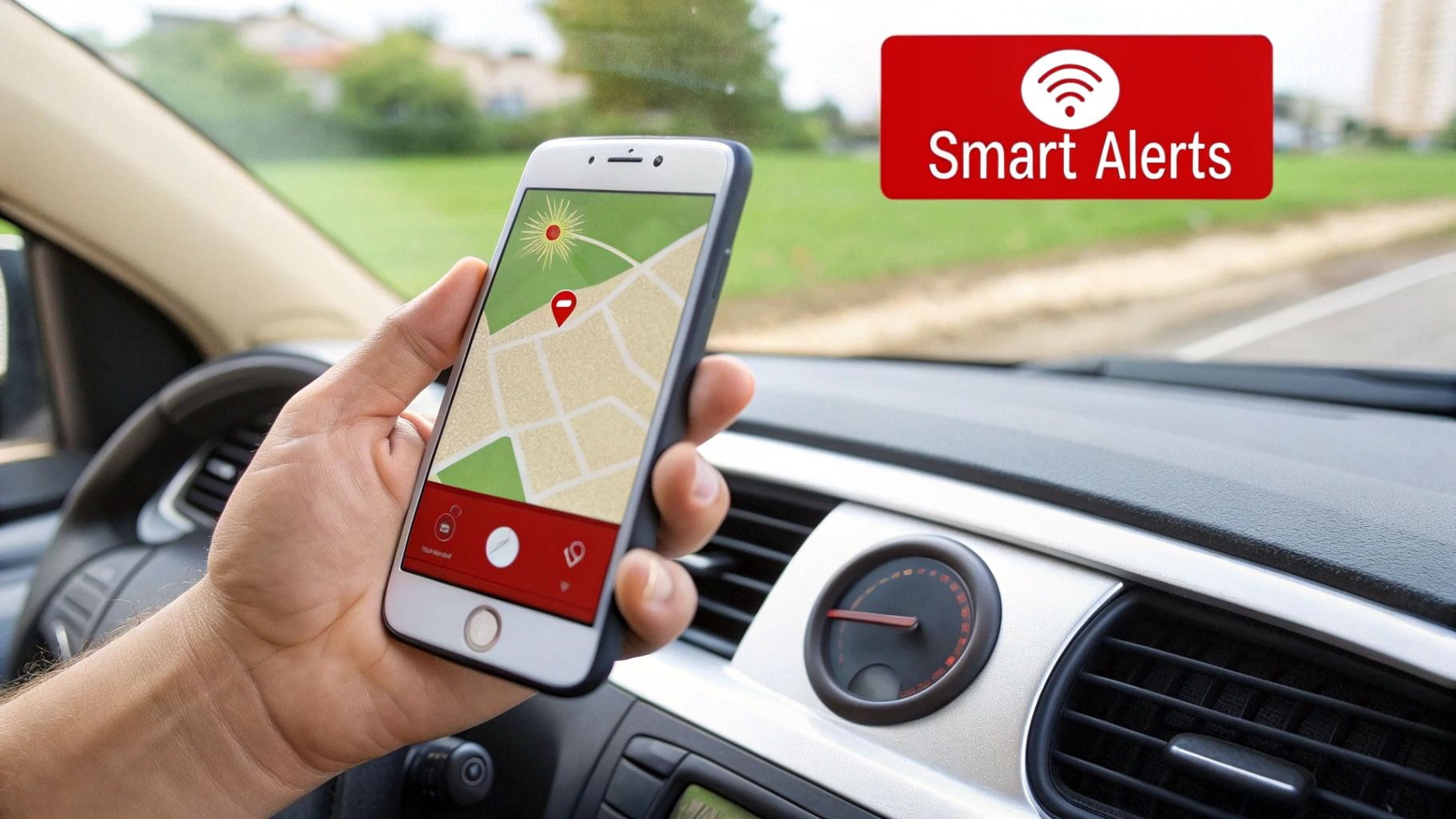
Geofencing: The Virtual Safety Net
One of the most powerful features available is geofencing. This allows you to draw virtual perimeters around any area you choose on a map. You can establish these digital boundaries around key locations like your home, office, or your child's school.
When your vehicle enters or leaves one of these pre-defined zones, you receive an instant notification on your phone. This has immense practical value in various situations:
- Theft Prevention: Receive an immediate alert if your car is moved from your driveway or a parking garage outside of normal hours.
- Teen Driver Monitoring: Confirm your new driver has arrived safely at their destination or be notified if they venture into unauthorized areas.
- Employee Accountability: Ensure a company vehicle remains within its designated service area during work hours.
This single feature transforms a simple map into an intelligent monitoring tool, delivering peace of mind without requiring constant app surveillance.
Immediate Alerts for Physical Threats
While geofencing monitors location, other sensors detect physical threats. Vibration detection, which utilizes the device's internal accelerometer, is a critical first line of defense. It is carefully calibrated to recognize suspicious movements that signal potential trouble.
A high-quality tracker can distinguish between a minor bump from a passing car and the distinct, sharp vibrations associated with a window break, a tire being stolen, or the initial jolt of a tow truck lifting the vehicle.
This means you receive an alert before a thief has a chance to drive away, which is crucial for stopping a theft in its tracks. Similarly, an engine start notification sends an alert the moment your car’s ignition is activated, providing another immediate warning against unauthorized use. These alerts work in tandem to provide a clear picture of events. To see how these features combine for ultimate protection, check out our guide on advanced car security measures.
Finally, features like harsh driving monitoring track aggressive behaviors such as rapid acceleration, hard braking, and sharp cornering. While often used for coaching teen drivers, this data can also indicate if a stolen vehicle is being driven recklessly, providing valuable information for law enforcement during a recovery effort. Each of these features adds another layer to your security, creating a powerful, interconnected system that keeps you in control.
Why You Need a Real Time Car Tracker
The high-tech features of a real time location tracker are impressive on paper, but their true value is realized in how they solve the actual problems car owners face. This is not just another gadget; it is a powerful tool for theft prevention, a co-pilot for coaching new drivers, and a smart asset for businesses with vehicle fleets. Let's examine how this technology provides genuine peace of mind in common situations.
Every year, vehicle theft results in significant financial losses and leaves owners feeling violated. According to the FBI, over 1 million vehicles were stolen in the U.S. in 2022, amounting to $8.9 billion in losses. This statistic underscores that vehicle theft is a persistent and costly problem. Investing in an effective security system is about reclaiming your sense of security.
From Hopeful Search to Precise Recovery
Imagine walking outside to an empty parking spot. The initial shock is quickly followed by a call to the police. After filing a report, a period of waiting begins. Without a tracker, vehicle recovery is largely a matter of chance—an officer happens to spot it, or it is found abandoned, often stripped of valuable components. This passive approach has a low probability of success.
Now, replay that scenario with a real time location tracker installed. The moment your car is moved without authorization, your phone receives an alert. You open an app and can see, right on the map, the exact location and direction of travel of your vehicle. The dynamic has completely shifted.
Instead of providing law enforcement with a vague "last seen here" location, you can give them a live, moving target. This type of actionable intelligence fundamentally changes the situation, dramatically increasing the odds of a rapid and successful recovery.
It is the difference between being a victim and being in control. You are no longer passively hoping for the best; you are an active participant in the recovery of your property.
Coaching Your Teen Driver with Confidence
Entrusting a newly licensed teenager with the car keys is a significant and often stressful milestone for parents. You want to grant them freedom and trust, but their inexperience is a constant source of concern. A real time car tracker provides a way to encourage safe driving habits without being physically present in the vehicle.
This is not about surveillance—it is about coaching. Imagine receiving a notification for "Harsh Braking" or "Rapid Acceleration." That data point serves as a perfect opportunity to initiate a conversation, not a confrontation.
- You can ask for context: "I saw an alert for hard braking on Oak Street around 3 PM. Is everything okay? Did someone cut you off?"
- It opens a dialogue about safety: This allows you to discuss real-world defensive driving techniques, such as maintaining a safe following distance or anticipating traffic light changes.
- It reinforces good behavior: The knowledge that their driving is being monitored often encourages teens to be more mindful and responsible, helping them build a foundation of safe habits that will last a lifetime.
These alerts provide objective data, transforming a general lecture about "driving safely" into a specific, teachable moment. It's a tool to help guide them toward becoming a skilled, confident driver.
Protecting Your Business Assets and Reputation
For a small business owner, a company vehicle is more than just transportation. It is a critical piece of equipment, a mobile advertisement for your brand, and a significant investment. A real time location tracker delivers the oversight needed to protect that asset and ensure team accountability.
Consider a landscaping company with a truck containing thousands of dollars worth of equipment. The owner needs to know that the truck is on its designated route, not being used for unauthorized purposes after hours, and is secure overnight.
With a tracker, the business owner can easily:
- Verify Routes and Schedules: A quick review of the location history confirms that drivers are adhering to the day's schedule and not taking inefficient detours.
- Monitor Unauthorized Use: Establish a geofence around a job site or the main office. You'll receive an instant alert if the vehicle leaves the area or is used outside of business hours.
- Protect Against Theft: Get immediate notifications if the vehicle—or the valuable equipment inside—is moved or tampered with, at any time of day or night.
This level of visibility helps ensure company resources are used appropriately, protects against potential misuse, and helps maintain a professional reputation by ensuring your team is where they need to be, when they need to be there.
How to Choose and Install Your Tracker
Selecting the right real time location tracker for your car can seem daunting, but it doesn't have to be. By focusing on a few key areas, you can easily identify a system that provides genuine security and peace of mind. Let's walk through how to choose the best device and complete the installation in minutes.
The demand for these trackers is growing rapidly. The global market for GPS tracking devices was valued at $1.78 billion in 2020 and is projected to reach $4.93 billion by 2028, with a compound annual growth rate (CAGR) of 13.6%. This is no longer a niche gadget; it is a mainstream tool for protecting personal and business assets. You can dig into the numbers yourself in this market report from Allied Market Research. This explosive growth means more choices, but it also makes it crucial to know what features truly matter.
Your Buyer's Checklist for the Right Tracker
When comparing different models, it's easy to get lost in technical specifications. The true value, however, lies not just in the hardware but in the overall user experience—the reliability of the connection, the clarity of the alerts, and the usability of the app. A powerful device is rendered ineffective if the app is difficult to navigate or alerts are delayed.
To help you cut through the noise, we have created a simple checklist of what to look for when choosing a real-time location tracker for your vehicle.
Real Time Location Tracker Buyer's Checklist
| Feature | Why It Matters | What to Look For |
|---|---|---|
| User-Friendly App | This is your command center. A clunky, confusing app will deter you from using it. | An intuitive design, clear maps, easy-to-access trip logs, and simple settings. |
| Reliable Cellular Link | Without a solid connection, alerts can be delayed or missed entirely, defeating the purpose of the device. | A tracker that uses major, reliable cellular networks to ensure you get notifications instantly. |
| Specific Security Alerts | Basic location pings are not enough. You need alerts that cover real-world threats. | Look for vibration detection, geofencing (virtual boundaries), and engine start notifications. |
| Transparent Fees | Most trackers require a data subscription. Hidden fees can negate the value of the device. | A clear, upfront subscription model with no surprise charges or long-term contracts. |
A system that integrates all these elements is what you should seek. CarLock, for example, designed its entire platform around these key features, which you can explore in their features and companion app.
Don't Worry, Installation Is a Breeze
If the prospect of installing a device in your car seems intimidating, you are not alone. Modern trackers have been engineered to eliminate this concern.
The most popular and user-friendly trackers are OBD-II port trackers. This port has been a mandatory standard on virtually all cars and light trucks manufactured in the United States since 1996, making this type of device compatible with the vast majority of vehicles on the road.
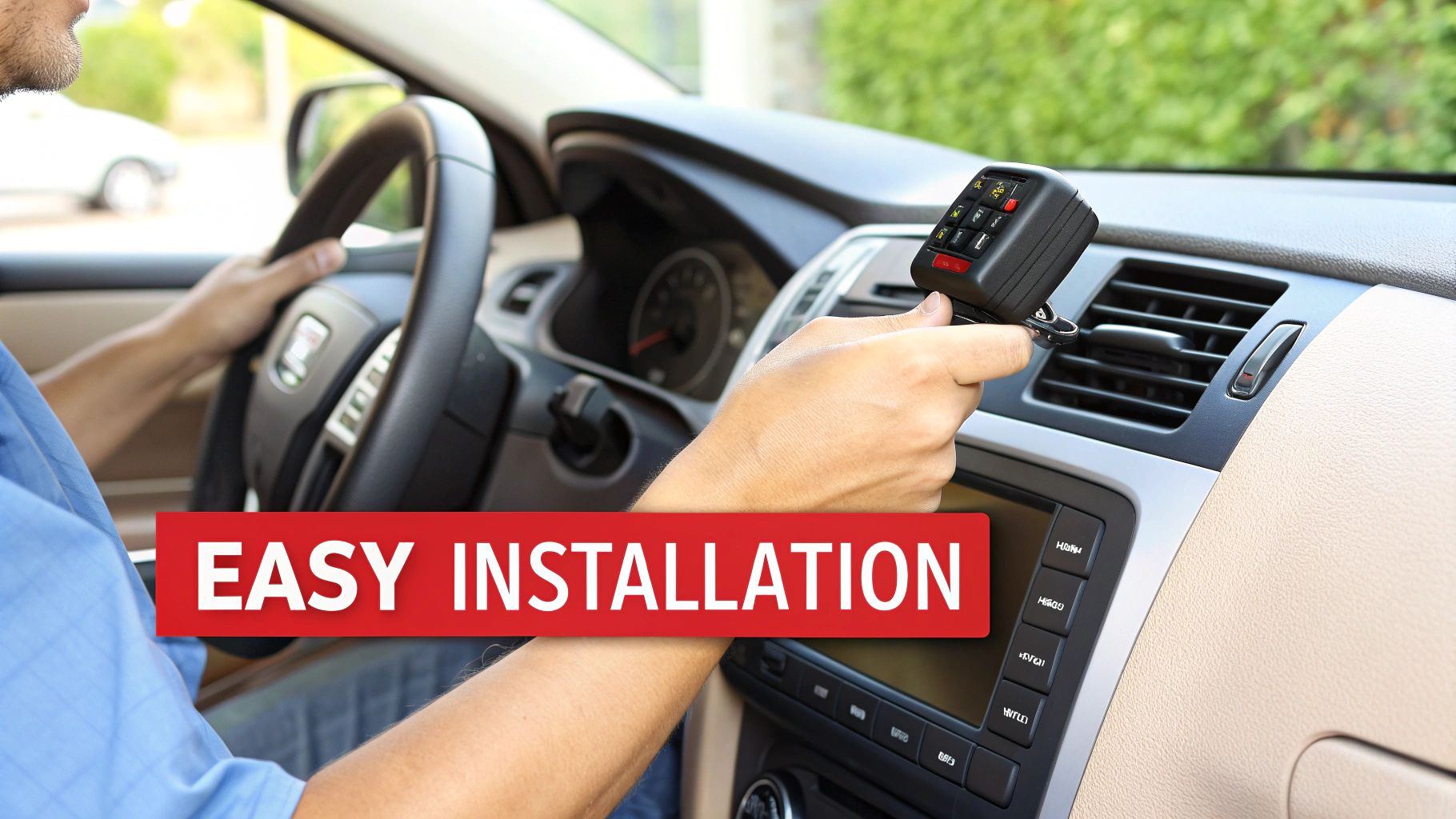
The On-Board Diagnostics (OBD-II) port is the same one your mechanic uses to diagnose engine codes. It is typically located under the dashboard on the driver's side. Utilizing this port makes the entire installation a simple plug-and-play process.
A Simple Plug-and-Play Setup
You do not need any tools or technical expertise. You can have your tracker installed and operational in less than a minute. It is one of the easiest and most effective security upgrades you can make to your vehicle.
Here is the simple three-step process:
- Find the Port: Locate the OBD-II port under your steering column.
- Plug It In: Insert the tracker firmly into the port until it clicks.
- Sync with the App: Open the tracker's app on your smartphone and follow the on-screen instructions to activate it.
That's it. In those few moments, you have equipped your car with a powerful, real-time security system. This effortless setup means anyone can add a serious layer of protection without the cost or hassle of professional installation.
Answering Your Top Questions About Car Trackers
Understanding the technology is one thing, but seeing how it integrates into your daily life is another. If you still have questions, you are not alone. We have compiled the most common inquiries from car owners, with direct answers to provide complete confidence.
From battery consumption to legal boundaries, every concern is valid. Let's address them head-on so you can see how a quality tracker is designed to be an invisible, reliable, and powerful guardian for your car.
Will a GPS Tracker Drain My Car Battery?
This is a primary concern for many users. A well-designed real time location tracker is engineered for minimal power consumption. When your vehicle is parked, the tracker enters a low-power sleep mode, drawing a negligible amount of energy—often less than the vehicle's own onboard computer systems.
A healthy car battery will not be noticeably affected. In fact, advanced systems like CarLock can help protect your battery. They actively monitor your car's voltage and will send you an alert if the battery level is running low, providing a warning long before you risk being stranded.
Is It Legal to Use a Real Time Location Tracker?
Yes. It is 100% legal to install a tracking device in a vehicle that you own. As the owner of the property, you have the right to protect it from theft, monitor its use by family members, or manage your business fleet.
Legal issues only arise when a tracker is placed on a vehicle without the owner's knowledge or consent. For protecting your own assets and family, you are completely within your legal rights.
How Accurate Is the Location Data?
Modern GPS technology is remarkably precise. A quality tracker can pinpoint your vehicle's location to within 5 to 10 meters (approximately 16 to 32 feet). This level of accuracy is more than sufficient to find your car on a specific street, identify it in a large parking lot, or locate it within a multi-level parking garage.
The best trackers don't just rely on one satellite system. They pull data from multiple constellations. So, if the signal gets weak between tall buildings or in a dense forest, the device uses cellular tower data as a backup to give you a reliable location no matter what.
This multi-layered approach ensures you always receive the most accurate information possible, especially when it matters most. For a closer look at other common concerns, check out these frequently asked questions about GPS trackers.
What Happens if the Tracker Loses Its Signal?
This is a key differentiator between a basic gadget and a professional security tool. If your vehicle enters an area with no cellular service—such as a remote rural area or a deep underground parking structure—a high-quality tracker does not cease to function.
It continues to record its GPS location points and stores them in its internal memory. As soon as the vehicle re-enters an area with cellular connectivity, the tracker automatically uploads all the stored data. This ensures you have a complete, uninterrupted history of every trip, with no blind spots or missing information.
Ready to give your vehicle the ultimate protection it deserves? The CarLock system provides all the advanced features discussed here—from instant security alerts to detailed trip tracking—in one simple, plug-and-play device. Secure your peace of mind today by visiting https://www.carlock.co.