


Driver’s Desk
A Complete Guide to Fleet GPS Trackers for Your Business
Managing a vehicle fleet without real-time tracking is like navigating a ship in a storm with no instruments. In an economic climate defined by tight margins, volatile fuel costs, and ever-present security risks, relying on guesswork is a direct route to inefficiency and loss.
This is where fleet GPS trackers become an indispensable technology. They are no longer just a dot on a map; they are the central nervous system of a modern, data-driven fleet operation, providing the intelligence needed to optimize every aspect of your mobile assets.
Why Modern Fleets Run on GPS Technology
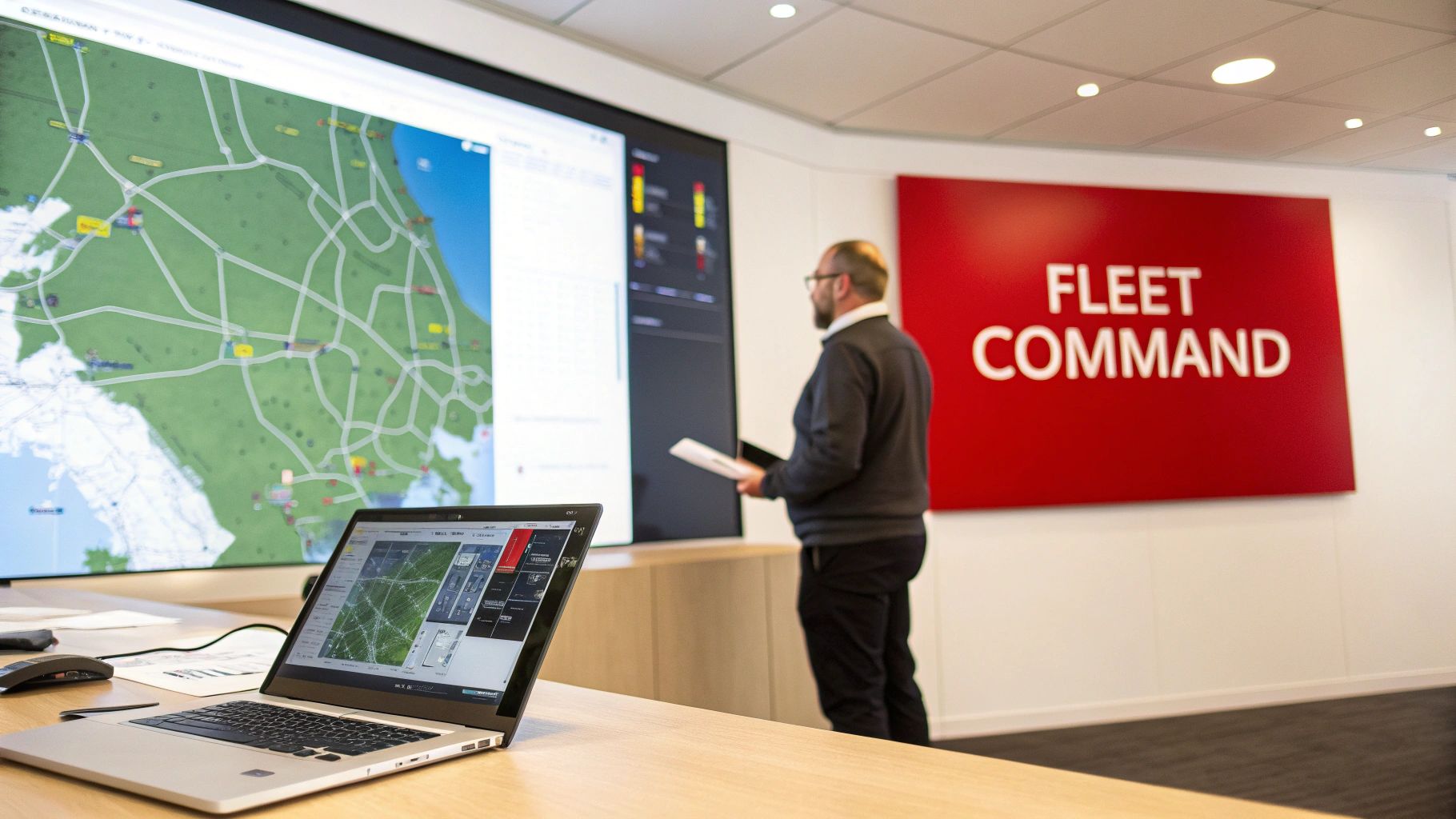
Attempting to manage vehicles without real-time data is a significant operational handicap. You might have a daily plan, but you lack the agility to react to traffic, avoid delays, or confirm you're on the most cost-effective path. Today, efficient fleet management isn't just about getting from point A to B; it's about optimizing every single mile and minute along the way.
Fleet GPS trackers provide the constant stream of location, performance, and security data required to transform a reactive, often chaotic, process into a proactive, data-driven strategy. They are the instruments that provide total situational awareness and control from your central dashboard.
The Shift from Guesswork to Certainty
Not long ago, managing a fleet was a constant cycle of phone calls, paper logs, and hoping for the best. A manager had no concrete way to verify if a driver took an inefficient route, used a work vehicle for a personal errand, or left the engine running for an hour during a 15-minute stop. These operational blind spots were costing businesses a fortune in wasted fuel, lost productivity, and unnecessary wear and tear.
GPS technology eliminates these blind spots. It provides a direct, real-time view into your daily operations, delivering hard data on critical questions:
- Asset Location: Where is every vehicle at this exact moment?
- Operational Status: Is a vehicle en route, parked, or idling and wasting fuel?
- Security Posture: Is a vehicle being moved without authorization or tampered with?
This transition from uncertainty to clarity empowers you to make smarter, faster decisions that directly impact the bottom line. It's the difference between hoping your assets are safe and knowing they are. This is a core part of building total awareness around your valuable vehicles, which you can learn more about at https://www.carlock.co/gps-car-tracker/awareness.
At its core, a GPS tracking system converts raw location data into business intelligence. It’s the tool that answers critical questions: "Where are my assets?" "How are they being used?" and "How can I make my operations more profitable?"
A Growing Market Driven by Necessity
The rapid adoption of GPS trackers isn't a fleeting trend—it's a direct response to the economic realities of modern business. Valued at USD 3.60 billion in 2025, the global GPS tracking device market is projected to reach an impressive USD 14.78 billion by 2035, growing at a compound annual growth rate (CAGR) of 15.17%.
What’s fueling this expansion? The undeniable need for greater efficiency in logistics, rising demands for better vehicle and asset security, and the proven ROI the technology delivers. For today’s businesses, fleet telematics has evolved from a "nice-to-have" luxury to an operational necessity.
Understanding The Core Features Of Fleet GPS Trackers
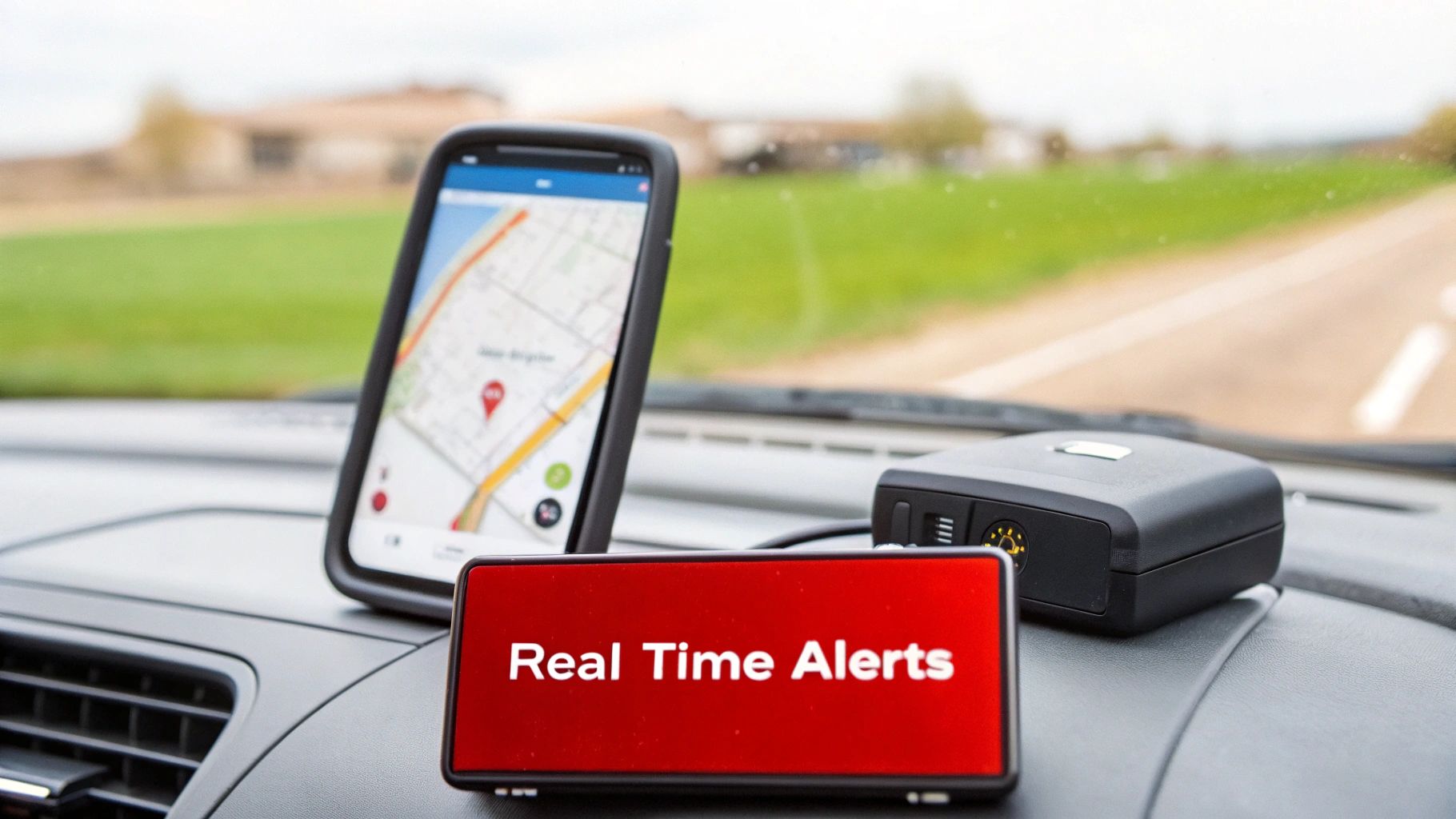
To fully appreciate the value of these devices, you must look beyond the "GPS" acronym. Modern fleet GPS trackers are sophisticated sensor hubs designed to boost security, streamline operations, and enhance accountability. Each feature serves a specific purpose, and together, they create a powerful management and security network for your entire fleet.
Let's dissect the features that deliver the most significant impact, exploring how they transform raw data points into intelligent decisions that protect your vehicles and your profits.
Real-Time Location Tracking
This is the foundational capability of any GPS tracker. It provides a live, up-to-the-second view of every vehicle's position on a digital map. Think of it as a private air traffic control system for your fleet, giving you complete visibility without requiring a single phone call.
But knowing a vehicle's location is just the beginning. This feature enables dynamic dispatching of the closest driver to a new job, allows you to provide customers with highly accurate ETAs, and offers instant verification that your team is on-site as scheduled. It’s the first and most crucial step toward gaining complete control over your daily operations.
Geofencing Virtual Perimeters
This is where GPS technology becomes truly proactive. Geofencing allows you to draw virtual boundaries around real-world locations on a map. You can create geofences around a job site, your main depot, a restricted zone, or a customer’s warehouse.
The moment a vehicle crosses one of these invisible lines—either entering or leaving—you receive an instant alert on your smartphone or computer. This functionality is a game-changer for several reasons:
- Confirming Arrivals: Automatically log when a truck arrives at a delivery point, creating an accurate, indisputable timestamp and eliminating manual check-ins.
- Preventing Unauthorized Use: Receive an immediate notification if a company van leaves the depot after hours, stopping misuse before it becomes a liability.
- Boosting Efficiency: Analyze exactly how long vehicles spend at each stop to identify and address operational bottlenecks.
Geofencing is like setting up a digital tripwire for your fleet. It doesn't just show you where a vehicle was; it actively tells you the second it crosses a critical boundary, turning a passive map into an active security tool.
To help you connect these features to real-world results, here’s a quick breakdown of how they translate into tangible business benefits.
Table: Key Features of Fleet GPS Trackers and Their Business Impact
| Feature | Description | Primary Business Benefit |
|---|---|---|
| Real-Time Tracking | Provides a live, continuous feed of each vehicle's location on a map. | Improved Dispatching & Customer Service |
| Geofencing | Creates virtual boundaries on a map that trigger alerts when crossed. | Enhanced Security & Operational Accountability |
| Engine Start Alerts | Sends an immediate notification when a vehicle's ignition is turned on. | Theft Prevention & Unauthorized Use Monitoring |
| Vibration Detection | Senses unusual vibrations (e.g., a window breaking or power tools) and sends an alert. | Early Warning of Break-Ins & Vandalism |
| Device Disconnect | Notifies you if the tracking device is unplugged or tampered with. | Anti-Tampering Security & Asset Protection |
| Driver Behavior | Monitors actions like harsh braking, rapid acceleration, and sharp cornering. | Reduced Fuel Costs, Wear & Tear, and Improved Safety |
| Maintenance Alerts | Tracks mileage or engine hours to send reminders for scheduled service. | Proactive Maintenance & Increased Vehicle Lifespan |
As you can see, each feature is designed not just to track, but to actively protect and optimize your fleet operations.
Critical Security and Tamper Alerts
For any business with vehicles on the road, security is non-negotiable. A stolen truck isn't just a missing asset; it represents a cascade of problems including lost revenue, canceled jobs, and skyrocketing insurance premiums. An advanced fleet GPS tracker acts as your 24/7 digital security guard, armed with intelligent sensors to detect threats in real time.
These are not your typical car alarms that merely create noise. They are intelligent alerts sent directly to you. The most vital ones include:
- Engine Start Alerts: Get an instant notification the moment an engine is started, which is crucial for monitoring vehicles after hours or in unsecured locations.
- Vibration Detection: The system can detect suspicious vibrations—like a window being smashed or a catalytic converter being sawed off—even before a full break-in occurs.
- Device Disconnected: If a thief finds the tracker and attempts to remove it, you'll know instantly, allowing for immediate action.
This type of system provides the critical head start needed to thwart a theft. By the time a standard car alarm sounds, the vehicle may already be gone. Smart alerts notify you of a threat the moment it begins. You can see how these security functions work in detail by checking out the specific CarLock device features.
Together, these core features—live tracking, geofencing, and smart security alerts—form the foundation of any robust fleet management system. They work in tandem to give you a complete, real-time picture of your fleet's activity, safety, and performance.
How GPS Tracking Actually Grows Your Business
Understanding a GPS tracker's features is one thing, but connecting those capabilities to tangible financial returns is what truly matters. These devices are not just for observation; they are powerful tools that convert raw data into higher profits, tighter security, and longer-lasting vehicles. The real value emerges when you see how a simple location ping or a maintenance alert directly improves your bottom line.
This impact is concentrated in four critical areas of improvement. Each one draws a direct line from a tracker's function to a significant financial or operational benefit, transforming your fleet from a cost center into a strategic asset.
Bolstering Asset Security and Preventing Theft
Your vehicles are among your company's most valuable assets. Protecting them is not just about avoiding replacement costs—it's about preventing the operational chaos that a theft causes. A single stolen truck can mean cancelled jobs, lost income, and irreparable damage to your company's reputation.
Fleet GPS trackers provide a powerful, multi-layered defense. You get instant alerts for unauthorized engine starts or vehicle movements outside of work hours. These act as an early warning system, often providing the opportunity to stop a theft in progress. And if a vehicle is stolen? Real-time tracking gives law enforcement the precise location data needed for a swift recovery. According to industry reports, fleets using GPS tracking often see their stolen asset recovery rate jump to over 90%.
Think of it this way: a standard car alarm just tells you a theft has already happened. A smart GPS tracker alerts you the second something suspicious starts, buying you precious time to step in and prevent the loss altogether.
This proactive security posture completely changes how you manage risk for your fleet.
Driving Down Operational Costs
For any business with a fleet, fuel and labor are consistently the two largest operational expenses. Without accurate data, controlling these costs is purely guesswork. Fleet GPS trackers provide the clarity needed to identify and eliminate financial leaks you didn't even know existed.
The most immediate savings typically come from smarter routing and fuel management. By analyzing historical trip data, you can identify more efficient routes that reduce both mileage and fuel consumption. According to the American Transportation Research Institute, just reducing daily idle time by 5 minutes per vehicle can save a company hundreds of dollars in fuel per vehicle each year.
Here’s where the savings are generated:
- Less Fuel Waste: Identify and correct expensive habits like excessive idling, aggressive acceleration, and speeding, which can increase fuel consumption by 15-30%.
- Accurate Billing: Provide irrefutable proof of service, showing exactly how long your crew was on-site. This eliminates billing disputes and ensures you are compensated for every minute of work.
- No More Unauthorized Use: With geofencing and after-hours alerts, you can guarantee company vehicles are used exclusively for company business, cutting down on personal trips that add mileage and liability.
By digging into your fleet's travel data, you can get a much clearer picture of how to make every single trip more cost-effective. You can learn more about how to unlock these savings by analyzing your fleet's route history.
Promoting Safer Driving and Reducing Liability
Your team's driving behavior directly impacts your company's finances and public image. Accidents lead to costly repairs, higher insurance premiums, and potential legal liabilities. Monitoring driving habits isn't about surveillance; it's about fostering a culture of safety that protects your employees, your assets, and the public.
Modern GPS trackers can flag key high-risk driving events, including:
- Harsh braking
- Rapid acceleration
- Sharp, high-speed cornering
- Speeding violations
This data allows you to identify at-risk drivers and provide targeted coaching before an accident happens. This proactive safety management also yields financial benefits with your insurance provider. Many insurers offer significant premium discounts—sometimes up to 15% or more—to fleets that can demonstrate they use telematics data to actively monitor and improve driver safety.
Enabling Proactive Vehicle Maintenance
Nothing disrupts productivity like unexpected vehicle downtime. A truck in the repair shop is not just an expense; it's a non-earning asset that can derail schedules and disappoint customers. GPS trackers help you transition from a reactive repair model to a proactive maintenance strategy.
By tracking actual mileage and engine hours, you can automate alerts for routine services like oil changes, tire rotations, and safety inspections. This data-driven approach ensures maintenance is performed precisely when needed, not just based on a generic calendar. The result is reduced premature wear and tear, an extended vehicle lifespan, and a dramatic decrease in the likelihood of costly roadside breakdowns.
Calculating the ROI of Your GPS Tracking System
Any new technology is an investment, and before you commit, you need a clear answer to one simple question: "Is it worth it?"
With fleet GPS trackers, that answer becomes crystal clear when you weigh the upfront costs against the powerful, recurring savings. Calculating your return on investment (ROI) isn't a complex accounting exercise. It’s about using real-world numbers to see how quickly the system pays for itself and starts generating a positive return for your business.
The formula is simple. On one side, you have your costs—the price of the hardware and any monthly subscription fees. On the other, you have the tangible savings the technology creates. When the cumulative savings exceed the costs, your ROI is positive.
Quantifying Your Savings
The financial benefits of a GPS tracking system are not abstract concepts; they are measurable improvements that appear directly on your balance sheet. The key is to pinpoint where you’ll see the biggest impact and assign a realistic dollar value.
Here are the primary areas where savings accumulate:
- Fuel Cost Reduction: This is often the largest and most immediate win. By optimizing routes, eliminating unauthorized vehicle use, and curbing excessive idling, fleets frequently reduce their fuel consumption by up to 15%.
- Lower Insurance Premiums: Many insurance providers offer discounts for vehicles equipped with anti-theft and driver monitoring technology. Documented use of such a system can lead to a significant reduction in annual premiums.
- Optimized Labor Hours: With automated time tracking and accurate location data, you ensure you are paying for productive work, not wasted time. This eliminates timecard padding and allows you to bill clients with pinpoint accuracy.
- Theft Prevention: The cost of a single stolen vehicle is substantial, encompassing replacement costs, operational downtime, and lost revenue. Preventing just one theft can easily pay for your entire tracking system for several years.
This chart illustrates the key areas where GPS tracking drives business growth and delivers a solid return.
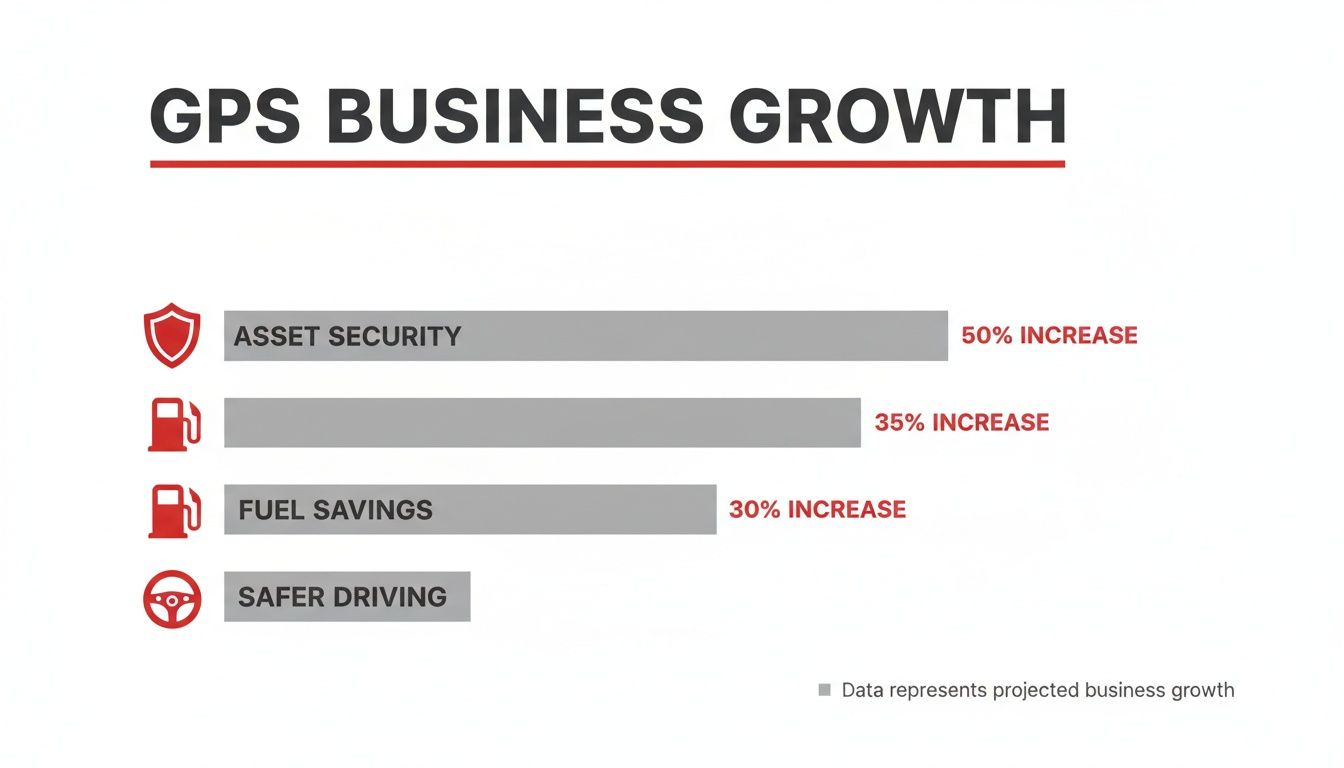
As the data shows, the benefits are multi-faceted, spread across security, direct operational savings, and the creation of a safer, more accountable driving culture.
A Small Fleet ROI Example
Let's analyze the numbers for a hypothetical small service company with a fleet of five vans.
Monthly Costs:
- Hardware (amortized) + Subscription: 5 vehicles x $25/month = $125 total monthly cost
Monthly Savings:
- Fuel Savings: Each van drives 1,500 miles/month. A 15% reduction in fuel use saves approximately $50 per vehicle. Total: $250.
- Labor Optimization: Eliminating just 30 minutes of wasted time (unauthorized stops, extended breaks, idling) per driver each day saves roughly $75 per vehicle per month. Total: $375.
- Insurance Discount: A 10% discount on a $150/month premium saves $15 per vehicle. Total: $75.
In this scenario, the total monthly savings amount to $700. After subtracting the system's $125 monthly cost, the fleet realizes a net profit of $575 per month. That translates to $6,900 annually. The ROI is not only immediate but also substantial.
This calculation doesn't even factor in the significant financial upside of proactive maintenance. By monitoring mileage and usage, you can prevent expensive breakdowns and keep your vehicles operating efficiently. You can learn more about how to do that by understanding your vehicle's health data. This is another powerful way these systems boost your bottom line.
A Practical Guide to Implementing Fleet Trackers

Deploying a new system can seem daunting, but implementing fleet GPS trackers is a straightforward process if approached methodically. The key to success isn't just plugging in a device; it's about selecting the right hardware and software for your specific needs and ensuring your entire team is aligned with the new program.
A well-planned rollout ensures you begin realizing the benefits of your investment immediately. This guide will walk you through the entire process, from hardware selection to driver onboarding, to make the transition as smooth as possible.
Selecting the Right Hardware and Software
The first step is choosing the physical tracker that best suits your fleet's operational requirements. The decision typically comes down to two main types, each with distinct advantages.
- Plug-and-Play (OBD-II) Trackers: These offer the simplest installation. Devices like CarLock plug directly into the On-Board Diagnostics (OBD-II) port, which has been a standard feature in nearly every vehicle manufactured since 1996. Installation takes seconds, requires no tools, and can be done by any driver.
- Hardwired Trackers: These units are wired directly into the vehicle's electrical system by a professional installer. This method results in a more permanent and covert installation, making it nearly impossible for a driver or thief to locate and tamper with the device.
For most fleets, OBD-II trackers provide an ideal balance of powerful features and effortless deployment. Once you have selected your hardware, you will need the corresponding software and data plan. Look for a user-friendly mobile application and a plan that offers unlimited data for a flat fee to avoid unexpected charges from frequent location updates or alerts.
Installation and Team Onboarding
With your hardware in hand, the physical installation can begin. However, bringing your team into the loop is just as critical. A thoughtful onboarding process is essential for gaining buy-in and ensuring the system is used effectively.
For OBD-II trackers, installation is as simple as locating the port (typically under the steering wheel) and plugging in the device. For hardwired units, schedule appointments with a professional installer to minimize vehicle downtime.
Simultaneously, you must communicate with your drivers. Transparency is paramount. Clearly explain why the company is adopting this technology, focusing on the benefits for everyone involved.
A common mistake is introducing tracking technology without explanation, which immediately fosters distrust. Frame the system as a tool for enhancing safety, security, and efficiency that supports the entire team—not as a surveillance device.
Demonstrate how it protects their company vehicle from theft, provides indisputable proof of service for customers, and can even help exonerate them in the event of an accident or false claim.
Establishing a Clear Usage Policy
Before activating the system, create a formal vehicle tracking policy and distribute a copy to every driver. This document eliminates ambiguity and sets clear expectations for all parties.
A comprehensive policy should cover:
- Purpose of Tracking: Clearly state that the system's purpose is to enhance safety, protect company assets, improve operational efficiency, and ensure accurate billing—not to micromanage employees.
- Data Collection: Be explicit about the data being collected (e.g., location, speed, harsh braking, engine status) and when it is being collected (e.g., only during designated work hours).
- Privacy Considerations: Address privacy concerns directly. Reassure drivers that their personal time and any authorized off-hours vehicle use will be respected in accordance with company rules.
- Benefits to the Employee: Reiterate the positive impacts. Remind them that the system contributes to their safety, protects them from false accusations, and enables smarter dispatching that can streamline their workday.
By proactively addressing potential issues and emphasizing the shared benefits, you create an environment where fleet GPS trackers are viewed as a valuable tool for the entire organization. This approach builds trust, ensures compliance, and secures cooperation from your most important assets—your drivers.
Navigating Employee Privacy and Legal Compliance
Implementing fleet GPS trackers offers significant operational advantages, but it also introduces legal and ethical responsibilities. The key is to balance the company's legitimate business interests—such as asset security and operational efficiency—with employees' right to privacy. A misstep in this area can lead to decreased morale, legal complications, and a severe erosion of trust.
Fortunately, it is possible to build a program that is effective, legal, and respectful. This is achieved through a commitment to transparency. The goal is not surveillance, but rather the creation of a safer, more accountable work environment for everyone. Your responsibility is to be crystal clear from the outset about why and how this technology is being used.
Establishing a Transparent Vehicle Tracking Policy
A clear, written policy is not just a recommendation; it is the cornerstone of your entire tracking program. This document must be provided to every employee before a single device is activated. It serves as the official playbook, eliminating gray areas and ensuring all stakeholders are on the same page. A robust policy is your best defense against future misunderstandings and disputes.
Your policy should articulate the following in plain language:
- Purpose: Be upfront about the reasons for tracking. State clearly if the focus is on improving driver safety, preventing theft, optimizing routes, or verifying service calls.
- Data Collected: Itemize exactly what information is being gathered. This typically includes vehicle location, speed, mileage, engine on/off status, and harsh driving events.
- Data Usage: Explain how the collected data will be used. For example, for dispatching the nearest driver, scheduling maintenance, investigating an accident, or providing driver feedback and coaching.
- Hours of Operation: Specify whether tracking is active 24/7 or only during work hours. This is a critical detail, especially if employees are permitted to take company vehicles home.
A well-crafted policy transforms tracking from a source of anxiety into a mutually beneficial tool. When drivers understand the "why" behind the technology—safety, security, and fairness—they are far more likely to embrace it as a positive part of their job.
Adhering to Key Regulations
Beyond internal policies, your program must comply with external regulations. In the United States, a major consideration is the ELD (Electronic Logging Device) mandate, which requires most commercial drivers to electronically log their Hours of Service (HOS). Many modern telematics systems integrate this functionality, streamlining compliance and eliminating paper logs.
When collecting data from fleet GPS trackers, you must also consider the broader legal landscape of data privacy. This includes understanding principles outlined in regulations and best practices, such as those related to Data Protection Officer Responsibilities. You can review how seriously we approach this by reading the CarLock privacy policy.
Ultimately, a steadfast commitment to legal and ethical standards protects everyone involved: your business, your assets, and your employees.
Got Questions About Fleet GPS Trackers? Let's Clear Things Up.
Adopting new technology into your operations naturally raises questions. When it comes to GPS trackers, fleet managers are typically concerned with the practical, day-to-day aspects: installation complexity, data consumption, and operational reliability in remote areas.
Let's address the most common questions directly to provide the clarity you need to make an informed decision for your business.
Are These Things a Pain to Install?
The ease of installation largely depends on the type of device you choose. Fortunately, most modern trackers are designed for user-friendliness.
- Plug-and-Play (OBD-II): This is the simplest option. A device like CarLock plugs directly into your vehicle's OBD-II port. If your vehicle was manufactured after 1996, it has one. The entire process takes seconds and requires no tools.
- Hardwired Units: These are intended for a more permanent, covert installation. A technician wires the tracker directly into the vehicle's electrical system. While it requires a professional upfront, it is the most secure option against tampering.
For most businesses, OBD-II trackers offer the ideal combination of powerful features and hassle-free setup.
How Much Data Do GPS Trackers Chew Through?
This is a frequent concern, but the data consumption is surprisingly low. These devices are engineered for efficiency.
A typical fleet GPS tracker uses only about 5-20 MB of data per month. For context, that is less than streaming a few minutes of music. The exact usage depends on the frequency of location reporting and the number of alerts generated. To simplify budgeting, most reputable providers bundle the data cost into a flat-rate subscription fee, ensuring a predictable bill with no surprises.
The technology is designed to be lean. Think of it like sending a quick text message versus streaming a movie. Each location ping is just a tiny blip of data, which keeps costs down and ensures everything runs smoothly.
Can a Driver Just Unplug or Disable a Tracker?
This is a valid concern, but security features are built into these systems to prevent covert tampering. While an OBD-II device can be physically removed, it cannot be done without detection.
For instance, the moment a CarLock device is disconnected from the port, it triggers a "device disconnected" alert that is sent directly to the fleet manager's phone. You will be notified immediately. Hardwired trackers are even more difficult to interfere with, as they are concealed within the vehicle's dashboard wiring. Locating and disabling one would require significant time and effort.
What Happens in Areas With Bad Cell Service?
They continue to function. Professional-grade trackers are designed for real-world conditions, including areas with intermittent cellular coverage. They feature internal memory that stores all location data when the vehicle is offline.
As soon as the vehicle re-enters an area with a cellular signal, the tracker uploads all the stored data to the server. This "store-and-forward" capability ensures you receive a complete, uninterrupted record of the entire trip. There are no gaps and no missing data—just the full history of your vehicle's journey.
Ready to get a handle on your fleet with a system that just works? CarLock offers that perfect mix of easy installation, powerful security alerts, and a simple app that puts you in total control. It's time to protect your assets, cut your costs, and finally get some peace of mind.
See for yourself how CarLock can make a difference in your fleet management by visiting https://www.carlock.co.