

Driver’s Desk
Your 2026 Guide to Buying a Cheap Car Tracker
When you're looking for peace of mind on a budget, a cheap car tracker can seem like the perfect solution. But it's vital to understand the technical and security trade-offs. The difference between a basic tracker and a comprehensive security system is substantial—one passively records location, while the other actively monitors for threats and provides immediate alerts.
What Does a Cheap Car Tracker Really Protect?
With vehicle theft statistics remaining a persistent concern for car owners, many are seeking affordable methods to secure their assets. A cheap tracker's low initial price is tempting, promising a layer of security that feels superior to having no protection at all. But is this basic protection sufficient when your vehicle is at risk?
In reality, the effectiveness is limited. A budget tracker provides a fundamental starting point by offering location data in the event of theft. However, this is often where its utility ends and its significant limitations become apparent.
This demand for vehicle monitoring has driven explosive growth in the market. The global GPS tracker market is expanding rapidly, with projections from Data Insights showing it will reach $23.54 billion by 2025. This growth signifies a broader trend: a consumer shift from traditional, passive car alarms toward proactive, real-time tracking solutions.
Comparing Basic and Advanced Systems
The fundamental difference between a cheap tracker and a proper security system lies in their operational approach: one is passive, the other is active. A basic tracker might report your car's location from five minutes ago. An advanced system alerts you the instant a security event occurs.
Let’s analyze what this means in practical terms:
- Security Alerts: Most budget trackers are silent. They lack the sensors and software to notify you if a tow truck is moving your vehicle, if the engine starts without authorization, or if a thief simply unplugs the device.
- Update Frequency: To conserve data and battery, a cheap device might only update its location every 5, 10, or even 30 minutes. During a theft, a vehicle can travel miles in that time, rendering the delayed data far less actionable.
- Reliability: The axiom "you get what you pay for" is highly relevant here. Low-cost hardware often translates to inconsistent performance, dropped cellular signals, and inaccurate location data precisely when it is most needed.
A cheap tracker provides a single piece of the puzzle—historical location. A true car security system delivers a complete, real-time intelligence overview, including instant security alerts, driver behavior analysis, and a direct communication link to your vehicle's status.
To provide a clear comparison, the table below contrasts the typical features of a budget device against a more comprehensive system. This side-by-side analysis is the first step in determining the level of security your vehicle truly requires. For a deeper dive into the architecture of modern systems, you can explore what complete car security entails.
Cheap Tracker vs Advanced System at a Glance
| Feature | Typical Cheap Car Tracker | Advanced System (e.g., CarLock) |
|---|---|---|
| Primary Function | Basic, passive location pinging | Real-time, active security monitoring |
| Security Alerts | None or very limited | Vibration, engine start, disconnect alerts |
| Location Updates | Infrequent (e.g., 5-30 mins) | Frequent (e.g., every 30 seconds while driving) |
| Installation Type | Often requires separate SIM card & data plan | All-in-one device, simple plug-in or hardwire |
| App Functionality | Basic map view only | Detailed trip history, driver scoring, multi-car management |
That low upfront price on a budget car tracker is often a marketing tactic, not a reflection of the total cost of ownership. The number on the box is merely the initial hardware expense. The true cost is frequently obscured by ongoing operational expenses that can make a "bargain" tracker surprisingly expensive over its lifespan.
A helpful analogy is a mobile phone. The device purchase is separate from the monthly service plan required for calls, texts, and data. A GPS tracker operates on the same principle. To transmit its location from the vehicle to an application on your phone, it requires a cellular connection, and that connection invariably comes with a recurring cost.
The Inescapable SIM Card and Data Plan
At its technical core, every GPS tracker is a small cellular device. It determines its coordinates using the Global Positioning System (GPS) and then utilizes a cellular network (like 4G/LTE) to transmit that data. This process necessitates a SIM card and a corresponding data plan—the most common hidden cost consumers encounter.
Providers typically handle this in one of two ways:
- Bring Your Own SIM (BYOS): Many of the cheapest trackers are sold as hardware only. This model places the burden on the consumer to source a compatible SIM card, select a data plan, and manage another monthly bill. This can be complex, involving compatibility checks and data usage estimates.
- Integrated SIM: A more user-friendly approach is a tracker with a pre-installed, integrated SIM card. With these systems, the service fee bundles the hardware, software access, and cellular data into a single, predictable subscription. While the initial or monthly cost may appear higher, it eliminates significant logistical complexity.
Identifying which model a cheap tracker uses is critical for calculating its true cost. A device that costs only $20 upfront but requires a separate $10-$15 monthly data plan will cost you far more over a year than initially anticipated.
Subscription Fees and Other Sneaky Charges
Beyond the data plan, many budget trackers have additional recurring fees that are not prominently advertised. The mobile app used to view your car’s location may be free to download, but unlocking its core functionality often requires a separate subscription payment.
The term "free app" is often a misnomer. The real work is performed by the cloud platform that processes, stores, and delivers your vehicle's location data. Access to this essential back-end service is almost never free. You must verify if the price includes the tracking platform or if that represents another monthly expense.
To gain a complete financial picture, you must identify all potential costs. Here is a checklist of other expenses to investigate before purchasing a cheap tracker:
- App Subscription Fees: Is there a monthly or annual fee required to access the software and view your car's location?
- Installation Costs: For hardwired trackers, professional installation is often recommended. This service can range from $50 to $150 or more, depending on vehicle complexity and labor rates.
- Battery Replacements: For portable, battery-powered models, the batteries have a finite lifespan. Research the cost and expected life of replacements and factor that into your long-term budget.
- Early Termination Fees: Some services lock users into long-term contracts. If the device proves unreliable and you wish to cancel, you could face a substantial penalty. Always review the terms of service.
By summing the device price, data plan, subscriptions, and other potential charges, you can calculate the true total cost of ownership. This is the only way to make a fair comparison and avoid the financial surprise that occurs when a "cheap" tracker proves to be anything but. To understand what these subscriptions power, you can learn more about how a robust cloud platform serves as the backbone of a modern security system.
The Hidden Dangers of a Cheap Car Tracker
While the low price of a budget GPS tracker is appealing, it's critical to understand the compromises made to achieve it. Often, the very features that are most effective in a real-world theft scenario are the first to be eliminated. In the context of vehicle security, these limitations are not minor inconveniences—they can render the tracker ineffective when it is needed most.
The most significant issue is the slow location update frequency of these devices. To minimize battery consumption and data costs, many budget models only transmit their position every five, ten, or even thirty minutes.
Consider the implications of this delay. In the time it takes for a cheap tracker to send a single update, a professional thief can have your vehicle miles away, concealed inside a garage, or loaded onto a flatbed truck. You are left attempting to track a target with outdated, historical data.
Why Slow Updates Are a Dealbreaker
Imagine you check your app and see your car’s location from 10 minutes ago on a major highway. By the time the next update arrives, the vehicle could be on a different route entirely or already parked inside a shipping container. You are not tracking a vehicle in real-time; you are following a cold, unreliable trail.
In a genuine theft scenario, real-time data is paramount. A delay of just a few minutes can be the difference between successful vehicle recovery and a total loss. The goal is to follow a moving target, not to guess its past movements.
This is not an accidental flaw but a deliberate design trade-off. Faster, more frequent updates require superior hardware and consume more cellular data—both of which are stripped from budget models to meet a low price point. While slow tracking may be adequate for non-critical monitoring, it represents a critical failure for theft recovery.
The Missing Alerts That Leave You Vulnerable
Even more concerning is what these cheap trackers don't report. Most are completely passive, meaning they only display a location when you manually open an app to check. They will not warn you when a security event is in progress, leaving you to discover the theft on your own, often hours later.
This is where a quality security system demonstrates its true value—it functions as a vigilant digital watchdog. Here are the crucial, proactive alerts you almost always sacrifice with a budget device:
- Vibration Detected: Thieves rarely handle vehicles gently. They may bump the car, smash a window, or use a jack to steal wheels or the catalytic converter. A cheap tracker will not notice this activity. A quality system uses a built-in accelerometer to detect unusual vibrations and send an immediate alert to your phone.
- Engine Started: You should be the only one starting your car. This alert notifies you the moment the ignition is engaged by an unauthorized user, giving you a critical head-start to react.
- Device Disconnected: Professional thieves are aware of trackers and know the OBD-II port is a common location. If they unplug a basic tracker, it simply goes offline. A smarter system instantly transmits a "device disconnected" alert, warning you of tampering.
These are not superfluous features; they are the core components of modern vehicle security. Without them, your response is always reactive. To see how these features integrate, you can explore the advanced features of a modern tracker device.
This technology is already mature and continuously improving. For years, fleet management has used trackers to optimize routes, leading to fuel cost reductions of up to 20%. The best consumer devices today, like CarLock, integrate powerful LTE-M for reliable connectivity and sensitive vibration sensors that can detect a tow truck attempt before a thief even enters the vehicle. When you opt for a cheap tracker, you are forgoing these vital security innovations that could be the key to saving your car. You can read more in this report on the GPS tracker market.
Choosing Your Installation: Plug-In vs. Hardwired
After evaluating features and costs, you face a practical decision: the installation method. This choice is critical, as it directly impacts the device's stealth, reliability, and ultimate effectiveness as a security tool.
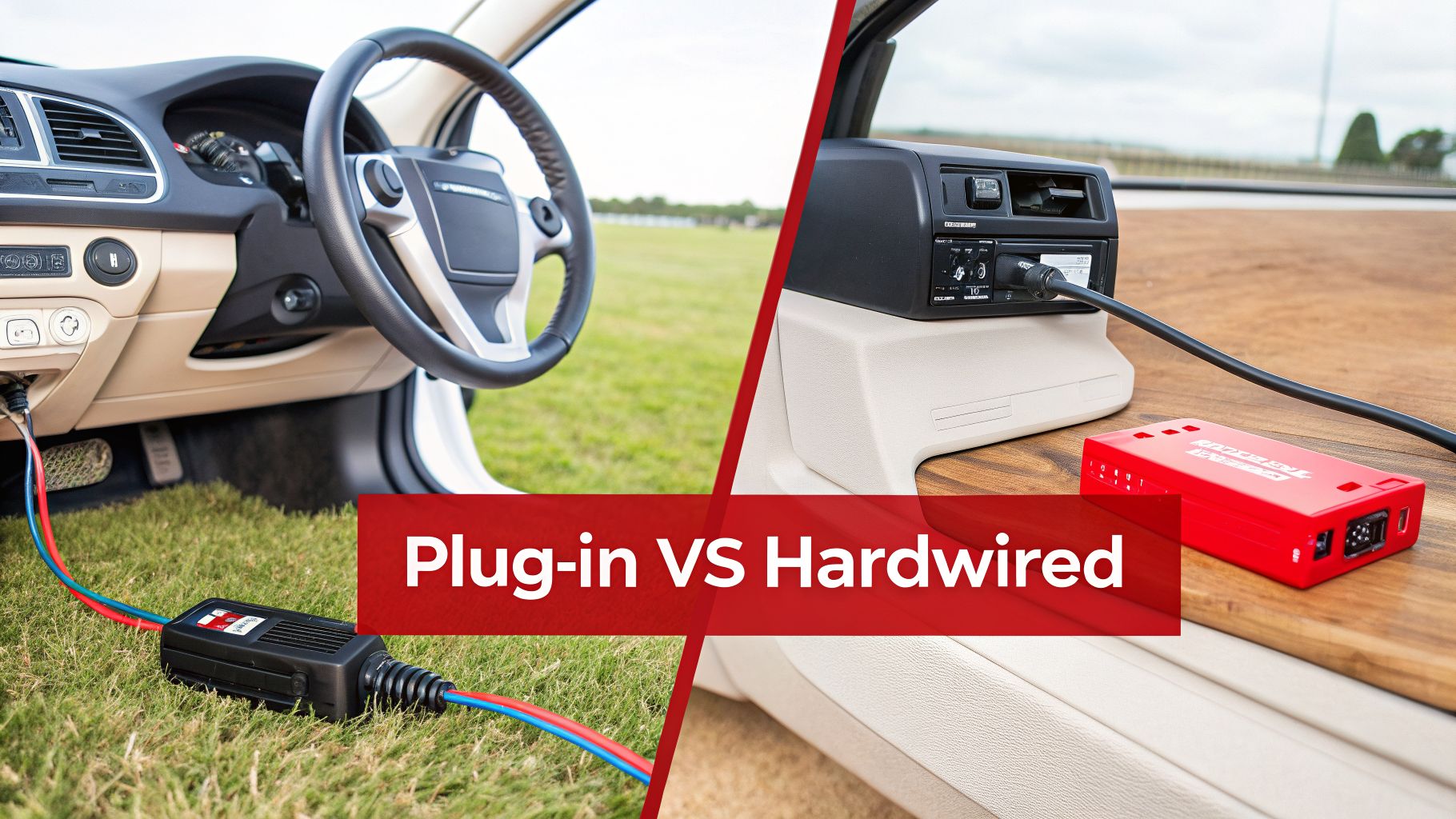
The two primary options are a simple plug-in device or a more integrated hardwired installation. The core trade-off is between ease of installation and security. A tracker that is easy for you to install is often just as easy for a thief to find and remove. Let's examine the implications of each method.
Plug-In Simplicity at a Cost
Plug-in trackers are designed for convenience. They connect directly to your vehicle’s OBD-II (On-Board Diagnostics) port, the same interface mechanics use for engine diagnostics. In the US, any vehicle manufactured after 1996 is equipped with this port, typically located under the steering column.
Installation is effortless—as simple as plugging in a phone charger. However, this ease of use is also its greatest security vulnerability.
- Easy to Find: Professional car thieves are well aware of the OBD-II port's location and function. It is one of the first places they check for security devices.
- Easy to Remove: A quick pull is all it takes to unplug the tracker, instantly cutting its power and disabling its ability to report its location.
A plug-in tracker is analogous to placing a security camera directly on your front doormat. It might deter an amateur, but a professional will simply disable it. This obvious vulnerability is why many individuals serious about security explore other forms of car tracking that offer a more concealed solution.
The Stealth of a Hardwired Installation
For those prioritizing robust security over simple convenience, a hardwired tracker is the superior choice. These devices are wired directly into the vehicle’s electrical system, drawing power from the car battery. This approach offers two significant advantages.
First, concealment. Because it is integrated into the vehicle's wiring, a hardwired tracker can be hidden almost anywhere—deep within the dashboard, behind interior trim panels, or even in the engine bay. This makes it virtually invisible to a thief operating under time pressure. A device cannot be disabled if it cannot be found.
Second, the connection is secure. A thief would require tools, time, and knowledge of automotive electronics to locate and disconnect it. This serves as a major deterrent when every second of the theft is critical.
DIY vs. Professional Installation
The primary drawback of hardwiring is the installation process itself. If you are experienced with automotive electrical systems, a DIY installation is possible. However, an incorrect installation can lead to significant problems.
- Vehicle Damage: A mistake could short-circuit sensitive onboard electronics, resulting in costly repairs.
- Battery Drain: Improper wiring can cause the tracker to draw excessive power, leading to a dead battery.
- Warranty Issues: Splicing into factory wiring could potentially void the vehicle’s warranty on certain electrical components.
For these reasons, professional installation, which typically costs between $50 and $150, is the recommended route for most users. This one-time cost ensures the device is installed safely, correctly, and, most importantly, covertly. Ultimately, the choice depends on your priorities: quick convenience or true, hidden security.
Understanding the Security and Privacy Risks
When you install a cheap tracker in your car, you are doing more than adding a gadget—you are granting a third party access to a continuous stream of sensitive location data. This device knows your location 24/7, your travel history, and your daily routines. Therefore, the critical question is: who is on the receiving end of that data, and can you trust them to protect your privacy?
The popularity of trackers is understandable, especially with rising vehicle theft rates. Data shows that a vehicle equipped with a GPS tracker is often recovered 70-90% faster. This effectiveness has fueled a market boom, with the global GPS device industry projected to grow from $3.67 billion in 2025 to an astonishing $9.59 billion by 2034, according to this Fortune Business Insights report.
However, this rapid expansion has a dark side. While a cheap tracker may seem like an easy security solution, the potential cost to your personal privacy can be extremely high.
Is Your Location Data Safe or for Sale?
With a cheap, no-name tracker, your data often becomes the real product. Many of these companies operate with minimal regulatory oversight, sometimes routing your information through servers in countries with lax data protection laws. This creates a perfect storm for a privacy disaster.
Consider what is at stake. Is your location data encrypted during transmission from the device to their servers? Is it stored securely, or is it held in a plaintext, unencrypted database? Worse, is it being sold to third-party data brokers without your knowledge or consent?
The sobering reality is that to achieve rock-bottom prices, many low-cost tracker companies compromise on cybersecurity first. Your location history—which details your home, workplace, and family's movements—could be exposed in a data breach or sold to the highest bidder. The tool you purchased for security can suddenly become a major privacy liability.
Red Flags to Watch for in a Cheap Car Tracker
It is not enough to evaluate the device; you must also investigate the company behind it. A trustworthy company is transparent about its data handling practices. For instance, you can review our CarLock privacy policy to see what a clear, comprehensive commitment to data protection should entail.
Here are the most significant red flags to look for before you buy:
- No Clear Privacy Policy: If you cannot find a detailed, easy-to-understand privacy policy on the company's website, do not proceed. A missing policy indicates a lack of legal commitment to protecting your data.
- Vague Data Encryption Claims: Look for specific technical details. Phrases like "secure servers" are meaningless marketing jargon. The company should explicitly state that they use end-to-end encryption or other recognized security standards.
- Suspicious App Permissions: When installing the tracker's companion app, pay close attention to the permissions it requests. Does it demand access to your contacts, photos, or microphone? A car tracker has no legitimate need for this information, and such requests are a major sign that the app is designed for data harvesting.
- Anonymous Company or No Support: Can you find a physical address, a working phone number, or a real customer support team? If the company is a ghost online, they will not be available to help when something goes wrong with the device—or with your data.
Your Checklist for Choosing the Right Tracker
We’ve covered a lot of ground, from technical specifications to privacy risks. Let's consolidate this information into a practical evaluation tool.
Use these five points as a checklist to assess any budget tracker you are considering. This systematic approach will help you identify substandard products and find a device that delivers genuine value and security.
1. The True Cost of Ownership
The advertised price is almost never the total cost. A tracker marketed for $25 can easily escalate to a $200+ annual expense if you do not account for all fees. Before purchasing, you must calculate the full financial commitment.
- The Sticker Price: This is the initial hardware cost. It is designed to get your attention but is rarely the final price.
- SIM Cards and Data Plans: Does the tracker include a data plan, or are you responsible for sourcing and paying for a separate one? A self-sourced SIM can add $10-$20 to your monthly expenses.
- Hidden Subscription Fees: This is the most common hidden cost. Read the fine print carefully. Many cheap trackers require a mandatory monthly or annual fee to use the app and access location data. This is where the true cost is often concealed.
2. Core Functionality and Performance
A tracker that is slow, inaccurate, or frequently offline is worse than no tracker at all, as it provides a false sense of security.
When evaluating a cheap tracker, ask these critical questions:
- How fast does it update? If it only updates its location every five minutes, it is not suitable for tracking a moving vehicle during a theft. For effective recovery, you need live tracking with updates every few seconds.
- How accurate is it? Check the technical specifications for GPS accuracy. A desirable range is 5-10 meters. A wider range could mean searching an entire city block for your vehicle.
- Is it powered or battery-operated? A standalone, battery-powered unit offers portability but requires constant recharging. For reliable security, a powered unit that draws a negligible amount of current from your car (via OBD plug-in or hardwire) is far superior.
3. Advanced Security Alerts
A basic tracker shows you a dot on a map. A true security system warns you the moment a potential threat is detected, enabling an immediate response. This is perhaps the single greatest differentiator between a budget gadget and a dedicated system like CarLock.
An effective system is proactive, not reactive. It should alert you to suspicious activity instantly, empowering you to intervene.
Ensure the device you are considering includes these critical alerts:
- Vibration Detection: Receive an instant notification if your car is bumped, impacted, or jacked up.
- Engine Start Alert: This notifies you the moment your car's ignition is engaged without your authorization.
- Device Disconnect Warning: For plug-in OBD trackers, this is a non-negotiable feature. It alerts you if a thief finds and attempts to unplug the device.
4. Installation and Usability
Even the most advanced technology is rendered useless if the installation is overly complex or the user interface is poorly designed. A good user experience should be seamless, from unboxing to daily use.
- How does it install? Do you prefer the 10-second convenience of an OBD plug-in device? Or do you value the stealth and security of a hardwired unit? Consider the best fit for your vehicle and security objectives.
- How tough is it? The physical durability of the tracker is important, especially for hardwired units that may be exposed to engine heat or moisture. Understanding what an IP67 rating for dust and water protection signifies will help you choose a device built to last.
- Is the app any good? Do not rely on marketing materials. Visit the app store and read user reviews. Is the application stable and intuitive, or is it buggy and frustrating to use? A poor app experience will undermine the entire system.
Here’s a simple way to think about a tracker's privacy features.
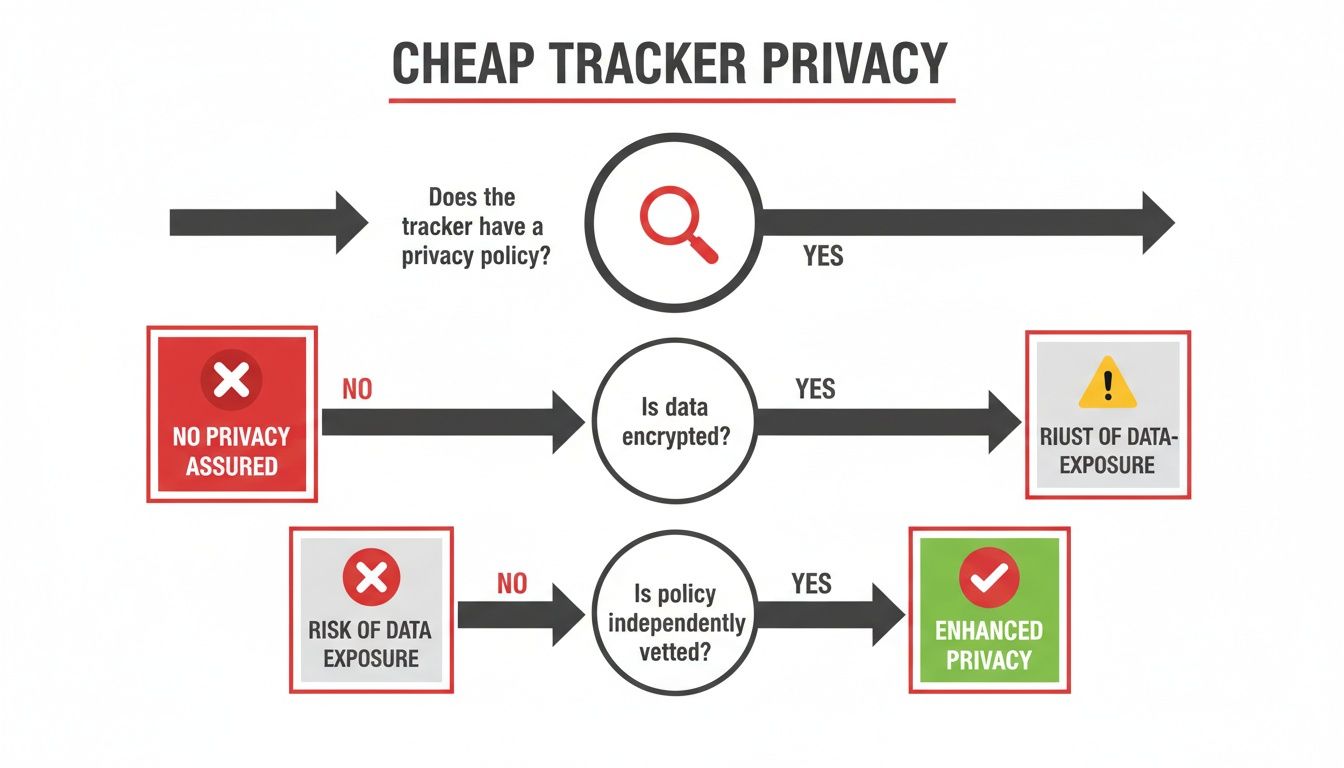
At a minimum, any tracker worth considering must have a clear privacy policy and use proper data encryption. If it lacks these fundamental protections, it should be avoided.
Your Top Questions About Car Trackers, Answered
When researching affordable car trackers, several key questions consistently arise. It is prudent to question the trade-offs between price and performance. Let's address some of the most common concerns.
Can a Cheap Car Tracker Drain My Car Battery?
This is a valid concern. No one wants to discover a dead car battery, especially after installing a device intended for security. The short answer is: a well-engineered tracker should not cause battery drain.
Most quality trackers, whether OBD-II or hardwired, are designed with a low-power "sleep mode." They consume a negligible amount of current when the vehicle is off. The problem arises with poorly manufactured cheap car trackers that may omit this critical feature, leading to a constant power draw that can slowly deplete your battery. When shopping, always verify that the device specifications mention a low-power or sleep mode.
How Accurate Are Cheap GPS Trackers?
A tracker's value is directly tied to its accuracy. This is a key area where significant differences emerge between budget and premium devices.
In general, you can expect a cheap GPS tracker to provide a location accuracy of 5 to 20 meters (approximately 16 to 65 feet). This is typically sufficient for locating a vehicle in an open parking lot but can become less reliable in dense urban environments where tall buildings cause GPS signal reflection (the "urban canyon" effect).
Several factors can degrade a tracker's accuracy:
- Signal Obstructions: Underground parking garages, dense forests, and dense urban areas can weaken or block GPS signals.
- Number of Satellites: A tracker needs to establish a connection with at least four GPS satellites for a reliable position lock. Cheaper devices may have less sensitive receivers that struggle to maintain this connection.
- Hardware Quality: The sensitivity of the internal GPS chipset is a major determinant of performance, particularly in challenging signal conditions.
Are Car Trackers Legal to Use?
The legality of using a GPS tracker is straightforward and is governed by principles of ownership and consent.
It is perfectly legal to install a GPS tracker on a vehicle that you own. This includes protecting your car from theft, monitoring your own driving habits, or supervising a new driver in your family (with their knowledge).
Legal issues arise when you track a vehicle you do not own without the owner's consent. Placing a tracker on someone else's car without their permission is illegal in most jurisdictions and can result in serious legal consequences, including charges of stalking or invasion of privacy. The bottom line: if it is not your car, do not track it without obtaining explicit consent.
Ready to move beyond basic tracking and invest in true security? CarLock offers a complete system with real-time alerts for vibration, engine starts, and device disconnection, giving you the proactive protection that cheap trackers lack.