

Driver’s Desk
Driver Behavior Monitoring: A Complete Guide for 2026
A single driving mistake can have consequences far beyond one rough stop or one missed glance at the road. One independent fleet safety source says about 90% of crashes are caused by human error (Embark Safety on driver behavior monitoring systems). That number explains why driver behavior monitoring has moved from a fleet-only tool into a broader conversation about family safety, vehicle security, and peace of mind.
For a non-technical car owner, the easiest way to think about it is this: driver behavior monitoring is like a fitness tracker for your car and the person behind the wheel. It doesn't just record where the car went. It pays attention to patterns like hard braking, aggressive acceleration, unusual cornering, and speeding, then turns those signals into alerts you can use effectively.
That sounds simple on paper. In practice, people get stuck on two questions. First, how do these systems know whether an alert means “unsafe habit” or “necessary reaction”? Second, where's the line between helpful safety monitoring and invasive surveillance? Those are the questions that matter most, especially for parents, small business owners, and everyday drivers who want security without overreach.
The Urgent Need for Driver Behavior Monitoring
Human error sits behind most crashes, which is why safer driving depends on catching risky patterns before they become a close call or a claim. Driver behavior monitoring helps by turning ordinary trips into usable feedback. It works like a fitness tracker for your car. Instead of counting steps, it watches for habits such as repeated hard braking, sudden acceleration, and speeding.
That matters because a single alert means very little on its own. One hard stop could mean tailgating. It could also mean the driver avoided a child, a cyclist, or a dog in the road. Value lies in context and pattern recognition. If the same vehicle shows repeated harsh braking, late-night speeding, and sharp cornering across many trips, that points to a habit worth addressing. If one event appears during an otherwise calm drive, it may be normal defensive driving.
Why simple location tracking is no longer enough
Older vehicle trackers mostly answered a logistics question. They showed where the car went and when it got there. Useful, but incomplete.
Car owners now want to know whether a trip looked safe, stressful, or suspicious. A pin on a map cannot show whether a teen rushed through traffic, whether a delivery driver took corners too fast, or whether someone borrowing the car treated it carelessly. Behavior monitoring adds that missing layer, so the information becomes useful for prevention instead of just recordkeeping.
This practical difference is why interest has expanded beyond commercial fleets. Families use it for reassurance. Small businesses use it to reduce avoidable wear, claims, and downtime. Individual owners use it to see whether a valet, mechanic, or unauthorized driver handled the car responsibly.
Why trust matters as much as the alerts
Many drivers hesitate for a fair reason. Monitoring can sound like surveillance if it is introduced badly or interpreted unfairly.
A good system should help you separate noise from risk. It should not label every sudden maneuver as bad driving. It should help you ask better questions. Was this a one-off reaction to traffic, weather, or a hazard? Or is it part of a pattern that keeps showing up? That approach builds trust because it treats the data as a starting point for judgment, not a final verdict.
For everyday car owners, that trust piece often matters more than the hardware. People are far more likely to use monitoring well when they understand what is being measured, why it is being flagged, and who can see it.
Where the urgency shows up in real life
The need becomes clear in ordinary situations:
- Parents want more than arrival updates. They want to know whether a new driver is building calm, repeatable habits.
- Vehicle owners want proof, not guesswork. If the car comes back with unusual wear or damage, driving data can add context.
- Small business operators want fewer expensive surprises. Repeated aggressive driving can raise fuel use, maintenance costs, and accident exposure.
If you want a practical overview of how monitoring supports safer habits and vehicle protection, CarLock's guide to vehicle security awareness and monitoring is a useful reference. For a broader look at consumer-facing safety tools, see BDISchool reviews of driving apps.
How Monitoring Technology Actually Works
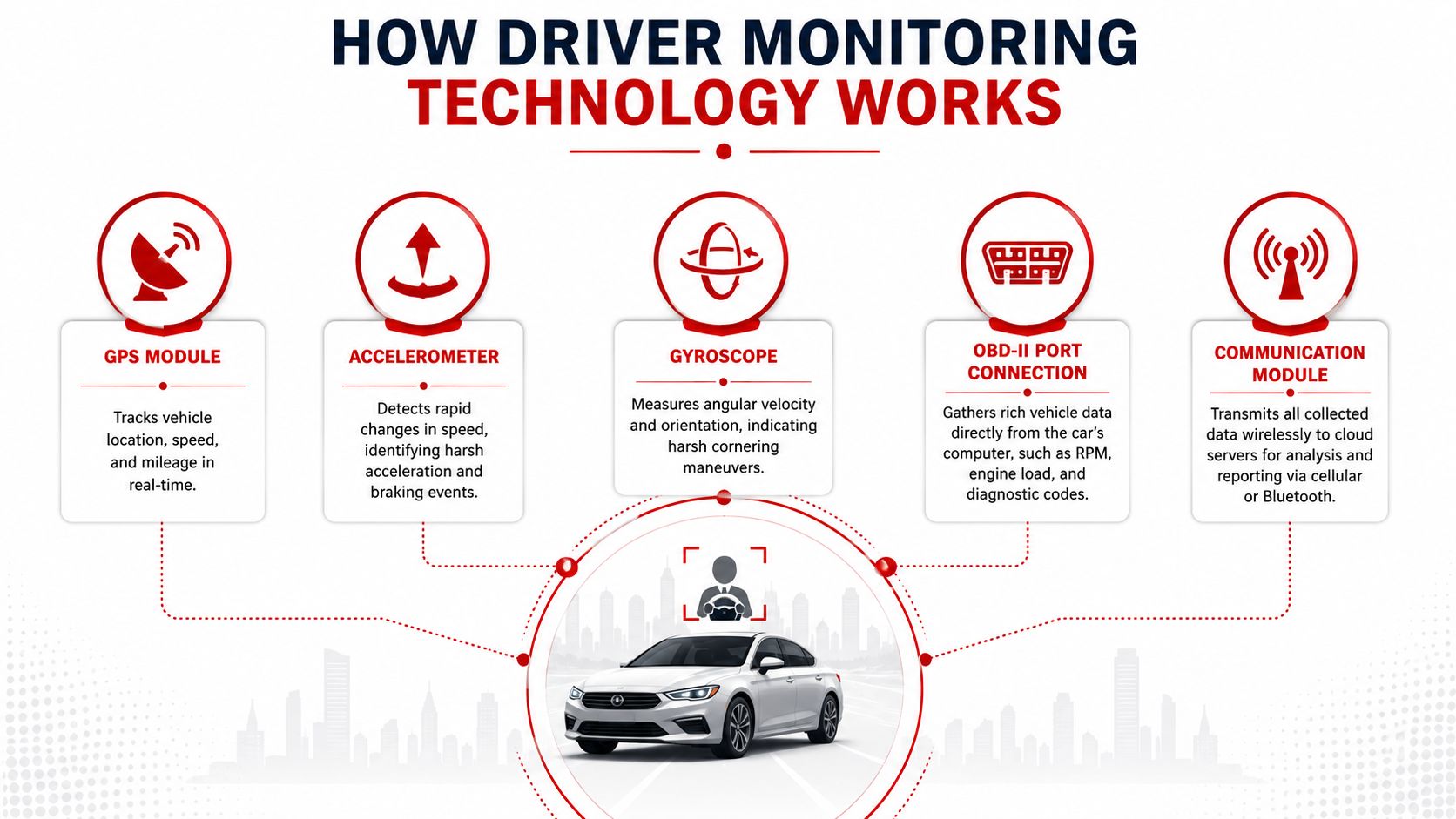
Driver behavior monitoring works less like a surveillance camera and more like a fitness tracker for your car. It collects small signals about motion, speed, direction, and vehicle status, then groups them into patterns that a person can interpret.
The core parts inside the system
A modern setup usually combines a few simple tools. Each one captures a different piece of the driving story.
| Component | What it does in plain English | Why it matters |
|---|---|---|
| GPS module | Works like the car's sense of place and pace | Tracks route, location, and speed |
| Accelerometer | Feels sudden changes in motion | Detects hard braking and quick acceleration |
| Gyroscope | Senses rotation and turning force | Helps identify sharp cornering or swerving |
| OBD-II connection | Reads information from the car itself | Adds engine and vehicle context |
| Communication module | Sends data to the app or cloud | Makes alerts available quickly |
The OBD-II port matters because it gives the device access to the car's own diagnostic information. It works like a checkup port under the dashboard. That extra context helps the system avoid relying on motion alone.
For example, a phone app may notice a sudden stop. A device connected to the vehicle can often add trip details and vehicle-level signals that make the event easier to interpret. Car owners comparing dedicated hardware can see that practical layer in CarLock's overview of tracker device features and vehicle monitoring functions.
How raw signals turn into behavior events
The system measures inputs, then software looks for patterns that match known driving events.
A single signal can be misleading. Hard braking by itself might mean risky tailgating, or it might mean a driver stopped quickly to avoid a child, cyclist, or sudden lane change ahead. Context is what turns a noisy alert into a useful one.
Here is a simple way to read the chain:
- GPS shows speed and location
- Accelerometer shows how suddenly speed changed
- Gyroscope shows whether the car was also turning
- OBD-II data can add vehicle status and trip context
- Software rules compare that mix of signals to event thresholds
If several signals happen at once, the system can classify the moment as harsh braking, aggressive cornering, rapid acceleration, or another event type. That still does not make the alert a final judgment. It gives you a clue worth checking.
A trustworthy monitoring system should help you separate patterns from one-off reactions. Repeated late braking on ordinary roads may point to a habit. One hard stop near a school crossing may point to a responsible decision.
What the app is actually doing behind the scenes
Most user apps translate technical sensor data into a short event summary, trip history, and alert feed. That translation layer is easy to overlook, but it is where trust is won or lost.
If the app floods you with unexplained warnings, people stop paying attention. If it shows when an event happened, where it happened, and whether it repeats, the data becomes more useful and more fair. That is why many drivers and parents compare monitoring tools based on clarity, not just feature count. For a consumer-oriented comparison, BDISchool reviews of driving apps gives a helpful overview.
Some systems also add video or road-context data, especially in commercial use. The goal is the same. Reduce guesswork. A useful alert should answer a practical question: was this a risky pattern, or a reasonable response to conditions?
The Key Metrics That Define Driving Behavior
Not every alert matters equally. That's one of the biggest sources of confusion for first-time users. A system may track many things, but a handful of metrics usually carry most of the safety value.
The signals that deserve the most attention
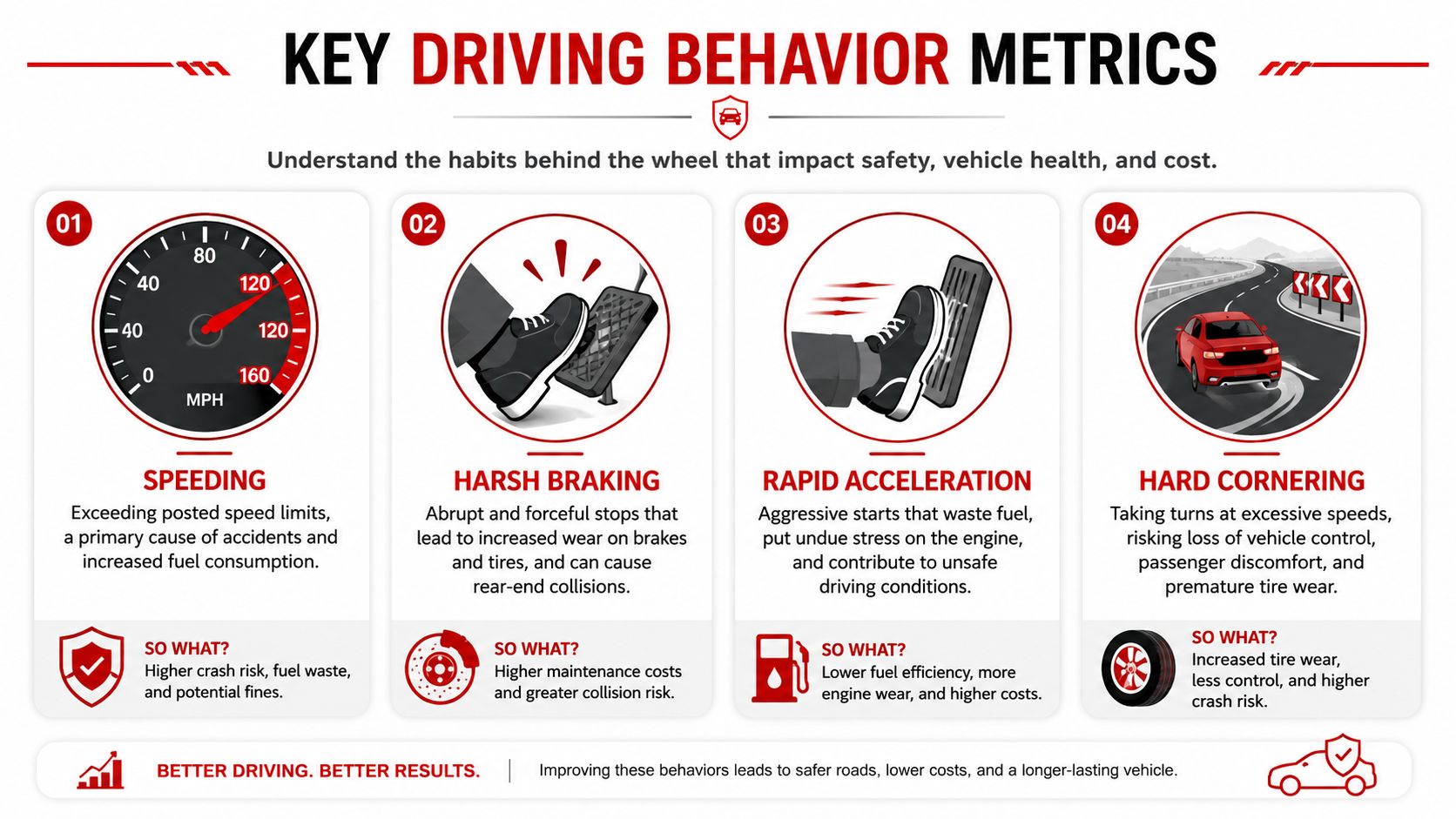
One industry ranking puts the strongest emphasis on speeding at 35%, followed by harsh braking at 25%, phone distraction at 20%, harsh acceleration at 10%, and cornering at 10%, using a 0 to 100 composite risk score to turn telematics data into coaching thresholds (Damoov on weighted driving behavior metrics).
That weighting is useful because it shows something most apps don't explain well: a driving score isn't just a random summary. It reflects which behaviors are considered stronger predictors of risk.
What each metric actually tells you
- Speeding often matters most because it reduces the time a driver has to react and can make every other mistake harder to recover from.
- Harsh braking can point to tailgating, late reactions, distraction, or stressful route conditions.
- Phone distraction matters because a driver can appear mechanically smooth while still being mentally absent.
- Harsh acceleration often suggests impatience, aggressive starts, or stop-and-go driving habits.
- Hard cornering can reveal poor speed judgment entering turns or unstable handling behavior.
Some systems also track idling, lane drifting, or fatigue-related indicators. Those can be useful, but the metrics above usually carry the clearest day-to-day coaching value.
The danger of treating every event the same
A good monitoring system shouldn't make a harsh brake and a brief speed fluctuation seem equally serious. Context matters, but prioritization matters too.
Here's a simple way to consider:
| Metric | What a single event might mean | What repeated events often suggest |
|---|---|---|
| Speeding | A brief lapse in attention | Habitual risk-taking |
| Harsh braking | Avoiding a hazard | Following too closely or delayed reaction |
| Harsh acceleration | Merging quickly | Aggressive throttle use |
| Cornering | One sharp turn | Consistent overconfidence in turns |
| Phone distraction | A momentary lapse | Ongoing divided attention |
Practical rule: Look for patterns first. Judge individual events second.
That's why trip history matters so much. When you can review routes and repeat events over time, you stop reacting to one noisy alert and start understanding the bigger pattern. Tools that include route history and trip playback make that easier because they show where events cluster instead of leaving you with isolated notifications.
Real World Applications From Families to Fleets
Driver behavior monitoring becomes easier to understand when you stop thinking about “data collection” and start thinking about decisions. Who needs to decide what? A parent deciding whether a teen is ready for more independence. A business owner deciding whether a driver needs coaching. A car owner deciding whether the vehicle was used appropriately.

For families with a new driver
A newly licensed teen doesn't need constant criticism. They need a feedback loop.
That's where monitoring can help. If a parent sees repeated hard braking late at night on the same stretch of road, the conversation becomes more specific and less emotional. Instead of “You drive recklessly,” it becomes “I'm seeing sudden stops on this route. Are people cutting you off, or are you following too closely?”
That difference matters. Specific feedback teaches. General suspicion creates conflict.
A healthy family setup often includes these boundaries:
- Agree on purpose: Say the tool is for safety and coaching, not nonstop surveillance.
- Review trends together: Weekly conversations are often more productive than reacting to every alert.
- Focus on improvement: Ask what caused the event before assuming bad intent.
For small fleets and service businesses
A plumber, electrician, courier, or landscaping company may only run a handful of vehicles, but the stakes are still high. Unsafe driving affects customer trust, maintenance schedules, and claim exposure.
A small operator may use driver behavior monitoring to flag patterns like repeated speeding in one van or unusually harsh driving on a specific route. In trucking and commercial transport, safety monitoring often overlaps with broader risk planning, which is why some owners also review practical resources like Coverage Axis trucking insurance when thinking through liability and operational protection.
The value here isn't only discipline. It's consistency. The owner can coach from the same set of signals across the whole team rather than relying on vague complaints or memory.
Here's a quick product walkthrough that helps make the concept more concrete:
For individual owners focused on security
This use case is often overlooked. A person may care less about scoring every trip and more about knowing whether their car was moved, started, towed, or driven aggressively by someone else.
That makes driver behavior monitoring especially useful when the car is:
- At a repair shop and you want to know whether it was road-tested responsibly
- Loaned to a friend or family member and you want objective trip history
- Parked in a risky area where unauthorized movement matters as much as location
- Used by multiple household drivers and you want a clearer picture of patterns
In these cases, monitoring supports both safety and security. It doesn't just tell you the car moved. It tells you how it was handled.
Turning Data into Actionable Insights and Alerts
Raw alerts are easy to generate. Useful alerts are much harder.
That's the true test of driver behavior monitoring. A phone notification that says “harsh braking detected” is only helpful if you can tell whether it points to a bad habit, a bad road, a bad intersection, or a completely reasonable evasive move.
Why one event can mislead you
A single harsh brake doesn't prove reckless driving. The driver may have stopped for a child chasing a ball, a cyclist cutting across traffic, or a sudden lane closure. If you punish every event in isolation, you teach people to distrust the system.
That concern isn't theoretical. Much of the existing coverage on monitoring tools doesn't answer the harder question of whether flagged events reflect real danger or unavoidable context such as traffic or road design. AAA's evaluation found that direct and indirect driver-monitoring systems can perform differently, and that both types were significantly affected by active circumvention attempts, which is a reminder that behavior signals can be noisy rather than perfectly diagnostic (AAA driver monitoring evaluation).
What good interpretation looks like
A better system, or a better user of the system, asks questions like these:
- Was this a one-off or a pattern?
- Did it happen on one route or many?
- Was the event clustered with speeding, sharp turning, or distraction?
- Does the driver have a stable overall history, or is this part of a trend?
Those questions turn alerts into judgments with context.
The goal isn't to catch every mistake. It's to identify repeatable risk.
A simple framework for separating signal from noise
You can use a basic three-layer approach when reviewing alerts:
| Layer | What to check | What it helps you decide |
|---|---|---|
| Event | What exactly happened? | Was the alert technically valid? |
| Context | Where and when did it happen? | Could road or traffic conditions explain it? |
| Pattern | Does it repeat over time? | Does this need coaching or policy action? |
Cloud reporting matters significantly. A platform that stores trip logs, event history, and trend views gives you far more than a live ping on your phone. CarLock's overview of cloud-connected vehicle tracking and alert reporting shows the kind of structure that makes review practical instead of overwhelming.
Turn alerts into conversations, not verdicts
For families, that may mean asking a teen why repeated braking happens near a school pickup zone. For businesses, it may mean discovering that one route forces abrupt stops because of bad traffic timing. For individual owners, it may mean confirming that a valet took a joyride instead of parking the car normally.
The pattern is the point. Alerts start the conversation. They shouldn't end it.
Navigating Privacy Legal and Trust Concerns
The initial concern regarding driver behavior monitoring often isn't technical. It's emotional. Drivers frequently don't want to feel watched all the time.
That concern is valid. A system that can detect movement, route history, and driving style can absolutely feel intrusive if nobody explains why it's there, who can see the data, and how it will be used.
Why trust breaks down
Independent fleet safety coverage often presents monitoring as a safety or cost-control tool, but it rarely deals directly with the side effects of continuous monitoring, such as resistance and questions about what happens to the data. That gap is really about operational acceptance, not just technology (Teletrac Navman on poor driving behavior and monitoring challenges).
People usually resist monitoring for predictable reasons:
- Unclear purpose: They think the actual goal is punishment, not safety.
- No data boundaries: They don't know what is collected or how long it stays stored.
- One-sided visibility: They feel monitored but not informed.
- Unfair interpretation: They worry every alert will be treated as guilt.
What responsible use looks like
A responsible setup is transparent from day one.
For families, that may mean a simple agreement: what gets monitored, when parents will review it, and what kind of behavior triggers a conversation. For employers, it means a written policy that explains the business reason, who has access, and how the data supports coaching instead of automatic discipline.
Trust rule: If a monitored driver can't explain what is being collected and why, the policy isn't clear enough.
A few practical safeguards help a lot:
- Limit access: Only the people who need the data should see it.
- Define retention: Keep data only as long as there's a real business or safety reason.
- Share the same view: Let drivers or family members review their own trips and events.
- Use trends, not gotchas: Judge habits over time instead of cherry-picking a single bad moment.
Where privacy and safety meet
There isn't one universal line between helpful monitoring and surveillance. The right line depends on the relationship and the purpose.
Tracking a company truck during work hours is different from tracking an employee's personal time. Monitoring a teen driver with a clear family agreement is different from secretly tagging an adult partner's car. The technology may be similar. The ethics aren't.
If you want to review how a vehicle tracking company states its handling of user data, CarLock's privacy policy and data practices are the right place to look before installing any system.
How to Choose and Deploy Your Monitoring Solution
A good driver behavior monitoring setup should answer a simple question: will this help you make better decisions, or will it just create more noise? The right system works like a fitness tracker for your car. It records patterns, flags unusual moments, and gives you enough context to judge what is important.
What to evaluate before you buy
Start with your real use case, not the longest feature list. A parent watching over a new teen driver needs something different from a small business managing several vehicles. One may care most about clear trip summaries and late-night movement alerts. The other may care more about consistent event logging and easy review across multiple drivers.
A few buying criteria matter more than the rest:
- Installation method: OBD-II devices are often the easiest choice for personal vehicles. Hardwired units can make more sense for commercial vehicles that stay in service for years.
- Alert quality: Look for alerts that explain what happened and when. A vague warning is hard to trust.
- Context around events: A harsh brake alert is only useful if you can review the trip, speed, and location around it.
- Trip review tools: Event history, route logs, and trend views help you spot habits instead of overreacting to one moment.
- App usability: If the app is confusing, the data will sit there unused.
- Security features: Movement alerts, tamper alerts, and engine start notifications can matter just as much as driver scoring.
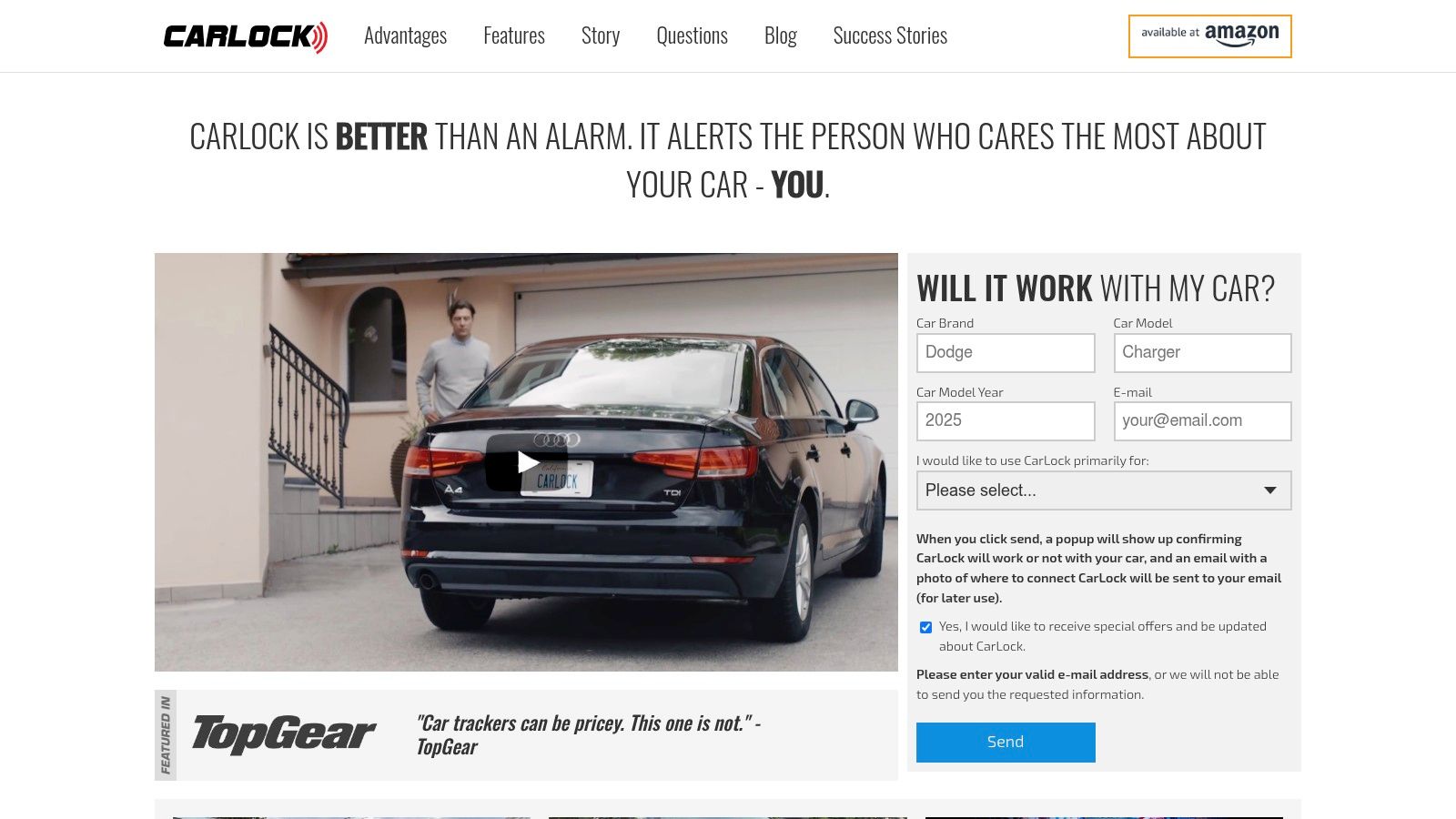
One consumer-focused option in this category is CarLock, which combines GPS tracking, trip history, movement and tamper alerts, and event monitoring for behaviors such as harsh braking, acceleration, and cornering. As noted earlier, its feature set is designed to cover both vehicle security and day-to-day driving awareness.
How to roll it out without friction
Deployment succeeds when expectations are clear. People trust monitoring more when they know what the system watches, what counts as a concern, and what happens after an alert.
Use a simple rollout process:
- Set the purpose first. Be specific. Theft protection, coaching a new driver, and fleet oversight each call for different alert settings and review habits.
- Choose a short list of priority events. Start with the behaviors that affect safety or vehicle risk.
- Create a review routine. Weekly or biweekly review usually gives better perspective than reacting to every notification in real time.
- Define what counts as a pattern. One hard brake in traffic may be defensive driving. Repeated speeding or aggressive cornering across many trips is a habit.
- Explain the response clearly. The goal should be a conversation, coaching, or policy review before punishment.
- Refine the setup after a trial period. If a route, driver, or vehicle produces misleading alerts, adjust the rules and interpretation.
Start small. A short list of meaningful alerts builds trust faster than constant notifications.
This is also the point where privacy and practical use come together. If drivers feel watched but not informed, they will resist the system. If they can see the same trips, understand the alerts, and know that context matters, the technology feels more fair.
The best deployment plan is easy to explain in plain language. What is being monitored. Who can see it. How long it is kept. What kind of event leads to a conversation. That clarity turns monitoring from a source of tension into a tool people can use.
If you want a tool that combines vehicle security with practical driver behavior monitoring, CARLOCK is worth a look. It gives car owners real-time GPS tracking, movement and tamper alerts, trip history, and driving-event notifications in one system, which makes it useful for theft protection, family oversight, and everyday awareness.