

Driver’s Desk
Vehicle GPS Tracker Device: A 2026 Security Guide
The market around vehicle tracking is no longer niche. The global GPS tracker market is projected to reach USD 6.13 billion in 2026 and rise to USD 14.98 billion by 2033, with a 13.6% CAGR, while the vehicle tracking segment alone accounts for 46.9% of the total global GPS tracking device market in 2025, according to Coherent Market Insights. That kind of growth tells you something important. Car owners, parents, and fleet operators are looking for more than a siren and a steering wheel lock.
A modern vehicle GPS tracker device answers a basic fear with a practical tool. If your car moves, starts, gets towed, or gets tampered with, you want to know right away. You don't want to discover a problem hours later when the driveway is empty and the trail is cold.
That's why the old model of vehicle security feels incomplete now. A loud alarm might scare off an amateur. A lock might slow someone down. But neither one tells you where the vehicle is, whether someone unplugged the tracker, or whether the battery is being drained. A connected tracker can.
Your Guide to Modern Vehicle Security
For many drivers, vehicle security isn't abstract. It's the uneasy feeling after parking overnight on a city street. It's handing the keys to a teenage driver for the first solo trip. It's leaving a work van full of tools outside a job site and hoping it's still there in the morning.
A vehicle GPS tracker device changes the conversation from reaction to awareness. Instead of waiting for damage, theft, or a call from a tow yard, you get direct visibility into what your car is doing. That's a major shift from traditional alarms, which usually make noise after something has already started going wrong.
Why this technology matters now
The market growth behind GPS tracking reflects how many people now see connected vehicle monitoring as part of normal car ownership, not a specialty gadget. The reason is simple. Drivers want real information, not just deterrence.
If your vehicle is moved without permission, you want to know. If someone starts the engine at an odd hour, you want an alert. If a car battery begins to weaken, that matters too, because security isn't just about theft. It's also about reliability and peace of mind.
Practical rule: The more valuable or exposed your vehicle is, the less sense it makes to rely on security tools that only make noise and don't send you live information.
Many drivers start with a basic alarm and later realize they need more visibility. If you want to compare connected monitoring with traditional alarm-based protection, this overview of a car alarm system is a useful starting point.
What concerned owners usually want to know
The questions tend to be straightforward:
- Can I see where my car is right now? That's the core job of a tracker.
- Will I get an alert if someone tampers with it? Better systems are built for exactly that.
- Can it help with family safety? Yes, especially when multiple people drive the same vehicle.
- Is a cheap Bluetooth tag enough? Usually not, and that confusion causes many bad buying decisions.
A good tracker doesn't just place a dot on a map. It helps you notice suspicious movement early enough to do something about it.
How GPS Vehicle Trackers Pinpoint Your Car
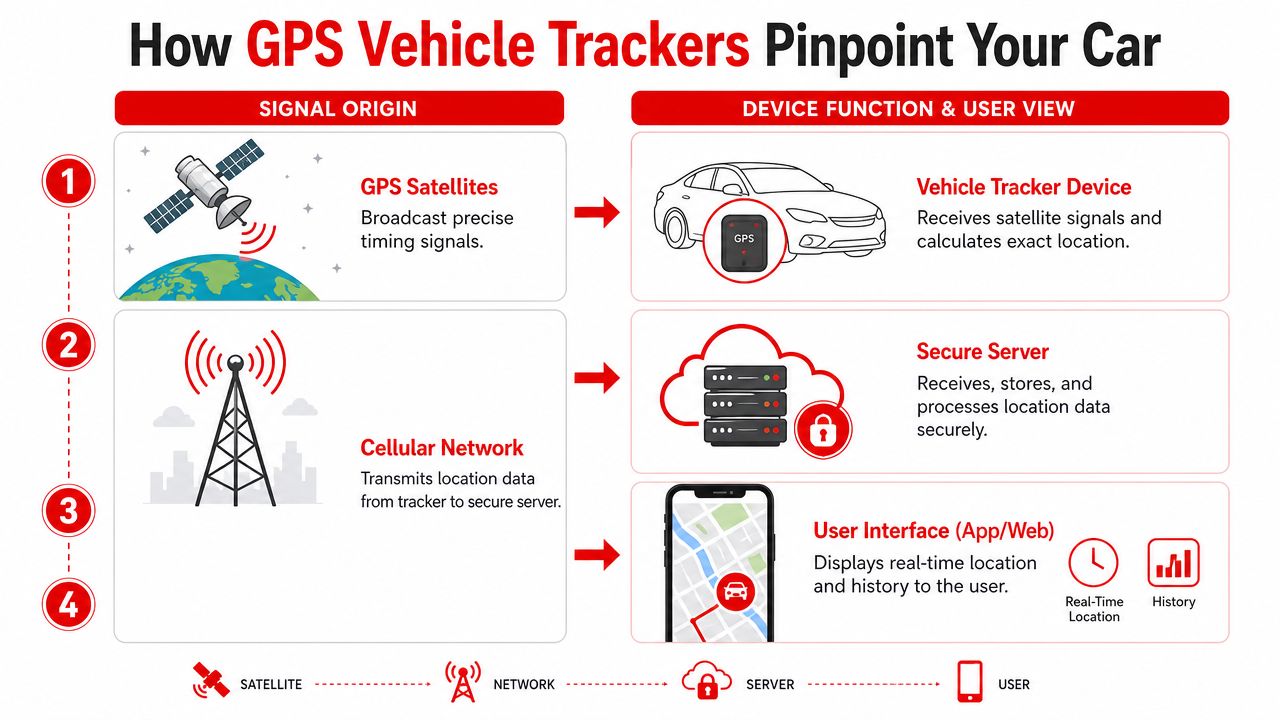
The easiest way to understand a vehicle GPS tracker device is to think of it as a small, dedicated smartphone for your car. It has one job. Learn where the vehicle is, send that information through the mobile network, and show it to you in an app.
That process has two separate parts, and people often mix them up. GPS figures out location. Cellular connectivity sends that location to you.
The location part
Modern vehicle GPS trackers use multi-constellation GNSS, including GPS, GLONASS, and Galileo, to reach about 8 to 15 feet of accuracy in open sky, with refresh rates of 15 to 60 seconds in standard modes and 5 to 10 seconds in premium real-time tiers, according to Car and Driver's testing overview. In plain language, the device listens to timing signals from satellites and calculates where the car is.
Using multiple satellite systems matters. If one signal is weak, another may still be available. That helps in places where signal conditions are tougher, such as dense city blocks or areas with heavy tree cover.
The communication part
Knowing the location isn't enough if the information stays trapped inside the device. That's where the cellular modem comes in. It sends the position data from the tracker to a server, and your app pulls it from there.
This is why a professional GPS tracker works differently from a simple tag. A tag is waiting to be noticed by something nearby. A cellular tracker actively reports in.
If you've ever used a service to track your vehicle shipment, you've already seen a version of this logic in action. The useful part isn't only that the vehicle has a location. It's that the location can be transmitted and viewed remotely.
GPS and Bluetooth are not the same tool
Here's the confusion I see most often. A lot of buyers compare a true tracker to a Bluetooth item finder because both can appear on a phone screen. But that's like comparing a home security system to a keychain whistle. Both can help in narrow situations, but they solve very different problems.
| Feature | Professional GPS/Cellular Tracker (e.g., CarLock) | Bluetooth Item Finder (e.g., AirTag) |
|---|---|---|
| How it gets location | Uses satellite positioning | Relies on nearby Bluetooth-enabled devices |
| How data reaches you | Sends updates over a cellular network | Depends on being detected within ecosystem range |
| Use in remote areas | Designed for remote tracking | Unreliable when no nearby devices are present |
| Use in underground parking | More capable because it reports through a broader connected system | Often limited if no nearby devices relay position |
| Theft response | Built for active monitoring and alerts | Better suited to locating misplaced items |
| Security purpose | Vehicle-focused | Item-finding focused |
For owners who want to see how a dedicated tracking app presents this information, a live car locator tool shows the kind of visibility people expect from a purpose-built system.
A vehicle tracker is useful because it combines location and communication. If either piece is missing, security gets weaker fast.
Core Features That Go Beyond Basic Tracking
A dot on a map is helpful. It's not enough.
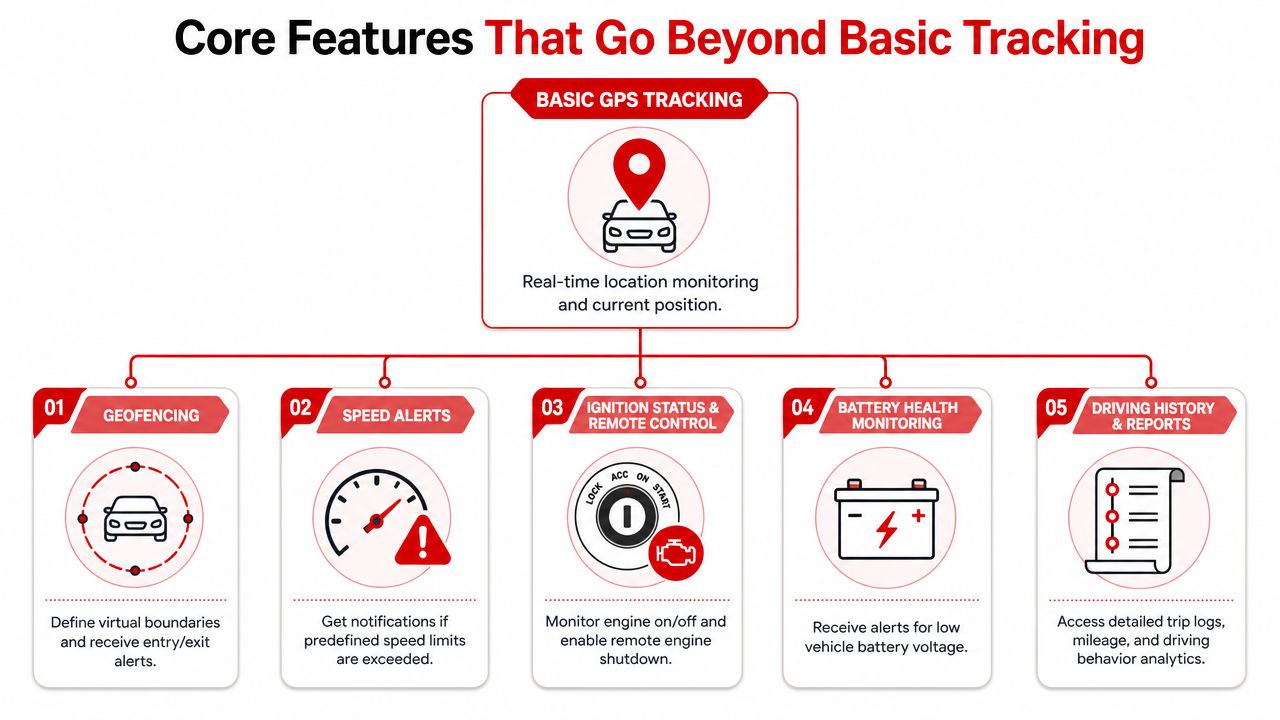
The primary value of a vehicle GPS tracker device shows up when it starts acting like a security system instead of a map tool. Good systems watch for patterns and events that usually happen before or during trouble. That means movement when the car should be parked, towing when the engine never started, or a sudden power cut that suggests someone found the device and tried to disable it.
Tamper alerts and towing detection
Advanced trackers can include a built-in energy reserve that sends a “last gasp” alert when main power is severed, and they use 3-axis accelerometers to detect unauthorized towing, vibration, or harsh driving events, according to Geotab's vehicle tracking device overview. That matters because many thefts don't begin with a smashed window and a hotwired ignition. Sometimes the vehicle is surreptitiously lifted, hooked, or rolled away.
A practical example helps. Your car is parked outside overnight. A thief tries to disconnect power to stop the tracker from reporting. A basic device goes silent. A more advanced one sends one final warning before power drops. That single alert can tell you tampering is happening right now, not three hours later.
Geofencing and speed alerts
Geofencing sounds technical, but it's simple. You draw a virtual boundary around a place that matters, such as home, school, or a job site. If the car enters or leaves that area, you get notified.
That can be useful in very different ways:
- For parents: You can confirm a teen arrived at school or left later than expected.
- For small business owners: You can see whether a van stayed within the work area during the day.
- For owners of valuable vehicles: You can know immediately if a car leaves the garage or storage address.
Speed alerts work the same way. You set a threshold, and the app warns you if the vehicle is pushed beyond it. For family use, that can start a conversation about driving habits. For commercial use, it can flag risk.
Battery health and trip history
Battery monitoring is underrated until it saves you from a no-start morning. A connected tracker can warn you when vehicle voltage begins to sag, which helps you catch battery problems early.
Trip history matters for a different reason. It answers the questions that come up after the fact. Where did the car go? When did it stop? How long was it parked there? That's useful for family oversight, for work records, and for theft investigations.
Security insight: The best alerts are the ones that tell you something has changed before you discover the problem yourself.
Some systems also add ignition alerts, driving behavior logs, and route playback. If you want to review the mix of app-based monitoring features available in a connected tracker, this GPS car tracker app features page shows the kind of functions owners typically compare before buying.
Why these extras matter
Basic tracking answers one question. Advanced features answer several at once.
- Is the vehicle where it should be?
- Did someone touch it, tow it, or unplug something?
- Is the driver using it safely?
- Is the battery healthy enough to trust tomorrow morning?
That's the difference between a passive locator and an active security device.
Why Bluetooth Finders Fail at Car Security
The sales pitch for Bluetooth tags is easy to understand. They're cheap, simple, and often marketed as having no subscription. For keys, bags, or luggage, that can be perfectly fine.
For car security, it's a weak substitute.
The core problem is that Bluetooth item finders were built to help recover misplaced belongings, not protect a vehicle that may be stolen, towed, hidden, or moved far away. A stolen car doesn't stay in the same environment as a missing wallet. It may end up in a remote lot, inside a structure, or across a state line. A device that depends on nearby phones is at a disadvantage the moment the vehicle leaves busy, connected areas.
The range problem is the whole problem
Recent 2024 to 2025 trends cited by Dawarich's guide to hidden GPS trackers state that 60% of car thefts in high-risk areas involve vehicles being towed or driven beyond Bluetooth range, which is why cellular and GPS tracking is essential for real anti-theft protection. That single point gets to the heart of the issue. If the theft method itself takes the vehicle outside Bluetooth conditions, the lower-cost tag stops being a security tool at the exact moment you need it most.
A common buyer mistake is focusing only on monthly cost. The key question is simpler. What still works when the car is no longer nearby?
Where Bluetooth tends to fail
Consider a few common situations:
- Underground parking: A tag may struggle if there aren't enough nearby devices to relay location.
- Remote storage lots: A car can sit out of practical Bluetooth reach for hours or days.
- Towing: The vehicle can be moved fast without ever needing to be started.
- Organized theft: If a car is taken to a low-traffic location, passive crowd-based tracking becomes much less useful.
A true vehicle security setup needs continuity. It needs to report movement, not just hope to be detected.
Why subscription isn't just a fee
People often dislike subscriptions on principle. I understand that. But with a real vehicle tracker, the recurring cost usually supports the cellular data connection and cloud service that make live monitoring possible. Remove that piece, and you often remove the reason the product works at all.
That's why a tag and a tracker shouldn't be treated as interchangeable. If you want a compact add-on for nearby item recovery, a Bluetooth tag has a role. If you want actual vehicle monitoring, choose a product built for that category, such as a dedicated GPS tracker tag alternative for cars.
Bluetooth helps when something is lost nearby. GPS and cellular help when something valuable is taken away.
Real-World Scenarios for GPS Trackers
A lot of buying decisions become easier when you stop thinking in terms of specs and start thinking in terms of daily life. Different drivers need different kinds of reassurance. The device may be the same, but the reason for using it can change completely.
A parent with a new driver
Your teenager has just started driving alone. You don't want to hover, but you do want to know they arrived safely, whether they took the expected route, and whether the car is being driven aggressively.
A tracker helps because it turns vague worry into specific information. Instead of texting three times and waiting, you can check whether the car reached school, whether it left on time, and whether there were any unusual driving events. That doesn't replace trust. It supports it with facts.
A small business owner with a few vans
Small fleets don't need enterprise complexity to have real problems. A van goes missing for part of the day. An employee says they were at a customer site longer than expected. Fuel and mileage records don't line up with memory.
Trip history and current location make these situations easier to sort out. You can verify where the vehicle went, when it stopped, and how the day unfolded. In commercial settings, vehicle tracking systems are widely used to improve efficiency, support safety, and reduce costs, including better fuel management and reducing gasoline theft, as summarized in the vehicle tracking system overview.
An owner in a high-theft area
Some people buy a tracker because they've already had a scare. A break-in on the block. A neighbor's car disappearing. A suspicious tow truck seen late at night. In that situation, the most important features aren't convenience tools. They're the alerts that tell you your parked car just moved, vibrated, or started when nobody should be using it.
That's where route playback also becomes valuable after the fact. If a vehicle was used unexpectedly, you can review where it went and when. For owners comparing how route history is displayed inside an app, this GPS route history view is the kind of record that helps turn uncertainty into a timeline.
The common thread
These three owners are solving different problems:
- The parent wants reassurance.
- The business owner wants accountability.
- The urban car owner wants fast theft awareness.
What they share is the need for dependable information at the moment questions appear. That's what a proper vehicle GPS tracker device provides when it's built for security rather than casual item finding.
The Ultimate Buyer's Checklist for GPS Trackers
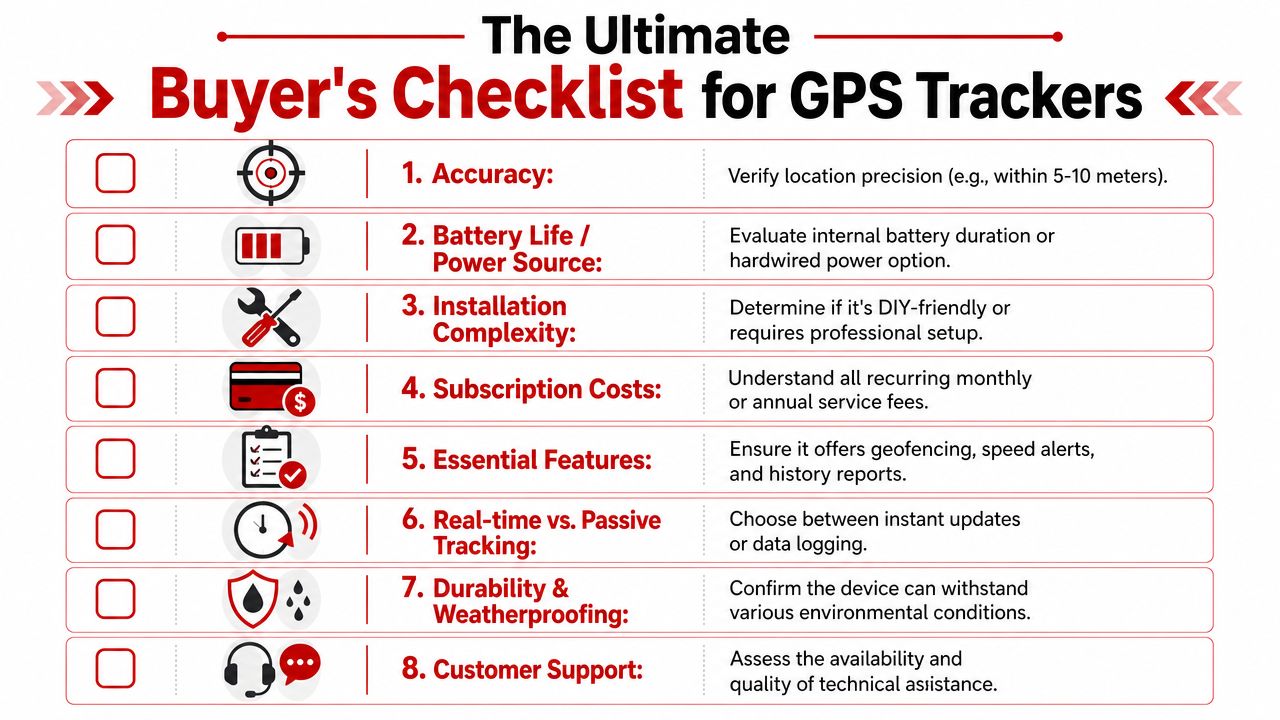
Shopping for a vehicle GPS tracker device can feel harder than it should. Many listings use the same promises, but two trackers that sound similar on a product page can perform very differently once your car is parked outside overnight.
A good checklist separates true vehicle security tools from products that only give the appearance of protection.
Start with installation and power
Your first decision is how the device lives in the car. That affects convenience, visibility, and how likely it is to stay working when you need it.
- OBD-II plug-in models: These are the easiest for many owners. You plug the device into the diagnostic port, pair the app, and start monitoring.
- Hardwired models: These are better if you want the device less visible, but setup is more involved and often calls for an installer.
Power matters just as much as placement. A tracker connected to the vehicle can monitor continuously. A battery-powered tag or portable tracker is more like a flashlight in the glovebox. Useful for short periods, but only while it still has charge and stays where you left it.
Check the features that affect real security
Long feature lists can distract from the basics. Focus on the functions that answer the questions you would have during a real incident.
- Real-time alerts: Look for notifications about movement, ignition, towing, vibration, and tampering.
- Trip history: After something unusual happens, a timeline of where the car went matters.
- Battery monitoring: Helpful if the car sits often or if you want warning signs before a no-start situation.
- Geofencing and speed alerts: Useful for family vehicles, shared cars, and business use.
The test is simple. If the car moves at 2 a.m., will the system warn you quickly and clearly?
Confirm how the tracker sends information
A common point of confusion for buyers is that GPS and Bluetooth are not interchangeable.
GPS determines location. Cellular sends that location to your phone. Bluetooth only works over a short distance and usually depends on nearby phones to help locate an item. For keys, a Bluetooth finder may be fine. For a stolen vehicle across town, it is a poor substitute for a GPS and cellular security device.
That is why the words on the box matter less than the connection method behind them.
Understand what the subscription pays for
A monthly plan can look frustrating until you break down what it covers. Live tracking, alert delivery, cloud-based trip records, and app access all depend on ongoing connectivity and server support.
Compare total function, not just purchase price. CARLOCK is one example of a vehicle-focused system that uses GPS and cellular reporting through an OBD-II device and smartphone app. That is a different category from low-cost Bluetooth finders sold as car trackers.
Buy for the risk you want to reduce. If your concern is theft, towing, or unauthorized driving, fast alerts and dependable reporting matter more than a low upfront price.
Don't ignore privacy and consent
This deserves a place on every buyer's checklist. Some owners focus so much on adding protection that they never ask whether a tracker is already in the car.
A common problem involves dealers or lenders installing location devices on financed vehicles for repossession purposes without clear, informed disclosure. Ownership papers and financing terms do not always make this obvious. In practice, that means a person can buy a car and later discover that someone else still has a way to monitor it. As discussed in this report on hidden dealer trackers and consent concerns, this issue raises serious privacy questions.
Your checklist should include two separate questions: What tracker do I want to install, and is there already a tracker in my vehicle that I never approved?
How to check your own vehicle
You do not need advanced technical skill to do a first inspection. Start with the easy places and work outward.
- Check the OBD-II port area: This is usually under the dashboard on the driver's side.
- Review dealer paperwork: Look for wording about monitoring, connected services, or repossession equipment.
- Inspect under-dash panels: Pay attention to anything that looks recently added or out of place.
- Ask direct questions in writing: If a dealer or lender installed anything, request a clear explanation.
- Get a mechanic or installer to inspect it: Hidden hardwired units are easier for a professional to spot.
The Checklist That Matters
Before you buy, confirm these points:
- Installation fit: Do you want a simple plug-in device or a less visible hardwired setup?
- Alert quality: Will it notify you about the specific events you care about?
- Tracking method: Is it a true GPS and cellular system, or a short-range Bluetooth finder?
- App usability: Can you quickly see location, trip records, and recent alerts?
- Power reliability: Can it keep monitoring without frequent charging?
- Privacy confidence: Do you know whether another tracker is already on the car?
The right device should reduce uncertainty. It should help you understand what your car is doing, who is moving it, and whether your privacy is still your own.
Frequently Asked Questions About Vehicle GPS Trackers
Will a tracker drain my car battery
Most vehicle-focused trackers are designed for low-power operation. The better question is whether the system can also warn you about battery issues, because that adds practical value. If your car sits for long periods, battery monitoring is worth having.
Are vehicle GPS trackers legal to use
Using a tracker on your own vehicle is generally a different matter from placing one on someone else's car without consent. Ownership and authorization matter. If the vehicle title, financing status, or shared use situation is complicated, it's smart to confirm the rules that apply where you live.
What if a thief finds the device and removes it
That's exactly why tamper awareness matters. Some advanced devices can send a final alert when power is cut, which gives you immediate notice that someone interfered with the system. Even if the device is removed, a fast alert can still give you a valuable head start.
Is installation difficult for non-technical owners
Not always. Many OBD-II devices are plug-and-play, which makes them approachable for owners who don't want wiring work. Hardwired models take more effort, but they can make sense when discreet installation is a priority.
Is real-time tracking better than passive tracking
For security use, yes. Real-time GPS tracking transmits data through cellular or satellite networks to a server within seconds, such as 5 to 10 second intervals, while passive tracking stores data on the device until someone downloads it later, as explained in Geoforce's comparison of real-time and passive GPS tracking. If your goal is theft response or immediate awareness, delayed data isn't enough.
Can a vehicle GPS tracker device help beyond theft recovery
Absolutely. It can help with family safety, driver accountability, battery health awareness, and trip verification. For many owners, the daily value ends up mattering just as much as the anti-theft value.
If you want a vehicle security system built for real-time alerts instead of passive item finding, CARLOCK is worth a look. It combines GPS, cellular connectivity, trip history, and smartphone alerts for events like movement, engine starts, towing, tampering, and battery issues, which makes it a practical option for owners who want continuous awareness of what's happening with their car.