

Driver’s Desk
Wheel Theft Prevention That Actually Works in 2026
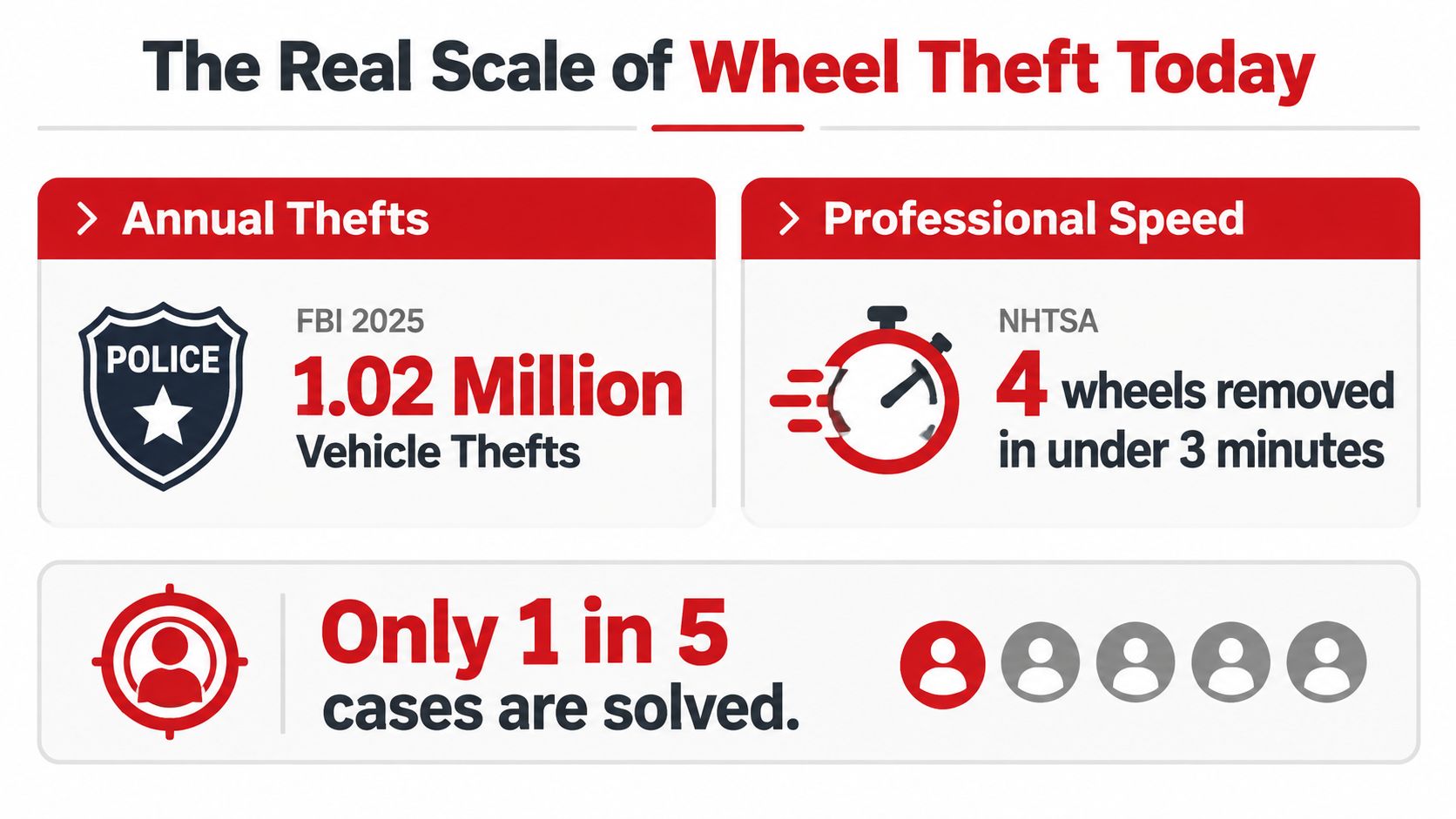
More than 650,000 vehicles were stolen in the United States in 2025, and the National Highway Traffic Safety Administration's theft data records a motor vehicle stolen every 48 seconds that year. Wheel theft prevention belongs inside that larger security problem. Thieves don't need to take the whole vehicle to create a major loss, and a single set of stolen wheels can leave you with damage, towing costs, an insurance claim, and days without transportation.
The practical answer isn't one miracle lock. It's a layered system that makes removal slower, creates noise and visibility, sends an immediate alert when someone jacks or moves the car, and preserves evidence for police and your insurer. The recommendations below focus on what those layers accomplish, where they fail, and how to build protection around the way you park.
The Real Scale of Wheel Theft Today
The FBI's 2025 vehicle-theft figure, more than 650,000 stolen vehicles, shows that vehicle crime remains a persistent national issue. NHTSA's separate benchmark for model years 2004 through 2014 found a median theft rate of 3.5826 thefts per 1,000 vehicles produced, which provides a useful historical baseline for understanding why owners still need more than factory security. See the FBI vehicle-theft release covering national theft data for the broader context.
Wheel theft is one part of the wider vehicle-accessory theft ecosystem. The target may be a premium factory wheel, a high-demand tire, or an aftermarket package that can be removed and resold. The owner absorbs the cost, including replacement parts, suspension or body damage, towing, missed work, and the time required to settle a claim.
The practical standard: Your vehicle doesn't need to become impossible to attack. It needs to become slower, louder, more exposed, and less attractive than the vehicle beside it.
The exact removal time depends on the vehicle, the tools, the parking surface, and whether the crew has selected that particular wheel package in advance. Local safety guidance warns that thieves can remove wheels in under 10 minutes, which is why a silent, single-layer defense is weak. WFTV's wheel-theft safety guidance recommends visible deterrents, bright parking, and cameras alongside wheel locks.
Organized crews also change the risk calculation. France Assureurs' 2025 vehicle-theft ranking reported that thefts fell 9% overall in France while warning that theft was becoming more professional and transnational. That doesn't mean every wheel theft is organized, but it does mean generic advice aimed only at casual opportunists leaves a gap.
A sensible prevention plan therefore has three jobs:
- Delay removal: Use physical barriers that require a thief to spend more time and apply more force.
- Detect tampering: Use tilt, vibration, movement, and disconnection alerts that reach you quickly.
- Support recovery: Preserve location history, photos, ownership records, and insurance documentation.
None of those layers guarantees safety. Each one should increase the thief's effort, raise the chance of interruption, or improve the evidence trail after the crime.
For vehicle owners who want the detection layer explained separately, this guide to GPS vehicle security awareness is a useful starting point.
Physical Deterrents That Buy You Time
Locking wheel nuts replace one or more ordinary lug nuts with uniquely patterned fasteners. A matching adapter is required for removal, so a thief can't use an ordinary socket immediately. That mechanism is valuable, but only as a delay tactic. Chase's explanation of wheel locks makes the essential point: the lock creates a tool and access problem, not an absolute barrier.
The quality and configuration matter. A cheap, shallow-pattern lock can be defeated with specialized extraction equipment, while a better-designed lock creates more time, noise, and uncertainty. Replacing only one lug per wheel still leaves ordinary fasteners available to remove first. A full locking-lug arrangement creates more work because the thief can't quickly clear most of the wheel before confronting the lock.
Installation is part of the security system
Use a torque wrench, not an impact wrench, when installing locking wheel nuts. The correct torque is vehicle-specific. A Mazda owner manual, for example, lists wheel-nut tightening torque at 108 to 147 N·m, or 80 to 108 ft·lbf, as documented by Elite Wheel Warehouse's wheel-lock guidance. That isn't a universal setting for every car.
Over-tightening can damage the fastener, stud, wheel seat, or locking pattern. Under-tightening can allow movement and create a service problem. Have the installer follow the manufacturer's specification, then keep the adapter available for tire service without storing it in an obvious location such as the glove compartment.
The adapter is a common failure point. Owners misplace it, leave it with a previous set of wheels, or forget to tell a repair shop that the vehicle uses locking nuts. RAC guidance on locking wheel nuts recommends periodic inspection every 6,000 to 12,000 miles, or at least annually. Another practical check is to re-check torque after approximately 50 to 100 miles following installation or wheel service, as recommended in the same guidance.
| Deterrent Type | Average Defeat Time | Price Range | Best Use |
|---|---|---|---|
| Standard keyed wheel lock | Can be defeated quickly with specialized tools | Varies by vehicle and brand | Basic visible deterrence |
| Higher-quality locking nuts | Slows removal and demands the correct adapter or extractor | Varies by design and vehicle | Everyday passenger vehicles |
| Full locking-lug configuration | Creates multiple locked fasteners per wheel | Varies by wheel and lug count | Higher-risk vehicles and valuable wheel packages |
| Wheel clamp or boot | Restricts wheel movement and provides visible warning | Varies by size and construction | Temporary or supplementary protection |
Don't confuse a wheel clamp with a locking wheel nut. A clamp or boot acts on the tire and is more suitable for trailers, caravans, storage situations, or temporary immobilization. It can be visible and useful, but it doesn't secure the vehicle's wheel fasteners and may be bypassed by someone prepared to remove the wheel or attack another part of the setup.
For properties, workshops, and fleet yards, physical devices work better when paired with broader surveillance. A resource on video security systems for business can help owners evaluate camera coverage beyond a single driveway view. Inside the vehicle, a connected alarm can add a separate warning layer, as outlined through the CARLOCK car alarm resource.
My verdict is straightforward. Physical locks don't stop a determined crew. They can stop an opportunist, and they can buy the minutes needed for lighting, witnesses, cameras, or an electronic alert to change the outcome.
Parking, Lighting, and Visible Security Layers
Parking determines how useful your physical hardware will be. A wheel lock on a vehicle parked in an isolated, dark area gives a thief privacy. The same lock on a curb-side vehicle in a visible, well-trafficked location forces a different decision because access is harder and observation is more likely.
A garage is the strongest routine option when it's used and secured. A private driveway offers more control than public street parking, but it still benefits from lighting and camera coverage. Apartment lots and urban streets create more uncertainty, so the vehicle needs visible deterrence and rapid detection rather than reliance on a lock alone.
Make the vehicle difficult to work around
Park close to the curb where appropriate, and turn the wheels so access to the lug area is less convenient. Don't block emergency access or violate local parking rules, but remove the clean, open working position that a thief wants. In a driveway, park where a camera can see the vehicle and where a neighbor or passing driver can notice activity.
Lighting should illuminate the vehicle, the ground around it, and the likely approach path. Motion activation is useful because a sudden change in brightness can expose activity and draw attention. Keep fixtures high enough to resist easy tampering, but aim them to avoid glare that washes out camera footage.
Visible cameras deter some opportunistic thieves. Their placement matters more than owning one. A camera should capture the approach, the vehicle, and identifying details such as the plate, while a second angle can record the side where wheel access is easiest. Hidden cameras can support prosecution, but visible cameras influence the thief before removal begins.
VIN etching and other ownership markings won't physically prevent removal. They can make resale and identification more difficult and give investigators stronger evidence. Mark the vehicle and retain photographs of the wheels, brand details, and distinctive damage or design features.
| Parking Scenario | Recommended Layers | Expected Delay |
|---|---|---|
| Suburban driveway | Locking wheel nuts, camera coverage, motion lighting, electronic movement alerts | Adds time and increases exposure |
| Apartment lot | Quality wheel locks, visible camera coverage, well-lit parking, rapid phone alerts | Makes a quiet attack harder to complete unnoticed |
| Urban street parking | Locking hardware, curb-side positioning, busy lighting, movement detection, documented wheel markings | Raises effort and improves early warning |
Parking strategy works because it changes the thief's environment. GEICO's wheel-protection guidance specifically recommends well-lit or garage parking, keeping the wheel-lock adapter away from the glovebox, and combining locks with other controls.
Electronic Detection and Recovery That Actually Helps
A passive alarm reacts after the vehicle detects a disturbance, usually by sounding a siren. That can help, but noise alone isn't enough. People ignore alarms, the owner may be too far away to respond, and a crew can finish before anyone identifies the source.
Active electronic detection changes the sequence. Instead of learning about the problem after discovering the car on blocks, you receive information while the vehicle is being lifted, moved, started, or disconnected. That warning gives you a chance to call police, contact a property manager, check a camera, or direct responders to the vehicle's location.
Match the sensor to the theft method
For wheel theft, prioritize sensors that recognize:
- Tilt: Detects the vehicle's angle changing as a jack lifts one side.
- Vibration: Identifies impact, tool use, or repeated movement.
- Jacking motion: Helps distinguish ordinary contact from lifting activity.
- Vehicle movement: Shows that the car has changed location.
- Device disconnection: Warns that someone may be tampering with the tracker or power source.
Alert speed matters. A notification that arrives while the vehicle is still at the parking location has practical value. A notification received long after the car has been stripped or transported mainly supports the record afterward. Test alerts yourself, because phone permissions, weak signal, dead batteries, and quiet hours can turn a capable system into an ignored one.
Hardwired or vehicle-powered GPS equipment is generally better suited to continuous vehicle monitoring than a small item tracker that depends on nearby phones. Battery-powered magnetic trackers can be useful as supplementary devices, but their battery condition, mounting security, and reporting interval need regular checks. Bluetooth fobs can identify a nearby item through compatible phones, but they aren't equivalent to a dedicated cellular and GPS vehicle-security system.
| Tracker Type | Alert Speed | Monthly Cost | Recovery Odds |
|---|---|---|---|
| Cellular GPS tracker | Real-time or near-real-time, depending on service and signal | Usually subscription-based | Strongest recovery support when alerts and location data are acted on |
| Bluetooth tracker | Depends on nearby compatible devices | Often no dedicated subscription | Limited by proximity and surrounding device coverage |
| Alarm-only system | Immediate local siren, with no inherent remote location history | Varies by system | Useful for interruption, weak for tracking after movement |
For a vehicle owner comparing dedicated tracking with item-finder technology, CarLock's car-tracking information explains the difference between movement alerts, GPS location, and connected monitoring. The important distinction isn't branding. It's whether the device can tell you where the vehicle is after it leaves the original parking spot.
My ranking is candid. A tilt-capable connected tracker changes the recovery equation most. A properly configured alarm is valuable for immediate attention. A Bluetooth tracker is better than having no location clue, but it shouldn't be treated as a primary anti-theft system for a vehicle.
Insurance, Reporting, and What to Do After a Theft
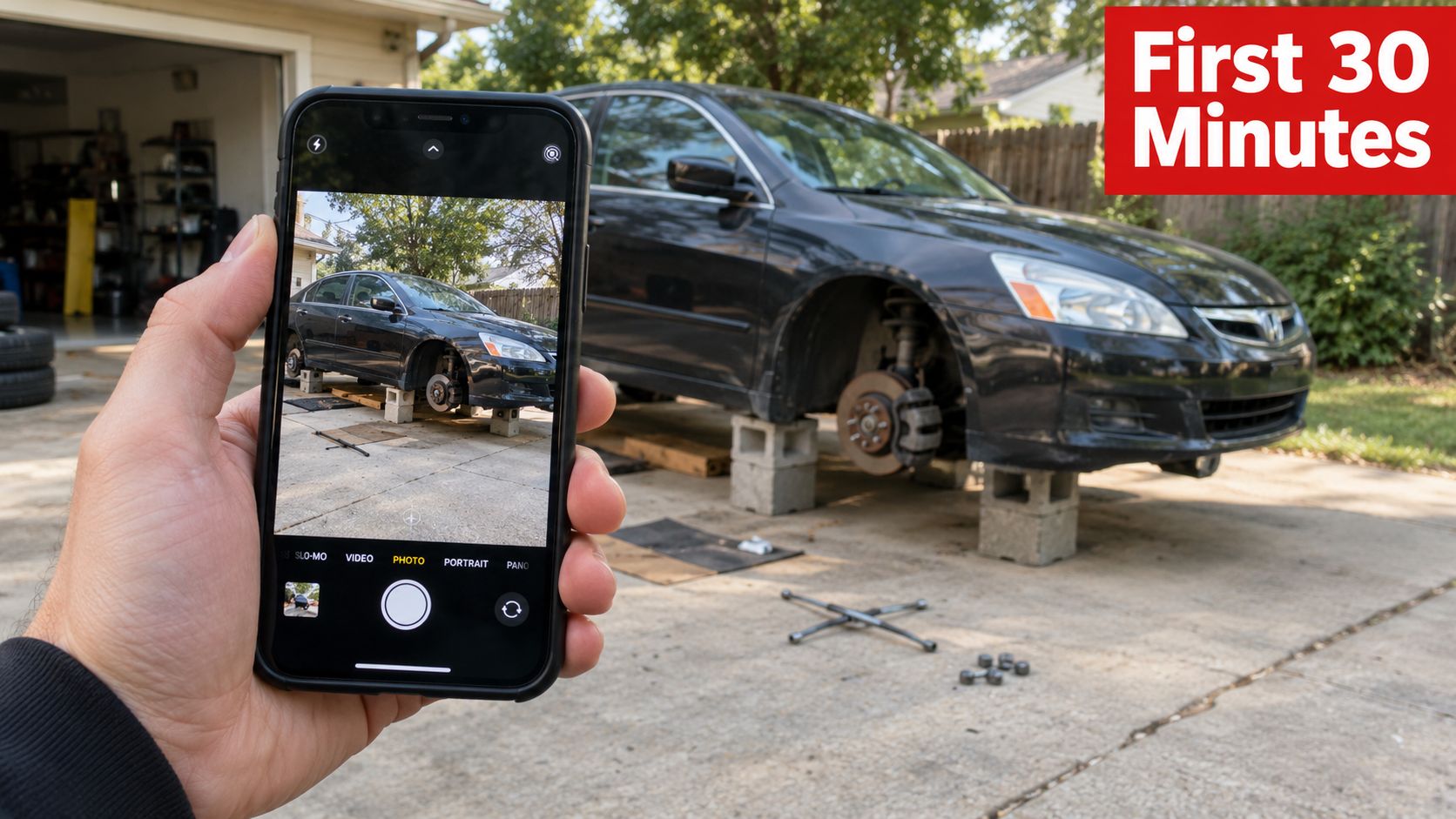
You wake up and find the vehicle resting on blocks. The first mistake is touching anything. Don't move the car, remove the blocks, or begin cleaning up before creating a record of the scene.
Start with wide and close photographs. Capture the vehicle's position, the blocks, damaged bodywork, missing wheels, loose parts, tool marks, and the surrounding parking area. Keep the scene undisturbed until you've documented it and confirmed what your insurer and police need.
The first response sequence
- Photograph the scene: Record the condition before moving the vehicle or its parts.
- Contact police: Provide the VIN, plate information, wheel description, tire markings, and the location.
- Call the insurer: Ask what documentation and towing process the policy requires before authorizing repairs.
- Arrange safe transport: Don't drive a vehicle that has been left on blocks. Use a suitable tow service and protect exposed components.
- Preserve digital evidence: Save camera stills, alert notifications, location records, and timestamps.
Theft-related losses are commonly covered, subject to policy terms and the deductible. Liability-only coverage generally does not pay for theft damage to your own vehicle. Aftermarket wheels may require a custom-parts or equipment endorsement, so check the wording before a loss rather than assuming the factory policy limit reflects what you installed.
Your deductible also affects the practical value of a claim. A deductible of $500 or more can make a smaller loss less attractive to file, while a higher-value wheel package may justify the claim and the resulting administrative work. Don't make that decision from memory. Ask the insurer how wheels, tires, related damage, towing, and aftermarket equipment are treated.
Documentation wins disputes: Keep purchase receipts, installation records, wheel-brand details, photographs, and any serial or identifying markings in a cloud folder before theft occurs.
Location history can support the timeline. A service with GPS route-history records may help show where the vehicle was parked, when it moved, and whether an alert preceded the discovery. That record doesn't replace a police report or proof of ownership, but it can make the account more precise.
Before theft, engrave or mark the VIN and wheel-specific identifiers where practical, and photograph the markings. NICB's vehicle-theft prevention guidance supports visible identification and ownership documentation as part of prevention and recovery. Markings won't stop removal, but they can improve the connection between recovered property and its owner.
Building Your 30-Day Wheel Theft Prevention Plan
A good plan starts with the layer that acts directly on the wheel, then improves the environment, then adds detection and documentation. Don't buy a collection of devices without testing how they work together. The goal is a system that remains usable when you need a tire change, a tow, a police report, or an insurance claim.
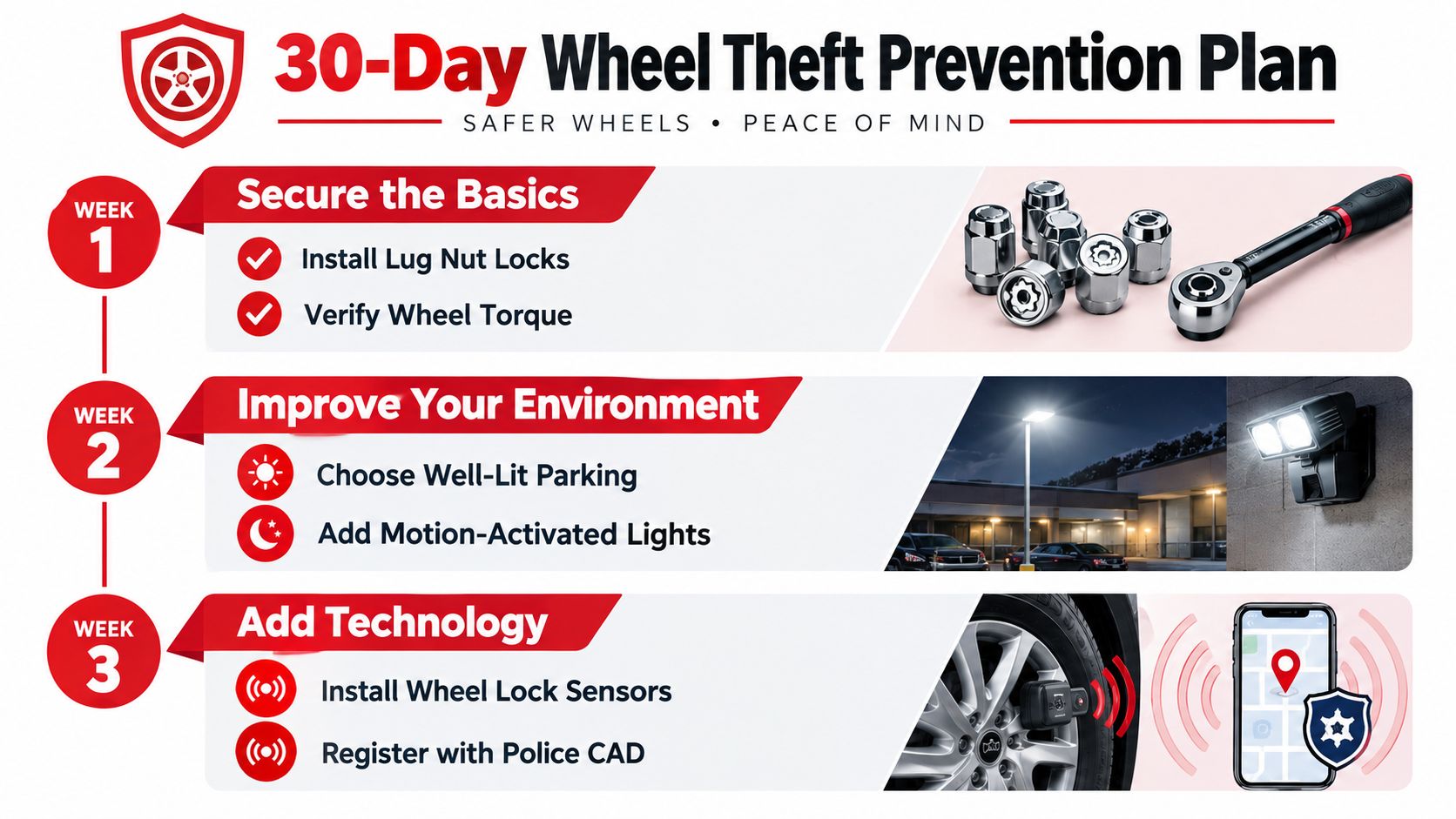
Week one, secure the hardware
Install quality locking wheel nuts or a full locking-lug configuration using the manufacturer's torque specification. Confirm that the adapter fits cleanly, record its key code, and store the adapter somewhere secure but accessible during maintenance. After the initial driving period, verify the torque as recommended by the installer or vehicle guidance.
Week two, improve the parking environment
Choose the most visible legal parking position available. In a driveway, add motion-activated lighting and adjust cameras to cover the vehicle, approach path, and plate. On the street or in an apartment lot, favor busy, illuminated areas and avoid leaving the vehicle in the same isolated position every night when you have a safer alternative.
Week three, add electronic detection
Install a connected tracker or configure your existing alarm with tilt and movement sensitivity. Set alerts for unauthorized movement, engine activity, unusual vibration, towing or jacking behavior, and device disconnection when the system supports those functions. Test the alert route with your phone, confirm that notifications arrive promptly, and make sure another trusted contact knows what the alert means.
Week four, verify recovery and proof
Review coverage, aftermarket wheel protection, deductibles, towing terms, and documentation requirements. Photograph all four wheels, save receipts, record identifying marks, and engrave the VIN or another ownership marker where appropriate. The CARLOCK app features can also be reviewed when configuring notifications, trip records, and vehicle activity monitoring.
Use this monthly checklist:
- Lock access: Confirm the wheel-lock adapter is present, labeled, and stored away from obvious hiding places.
- Fastener condition: Inspect the locking nuts for damage and re-torque after tire rotations or wheel service.
- Tracker health: Check power, battery condition, cellular reporting, and current notification permissions.
- Alarm sensitivity: Test tilt and vibration settings without leaving the system so sensitive that routine activity creates constant false alerts.
- Camera retention: Confirm that recent footage is still available and that the camera view hasn't shifted.
- Records: Update wheel photographs, receipts, and ownership markings after any wheel or tire change.
Every quarter, update emergency contacts, review the preferred parking locations, rotate habits that make the vehicle predictable, and re-check geofences. Security degrades when batteries fail, camera storage fills, adapters disappear, and alerts become background noise. A short recurring review keeps the system operational instead of symbolic.
CARLOCK gives vehicle owners connected movement, vibration, engine-start, tamper, and location alerts that can support wheel theft prevention when a vehicle is lifted or moved. Visit CARLOCK to evaluate a real-time vehicle-security setup and add detection and recovery support to your physical wheel protection.