

Driver’s Desk
Choosing the Best Prevent Car Theft Device for Your Car
A modern prevent car theft device is more than just a smart accessory; it’s an essential shield for your vehicle. According to the National Insurance Crime Bureau (NICB), over one million vehicles were reported stolen across the United States in 2023, representing a loss of billions of dollars for consumers. The factory-installed alarm your car came with simply can’t keep up with today's tech-savvy criminals, making a layered defense of trackers and immobilizers the only real way to protect your investment. Let's walk through the most effective tools to keep your car right where you parked it.
Why Your Car's Factory Alarm Is No Longer Enough
In an era of keyless entry and push-to-start ignitions, that familiar chirp from a factory alarm offers a dangerously false sense of security. While these built-in systems were once a decent deterrent, professional thieves now see them as a minor hurdle they can easily overcome. The game has changed, and our defenses need to change with it.
Modern car theft isn't about brute force anymore; it's a high-tech operation. Criminals now use sophisticated gadgets that bypass standard security measures silently and in seconds.
The Rise of High-Tech Theft
Two of the most common methods thieves use today are relay attacks and CAN bus hacking. A relay attack is shockingly simple: a thief uses a device to capture the signal from your key fob inside your house, amplifies it, and tricks your car into thinking the key is right next to it. The entire process can take less than a minute, and they never even have to touch your keys.
CAN bus hacking is even more invasive. Thieves tap into your car's internal computer system—the Controller Area Network—to send commands that unlock the doors and start the engine. They can gain access through vulnerable points like the wiring in your headlights, making a traditional alarm completely useless.
According to data from the FBI, a vehicle was stolen every 32 seconds in the United States in 2023. That staggering statistic highlights the very real threat every car owner faces. Relying on outdated security is a gamble, and the odds are not in your favor.
A Growing Market for Better Security
The alarming rise in sophisticated theft has created a huge demand for better security solutions. This is reflected in the global anti-theft system market, which was valued at around $17.75 billion in 2024. Projections show it climbing to $28.34 billion by 2034, all thanks to rising theft rates and smarter consumers. You can dig into the numbers yourself over at Precedence Research.
This growth points to a critical reality: a simple factory alarm just doesn't cut it anymore. To truly protect your car, you need to think in layers—combining visible deterrents with silent, intelligent monitoring. You can learn more about how an advanced car alarm system provides comprehensive protection. A modern prevent car theft device is your vehicle's silent guardian, giving you the real-time alerts and tracking that factory systems could never offer.
Comparing Different Types of Car Security Devices
Navigating the world of car security can feel overwhelming. The options range from old-school physical locks you can hold in your hand to silent, high-tech trackers that work behind the scenes. Each prevent car theft device operates on a different principle, offering its own unique set of strengths and weaknesses.
Getting a handle on these core differences is the first real step toward building a security strategy that actually protects your vehicle.
This infographic breaks down the main security options available to car owners today.
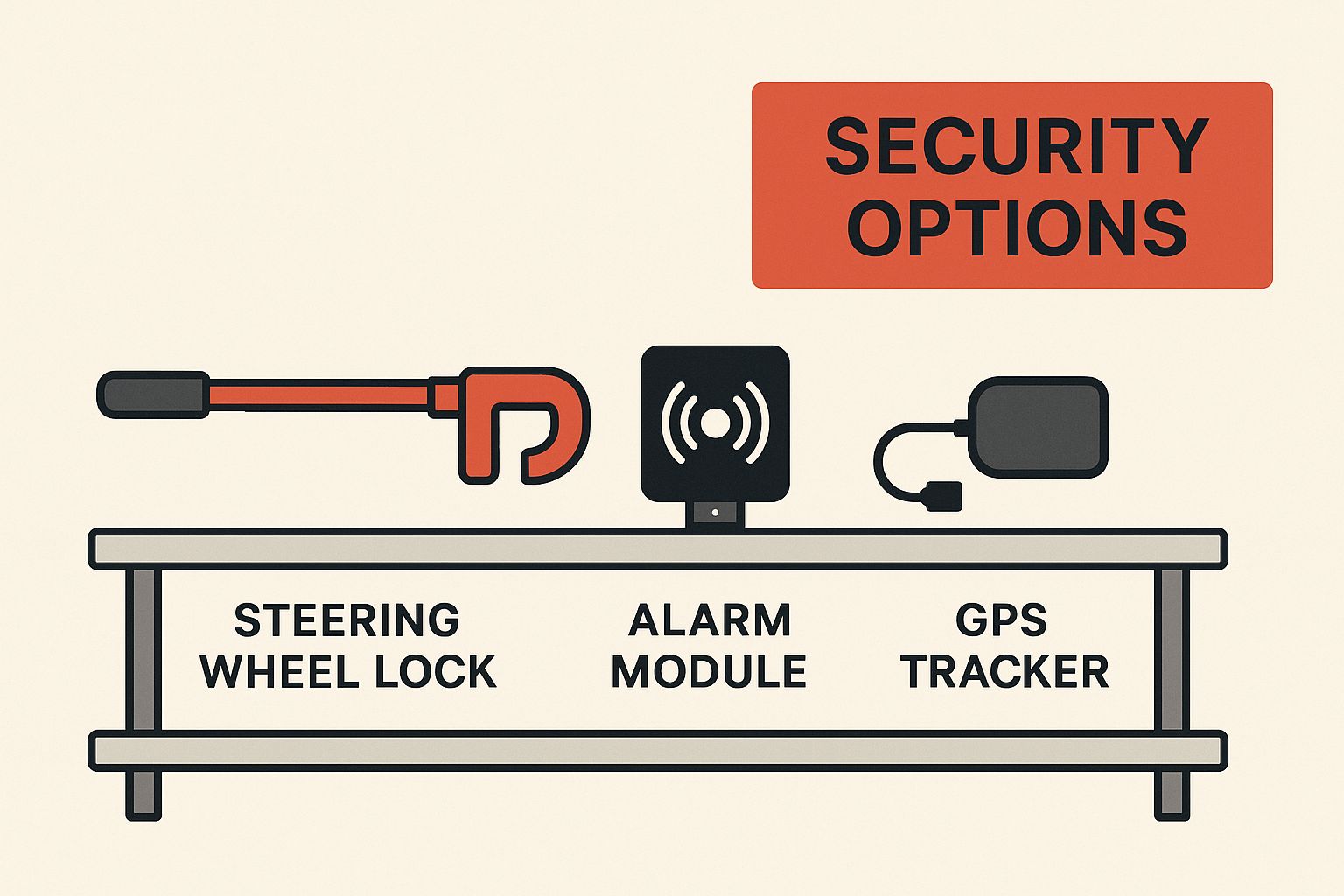
As you can see, the choices progress from simple, visible deterrents all the way to complex electronic monitoring systems. Let's dig into what that really means for you.
Mechanical Immobilizers: The Visible Deterrent
Mechanical immobilizers are your classic, first line of defense. These are physical devices you manually attach to your vehicle to stop it from being driven. Think of them as a big, loud "Keep Out" sign for would-be thieves.
The most common examples include:
- Steering Wheel Locks: These bar-style locks clamp right onto the steering wheel, making it impossible to turn. Their bright, obnoxious colors make them highly visible from outside the car.
- Brake or Clutch Locks: These devices fit over the brake or clutch pedal, preventing them from being pushed down and rendering the car undrivable.
- Tire Claws: While you see these less on personal cars, these heavy-duty clamps lock around a wheel, physically stopping it from rotating.
The biggest benefit here is their power as a visual deterrent. An opportunistic thief looking for an easy target will likely skip a car with a visible lock and move on. Their weakness, however, is that a determined criminal with the right tools and enough time can often cut right through them.
Electronic Security Systems: The Digital Gatekeeper
Next up are the electronic security systems, which are standard equipment on most modern vehicles. These systems use your car's own electrical network to prevent unauthorized use. They act as a digital gatekeeper, only granting access when they see the correct credentials.
This category includes factory-installed alarms and engine immobilizers. An engine immobilizer is a security feature that prevents the engine from starting unless the correct transponder key is used. A chip inside your key sends a unique code to the car's computer. If the codes match, the car starts. If not, the engine stays dead.
These systems are pretty effective against amateur thieves who still rely on old-school hot-wiring. But as we've discussed, professionals can bypass them using relay attacks or by hacking into the car's CAN bus. They're a good foundational layer, but they're no longer enough on their own.
Advanced Tracking Systems: The Silent Guardian
This brings us to the final and most powerful category: advanced tracking systems that use GPS and cellular technology. Unlike alarms that just make noise or locks that can be broken, these devices act as your vehicle's silent guardian, giving you real-time intelligence and the power to recover your car.
In 2020, motor vehicle theft resulted in $7.4 billion in losses in the U.S. alone, according to the FBI's Uniform Crime Reporting Program. A huge chunk of that comes from vehicles that are never recovered. Advanced trackers drastically improve the odds of getting your car back.
GPS trackers are small devices that transmit your vehicle's precise location to an app on your smartphone. They can alert you instantly to suspicious activity, such as:
- Unauthorized Movement: You get a notification the second your car moves without your knowledge.
- Engine Start: The system alerts you if someone starts the engine, even with a cloned key.
- Vibration Detection: You’re notified of potential break-in attempts if the device senses unusual vibrations.
This immediate feedback is what truly sets trackers apart. While an alarm might scare a thief away for a moment, a tracker gives you and law enforcement the exact location needed for a swift recovery. A high-quality GPS tracker is the ultimate prevent car theft device because it turns a potential theft into a solvable problem.
To give you a clearer picture, let's compare these device types side-by-side.
Comparison of Car Theft Prevention Device Types
| Device Type | Primary Function | Pros | Cons | Typical Cost Range |
|---|---|---|---|---|
| Mechanical Locks | Physically prevents operation (steering, brakes). | Highly visible deterrent, low cost, no battery drain. | Can be defeated with tools, can be cumbersome to use. | $30 – $150 |
| Electronic Alarms | Makes loud noise to scare thieves and alert public. | Standard on most cars, integrated with key fob. | Often ignored (false alarms), can be bypassed by pros. | $150 – $500 (aftermarket) |
| GPS Trackers | Provides real-time location tracking and alerts. | Swift recovery, instant notifications, advanced features. | Requires a subscription, can be found and disabled. | $50 – $200 + Subscription |
Ultimately, by combining different layers of security, you create a formidable defense that protects your vehicle from every angle.
How Vehicle Security Has Changed Over the Years
The world of vehicle security has always been a game of one-upmanship. For a long time, the game moved slowly. A simple, loud car alarm was considered top-of-the-line defense. But as technology got smarter, so did the thieves. This constant back-and-forth has forced security technology to evolve at a dizzying speed.
What started as a basic mechanical lock or a shrieking siren has morphed into a sophisticated digital network. The old-school car alarm has been replaced by silent, intelligent systems that talk directly to you, right on your phone. This change reflects how cars themselves have evolved from simple machines into connected computers on wheels.
The biggest shift? Moving from reactive to proactive security. An old alarm only screams after a window is already smashed. A modern prevent car theft device spots the threat and empowers you to act before your car is even a block away.
From Simple Alarms to Smart Systems
The journey started with basic alarms—the kind that would go off if a door was pried open or glass was broken. They worked against amateur thieves, but professionals learned to disarm them in seconds. Then came engine immobilizers, a big leap forward that used a chip in the key to prevent the engine from starting without it.
But thieves adapted. They developed tools for "relay attacks" and CAN bus hacking to trick these digital systems. This constant pressure pushed the industry to create the multi-layered security we see today. The goal isn't just to make noise anymore; it's to create a silent, unbreakable link between you and your vehicle.
The heart of modern car security is constant communication. If your security system can't tell you what's happening in real-time, it's already one step behind today's car thieves.
This fundamental need for instant, reliable information is what drove the development of features that would have sounded like something out of a spy movie just a decade ago.
The New Frontier of Vehicle Protection
Today's vehicle security is all about creating multiple layers of defense. The industry is embracing advanced solutions that make a thief's job exponentially harder.
We're seeing things like biometric scanners (fingerprint and facial recognition) and multi-factor authentication become more common. Porsche, for example, now offers GPS-assisted anti-theft protection that sends alerts from various sensors straight to your phone. Back in 2018, Nissan even showed off its 'Xmotion' concept, which used fingerprint ID to secure the vehicle. You can see how these trends are shaping the entire vehicle anti-theft system market.
These advancements all point to one thing: security is becoming deeply personal and baked into the car's DNA. It's not just an accessory anymore; it's part of the car's very identity.
This relentless evolution drives home a critical point for every car owner. As thieves get more sophisticated, your security has to keep up. Relying on decade-old technology is like bringing a padlock to a digital fight. A modern prevent car theft device isn't a luxury—it's a necessary upgrade to stay ahead of criminals who are always looking for an easy target.
How GPS Trackers Revolutionize Vehicle Recovery
While a good old-fashioned steering lock is a nice visual warning and a factory alarm makes a lot of noise, neither one can answer the one question you really have after a theft: Where is my car right now?
This is where a modern GPS tracker completely changes the game. It shifts the entire focus from just hoping a thief gets scared off to actively recovering your vehicle in real-time. You're no longer a passive victim; you're an active participant in getting your car back.
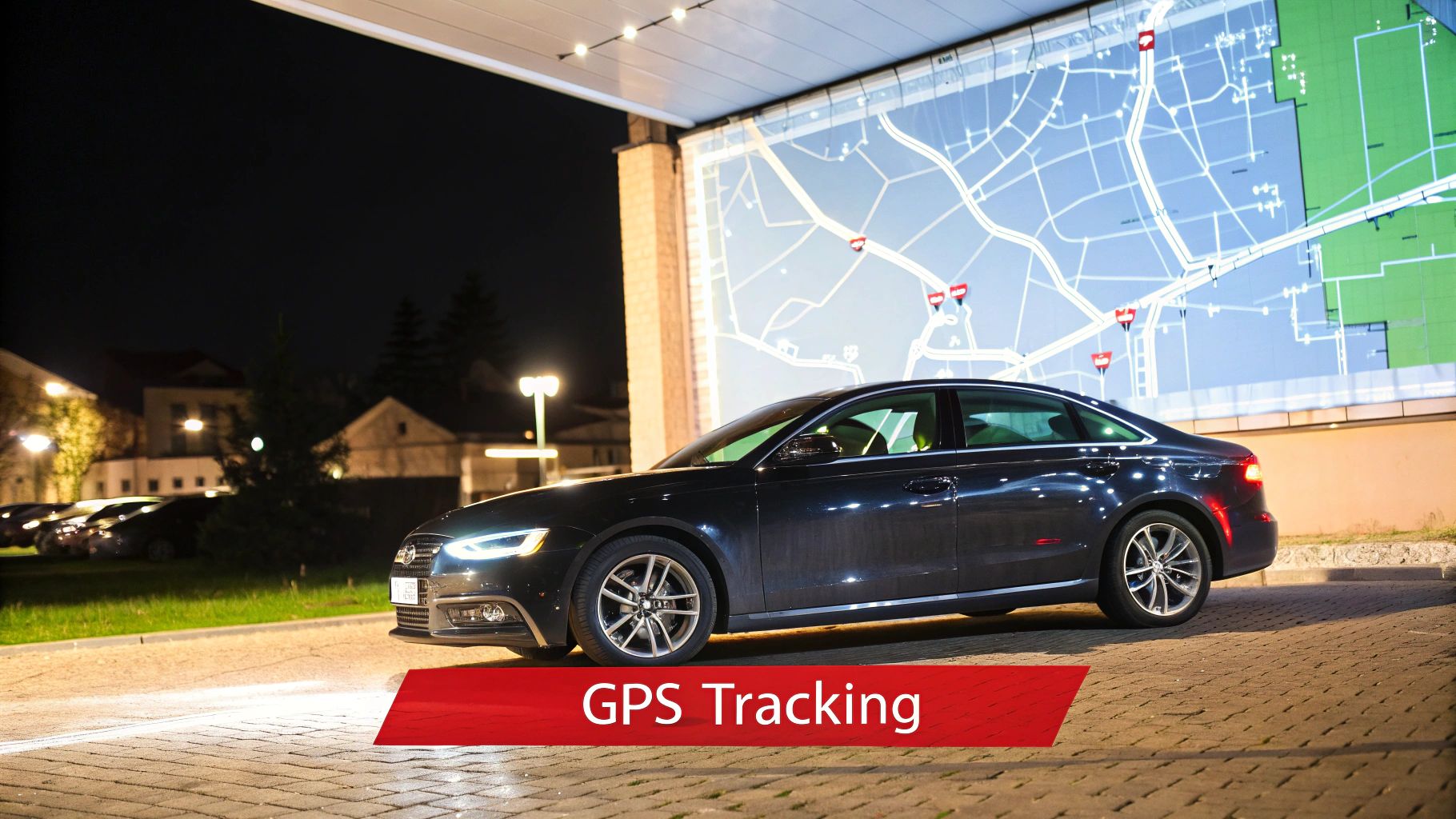
Unlike passive security, a GPS-based prevent car theft device is your eyes and ears on the ground. It uses the Global Positioning System to lock onto its exact coordinates, then uses the cellular network to send that location straight to an app on your phone. Think of it as a constant, invisible link between you and your car, no matter where it goes.
Real-Time Intelligence for a Fast Recovery
The true power of a GPS tracker is the actionable intelligence it gives you. Instead of just knowing your car is gone, you get a whole suite of tools designed for an immediate, informed response. This is so much more than just a dot on a map.
Key features that truly empower car owners include:
- Geofencing Alerts: You can draw virtual fences around important places, like your home or office. The second your car crosses that line without permission, you get an instant alert on your phone.
- Speed Monitoring: Worried about a joyride? Set a maximum speed limit. If a thief—or maybe your teenager—goes over it, you'll know immediately.
- Historical Route Data: The tracker logs the car's entire journey, complete with timestamps. This detailed trip history is pure gold for the police, often revealing the thief's patterns, hideouts, or final destination.
These tools turn a helpless, gut-wrenching situation into one where you have concrete information and a measure of control. In some complex cases, this data can even be supplemented by professional private investigator services who can use the information to assist law enforcement.
According to the NICB, a vehicle theft results in an average loss of $9,166, and a shocking number of stolen cars simply vanish forever. A GPS tracker flips the odds dramatically in your favor, turning a potential total loss into a temporary headache.
The Real-World Difference: Alarms vs. Trackers
Let's play out a scenario. It's 2 AM, and a thief smashes your car window. The factory alarm starts blaring, lights flash, and maybe a neighbor sleepily peeks outside before shrugging and going back to bed. The thief, annoyed but not stopped, yanks a few wires to kill the siren and disappears into the night. When you wake up, your car is gone, and all you can do is file a police report with a vague "sometime last night" timeline.
Now, let's rewind. Same scenario, but with a GPS tracker hidden in your car. The moment the thief starts the engine or even just shakes the car violently, you get a quiet, urgent alert on your phone. You immediately open the app and see your car's icon moving down the street. You can track its every turn, feeding law enforcement live, pinpoint updates. This allows police to intercept the car quickly—often within minutes or hours, not days.
This is exactly how an advanced car locator system works. The comparison couldn't be starker. One device makes noise; the other provides answers. In the modern fight against car theft, a reliable GPS tracker is the single most powerful tool for making sure your car comes home.
Introducing CarLock: The Smart Car Security Solution
We've walked through the old-school ways of securing a vehicle, from simple mechanical locks to the more modern GPS trackers. But it's pretty clear that a real defense in today's world needs more than just one layer of protection. This is exactly where a complete monitoring system like CarLock comes into the picture.
CarLock isn't just another gadget. It's a direct line of communication between you and your car, moving way beyond generic features to give you real-world, actionable intelligence.
Think of CarLock as your car's silent guardian. It's designed to alert you to threats before a thief can finish the job, giving you that critical window to react. This proactive approach is what truly separates a smart security solution from a traditional, reactive alarm that just makes a lot of noise.
Here's a quick look at the CarLock interface. You can see how clean and straightforward it is to keep an eye on your vehicle.
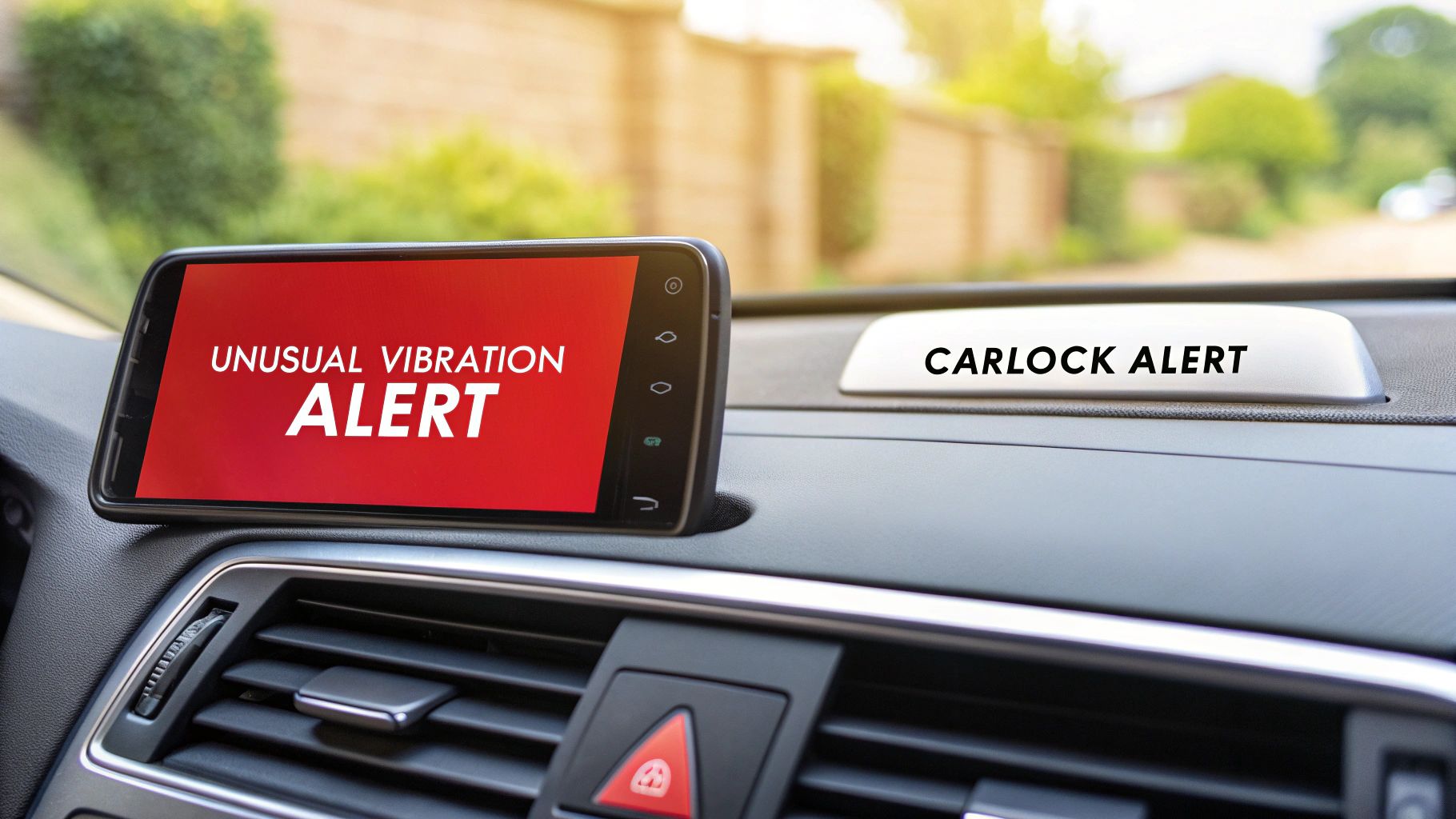
Everything is built around a user-friendly app that puts your car's status and location right at your fingertips.
Proactive Alerts That Actually Make a Difference
Picture this: a thief is trying to break into your car. Instead of a blaring alarm that your neighbors will probably just ignore, CarLock sends a quiet but urgent notification straight to your phone: "Unusual vibrations detected." This alert often goes off at the very first sign of trouble—like someone messing with the lock or smashing a window—giving you a crucial head start.
The whole system is built around these critical, real-time notifications:
- Engine Started Alert: Did someone manage to start your engine, maybe even with a cloned key? You'll know the second it happens.
- Vehicle Moved Alert: You get a notification the moment your car starts moving without you in it, letting you track it from the very first second.
- Device Disconnected Alert: This one is a game-changer. If a thief finds the CarLock device and yanks it from the OBD-II port, the system fires off one last alert to let you know it's been tampered with. This completely foils any attempt to disable the tracker silently.
CarLock transforms your smartphone into an advanced security hub, delivering instant alerts that a traditional car alarm just can't compete with. It’s about keeping you informed, not just making noise.
These alerts aren't just a bulleted list of features; they're practical tools designed to give you back control in a seriously stressful situation. They deliver the specific information you need to act fast. You can dive deeper into the full range of CarLock's app-based features and see how they all work together.
More Than Just a Car Theft Prevention Device
While its number one job is stopping theft, CarLock is a complete vehicle management solution that brings peace of mind to your daily life. This is especially useful for families or anyone who shares their car.
For instance, parents can get alerts for harsh driving—think rapid acceleration, hard braking, and sharp turns. This makes CarLock a fantastic tool for coaching new teen drivers and encouraging safer habits on the road.
On top of that, the system keeps an eye on your car’s electrical system. It will let you know if your vehicle’s battery is running dangerously low, a pre-emptive warning that could save you from being stranded somewhere with a dead battery.
The demand for this kind of connected security is exploding. The global automotive anti-theft device market is set to grow with a compound annual growth rate (CAGR) of around 7% from 2025 to 2033, driven by new tech in GPS tracking and smartphone integration.
Ultimately, CarLock is both a comprehensive prevent car theft device and a full-circle car management system, putting security, safety, and awareness right in the palm of your hand.
Common Questions About Car Theft Prevention
Even after you've got a good handle on the tech, some practical questions always pop up when you're about to choose a prevent car theft device. Investing in your vehicle's security is a big deal, so it's only natural to have questions about things like your car's warranty, how the devices actually work in the real world, and any ongoing costs.
Let's clear the air and tackle some of the most common questions we hear from car owners looking to seriously upgrade their security.
Will an Aftermarket Device Void My Warranty?
This is probably the biggest worry we hear, but for most modern gear, it's a non-issue. If you go with a system that simply plugs into your car’s OBD-II port, like CarLock, the answer is a straightforward no. These devices are specifically designed to be non-invasive; they just read data from your car's computer without messing with any of its wiring or software.
They are completely "plug-and-play," meaning you can pop it in or pull it out in seconds without leaving a single trace. Now, if you're looking at something that needs to be hardwired by cutting into your car's factory wiring (like some old-school immobilizers), then yes, that could potentially cause a warranty headache. For those, you'll definitely want to check your manufacturer's policy and have a certified pro do the work.
Peace of mind comes from knowing all the facts. A non-invasive, OBD-II tracker is the safest way to add powerful security without risking your vehicle’s factory warranty.
How Effective Are GPS Trackers Against Jammers?
It's true, GPS jammers are out there, but their use by your average car thief is blown way out of proportion. These things are illegal in most places and aren't exactly part of the standard toolkit for an opportunistic crook. Still, any top-tier prevent car theft device is built with this threat in mind.
Advanced systems like CarLock have a smart backup plan. If the GPS signal gets blocked, the device can switch to using cellular tower triangulation to get an approximate location. Even better, CarLock sends you an immediate "Device Disconnected" or signal loss alert right to your phone. This means you know the second someone tries to tamper with it, giving you a crucial head start.
Want to dive deeper? You can find more answers in our full list of frequently asked questions about GPS trackers.
Are There Ongoing Subscription Costs?
The cost structure really depends on the device. A simple mechanical lock, like a steering wheel club, is a one-and-done purchase. No monthly fees there.
But for a real-time GPS tracking system to do its job, a small subscription is essential. This fee covers the cellular data for the SIM card that's built right into the tracker. It’s what lets the device talk to the network, pinpoint its location, and fire off those instant alerts to your smartphone, 24/7. It's less of a "fee" and more like a tiny insurance policy that keeps your lifeline to your car active and secure.
Ready to secure your vehicle with the smartest prevent car theft device on the market? CarLock offers real-time tracking, instant alerts, and a non-invasive setup that gives you complete peace of mind. Protect your investment today by visiting https://www.carlock.co.