

Driver’s Desk
Top 10 Best Car Alarm with GPS Tracking for Maximum Security
Finding the best car alarm with GPS tracking isn’t just about stopping a thief in their tracks anymore. It's about recovering your vehicle swiftly and maintaining constant awareness of its status. Modern systems, like CarLock, merge traditional alarm functionalities with real-time GPS location and instant push notifications to your smartphone. This transforms your car's security from a simple noisemaker into a smart, active defense and recovery system.
Why Modern Vehicle Security Needs More Than a Siren
There’s no worse feeling than walking up to an empty parking spot where your car should be. In today's urban environments, a blaring car alarm often becomes ignored background noise. According to a study by the Highway Loss Data Institute (HLDI), conventional audible alarms have a negligible effect on deterring theft. This unfortunate reality means traditional car alarms are largely ineffective against today's sophisticated thieves, who operate with speed and stealth.
The primary limitation of a standard alarm is its passive nature. It creates a loud noise, hoping a bystander will intervene or the thief will be deterred. However, once you are out of earshot, it provides zero actionable information. This critical gap is why the integration of alarm features with real-time GPS tracking has become essential for comprehensive vehicle protection.

The Proactive Approach of GPS Integration
When you integrate GPS, your car's security transitions from a passive deterrent to an active recovery tool. Instead of merely making noise, it communicates directly with you. This is analogous to replacing a standard doorbell with a smart security camera that streams live video directly to your phone, providing immediate, actionable intelligence.
This shift toward proactive security is a necessity, not a luxury. The FBI's latest Uniform Crime Reporting (UCR) Program data reveals that a vehicle is stolen every 32 seconds in the United States, culminating in over 1 million stolen vehicles in 2023. The good news? Recovery rates for vehicles equipped with GPS tracking systems are significantly higher, often exceeding 90% when reported promptly.
A modern GPS alarm system doesn't just tell you that something might be wrong; it tells you exactly what is happening and where your vehicle is, right now.
This level of detail empowers you and law enforcement with the critical information needed for rapid recovery. It’s the difference between discovering a theft hours later and receiving an alert the moment a thief tampers with your vehicle. For a closer look at how this works, check out our guide on improving your car security awareness.
Ultimately, combining a sensitive alarm with precise GPS tracking provides several key advantages:
- Instant Notifications: Receive immediate alerts on your phone for detected vibrations, engine starts without your key, or device tampering.
- Real-Time Location Tracking: Monitor your car’s exact location on a map, providing crucial data for law enforcement recovery efforts.
- Peace of Mind: Gain confidence from a direct, constant connection to your vehicle's safety, regardless of your location.
How a GPS Car Alarm Actually Protects Your Vehicle
Ever wonder what really happens the moment someone tries to tamper with your car? A modern GPS-powered alarm isn't just a glorified horn. It’s an intelligent guardian that doesn't just "bark"—it sends you the intruder's exact location in real-time. This provides a significant tactical advantage over thieves that legacy alarms simply cannot match.
The system operates through a rapid chain reaction. A potential thief breaks a window or forces a door lock. Instantly, the system’s high-sensitivity sensors detect this unauthorized activity. This is the first step in the automated security sequence.
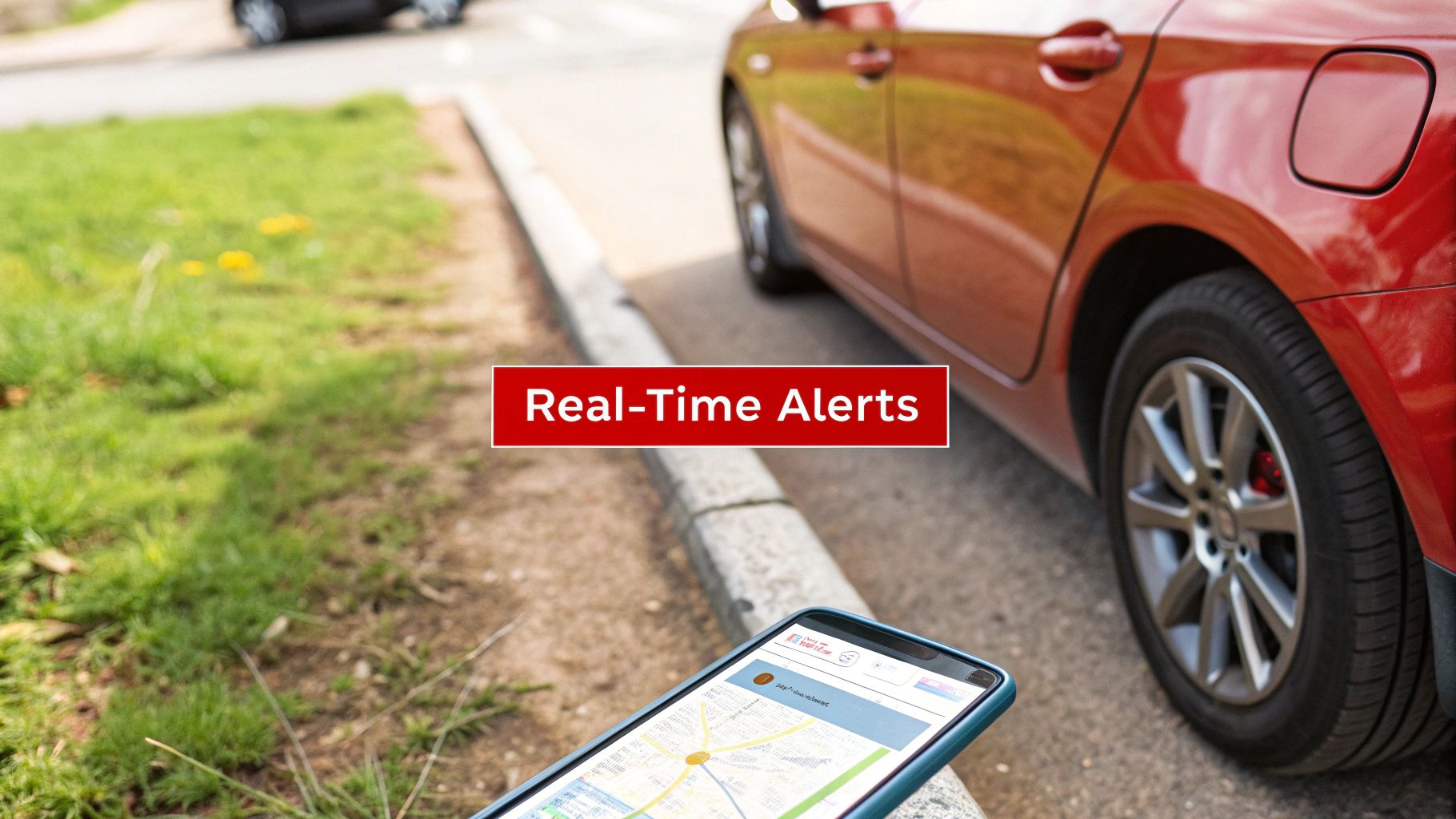
The moment a sensor is triggered, two other critical components activate simultaneously. First, the integrated GPS module acquires a precise satellite lock on your vehicle's coordinates. Concurrently, the cellular transmitter—a dedicated communication module within the device—sends this critical data packet to a secure cloud server.
From Trigger to Your Pocket in Seconds
This entire sequence unfolds in mere seconds. The server receives the alert and location data, processes it, and immediately pushes a notification directly to your smartphone app. This isn't a vague warning. It’s specific, informing you of what occurred (e.g., "Vibration Detected") and where it occurred, complete with a map showing your vehicle's pinpoint location.
Data from the National Insurance Crime Bureau (NICB) highlights the importance of this immediacy. A significant number of vehicle thefts occur in residential areas—often directly from the owner's driveway. An audible alarm is easily ignored in such settings, but a direct notification to your phone cuts through the noise. You become the first to know.
You can dive deeper into how to pinpoint your vehicle’s location with our guide on using a car locator.
This immediate, direct line of communication is what separates passive from active security. Instead of hoping a neighbor intervenes, you become the first responder.
The real magic of a top-tier car alarm with GPS tracking is its ability to transform a local disturbance into an immediate, actionable alert delivered right to you, no matter where you are.
The Team Behind the Tech
To fully appreciate how this technology puts you back in control, let's break down the hardware components that work in concert to protect your vehicle.
- Sensors (The Nerves): These are the system's sensory inputs. They include multi-axis accelerometers that detect vibrations from a window breaking or a significant impact, as well as systems that monitor your vehicle's ignition status to detect an unauthorized engine start.
- GPS Module (The Navigator): This component communicates with the Global Navigation Satellite System (GNSS) to determine your car’s precise latitude and longitude, providing the critical location data necessary for tracking.
- Cellular Transmitter (The Messenger): This is the communications hub. Utilizing its own SIM card and a cellular network (like 4G LTE), it transmits all alert and location data from your vehicle to the cloud infrastructure and ultimately to your smartphone.
This tightly integrated system ensures you have a clear, unbroken line of sight into your vehicle's safety, from the moment of impact to the notification buzzing in your pocket.
Decoding the Must-Have Features of GPS Car Alarms
When choosing a car alarm with GPS, it's crucial to look beyond the siren. The real value lies in the features that grant you control and provide actionable intelligence. Not all systems are created equal, and the difference between a basic tracker and a comprehensive security solution is found in the details—how it communicates, what it monitors, and the power it places in your hands.
The Absolute Essentials
The most fundamental feature is real-time location tracking. This is more than just a dot on a map; it's about receiving instant, accurate location data when it matters most. In the event of a theft, the ability to track a vehicle's movement second-by-second provides law enforcement with actionable data, dramatically increasing the probability of a successful recovery.
The demand for smarter security is reflected in market trends. According to a report by Grand View Research, the global automotive GPS tracker market size was valued at USD 2.53 billion in 2022 and is expected to grow at a compound annual growth rate (CAGR) of 12.7% from 2023 to 2030. This growth is driven by consumer demand for better anti-theft solutions.
Geofencing: Your Car's Invisible Fence
One of the most powerful tools in a modern GPS alarm's arsenal is geofencing. This feature allows you to create a virtual perimeter around a specific location—your home, office parking garage, or a child's school. If your vehicle enters or exits this predefined area, you receive an immediate alert on your phone.
Its practical applications are numerous. For instance, setting a geofence around your workplace ensures you are notified the moment your vehicle is towed or stolen from the lot. This prevents the shock of discovering an empty parking space at the end of the day.
Geofencing transforms your car's security from reactive to proactive. It doesn't wait for a thief to be miles down the road; it alerts you the second your car leaves a designated safe zone, giving you a critical head start.
This infographic neatly lays out how these core features work together to create layers of protection for your vehicle.
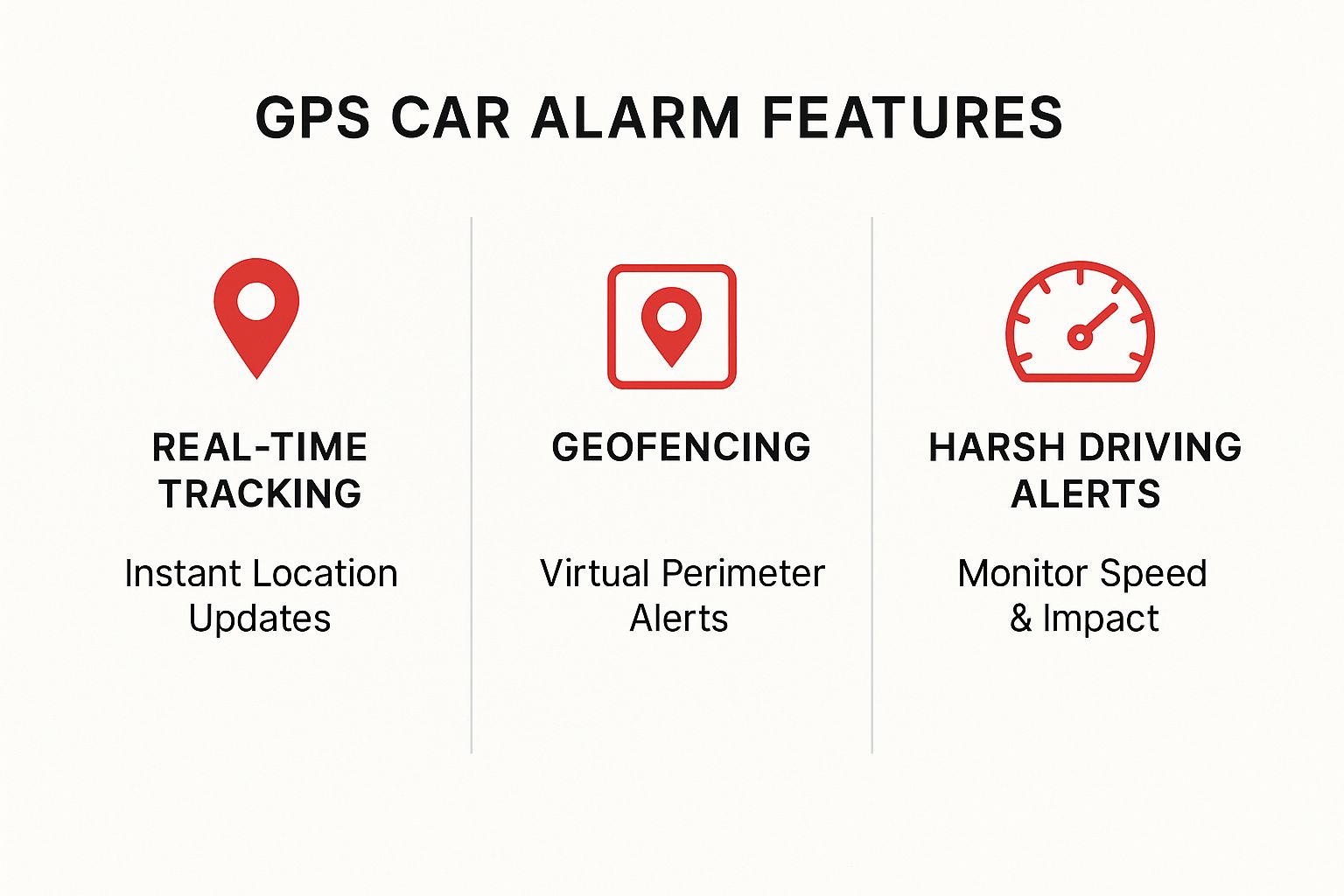
As you can see, each element provides a distinct type of security, from live location data and boundary alerts to driver safety monitoring. It's a holistic security posture.
Beyond Anti-Theft: Monitoring Driver Behavior
The best systems today offer functionalities that extend beyond theft prevention. Features like harsh driving alerts are invaluable for parents of teen drivers or small business owners managing a fleet. These systems can notify you of specific driving events, including:
- Harsh Acceleration: Detects aggressive, fuel-wasting takeoffs.
- Hard Braking: Alerts you to sudden, potentially dangerous stops that may indicate distracted driving.
- Sharp Cornering: Lets you know if the vehicle is being maneuvered recklessly at high speeds.
Additionally, a detailed trip history provides a complete log of every journey, allowing you to review routes, verify mileage for business expenses, and ensure your vehicle is being used responsibly. The fusion of robust security and intelligent monitoring is what distinguishes a top-tier GPS car alarm.
To help you determine your needs, here is a detailed comparison of essential security features versus advanced monitoring capabilities.
Essential vs. Advanced Features in GPS Car Alarms
| Feature | What It Does | Primary Benefit |
|---|---|---|
| Real-Time Tracking | Provides the live GPS location of your vehicle on a map. | Instant vehicle recovery assistance in case of theft. |
| Geofencing | Creates virtual boundaries and sends alerts when your car enters or exits them. | Proactive security; know immediately if your car leaves a "safe" area. |
| Vibration/Movement Alerts | Detects unusual vibrations (like from prying or power tools) when the car is parked. | Early warning against break-ins, vandalism, or towing attempts. |
| Harsh Driving Monitoring | Tracks sudden acceleration, hard braking, and sharp cornering. | Encourages safer driving habits and provides peace of mind for parents or fleet managers. |
| Trip History Log | Records and stores all routes, travel times, and distances. | Useful for reviewing vehicle usage, business mileage, or verifying locations. |
| Low Battery Alerts | Monitors your car's battery health and notifies you if it's running low. | Prevents you from getting stranded with a dead battery. |
Your choice depends on your primary use case. If theft recovery is your sole objective, the essential features suffice. However, for a complete overview of your vehicle's security and usage, the advanced features provide invaluable data and insight.
You can explore a full list of these advanced capabilities to see how modern devices enhance your control over vehicle security and safety.
Choosing the Right GPS Security System for You
Navigating the car security market can be complex, but selecting the best car alarm with GPS tracking boils down to your specific requirements. The decision typically hinges on three key factors: ease of installation, transparency of subscription costs, and the reliability and functionality of the mobile application.
These elements determine whether a system integrates seamlessly into your life or becomes a source of frustration. For instance, some systems require professional hardwiring, which involves splicing into your vehicle’s electrical system—a process that can be both complicated and costly.
Fortunately, modern plug-and-play devices offer a far simpler and more accessible alternative.
Installation Simplicity and Cost Transparency
A major consideration is the device's method of connection to your vehicle. There are two primary options:
- OBD-II Plug-and-Play: This is the most user-friendly approach. Devices like CarLock plug directly into your car's On-Board Diagnostics (OBD) port, typically located under the dashboard. Installation takes seconds, requires no tools, and can be performed by anyone.
- Hardwired Systems: These units are wired directly to the vehicle's battery and electrical system. While they can be more covertly installed, they almost always require professional installation, adding to the total cost and complexity.
Beyond the initial hardware purchase, it is essential to factor in the monthly or yearly subscription fees. These fees are necessary for the device's cellular connectivity, which enables it to transmit alerts and location data to your phone. A reputable provider will be transparent about these costs, with no hidden fees. This clarity is crucial for understanding the total cost of ownership over the device's lifetime.
The market for this technology is expanding rapidly. The global GPS tracking device market was valued at around $3.74 billion in 2024 and is projected to climb to $10.88 billion by 2033. This growth is fueled by smarter IoT and cloud technology that makes these systems more powerful and easier to use. You can dive deeper into the GPS tracking device market growth on Straits Research.
Matching the System to Your Lifestyle
The ideal GPS security system is one that aligns with your life. Different vehicle owners have distinct priorities, and a versatile system should accommodate them.
A truly effective car security system adapts to your life. It should provide robust theft protection for a classic car enthusiast, driving insights for the parent of a new driver, and daily peace of mind for a city commuter.
Consider these real-world scenarios:
- For Parents of Teen Drivers: Your focus is likely on safety as much as security. A system with harsh driving alerts (monitoring speeding, hard braking, and sharp cornering) and geofencing capabilities is essential to ensure your new driver is operating the vehicle safely and within approved areas.
- For Classic Car Owners: Your primary concern is protecting an irreplaceable asset from theft. An OBD-II system like CarLock provides an instant "Device Disconnected" alert, notifying you the moment it is tampered with—a critical first line of defense.
- For the Daily Commuter: You require reliability and convenience. A user-friendly app with real-time location tracking and low battery alerts ensures you remain connected to your vehicle's status without any complexity.
By evaluating these factors—installation, cost, and your specific use case—you can confidently select a system that delivers robust security and genuine peace of mind. To see how all these pieces fit together, you can learn more about what makes up a modern car security system.
Common Mistakes to Avoid When Buying a Car Alarm

Investing in a GPS car alarm is a significant step toward protecting your vehicle. However, several common pitfalls can lead to a purchase that causes more frustration than security. A little foresight can help you sidestep these traps and choose a system that delivers on its promises.
One of the biggest mistakes is focusing solely on the upfront hardware price while overlooking recurring subscription fees. These fees are essential for the device's cellular connectivity, which enables real-time alerts and location updates. Without this subscription, the GPS tracking and notification features are rendered useless.
This oversight can turn an apparent bargain into a significant long-term expense. It is crucial to evaluate the total cost of ownership. Calculate the hardware price plus at least two to three years of subscription fees to understand the true financial commitment.
Underestimating the Importance of the Mobile App
In today's connected ecosystem, the mobile app is not merely an accessory—it is your command center. A poorly designed, buggy, or unreliable app can render even the most advanced hardware frustratingly useless.
Imagine receiving a critical alert, only for the app to crash upon opening. Such a failure is catastrophic when every second is critical for vehicle recovery.
Before committing to a system, thoroughly research the app store reviews. Look for user feedback on:
- Reliability: Does the app have a history of crashing or failing to deliver push notifications reliably?
- Ease of Use: Is the user interface intuitive, or is it a confusing maze of menus?
- Feature Accessibility: Can you easily access core functions like live mapping and geofence configuration without difficulty?
A stable and well-designed app is as critical as the hardware itself. It is the vital link between you and your vehicle's security.
A great GPS alarm system is a partnership between powerful hardware and an intuitive, dependable mobile app. If one part fails, the entire system's value collapses, leaving your vehicle vulnerable.
Forgetting to Check Alert Latency
Another critical error is ignoring the speed of the alerts. The primary value of a real-time tracker is receiving immediate notifications. An alert that arrives five or ten minutes late is nearly as ineffective as no alert at all.
This delay, known as latency, is a common issue with low-cost, inferior systems that utilize slow servers or unreliable cellular networks.
The best systems are engineered for minimal latency. They ensure that a notification for a detected vibration, an unauthorized engine start, or device tampering reaches your phone in seconds. This speed provides the critical window of opportunity to contact law enforcement and potentially prevent a theft in progress. By avoiding these common errors, you can confidently choose a system that provides genuine security and lasting peace of mind.
Your Questions About GPS Car Alarms, Answered
Adopting any new technology for your vehicle naturally raises questions. This is a positive sign—it indicates you are conducting thorough due diligence. Let's address some of the most common inquiries regarding GPS car alarms.
Will a GPS Car Alarm Kill My Car Battery?
This is a primary concern for many vehicle owners. A well-engineered, modern GPS tracker—especially a high-quality OBD-II device like CarLock—is designed for extreme power efficiency.
When your vehicle is parked, these devices enter a low-power "sleep" mode. They remain vigilant, monitoring for vibrations or movement, but consume only a minuscule amount of power (typically less than 2mA). For any healthy car battery, this current draw is negligible and will not cause depletion, even if the vehicle remains parked for extended periods. The risk of battery drain is higher with poorly designed, hardwired trackers that lack sophisticated power management. Sticking with a reputable brand is crucial.
Is a Subscription Fee Really Necessary?
Yes, for a GPS tracker to provide real-time alerts and location updates from anywhere, a subscription is indispensable. The tracker functions like a dedicated cellular device for your car, containing its own SIM card and requiring a cellular network to transmit data.
The subscription fee covers the ongoing operational costs that make the system functional:
- The Cellular Data Plan: This covers the data transmission costs between the device and the network.
- Cloud Servers: Securely hosts and processes your trip histories, alert data, and account information.
- App Development & Updates: Funds the continuous maintenance and improvement of the mobile application.
- Customer Support: Ensures technical assistance is available when you need it.
Be cautious of products marketed with "no subscription." These are almost always short-range Bluetooth locators, not true, real-time GPS security systems capable of global tracking. If you want to dive deeper into this, we've got more answers to common GPS tracker questions on our site.
Can't a Thief Just Unplug the Tracker?
This is where intelligent system design becomes a key security feature. With an easy-to-install OBD-II tracker like CarLock, the moment a thief removes it from the port, you receive an instant "Device Disconnected" alert on your phone.
This alert often serves as an even faster warning than you would receive from a complex hardwired system, which a thief might spend time trying to locate and disable. It immediately signals that someone is tampering with your vehicle, giving you a critical head start to react. A potential theft can be thwarted thanks to this immediate, actionable notification.
Ready to stop worrying and give your vehicle the best real-time monitoring available? Join the thousands of drivers who trust CarLock for total peace of mind. Take a look at our features and find the perfect fit for you at https://www.carlock.co.