

Driver’s Desk
Your Guide to Car Anti Theft GPS Tracker Security
At its core, a car anti theft gps tracker is a compact security device that uses the Global Positioning System (GPS) to pinpoint your vehicle's precise location. It transmits that information, along with real-time alerts for unauthorized activity, directly to an application on your smartphone. It functions as a silent, vigilant guardian, providing a powerful and immediate method for vehicle recovery in the event of theft.
Why Modern Vehicle Security Demands a GPS Tracker
Vehicle theft is a persistent and costly issue impacting hundreds of thousands of individuals annually. While conventional car alarms can act as an audible deterrent, their effectiveness largely ceases once a thief has driven away. This critical gap in security is precisely where a GPS tracker becomes indispensable, transforming a vehicle's security from passive deterrence to active recovery.
The data underscores the scale of the problem. According to the National Insurance Crime Bureau (NICB), over one million vehicles were stolen in the United States in 2022, a 7% increase from the previous year and the highest reported number since 2008. These thefts represent billions of dollars in losses and significant distress for owners.
This statistical reality is why a car anti theft gps tracker has evolved from a technological luxury into a foundational component of any robust vehicle security strategy. It provides the crucial link between theft prevention and the high-probability recovery of a stolen asset.
The Power of Proactive Protection
A standard car alarm merely generates noise. A GPS tracker, in contrast, provides actionable, real-time intelligence and restores a degree of control to the owner. It doesn't just signal that something is wrong; it provides the exact location of your vehicle, updated second-by-second, giving law enforcement the critical data needed for rapid intervention.
The primary advantage of a GPS tracker is its ability to elevate the car owner from a passive victim to an active participant in the recovery process. Instead of waiting and hoping, the owner provides the precise location data required to convert a potential total loss into a swift retrieval.
This infographic illustrates the direct relationship between rising vehicle theft rates and the increasing adoption of GPS tracking technology as a countermeasure.
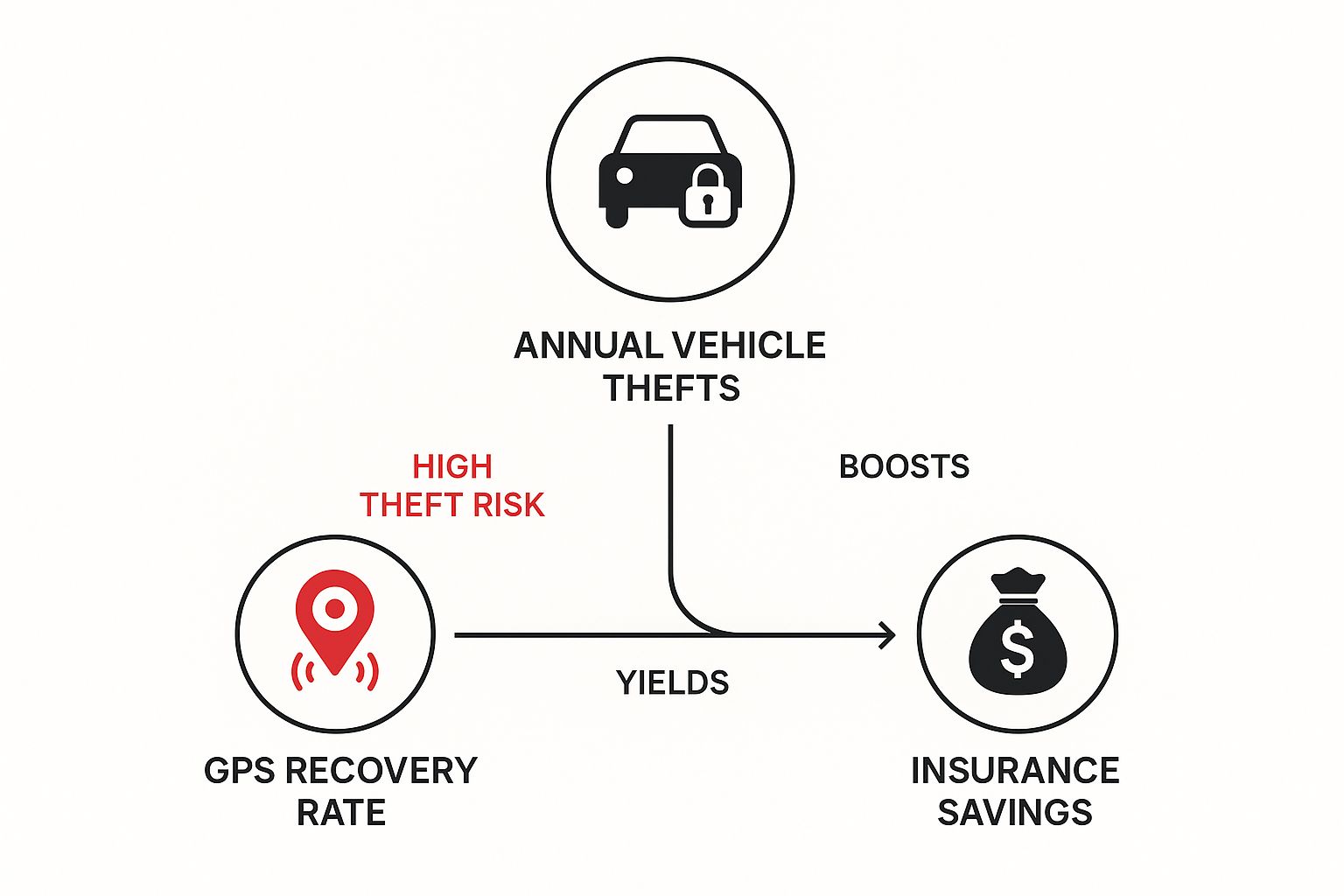
As shown, the high incidence of theft makes GPS trackers an invaluable asset. Their use demonstrably increases recovery rates and can often lead to a reduction in insurance premiums.
A Modern Solution for a Modern Problem
Today's vehicle thieves often employ sophisticated electronic tools to bypass factory-installed security systems. A well-concealed, aftermarket GPS tracker operates as a separate, powerful layer of security they are unlikely to detect. The advantages are statistically significant.
- Dramatically Higher Recovery Rates: Data consistently shows that vehicles equipped with a GPS tracker have a recovery rate that can reach as high as 98%, compared to the national average recovery rate of just 34% for stolen vehicles.
- Instantaneous Alerts: Receive immediate notifications on your smartphone for a range of security triggers. Whether it's an unauthorized engine start, unexpected movement, or even a detected vibration, you are alerted in real-time, providing a critical window to react before the vehicle is gone.
- Verifiable Peace of Mind: The ability to verify your vehicle's location with a simple tap on your phone offers a level of security that legacy alarm systems cannot match. You can explore how GPS trackers deliver complete car security in our detailed guide.
This guide will provide a comprehensive overview of this essential technology, detailing its operational mechanics, the most critical features to evaluate, and how to select the optimal device to protect your investment.
How a GPS Tracker Pinpoints Your Vehicle's Location
The technology behind a car anti-theft GPS tracker is an application of the same system that provides turn-by-turn directions on a smartphone, but it is specifically optimized for vehicle security. The system relies on a coordinated interaction between three components: a network of satellites, a receiver hidden within your vehicle, and your smartphone.
The process begins with the GPS satellite constellation. A network of more than 30 operational GPS satellites continuously orbits the Earth, each broadcasting unique radio signals. These signals contain the satellite's precise location and the exact Coordinated Universal Time (UTC) the signal was transmitted.
Installed discreetly in your vehicle, the GPS tracker functions as a highly sensitive receiver. Its sole purpose is to listen for these satellite signals. It is a passive device, meaning it only receives data and does not transmit back to the satellites. To calculate an accurate position, the tracker must acquire signals from a minimum of four satellites simultaneously.
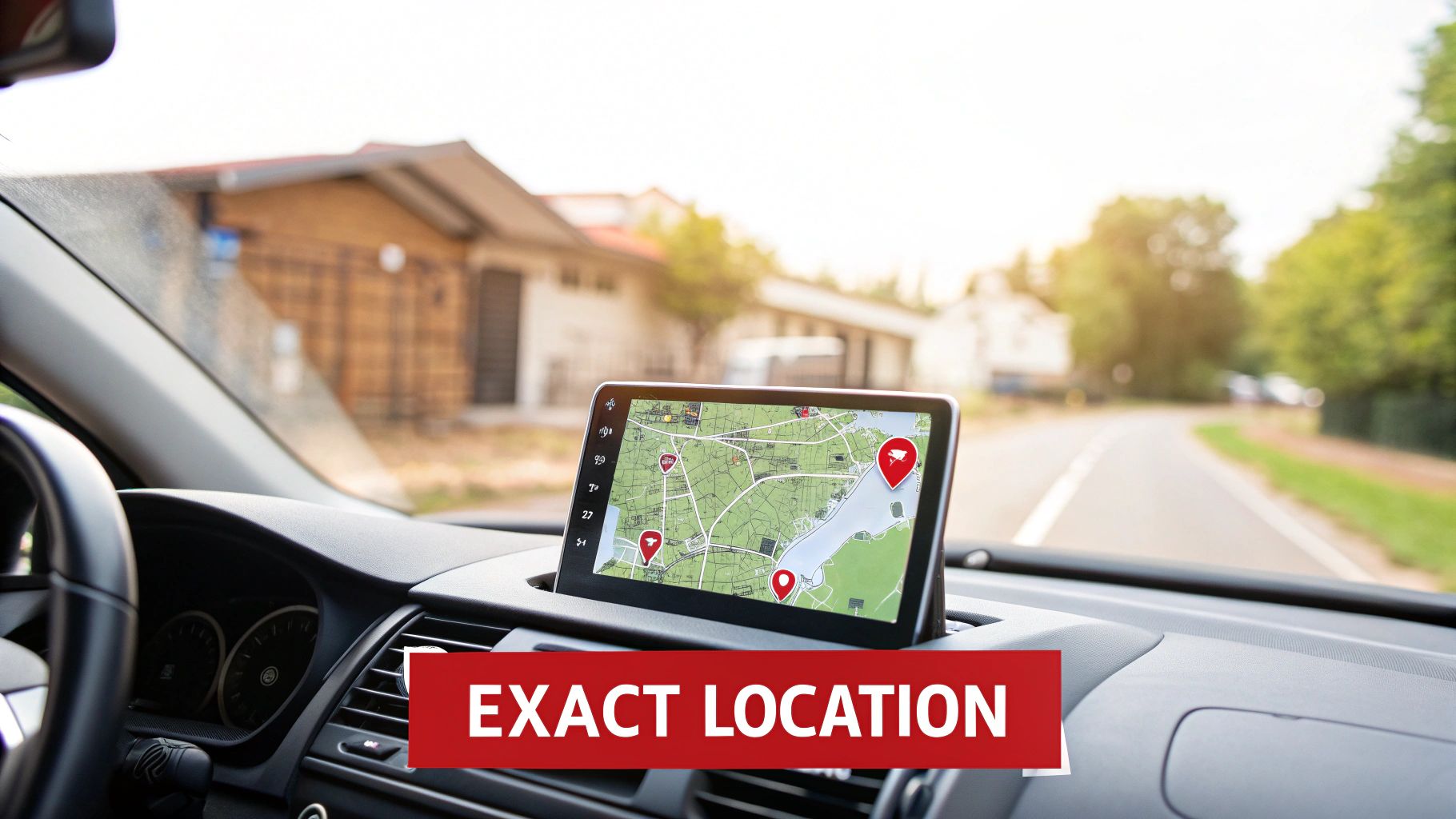
From Signal to Street Address
How are these raw signals converted into a precise location on a map?
Once the tracker locks onto the necessary satellite signals, it performs rapid calculations. By measuring the time delay between when each satellite transmitted its signal and when the tracker received it, the device can calculate its distance from each of those satellites.
This process is known as trilateration. To visualize it, imagine knowing your precise distance from three known points on a map. By drawing a circle around each point with the corresponding radius, your location is the single point where all three circles intersect. A GPS tracker performs a more complex, three-dimensional version of this calculation to determine the vehicle's latitude, longitude, and altitude with an accuracy often within 2.5 meters (8 feet).
Connecting Your Car to Your Phone
Knowing the location is only half the battle; that data must be transmitted to you. This is the final, critical step in the process. Every car anti theft GPS tracker is equipped with a SIM card and a cellular modem, effectively functioning as a small, dedicated mobile device.
After calculating its position from satellite signals, the tracker uses a cellular network (e.g., 4G LTE) to transmit this location data to a secure cloud server. Your smartphone application then communicates with this server to retrieve the data and display your vehicle's real-time position on a map. It is this dual-system architecture—GPS for location, cellular for communication—that enables remote vehicle tracking from anywhere in the world. Once you learn how to use a car locator feature on your app, you have immediate oversight.
The effectiveness of a modern tracker lies not just in its ability to determine its own location, but in its capacity to communicate that location instantaneously. The seamless integration of GPS and cellular technology transforms a simple coordinate into a powerful vehicle recovery tool.
Active vs. Passive Tracking Technology
It is crucial to distinguish between the two primary types of GPS tracking technology, as they are designed for fundamentally different purposes.
- Active Trackers (Real-Time): This is the technology essential for vehicle security. These devices transmit location data continuously over a cellular network, allowing you to monitor your vehicle's movements live on a map. This immediate feedback is non-negotiable when dealing with a theft in progress.
- Passive Trackers (Loggers): These devices function like a vehicle's black box. They log and store location data on internal memory. To access this data, one must physically retrieve the device and connect it to a computer to download the trip history. While suitable for applications like mileage logging for business expenses, they are completely ineffective for theft recovery.
For the purpose of protecting your vehicle, an active, real-time car anti theft GPS tracker is the only viable option. The ability to receive instant alerts and view a live location is what empowers a rapid response and successful recovery.
What A Modern GPS Tracker Can Really Do For You
A modern car anti theft gps tracker offers a suite of capabilities that extend far beyond simple location plotting. While real-time location is the core function, a range of integrated features transforms the device into a comprehensive, active security and vehicle management system. These tools provide a level of control and situational awareness previously unavailable to consumers.
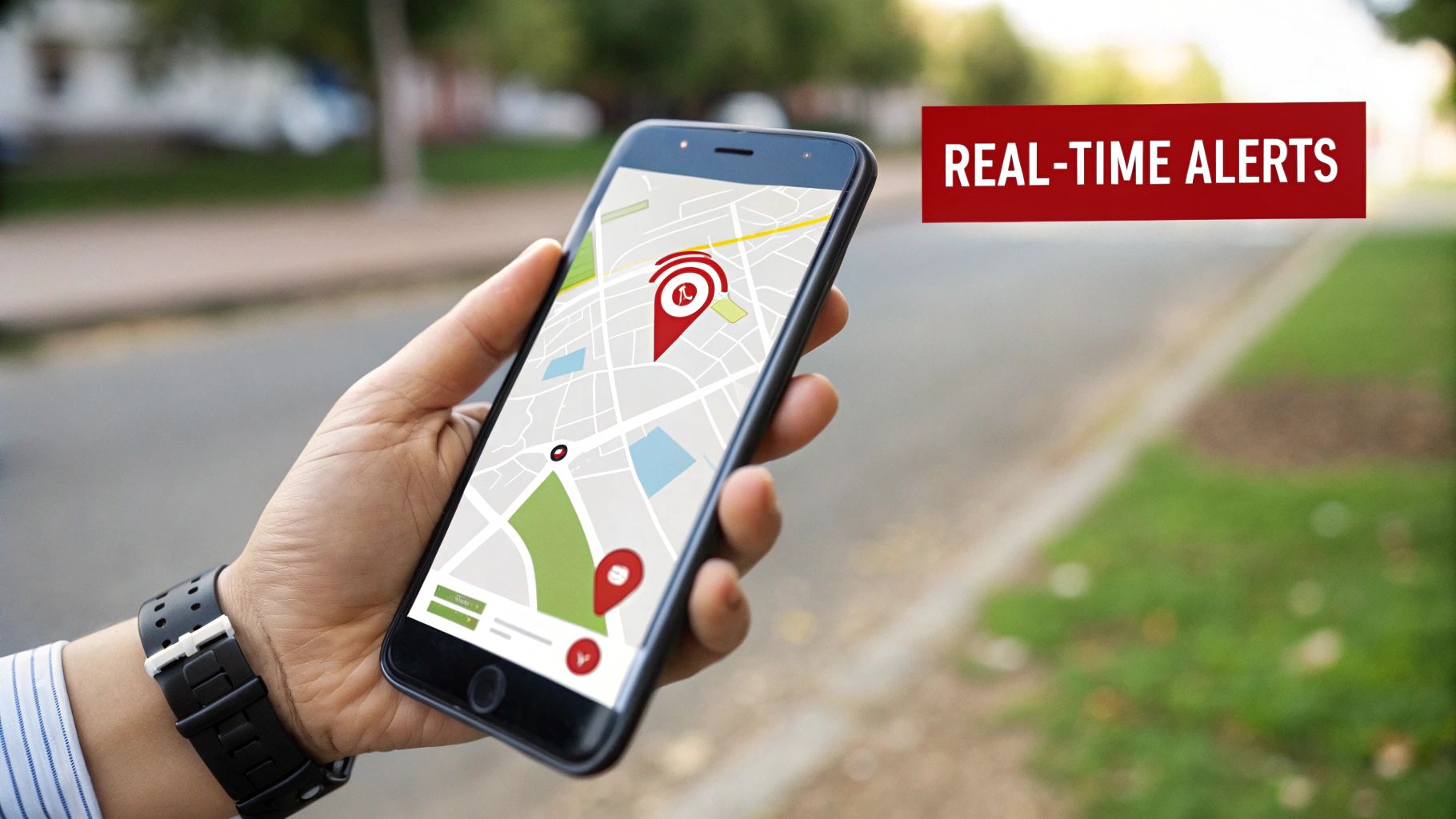
Understanding these features is key to differentiating between a basic locator and a genuine security solution. It's the difference between discovering a theft hours later and receiving an alert that enables you to thwart a thief in the act.
Real-Time Live Tracking
The foundational feature of any effective security tracker is real-time tracking. This is not a passive data logger that records a journey for later review. A real-time tracker continuously transmits its location data, allowing you to open a mobile application and observe your vehicle's movement on a map with updates every few seconds.
In a theft scenario, this live data feed is invaluable. It enables you to provide law enforcement with precise, up-to-the-minute coordinates, dramatically increasing the probability of a safe and swift recovery. The accuracy is typically sufficient to identify a specific parking space on a given street.
Geofencing Virtual Boundaries
This feature introduces a layer of intelligent automation. Geofencing allows you to define virtual perimeters around specific geographic areas on a map—such as your home, office, or a service center. It acts as an invisible digital fence for your vehicle.
The moment your vehicle enters or exits one of these predefined "safe zones" without authorization, an instant alert is pushed to your smartphone. This is a transformative feature. You are no longer required to manually check on your vehicle's status; you are automatically notified of any unauthorized movement.
For instance, by setting a geofence around your workplace, you would receive an immediate notification if your car leaves the parking lot during work hours, providing a critical head start to contact authorities before a thief can get far.
Geofencing elevates your tracker from a reactive recovery device to a proactive alert system. It's the digital tripwire that notifies you of a security breach the instant it occurs, often before you would have otherwise realized the vehicle was missing.
Instant Security Alerts
A high-quality car anti theft gps tracker is equipped with a variety of sensors designed to detect suspicious activity and report it immediately. These alerts form the core of the system's active security function, warning you of a potential threat the moment it begins.
Essential alerts to look for include:
- Vibration Detection: The device's accelerometer can detect unusual vibrations, such as those caused by a window breaking, a tow truck connection, or the use of power tools. This can trigger an alert before the thief even gains entry.
- Engine Start Alert: Receive a notification the moment the vehicle's ignition is turned on, providing a clear indication of unauthorized use.
- Device Disconnect Warning: If a thief discovers the tracker and disconnects it from its power source (e.g., the OBD-II port), you receive an immediate notification of tampering, allowing you to act quickly. To see a full system in action, you can explore the range of features a modern device offers.
The following table provides a comparison of the most critical features for anti-theft applications.
Comparing Key GPS Tracker Features
| Feature | Description | Primary Benefit |
|---|---|---|
| Real-Time Tracking | Provides a live, second-by-second location feed on a map. | Allows for immediate vehicle location during a theft. |
| Geofencing | Lets you set virtual boundaries and get alerts when your car crosses them. | Proactively notifies you of unauthorized movement. |
| Vibration & Tamper Alerts | Detects unusual movements or if the device is disconnected. | Warns you of a break-in or theft before the car is driven away. |
| Remote Engine Cutoff | Allows you to disable the vehicle's engine from your smartphone. | Safely stops a thief in their tracks, making recovery much easier. |
| Driving Behavior Reports | Monitors speed, harsh braking, and acceleration. | Great for monitoring teen drivers or improving fuel efficiency. |
| Route History | Stores past trips and routes taken by the vehicle. | Useful for business mileage tracking or reviewing a vehicle's past activity. |
The ideal combination of features depends on your primary use case, whether it is purely for anti-theft security, monitoring a novice driver, or managing vehicle logistics.
Remote Engine Cutoff
Perhaps the most potent anti-theft feature is the remote engine cutoff, also known as an engine immobilizer. This function grants you the ability to safely disable your vehicle's engine via your smartphone application.
After confirming a theft and notifying law enforcement, you can activate this feature. The system is designed for safety, typically waiting until the vehicle's speed drops below a safe threshold (e.g., 10 mph / 15 km/h) before preventing the engine from restarting.
This capability effectively stops a thief, transforming a high-risk pursuit into a simple vehicle recovery operation for the authorities. It is a critical feature for anyone serious about vehicle protection.
How to Choose the Right Car Anti Theft GPS Tracker
Selecting a GPS tracker can seem daunting due to the variety of models, subscription plans, and technical specifications. However, the process becomes straightforward when you focus on matching the device's capabilities to your specific requirements. The goal is not to find the single "best" tracker, but the one that is best suited for your vehicle, budget, and security needs.
Comparing the Three Main Tracker Types
The first decision involves choosing the type of tracker. Nearly all consumer-grade devices fall into one of three categories, each with distinct advantages and disadvantages regarding installation, power source, and concealability.
-
Hardwired Trackers: For maximum, permanent security, hardwired units are the superior choice. These trackers are wired directly into the vehicle's electrical system, ensuring a constant and reliable power source, eliminating the need for battery charging. Critically, this installation method allows the device to be concealed deep within the dashboard, engine bay, or other interior cavities, making it extremely difficult for a thief to locate and disable.
-
OBD-II Plug-In Trackers: These trackers offer an excellent balance of high performance and simple installation. They connect directly to the vehicle's On-Board Diagnostics (OBD-II) port, which is standard on all cars and light trucks manufactured since 1996. Installation is tool-free and takes seconds. The primary drawback is that the OBD-II port location is standardized, meaning a knowledgeable thief may know to check this area first.
-
Battery-Powered Trackers: These are self-contained, portable units that offer maximum installation flexibility. Often equipped with powerful magnets, they can be attached to any metallic surface on or within the vehicle. This allows for creative and unconventional hiding spots and the ability to move the tracker between vehicles. The significant trade-off is the reliance on battery power, which requires periodic recharging to ensure the device remains operational.
Demystifying Subscription Plans
A common point of inquiry is the necessity of a monthly subscription fee. Nearly all real-time car anti theft gps tracker units require a service plan. This recurring fee is essential for the system's operation, as it covers the costs associated with cellular data transmission.
Think of it as a dedicated mobile phone plan for your tracker. The subscription fee typically covers:
- Cellular Data: The tracker's internal SIM card uses a cellular network to transmit location data and alerts.
- Server & App Maintenance: The data is processed on secure cloud servers before being delivered to your smartphone app. The fee maintains this critical infrastructure.
- Ongoing Support & Updates: This cost funds software development, feature enhancements, and the customer support team.
A 2022 market analysis reported that typical consumer plans range from $5 to $25 per month. When evaluating plans, prioritize those that offer a high frequency of location updates (e.g., every 3-5 seconds), as this is critical for tracking a moving vehicle during a theft.
Key Questions to Ask Yourself Before Buying
To select the optimal tracker, consider your specific needs and priorities. Your answers to these questions will guide you to the most appropriate solution.
The ideal tracker is not defined solely by its technology, but by how seamlessly that technology integrates with your daily life, vehicle, and security expectations. The right choice should function as an invisible extension of your car's security, not a complex gadget requiring constant management.
Use this checklist to refine your decision:
- How critical is stealth installation? If your primary goal is to defeat a determined and knowledgeable thief, a professionally installed hardwired tracker is the most secure option. If convenience is a higher priority, an OBD-II model is an excellent alternative.
- What is my technical comfort level? Are you comfortable with basic automotive wiring, or is a 10-second, no-tool installation more appealing?
- What level of tracking precision is required? While most modern trackers offer accuracy within a few meters, the update frequency is the key differentiator. For theft recovery, a device that updates its position every 3-5 seconds is far more effective than one that updates every 2-3 minutes.
- Which specific alerts are most important? Determine your primary use case. Are you focused on anti-theft alerts like vibration and power disconnect warnings, or are features like geofencing for monitoring a teen driver more critical? Choose a tracker that excels in the features you will rely on most.
By systematically evaluating the tracker type, understanding the subscription's role, and assessing your own requirements, you can confidently select a car anti theft gps tracker that provides genuine security and value.
Getting the Installation Right for Maximum Security
You can purchase the most advanced car anti theft gps tracker available, but its effectiveness is ultimately determined by its installation. If a thief can easily locate and remove the device, its security value is nullified. Proper, covert placement is the key to transforming your tracker into a silent guardian that remains undetected when it matters most.
The primary objective is concealment. Professional car thieves are aware of common security measures and will check obvious locations immediately after gaining entry. Placing a tracker in a predictable spot like the glove box or under a seat is a critical error.
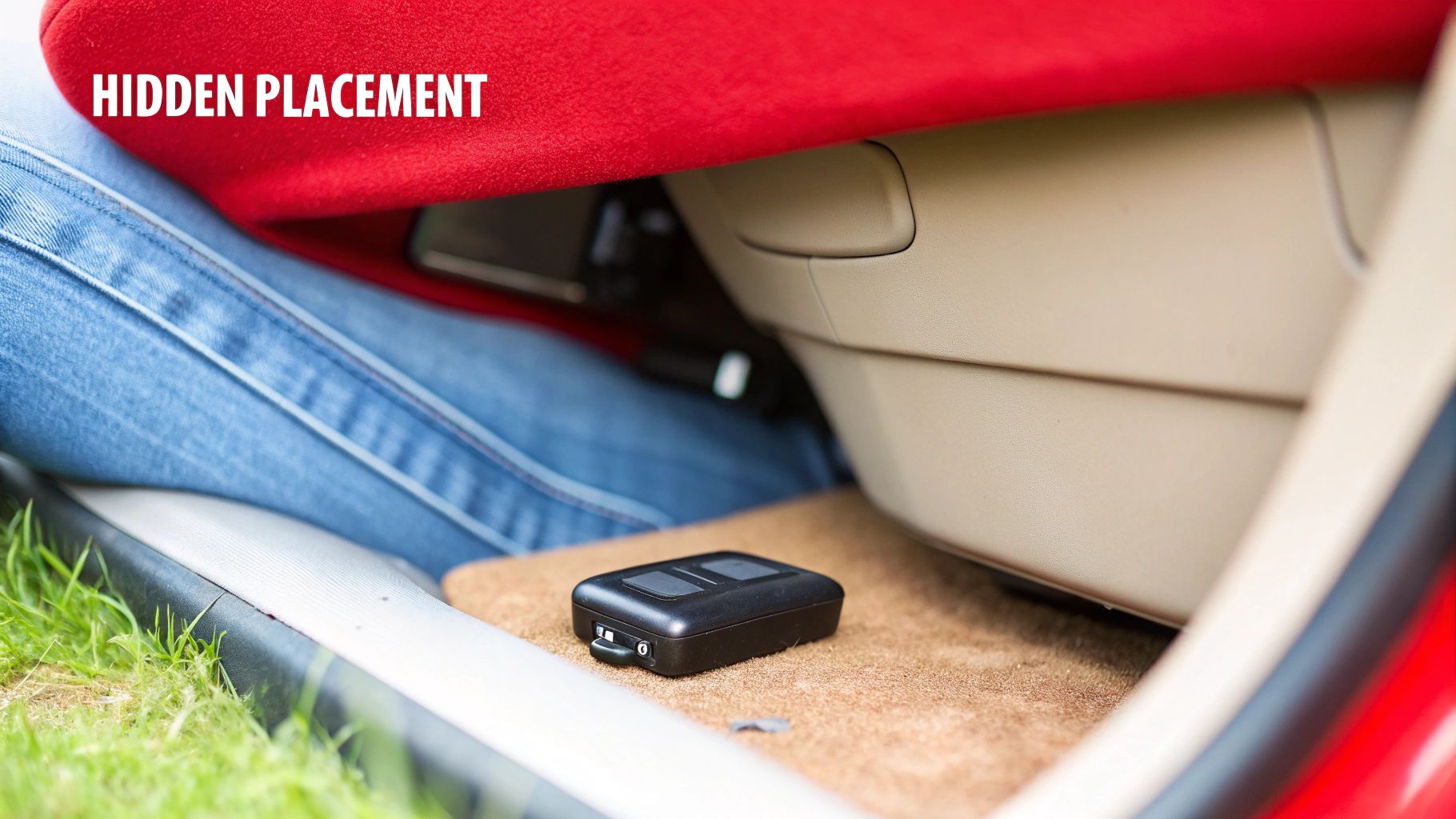
Strategic Hiding Spots for Your Tracker
To outsmart a thief, you must consider locations that are difficult and time-consuming to access—two commodities a thief in the act does not have.
For hardwired trackers, which offer the highest degree of stealth, consider these prime locations:
- Inside the Dashboard: This is the industry-standard for covert installations. Securing the device deep behind the stereo, instrument cluster, or climate control unit makes it virtually impossible to find without extensive disassembly of the dashboard.
- Within the Center Console: The internal structure of the center console provides another excellent concealment area, keeping the device protected and out of sight.
- Under the Rear Deck (Sedans): In sedans, the space beneath the rear window deck is a frequently overlooked location that provides good signal access while remaining hidden.
- Inside a Door Panel: While a more complex installation, this is a highly effective tactic. Few thieves would consider removing an interior door panel to search for a tracking device.
For simpler OBD-II or battery-powered models, which trade some stealth for convenience, creative placement is still key. An OBD-II extension cable allows you to plug into the port but then secure the actual tracker module high up under the dashboard, away from the easily accessible port itself.
Finding the Sweet Spot: Concealment vs. Signal Strength
While concealment is critical, the tracker must still be able to receive GPS satellite signals and transmit over cellular networks. Enclosing a device within a sealed metal container, for example, will block these signals and render it useless. The goal is to find a location that is both covert and allows signals to pass through non-metallic materials like plastic, glass, foam, or fabric.
The optimal installation location represents a strategic compromise between maximum concealment and reliable signal integrity. You are seeking a location that is difficult for a thief to access but still permits the tracker to communicate effectively with external networks.
Before finalizing the installation, it is best practice to temporarily place the tracker in the intended location and verify the signal strength using your mobile app. This ensures it can acquire a solid GPS lock and maintain a stable cellular connection.
Don't Forget Maintenance and Regular Testing
Once installed, routine checks ensure your tracker is fully operational. This is analogous to testing a traditional car alarm. In fact, a GPS tracker is an ideal complement to a modern alarm system, which you can learn about in our comprehensive article on car alarm systems.
Follow these simple maintenance procedures:
- Run Regular "Ping" Tests: At least once per month, use your app to request a live location update. This simple action confirms the device is powered, connected to the network, and reporting its position accurately.
- Monitor Battery Levels (for Battery-Powered Units): If using a battery-powered model, set a recurring calendar reminder to check the charge level. While most apps provide low-battery alerts, proactive monitoring is a good habit.
- Check Your Subscription Status: This is a crucial and often overlooked step. Ensure your service plan is active and payment information is up to date. A lapsed subscription is the most common reason for a tracker to cease functioning.
By combining a strategic, covert installation with these simple verification checks, you can ensure your car anti theft gps tracker is always ready to perform its critical function.
More Than Just Theft Recovery: The Everyday Perks of a GPS Tracker
A GPS tracker's primary function is vehicle recovery. However, limiting its utility to this single purpose is like using a smartphone only for calls; you would miss a host of valuable features that can enhance safety, improve efficiency, and generate cost savings.
Modern trackers have evolved into multi-functional devices that provide significant day-to-day value beyond their anti-theft role.
A key secondary benefit is providing peace of mind for parents of new drivers. A GPS tracker can function as a "digital co-pilot," providing data-driven insights to help coach safer driving habits.
Coaching Safer Drivers
You can configure alerts for events such as exceeding a set speed limit, harsh braking, or rapid acceleration. This is not about surveillance, but about using objective data to facilitate constructive conversations about defensive driving.
The statistics highlight the importance of this. According to the CDC, drivers aged 16 to 19 are at a nearly three times greater risk of being in a fatal crash than drivers aged 20 and over. Using real data from a tracker can help instill safe driving habits that last a lifetime.
For families or small businesses managing multiple vehicles, these devices are a logistical tool. You can view all vehicle locations on a single map, coordinate schedules, or monitor a delivery's progress without distracting drivers with calls or texts.
A GPS tracker transforms from a purely reactive security device into a proactive management tool. It provides the data you need to ensure safety, improve efficiency, and protect your automotive investment every single day.
Unlocking Real Financial Savings
Beyond security and logistics, a tracker can yield direct financial benefits. Many insurance providers recognize the effectiveness of GPS trackers in theft recovery. Because a tracked vehicle is far more likely to be recovered, it represents a lower risk to the insurer.
Consequently, many companies offer significant discounts on insurance premiums—sometimes up to 25%—for vehicles equipped with an active anti-theft tracker. These savings can often offset or even exceed the annual subscription cost of the device, making the security features effectively free.
Furthermore, a tracker can contribute to better vehicle maintenance. Adhering to expert tips for making your car last longer is always prudent. Some advanced trackers can connect to your car's diagnostic systems to alert you to potential engine issues before they escalate into costly repairs. You can learn more about how to monitor your vehicle health with a GPS tracker and stay ahead of maintenance needs.
These cumulative benefits turn a simple anti-theft device into an intelligent tool for modern vehicle ownership.
Still Have Questions About GPS Trackers?
Even after a detailed overview, it's common to have specific questions about the day-to-day use and implications of a car anti theft gps tracker. Here are answers to some of the most frequently asked questions.
Is It Actually Legal to Put a GPS Tracker on a Car?
Yes, it is perfectly legal to install a GPS tracker on a vehicle that you own. As the legal owner of the property, you have the right to monitor its location.
The legality becomes complex when you do not own the vehicle, or if it is co-owned. The law is very clear on this matter. For example, installing a tracking device on a vehicle owned by another person without their explicit consent is illegal in all 50 states and can result in significant civil and criminal penalties. This applies to complex scenarios as well, such as a jointly-owned vehicle during a contentious divorce.
The legal principle is straightforward: if the vehicle's title is in your name, you are legally permitted to track it. If not, or if a co-owner has not consented, you may be breaking the law.
Will a GPS Tracker Kill My Car Battery?
This is a valid concern, but modern, high-quality trackers are engineered for extremely low power consumption. When the vehicle's engine is running, the tracker draws a negligible amount of power from the alternator.
The critical design feature is the device's "sleep mode." When the vehicle is parked, the tracker enters a low-power standby state, waking only periodically to send a location update or if its sensors are triggered by an event like a vibration. In this mode, the power draw is typically less than 1 milliamp (mA). This is an insignificant drain on a healthy car battery and will not cause depletion, even if the vehicle remains parked for several weeks.
Can a Thief Just Rip It Out?
While no security measure is completely foolproof, a professionally installed, covert car anti theft gps tracker is exceptionally difficult for a thief to defeat. The entire strategy is based on covert installation. A hardwired unit concealed deep within a dashboard or body panel cannot be quickly found and removed.
Furthermore, premium trackers incorporate anti-tampering features:
- Tamper Alerts: The moment the device is disconnected from its primary power source, it transmits an immediate "power disconnect" alert to your smartphone.
- Backup Battery: Most high-quality trackers contain a small internal backup battery. This allows the device to continue transmitting its location for a period of time even after the vehicle's main battery has been disconnected.
These features create a redundant security system. Even if a thief suspects a tracker is present, the time required to locate and disable it, combined with the instant tamper alerts, provides a critical window for you and law enforcement to intervene.
Ready to give your vehicle the smartest, most user-friendly protection out there? The CarLock system offers live tracking, immediate security alerts, and the kind of peace of mind that lets you sleep at night. Protect your car today with CarLock.