

Driver’s Desk
What is an Anti-Theft Device For a Car? How It Protects Your Ride
An anti-theft device for your car is any tool or system engineered to make your vehicle a significantly harder target for thieves. Think of it as a dedicated security detail for your car. This can range from a highly visible, physical deterrent like a bright yellow steering wheel lock, to a completely covert electronic system like a hidden GPS tracker.
Regardless of the type, these devices all serve two critical functions: preventing the theft from happening in the first place and helping you recover your car if it is stolen. Modern security strategies emphasize a combination of both.
Understanding Car Anti-Theft Devices
At its core, a car anti-theft device is a layer of protection standing between your valuable vehicle and a potential criminal. Vehicle theft remains a persistent threat; according to the National Insurance Crime Bureau (NICB), over one million vehicles were stolen in the United States in 2022, a 7% increase from 2021. This data underscores that relying solely on factory-installed locks is often insufficient.
The primary goal is to make the process of stealing your car as difficult, noisy, and time-consuming as possible for a would-be thief.
This is where the principle of "layered security" comes into play. It’s analogous to securing your home. You have basic locks on your doors (your car's standard locks), but you might also add a heavy-duty deadbolt (a steering wheel lock), a blaring alarm system, and security cameras (a GPS tracker). Each additional layer makes a break-in significantly less appealing.
Prevention and Recovery: The Two Core Functions
Every anti-theft device falls into one of two primary categories: prevention or recovery. The most robust security strategies integrate elements from both to create a comprehensive defense.
Let's break down these two functions and their real-world applications.
| The Two Core Functions of Car Security Systems |
| :— | :— | :— |
| Primary Function | How It Protects Your Vehicle | Common Device Examples |
| Prevention | Creates physical or audible barriers to stop a theft before it's completed. The main goal is deterrence. | Steering wheel locks, car alarms, engine immobilizers, brake pedal locks. |
| Recovery | Helps law enforcement locate and retrieve your vehicle after it has been stolen. | GPS trackers, vehicle recovery systems (e.g., LoJack), VIN etching. |
As you can see, prevention is about making your car a difficult target, while recovery serves as your critical backup plan if a determined thief succeeds.
An effective security plan doesn't just rely on stopping a thief in the moment; it also provides a powerful backup plan to get your property back. This dual approach offers comprehensive peace of mind.
Modern systems, like a modern car alarm combined with a GPS tracker, are highly effective because they bridge the gap between prevention and recovery. For instance, a system that sends an instant alert to your phone the moment a theft is attempted allows you to act immediately, potentially stopping the crime in its tracks while also tracking the car's every move.
By understanding these two distinct roles, you can build a security setup that truly protects your vehicle from modern threats.
The Evolution of Vehicle Security Technology
The history of vehicle security is a fascinating cat-and-mouse game between manufacturers and criminals. Initially, protection was purely mechanical and relatively simple. The first line of defense was often a highly visible tool like a steering wheel lock—a brute-force approach designed to make turning the wheel impossible.
This mechanical era was defined by creating physical barriers. While effective against opportunistic thieves, determined criminals quickly developed methods to break or bypass these simple locks. It became clear that a more active and attention-grabbing defense was necessary.
From Mechanical Barriers to Electronic Alarms
The piercing shriek of a car alarm became the soundtrack of the 1980s and 90s for good reason. Alarms were the first electronic guardians, designed to create an unwelcome public scene. Using sensors to detect forced entry or impact, they would trigger a loud siren to scare off the thief and alert anyone nearby.
This was a significant technological step forward, but alarms developed their own weaknesses. Professional thieves learned to disable them in seconds. Furthermore, the high rate of false alarms from passing trucks or severe weather led to a "boy who cried wolf" effect, causing the public to largely ignore them. The industry needed something smarter—a system that didn't just make noise but actively prevented the car from being driven.
The next major leap in car security came from turning the car against itself. The goal shifted from simply creating a noisy deterrent to making the vehicle's own engine the ultimate lock.
The Digital Guardian: Engine Immobilizers
This crucial shift led to the development of the electronic engine immobilizer. First appearing in the late 1990s and becoming a standard feature, this technology dramatically reduced theft rates. It works by using a transponder chip inside the car key that communicates with the vehicle's engine control unit (ECU).
Without the correctly coded key, the ECU will not allow the engine to start, rendering traditional hot-wiring attempts useless. This innovation was a game-changer, contributing to a significant drop in auto theft for over a decade. In fact, a study by the Highway Loss Data Institute (HLDI) found that immobilizers led to a 40% drop in the overall frequency of theft claims.
However, just as manufacturers built a better digital lock, thieves developed digital lockpicks. Modern criminals now use sophisticated relay attacks and key cloning devices to bypass factory immobilizers. This escalating tech race is precisely why a single layer of security is no longer sufficient, paving the way for today's connected, GPS-powered recovery systems like CarLock.
Breaking Down the Types of Anti-Theft Devices
To fully understand what a car anti-theft device is, it's helpful to categorize them. Vehicle security is not about a single, all-in-one solution; it’s about layering different types of protection that work in concert. Generally, these devices can be grouped into three main categories, each playing a distinct role in safeguarding your car.
This infographic provides a quick visual of how car security has evolved, from simple mechanical locks to the sophisticated digital systems available today.
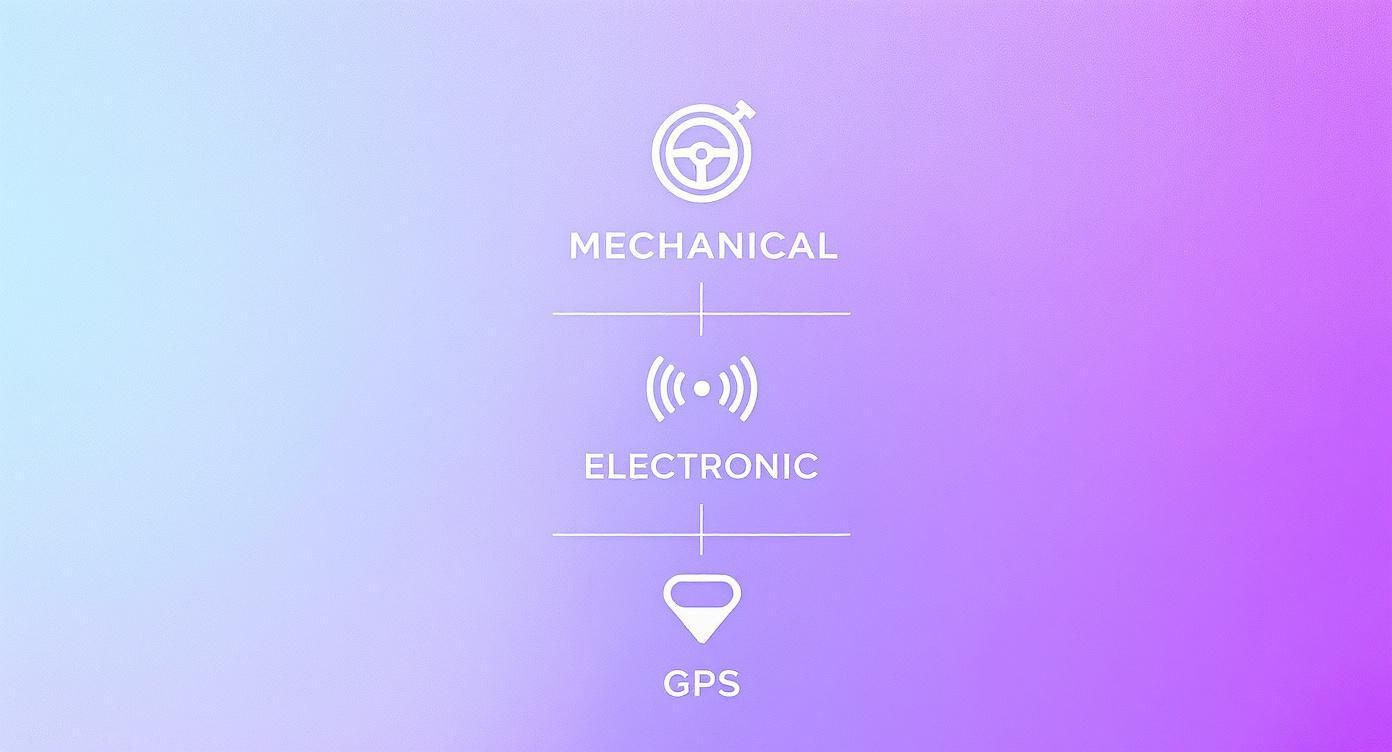
As you can see, each time thieves became more sophisticated, security technology had to advance. That’s why we now rely on a multi-layered approach.
Visible and Mechanical Deterrents
This first group is about creating a prominent, physical roadblock. These include devices like steering wheel locks, brake pedal locks, or the hard-to-miss, brightly colored wheel clamps. Their primary advantage is their high visibility, which screams "this car is protected."
A car thief typically seeks a quick, low-risk target. When they see a car with a visible mechanical lock, they are far more likely to move on to an easier option. It’s a clear signal that stealing this particular car will be a loud, time-consuming hassle—a risk most are unwilling to take.
The downside? A determined professional with the right tools can eventually bypass them. They serve as a fantastic first line of defense but should not be your only one.
Electronic Security Systems
Next are the electronic systems that often come standard in modern cars. This category includes your factory-installed car alarm and, more importantly, the engine immobilizer.
Unlike a large steering wheel club, these systems are invisible and operate silently in the background. An immobilizer is a clever piece of technology that prevents the engine from starting unless it detects the correctly coded transponder key. This single innovation effectively ended old-school hot-wiring and led to a massive reduction in car thefts for years.
But thieves have adapted. They now employ sophisticated electronic gadgets, like relay attack devices, that can capture your key fob's signal from a distance and clone it. This is precisely why relying solely on your car’s built-in security is no longer a foolproof strategy.
Tracking and Recovery Systems
That brings us to the most modern layer of car security: tracking and recovery systems. These devices change the game entirely. Instead of just trying to prevent a theft, they are designed to ensure you get your car back if the unthinkable happens.
The core advantage of a tracking system is that it gives you the power to act immediately after a theft is detected, turning a potential total loss into a recoverable situation.
These systems use GPS to pinpoint your car's real-time location, which is displayed on your smartphone. Take a system like CarLock, for instance. It doesn't just track; it sends you instant alerts for any suspicious activity. Unauthorized engine start? You get an alert. Unusual vibrations, such as from a power tool? You get an alert. Car being towed or moved? You guessed it—an alert.
This means you can provide police with the live, exact location of your stolen vehicle, which dramatically boosts the chances of a swift recovery. To see just how powerful this is, you can explore the features of a modern car locator and understand the level of control it provides. When you combine a smart tracker with other deterrents, you create the toughest defense possible.
To help you choose the right approach, it's useful to compare how these different types of devices perform in a real-world context.
A Practical Comparison of Anti-Theft Devices
The table below breaks down the most common anti-theft devices, comparing their main purpose, general effectiveness, and typical cost.
| Device Type | Primary Function | Effectiveness Level | Typical Cost Range |
|---|---|---|---|
| Steering Wheel Lock | Visual Deterrent & Mechanical Immobilization | Low to Medium | $30 – $150 |
| Factory Car Alarm | Audible Alert for Unauthorized Entry | Low to Medium | Included with Vehicle |
| Engine Immobilizer | Prevents Engine Start without Correct Key | Medium to High | Included with Vehicle |
| GPS Tracking System | Real-Time Location Tracking & Recovery | High | $50 – $200 + Subscription |
This comparison clarifies that while mechanical locks are a good starting point and factory systems provide a baseline of protection, a GPS tracking system is uniquely designed to combat modern theft methods by focusing on recovery.
How GPS Trackers Changed the Game in Car Security
For decades, car security was about prevention. Steering wheel locks and blaring car alarms were designed to stop a thief from entering or driving away. GPS tracking technology flipped the script entirely, shifting the focus from simply preventing theft to enabling rapid, real-time recovery.
This was a massive leap forward, moving from a passive defense to an active response. It gives car owners a level of control and awareness that was previously unimaginable.
Today's GPS trackers are much more than a dot on a map; they are smart, connected guardians for your vehicle.
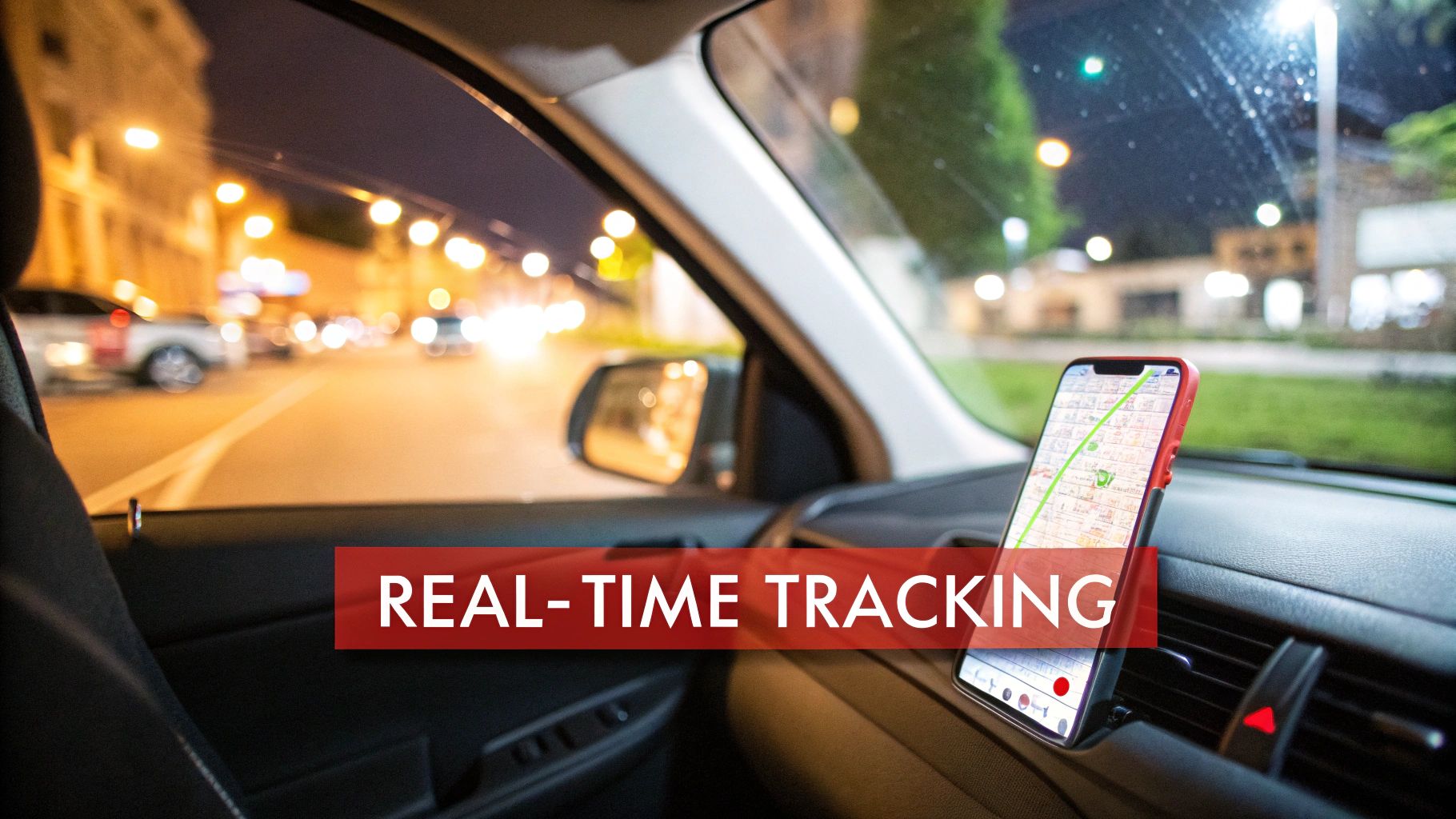
Here's how they work: the device uses the Global Positioning System (GPS) satellite network to determine its precise location. It then uses cellular networks to transmit that information directly to your smartphone, creating an always-on link between you and your vehicle.
More Than Just a Map Pin
Modern systems like CarLock have evolved far beyond simple location tracking. They now offer a suite of intelligent alerts that notify your phone the second a potential threat is detected, turning your phone into a 24/7 security hub for your car.
This proactive approach is what truly distinguishes today’s GPS trackers from older anti-theft gadgets. This shift is reflected in market trends; the global automotive anti-theft system market was valued at $13.2 billion in 2023 and is projected to reach $23.7 billion by 2030, according to a report by Grand View Research, with much of this growth driven by connected GPS technology.
The Power of an Instant Notification
Imagine it's 2 a.m., and you receive an alert on your phone: Your car's engine has started. But your keys are securely on your nightstand. That is the power of a modern GPS anti-theft device.
This is made possible by features designed for immediate notification:
- Unauthorized Movement Warnings: If your parked car is bumped, towed, or moved, you get an instant notification.
- Engine Start Notifications: You’ll know the moment the ignition is turned over, allowing you to react before a thief can drive away.
- Geofencing Alerts: You can set virtual perimeters around key locations like your home or office. If your car crosses that boundary without authorization, you are alerted immediately.
These alerts work together to create a powerful security net around your vehicle. This heightened vehicle security awareness is what can prevent a potential theft from becoming a total loss.
With a GPS tracker, you are no longer a passive victim. You become an active participant in your car's security, armed with the real-time information needed to coordinate with police for a swift recovery.
Providing law enforcement with your car's live, second-by-second location drastically increases the odds of getting it back—often within hours. It turns a nightmare scenario into a manageable problem, offering a peace of mind that older systems simply cannot deliver.
Choosing the Right Security for Your Vehicle
Selecting the right anti-theft setup for your car is not a one-size-fits-all decision. The needs of a new SUV parked on a busy city street are vastly different from those of an older sedan kept in a secure garage. To make an informed choice, you must assess your unique situation.
Consider these factors: What is your vehicle’s value? What are the local crime rates? Where do you typically park it overnight? Answering these questions helps determine the level of protection you need. A simple wheel lock might deter a casual thief, but determined criminals targeting high-value cars will require a more robust defense.
Adopting a Layered Security Mindset
Security experts universally agree that relying on a single device is a flawed strategy. The best approach is to create layers of defense. This is, without question, the most effective way to protect your vehicle. Each additional layer slows a thief down, increases their risk of being caught, and makes them more likely to abandon the attempt for an easier target.
A highly effective strategy combines a very obvious, physical deterrent with a hidden electronic system.
- Layer 1: The Visible Deterrent: This is something like a large, brightly colored steering wheel lock. Its primary function is to serve as a visual warning: "This car is protected, and attempting to steal it will be a loud, difficult, and time-consuming process."
- Layer 2: The Invisible Guardian: This is your silent partner, a hidden GPS tracker. If a thief manages to bypass the first layer, this one activates, providing real-time alerts and the ability to track your car's every move.
When you combine these two, you create a security net that is far more formidable than either device could be on its own. The demand for such advanced solutions is growing rapidly. Projections show the global vehicle anti-theft system market is expected to grow significantly, driven by consumer demand for more sophisticated security technology.
Making an Informed Investment
Ultimately, you want to invest in a system that delivers real protection and genuine peace of mind. A basic alarm or a simple lock is a decent starting point, but today's threats require modern solutions. Systems that provide instant notifications and live tracking put the power back in your hands, allowing you to act the moment something is wrong.
Combining a visible lock with a hidden GPS tracker creates a comprehensive security net. The lock deters the amateur, while the tracker outsmarts the professional, ensuring you have a plan for both prevention and recovery.
This layered approach covers all the bases, protecting you from a wide range of theft tactics. When you explore the features of a modern GPS device, you'll see how an active system provides a level of awareness that passive deterrents cannot match. It’s an investment not just in a product, but in the confidence that comes from knowing your vehicle is truly secure.
Answering Your Top Car Security Questions
When researching car security, several common questions often arise. It's natural to wonder about the sophistication of modern thieves, whether an aftermarket gadget will affect your warranty, or if the investment is truly worthwhile.
Getting clear answers is the best way to feel confident in your security choices. Let's address some of the most frequent questions people have when selecting an anti-theft device.
Can Thieves Bypass Factory Immobilizers?
Unfortunately, yes. While the electronic engine immobilizer was a revolutionary security feature, professional thieves have developed methods to circumvent it. They now use high-tech tools like "relay attack" devices to capture and amplify your key fob's signal.
This technique tricks the car into believing the key is nearby, allowing thieves to unlock the doors and start the engine in seconds—all without physically possessing your keys. This vulnerability is precisely why adding a secondary, independent security layer like a GPS tracker or a robust mechanical lock is crucial for modern vehicles.
Will an Aftermarket Device Void My Warranty?
This is a valid concern, and the answer depends on the type of device. The good news is that many leading modern systems are specifically designed to be warranty-safe.
A simple, plug-and-play anti-theft device that connects to your car’s On-Board Diagnostics (OBD-II) port is generally considered non-invasive. Since it doesn't require cutting or splicing any wires, it typically has no impact on your vehicle's warranty.
However, if you are considering a system that requires professional hardwiring into your car's electrical system, it's a different situation. For these installations, it is essential to consult with both the device manufacturer and your vehicle's warranty provider before proceeding.
Are GPS Trackers Complicated to Use?
Not anymore. While first-generation tracking systems could be cumbersome, today's devices prioritize user-friendliness. Modern plug-in trackers, for example, can be installed and activated in seconds. If you can plug in a phone charger, you can install one of these devices.
All management is handled through a clean, intuitive smartphone app. With just a few taps, you can view your car's location on a map, customize security alerts, and review trip histories. The entire experience is designed to put you in control without any technical complexity. To see just how simple it is, check out the answers to more common GPS tracker questions.
Can an Anti-Theft Device Lower My Insurance?
In many cases, yes. Numerous insurance companies offer discounts for vehicles equipped with approved security systems. From their perspective, these devices reduce risk, and they are often willing to pass those savings on to you in the form of lower premiums.
Insurers are particularly favorable toward systems with active tracking and recovery features, as these dramatically increase the likelihood of recovering a stolen vehicle. It is always worth contacting your insurance provider to inquire about specific discounts they offer for anti-theft devices like alarms, immobilizers, and GPS trackers. You might be pleasantly surprised by the potential savings.