

Driver’s Desk
Top Picks: Best GPS Tracker for Car | Secure Your Vehicle
For many car owners, the best GPS tracker for a car does more than just show a dot on a map—it’s a proactive shield against theft, offering invaluable peace of mind. According to a 2023 report from the National Insurance Crime Bureau (NICB), vehicle thefts have surged, with over one million vehicles stolen in the United States in 2022, a 7% increase from the previous year. The right device blends pinpoint real-time tracking accuracy with instant security alerts, all managed through an app that effectively turns your smartphone into a 24/7 command center for your vehicle.
Why a GPS Tracker Is a Modern Car Security Essential
That heart-stopping moment when you can't find your car is a feeling no one should experience. As vehicle theft methods become more sophisticated, relying solely on traditional alarms is no longer sufficient. Modern thieves can often bypass or silence factory alarms in seconds, leaving a vehicle vulnerable. FBI data indicates that a vehicle is stolen every 32 seconds in the U.S., highlighting the inadequacy of passive security measures.
This is where a GPS tracker fundamentally changes the security paradigm. It elevates your vehicle's protection from a passive system to an active, real-time response network. Instead of merely hoping a loud siren will deter a criminal, you gain the power to know your car's exact location at any moment, providing actionable intelligence for law enforcement.
Proactive Protection Beyond Simple Tracking
The true value of a top-tier GPS tracker lies in its ability to alert you to a potential threat before your vehicle is gone. The focus shifts from recovery to prevention. A robust system provides a multi-layered defense that keeps you informed and in control.
These systems are engineered to send critical notifications for specific events:
- Vibration Alerts: Receive an alert if the device senses vibrations consistent with a break-in attempt, shattered glass, or unauthorized towing.
- Engine Start Alerts: You will be notified the moment your engine is started, allowing you to react if you are not behind the wheel.
- Device Disconnection: Receive an immediate alert if a thief discovers and attempts to remove the tracker.
This immediate feedback loop provides a critical time advantage to notify authorities, potentially stopping a theft in progress. You can explore how these features create a comprehensive defense in our guide to modern car security.
More Than Just Security
Beyond theft prevention, the best GPS tracker for a car delivers benefits that enhance daily life. It offers a clear, data-driven overview of how your car is being used, which is invaluable for parents of new teen drivers or owners of high-value vehicles.
Modern security is about creating a connected ecosystem. Integrating your car's protection with other smart technologies builds a much stronger safety net. For example, understanding the benefits of upgrading to a smart garage door opener shows how different devices can work in concert to secure your property from every angle.
How Your Car's Location Reaches Your Phone
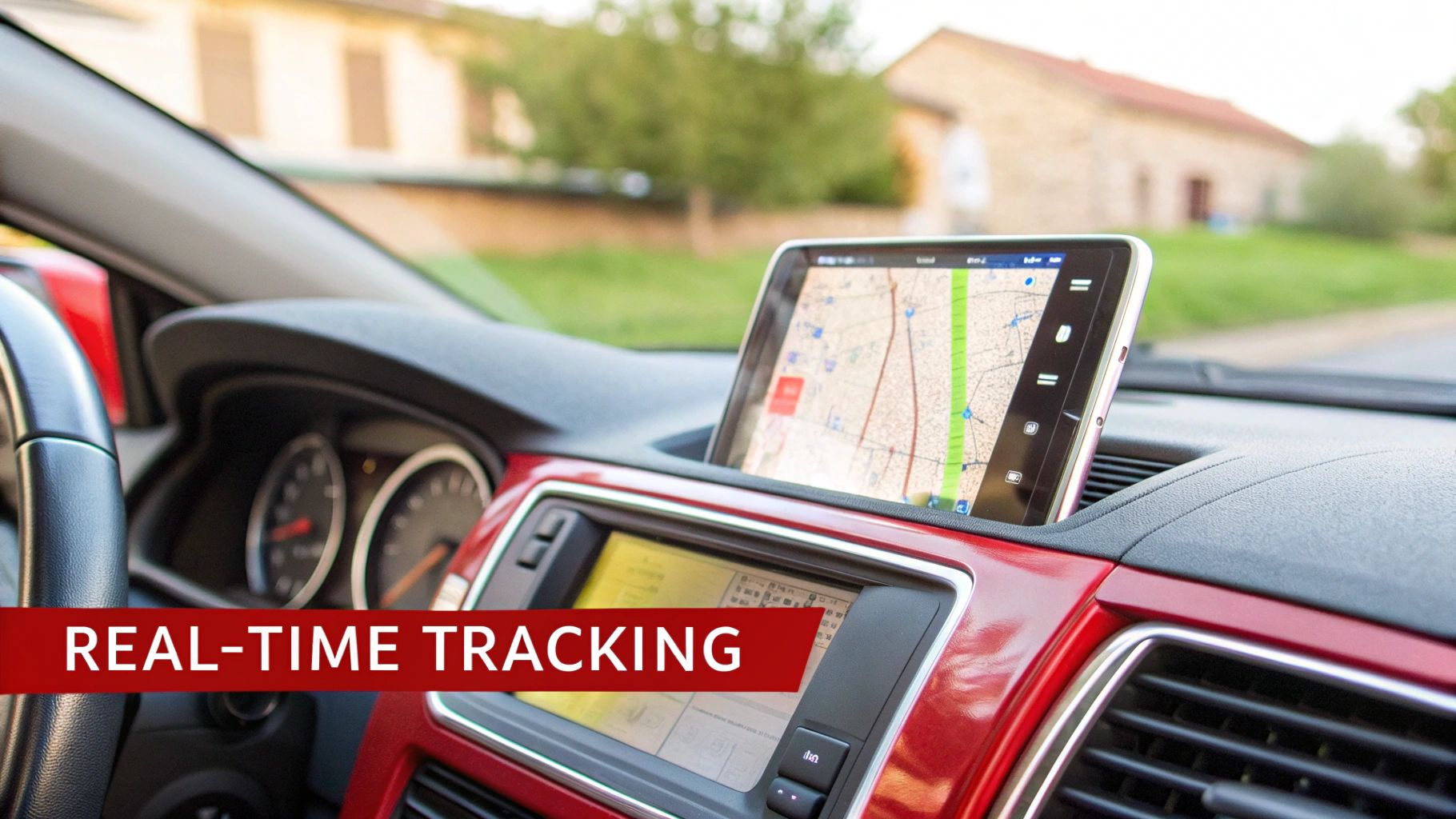
The process seems instantaneous: you open an app, and within seconds, your vehicle's exact location appears on a map. This is not magic, but a high-speed data exchange between satellites, the tracker in your vehicle, cellular networks, and a secure server.
Understanding this journey clarifies why a quality GPS tracker is such a reliable security tool. The entire process unfolds in three key stages: the tracker determines its position, it transmits that location data, and finally, that information is delivered to your smartphone.
The Satellite Handshake: Pinpointing Location
Orbiting high above the Earth is a constellation of Global Positioning System (GPS) satellites. These satellites act as ultra-precise clocks in space, continuously broadcasting their time and location signals. Your car’s GPS tracker is a specialized radio receiver designed to listen for these signals.
To determine its location, the tracker must receive signals from at least four of these satellites. By measuring the minute time delay between when a satellite transmitted its signal and when the tracker received it, the device calculates its distance from that satellite.
Once the tracker has established its distance from four or more satellites, it uses a process called trilateration to triangulate its precise position on the globe. This mathematical calculation delivers the pin-point accuracy required to show your car in a specific parking space, not just a general neighborhood.
This process repeats continuously, allowing the tracker to update its location as the vehicle moves. The quality of the tracker's internal GPS chipset dictates its accuracy and its ability to maintain a signal lock in challenging environments, such as dense urban canyons.
From Your Car to the Cloud: The Cellular Connection
Knowing its location is only the first step. The tracker must then transmit this information. This is where cellular technology comes into play. Every real-time GPS tracker contains a SIM card and a cellular modem—essentially a dedicated mini-cell phone.
This hardware enables the tracker to connect to mobile networks, such as 4G LTE. After calculating its GPS coordinates, it packages the data and sends it over the cellular network to a secure central server. The global GPS market for passenger cars was valued at $23.1 billion in 2023, a figure driven by the proven reliability of this integrated cellular technology for security and telematics.
This constant cellular link is why the best GPS trackers require a subscription. This fee covers the cost of the mobile data plan, ensuring your device remains connected and operational without requiring any user intervention.
The Final Step: From the Server to Your App
The secure server acts as the mission control for the entire system. It receives the raw location data from your tracker, processes it, and stores it securely. When you open your car security app, your phone sends an authenticated request to this server.
The server instantly verifies your request and transmits the latest location data for your vehicle back to your phone. The app's software then translates these raw coordinates into a user-friendly format—a pin on a familiar map interface, like Google Maps. This final stage converts complex data into simple, actionable intelligence.
Beyond a Dot on a Map: The Features That Really Matter
Consider a quality GPS tracker not merely as a locator, but as a silent co-pilot and a 24/7 security guard. While knowing your vehicle's location is the foundation, the best systems build upon it with features designed for proactive alerts, valuable insights, and genuine peace of mind.
Analyzing these features is the most critical step in selecting a device. It distinguishes a simple tool that helps after a theft from a smart system that can prevent it entirely. These capabilities work in concert to create a powerful security net around your vehicle.
This chart breaks down the core features to prioritize based on your primary security concerns.
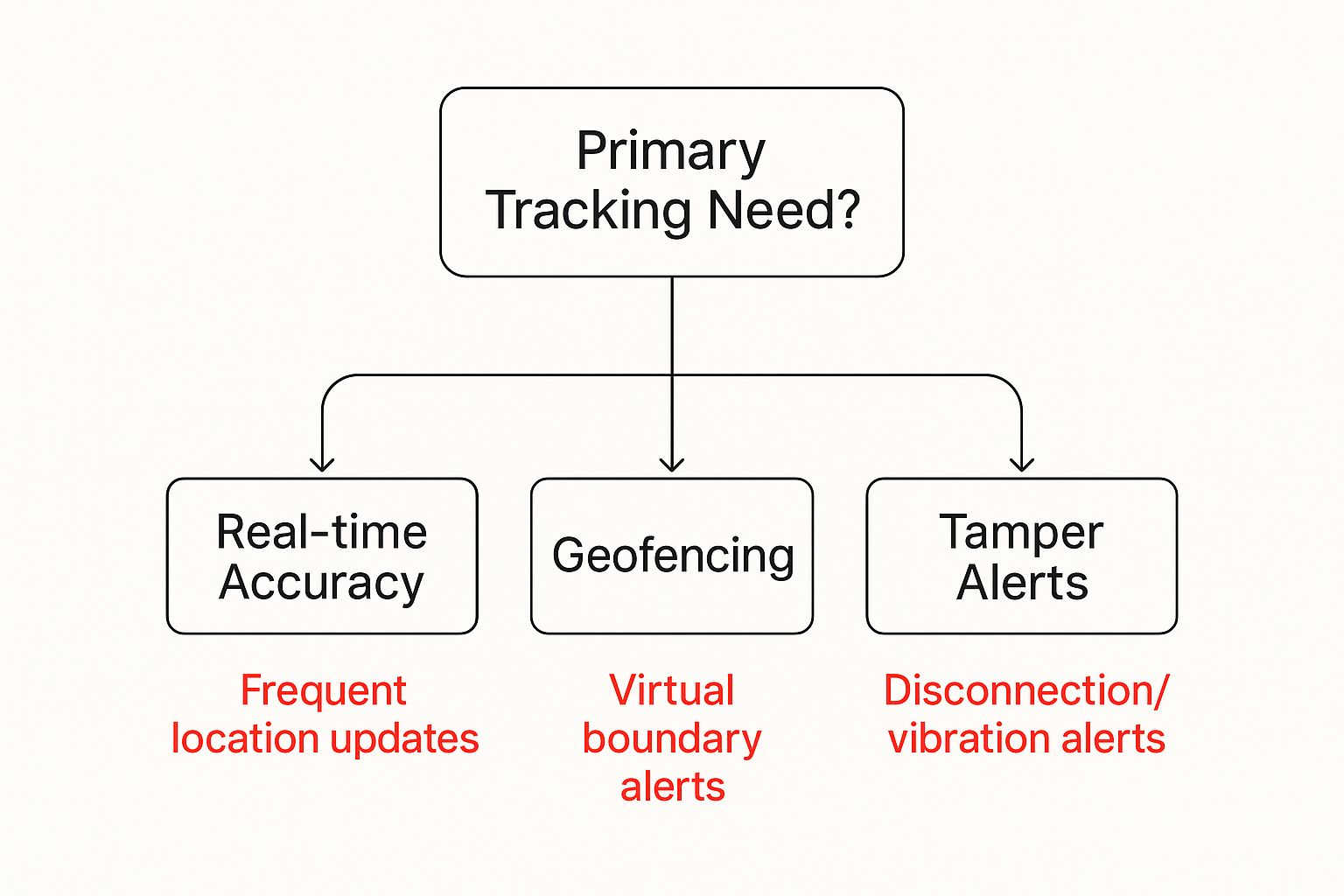
As illustrated, your top priority—whether it is pinpoint location accuracy, setting virtual boundaries, or detecting physical tampering—will guide you to the most critical feature set for your needs.
Real-Time Tracking Accuracy
The absolute cornerstone of any serious GPS security system is real-time tracking. This means a continuous, live feed of your vehicle’s position, not an update every five minutes.
During a theft, every second is critical. A delay of just a minute can be the difference between recovery and total loss. Look for devices that update their location every few seconds. This level of precision ensures the dot on your map is exactly where your car is at that moment, providing the actionable intelligence law enforcement needs to intercept a vehicle in motion.
Geofencing: Your Virtual Boundaries
One of the most intelligent preventative features is geofencing. This function allows you to draw virtual perimeters on a map around key locations like your home, office, or a child's school, creating digital safe zones.
Once a geofence is set, the system automates monitoring. You will receive an instant alert on your phone the moment your car enters or leaves a designated area. This is ideal for detecting if a valet takes your car for an unauthorized drive or if a thief moves it from your property in the middle of thenight.
Geofencing transforms your tracker from a passive "find my car" tool into an active security monitor. It doesn't wait for you to check the app; it notifies you the second a boundary is breached, giving you a crucial head start.
Instant Security Alerts
This is what truly differentiates a security-focused GPS tracker from a simple location device. Thieves are fast and proficient at disabling factory alarms. The best systems have integrated sensors to detect the tell-tale signs of a break-in and notify you immediately.
Essential alerts include:
- Vibration Detection: A built-in accelerometer can sense unusual vibrations, such as a window being smashed, a door being forced open, or the vehicle being lifted onto a tow truck.
- Engine Start Notification: Receive an alert the instant the engine turns on, so you know immediately if your car has been started without authorization.
- Device Disconnect Alert: If a thief finds and unplugs the tracker, the device utilizes its internal backup battery to send one final, critical alert to your phone.
These notifications are your first line of defense, often arriving on your phone before a thief has even put the car in gear. To see a detailed breakdown of these functions, you can explore the full range of CarLock device features.
Detailed Trip History and Driver Behavior
Beyond theft prevention, a good tracker offers a wealth of information through detailed logs. A complete trip history allows you to review every route taken, with timestamps, speeds, and stops recorded. This is highly useful for logging business mileage or monitoring vehicle usage.
Driver behavior monitoring adds another layer of safety, particularly for parents with new teen drivers. This feature can track and flag events such as:
- Harsh acceleration
- Hard braking
- Sharp cornering
- Speeding
This data is not about micromanagement; it's about encouraging safer driving habits and providing peace of mind. Businesses have widely adopted this technology; the commercial vehicle GPS tracker market was valued at approximately USD 818 million and is projected to reach USD 1.396 billion by 2032, driven largely by the demand for this kind of detailed monitoring.
Choosing Your Tracker Type: Wired vs. Wireless
When selecting a GPS tracker for your car, one of the primary decisions is the installation method. There are two main options: a hardwired tracker that is professionally installed or a wireless, plug-and-play model you can set up yourself in seconds.
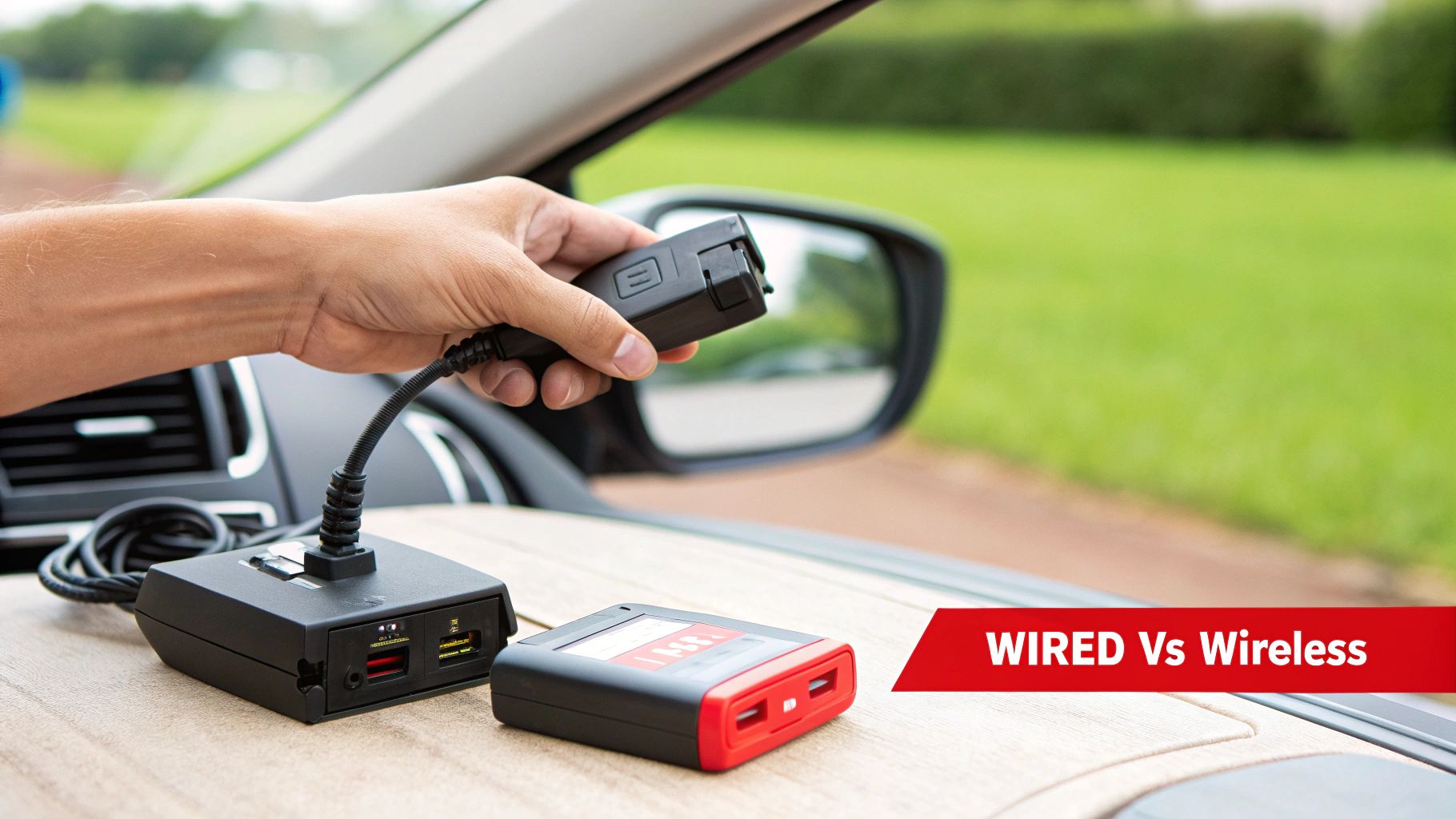
The choice is analogous to selecting a home security system. You could opt for a fully integrated, professionally installed setup that is completely concealed. Alternatively, you could choose a smart, DIY system that you plug in and control from your phone. Each approach has distinct advantages, and the optimal choice depends on whether you prioritize stealth and permanence or convenience and flexibility.
The Case for Hardwired GPS Trackers
A hardwired GPS tracker is a device wired directly into your vehicle’s electrical system. While this method is more involved and often requires professional installation, the result is a "set it and forget it" solution with significant security benefits.
The primary advantage is a constant, reliable power source. Because it is connected to the car's battery, you never have to worry about recharging it. This ensures 24/7 uninterrupted protection, providing ultimate peace of mind.
Furthermore, a hardwired installation is exceptionally discreet. A professional can conceal the unit deep inside the dashboard or another hidden location, making it nearly impossible for a thief to find and disable. This stealth factor is a critical security advantage—a tracker that cannot be found cannot be defeated.
The Simplicity of Wireless GPS Trackers
On the other end of the spectrum are wireless GPS trackers, which emphasize plug-and-play simplicity. These trackers connect directly to your car’s On-Board Diagnostics (OBD-II) port. If your vehicle was manufactured after 1996, it has an OBD-II port, typically located under the steering wheel. Installation takes only a few seconds and requires no tools or technical expertise.
This makes wireless trackers highly accessible and portable. If you have multiple vehicles, you can easily swap the device between them, which is ideal for families or small businesses. The ease of use removes technical barriers, making advanced car security available to anyone.
The primary trade-off with a plug-in device is its visibility. While convenient, the OBD-II port is a standardized location, and a knowledgeable thief may check it. However, the best wireless trackers mitigate this risk with instant disconnect alerts, notifying you the moment the device is unplugged.
These alerts are a crucial feature. Even if a thief finds and removes the tracker, its small internal backup battery activates to send one final, critical notification to your phone. You receive an immediate warning that your vehicle is being tampered with. You can learn more about how these smart notifications function by exploring the benefits of a GPS car tracker with advanced features.
Comparing Your Options Side-by-Side
To clarify the decision, let's compare these two types of trackers directly. Each is designed for a different type of car owner, and seeing the pros and cons laid out helps you focus on what is most important for your specific situation.
Comparison of Wired vs. Wireless GPS Car Trackers
Here is a summary of the key differences between wired and wireless (plug-in) GPS tracking devices. This table should help you determine which option is the best fit for your vehicle and lifestyle.
| Feature | Wired GPS Tracker | Wireless (Plug-in) GPS Tracker |
|---|---|---|
| Installation | Professional installation is often recommended, requiring connection to the vehicle’s wiring. | Extremely simple plug-and-play setup into the OBD-II port, taking less than a minute. |
| Power Source | Draws constant power directly from the car's battery, eliminating the need for recharging. | Powered by the OBD-II port when the car is on; uses an internal battery for disconnect alerts. |
| Discretion | Highly discreet. Can be hidden deep within the vehicle, making it very difficult for thieves to locate. | Less discreet. The location of the OBD-II port is standardized and generally easy to access. |
| Portability | Not easily portable. Moving it to another vehicle requires a complete re-installation. | Highly portable. Can be swapped between vehicles in seconds. |
| Best For | Owners seeking the highest level of covert security and a permanent, maintenance-free solution. | Owners who value convenience, flexibility, and a non-invasive setup with powerful alert features. |
Ultimately, whether you choose the stealth of a wired tracker or the convenience of a plug-in model, you are taking a significant step toward securing your vehicle. The key is to select the tool that best aligns with your needs and provides the greatest confidence.
The Solution We Trust for Comprehensive Car Security
After analyzing the various features and installation methods of GPS trackers, one conclusion is evident: not all devices are created equal. Many trackers are proficient at displaying a location on a map, but only a select few deliver a complete security system capable of actively preventing theft.
This is precisely why we stand behind CarLock. It is our primary recommendation for any car owner serious about implementing proactive, real-world security. CarLock was engineered from the ground up to be more than just a tracking gadget; it is a powerful, multi-layered alarm system controlled directly from your smartphone. It is a solution designed for the everyday user who needs a reliable system that works seamlessly without technical complications.
A Proactive Security System in Your Pocket
What truly distinguishes CarLock is its intelligent and aggressive alert system. It is designed to warn you of a potential threat long before a thief can drive away with your vehicle. Think of it as a vigilant, sleepless guard constantly monitoring your car.
This system delivers a comprehensive suite of instant notifications for critical events:
- Vibration Detected: The moment the device registers unusual vibrations—such as a window shattering or a door being forced open—your phone receives an alert.
- Engine Started: You will know the instant the engine is turned over without your presence in the driver's seat.
- Device Disconnected: If a thief locates and unplugs the unit, it does not go offline silently. It utilizes its internal battery to send a final, critical alert.
These are not just checklist features; they simplify the search for the best gps tracker for car. The focus shifts from mere tracking to identifying the system that provides the best opportunity to stop a theft in its tracks. You can delve deeper into how this technology functions in our guide on car tracking solutions.
User-Focused and Exceptionally Reliable
Beyond its advanced alert system, CarLock excels in user experience. The installation process is exceptionally simple—just plug the device into your car's OBD-II port, and the setup is complete in seconds. There is no wiring, no need for mechanics, and no complexity.
The accompanying app is equally straightforward. It features a clean, intuitive interface that makes it easy to check on your vehicle, review trip histories, and adjust settings. This combination of reliability and ease of use is why it is trusted in major markets. In fact, North America constitutes approximately 40% of the global GPS tracker market, a share driven by high consumer demand for proven, no-nonsense security solutions.
CarLock is not just a device you plug in and forget. It is a complete, easy-to-use security partner that delivers real protection and, most importantly, genuine peace of mind.
Answering Your Top Questions About GPS Trackers
Even after a thorough review of features and functionalities, it is natural to have remaining questions before purchasing a GPS tracker for your car. We've compiled answers to the most common concerns we hear from vehicle owners to help resolve any lingering doubts.
Our objective is to ensure you feel 100% confident in your decision to protect your vehicle with today's leading security technology.
Will a GPS Tracker Drain My Car Battery?
This is a primary and valid concern. However, a professionally engineered tracker is designed for extreme power efficiency. A quality device like CarLock enters a low-power "sleep mode" when your car is parked, consuming a minimal amount of energy just to remain on alert. For any healthy car battery, this power draw is completely negligible.
Furthermore, the CarLock system includes an additional layer of battery protection. It actively monitors your car’s voltage and will send a notification to your phone if the charge becomes critically low. You will receive a warning long before it could become an issue.
Is It Legal to Use a GPS Tracker on My Car?
Absolutely. In virtually all jurisdictions, it is legal to install and use a tracking device on a vehicle that you own. As the owner of the property, you are well within your rights to protect it.
Legal issues typically arise only when a device is used to track a vehicle without the owner's knowledge or consent. For securing your personal vehicle against theft, you are on solid legal ground. For a more detailed examination of this topic, we have compiled additional information in our common GPS tracker questions resource.
For business owners using trackers on company vehicles, it is best practice to inform employees that the vehicles are being monitored. However, for your own vehicle's security, there are no legal impediments.
How Much Data Does a Car GPS Tracker Use?
You might be surprised at how little data a GPS tracker consumes. These devices are not streaming video or downloading large files. Instead, they transmit small, highly efficient packets of location data only when necessary.
This minimal data usage is always covered by the device's subscription fee. With a service like CarLock, you never have to worry about data caps or unexpected overage charges. The affordable subscription includes all the data the tracker needs to communicate with your app, providing seamless protection with no hidden costs.
Ready to secure your vehicle with a system trusted by thousands? CarLock offers the multi-layered, proactive security you need with the simplicity you want.