

Driver’s Desk
How to Protect My Car From Theft and Keep It Safe
To effectively protect your car from theft, a layered security strategy is essential. A single solution is no longer sufficient; the goal is to combine robust physical deterrents, advanced electronic security like a GPS tracker, and consistent, common-sense habits.
This multi-layered approach creates a formidable defense against a wide spectrum of threats, from the opportunistic joyrider to the sophisticated professional using high-tech methods. By making your vehicle a significantly more difficult and risky target, you dramatically reduce the probability of it being stolen.
Before diving into specific tools and tactics, it's crucial to understand the framework of this layered approach. The most effective way to conceptualize it is as a three-part strategy, where each layer reinforces the others to create a comprehensive security posture.
Your Three-Layer Security Strategy
| Security Layer | What It Does | Examples You Can Use Today |
|---|---|---|
| Physical Deterrents | Makes your car visibly harder and slower to steal, encouraging thieves to move on. | Steering wheel locks, tire clamps, VIN etching on windows. |
| Electronic Security | Actively monitors your vehicle and alerts you to unauthorized activity in real-time. | GPS trackers (like CarLock), advanced alarm systems. |
| Situational Awareness | Reduces the opportunity for theft through smart habits and environmental choices. | Parking in well-lit areas, never leaving keys in the car, using a Faraday pouch for fobs. |
This table provides a high-level overview. Now, let's delve into the data and tactics that explain why these layers, particularly the electronic one, are so indispensable in today's threat environment.
Understanding Modern Car Theft Tactics
To understand how to protect your car, you must first understand the adversary. The antiquated image of a thief smashing a window and hot-wiring a car is largely a relic of the past. Today's criminals leverage sophisticated technology to bypass factory security systems with alarming speed and stealth.
Ironically, they often exploit the very convenience-focused technology that manufacturers integrate into modern vehicles. Keyless entry and push-to-start systems, for instance, have become a primary vector for attack.
High-Tech Theft Methods
One of the most prevalent tactics is the relay attack. Using a two-part electronic device, thieves capture the signal from your key fob—even when it’s securely inside your home—and amplify it to a receiver held near your car. This fools the vehicle's computer into thinking the key is present, allowing criminals to unlock the doors, start the engine, and drive away in under a minute, often without making a sound.
An even more advanced technique is CAN (Controller Area Network) bus injection. Criminals access your car's internal computer network via an external point, such as a headlight connection. From there, they "inject" malicious commands that instruct the car to unlock and start, completely bypassing the factory alarm and immobilizer. According to a 2023 report from the cybersecurity firm Canis Labs, this method allows thieves to steal certain vehicle models in less than two minutes.
"The most serious attacks no longer target individual vehicles, but rather their manufacturers’ servers. A single compromised server can expose millions of vehicles at once." – VicOne, Automotive Cybersecurity Report 2023.
The Evolving Threat Landscape
The statistics paint a picture of a persistent, evolving crisis. While preliminary FBI data indicated a potential decrease in early 2024, the National Insurance Crime Bureau (NICB) reported that vehicle thefts exceeded one million in the U.S. for the second consecutive year in 2023, marking the highest number since 2008.
California remains a major hotspot, with nearly 200,000 vehicles reported stolen in 2023. This data underscores a critical reality: relying solely on the security system that came with your car is no longer a viable strategy against modern threats.
Understanding these vulnerabilities is the first step toward building a robust defense. For a more detailed exploration, we offer an in-depth guide on raising your car security awareness. As thieves adapt, our protective measures must evolve as well.
Building a Strong Physical Defense
Making your car a physically formidable target is the foundational layer of any effective theft prevention plan. Despite the rise of high-tech hacks, a significant percentage of car thefts remain crimes of opportunity. A vehicle that appears difficult and time-consuming to breach is often enough to deter a thief, prompting them to seek an easier target.
The strategy is straightforward: create multiple barriers, both physical and visual, that increase the time, effort, and noise required to steal the vehicle. For these deterrents to be effective, they must be used consistently.
Layering Visible Deterrents
The most effective physical defenses are those a thief can identify from a distance. A brightly colored steering wheel lock is not merely a physical barrier; it's a clear visual signal that your car is protected and will not be an easy acquisition. These tools are designed to slow criminals down and force them to use loud, attention-drawing methods.
Here are some of the most effective physical deterrents available:
- Steering Wheel Locks: These classic devices remain highly effective. Modern designs that envelop the entire steering wheel or hook directly to the brake pedal are extremely difficult to cut through quickly or silently.
- Brake or Pedal Locks: Also known as pedal jacks, these devices immobilize the brake or clutch pedal, rendering the vehicle undrivable even if a thief successfully starts the engine.
- Tire or Wheel Clamps: While requiring more effort to apply, a wheel clamp is one of the most powerful visual deterrents available. It is an unmistakable indicator that the vehicle is securely immobilized.
These traditional physical tools work synergistically with modern electronic systems. For instance, vehicle immobilizers—the technology preventing a car from starting without the correct key transponder—have significantly reduced theft rates since their widespread adoption. However, when an immobilizer is paired with a robust physical lock, you create a powerful defense that can thwart both casual and determined thieves.
Reducing the Value of Stolen Parts
Professional thieves often target high-value components like catalytic converters or steal entire vehicles to be dismantled at "chop shops." A highly effective countermeasure is to devalue your car's components on the illicit market.
The objective is to make your car's parts traceable, rendering them nearly worthless to a thief. A marked catalytic converter is significantly harder to sell anonymously, which removes the profit motive driving this type of theft.
This is where VIN etching proves to be a powerful, low-cost defense. The process involves permanently engraving your Vehicle Identification Number (VIN) onto all major windows and other valuable parts, such as the catalytic converter. A car with an etched VIN requires a thief to replace all the glass before reselling it—a costly and time-consuming process that erodes their potential profit.
Combining visible locks with permanent markings creates a formidable defensive layer. While these physical measures are a critical foundation, they are most effective when supported by an active alert system. A modern car alarm can notify you instantly of any tampering, bridging the gap between passive defense and real-time response. For homeowners, installing a secure gate can add another extremely effective layer of security.
Using Technology to Secure Your Vehicle
While physical locks and deterrents form an excellent first line of defense, today's technologically proficient thieves necessitate a modern, electronic countermeasure. Relying solely on physical barriers is akin to building a fortress with no sentinels; it appears strong but remains passive. This is where active, real-time security technology is essential, transforming your car from a stationary target into a constantly monitored asset.
Modern electronic security has advanced far beyond a simple siren. It now revolves around receiving immediate, actionable intelligence directly to your smartphone the moment a threat is detected. This active defense layer provides 24/7 vigilance over your vehicle, regardless of your location.
Moving Beyond Factory-Installed Systems
Most new vehicles are equipped with some form of electronic security, such as an engine immobilizer or a basic alarm. The critical flaw is that professional thieves often view these factory systems as minor obstacles. They employ sophisticated devices like CAN injectors to bypass them entirely, frequently accessing the vehicle's network through an external point like a headlight connection to send commands that unlock and start the car.
This vulnerability highlights why an independent, aftermarket GPS tracking and alert system is so crucial. It operates on a separate network from your car's factory electronics, providing a layer of security that thieves are not equipped to easily disable. It functions as your vehicle's silent guardian.
When selecting a system, the primary value is not just tracking a stolen vehicle post-theft. The real power lies in receiving instant notifications of suspicious activity before the car is moved, affording you critical seconds to react and notify law enforcement.
The Power of Real-Time Monitoring and Alerts
The most effective electronic security systems integrate GPS tracking with a comprehensive suite of sensors to create a virtual shield around your vehicle. When researching how to protect my car from theft, these are the features that deliver a decisive advantage.
This process flow infographic shows how different physical defenses work together to protect your vehicle.
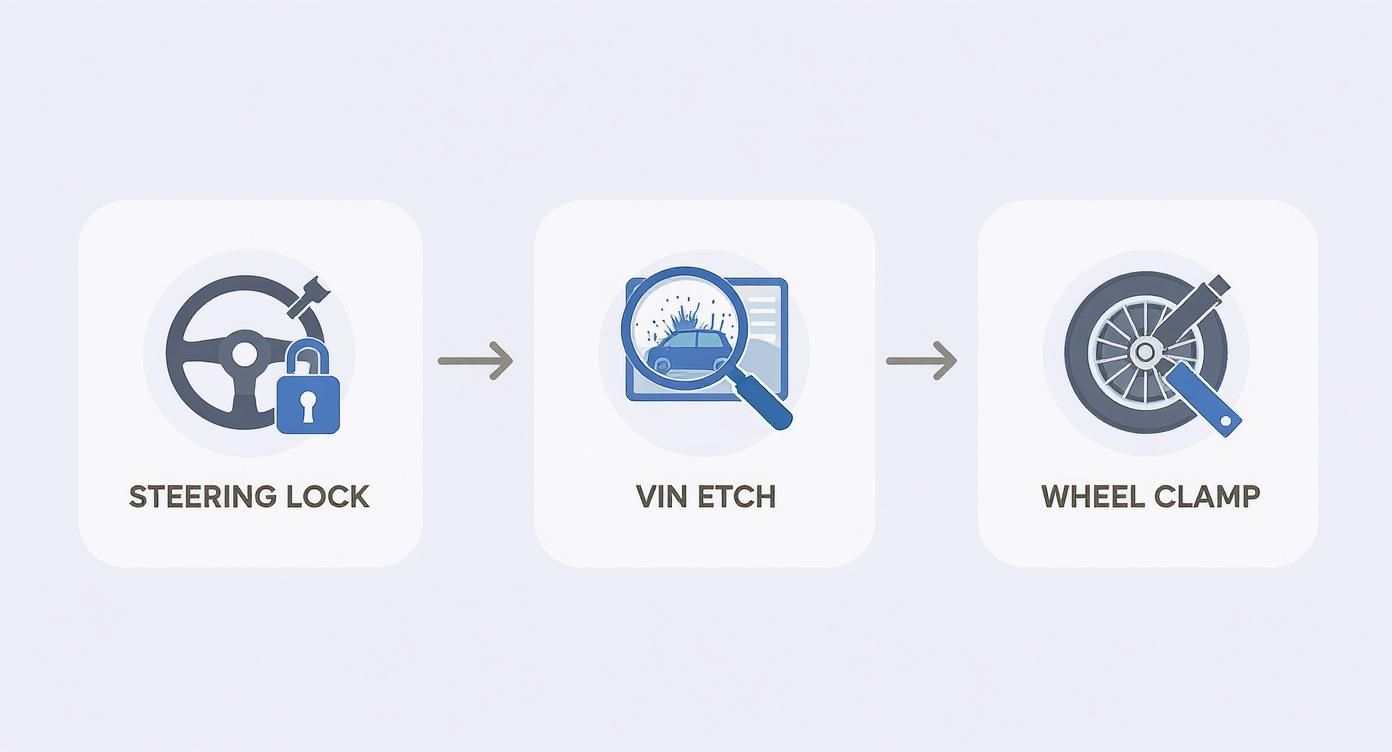
As the image illustrates, a layered physical approach—such as combining a steering lock, VIN etching, and a wheel clamp—creates multiple frustrating obstacles for a potential thief.
Advanced systems like CarLock introduce a powerful digital layer with features designed for immediate threat notification:
- Vibration Alerts: Receive a notification if the system detects vibrations consistent with a window being smashed, a door being forced, or the vehicle being jacked up for wheel or catalytic converter theft.
- Engine Start Notifications: Receive an alert the moment the engine starts without your authorization. This is a critical warning against silent relay attacks, where thieves can start the engine without making a sound.
- Geofencing: Establish a virtual perimeter (a "safe zone") around your car. If the vehicle moves outside this user-defined area, you are notified instantly. This is ideal for monitoring your car when parked at work, an airport, or in a public garage.
Selecting and Configuring Your System
Choosing the right technology is the first step, but proper configuration is what maximizes its effectiveness. A system that generates frequent false alarms will likely be ignored, defeating its purpose. The goal is to receive timely, relevant alerts.
During setup, it is important to adjust the sensitivity of the vibration sensor based on your typical parking environment. If you frequently park on a busy street with heavy traffic, a lower sensitivity setting can help prevent unnecessary notifications.
You can also broaden your technological defense by integrating wider surveillance. For example, exploring options detailed in this Homeboy Security Camera review can help monitor your vehicle's surroundings. Pairing a device that alerts you to a break-in with a camera that records the event creates a powerful evidence trail for law enforcement.
By layering these electronic tools, you construct a robust, active defense that protects your vehicle around the clock. For a deeper analysis of system features, consult our detailed guide on what to look for in car security systems.
Adopting Smart Habits to Outsmart Thieves
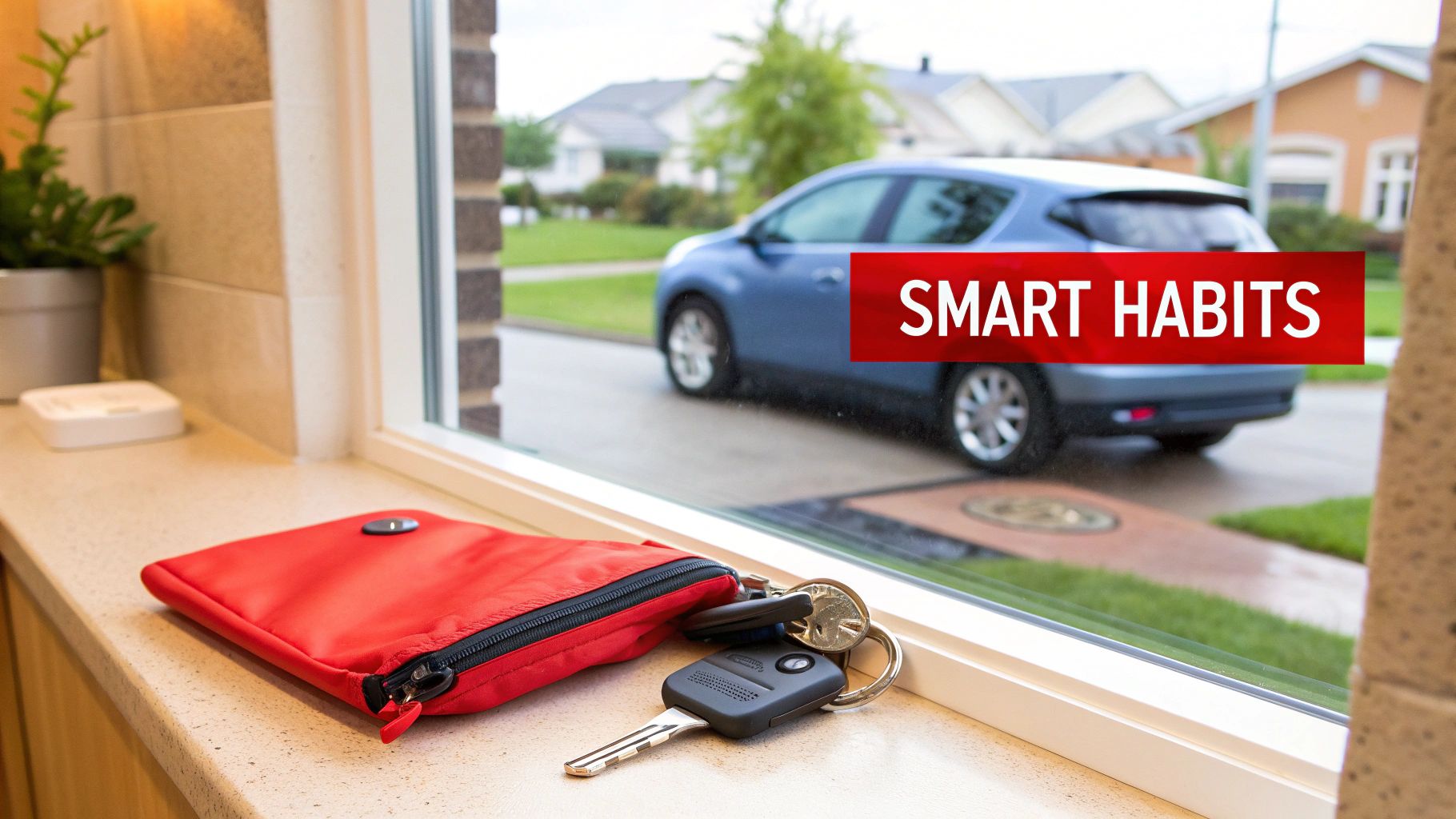
Physical locks and high-tech alerts are crucial layers of security, but they represent only part of the solution for protecting your car. The true linchpin of your entire security strategy is your daily habits.
These small, mindful actions, performed consistently, cost nothing yet can dramatically lower your vehicle's risk profile. They are proactive measures that make your car a less appealing and more difficult target for opportunistic criminals.
This extends beyond simply locking the doors. True security is cultivated through situational awareness—learning to identify vulnerabilities from a thief's perspective. It's about actively creating an environment around your car that is inconvenient and unattractive to criminals.
Parking with a Defensive Mindset
Where and how you park can be your most powerful, no-cost security measure. Thieves thrive on darkness, concealment, and easy escape routes. Your objective is to deny them all three.
Adopt a defensive mindset every time you leave your vehicle. A few minor adjustments to your routine can yield significant security benefits.
- Seek Out the Spotlight: Always prioritize parking in well-lit, high-traffic areas. Criminals detest being observed and prefer to operate in shadows where they are less likely to be noticed. A parking space directly under a streetlamp is prime real estate.
- Complicate a Tow: When parking on an incline, turn your wheels toward the curb. On a level surface, turn them sharply to one side. This simple action significantly complicates any attempt to tow your vehicle away quickly.
- Use Your Surroundings: Utilize a secure garage whenever possible. If parking on the street, position your car tightly against a wall or another vehicle to limit access to the doors.
Safeguarding Your Keys and Valuables
Modern car thieves often bypass brute force entirely, focusing instead on capturing your key fob's signal or stealing valuables left in plain sight. This is where your habits can directly counter their high-tech and low-tech methods. Furthermore, never leave your vehicle running unattended, even for a moment. This is a direct invitation for theft.
A critical error is assuming your car is safe merely because it is locked. Many thefts occur because owners inadvertently provide thieves with the tools they need—from an unprotected key fob signal to registration documents that can facilitate identity theft.
Making these protective habits reflexive is crucial.
- Block That Signal: Relay attacks are a significant threat to any vehicle with keyless entry. Make it a habit to store your key fob in a signal-blocking Faraday pouch or a metal container when at home. This blocks the radio-frequency identification (RFID) signal, rendering it impossible for thieves to amplify it.
- Clean Out Your Car: This fundamental rule is vital. Never leave electronics, bags, or wallets visible. More importantly, do not store your vehicle's title or registration in the glove compartment. A thief can use these documents to commit identity fraud or simplify the process of selling your stolen vehicle.
By integrating these smart habits into your daily routine, you build a powerful, proactive defense that enhances the effectiveness of all your physical and electronic security measures.
Creating an Action Plan for a Stolen Car
It’s a scenario no one wants to face: the gut-wrenching realization that your car has vanished. While panic is a natural first response, a clear head and a pre-established action plan can transform chaos into focused, effective action. Swiftness is paramount and can dramatically increase the odds of recovering your vehicle.
First, take a moment to confirm the vehicle wasn't towed. Check the area for temporary parking restrictions you may have overlooked and contact local towing companies. Once you have confirmed it is not in an impound lot, your immediate next call is to the police. Every second of delay provides thieves with more time.
Filing a Police Report Immediately
When you contact law enforcement (dialing 911), be prepared with specific information. Filing a police report is not just a procedural step; it officially initiates the investigation and is a mandatory requirement for any insurance claim.
Have these key details ready:
- Your car’s make, model, year, and color.
- The license plate number.
- The Vehicle Identification Number (VIN). (Pro tip: keep a photograph of your VIN plate, located on the dashboard or driver's side door jamb, on your phone for easy access).
- Any distinguishing features, such as dents, scratches, stickers, or aftermarket modifications.
This is where a GPS tracker like CarLock becomes a game-changer. While on the phone with the dispatcher, you can provide your vehicle's exact, real-time location. Supplying law enforcement with a live tracking link can immediately escalate the priority of your case and lead them directly to your vehicle, often within minutes. You can see precisely how a real-time car locator makes a critical difference in these situations.
Notifying Your Insurance Provider
As soon as you have concluded the call with the police, contact your insurance company. The sooner they are notified, the faster they can begin the claims process. They will require the police report number, so ensure you obtain it from the officer.
You will provide them with much of the same information given to the police, but they will also inquire about any personal belongings that were inside the vehicle. It is advisable to compile a list of any valuables stolen with the car, as your policy may offer some coverage for personal items.
Having a plan is about controlling what you can in an uncontrollable situation. Swiftly reporting to the police with accurate data and immediately informing your insurance company are the two most critical steps you can take.
Realistically, not every stolen car is recovered. The latest data shows that the recovery rate for stolen vehicles was just 58.3% in the first quarter of 2025. A staggering 40% of stolen cars are never seen again, often because they're quickly taken to chop shops or have their VINs illegally changed for resale. You can read the full analysis from Équité Association to see the numbers. Acting fast is your best chance to beat those odds.
Common Questions on Car Theft Protection
Even with a robust security plan, questions are likely to arise. Addressing these common concerns can provide greater confidence in the security layers you choose to implement.
Will a Steering Wheel Lock Actually Stop a Determined Thief?
No single device can guarantee protection against a highly motivated professional targeting a specific vehicle. However, a high-quality steering wheel lock is an extremely effective deterrent because it introduces significant friction into the theft process.
Most car thieves are opportunists seeking a fast, low-risk target. A large, brightly colored lock on the steering wheel is an immediate visual signal that your car is not an easy target, often causing them to move on.
For a more persistent thief, removing the lock requires noisy tools like an angle grinder, which creates sparks and significant noise. This dramatically increases their risk of being caught. The lock's primary function is less about being unbreakable and more about making your car a much riskier and less appealing target than the next one.
Are Factory-Installed Alarms and Immobilizers Enough Protection?
While they once provided a solid defense, they are no longer sufficient on their own. Factory systems serve as a good baseline, but criminals have adapted their methods. Thieves can now purchase sophisticated electronic devices online specifically designed to bypass the standard security systems on even the newest models.
The factory immobilizer you rely on is vulnerable to a silent "relay attack," where a thief captures and amplifies your key fob's signal from outside your house to unlock and start your car. According to law enforcement reports, these thefts can be completed in under 60 seconds without making a sound.
This is precisely why a layered approach is non-negotiable today. An aftermarket GPS tracker like CarLock operates independently of your car's factory systems. It adds that critical layer of real-time alerts and tracking that thieves have not yet found a way to quietly defeat. For a more detailed explanation, you can explore frequently asked questions about GPS trackers and see how they address these modern security gaps.
A common misconception is that a new car is a secure car. In reality, the very technology that makes new cars convenient, like keyless entry, often creates the vulnerabilities that thieves are now experts at exploiting.
Does My Car's Color or Condition Affect Its Theft Risk?
It may seem unusual, but yes, it can. Thieves operate with efficiency in mind. They often target common models in neutral colors—such as black, white, silver, and gray. The reason is twofold: these vehicles blend into traffic, making them less conspicuous to law enforcement after a theft, and their parts are in high demand on the black market. A silver Honda Civic, for example, represents a valuable inventory of sellable components.
Conversely, a vehicle with a bright, distinctive color, custom graphics, or even noticeable body damage is far more memorable and stands out. This makes it a riskier vehicle for a thief to drive or attempt to sell. While a unique paint job is not a standalone security strategy, your car's distinct appearance can certainly make it a less attractive target.
Ready to add a powerful, modern layer of security that factory systems can't match? CarLock provides real-time GPS tracking and instant alerts for vibrations, engine starts, and vehicle movement, giving you peace of mind. Secure your vehicle with CarLock today.