

Driver’s Desk
Best Car Alarm System: An In-Depth Guide to Modern Vehicle Security
The best car alarm system for today's world does more than just make noise—it provides real-time GPS tracking and instant alerts directly to your smartphone. While traditional alarms are often ignored, modern systems transform your vehicle into a connected, traceable asset you can monitor from anywhere, anytime. In 2022 alone, the United States saw over one million vehicle thefts, a 7% increase from the previous year, highlighting the urgent need for more effective security solutions.
Why Modern Car Security Is More Than Just Noise
That sinking feeling you get staring at an empty parking spot where your car should be is a nightmare. For decades, the go-to solution was a screaming siren meant to spook thieves and attract attention. But as thieves have adapted and the public has become desensitized to noise, that old "honking box" is no longer a sufficient deterrent. According to the National Insurance Crime Bureau (NICB), a vehicle is stolen every 32 seconds in the U.S., proving that conventional methods are falling short.
This guide is about moving past that outdated thinking. We'll explore what makes a car alarm system truly effective today. It’s a shift from a passive noisemaker to an active defense system that keeps you connected to your vehicle's status, 24/7.
The New Standard of Vehicle Protection
The most effective systems now blend physical hardware with intelligent software, turning your phone into the ultimate command center. Instead of just causing a racket that your neighbors tune out, these systems send silent, immediate notifications straight to you. This modern approach is built on a few core principles:
- Instant Awareness: You're the very first to know if something's wrong, whether it's an engine starting unexpectedly, an unusual vibration, or your car being towed.
- Active Monitoring: Modern alarms don't just wait for a trigger; they are always on guard. This includes keeping tabs on your vehicle's location and status in real-time. You can get a deeper look at how this advanced car tracking technology works in our detailed guide.
- Data for Recovery: In the unfortunate event of a theft, you have precise GPS data to provide to law enforcement, which significantly increases the chances of a swift recovery.
This shift toward smarter, connected security is why the market is expanding rapidly. The global car alarm system market was valued at USD 15.43 billion in 2023 and is projected to reach USD 37.66 billion by 2032. This growth underscores the public's demand for protection that surpasses factory-standard offerings.
The right security solution isn't a one-size-fits-all product. It's a system tailored to your specific vehicle, your daily environment, and your personal security needs.
Ultimately, picking the right system comes down to understanding the core technology, the features you can't live without, and the practical steps to take. This guide will give you that solid foundation to make a smart, confident decision.
Decoding the Technology Inside Your Car Alarm
To choose the right car alarm, you first need to understand the technology powering it. A basic factory alarm is like a simple tripwire: it makes a loud noise when triggered, but that’s where its functionality ends. Today's advanced systems are vastly different—more like a digital nervous system for your car, constantly monitoring its status and reporting directly to you.
The fundamental game-changer is communication. Old-school systems are one-way; they scream into the void and hope someone pays attention. Modern systems, by contrast, create a direct, two-way link between your vehicle and your smartphone, ensuring you're always in the loop.
This image really highlights the difference between the old, noisy alarms and the new, connected systems that define modern vehicle security.
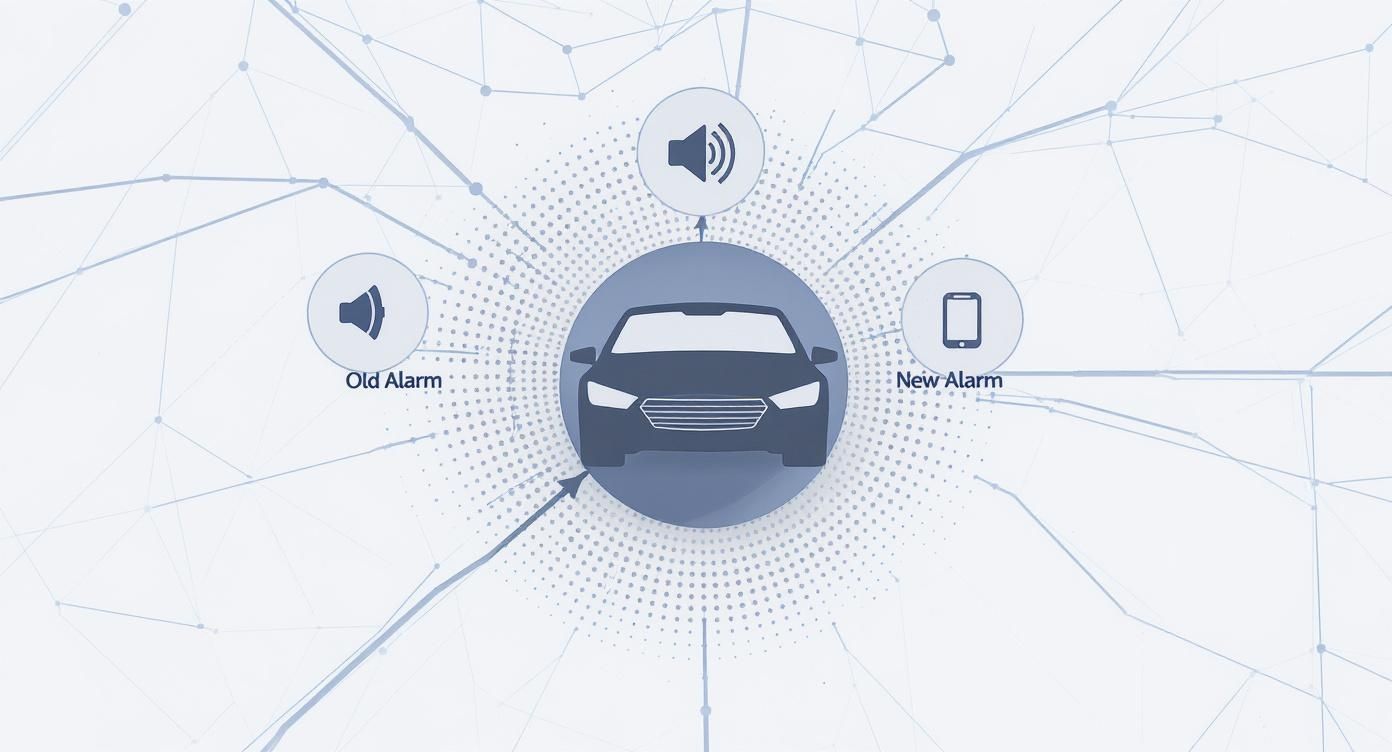
The key takeaway here is the leap from a passive siren to an active, smartphone-based tool that gives you real-time information and control right in the palm of your hand.
One-Way Alarms: The Traditional Approach
A one-way alarm is the most basic type available. When you press the lock button on your key fob, a signal is sent from the remote to the car, and the communication ends there.
If a sensor is triggered, the siren blares and the lights flash. However, it sends zero feedback to your remote. Unless you are within earshot of the commotion, you remain completely unaware—a significant vulnerability.
Two-Way Alarms: A Smarter Conversation
This is where car security evolves. A two-way alarm system establishes an ongoing dialogue between your car and your remote or smartphone. When you arm it, the system sends a confirmation back to you, letting you know everything is secure.
If the alarm is triggered, it doesn't just make a noise. It sends an instant alert directly to your device, often including details about what triggered it, such as an impact or an opened door. It's the difference between hoping a neighbor calls the police and being able to react yourself, immediately.
With real-time alerts, you are notified the moment your car is tampered with. This instant feedback allows you to take action immediately, a critical advantage over systems that only make a local noise.
The Sensors: Your Car's Eyes and Ears
At the heart of any alarm system are its sensors, which are designed to detect various threats. The best systems utilize a combination of sensors to create layers of protection, and understanding them is key to appreciating what modern GPS car tracker features and device capabilities can do.
Here are the most important sensors to look for:
- Shock Sensors: These act as a digital seismograph for your car, detecting impacts ranging from a minor bump in a parking lot to a forceful break-in attempt. Many are "dual-stage," differentiating between a light tap (which might trigger a warning chirp) and a heavy blow (which activates the full alarm).
- Tilt Sensors: These monitor your car’s orientation. A tilt sensor is specifically designed to detect if the vehicle is being lifted or jacked up—a common tactic for stealing expensive wheels or towing the entire car.
- Glass-Break Sensors: This sensor is essentially a tiny microphone tuned to the specific acoustic frequency of shattering glass. It provides another layer of defense against smash-and-grab thefts, triggering the alarm the moment a window is broken.
- Door and Hood Triggers: These are the most fundamental sensors, detecting when a door, trunk, or hood is opened while the alarm is armed. It's a basic but absolutely essential line of defense.
When all these sensors work in concert, they create a comprehensive security perimeter around your vehicle. The best car alarm isn't a single component; it's an ecosystem of technology designed to detect, deter, and report threats in real-time, giving you the power to protect your investment.
What Really Makes a Top-Tier Car Alarm System?
So, what differentiates a basic car alarm from one that provides genuine peace of mind? It's not about being louder. The best car alarm system today is defined by its intelligence—transforming a simple noisemaker into a sophisticated monitoring and recovery powerhouse.
Forget the days of relying solely on a blaring siren. The best systems operate silently in the background, feeding you critical information directly to your phone.
The absolute game-changer in modern vehicle security is real-time GPS tracking. This isn't just a premium feature; it fundamentally changes the dynamic of car theft. Instead of your car vanishing, it becomes a moving pin on a map, giving you—and law enforcement—a massive advantage in recovery efforts.
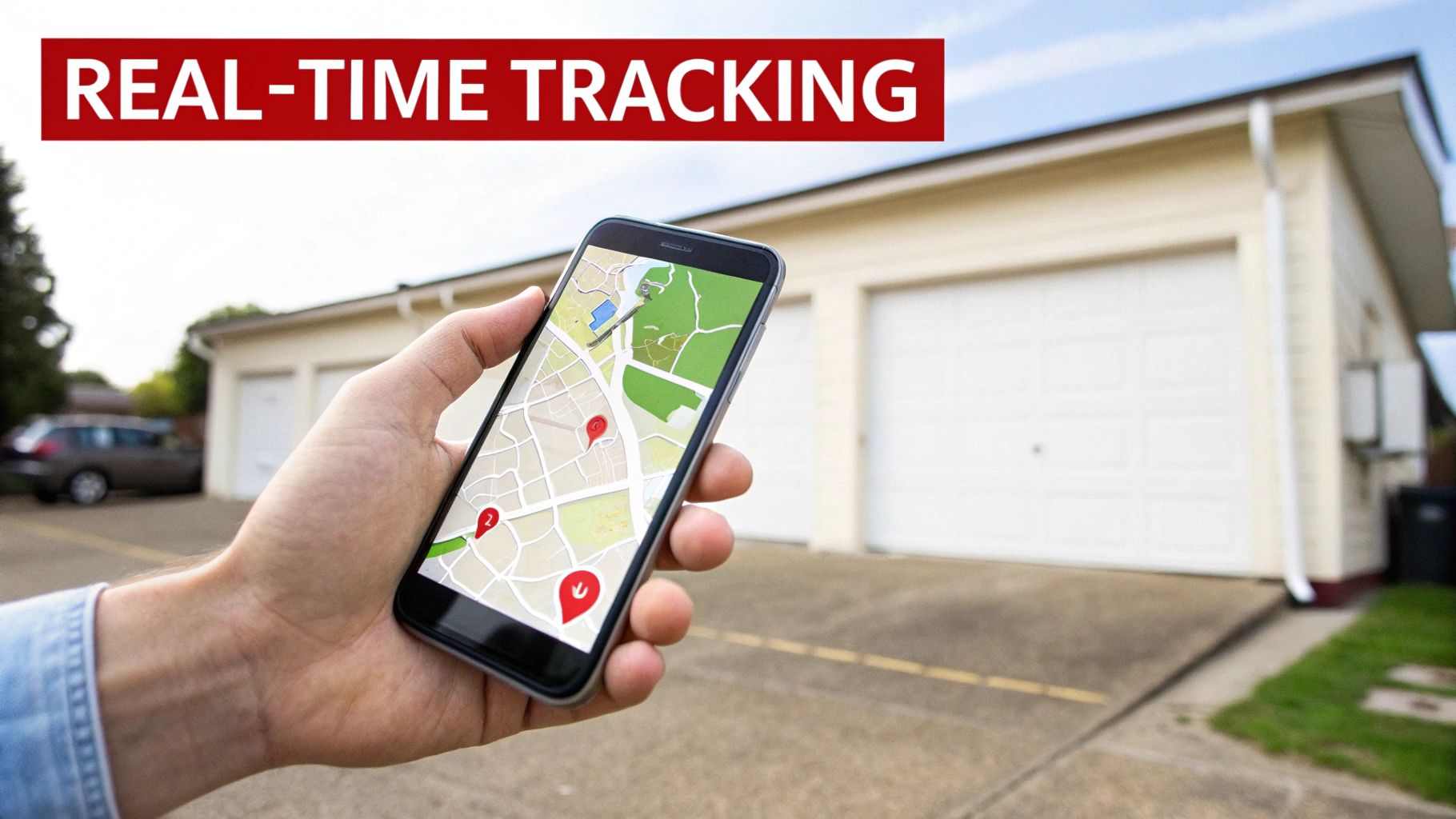
But GPS does more than just track a stolen vehicle. It is the engine that drives a whole suite of proactive features designed to keep you one step ahead.
Geofencing: Your Car’s Digital Leash
One of the most powerful applications of GPS is geofencing. This feature allows you to draw an invisible boundary around a specific area on a map—such as your home, office, or your teenager's school.
If your car ever enters or leaves that predefined zone, you receive an instant notification. This is incredibly practical for monitoring new drivers or ensuring a work vehicle remains within its designated area. It’s security that doesn’t just react; it actively monitors.
Complete Smartphone Integration
The other critical component is complete smartphone integration. Your phone becomes the command center for your car's security. This is far more than a glorified remote; it's a direct link to your car's vital signs.
This constant connectivity is what makes modern alarms so powerful. It puts crucial updates right in your pocket the moment something happens.
Imagine you're in a meeting and you get a silent notification on your phone. You can immediately see your car's exact location in real-time and share that live data with the police. This is the new gold standard for vehicle protection.
There’s a reason this technology is booming. The global connected car security market, valued at USD 5.74 billion in 2025, is projected to surge to USD 19.11 billion by 2032. This isn't just a trend; it's a fundamental shift away from obsolete alarms toward intelligent, connected systems.
The Critical Alerts You Actually Need
A truly smart system doesn't just ping you when a door opens. It watches for subtle but important signs of trouble, sending specific alerts so you know exactly what’s going on. The best systems will notify you about:
- Unauthorized Engine Starts: You'll know the second the engine turns over when it shouldn't. This is your first line of defense against both traditional hot-wiring and modern key-cloning attacks.
- Vibration Detection: Even if a thief can't open a door, a smart alarm will detect vibrations from a window being smashed or the car being jacked up to steal wheels.
- Device Disconnection: A common tactic thieves use is to unplug a security device before taking the car. A top-tier system will alert you the instant it's disconnected from its power source.
- Low Battery Warnings: A great security system shouldn't be the reason you're stranded. It will monitor your car’s battery and let you know if the voltage drops, giving you a heads-up before it becomes a problem.
These intelligent alerts are powered by a combination of advanced sensors and software. You can get a feel for what’s possible by exploring the many advanced features available through a dedicated security app. When you combine real-time GPS with instant smartphone notifications, you get layers of protection a simple siren could never offer.
Your Smart Buyer's Checklist for Vehicle Security
Choosing the right security system can feel like wading through a sea of technical jargon and feature lists. To find the best car alarm for your specific situation, you must ask the right questions before making a purchase.
This simple checklist will walk you through the key decisions, ensuring you invest in protection that actually fits your life.
First, you need to be honest about your risk profile. Where you live and park your car dramatically changes the level of security you need. FBI data reveals that nearly 30% of vehicle thefts occur in residential areas, shattering the false sense of safety many feel at home.
Think about your environment. Do you live in a high-theft area? Or are you primarily seeking peace of mind for a cherished vehicle? The answer will guide you on whether a basic alarm is sufficient, or if you need an active system that can help you track and recover your vehicle.
Evaluating Installation Simplicity
Next is installation. Car security systems generally fall into two categories: simple plug-and-play devices and more complex hardwired systems. Your comfort level with your car’s electronics—and your vehicle’s warranty—are the major deciding factors.
- Plug-and-Play (OBD-II): These are by far the most user-friendly. Devices like CarLock plug directly into your car’s On-Board Diagnostics (OBD-II) port, which has been standard on all cars manufactured since 1996. Installation takes just seconds with no tools required. It's also completely reversible, making it an ideal choice for almost anyone.
- Hardwired Systems: These systems require professional installation, as they are wired directly into your car's electrical infrastructure. It’s a more permanent and invasive process but can enable features like a starter-kill function. Expect professional installation to add anywhere from $150 to $500 to your total cost.
For the vast majority of drivers, the simplicity and power of an OBD-II device strikes the perfect balance, providing advanced security without the hassle or extra cost of a hardwired setup.
Understanding the Total Cost of Ownership
It’s easy to focus solely on the upfront price when shopping for a car alarm. However, the most effective systems operate on a subscription model, and it's vital to understand what that cost covers. This isn't just an additional fee; it’s the lifeblood of the system’s most important features.
Think of it like your cell phone. You pay for the device once, but its true power—making calls, sending texts, browsing the web—comes from your monthly service plan. A connected car alarm is no different.
A subscription fee isn't an add-on; it's the power source for the features that matter most. It enables the constant connectivity required for real-time GPS tracking, instant mobile alerts, and cloud-based monitoring.
Without that ongoing connection, your "smart" alarm is just another loud noisemaker that no one pays attention to. The monthly or annual fee ensures your car can communicate its status to you, 24/7, no matter where you are in the world.
Aligning Features with Your Needs
Finally, make sure the system’s features solve your specific problems. There is no point in paying for technology you’ll never use. Ask yourself what you are really trying to achieve.
- Are you a parent with a new teen driver? You’ll want geofencing and harsh driving alerts.
- Do you manage a small fleet of work vehicles? Real-time GPS tracking and detailed route histories are non-negotiable.
- Is your biggest fear having your car stolen? Then prioritize instant alerts for engine starts, unusual vibrations, and device disconnections.
By walking through this checklist—evaluating your risk, considering installation, understanding the total cost, and matching features to your needs—you can cut through the marketing noise. You’ll be ready to choose not just any alarm, but the best car alarm system for your vehicle and, more importantly, your peace of mind.
How CarLock Delivers Modern Vehicle Protection
We’ve covered the essential features and created a buyer’s checklist. Now, let’s examine how these principles are applied in a real-world solution. CarLock exemplifies what a modern car security system can achieve, translating advanced technology into practical, everyday protection.
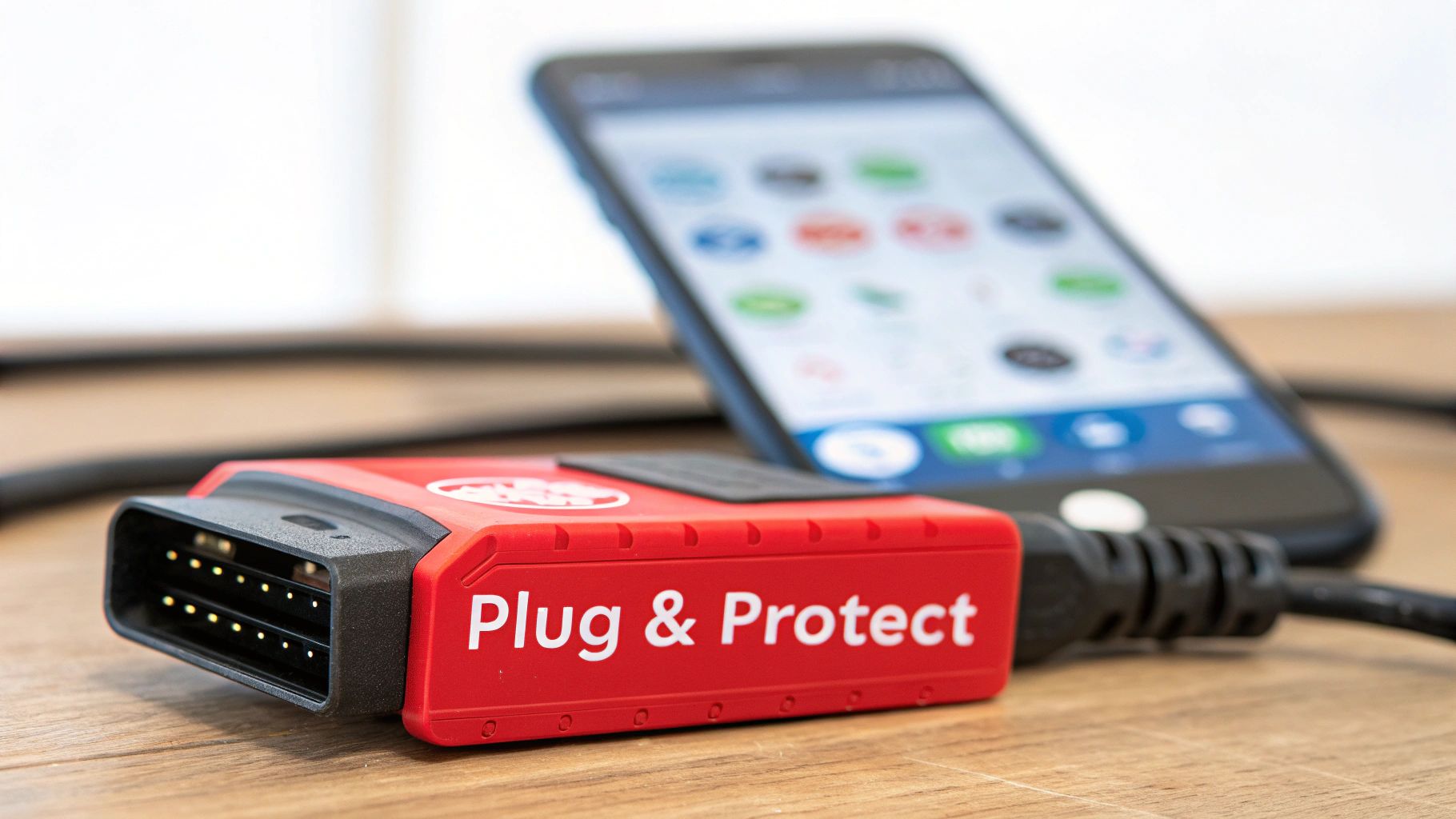
The core concept is to make security accessible and provide immediate awareness. It’s a monumental leap from old-school alarms. Instead of just blasting a loud, often-ignored siren, CarLock focuses on delivering silent, real-time intelligence directly to the one person who needs it most—you.
The Power of Simplicity and Integration
One of the biggest hurdles with advanced security has always been installation. Hardwired systems typically require professional service, adding extra cost and downtime for your vehicle. CarLock completely sidesteps this issue with its plug-and-play OBD-II device.
This makes top-tier security accessible to nearly any car owner, regardless of technical skill. You simply plug it into your car's standard diagnostic port—a process that takes seconds. That single compact device houses a full suite of sensors and its own cellular connection, creating a unified security hub.
CarLock's real strength is how it bundles multiple security functions—GPS tracking, vibration sensing, and engine monitoring—into one straightforward system that you manage entirely from your smartphone.
This integrated approach means every alert is part of a complete picture, delivered through one intuitive app. You’re not just getting random notifications; you're getting a clear view of your vehicle's status, anytime, anywhere.
A Focus on Actionable Intelligence
A modern alarm is only as good as its alerts. CarLock is engineered to detect the subtle, early warning signs of theft that older systems would completely miss, providing you with notifications you can actually act on.
Here’s a snapshot of what that looks like in practice:
- Vehicle Moved Notification: Get an instant heads-up if your car is moved without your knowledge, a critical defense against being towed.
- Engine Started Alert: Know the second your engine turns on. This gives you a crucial head-start if a thief gets inside.
- Vibration Detected: The system flags vibrations consistent with a break-in attempt or someone tampering with your car.
- Device Disconnected: If a thief finds and unplugs the device, you get an immediate alert—a smart feature that outwits a common criminal tactic.
By providing this level of detail, the system transforms from a simple deterrent into a powerful monitoring tool. You can see for yourself how CarLock functions as a complete car security system and what it offers.
The Value of a Connected Service
Like any advanced connected device, CarLock operates on a subscription. This fee covers the cellular data and cloud services required for constant monitoring and instant communication between your car and your phone. Without that connection, real-time GPS tracking and push notifications would be impossible.
There's also a financial benefit to this model. Many insurance providers now offer premium discounts for installing anti-theft devices with active tracking, which helps make these systems even more affordable for car owners.
Ultimately, CarLock demonstrates what happens when modern technology, thoughtful design, and a user-first approach converge. The result is a security solution that is both incredibly powerful and surprisingly easy to live with.
Common Questions About Car Alarm Systems
As you research the best way to secure your car, several questions inevitably arise. Getting clear answers is essential to feeling confident in your choice—one that genuinely protects your vehicle and allows you to rest easy.
One of the biggest concerns, particularly for owners of newer cars, is the warranty. Will installing a new security system cause problems with the dealership?
In most cases, no. In the U.S., the Magnuson-Moss Warranty Act prevents a manufacturer from voiding your warranty simply because you installed an aftermarket part. The caveat is that if the part is installed incorrectly and directly causes damage, they can deny a claim for that specific issue. This is precisely why a simple plug-in system or a professional installation for hardwired alarms is so critical.
Do Car Alarms Still Work Against Modern Thieves
This is the crucial question. To be blunt: traditional car alarms that only make noise are largely ineffective today. Thieves have learned to ignore them, knowing that the public will, too. They have become background noise.
However, modern, connected alarms are a completely different proposition. They are highly effective because they shift the strategy from creating a local disturbance to providing you with silent, instant intelligence.
Instead of just blaring a siren, today's best systems send immediate alerts straight to your phone. They track your vehicle's live location with GPS and can even detect subtle threats like vibrations from a drill or an unauthorized engine start. This turns the alarm from a simple noisemaker into a powerful monitoring and recovery tool.
This proactive approach gives you a real advantage against the tactics modern thieves employ. If you want to go deeper, you can explore more frequently asked questions about GPS car trackers and see how this technology works.
How Much Should a Good Car Alarm Cost
The price can vary significantly depending on the technology. Here's a quick breakdown:
- Basic Alarms: A simple, noise-only unit might cost less than $150.
- Advanced Systems: Alarms with two-way remotes that confirm commands typically range from $150 to $500.
- Connected Systems: Top-tier systems that connect to your smartphone and offer real-time GPS tracking will have an initial hardware cost plus a subscription. That small recurring fee is what powers the cellular connection and cloud services that enable the most powerful features.
Another common question is about battery drain. It's a valid concern—any electronic device will draw a small amount of power. Reputable systems are designed with low-power modes to minimize this draw when your car is parked for long periods. The best systems even monitor your car's battery and send you an alert if the voltage drops too low, ensuring your car remains protected without leaving you stranded.
Ready to upgrade to a truly modern security solution? CarLock provides real-time GPS tracking and instant alerts directly to your smartphone, giving you the ultimate peace of mind. Check out the system and see how easy it is to protect your vehicle at https://www.carlock.co.