

Driver’s Desk
Your Guide to an OBD-II Vehicle Tracker
Ever wondered what your car is doing when you're not around? What if you could get a heads-up on engine trouble before it leaves you stranded, or know the second someone tries to break in? This isn't science fiction; it’s what an OBD-II vehicle tracker does. It's a small, plug-and-play device that acts as a direct line of communication between you and your car, accessible right from your smartphone.
A Guardian Angel For Your Car
Think of it like this: you plug a tiny gadget into a port that’s been standard on almost every car since 1996. Instantly, it starts drawing power from your car's battery and taps into the vehicle’s main computer. Using its built-in GPS and a cellular connection, it sends you real-time updates about its location, health, and security status.
This simple connection gives you the power to know exactly where your car is at all times. You get alerts if it’s tampered with, towed, or even if the engine starts without you. It’s about creating a comprehensive safety net for one of your most valuable assets. According to the National Insurance Crime Bureau (NICB), over one million vehicles were stolen in the U.S. in 2022, a 7% increase from 2021, highlighting the need for advanced security.
Beyond Just Location Tracking
The real power of an OBD-II tracker lies in the data it delivers. It transforms your relationship with your car from reactive to proactive.
A sudden vibration alert, for example, could be the first warning of an attempted break-in, giving you a precious window to react. For business owners managing a fleet, the detailed reports are a game-changer, opening the door for advanced strategies like data analysis for reducing fuel costs. It’s all about having the right information at the right time.
OBD-II Vehicle Tracker At a Glance
To really nail down what makes these devices so useful, let’s break down the core features and who they help the most. The table below gives a quick snapshot of what you get with an OBD-II tracker, showing how one small device can serve everyone from worried parents to security-conscious car owners.
| Feature | Primary Benefit | Ideal User |
|---|---|---|
| Real-Time GPS Tracking | Instantly locate a vehicle for theft recovery or monitoring. | Car owners in high-theft areas. |
| Security Alerts | Receive notifications for vibrations, unauthorized engine starts, or movement. | Anyone seeking enhanced vehicle security. |
| Driving Behavior Monitoring | Track harsh braking, rapid acceleration, and speeding events. | Parents of teen drivers and fleet managers. |
| Vehicle Health Diagnostics | Get alerts for low battery levels and access engine trouble codes. | Every car owner wanting to avoid surprise repairs. |
Ultimately, an OBD-II vehicle tracker brings you peace of mind. It’s the ability to quickly check on your car's vehicle health, see how a new driver is doing on the road, or have the best possible chance of getting your car back if it’s stolen.
How Your Tracker Connects Your Car to the Cloud
Ever wondered how an OBD-II tracker works its magic? It might seem like high-tech wizardry, but the process is surprisingly simple. Think of it like sharing your location with a friend on your smartphone. Your phone uses GPS to find its position, a cell connection to send that info, and an app to show it on a map. An OBD-II tracker does the exact same thing, but for your car.
This clever process essentially puts your vehicle online, giving you a direct window into its location and health, no matter where you are. Let's pull back the curtain and look at the four key pieces of the puzzle that bring all that valuable data straight to your fingertips.
The OBD-II Port: Your Car’s Data Hub
It all starts with the On-Board Diagnostics (OBD) port. If your car was made after 1996, you’ve got one. This port is like the central nervous system for your vehicle's electronics. While mechanics plug into it to figure out what's wrong, your tracker uses it for two very important jobs.
First, it sips a constant stream of power from your car's battery, which means you never have to worry about charging it. Second, it gives the tracker access to a goldmine of vehicle data, from your engine's status to the battery's voltage. It’s the simple plug-and-play connection that makes the whole system work.
This little port is becoming a big deal. The global automotive OBD market is set to explode, projected to jump from $6.23 billion in 2025 to a massive $12 billion by 2035. The OBD-II segment—the one in your car—is expected to double from $2 billion in 2024 to $4 billion by 2035.
GPS: Pinpointing Your Exact Location
As soon as the tracker is plugged in and powered up, its internal GPS module wakes up. This is the part that talks to a network of satellites orbiting the Earth. By triangulating signals from several satellites at once, the device can calculate its precise latitude and longitude with impressive accuracy.
It’s the same technology that guides you turn-by-turn in your favorite navigation app. But instead of just telling you where to go, the OBD-II tracker uses this location data to keep a constant, running log of exactly where your car is at all times.
Cellular Connection: The Link to the Cloud
Knowing the location is great, but that information is useless if it's stuck in the tracker. It needs a way to get that data to you. That's where the built-in cellular connection comes into play. It works just like a tiny cell phone, complete with its own SIM card and modem, to send data over mobile networks.
This is the bridge that sends not only the GPS coordinates but also any important alerts from the OBD-II port, like a low battery warning or an engine trouble code. All of this information is beamed securely to a central server—what we often call "the cloud." You can learn more about how the CarLock Cloud keeps your vehicle's data safe and easy to access.
This graphic shows how all these pieces fit together to deliver security, monitoring, and a clear picture of your car's overall health.
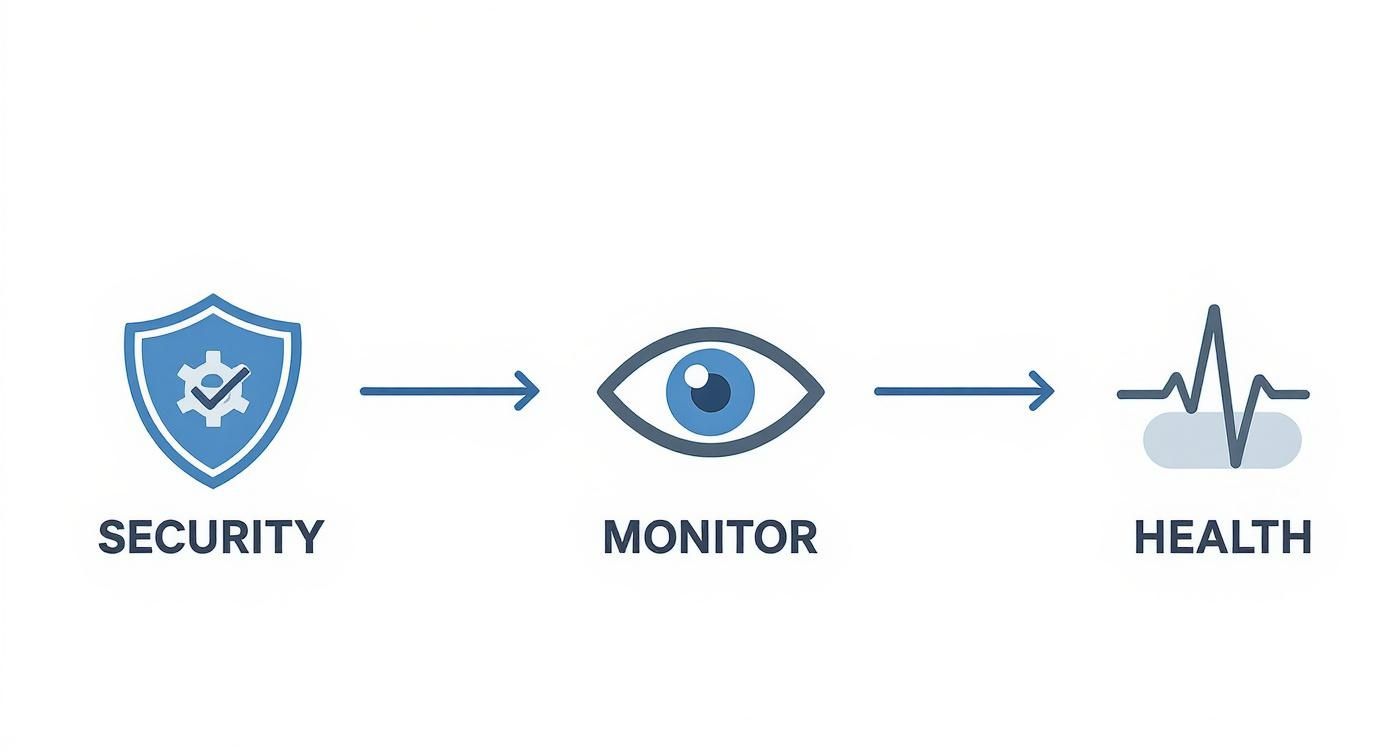
As you can see, it's not just about collecting data. It’s about turning that data into real, actionable insights that help you take better care of your car.
From Data to Your Smartphone Screen
The final step is turning all that technical data into something you can actually use. The information sent to the secure server is processed and organized. When you pull up the app on your phone, it fetches that neatly packaged information and displays it in a clean, simple format.
The real job of the system is to translate complex vehicle data into simple, actionable alerts. A long string of GPS coordinates becomes a clear dot on a map. An obscure engine code becomes a straightforward "Check Engine" notification right on your phone.
This seamless four-step dance—power from the port, location from GPS, transmission via cellular, and display on your app—is what makes an OBD-II vehicle tracker such an indispensable tool for any modern car owner.
Real-World Security and Monitoring Benefits
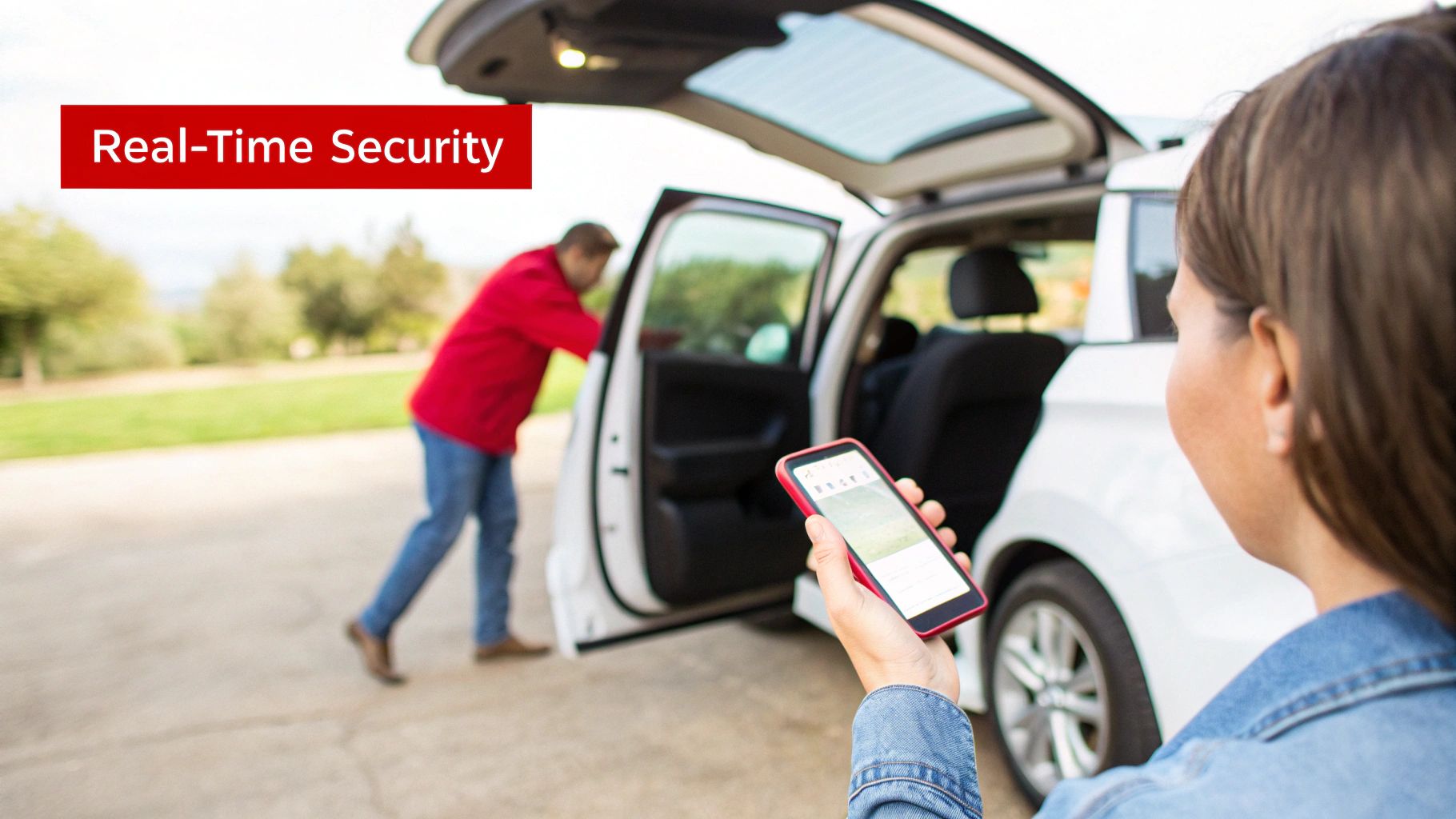
It’s one thing to understand the tech behind an OBD-II vehicle tracker, but what really matters is how it helps in your day-to-day life. This little device takes a stream of data and turns it into real, tangible benefits—giving you a powerful layer of security and some much-needed peace of mind.
From stopping thieves in their tracks to helping you coach a new teen driver, the advantages are immediate. Let's look at how an OBD-II tracker becomes more than just a gadget; it becomes your car's silent guardian.
A Powerful Anti-Theft System
Think about this: a vehicle is stolen in the UK every 18 minutes. An OBD-II tracker completely changes the game. It moves your car’s defense from a passive alarm that thieves are trained to ignore into an active, smart security system that alerts you. The second a thief tries to break in, the device's vibration sensor can send an instant notification straight to your phone.
If the engine starts without you, or if your car is being towed, you’ll know right away—not hours later when it's too late. That real-time location data is everything. It gives law enforcement a live target to follow, massively boosting the chances of getting your car back quickly and in one piece.
This is the very essence of modern vehicle anti-theft solutions. You're no longer finding out about a theft after the fact. Instead, you're alerted at the first sign of trouble, giving you a critical head start.
An OBD-II tracker essentially deputizes you, the owner, as the first line of defense. It provides the intel needed to act decisively, turning a potential total loss into a recoverable incident.
The demand for this level of security is skyrocketing. The global market for 4G OBD GPS trackers is on track to hit $556 million by 2025. It’s a clear sign that car owners and businesses are looking for smarter, more effective ways to protect their assets.
Peace of Mind for Parents
Handing the keys over to a newly licensed teenager is one of the most nerve-wracking moments a parent can go through. An OBD-II tracker gives you a way to watch over them and encourage safe habits without feeling like you're constantly looking over their shoulder.
Imagine getting a quiet notification if your teen pushes the speed limit you agreed on, or if they're braking too hard. This isn't about getting them in trouble. It's about opening up a conversation based on real examples, not just nagging suspicions. According to the CDC, drivers aged 16–19 are nearly three times as likely as drivers aged 20 and over to be in a fatal crash.
Key monitoring features for parents include:
- Speed Alerts: You set the limit. If they go over it, you get an alert. It’s that simple.
- Geofencing: Create virtual fences around places like school, home, or their part-time job. You'll get a notification when the car enters or leaves those zones.
- Trip History: Quickly review their routes to make sure they’re sticking to familiar roads and not making unexpected late-night detours.
These features aren't about spying—they're about safety and coaching. It's a support system that helps you build a foundation of trust and good driving habits that will stick with them for life.
Simplified Fleet Management for Small Businesses
For a small business, every van and car is a crucial asset. OBD-II trackers offer a dead-simple, affordable way to monitor a small fleet without shelling out for complicated, hardwired systems. Seriously, installation is just plugging it in. You can have your whole fleet online in minutes.
With a tracker in each vehicle, you can pull up a map and see where everyone is in real time. This lets you quickly check if drivers are on the most efficient routes, not taking personal side trips, and sticking to the day's schedule.
The benefits hit your bottom line directly. You can give customers more accurate arrival times, cut down on fuel wasted from bad routes or idling, and make sure your company vehicles are being used for company business. It's a straightforward tool for boosting efficiency and accountability.
Understanding the Limitations and Security Risks
While an OBD-II tracker is a fantastic tool for keeping your car safe, it's not a magic shield. It's smart to go in with your eyes wide open, understanding the potential downsides. Knowing these limitations doesn't just make you a smarter buyer; it helps you use the device to its full potential, safely and effectively. This way, there are no surprises down the road.
The biggest worry often comes from the tracker's best feature: its super-simple installation. If you can plug it in in a few seconds, what's to stop a thief from unplugging it just as fast? It's a fair question, but one with a pretty simple fix.
Addressing Physical Vulnerability
The plug-and-play convenience of an OBD-II tracker is a huge plus, but its location right under the dash can sometimes be a drawback. A thief who knows their way around a car might take a quick peek under the steering wheel for any connected gadgets before making their move.
Luckily, you can easily get around this risk. The best trick in the book is to use an OBD-II extension cable, especially one with a slim or flat connector. This lets you plug the cable into the port and then tuck the actual tracker unit deep under the dashboard, completely out of sight. A small step like this makes it much harder for a thief to spot and rip out in a hurry.
Plus, a good tracker has its own built-in defense mechanism. Top-tier devices will fire off an immediate unplug alert directly to your phone the second they lose power. So, even if a thief finds and removes it, you're instantly notified that your car is being tampered with. That gives you a precious window of time to react.
No security system is 100% foolproof, but the name of the game is creating layers of deterrence. Hiding the tracker and having instant unplug alerts on your side drastically cuts down the risk of it being disabled before you know something's wrong.
Data Privacy and Information Security
Plugging any third-party device into your car's main computer system is bound to raise some questions about data privacy. What kind of information is it collecting? Who sees it? How is it protected? These are all critical questions you should be asking before you buy.
Typically, an OBD-II tracker gathers a few key types of data:
- Location Data: This is the GPS information used for real-time tracking and mapping out your trip history.
- Driving Behavior: It logs things like your speed, instances of harsh braking, and quick acceleration.
- Vehicle Health: The device can pull diagnostic trouble codes from your engine and keep an eye on your car's battery voltage.
This is exactly why choosing a provider with a solid reputation is so important. A trustworthy company will be completely transparent about what data they collect and why. They should be using strong end-to-end encryption to scramble your information as it travels from the tracker, to the cloud, and finally to the app on your phone.
Before you commit, take a few minutes to read the company’s privacy policy. For instance, you can see exactly how CarLock handles your data by checking out our detailed privacy policy. It’s crucial that you understand and are comfortable with how your information is being managed.
The Risk of Battery Drain
One final concern, though it's become much less of an issue over the years, is the potential for the tracker to drain your car’s battery. Because the device is powered by the OBD-II port, it's technically always on. With older or poorly made trackers, this could cause a problem if you let your car sit for a long time.
However, any modern, high-quality OBD-II tracker is built to avoid this. They come equipped with a low-power sleep mode that kicks in automatically when your car is parked and the engine is off. In this state, the device sips a tiny amount of power—often less than the car's own computer systems—but it's still alert enough to wake up and send a notification if it feels a vibration or movement. This smart design ensures your car battery stays healthy, even if you don't drive it for weeks at a time.
Comparing Different Types of GPS Trackers
When you start looking into vehicle tracking, you'll quickly see that the obd ii vehicle tracker is a super popular choice. But it's definitely not the only game in town.
Figuring out the key differences between the main types of GPS trackers is the first step. It helps you choose the right tool for what you actually need, making sure you get the security and data you’re looking for. Each option—OBD-II, hardwired, and battery-powered—comes with its own set of pros and cons. The best one for you really boils down to what you care about most: Is it super-easy installation? Maximum stealth? The ability to move it around? Or getting deep insights into your car's health?
The Three Contenders in Vehicle Tracking
Think of an OBD-II tracker as the versatile all-rounder. It's perfect for most everyday drivers, parents keeping an eye on a new driver, or even small businesses. A hardwired unit, on the other hand, is the specialist—a more permanent, tamper-resistant solution for when security is your absolute top priority. Finally, you’ve got the battery-powered tracker, which offers ultimate flexibility to track just about anything that moves, not just your car.
Let's break down how these devices really stack up against one another.
GPS Vehicle Tracker Comparison
Choosing a tracker isn't a one-size-fits-all deal. Your specific needs will point you to the best solution. The table below lays out the core differences to help you see which type of device aligns with your goals, whether that’s protecting your family car or monitoring a small fleet of work vans.
| Feature | OBD-II Tracker | Hardwired Tracker | Battery-Powered Tracker |
|---|---|---|---|
| Installation | Plug-and-play; installs in seconds. | Professional installation required. | Place and go; magnetic or adhesive. |
| Power Source | Vehicle's battery via OBD-II port. | Vehicle's battery (direct connection). | Internal rechargeable battery. |
| Stealth Factor | Moderately stealthy; can be hidden. | Very stealthy; hidden deep in the dash. | Varies; can be placed anywhere. |
| Vehicle Diagnostics | Yes (engine codes, battery voltage). | No, provides location data only. | No, provides location data only. |
| Portability | Easily moved between compatible cars. | Permanent; difficult to move. | Extremely portable; tracks any asset. |
| Best For | Everyday drivers, parents, small fleets. | High-value assets, anti-theft focus. | Trailers, equipment, temporary needs. |
As you can see, the trade-offs are clear. What you gain in one area, like portability, you might sacrifice in another, like vehicle diagnostics. Now let's dig into when each one makes the most sense.
When to Choose an OBD II Vehicle Tracker
For the vast majority of people, an obd ii vehicle tracker hits that perfect sweet spot. Its biggest selling point is the ridiculously easy plug-and-play installation. No tools, no wiring, no calling a mechanic—you just plug it in and you're good to go. This makes it a fantastic choice for anyone who wants to add a layer of security and insight to their vehicle without any hassle.
But it's more than just a location dot on a map. Because it connects directly to the OBD-II port, it can tap into your car's brain. This means you can get alerts for things like a low car battery or a check engine light, turning it into a proactive maintenance tool that other trackers just can't match. To get a feel for the full range of data you can get, check out the CarLock device features to see what's possible.
The OBD-II tracker is the ideal solution for users who want comprehensive vehicle information—location, security, and health—without the cost or complexity of a professional installation.
Hardwired Trackers for Maximum Security
If your number one concern is theft prevention and making the tracker as invisible as possible, then a hardwired unit is the way to go. These devices are wired directly into your car's electrical system by a professional and tucked away deep inside the dashboard or engine bay.
This covert installation makes them incredibly difficult for a thief to find and disable in a hurry. Because they're wired in, they have a constant, reliable power source. The main downside, however, is that permanence. They aren't easy to swap between vehicles, and the need for professional installation adds to the upfront cost.
Battery-Powered Trackers for Ultimate Flexibility
For those times when you need to track something that isn't always tied to a car, a battery-powered tracker is unbeatable. These are compact, self-contained units you can slap on pretty much anything: a car, sure, but also a construction trailer, a valuable piece of equipment in a shipping container, or even a backpack.
Their strength is their sheer versatility. The big trade-off? Battery life. You’ll have to periodically retrieve the device to recharge it, which could be every few days or every few weeks, depending on the model and how you use it. They also don't offer any vehicle diagnostic data; they're purely location beacons. This makes them great for temporary tracking jobs or for assets without their own power source, but less ideal for the daily grind of vehicle security.
How to Choose and Install Your Tracker

Okay, you've seen the different types of trackers out there. Now comes the fun part: picking the right one and getting it set up. This is your hands-on guide to getting started with an OBD-II vehicle tracker.
Don't worry, this isn't a job for a mechanic. The whole process is designed for any car owner to handle without special tools or a degree in engineering. We’ll run through a quick checklist for choosing the best tracker for you, then walk you through a simple installation that takes just a few minutes.
Your Pre-Purchase Checklist
Before you hit "buy," a few quick questions will make sure you get a device that’s a perfect match for your car and your needs. The market for these devices is exploding, which is great for options but can also feel overwhelming.
In fact, the broader automotive diagnostic tool market—which includes OBD-II trackers—is projected to jump from $40.51 billion in 2024 to an massive $55.93 billion by 2029. With that kind of growth, it pays to focus on quality. You can read more about these automotive market trends if you're curious about where the tech is headed.
Here’s what really matters:
- Vehicle Compatibility: First things first. Does your car have an OBD-II port? If your vehicle was made and sold after 1996, the answer is almost certainly yes.
- Subscription Plan Value: Most trackers need a monthly or annual plan to pay for the cellular connection. Dig into what each plan offers. Compare the data limits, the types of alerts you get, and the quality of customer support.
- Mobile App Quality: The app is where you'll interact with your tracker every day. Skim through reviews to see if it’s reliable, easy to navigate, and has the features you actually want, like clear maps and instant notifications.
A Simple 3-Step Installation Guide
One of the best things about an OBD-II tracker is its plug-and-play simplicity. Seriously, you can have this done in less time than it takes to brew a cup of coffee.
- Locate the OBD-II Port: You'll almost always find this port on the driver’s side, tucked under the dashboard. It's usually within about 18 inches of the steering wheel, sometimes behind a small plastic flap.
- Plug in the Device: Once you find the port, just push the tracker in firmly. You should hear or feel a solid "click" as it connects. The device will power on instantly and start searching for cellular and GPS signals.
- Activate and Sync the App: Download the tracker’s app on your phone, set up an account, and follow the instructions to link your device. This is usually as simple as scanning a QR code on the tracker or typing in its unique ID.
Quick Troubleshooting Tips
Even the simplest tech can have a hiccup. If you hit a snag during setup, one of these tips will likely solve the problem.
A device not connecting immediately is often due to poor cellular or GPS signal. Simply driving the car for a few minutes into an open area is usually all it takes to establish a strong, stable connection for the first time.
If the tracker doesn’t seem to power on at all, make sure it’s pushed all the way into the port. An accidental bump can easily loosen the connection. If the app can't find your device, a quick restart of the app or toggling your phone's Bluetooth and Wi-Fi off and on again will often do the trick.
Still Have Questions About OBD II Trackers?
You've seen what these trackers can do, but it's totally normal to have a few questions rolling around in your head. Making a smart choice for your car's security means getting all the facts straight.
This is where we'll tackle the most common questions we hear from drivers just like you. Let's get you some clear, straightforward answers to clear up any final doubts.
Will an OBD II Tracker Void My Car’s Warranty?
This is a big one, especially for new car owners. The good news is, in nearly all cases, the answer is no. A simple plug-in OBD II tracker won't void your vehicle's warranty.
In places like the United States, consumer protection laws like the Magnuson-Moss Warranty Act are on your side. These laws prevent manufacturers from denying warranty coverage just because you used an aftermarket part. For a warranty claim to be denied, the manufacturer has to prove that the device you plugged in was the direct cause of the failure.
Since a quality tracker is designed just to read data—not write or change anything in your car's computer—the risk is incredibly low. Think of it as a passive listener, not an active participant.
How Much Mobile Data Does This Thing Use?
It’s a fair question. The last thing anyone wants is another device secretly racking up a huge mobile data bill.
Fortunately, an OBD II tracker uses a surprisingly tiny amount of data. It’s only sending small packets of information—things like GPS coordinates or an alert trigger. It's not streaming video or music. Better yet, the cost for that cellular connection is almost always wrapped into the tracker's subscription fee. You won't be getting a separate bill from a cell phone company.
The subscription you pay for your tracker is an all-in-one package. It covers the app, the cloud service that processes the data, and all the cellular data the device needs to phone home. No hidden fees, no surprise overages.
Can I Switch the Tracker Between Different Cars?
Absolutely! This is one of the best things about choosing an OBD II vehicle tracker over a hardwired one. Its plug-and-play nature means you can pop it out of one car and into another in seconds.
This kind of flexibility is a game-changer for a few situations:
- Multi-car families: Easily swap the tracker into whichever car your teenager is taking out for the night.
- When you get a new car: Just unplug the tracker from your old ride and plug it right into the new one. No fuss.
- Small business fleets: Need to keep an eye on a temporary rental or a new vehicle? Just move a tracker over as needed.
The process is as simple as it sounds: unplug, walk over, plug it back in. The only thing you'll want to remember is to update the vehicle's profile in the app to keep your trip logs and data nice and organized.
Ready to add a serious layer of security and peace of mind to your vehicle? The CarLock system gives you real-time tracking, instant security alerts, and detailed trip monitoring, all from a simple app on your phone. It's time to protect your car.