

Driver’s Desk
A Guide to Real Time GPS Vehicle Tracking Systems
The piercing wail of a car alarm in a parking garage is a sound most of us have learned to ignore. It’s a relic from a bygone era of vehicle security—a passive, often ineffective defense in a world of increasingly active and sophisticated threats. For decades, it was the standard, but today’s car thieves can disable conventional alarms in seconds, rendering them little more than a noisy nuisance.
This leaves car owners with a familiar sense of vulnerability, especially when parking on an unfamiliar street or in a crowded lot. This widespread concern highlights a critical need for a smarter, more connected approach to protecting our vehicles—one that offers proactive alerts and real-time intelligence.
Beyond Car Alarms: A New Era of Vehicle Protection
The traditional car alarm is purely reactive. It only sounds an alert after a window is smashed or a door is forced open. It's a system that relies entirely on the hope that a nearby stranger will intervene. The owner is left completely unaware, often discovering the theft or damage long after the perpetrator is gone.
Modern vehicle protection fundamentally changes this dynamic. It's about proactive security—receiving an instant, detailed alert on your smartphone and having the ability to track your car’s every move in real time.
This is where a real-time GPS vehicle tracking system becomes an indispensable tool. Instead of merely creating a disturbance, it acts as a silent, digital guardian for your vehicle, directly connected to you. This technology doesn't wait for a hero; it empowers the owner with immediate, actionable information the moment a threat is detected.
The Shift to Connected Security
The transition to connected car security is not a fleeting trend; it’s a fundamental evolution in how we approach asset protection. As thieves employ more advanced techniques, from signal jamming to key fob relay attacks, owners are demanding tools that provide constant visibility and control. This demand is clearly reflected in the market’s explosive growth.
The global vehicle tracking systems market was valued at USD 27.64 billion and is projected to soar to approximately USD 99.56 billion by 2034, according to market analysis. This represents a compound annual growth rate (CAGR) of 13.67%, a clear indicator that consumers and businesses are rapidly adopting this technology. More detailed market data is available from Precedence Research.
This growth is not limited to commercial fleets. The data reveals that passenger vehicles now constitute a significant portion of the market, accounting for around 41% of the total share. This demonstrates a clear shift among everyday drivers away from outdated, noise-based alarms toward intelligent, data-driven security.
Leading this charge are advanced solutions like CarLock, which completely redefine the capabilities of a security system. By integrating a hyper-sensitive motion detector with live GPS tracking and instant smartphone alerts, it provides a multi-layered defense. This guide will provide a detailed breakdown of how these systems operate and why they represent a quantum leap beyond traditional alarms.
For a deeper analysis of older technologies, you can learn more about the limitations of traditional car alarms in our dedicated article.
How a GPS Vehicle Tracking System Actually Works
Forget the simplistic model of an old-school car alarm. A modern real-time GPS vehicle tracking system functions as a sophisticated, silent digital sentinel for your car. It doesn't just broadcast an audible alert; it precisely determines your vehicle's location, senses the slightest unauthorized movement, and transmits a detailed notification directly to your smartphone.
This isn't magic, but a well-orchestrated process built on proven technologies. Let's delve into the technical components that make this system work.
The Three Pillars of Real-Time Tracking
Regardless of the specific brand or model, every effective real-time GPS tracker relies on three core technological components working in concert. Each plays a distinct, critical role in delivering timely and accurate information.
-
The GPS Receiver: This is the system’s navigational core, constantly listening for signals from the Global Navigation Satellite System (GNSS) constellation orbiting the Earth. By receiving timing signals from at least four satellites, the receiver performs a complex calculation known as trilateration to determine the vehicle's precise geographic coordinates—latitude, longitude, and altitude.
-
The Cellular Modem: This component serves as the system's communication link. Once the GPS receiver calculates the vehicle's position, that data must be transmitted. A small, integrated cellular modem connects to mobile data networks (e.g., 4G LTE) to send location data, sensor readings, and alert triggers to the company's secure cloud servers, which then push the information to your app.
-
The Accelerometer: This is the system's motion-sensing nerve center. An accelerometer is a highly sensitive electromechanical device that measures acceleration forces, including those caused by vibration, shock, and changes in orientation. If someone bumps your car, attempts to tow it, or starts the engine without authorization, the accelerometer detects the corresponding motion and triggers an immediate alert.
These three elements work together seamlessly to create a comprehensive security shield. For a more technical look at the hardware that enables this protection, you can explore the CarLock device and its key features.
The diagram below illustrates the technological evolution from outdated alarms to today's intelligent, connected systems.
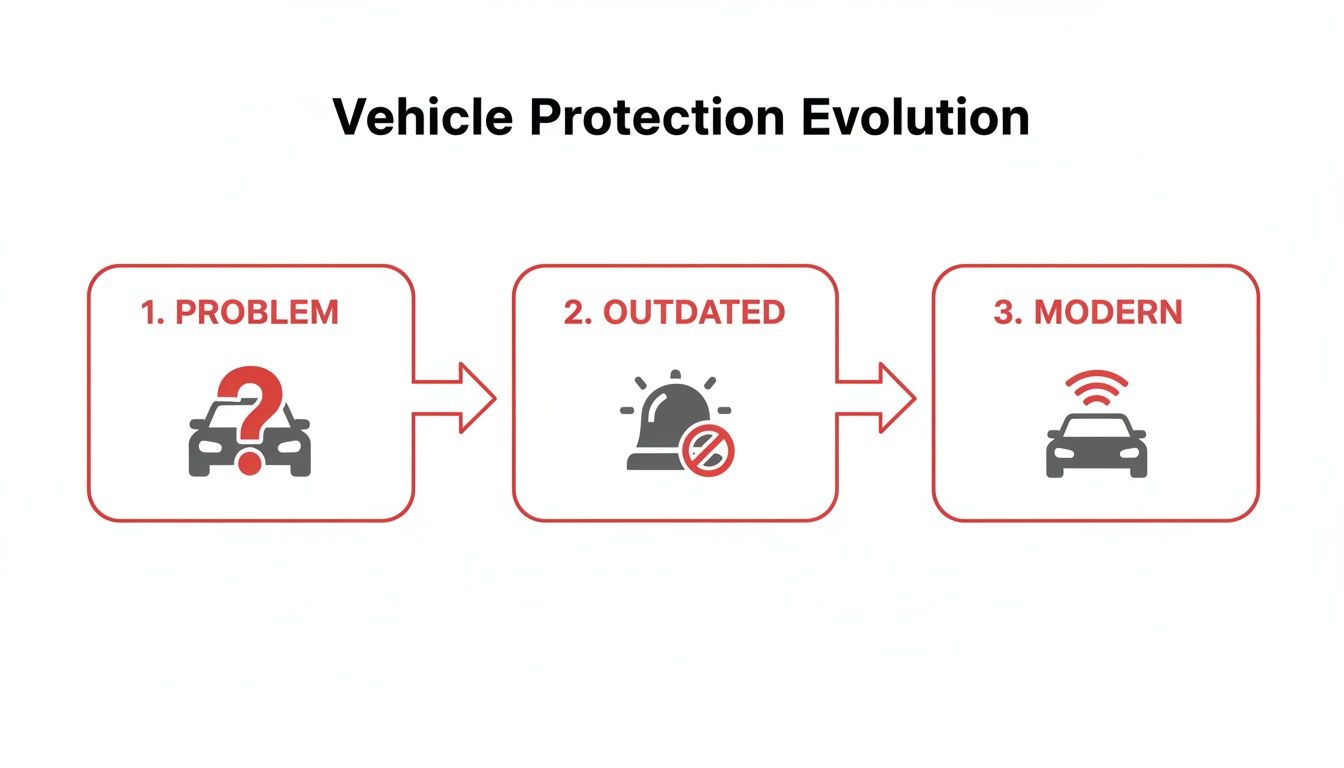
This visual representation captures the significant leap from relying on a loud noise to having a direct, real-time data link to your vehicle's status and location.
From Event to Alert: A Step-by-Step Process
How does this technology function in a real-world threat scenario? Imagine an attempted theft late at night. Here is a detailed breakdown of the system's response, which typically occurs within seconds.
-
Event Detection: The moment a thief forces the lock or even just bumps the car door, the accelerometer registers the anomalous vibrations. If they succeed in starting the engine, the system immediately recognizes this as an unauthorized ignition event.
-
Location Pinpointing: The GPS receiver, which is always on standby, instantly acquires signals from multiple satellites to confirm the vehicle's precise coordinates. Its effectiveness is maintained whether the vehicle is in an open lot or a dense urban environment.
-
Data Transmission: The device packages this critical information—the specific alert type (e.g., Vibration Detected or Engine Started) and the exact GPS coordinates—into a small, encrypted data packet. The cellular modem then transmits this packet over the mobile network to a secure cloud server infrastructure.
-
Instant Alert Notification: The server processes the data and sends a push notification directly to your smartphone. You receive a specific, actionable message detailing what is happening and where, accompanied by a live map showing your vehicle's location. This empowers you to react immediately, an advantage that traditional alarms could never offer.
What Modern Vehicle Security Actually Looks Like
A real-time GPS vehicle tracking system offers far more than a simple dot on a map. It's a comprehensive security ecosystem that grants you complete situational awareness and control over your vehicle, regardless of your location. These features are not superfluous add-ons; they are the fundamental components of genuine peace of mind in the modern age.
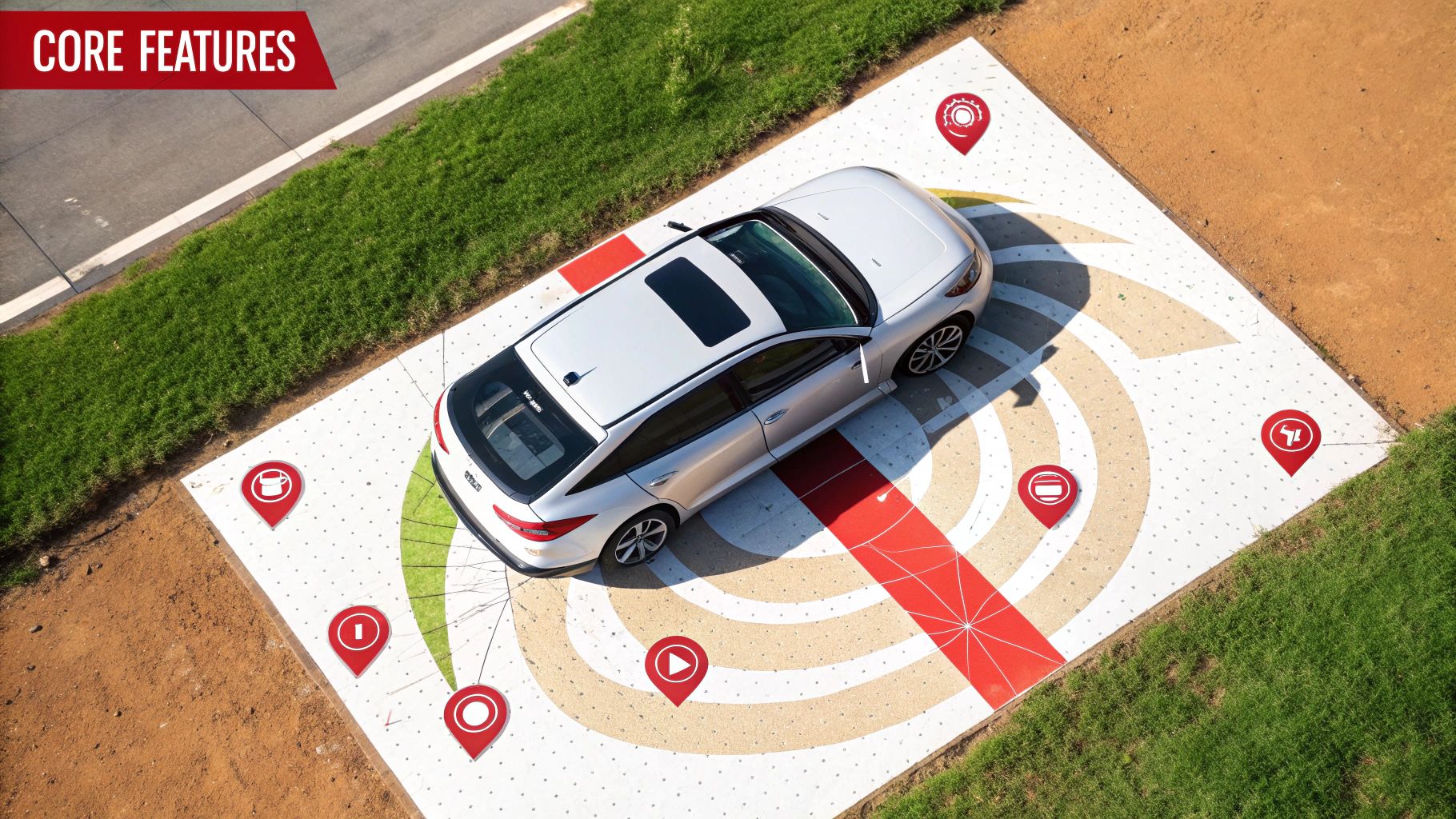
This technology effectively transforms your smartphone into a remote command center for your car's security. Let's examine the essential features that define modern vehicle protection and their practical applications.
Instant Security Alerts
The primary function of any security system is to provide immediate notification of a potential problem. While a car alarm blares indiscriminately, a GPS tracker sends specific, actionable alerts directly to your phone, where you can take meaningful action.
These are not generic warnings. A sophisticated system can differentiate between various threat levels and provide the necessary context.
- Vibration Detected: This serves as the first line of defense. A sensitive internal accelerometer detects the subtle vibrations associated with someone bumping your car, attempting to use a jack, or breaking a window.
- Engine Started: You receive a notification the moment the engine is turned on. This is a critical alert that can mean the difference between preventing a theft in progress and merely reporting it after the fact.
- Device Disconnected: If a thief locates and removes the tracking device, its small internal backup battery will power one final transmission, alerting you that the system has been tampered with.
Geofencing: Your Virtual Boundaries
Geofencing is the process of creating a virtual perimeter around a real-world geographic area. When your vehicle enters or exits this predefined zone, you receive an automatic notification. This is an incredibly practical tool for both security and monitoring purposes.
For example, a parent can establish a geofence around their teenager's school to receive a quiet, non-intrusive notification of their safe arrival and departure. For security, you could geofence your office parking lot to get an immediate alert if your vehicle is moved during work hours without your knowledge.
Detailed Trip History And Logging
Beyond live tracking, a robust system maintains a detailed, historical log of every trip. This is not just a line on a map; it is a comprehensive record that includes start and end times, the exact route taken, mileage, and average speed.
This historical data is invaluable in numerous scenarios. In the event of a theft, you can provide law enforcement with a complete trail of the vehicle's movements, significantly increasing the probability of recovery. It is also useful for everyday purposes, such as verifying that a valet only drove the car to the designated parking area. To see how this data is presented, you can explore the CarLock features and app capabilities.
Driver Behavior Monitoring
Modern trackers do more than just monitor where a vehicle is; they also analyze how it is being driven. Using data from the accelerometer and GPS, the system can detect and log unsafe or aggressive driving habits.
This level of telematics was once exclusive to commercial fleet management but is now widely available to consumers. The global GPS tracker market, valued at USD 4.04 billion, is projected to reach USD 9.83 billion by 2030. This expansion is fueled by both logistics companies seeking to mitigate risk and everyday consumers who want the same level of insight for their families. You can find more details on these market trends on Grandview Research.
Common behaviors flagged by the system include:
- Harsh Acceleration: Rapid acceleration from a stop, which increases fuel consumption and mechanical wear.
- Hard Braking: Abrupt stops, often indicative of tailgating or distracted driving.
- Sharp Cornering: Taking turns at excessive speeds, which compromises vehicle stability.
For parents of new drivers, this feature provides invaluable, data-driven coaching opportunities, helping to instill safer driving habits from the outset.
Who Benefits Most from a Real Time GPS Tracker
While the technology behind a real time GPS vehicle tracking system is impressive, its true value lies in solving real-world problems for a diverse range of users. This is not about technological novelty; it's about providing security, peace of mind, and a sense of control in critical situations.
Different users adopt this technology for different reasons, but all share a common need for reliable, instantaneous information about their vehicles. Let's examine the primary user groups who derive the most benefit.
The Security-Conscious Car Owner
For anyone living in or near an urban area, vehicle theft is a persistent concern. Parking on the street or in a large public garage often feels like a gamble. A real-time tracker transforms this passive hope into active, verifiable security. It serves as both a powerful deterrent and an unparalleled recovery tool.
Consider this scenario: your vehicle is tampered with in the middle of the night. Instead of an ignored car alarm, you receive an immediate notification on your phone: Vibration Detected. If the thief starts the engine, a second alert follows: Engine Started. You can instantly access your car's live location on a map and provide law enforcement with a precise, real-time trail to follow, dramatically increasing the odds of a swift recovery.
The global market for dedicated vehicle tracking devices was valued at approximately USD 2.34 billion in 2023 and is projected to nearly triple to USD 6.56 billion by 2032. It's no coincidence that SUVs and passenger cars represent the largest market segments—they are common family assets and frequent targets for theft. You can find more data-driven insights on this growing demand from Fortune Business Insights.
The Concerned Parent of a Teen Driver
Entrusting a newly licensed teenager with the car keys is a milestone moment, often accompanied by significant anxiety. A real time GPS vehicle tracking system offers a discreet and effective way to monitor their safety without constant calls and texts. It is a tool for responsible oversight and peace of mind.
Several features are particularly beneficial for parents:
- Speed Alerts: Set a maximum speed limit and receive a notification if it is exceeded. This provides a calm, data-based opportunity to discuss safe driving habits.
- Geofencing: Establish virtual perimeters around key locations like home, school, or a workplace. You will receive simple notifications of arrivals and departures, confirming their schedule and location.
- Driver Behavior Monitoring: The system can also flag hard braking, sudden acceleration, or aggressive cornering. This data is not for punitive measures but for coaching, helping you guide your teen toward becoming a more skilled and defensive driver.
The Small Fleet Manager
For a small business reliant on vehicles—such as a local delivery service, landscaping company, or HVAC contractor—each van and truck is a critical operational asset. In this context, a real-time GPS tracker is more than a security device; it is a powerful business management tool.
Managers can verify that drivers are adhering to assigned routes, preventing unauthorized personal use that wastes fuel and accelerates vehicle wear. The detailed trip logs are also invaluable for client billing, proof of service, and optimizing routes. You can explore our guide on how a vehicle's route history can be leveraged for business to see these benefits in action.
Furthermore, if a work vehicle containing expensive tools and equipment is stolen, the ability to track and recover it immediately can prevent a financially devastating loss. As the commercial transport sector evolves, understanding the impact of technology on trucking insurance is crucial. By providing verifiable data on vehicle usage and driver behavior, these systems can help lower insurance premiums and improve overall operational safety, making them a wise investment for any business on wheels.
Choosing the Right GPS Tracking System for Your Car
Selecting the right real time gps vehicle tracking system can seem daunting, but the decision hinges on a few key criteria. Approach the process not as if you are buying a complex gadget, but as if you are hiring a reliable security partner for your vehicle. A high-quality system integrates seamlessly into your life, whereas a poorly designed one becomes a constant source of frustration. The key is to look past marketing hype and focus on what truly matters: ease of installation, software usability, transparent pricing, and robust performance.

This section serves as a practical checklist. We will analyze the most important factors to help you choose a tracker with confidence and achieve the peace of mind you seek.
Installation Simplicity Matters
The initial setup process is your first interaction with the product, and it often reflects the overall user experience. There are two primary installation methods, which differ significantly in terms of convenience and cost.
- Hardwired Systems: These trackers require a direct connection to the vehicle’s electrical system. The main advantage is that they are concealed and difficult for a thief to locate and disable. However, this typically necessitates professional installation, which adds extra time, expense, and logistical complexity.
- OBD-II Plug-and-Play: This is the most user-friendly and common option for consumer vehicles. The device plugs directly into the car’s On-Board Diagnostics (OBD-II) port, which is standard on all vehicles manufactured since 1996 and is usually located beneath the steering wheel. The entire process takes less than 30 seconds and requires no tools or technical expertise.
For the vast majority of car owners, the convenience and simplicity of an OBD-II tracker are decisive advantages. You can have a complete security system operational in minutes and easily transfer it between vehicles if needed.
The App Is Your Command Center
The physical device is only one half of the system. The mobile application is your daily interface, making its design, performance, and reliability absolutely critical. A poorly designed, unintuitive app can render even the most advanced hardware useless.
When evaluating a system's app, consider the following:
- User Interface: Is the layout clean and intuitive, or is it cluttered and confusing?
- Alerts: Are notifications instantaneous, clear, and specific?
- Functionality: Can you easily access trip history, manage geofences, and check vehicle status?
- Performance: Does the map load quickly and display an accurate, up-to-the-minute location?
A well-designed, highly-rated app is a strong indicator of a company's commitment to user experience. This goes beyond aesthetics; it's about ensuring you can access critical information quickly and easily, especially during a high-stress event like a potential theft.
Transparent Costs and Real Support
Hidden fees can undermine the value of any product. A reputable provider of a real time gps vehicle tracking system will be completely transparent about all costs involved. This includes the upfront price of the device and the recurring subscription fee that covers the cellular data connection and server access. Be wary of any company that is not forthcoming about its monthly or annual service plans.
Equally important is the availability and quality of customer support. What happens if you encounter a technical issue or have a question about a feature? Look for companies that offer accessible, responsive support from real people. A strong support team demonstrates that a company stands behind its product and is committed to its customers' success.
Finally, scrutinize the company's data privacy policy. Your tracker collects sensitive location data, so you must choose a provider with clear, understandable policies regarding data protection and usage. Your vehicle's security should never come at the expense of your personal privacy.
Why CarLock is More Than Just a Tracker
Understanding the features of a great real-time GPS tracker is one thing; finding a system that delivers on all fronts is another. This is where CarLock distinguishes itself. It is not merely a piece of hardware but a comprehensive security service engineered to provide total peace of mind without the typical complexity and hassle.
Eliminate the need for costly and time-consuming professional installation. CarLock is designed for simplicity. You plug the device directly into your car’s OBD-II port in less than 30 seconds. With this single action, your car is protected by an advanced, connected security system—no tools or technical skills required.
Your Security Command Center in Your Pocket
Once installed, all system functions are managed through the intuitive and highly-rated CarLock mobile app. This app serves as your direct link to your vehicle’s security status, sending clear, instantaneous notifications the moment it detects any unusual activity.
The CarLock app provides a clean, user-friendly dashboard for at-a-glance monitoring of your vehicle's status.
This interface is meticulously designed to translate complex GPS and sensor data into simple, actionable alerts. You receive the information you need without being overwhelmed by technical details. Every feature, from reviewing trip histories to establishing virtual boundaries, is easily accessible.
A key differentiator for CarLock is its multi-layered alert system. You are notified of a full spectrum of events—from subtle vibrations and device disconnection to the engine starting without your presence. This proactive monitoring ensures you are always the first to know about a potential threat.
This powerful combination of dead-simple hardware, a sophisticated app, and a vigilant alert network makes CarLock far more than a simple tracker. It is a complete, modern security solution built for the real-world concerns of today’s vehicle owners. The team behind the product is deeply committed to this mission, a dedication further detailed in the CarLock company story. Ultimately, CarLock delivers confidence and control that you can hold in the palm of your hand.
Got Questions? Let's Talk GPS Trackers
It is perfectly normal to have questions before investing in a real-time GPS tracker. Common concerns regarding battery consumption, legality, and accuracy frequently arise. Let's address some of the most pressing questions with factual, detailed answers to ensure you can make an informed decision.
Will a GPS Tracker Kill My Car Battery?
This is the most common concern, but a well-engineered tracker poses no threat to a healthy car battery. Quality devices are designed for extremely low power consumption. While they do draw a minuscule amount of energy from the vehicle's battery to operate, the draw is negligible.
Modern OBD-II trackers feature intelligent power management modes. When the vehicle is parked and the ignition is off, the device enters a "sleep" or low-power state, consuming only a few milliamps of current to maintain its connection and monitor sensors. It only draws more power when an event is triggered—such as a vibration or the engine starting—or during active driving. This ensures that your battery's starting capacity is preserved.
Is It Legal to Put a Tracker on My Own Car?
Yes, it is 100% legal to install a GPS tracking device on any vehicle that you own. The law is unequivocal on this point: as the owner of the property, you have the right to monitor it for security and other legitimate purposes.
This right extends to vehicles you co-own or are currently financing. The legal boundaries are only crossed if you attempt to track a vehicle you do not own without the explicit consent of the owner. Therefore, for the purposes of theft prevention, monitoring a teen driver (in a family-owned vehicle), or managing your business fleet, you are operating entirely within your legal rights.
Just How Accurate is "Real-Time" Tracking?
Contemporary GPS technology offers remarkable accuracy. A high-quality consumer real time GPS vehicle tracking system can determine your vehicle's location to within 5 to 10 meters (approximately 16 to 33 feet) under optimal conditions (i.e., with a clear view of the sky). This level of precision is more than sufficient for locating a stolen vehicle on a specific street or even identifying its position within a large parking structure.
It is important to understand that GPS accuracy is dependent on receiving clean signals from multiple satellites. Environmental factors such as dense urban canyons with tall buildings or deep underground parking garages can temporarily obstruct these signals, a phenomenon known as "signal attenuation." However, the tracker will re-establish a precise lock the moment it regains a clearer view of the sky.
This means that when you receive an alert, the location provided on the map is reliable, actionable intelligence that you can provide directly to law enforcement to facilitate a swift recovery.
Ready to experience the peace of mind that comes from knowing your car is truly protected? CarLock offers a simple, powerful, and complete system to watch over your vehicle 24/7. See how our advanced real-time GPS tracker can keep your car safe at https://www.carlock.co.