


Driver’s Desk
Your Guide to GPS Tracking Without Monthly Fees
Yes, it is possible to acquire a GPS tracker without monthly fees, but it is critical to understand the compromises involved. Essentially, you are trading real-time security capabilities for a lower initial cost. These devices are suitable for non-urgent applications, such as logging a road trip or locating misplaced items within a small radius, but they are fundamentally inadequate for the critical task of tracking a stolen vehicle in real time.
How "No-Fee" GPS Trackers Actually Work
When a tracker is advertised with "no monthly fees," it signifies a different operational model compared to a subscription-based system designed for active vehicle security.
The distinction is analogous to the difference between a simple motion-activated floodlight and a professionally monitored home security system. Both offer a degree of security, but they operate on fundamentally different principles and provide vastly different levels of assurance and functionality.

The primary differentiator is the method of data transmission. A monthly subscription fee almost invariably covers the cost of an integrated cellular connection. This enables the tracker to transmit its location data to your smartphone in real-time from virtually any location, which is the core component of effective anti-theft protection. Our guide on the essentials of car tracking provides a more detailed analysis of why this live connectivity is indispensable for security.
The Inherent Trade-Offs
Opting for a no-fee device means choosing a product that bypasses this constant cellular link. Instead, it employs alternative methods to store or transmit its data, which introduces significant limitations.
- Delayed Data: A GPS logger records a vehicle's complete route, but you must physically retrieve the device and connect it to a computer to access the location history.
- Limited Range: Bluetooth trackers are only effective if they are within proximity of a network of other users' smartphones. In remote areas or subterranean parking structures, they become effectively offline.
- No Instant Alerts: Lacking a live connection, these trackers cannot send immediate notifications if your vehicle is towed, stolen, or tampered with.
This compromise between cost savings and real-time data access is the central consideration in your purchasing decision.
A Market on the Rise
The demand for GPS tracking without monthly fees has grown substantially over the past decade, driven by decreasing hardware costs and consumer aversion to additional monthly subscriptions.
The global GPS tracker market is projected to expand significantly, from approximately USD 4.41 billion in 2025 to USD 9.83 billion by 2030, representing a compound annual growth rate (CAGR) of 17.4%. Concurrently, the cost of the hardware has plummeted. Basic trackers that would have cost over USD 200 a decade ago are now widely available for under USD 50. Further market data on this trend is available from Fact.MR.
To clarify the comparison, the following table breaks down the key differences between the two approaches.
Subscription vs. No-Fee GPS Tracking at a Glance
This table summarizes the core distinctions between the two tracker types, highlighting their respective strengths and weaknesses.
| Feature | Subscription-Based Trackers (e.g., CarLock) | No-Monthly-Fee Trackers |
|---|---|---|
| Cost Structure | Low upfront hardware cost, ongoing monthly or annual fee. | Higher one-time hardware cost, no recurring fees. |
| Real-Time Tracking | Yes, provides live location updates via a cellular network. | No, or very limited. Relies on Bluetooth range or manual data retrieval. |
| Primary Use Case | Anti-theft, vehicle recovery, real-time monitoring of drivers. | Logging trips, finding items in a known area (e.g., parking lot), asset tracking with delays. |
| Instant Alerts | Yes, sends immediate notifications for theft, towing, or disturbances. | No, cannot send real-time alerts without a cellular connection. |
| Coverage | Global or nationwide, wherever there is cellular service. | Highly limited—restricted to Bluetooth range or requires physical access to the device. |
Ultimately, your choice depends on your objective. If your goal is simply to log a route, a no-fee device may suffice. However, if you require a robust tool for vehicle recovery in the event of theft, a subscription-based system is the superior solution.
How No-Fee GPS Trackers Actually Work
So, how does GPS tracking without a monthly fee really work? The key is to view them not as live security systems, but as specialized data recorders. Their entire design is engineered to avoid the single component that necessitates a subscription: a constant, live connection to a cellular network.
This one distinction fundamentally alters their functionality, their intended applications, and their inherent limitations.
The difference is comparable to sending a letter versus making a telephone call. Both methods convey a message, but one is immediate and allows for interactive communication, while the other is unidirectional and involves a delay. Subscription-based trackers are the phone call—providing live, real-time information. No-fee trackers are the letter—they capture information that must be retrieved later.
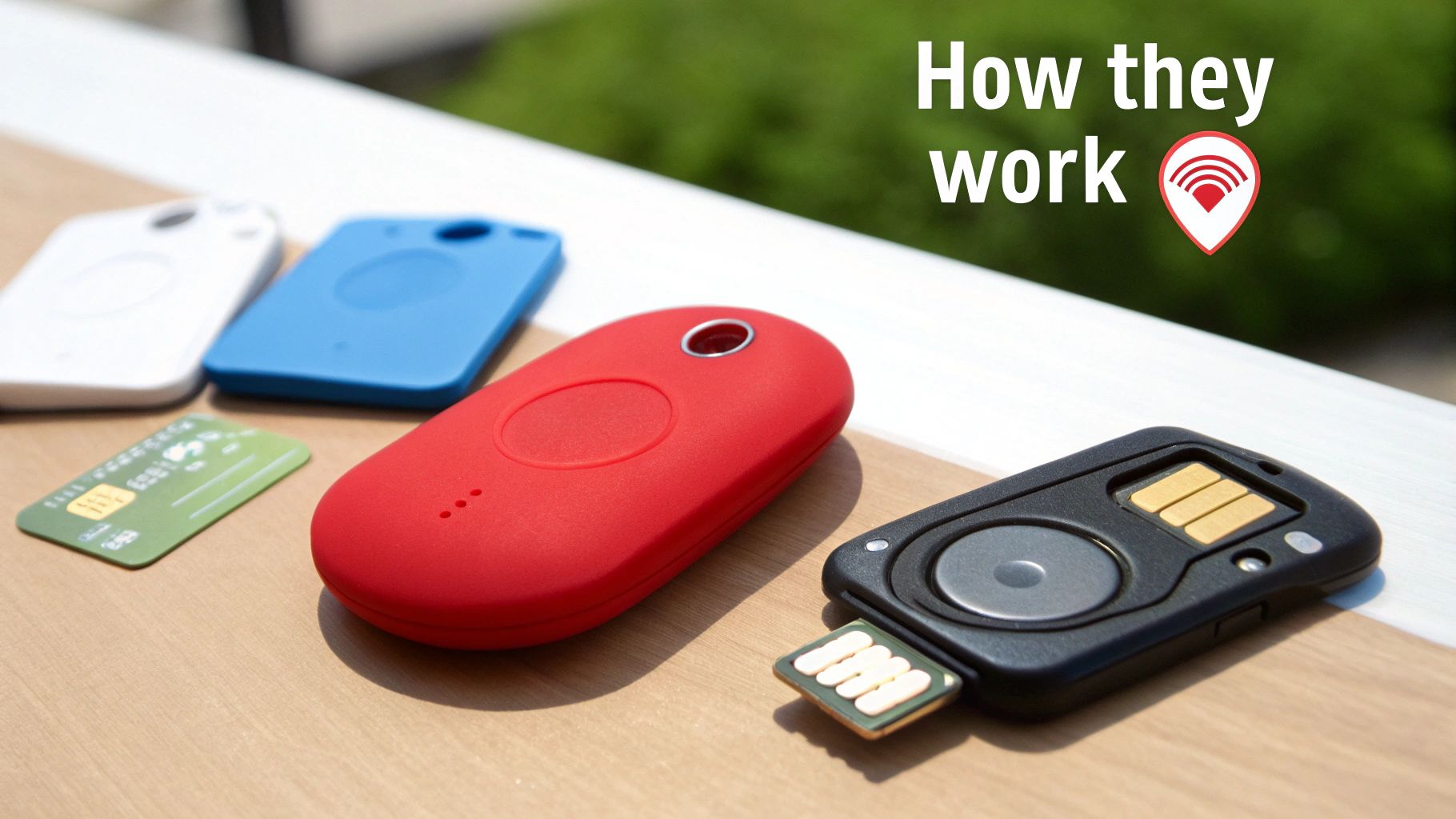
When vehicle protection is the primary objective, this distinction is absolutely critical. Let’s examine the operational mechanics of the most common types of no-fee trackers.
GPS Loggers: The Digital Breadcrumb Trail
A GPS logger represents the most basic form of subscription-free tracking. It functions like a flight data recorder for your car, diligently recording its journey using satellite signals but storing all information internally on a memory chip.
It pings GPS satellites to acquire its coordinates, timestamp, and speed at regular intervals, saving each data point to its internal storage. The crucial point is that there is no outgoing signal. There is no method to access its data remotely while the vehicle is in motion.
To review the vehicle's travel history, you must:
- Physically access the vehicle and retrieve the logger.
- Connect it to a computer, typically via a USB cable.
- Use specialized software to download and visualize the stored route on a map.
This is an excellent tool for logging a long road trip or verifying that a delivery route was followed correctly. For tracking a stolen vehicle, however, it is entirely ineffective in the moment it is needed.
Bluetooth Trackers: The Crowdsourced System
Bluetooth trackers, such as Tile or Apple AirTag, operate on a completely different principle. They do not communicate with GPS satellites. Instead, they broadcast a low-energy Bluetooth signal that can be detected by nearby smartphones within their network.
This functions as a crowdsourced location network. When another user's smartphone (with the appropriate app and permissions enabled) comes within Bluetooth range—typically 30 to 100 feet—it anonymously detects your tracker’s signal. That phone then reports the location to the cloud, which updates the "last seen" position on your map.
Key Takeaway: The efficacy of a Bluetooth tracker is entirely dependent on the density of the surrounding user network. It is highly effective for finding keys in a house or a car in a crowded parking lot. However, if a vehicle is stolen and taken to a remote area, an underground garage, or even a quiet residential street, it becomes practically invisible to the network.
Pay-As-You-Go SIM Trackers: The Prepaid Approach
This third category represents a middle ground, often marketed as a no-fee solution. These trackers include a SIM card slot, similar to a subscription device, but require you to provide your own prepaid or pay-as-you-go data plan.
It is essentially a prepaid cellular device for your car. You purchase the tracker, acquire a separate SIM card, and load it with data credit. The device consumes this data to transmit location updates. Therefore, while you are not locked into a monthly contract, it is not truly free—it requires continuous management and payment for data usage.
The costs can be unpredictable. Frequent location updates can deplete data credit rapidly, and the device may go offline at a critical moment if you forget to replenish the balance. This approach offers more control but also transfers the responsibility of network management from the service provider to you.
Each of these methods has its utility, but it is crucial to align their operational mechanics with your specific requirements. For a closer look at the technological differences between a basic tracker and a dedicated security device, you can review the features of the CarLock GPS car tracker.
The Hidden Costs and Security Gaps of No-Fee Trackers
The phrase "no monthly fees" is a powerful marketing tool, suggesting a simple, one-time purchase without ongoing financial commitment. While appealing, it is critical to look beyond the initial price and evaluate what you are sacrificing, especially when protecting a high-value asset like a vehicle.
When you opt for GPS tracking without monthly fees, the upfront savings often conceal significant trade-offs in performance, reliability, and, most importantly, security. These are not minor inconveniences; they can be the deciding factor between recovering a stolen vehicle and a total loss.

Useless in a Real-Time Theft
Consider a worst-case scenario: you discover your vehicle is missing. This is the moment where your choice of tracker becomes paramount.
If you have a GPS logger, it offers zero assistance. It may be recording the thief's route, but that data is inaccessible, stored on a device you no longer possess.
A Bluetooth tracker is similarly ineffective. Its functionality relies on a dense, crowdsourced network of nearby phones. The moment your car leaves a populated area, that network disappears. It is rendered useless in quiet suburbs, underground garages, or rural locations—areas where professional thieves often take vehicles to be dismantled.
A critical fact from the National Insurance Crime Bureau (NICB) highlights that law enforcement's ability to recover a stolen vehicle increases dramatically with real-time location data. The probability of recovery diminishes with each passing hour, making the inherent delay of most no-fee trackers a critical security vulnerability.
The Impact of Unexpected Costs and Unreliability
Even options that seem to offer a compromise, like pay-as-you-go SIM trackers, introduce their own challenges. With these devices, you assume the role of network manager, a task with hidden complexities.
- Unpredictable Data Consumption: Frequent updates or operation in areas with poor signal strength can cause the device to consume data far more rapidly than anticipated, leading to unexpected costs and a depleted balance.
- Failure to Replenish Credit: It is easy to forget to add credit to a SIM card. If the balance runs out, the tracker simply ceases to function without warning, potentially leaving your vehicle unprotected at the most critical time.
- Network Compatibility Issues: Not all SIM cards are compatible with every tracker or network. You could face technical issues or find yourself in a coverage dead zone—problems that a fully managed subscription service is designed to solve.
These "hidden costs" are not merely financial. They include the cognitive load of device management and the persistent risk of system failure when you need it most. To understand how a fully managed system avoids these pitfalls, review our analysis of advanced car security.
Feature Comparison of No-Fee Tracking Technologies
To fully grasp the trade-offs, a side-by-side comparison is useful. While each technology has a purpose, the table below reveals significant security gaps in the context of theft recovery.
| Feature | GPS Loggers | Bluetooth Trackers | Pay-As-You-Go SIM Trackers |
|---|---|---|---|
| Real-Time Data | None. Requires physical retrieval of the device. | Extremely limited. Only works when near other users. | Conditional. Only if SIM has credit and a good signal. |
| Theft Recovery Use | Useless. No live location to provide to law enforcement. | Very low probability. Fails in remote or low-traffic areas. | Unreliable. Can go offline from data or signal loss. |
| Geofencing Alerts | No. Incapable of sending any live alerts. | Limited. Only notifies when the user is already in range. | Yes, but this requires constant data usage and management. |
| Hidden Costs | None. A true one-time purchase. | None. The only recurring cost is battery replacement. | High Potential. Data top-ups can become a significant expense. |
| Best Use Case | Recording a completed journey for later review. | Finding keys or locating a vehicle in a large parking lot. | Low-frequency tracking where the user actively manages the SIM. |
The conclusion is clear. While each of these technologies has legitimate applications, none are engineered for the high-stakes, time-sensitive crisis of a vehicle theft. The absence of reliable, real-time data is a fundamental design flaw. Relying on a no-fee solution for security is like installing a smoke detector without batteries—it may provide a false sense of security, but it will fail in a genuine emergency.
When a No-Fee GPS Tracker Is Actually the Smart Choice
While subscription-free trackers are ill-suited for anti-theft applications, dismissing them entirely would be a mistake. They should be viewed as specialized tools. In specific, low-risk scenarios, choosing GPS tracking without monthly fees is not only about cost savings; it is the most practical and logical decision.
The key is to match the tool to the task. Not every vehicle requires a high-alert, real-time security system. Sometimes, the goal is simply to log a location, document a journey, or add convenience. This is where no-fee devices excel.
Locating Your Vehicle in a Large Parking Area
A common frustration is locating a vehicle in a vast parking structure. This is a perfect use case for a simple, no-fee tracker. A basic Bluetooth tracker is an ideal tool for navigating the confusing lots at airports, stadiums, or large shopping centers.
In these environments, the vehicle is not at a high risk of theft; it is merely temporarily misplaced. The tracker’s short-range signal, which leverages a network of nearby phones, provides a "last seen" pin on a map, guiding you back to your vehicle without the need for a cellular connection.
Documenting a Journey
Another excellent application is using a GPS logger to create a digital record of a road trip. A logger can quietly record every mile and scenic stop without requiring a cell signal or draining your phone's battery.
Upon returning home, you can download the data to visualize your entire route on a map, creating a detailed and shareable account of your adventure. A live anti-theft system would be excessive for this purpose.
This type of personal use is a significant factor in the booming GPS tracking device market. It's projected to grow from USD 4.21 billion in 2025 to USD 10.88 billion by 2033. While commercial logistics is a primary driver, consumer devices for hobbies and personal use constitute a rapidly growing segment. You can explore these market trends in more detail at Straits Research.
Low-Stakes Business Verification
For a small business owner, a no-fee tracker can be a simple and effective operational tool. For example, a local delivery service may only need to confirm routes for mileage reimbursement or to verify a driver's past location.
- Simple Route Confirmation: A GPS logger provides a complete historical record of a vehicle's daily route.
- No Ongoing Costs: This offers simple, after-the-fact verification without the expense of a real-time fleet management subscription.
- Easy Data Access: At the end of the day, the device can be retrieved and the data downloaded for administrative purposes.
In these scenarios, the objective is historical record-keeping, not live monitoring. A GPS tracker without a monthly fee accomplishes this task perfectly while minimizing operational costs.
Why Real-Time Data Is a Game-Changer for Car Security
When evaluating GPS tracking without monthly fees, the primary question must be: what is the ultimate goal? For logging a family vacation or remembering a parking spot, a device with delayed data is sufficient. However, for protecting your vehicle from theft, the requirements change dramatically.
In a theft scenario, every second is critical. The difference between vehicle recovery and total loss is often measured in minutes. The historical data from a GPS logger is useless to law enforcement during an active theft. They require the vehicle's current location, not where it was hours ago. This is where the primary weakness of no-fee solutions becomes a critical liability.
The Power of an Instant Heads-Up
A modern, real-time GPS security system is far more than a simple location tracker. It functions as a silent, digital alarm that provides immediate alerts, giving you a crucial head start the moment a potential threat is detected.
Imagine receiving an instant notification on your phone when:
- The engine starts without your key in proximity.
- The system detects vibrations consistent with a break-in or towing attempt.
- The vehicle is moved from its parked location.
These alerts transform you from a passive victim into an empowered actor. You can contact law enforcement immediately with live, actionable intelligence, dramatically increasing the probability of a swift recovery. You can learn more about how CarLock’s cloud-based features deliver these instant warnings directly to your phone.
Why Live Tracking Is Statistically Smarter
The necessity for real-time data is not theoretical; it is supported by vehicle theft statistics. Law enforcement agencies confirm that the probability of recovering a stolen vehicle decreases significantly with each passing hour. Once a thief transports a vehicle to a concealed location or a chop shop, the trail often goes cold permanently.
A live GPS signal is the single most effective tool for vehicle recovery. It provides law enforcement with a moving target on a map, converting a potentially hopeless search into a direct pursuit. This capability is entirely absent in passive, no-fee tracking devices.
The demand for superior stolen vehicle recovery solutions is a major force shaping the GPS industry. Security applications are a primary reason the market is expanding, with one report projecting the GPS tracking device sector will grow from USD 3.61 billion in 2025 to USD 6.39 billion by 2029. Much of this growth is linked to features like geo-fencing and smart alerts—technologies that are only possible with a live data connection. You can explore more insights on this booming market on ResearchAndMarkets.com.
While no-fee trackers serve certain purposes well, they are the wrong tool for the high-stakes task of theft prevention and recovery. For genuine security, the immediate, actionable intelligence provided by a real-time, subscription-based system is unparalleled.
Choosing the Right GPS Tracker for Your Vehicle
Having reviewed the technical distinctions, the next step is to apply this information to make an informed decision for your vehicle. The market for GPS tracking without monthly fees is extensive, but the optimal choice is always the one that aligns with your specific needs and risk tolerance.
To simplify the selection process, it is essential to answer a few key questions. Your responses will guide you to the appropriate type of tracker for your situation.
A Simple Decision Checklist
Before making a purchase, consider these points to determine whether a no-fee device is adequate or if an investment in a real-time security system is warranted.
- What is my primary reason for tracking? Is the goal to log a recreational journey, or is it for immediate theft recovery? If security is the primary objective, real-time data is non-negotiable.
- What are my security deal-breakers? Are the potential vulnerabilities of no-fee devices—such as network blind spots or delayed location updates—acceptable risks? Or does your budget permit a subscription that mitigates these concerns?
- What is the value of real-time peace of mind? The core benefit of a subscription is knowing your vehicle's precise location at any given moment. If this capability is essential, a no-fee tracker will likely prove insufficient.
This decision flowchart illustrates the response protocol in the critical initial moments of a vehicle theft, clarifying why live tracking data is indispensable.
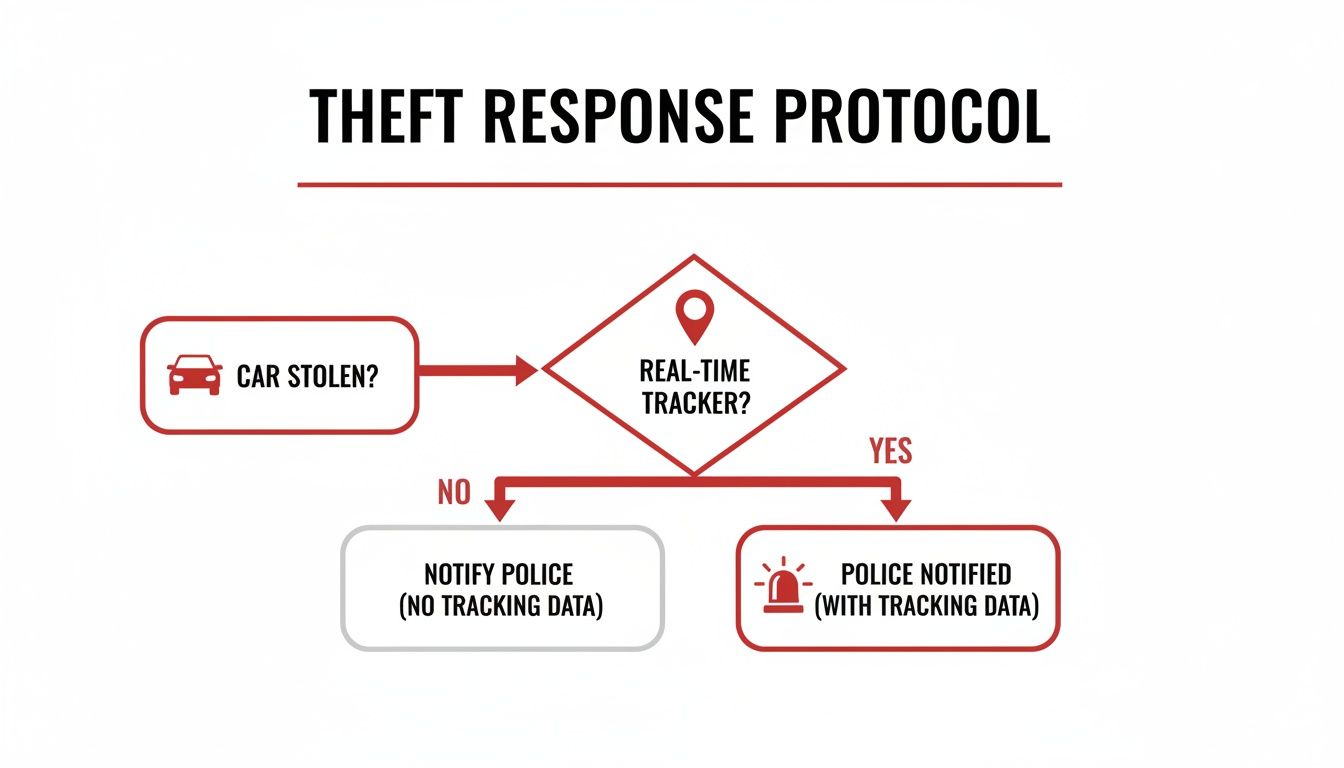
As the flowchart demonstrates, a real-time tracker provides live, actionable information that can be relayed directly to law enforcement, which dramatically increases the chances of a rapid and successful recovery.
The bottom line is this: while "no monthly fee" is an attractive proposition, it often means sacrificing the very features that make a tracker an effective anti-theft tool.
Ultimately, it is a practical choice. For low-stakes applications, such as mapping a vacation route or locating a car in a large parking lot, a no-fee GPS tracker is an excellent, budget-friendly option.
However, for true anti-theft protection and the genuine peace of mind that accompanies it, a professional, real-time system is specifically engineered for that purpose—and its value is unmatched.
Frequently Asked Questions
Navigating the options for GPS tracking without monthly fees can be complex. This section addresses some of the most common questions to help you determine the best solution for your vehicle.
Are No-Fee Trackers Really Free After Purchase?
The short answer is, not always. While you avoid a recurring subscription, other operational costs may arise.
For example, a pay-as-you-go tracker requires a data plan, meaning you will need to periodically purchase credit for its SIM card. Some associated mobile apps may also restrict advanced features behind a one-time "pro" upgrade fee. Therefore, the initial hardware cost may not unlock the device's full functionality.
Key Takeaway: "No monthly fee" should be interpreted as "no recurring subscription contract." It does not guarantee that the device will be completely free to operate indefinitely, especially if it relies on a data connection for updates.
How Accurate Are No-Fee Options?
Accuracy is largely a function of the device's reporting frequency. Subscription-based trackers are designed for continuous communication, which is covered by the fee, providing a steady stream of real-time location pings.
Conversely, many no-fee options are engineered to conserve power and data. Bluetooth trackers have a limited effective range, while data-based loggers might only update their position every few minutes or even hourly to minimize prepaid data consumption. In an emergency, this time lag can be a critical disadvantage. For a more detailed examination, please review our comprehensive list of GPS car tracker questions.
Can a No-Fee Tracker Help Recover a Stolen Car?
Realistically, the chances are exceedingly slim. Stolen vehicle recovery is a time-sensitive operation that depends on providing law enforcement with a live, accurate location for immediate action.
A GPS logger is of no use during an active theft, as all data is stored locally on the device. A Bluetooth tracker will likely lose its signal as soon as the thief enters an underground structure or a remote area. Even a pay-as-you-go device can fail if it exhausts its data balance or loses cellular reception at a critical moment. These devices are simply not designed for the rigorous demands of theft recovery.
For genuine peace of mind and the highest probability of recovering your vehicle, nothing surpasses a real-time, monitored security system. CarLock delivers instant alerts upon detecting suspicious activity and provides live tracking, giving you and law enforcement the critical information needed to act swiftly. Discover how CarLock can protect your vehicle today.