

Driver’s Desk
How GPS Tracking Devices Work: A Complete Technical Guide
Ever wondered how an app on your phone knows exactly where your car is parked? It’s not magic—it's a high-tech conversation between your vehicle and a network of satellites orbiting high above the Earth. This process breaks down into a few simple but powerful steps that deliver real-time security right to the palm of your hand.
At the heart of it all is a small device in your car, the GPS tracker, which is constantly listening for signals. These signals come from the Global Positioning System (GPS), a U.S.-owned utility consisting of at least 31 operational satellites orbiting our planet at an altitude of about 13,000 miles (20,200 km).
How GPS Trackers Pinpoint Your Car's Location
To determine its precise location, the tracker needs to receive signals from a minimum of four satellites simultaneously. Using a precise method called trilateration, it measures the time it takes for each signal to travel from the satellite to the device. Because radio waves travel at a constant speed (the speed of light), this time delay can be converted into an exact distance from each satellite.
With four distance measurements from four different satellites, the tracker’s microprocessor can calculate its precise coordinates—latitude, longitude, and altitude. This calculation happens continuously, providing a constant, reliable stream of location data.
This visual breaks down the simple four-step process, showing how a signal from space makes it all the way to your smartphone.
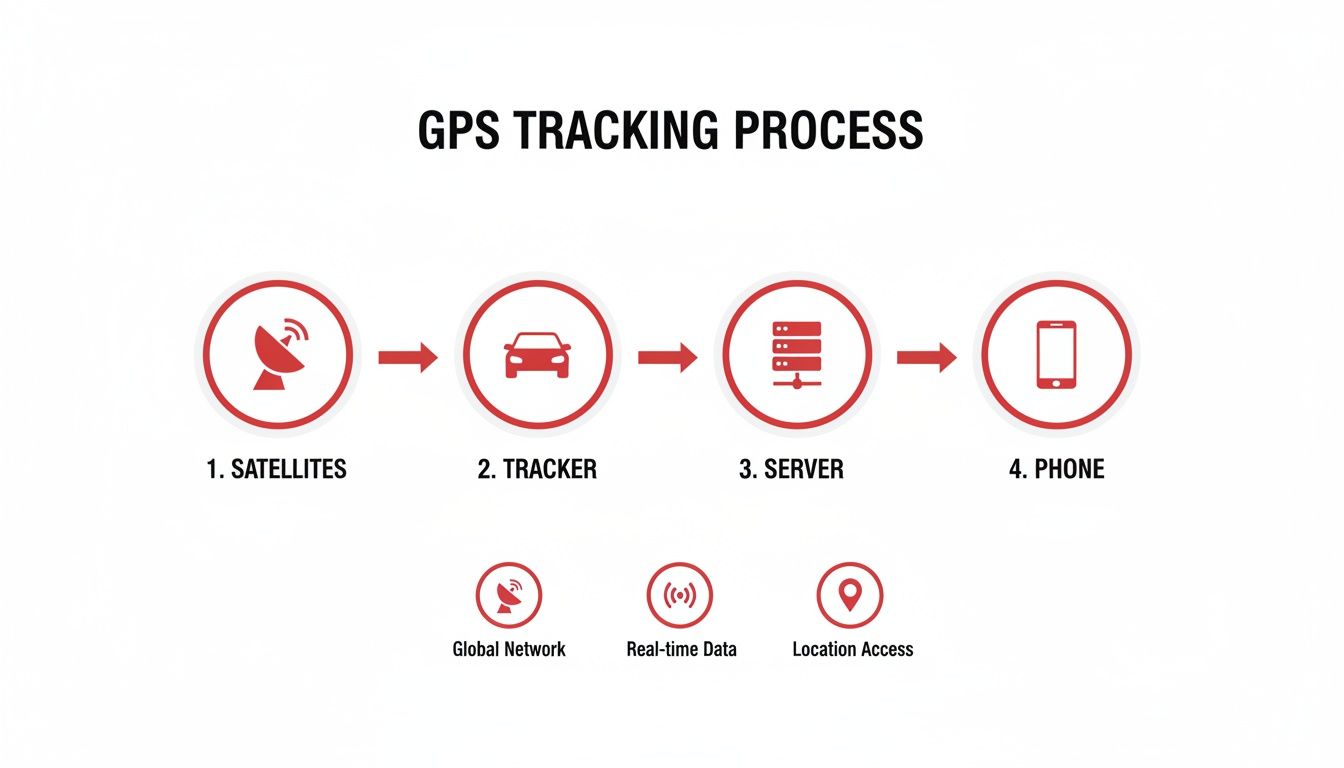
This entire journey, from a satellite signal to a dot on your map, is what makes modern vehicle tracking possible.
To make this complex process easier to digest, let's break it down into four core stages.
The Four Core Stages of GPS Tracking
| Stage | What Happens | Key Technology Involved |
|---|---|---|
| 1. Satellite Signal Reception | The GPS tracker in the car actively listens for and receives timing signals broadcast from at least four GPS satellites. | GPS/GNSS Satellites, GNSS Receiver |
| 2. Location Calculation | Using trilateration, the tracker's internal processor calculates its precise latitude, longitude, and altitude based on the signal delays. | On-device Processor, Trilateration Algorithms |
| 3. Data Transmission | The tracker sends its calculated location coordinates over a mobile network to a secure cloud server. | Cellular Modem (SIM Card), Mobile Networks (4G/LTE) |
| 4. User Notification | The server processes the data and instantly pushes it to a smartphone app, displaying the car's location on a map. | Cloud Servers, Mobile App, Push Notifications |
These four steps work together seamlessly to provide the location updates you see in your app, turning complex satellite science into practical, everyday security.
From Your Car to Your Phone
Once the tracker knows its coordinates, it needs a way to transmit that data to you. That's where a built-in cellular connection comes in, working much like a mobile phone.
The tracker sends its location data over a mobile network to a secure server. From there, the information is instantly pushed to a dedicated app on your smartphone, like the one used by CarLock's advanced car locator. You can then see your vehicle’s exact position on a map, all in real-time. This seamless journey from satellite to smartphone is what makes modern car security so effective.
The Satellite Science Behind Pinpoint Accuracy

The incredible science that lets you see your car’s location on a map starts way up in space. It all relies on a network called the Global Navigation Satellite System (GNSS). Most of us just call it "GPS," but that's technically just the American-owned part of the system. Modern trackers are far more advanced, often equipped with receivers that can communicate with multiple satellite networks at once (e.g., Galileo from Europe, GLONASS from Russia).
This multi-constellation capability is a significant factor in accuracy and reliability. Instead of just listening for one system's signals, your tracker can pull in data from a wider array of satellites, giving it a much clearer, more robust fix on your car's position.
Why More Satellites Mean Better Accuracy
Imagine you’re trying to find your exact position in a large, open field using sound. If you only hear one person shout, you know their distance but not the direction. If two people shout, you can narrow your location to two possible points. With three, you can pinpoint your 2D location.
That's essentially how a GPS tracker works, using the precise timing of radio signals in a technique called trilateration. To achieve full accuracy, it needs to receive data from at least four satellites:
- Satellites 1, 2, and 3: These three signals are used to calculate the tracker's latitude and longitude, placing your car on a 2D map.
- Satellite 4: This fourth signal is crucial. It provides altitude data, but more importantly, it allows the receiver to correct for any tiny timing discrepancies in its own internal clock versus the atomic clocks on the satellites, which dramatically improves the overall positional accuracy.
Each satellite carries multiple atomic clocks that are accurate to within a few nanoseconds. The tracker measures the time difference between when a satellite sends a signal and when it is received. By performing this calculation with four satellites, it can pinpoint its location to within a few meters.
This global network is the backbone of modern vehicle security. The global GPS tracking device market is projected to reach USD 10.88 billion by 2033, a testament to how many car owners and fleet managers now rely on this technology for security and logistics. You can learn more about this trend over at Research and Markets.
The Global Network Protecting Your Vehicle
While the U.S. GPS network is the most famous, modern devices like CarLock tap into multiple GNSS constellations at the same time. This is a game-changer, especially in urban canyons where tall buildings can easily block signals from satellites that are low on the horizon.
By using multiple satellite systems, a GNSS receiver achieves a faster Time to First Fix (TTFF) and maintains a more accurate lock on its position. This built-in redundancy provides the reliable, real-time tracking required for real vehicle security.
This robust system ensures that no matter where your car is, it has a clear line of sight to a sufficient number of satellites. The increased awareness of your car's location is a cornerstone of what makes today's security systems so effective. All these different satellite networks work in harmony, creating a powerful global safety net that watches over your vehicle 24/7.
Exploring the Hardware Inside a GPS Tracker
Satellites might provide the signals, but the real magic happens inside that compact device plugged into your car. A modern GPS tracker is not just a receiver; it's a dedicated microcomputer, engineered specifically for vehicle security. To fully understand how these devices work, it's essential to examine the core hardware components that function in unison.
At its core, every tracker has a processor and a set of sensors, each playing a critical role in monitoring and protecting your vehicle.
The Brains and Ears of the Operation
The first key component is the GNSS (Global Navigation Satellite System) receiver. This is the tracker's "ears," a specialized radio receiver designed to listen for the extremely low-power timing signals broadcast by satellites thousands of miles away. Its sole function is to acquire these signals and pass the raw data to the processor.
Running the entire operation is the microprocessor, the device's brain. This is a small but powerful chip responsible for executing complex calculations in milliseconds. It takes the raw signal timing data from the GNSS receiver and performs the trilateration calculations needed to determine the car's precise location. It also manages the other hardware components, orchestrating data collection and transmission.
The Voice Reporting Back to You
So, the microprocessor has calculated the car's location. How does it report this to you? This is the function of the cellular module and a pre-installed SIM card. Just like a mobile phone, this component connects to nearby cellular networks (typically 4G/LTE) to transmit small packets of data—containing coordinates, speed, and sensor readings—to a secure cloud server.
This constant communication channel is what enables real-time tracking and allows instant alerts to be pushed directly to your smartphone app.
The Sensors That Detect Trouble
Positional data is crucial, but a comprehensive security picture requires more information. That's why high-quality trackers are equipped with additional sensors to detect physical threats, providing layers of protection that go beyond simple location tracking.
- Accelerometer: This sensor detects motion, vibration, and impact. It’s what triggers an alert if your car is bumped in a parking lot, a window is smashed, or the vehicle is being towed without the engine running. It's sensitive enough to distinguish between normal road vibrations and suspicious activity.
- Gyroscope: Working in tandem with the accelerometer, the gyroscope measures the car's orientation and angular velocity. It can detect if the vehicle is being tilted, such as when it's being jacked up or loaded onto a tow truck.
These advanced hardware components are what separate a simple location tracker from a comprehensive car security system.
A GPS tracker is more than just its receiver; it's an integrated system where the microprocessor, cellular modem, and motion sensors work together to create a vigilant digital guardian for your car.
Powering the System
Finally, none of this hardware can function without a reliable source of power. GPS trackers typically come in two main configurations:
- OBD-II Port Trackers: These devices are designed for simple plug-and-play installation. They connect directly to your car's On-Board Diagnostics port and draw a minimal amount of power from the vehicle's battery. This ensures they are always active and monitoring without requiring manual recharging.
- Battery-Powered Trackers: These offer greater flexibility in placement but require periodic recharging. They are often used for temporary tracking applications, whereas OBD-II trackers provide a more permanent, "set-it-and-forget-it" security solution.
How Your Tracker Delivers Instant Security Alerts
Knowing your car's location is a great start, but getting instant, actionable alerts is what really brings peace of mind. The true magic behind modern car security isn't just seeing a dot on a map. It’s about how raw location data is transformed into critical security notifications delivered right to your phone, often in seconds.
This process turns your tracker from a passive dot into an active guardian for your vehicle.
It all kicks off when the tracker sends small, efficient packets of data over the cellular network to a central server. These aren't just coordinates; they're a full snapshot of your car's status, including location, speed, and even readings from internal sensors like the accelerometer.

As soon as this data hits the server, powerful software analyzes it in real-time against the rules you've defined in your app. This is where your personal security settings come to life.
Turning Data into Actionable Alerts
This server-side intelligence is what powers the most important features of a comprehensive car security system. Instead of just logging data, the system is actively looking for behavior that falls outside of what you’ve defined as normal and safe.
A smart GPS security system doesn’t just report what happened—it alerts you the moment something suspicious begins. This proactive approach gives you the crucial head start needed to prevent a theft before it's too late.
The most common (and effective) alerts are triggered by very specific events:
- Geofencing Alerts: You can draw a virtual boundary, or "geofence," around your home, office, or any other important spot. If your car enters or leaves this zone without your permission, you get an immediate notification pushed to your phone.
- Suspicious Movement Alerts: The built-in accelerometer is incredibly sensitive to unusual vibrations. If someone bumps your car, smashes a window, or tries to jack it up, the system flags this as a threat and alerts you instantly.
- Engine Start Notifications: This one is simple but powerful. You get an alert the second your car’s engine is started, so you know immediately if it's being operated without your knowledge.
- Device Disconnected Alerts: What if a thief finds the tracker and unplugs it from the OBD-II port? The server recognizes the loss of connection and sends a final, critical alert with the car's last known location.
This technology isn't just for individuals, either. The transportation and logistics sector, the largest user of GPS tracking, relies on the exact same real-time alerting to manage massive fleets. Hardware components make up about 44.8% of the GPS fleet tracking market, proving the industry's trust in dedicated devices to protect valuable assets. This professional-grade adoption gives everyday car owners confidence that they are using proven, reliable technology. You can see more data on the GPS tracking market at Metastat Insight.
Putting GPS Tracking to Work in the Real World
Knowing the tech behind how GPS trackers work is one thing, but seeing how that tech solves real problems? That’s where it gets interesting. For anyone who owns a car, this isn't just abstract technology—it's about real security and genuine peace of mind. Let’s walk through a few everyday situations where having instant alerts and live location data can make all the difference.

Think of a smart GPS tracker as a digital co-pilot, one that’s always on watch, ready to flag potential threats the second they pop up.
For the Urban Car Owner
City living often means parking on crowded streets or in large, anonymous parking garages—prime locations where vehicles are most vulnerable. Picture this: a thief attempts to break into your car. A system like CarLock utilizes its built-in accelerometer to detect that suspicious vibration immediately.
Before the thief can even tamper with the ignition, an alert is sent directly to your phone. This instant notification provides critical seconds to assess the situation or contact law enforcement, potentially stopping a theft before the vehicle is even moved.
For the Concerned Parent
There’s a unique kind of worry that comes with handing the car keys to a new teenage driver. This is where GPS tracking becomes an incredibly powerful tool, not for surveillance, but for ensuring their safety and encouraging responsible driving habits.
- Geofence Notifications: You can establish virtual perimeters around key locations like home, school, or a part-time job. You'll receive a quiet, automatic notification when they arrive safely, offering reassurance without needing to send intrusive "did you get there?" texts.
- Driving Behavior Alerts: Receive notifications for driving habits such as harsh acceleration, hard braking, or sharp cornering. This data isn't for punitive action; it's a tool to facilitate constructive conversations about safe driving practices.
For the Small Business Owner
For a small business, a company vehicle is a critical, high-value asset, not just a mode of transportation. A GPS tracker is an effective way to ensure that asset is both protected and being used efficiently and appropriately. You can monitor its location during business hours to ensure employees are on schedule and confirm it's parked securely after hours.
Beyond a single vehicle, GPS tracking is essential for streamlining commercial operations. For example, it’s a cornerstone for anyone understanding EV fleet management in the UK and optimizing their routes and charging schedules.
The table below breaks down how different users can get the most out of a system like CarLock, matching specific features to their biggest concerns.
GPS Tracker Features for Different User Needs
| User Type | Primary Concern | Most Valuable CarLock Feature | How It Helps |
|---|---|---|---|
| Car Owner | Theft and vandalism | Vibration Detected & Engine Started Alerts | Provides immediate notification of a break-in or unauthorized use, allowing for a rapid response. |
| Parent of Teen | Safe driving habits and whereabouts | Harsh Driving Notifications & Geofencing | Encourages responsible driving and offers peace of mind by confirming safe arrival at key locations. |
| Fleet Manager | Asset security and employee accountability | Real-Time Tracking & Trip History | Monitors vehicle location during work hours, verifies routes, and secures the vehicle after hours. |
As you can see, the right feature turns a simple tracking device into a tailored solution for very different, but equally important, needs.
By connecting specific features to everyday concerns, the abstract concept of GPS tracking becomes a practical, indispensable tool for vehicle security and personal peace of mind.
It’s no surprise that this technology is catching on globally. The Asia-Pacific region has emerged as the fastest-growing market, projected to expand at a CAGR of 13.5%. While North America still leads with a 37.5% market share, this worldwide growth points to a universal need for reliable vehicle security, making advanced tracking solutions more accessible than ever.
Got Questions? We've Got Answers.
Alright, now that we've peeled back the layers on how GPS trackers actually work, you're probably buzzing with a few practical questions. It’s one thing to understand the tech, but it’s another to feel confident about putting it to work for your own vehicle. Let’s tackle some of the most common things car owners ask us.
One of the first questions we usually hear is about data usage. People worry that a real-time tracker will consume significant mobile data. In reality, GPS trackers transmit tiny, highly efficient data packets. This usage is minimal and is typically covered by a predictable subscription fee, meaning you won’t encounter unexpected data overage charges.
What About Legality and Signal Jamming?
Another common question concerns legality: "Is it legal to track my own car?" The answer is straightforward: Yes, absolutely. As the owner of the vehicle, you have the legal right to install a GPS tracking device for security and asset recovery purposes.
But what if a thief uses a signal jammer to block the tracker? A GPS jammer is a radio frequency transmitter designed to block or interfere with radio communications, including GPS signals. While these devices exist, their use is highly illegal in most countries. Most opportunistic car thieves do not possess or use such equipment.
However, a sophisticated security system like CarLock has a countermeasure. If a jammer is activated and the CarLock device loses its connection to the cellular network, our servers detect this communication loss. The system immediately flags this as a critical event, sends you an alert about the lost signal, and provides the car's last known location.
This fail-safe is a game-changing feature. For more straight-up answers, check out our complete list of frequently asked questions about GPS trackers.
Secure your vehicle with the same technology trusted by thousands. CarLock provides real-time alerts for suspicious vibrations, engine starts, and device disconnections, giving you the power to protect your car 24/7. Discover how CarLock can safeguard your vehicle today.