

Driver’s Desk
A Complete Guide to Real-Time Location Tracking for Vehicle Security
Imagine having a digital guardian angel for your car, one that tells you exactly where it is and alerts you the second something is wrong. That’s the core promise of real-time location tracking. This isn't your old-school, reactive car alarm; it's a proactive, data-driven, 24/7 security system that gives you genuine peace of mind.
What Is Real-Time Location Tracking?
At its heart, real-time location tracking for your car is a system that provides a continuous, live feed of its every move, sent directly to your smartphone or computer. Forget wondering if your car is still where you parked it. With this technology, you get immediate, actionable data about its precise location, any unauthorized movement, and its overall security status.
This fundamentally changes the landscape of vehicle security. It's no longer a guessing game—it's a system built on instant alerts and clear, verifiable information.
But the applications extend beyond anti-theft. The technology is invaluable for parents monitoring a new teen driver or for a small business owner who needs to manage a fleet of company vehicles. Seeing where a vehicle is, where it's been, and even how it’s being driven adds a powerful layer of oversight and accountability.
More Than Just a Dot on a Map
Modern real-time tracking systems are a far cry from a simple pin on a map. They offer a comprehensive suite of features that work in concert to create a complete security net. You’re not just passively watching; you’re being actively notified when it matters most, backed by detailed data.
Here’s what you can typically expect from a professional-grade system:
- Instant Theft Alerts: Get a notification the moment your car senses suspicious activity, like vibrations from a break-in attempt, the engine starting without authorization, or the device being tampered with.
- Live Location Monitoring: Watch your car’s exact position update continuously on a detailed map, a feature that is absolutely critical for successful vehicle recovery by law enforcement.
- Driver Behavior Insights: Monitor driving habits such as harsh acceleration, hard braking, or sharp cornering—perfect for coaching new drivers and improving fuel efficiency.
The screenshot below from the CarLock app illustrates how all this critical information is consolidated into a user-friendly interface.
This kind of dashboard provides a quick, data-rich overview of your car's security. You can learn more about how a dedicated car locator functions on the CarLock platform.
A Rapidly Growing Security Standard
This technology has exploded in popularity, shifting from a niche gadget to an essential tool for modern car ownership. Market analysis confirms this trend: the global market for real-time location systems (RTLS) is projected to grow from USD 7.14 billion in 2025 to a staggering USD 25.85 billion by 2031.
This represents a compound annual growth rate (CAGR) of 23.91%. This isn't just a fleeting trend; it's a clear indicator that both consumers and businesses are increasingly relying on this technology to protect their valuable assets. You can find more market insights and a deeper dive into its applications online.
The Tech Behind Instant Vehicle Tracking
When your car sends a security alert straight to your phone, it feels like magic. But behind that instant notification is a seamless, invisible conversation happening between your vehicle, a network of satellites orbiting Earth, and the global cellular infrastructure. Understanding this technology is the first step to appreciating just how powerful real-time tracking is for your peace of mind.
At the core of the system is the Global Positioning System (GPS). This is a satellite-based radionavigation system owned by the United States government and operated by the United States Space Force. A constellation of at least 31 operational satellites is always circling the planet, broadcasting precise timing signals. The GPS tracker in your vehicle is designed to listen for these signals. By receiving signals from at least four different satellites, the device can use trilateration to pinpoint its exact location on Earth with remarkable precision.
This isn't just a rough estimate; it's a hard calculation. The U.S. government made this technology fully available for civilian use in 2000, which paved the way for the sophisticated and reliable tracking systems we rely on today.
From Satellite Pings to Smartphone Alerts
Knowing your car's location is one thing, but getting that information to you instantly is what makes the system effective for security. This is where cellular technology—the same 4G/LTE network your phone uses—comes into play. Your car’s GPS tracker grabs its location coordinates and then acts like a modem, transmitting that data packet over the cellular network to secure cloud servers.
From the cloud, that information is immediately pushed via notification to the app on your smartphone. The entire trip, from a satellite in space to the tracker in your car and finally to the screen in your hand, happens in just a few seconds. This low latency is what makes real-time alerts for events like unexpected vibrations or an engine start so effective. You can learn more about how this data is kept safe and processed by exploring the CarLock Cloud features.
This diagram shows how all the components connect to create a robust security ecosystem for your vehicle.
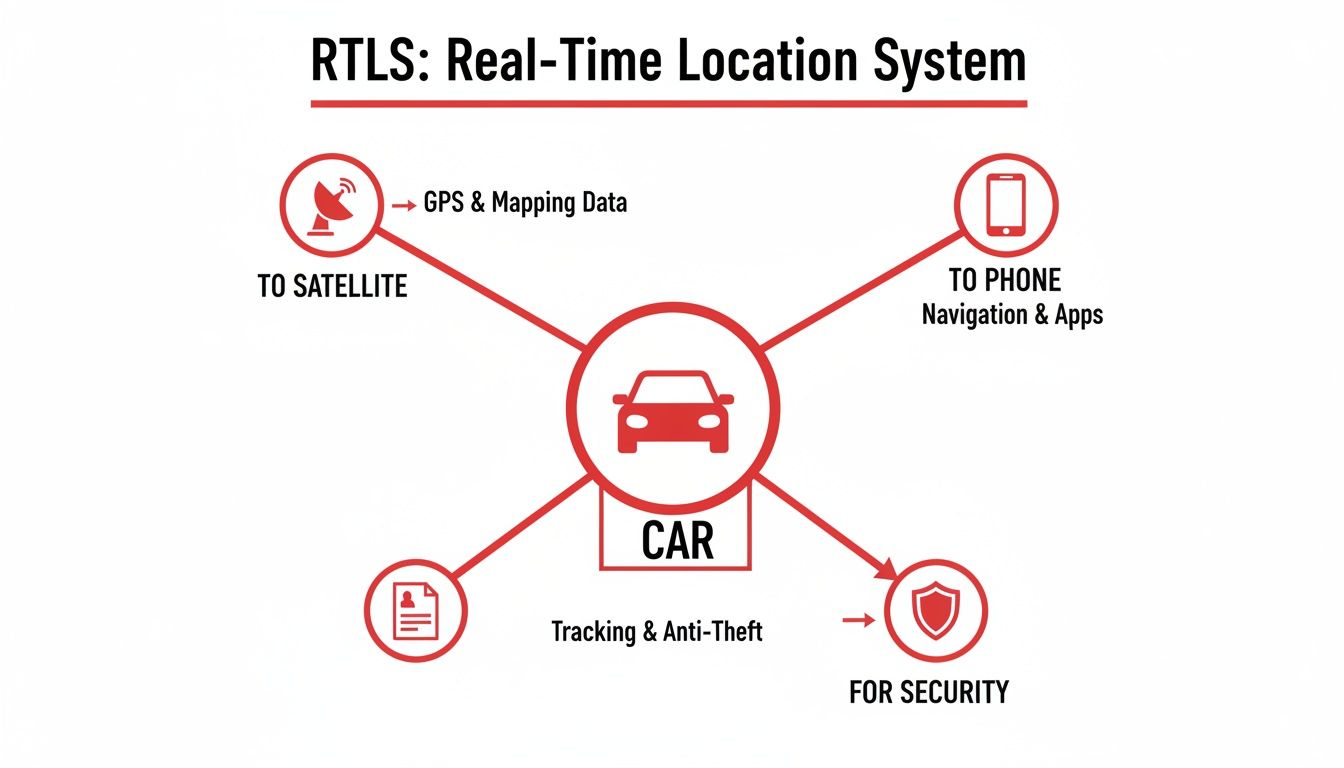
As you can see, the system relies on the car's ability to determine its position via satellite, transmit that data through cellular networks to your phone, and ultimately create a powerful security shield.
Fine-Tuning Location With Hybrid Systems
While GPS and cellular are the workhorses of location tracking, some advanced systems add another layer for even smarter security: Bluetooth Low Energy (BLE). BLE is a short-range wireless communication protocol designed for low power consumption, making it perfect for identifying specific devices—or people—in close proximity.
In a car security context, a small BLE tag, perhaps on your keychain, can identify you as an authorized driver. If the vehicle's system detects movement or an engine start but cannot sense your authorized tag nearby, it can trigger a high-priority theft alert. This hybrid approach is highly effective at reducing false alarms and adding a more personal, intelligent layer of protection.
The latest generation of GPS III satellites has dramatically improved positioning capabilities, narrowing accuracy down to within 3–10 feet (approximately 1-3 meters) under optimal conditions. This level of precision is a significant leap forward, ensuring you know exactly where your vehicle is, not just the general vicinity.
A Quick Look At The Tech
To get a clearer picture, let's compare the different technologies that power modern vehicle tracking. Each has its own strengths and is best suited for different functions within the system.
| Technology | Primary Use | Typical Accuracy | Key Advantage | Limitation |
|---|---|---|---|---|
| GPS | Pinpointing exact outdoor location | 3–10 feet | Global coverage, high accuracy | Requires a clear line of sight to the sky |
| Cellular (4G/LTE) | Transmitting data to the user | Varies (100–1000 ft) | Widespread network coverage | Can have service gaps in remote areas |
| Bluetooth (BLE) | Identifying authorized drivers | < 30 feet | Extremely low power consumption | Very short communication range |
| Hybrid Systems | Combining technologies | High (uses the best available) | Reduces false alarms, highly versatile | More complex and potentially costly |
This table illustrates that there’s no single “best” technology; the most effective systems, like CarLock, intelligently combine them to provide robust, reliable, and layered security.
Why Speed and Precision Are Non-Negotiable
When we talk about real-time tracking for security, two technical terms matter more than any others: accuracy and latency.
- Accuracy refers to how close the reported location is to your car’s actual physical position. For recovering a stolen vehicle, pinpoint accuracy is essential for law enforcement.
- Latency is the time delay between an event (like a door opening) and the moment you receive an alert. For security applications, low latency is critical.
Consider the scenario: if a thief smashes your window, a high-latency system might not send you an alert for several minutes. By then, your car could be gone. A low-latency system, however, notifies you almost instantly. Those precious seconds are often the difference between catching a thief in the act and dealing with the total loss of your vehicle.
What to Expect From a Modern Car Tracking System
A high-quality real-time location tracking system is so much more than a moving dot on a screen. Today's best trackers come with a full suite of features that work together, creating powerful, overlapping layers of security. Essentially, they transform your smartphone into a remote command center for your vehicle's safety.
Instead of just helping you find your car after it's stolen, these tools are designed to alert you to potential threats the moment they occur. That proactive head start can make all the difference.
Creating Virtual Boundaries with Geo-Fencing
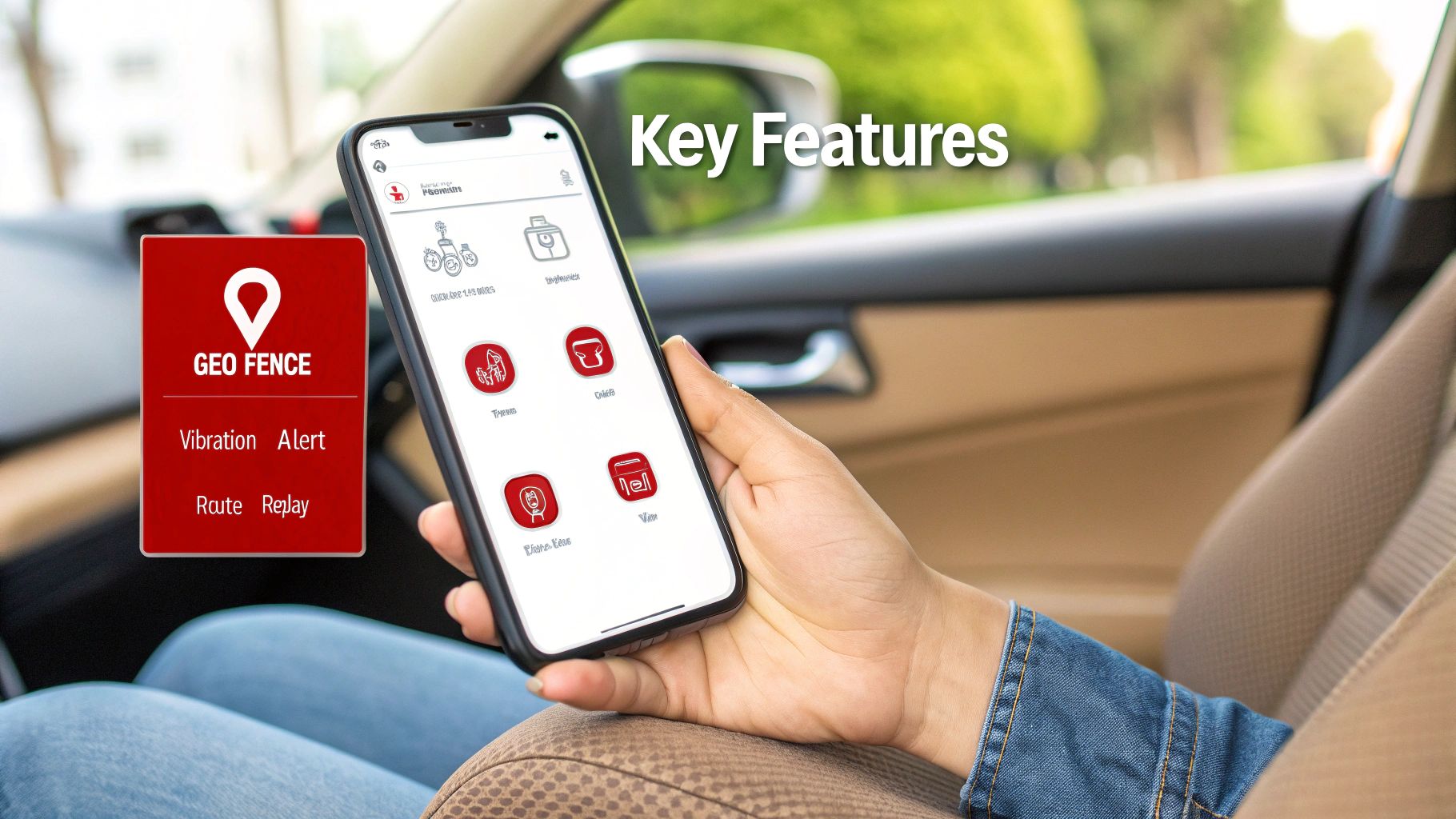
One of the most intelligent features available is geo-fencing. Think of it as drawing an invisible, digital perimeter around a real-world location. You can set up these "fences" around your home, your office parking lot, or any other area of importance.
If your vehicle ever enters or exits this digital perimeter without your authorization, you receive an instant alert on your phone. This feature is perfect for ensuring peace of mind when leaving your car in long-term airport parking or for verifying that a teenage driver has remained within an agreed-upon area.
Getting Ahead of Trouble with Proactive Security Alerts
Modern trackers are equipped with sophisticated sensors that act as your car’s personal watchdog. They are engineered to detect suspicious activity long before a thief can drive away.
A comprehensive system should provide these key alerts:
- Vibration Detection: If someone bumps your car, tries to break a window, or even jacks it up to steal the wheels or catalytic converter, the built-in accelerometer will sense the vibration and send you an immediate notification.
- Engine Start Notification: This is a critical alert. You’ll know the exact moment your car’s engine is started, which helps distinguish a minor disturbance from an active theft attempt.
- Device Disconnected Alert: Savvy thieves might try to locate and unplug the tracker from the OBD port. A superior system has a backup battery and will instantly warn you that it has been tampered with.
These alerts constitute your early warning system, giving you precious time to react and notify authorities. You can see how the CarLock app bundles these features to provide a complete, real-time picture of your car's security.
Monitoring Driving Habits for Safety and Insight
Beyond theft prevention, many trackers can provide detailed data on how your car is being driven. This is a game-changer for parents with new drivers or managers overseeing a small fleet of commercial vehicles.
Alerts for harsh driving can flag events such as:
- Rapid Acceleration
- Hard Braking
- Sharp Cornering
This isn't about micromanagement; it's about promoting safer driving habits, reducing wear and tear on the vehicle, and identifying potential issues early on. This kind of real-time sensing technology is becoming more common in modern vehicles, even in advanced driver-assistance systems like adaptive cruise control.
Hitting Rewind with Historical Route Replay
Another incredibly useful tool is historical route replay. The system maintains a detailed log of every trip, including the exact routes taken, stops made, and even vehicle speeds. It’s like having a DVR for your car’s entire journey history.
This digital record is a huge asset. In the unfortunate event of a theft, you can provide police with a turn-by-turn history of where the vehicle went, which dramatically increases the probability of a successful recovery. For businesses, it automates the tedious process of logging mileage for tax and expense purposes.
The great news is that this level of technology is no longer exclusive to large corporations. The real-time locating systems market is expected to generate between USD 7 billion and USD 14.9 billion in revenue in 2026, largely because the necessary hardware has become more affordable and accurate. These advancements have finally made professional-grade tracking accessible to everyday car owners, completely changing the game for vehicle security.
When Real-Time Tracking Saves the Day
Let's move beyond technical specifications. The true value of live location tracking isn't in the data sheets—it's in its performance during a real-world crisis. In those critical moments, having instant, accurate information can turn a potential disaster into a resolved incident. These aren't just hypotheticals; they are the kinds of situations where this technology proves its worth.
The Shopping Mall Theft
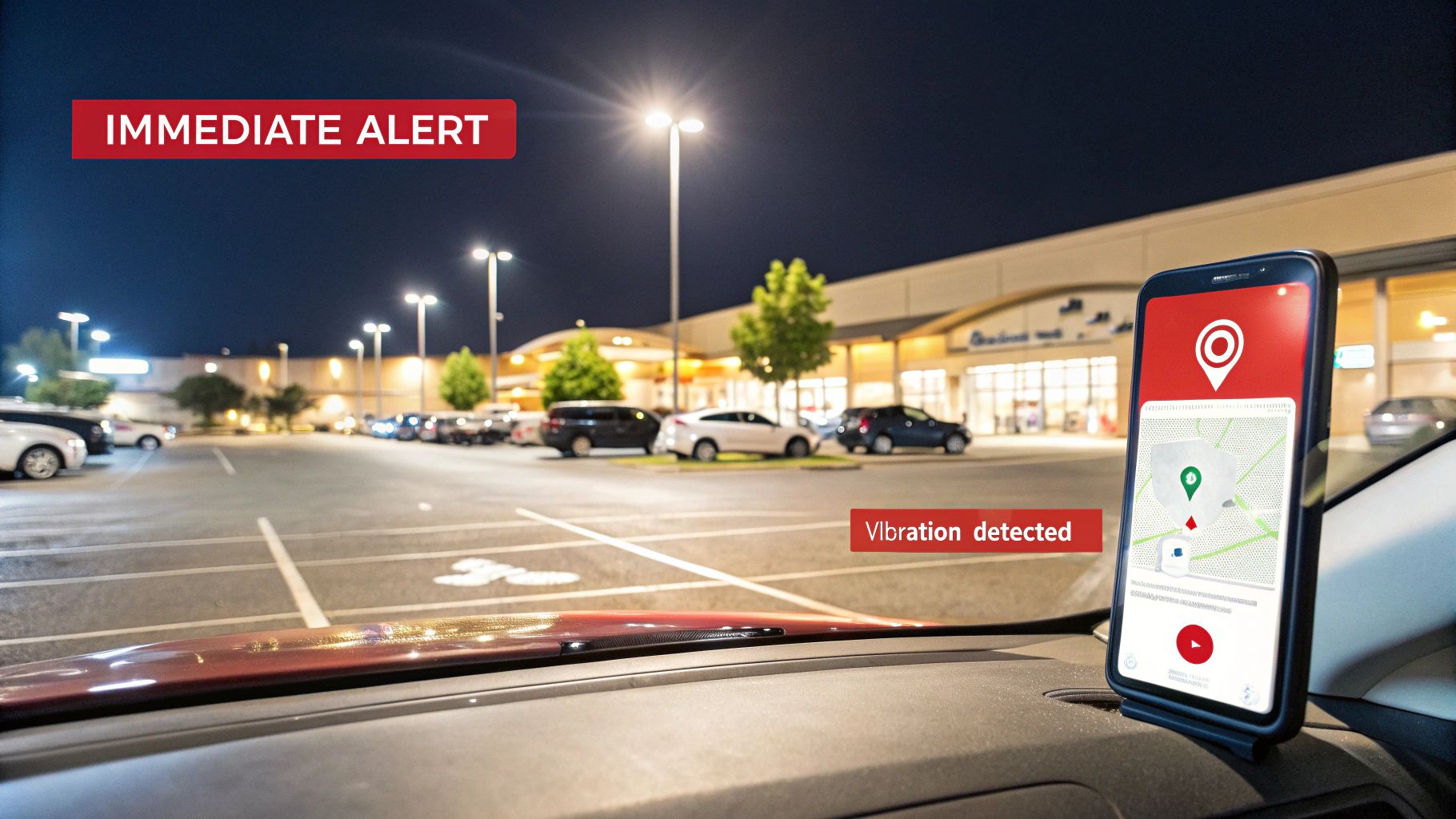
Picture this scenario: You’re in a crowded mall, and your phone buzzes. It's not a text message. It's a security alert: "Vibration Detected." Before you can react, another one follows: "Engine Started." Your heart sinks. That's your car.
You immediately open the tracking app and see the icon representing your vehicle moving out of its parking space. This is a theft in progress. You dial 911, but you're not just reporting a missing car. You are providing the dispatcher with its live location, speed, and direction of travel.
As the thief navigates city streets, you're relaying every turn to the police. What would have been a frantic, needle-in-a-haystack search becomes a guided intercept. Within minutes, law enforcement recovers your vehicle, and the perpetrator is apprehended. Without that instant alert and live data feed, your car would have likely vanished.
The Teenager's Unauthorized Joyride
Handing the keys to a newly licensed teenager is a rite of passage filled with both pride and significant worry. You’ve established clear rules—no driving after 10 PM, and stay within a 15-mile radius. But one Friday night, your phone chimes. It's a geo-fence alert; the car has just crossed the boundary you established.
A quick glance at the map confirms your car is now on the highway, far from where it's supposed to be. Another alert pops up for excessive speeding.
Instead of pacing the floor all night, you can take informed action. A quick phone call is all it takes to address the situation, get your teen to turn around, and ensure they return home safely. This isn't about spying. It's about having a tool to enforce crucial safety rules and help build responsible driving habits from the very beginning.
The average transaction price for a new car in the U.S. now exceeds $47,000. For a family or a small business, that’s a massive asset. Monitoring your vehicle isn't just about preventing theft; it's about protecting a significant financial investment.
The Small Business Owner's Alibi
Imagine you run a small plumbing business. You receive an irate call from a homeowner who claims one of your vans damaged their property last Tuesday and is threatening a lawsuit.
Normally, this would devolve into a messy "he said, she said" dispute. But instead of panicking, you open your fleet tracking dashboard and pull up the historical route replay for that specific van on that date. The data provides a rock-solid, time-stamped alibi.
The logs show, with indisputable evidence, that the van was across town on a different job site all day. It never came within five miles of the claimant’s address. Armed with this proof, you can shut down the false claim immediately, saving your company thousands in potential legal fees and protecting your hard-earned reputation. It’s a perfect example of how tracking provides operational proof, not just security.
How to Choose and Install a Real-Time Tracking Device
Selecting the right real-time location tracking system isn't as complicated as it may seem. The decision comes down to a handful of key factors that will provide the security and confidence you’re seeking. The main goal is to find a device that fits your vehicle and your budget while delivering information that is fast, clear, and easy to act on.
The first major choice is the installation method. Many modern trackers, like the CarLock device, are simple plug-and-play units. These OBD-II (On-Board Diagnostics) trackers are incredibly easy to set up. You simply locate your car's OBD-II port—typically found under the dashboard near the steering column—and plug it in. The entire process takes less than a minute, requires no tools, and the device can be removed just as easily. This makes it the ideal solution for most car owners.
Alternatively, there are hardwired systems. These are connected directly to your vehicle's battery and electrical system. This type of installation is more involved and often requires a professional, but the advantage is a much stealthier and more permanent solution that a thief cannot simply unplug.
Evaluating Subscriptions and App Usability
After considering the hardware, it's time to evaluate the software and the associated service plan. Real-time trackers require a subscription to cover the cost of the cellular data they use to transmit location updates from your car to your phone. When comparing plans, don't just look at the price; scrutinize what features are included.
A good subscription should provide:
- Continuous real-time tracking without restrictive data caps or slow update intervals.
- A full suite of security alerts, including notifications for vibration, geo-fencing, engine start, and device tampering.
- Access to historical trip logs so you can review where your car has been.
The mobile app is your primary interface with the device, so its usability is paramount. A well-designed app presents the information you need clearly and concisely, without a cluttered or confusing layout. Before purchasing, it’s a good idea to check app store reviews or watch demo videos to ensure the interface is intuitive and the alerts are simple to configure. To see what a modern system can do, you can explore the features of the CarLock tracker and see how it prioritizes a clean and simple user experience.
From Unboxing to Your First Alert
Getting your new tracking system up and running is designed to be a straightforward process. It typically breaks down into three quick steps:
- Activate the Device: First, you’ll create an account on the company’s website or through their mobile app. This is where you will link your new hardware to your account using its unique serial number.
- Install the Hardware: For an OBD-II tracker, locate your car’s port and plug the device in until it’s secure.
- Configure Your Alerts: This is the most important step for security. Open the app and set up your first geo-fence, perhaps around your home or workplace. Then, enable key notifications like “Vibration Detected” and “Engine Started.”
This push for accessible tracking technology is a global phenomenon. In the Asia Pacific region alone, the market for real-time location systems is growing by an impressive 23.4% CAGR. While much of that growth is driven by large industries like manufacturing and logistics, this trend makes high-quality vehicle security solutions far more affordable and reliable for everyday car owners. You can read more about this global expansion of RTLS technology to understand how it’s changing the security landscape.
Navigating Data Privacy and Security Concerns
Using a real-time location tracking device means you're placing significant trust in the company behind it. You're sharing sensitive location information, and it's completely reasonable to question who can access this data and how it is being protected. These are valid concerns, and any reputable security provider takes this responsibility seriously.
The bedrock of modern data security is end-to-end encryption. The best analogy is a sealed, digital tunnel running directly from your vehicle's tracker to your smartphone. When the tracker transmits its location, that data is instantly scrambled into a complex, unreadable code. It remains encrypted as it travels over the cellular network and can only be decrypted when it reaches your app, using a unique digital key that only you possess.
This process ensures that even if a third party managed to intercept your data mid-transit, it would be unintelligible. Only you, the authorized user, can view your car’s actual location, its history, and any associated alerts. Reputable companies invest heavily to build a digital fortress around your personal information.
Understanding Legal and Ethical Boundaries
Beyond the technology, there are the legal and ethical rules of use. The fundamental principle is clear: you have the absolute right to track your own property. Installing a device in a vehicle you own for security purposes is a perfectly legal and prudent action.
However, the situation requires transparency when other people drive that car, whether they are family members or employees.
- Family Members: If you're using a tracker on a vehicle driven by your teen or spouse, open communication is essential. The goal is safety, not secret surveillance. Ensuring they are aware of the device builds trust and keeps everyone on the same page.
- Employees: For business owners tracking company vehicles, a clear, written policy is a must. This policy must inform employees that the vehicles are monitored for operational efficiency and security. In many jurisdictions, this is not just good practice—it's a legal requirement.
Being upfront protects all parties involved and ensures the technology is used responsibly and ethically. If you'd like to see an example of how a company like CarLock handles this, you can read our detailed privacy policy.
A study from the Pew Research Center found that a staggering 81% of Americans feel they have very little or no control over the data that companies collect about them. This statistic underscores why it is so important to choose a tracking provider that prioritizes user control and robust data protection.
Putting Your Security Above All Else
Ultimately, a professional tracking system is designed to give you more control, not take it away. When you choose a service that utilizes strong encryption and operates on a foundation of ethical use, you gain powerful security features without sacrificing your privacy.
This unwavering focus on protecting your data is what separates a reliable security tool from a simple gadget. It's the guarantee that while you're keeping an eye on your vehicle, your personal information is being kept safe from everyone else.
Got Questions About Vehicle Tracking? We've Got Answers.
Even after reviewing the benefits and technology, you likely have a few practical questions. That's completely normal. Understanding the day-to-day operational details is what helps you feel truly confident about integrating a tracker into your vehicle's security plan.
Let's address the most common questions we hear from car owners.
"Will a GPS Tracker Kill My Car's Battery?"
This is the number one concern for many users, and for good reason. No one wants to be stranded by a dead battery caused by a security device.
Fortunately, any well-designed, modern tracker is engineered for extreme energy efficiency. A device that plugs into your car's OBD-II port sips a minimal amount of power, drawing a current roughly equivalent to your car's dashboard clock.
When your engine is running, the alternator easily handles this negligible load. The real engineering comes into play when you turn the car off. The tracker enters a low-power "deep sleep" mode, waking up only for brief moments to check in or if its sensors detect a genuine threat, like a sudden vibration. For any healthy car battery, this draw is so minuscule that it will not cause a problem, even if the car remains parked for weeks at a time.
"Are There Really Monthly Fees Involved?"
Yes, and there’s a critical reason for them. Real-time trackers need a persistent connection to communicate with you, and that requires access to a cellular network. The small monthly subscription fee is essentially a dedicated, miniature data plan for your car's security device.
This constant connectivity is what enables real-time tracking. Without it, the device might know its location, but it would have no way to send you that urgent "Engine Started" alert the second a thief gets behind the wheel. Think of the fee as the operational cost of maintaining a 24/7 direct line to your vehicle's location and security status.
"What If a Thief Just Unplugs It?"
This is a key differentiator between a cheap, basic tracker and a professional security system. Thieves are often aware of OBD-II devices, which is why a quality tracker is designed with this specific scenario in mind.
The instant a smart tracker is disconnected from the car's power source, its own internal backup battery takes over. The very first action it performs is to send a "Device Disconnected" alert directly to your phone, notifying you of potential tampering.
Even while unplugged, the device will continue to broadcast its location using that backup battery, giving you and the police a crucial window of time to track and recover it.
"Is This Going to Be a Pain to Install?"
Absolutely not. For most modern trackers, installation is remarkably simple. The vast majority of systems available to consumers today are designed for the OBD-II port. If your car was manufactured after 1996 (for the U.S. market), it has one. This is the same port your mechanic uses to run vehicle diagnostics.
Getting it set up is a breeze:
- Locate the port. It's typically under your dashboard, near the steering column.
- Plug the device in. You'll feel it click securely into place.
- Open the mobile app and follow the on-screen steps to activate it.
That’s it. The entire process takes less than a minute and requires zero tools or technical expertise. It’s true plug-and-play security, making this powerful technology accessible to every car owner.
For a system that thoughtfully addresses all these concerns with smart, easy-to-use features, CarLock offers a complete real-time tracking and alert solution built for today's security needs. Keep your vehicle safe with a device that ensures you're always connected and in control. See how it works at https://www.carlock.co.