


Driver’s Desk
The Ultimate Guide to Real-Time Location Tracker Technology
A real-time location tracker is an advanced vehicle security device that provides continuous, live monitoring of your vehicle's exact position, reporting directly to a smartphone or web application. In an era of rising vehicle crime, this technology has become an essential tool for car owners, offering a proactive layer of security that traditional car alarms cannot provide. Its core function is to deliver immediate, actionable intelligence the moment a potential threat is detected.
Beyond Alarms: The Evolution to Proactive Vehicle Security
Conventional car alarms are passive deterrents, often generating loud noises that are frequently ignored in urban environments. In contrast, a real-time location tracker operates as a silent, vigilant guardian. It provides immediate notifications and precise location data, enabling swift action and significantly increasing the chances of vehicle recovery.
This shift from passive alerts to active monitoring is why these devices have transitioned from a niche gadget to a mainstream security necessity. The market data reflects this trend. According to a report by Fortune Business Insights, the global GPS tracking device market was valued at $2.53 billion in 2021 and is projected to reach $6.97 billion by 2029, exhibiting a compound annual growth rate (CAGR) of 13.5%. This growth is largely driven by private vehicle owners seeking more robust and reliable security solutions.
Who Benefits from Real-Time Location Tracker Technology?
The application of this technology extends to any individual or entity that values the security and oversight of their vehicles. It provides tangible solutions to common and critical problems for a diverse range of users.
- Parents of New Drivers: Geofencing capabilities allow parents to receive instant alerts when a teen driver arrives at or departs from designated locations, such as school or home, ensuring their safety without intrusive check-ins.
- Owners in High-Theft Areas: In the UK alone, a vehicle is stolen every five minutes. A real-time tracker provides immediate notifications if a vehicle is bumped, towed, or started without authorization, giving owners a critical window to alert law enforcement.
- Fleet Managers: For businesses, trackers are indispensable for optimizing routes, monitoring driver behavior, preventing unauthorized vehicle use, and improving overall operational efficiency, leading to significant cost savings.
- Owners of Valuable Vehicles: For classic, luxury, or high-performance cars, a tracker offers unparalleled protection by detecting subtle vibrations or movements indicative of a theft attempt, safeguarding a significant financial and personal investment.
A real-time location tracker transforms a vehicle from an isolated asset into a connected, monitored entity. It is the critical difference between discovering a theft hours after the fact and being notified the instant it commences.
Ultimately, whether you are a concerned parent or a business owner managing assets, a real-time location tracker establishes a direct, live link to your vehicle. It provides a precise, unequivocal answer to the crucial question—"Where is my car right now?"—which serves as both a powerful deterrent to criminals and an invaluable tool for recovery. Understanding the mechanics of a car locator is the first step toward appreciating the comprehensive security it provides.
How Vehicle Tracking Technology Actually Works
A real-time location tracker operates through a sophisticated integration of three core technologies: the Global Positioning System (GPS), cellular communication networks, and motion-sensing accelerometers. This system is engineered to pinpoint a vehicle's exact location, transmit that data in real-time, and detect physical disturbances, converting complex technical processes into a simple, clear alert on your smartphone.
The diagram below illustrates how a potential security threat is detected and communicated to the user almost instantaneously.
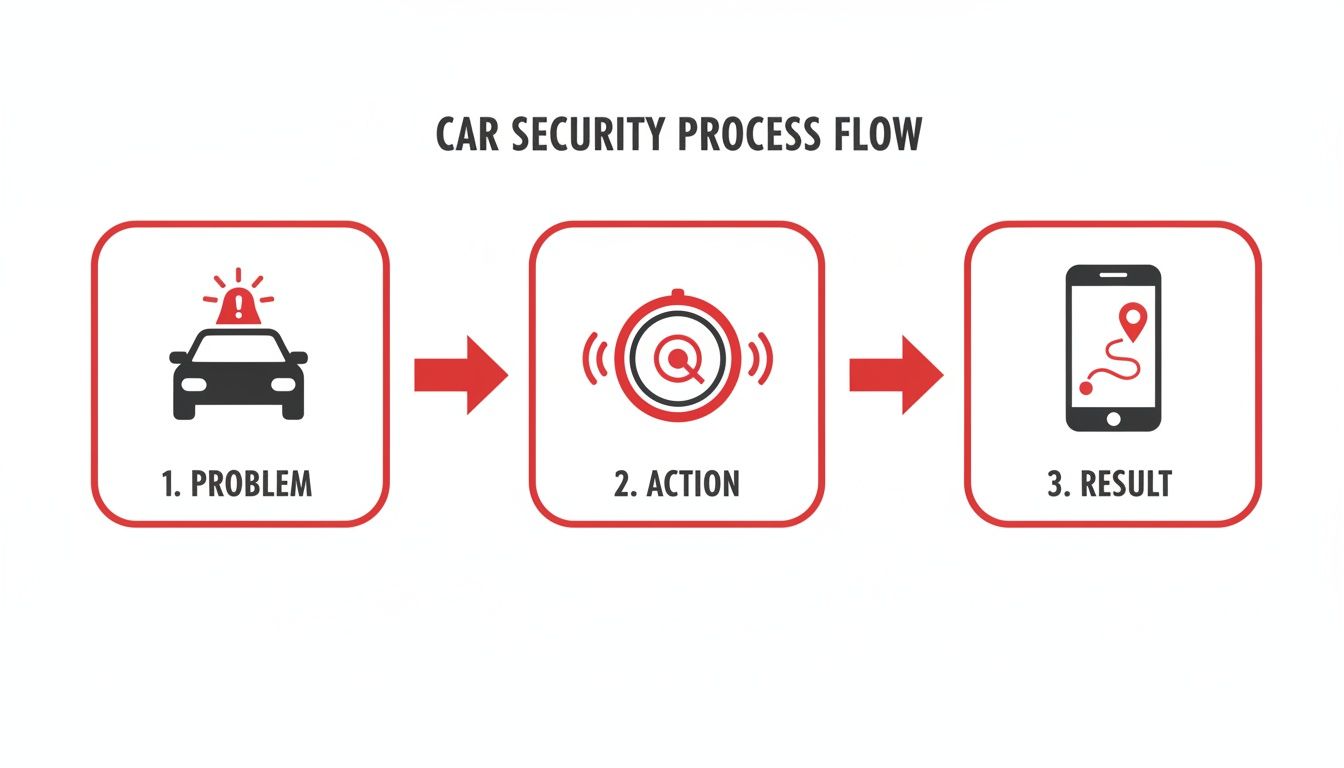
This process—from threat detection to mobile alert—forms the foundation of modern, effective vehicle security.
The Foundation: GPS for Pinpoint Accuracy
The system's functionality begins with the Global Positioning System (GPS), a U.S.-owned utility comprising a constellation of at least 24 operational satellites orbiting the Earth. Each satellite continuously broadcasts precise timing signals and its orbital position.
The tracker device contains a GPS receiver that listens for these signals. To calculate its position, the receiver must acquire signals from a minimum of four satellites. By measuring the precise time it takes for each signal to arrive, the device performs a complex calculation known as trilateration.
This process yields highly accurate location data. Under optimal conditions with a clear line of sight to the sky, a high-quality GPS tracker can determine a vehicle's location to within an accuracy of 5 to 10 meters (approximately 16 to 32 feet). This level of precision is critical for the effective recovery of a stolen vehicle.
The Connection: Cellular Networks for Instant Communication
Acquiring location data is only the first step; this information must be transmitted to the user. This is accomplished using cellular technology, specifically the same GSM/LTE networks that mobile phones rely on.
The tracker functions like a miniature modem, sending packets of GPS coordinate data to a secure central server at regular intervals. This continuous data stream is what enables users to monitor their vehicle's movement in real-time on a digital map. Without this cellular link, the device would merely be a data logger, incapable of providing live security alerts.
The synergy of GPS and cellular technology is the engine of modern vehicle security. GPS establishes the location, while the cellular network delivers this critical information to the user's fingertips, maintaining a constant connection to the vehicle regardless of distance.
This uninterrupted communication is what defines the tracker as an active, protective system. To delve deeper, you can explore how advanced car tracking systems leverage these technologies to maintain constant vigilance.
The Senses: Accelerometers for Immediate Alerts
The component that elevates a tracker to a comprehensive security system is its internal sensor suite, most notably the accelerometer. This micro-electromechanical system (MEMS) detects motion, vibration, and changes in orientation.
This technology is responsible for providing threat warnings even before a vehicle is moved.
- Vibration Detection: The accelerometer is calibrated to be sensitive enough to detect the specific frequencies and amplitudes associated with a window break, a forced entry attempt, or the use of power tools on the vehicle's body.
- Engine Start Alerts: It can identify the unique vibrational signature of the engine starting and immediately transmit an alert if this occurs without authorization.
- Towing or Movement: If the vehicle is moved without the engine running—a common tactic using tow trucks—the accelerometer detects this motion and triggers an alarm.
By integrating the pinpoint accuracy of GPS, the instant communication of cellular networks, and the physical awareness of an accelerometer, a real-time location tracker establishes a multi-layered security perimeter around your vehicle.
When evaluating a real-time location tracker, it is crucial to look beyond basic location mapping. A truly effective device is a complete security ecosystem, equipped with features that empower the owner to manage their vehicle's safety proactively. Understanding these core functions is essential for building a robust security strategy for your car.

The market for this technology is expanding rapidly for clear reasons. Vehicle theft remains a significant global issue, with statistics from the National Insurance Crime Bureau (NICB) showing over one million vehicles stolen in the U.S. in 2022, the highest number since 2008. This is driving the vehicle tracking systems market, which is projected to grow from $27.64 billion in 2024 to $99.56 billion by 2034. The software component, accounting for 66% of market revenue, powers the sophisticated applications—like CarLock's—that deliver these critical instant alerts.
These alerts have a demonstrable impact. Law enforcement data consistently shows that vehicles equipped with tracking devices have recovery rates exceeding 90%, a stark contrast to the much lower rates for untracked vehicles.
Instant Alerts: Motion and Vibration Detection
The most critical feature of any vehicle security system is its ability to provide immediate notification of a potential threat. A high-quality tracker utilizes its built-in accelerometer to detect physical disturbances and instantly sends a push notification to the user's smartphone.
These are not generic warnings but specific, actionable alerts corresponding to real-world threats:
- Vibration Detected: This serves as the first line of defense, triggering an alert if a thief attempts to break a window, force a lock, or use tools on the vehicle.
- Device Disconnected: A common tactic for thieves is to locate and unplug the tracker. This alert immediately informs the owner if the device has been tampered with or disabled.
- Engine Started: A notification is sent the moment the engine turns over, providing instant confirmation of an unauthorized start.
- Vehicle Moved: This is crucial for detecting theft by towing. It warns the owner if the vehicle is moved or loaded onto a flatbed truck, even with the engine off.
For a truly layered defense, many owners combine a tracker with physical anti-theft measures. It is beneficial to understand how systems like Ghost Immobiliser technology can be used in conjunction with a tracker to create a near-impenetrable security solution.
Geofencing: Creating Virtual Perimeters
Geofencing is a powerful feature that allows users to create virtual boundaries around specific geographic locations. These perimeters can be established for key areas such as a home, office, or school.
When the vehicle enters or exits one of these predefined zones, the system automatically sends a notification to the user's phone. This functionality is invaluable for parents monitoring a teen driver's safe arrival at a destination or for business owners ensuring that company vehicles remain within designated service areas.
A geofence transforms a passive location marker into an active monitoring tool. It automates the process of location verification, providing peace of mind without requiring constant manual map checking.
Power and Installation Options
The method by which a tracker is powered and installed is a significant consideration. The choice depends on the user's technical comfort level and desired level of security, with each option offering a different balance of convenience, discretion, and reliability.
A thorough evaluation of the pros and cons of common power sources is advisable before purchase. This table provides a breakdown of what to expect from each.
Core Features of a Modern Real-Time Location Tracker
| Feature | What It Does | Why It Matters for Security |
|---|---|---|
| Real-Time Alerts | Sends instant push notifications for vibration, movement, engine start, or device disconnection. | Provides the critical time advantage needed to notify police and potentially thwart a theft in progress. |
| Geofencing | Lets you set up virtual boundaries and get notified when your car enters or leaves them. | Automates monitoring for key locations like home or work, providing peace of mind without constant map-watching. |
| Trip History | Logs and stores detailed route information, including speed, time, and distance for every trip. | Provides a verifiable record for vehicle recovery, monitoring driving habits, or documenting business mileage. |
| Driving Behavior | Monitors for harsh acceleration, hard braking, and sharp cornering. | Crucial for coaching teen drivers or ensuring fleet vehicles are being operated safely and in compliance with company policy. |
| Battery Voltage | Tracks your car's battery health and alerts you to low power levels. | Helps prevent being stranded by a dead battery and can serve as an early indicator of potential vehicle electrical issues. |
Ultimately, the most valuable features are those that deliver actionable intelligence when it is needed most.
Selecting the right combination of features and power source is key to maximizing the effectiveness of your vehicle security. CarLock provides comprehensive details on its device and the full suite of features you can count on to protect your vehicle. The optimal real-time location tracker is one that seamlessly integrates with your lifestyle while delivering robust, immediate, and genuinely useful security alerts.
Who Really Needs a Location Tracker?
While the underlying technology of a real-time location tracker is complex, its true value lies in its practical application to solve real-world problems. This is not merely a gadget for technology enthusiasts; it is a pragmatic tool that delivers security and peace of mind to a broad spectrum of users. From parents of new drivers to meticulous business owners, a high-quality tracker addresses tangible, significant concerns.
Market data corroborates this wide-ranging utility. The global vehicle tracking market, valued at $21.54 billion in 2022, is projected to reach an impressive $60.89 billion by 2030. This exponential growth is fueled by various sectors, but the passenger car segment—which accounts for over 40% of the market—is a primary driver as individuals increasingly seek superior methods to protect their personal vehicles.
Parents of Teen Drivers
The milestone of a teenager earning their driver's license is often accompanied by significant parental anxiety. A location tracker serves as a digital safety net, providing reassurance without necessitating constant communication.
For example, a geofence can be established around a teen's school or workplace. The parent receives an automated notification upon their arrival, confirming their safety discreetly. Alerts can also be configured to notify parents of unexpected detours, facilitating communication and ensuring adherence to agreed-upon plans. This is not about surveillance, but about fostering trust and confirming a young driver's well-being from a distance.
Business Owners and Fleet Managers
For any enterprise that operates a vehicle fleet, a tracker is an essential operational and risk management tool. Whether managing a few delivery vans or a large contingent of service trucks, real-time asset location is non-negotiable.
Fleet managers can leverage tracking data to design more efficient delivery routes, resulting in substantial fuel savings and improved customer satisfaction through accurate arrival estimates. Furthermore, it helps eliminate unauthorized use of company vehicles, a common issue that increases mileage, wear-and-tear, and liability. The operational benefits are extensive, as detailed in this analysis of the Top 10 Fleet Management System Benefits.
Tracking provides more than just location data; it provides accountability. It delivers the empirical data required to protect investments, inform strategic decisions, and ensure that personnel operate safely and efficiently.
This level of oversight is fundamental to protecting the company's bottom line and optimizing daily operations.
Owners of Valuable or Classic Cars
For owners of classic, custom, or high-value vehicles, the threat of theft represents a significant financial and emotional risk. A standard car alarm is often insufficient protection for such assets, whereas a real-time location tracker offers a direct and active defense.
Consider the owner of a meticulously restored classic car. If a thief attempts to force a door lock, the resulting vibration is instantly detected, triggering an alert on the owner's phone. This immediate notification provides a crucial window of opportunity to assess the situation and contact law enforcement, potentially stopping the theft before the vehicle is even moved. For these owners, a tracker is not merely a recovery device—it is an active, 24/7 security detail for their investment and passion.
Getting a Handle on Tracker Costs and Installation
When researching a real-time location tracker, it is important to consider the total cost of ownership, which comprises two primary components: the upfront hardware cost and the ongoing service subscription. This model is standard for the industry, as it covers the continuous connectivity required to protect your vehicle around the clock.
The initial expense is for the physical tracking device. Hardware prices can vary significantly based on the sophistication of the internal components. A basic model may offer simple GPS location pings, whereas a more advanced unit will include highly sensitive accelerometers, a superior cellular radio for enhanced coverage, and a more polished, feature-rich mobile application.
Understanding the Subscription Fee
The ongoing subscription is what activates and maintains the tracker's functionality. This monthly or annual fee is not an ancillary charge but the core payment for the entire live security service.
This fee covers several critical operational costs required for the device to communicate with the user:
- A Dedicated Cellular Plan: Each tracker is equipped with its own SIM card and requires a data plan to transmit location updates and alerts over the cellular network. The subscription covers this data usage.
- Cloud & Server Costs: All data from the tracker is transmitted to secure cloud servers, where it is processed and relayed to the user's app. The maintenance, security, and scaling of this server infrastructure represent a significant operational expense.
- Ongoing App Support: The mobile application requires continuous development, including updates for new iOS and Android operating systems, security patches, bug fixes, and the introduction of new features.
The subscription is what transforms a piece of hardware into a live, responsive security service. It is the vital link that ensures an alert is transmitted from your vehicle to your phone within seconds.
Without this active service, the tracker would be a passive, non-communicative device, unable to provide warnings in a critical situation.
Installation Is Simpler Than You Think
The setup process for modern trackers is often far less complex than many people assume, particularly with the prevalence of plug-and-play designs. The ideal installation method depends on whether the user prioritizes ease of setup or a more covert, permanent installation.
The majority of consumer-grade trackers are OBD-II (On-Board Diagnostics) devices. Installation is straightforward:
- Locate Your OBD-II Port: Virtually every vehicle manufactured since 1996 is equipped with this port, typically located under the dashboard on the driver's side.
- Plug in the Device: The tracker plugs directly into the port, immediately drawing power from the vehicle's battery and beginning its initialization sequence. The entire process takes less than a minute.
For those seeking a more concealed solution, hardwired trackers are the preferred option. These devices are wired directly into the vehicle's electrical system, making them invisible to a potential thief. While this installation is more involved—and professional assistance is often recommended—the result is a tamper-resistant security system that is permanently powered and hidden from view.
Navigating the Legal and Privacy Side of Vehicle Tracking
A real-time location tracker is a powerful security tool, but its use is governed by important legal and ethical principles. Understanding these regulations is essential for using a tracker responsibly and respecting individual privacy rights.
The legality of using a tracker is primarily determined by vehicle ownership.
If you are the legal owner of the vehicle, you have the right to install a tracking device on it. This applies to your personal car, a classic vehicle, or a vehicle co-owned with a spouse. Protecting one's own property is a fundamental and legally protected right.
However, it is illegal in most jurisdictions to place a tracking device on a vehicle you do not own without the explicit consent of the owner. Such an act can lead to serious legal consequences, including charges of stalking, harassment, or invasion of privacy. Consent is the determinative factor that distinguishes legitimate security monitoring from unlawful surveillance.
A Compliance Guide for Business Owners
For business owners intending to track a fleet of company vehicles, transparency is paramount. While the business owns the vehicles, employees have a reasonable expectation of privacy. Tracking them without their knowledge can erode trust and potentially violate labor laws.
To ensure ethical and legal compliance, the following steps are necessary:
- Establish a Formal Written Policy: Create a clear, comprehensive policy that outlines the purpose of the tracking (e.g., safety, dispatch efficiency, asset security), the specific data being collected, and how that data will be used.
- Obtain Signed Consent: Require every employee who operates a company vehicle to read and sign a consent form acknowledging the tracking policy. This documentation serves as proof that employees are aware of and have agreed to the monitoring during work hours.
Implementing these measures does more than ensure legal compliance; it fosters a more transparent and professional work environment. When employees understand that the objective is to enhance safety and operational efficiency—not to micromanage—they are more likely to accept and support the initiative.
Who’s Protecting Your Data?
Beyond the legalities of device placement, it is crucial to consider the security of your own data. The tracker collects a significant amount of sensitive information, including daily routes, frequently visited locations, and driving habits. A reputable service provider will implement robust security measures to protect this data.
This includes end-to-end encryption for data transmission and storage, ensuring that only authorized users can access the vehicle's location history. Before committing to a service, always review the company's privacy policy. For example, you can learn how a responsible provider handles data security by reviewing CarLock's commitment to protecting user privacy.
Your Questions About Vehicle Trackers Answered
We will conclude by addressing some of the most frequent questions that arise when individuals consider acquiring a real-time location tracker. Obtaining clear, factual answers to these practical concerns is key to making an informed decision about your vehicle's security.
Will a GPS Tracker Drain My Car Battery?
This is a valid concern, but a well-engineered tracker is designed for minimal power consumption. Most modern trackers that connect to a vehicle's OBD-II port draw a negligible amount of current, comparable to the vehicle's digital clock. They incorporate intelligent power management, entering a low-power "sleep" mode when the vehicle is stationary and only activating to transmit data when motion is detected or a scheduled check-in occurs.
For any vehicle with a healthy battery, the tracker's power draw will be unnoticeable. Furthermore, advanced systems like CarLock actively monitor the vehicle's battery voltage and will send an alert to the user if the battery level becomes critically low, ensuring the tracker itself never becomes the cause of a dead battery.
How Accurate Is Real-Time Location Tracking?
Modern GPS technology offers remarkable precision. A high-quality tracker can typically pinpoint a vehicle’s location to within 5 to 10 meters (approximately 16 to 32 feet) under open-sky conditions. This level of accuracy is more than sufficient for law enforcement to locate a stolen vehicle on a specific street or within a large car park.
In a vehicle recovery scenario, the accuracy of a real-time location tracker is its most significant asset. It provides the precise data needed to guide authorities directly to the stolen asset, drastically increasing the probability of a successful recovery.
It is important to note that accuracy can be temporarily reduced in dense urban environments with tall buildings ("urban canyons") or in subterranean structures like underground parking garages where satellite signals are obstructed. In these instances, the system will report the vehicle's last known location just before signal loss, providing a critical last-seen point to begin a search.
What Happens If a Tracker Loses Cellular Signal?
Professional-grade trackers are engineered to handle intermittent cellular connectivity. If a vehicle travels through an area with no mobile service, such as a remote rural area or a long tunnel, the device does not cease operation.
Instead, it continues to record GPS coordinates and stores this data in its internal memory buffer. As soon as the vehicle re-enters an area with cellular coverage, the tracker automatically transmits the stored data to the server in chronological order. This "store-and-forward" capability ensures a complete and uninterrupted trip history, with no data gaps, even if real-time transmission was temporarily paused.
You can find more answers to common questions in our detailed FAQ section.
Ready to experience the peace of mind that comes with knowing your car is always protected? With CarLock, you get instant alerts, precise location tracking, and a direct link to your vehicle’s security 24/7. Invest in the best protection for your car today. Learn more about CarLock.