

Driver’s Desk
Your Guide to GPS Device Tracking Software for Cars
Think of GPS device tracking software as your car's digital co-pilot—an always-on connection that bridges the gap between your vehicle and your smartphone. It pairs a small, physical GPS unit with a powerful app, giving you a level of real-time awareness and control that makes old-school car alarms feel like relics from a bygone era.
Why Modern GPS Tracking Is Your Car's Best Defense
We’ve all been there. You leave your car parked on an unfamiliar street or nervously hand the keys over to a new teenage driver. That little pit of anxiety in your stomach is a feeling most car owners know well. For decades, our only line of defense was the blaring siren of a traditional car alarm, a "solution" that's now so common it’s mostly just noise pollution. According to a 2022 study, an estimated 95% of car alarm activations are false alarms, leading to widespread public indifference.
But car security has come a long way. Today, GPS device tracking software doesn't just make a racket; it acts as a proactive digital bodyguard for your vehicle. It creates a constant, invisible link between you and your car, delivering genuine peace of mind through intelligent monitoring and instant alerts sent right to your phone. It’s not just about finding your car after it’s gone—it’s about stopping a theft before it even happens.
The Problem with Traditional Alarms
Let's be honest, traditional car alarms just don't cut it anymore. They were designed to scare off thieves with noise, but their effectiveness has plummeted due to several key factors.
- Alert Fatigue: We hear car alarms go off so often that our collective instinct is to simply ignore them. A survey by the UK-based Noise Abatement Society found that only 1 in 20 people would call the police upon hearing a car alarm.
- Limited Range: A siren is useless if you're not close enough to hear it. If you're in an office building or a shopping mall, you'll never know there's a problem until you return to an empty parking spot.
- No Real-Time Information: Once a professional thief silences the alarm (which often takes less than 60 seconds) and drives off, you’re left completely in the dark. Your car is gone, and you have no idea where.
To see how far the technology has come, it's helpful to compare these outdated systems with what's possible today.
Traditional Car Alarms vs Modern GPS Tracking Software
This table breaks down the key differences between the old guard and the new standard in vehicle protection.
| Feature | Traditional Car Alarm | GPS Device Tracking Software (like CarLock) |
|---|---|---|
| Primary Function | Make a loud noise to deter thieves and alert people nearby. | Provide real-time location data, instant alerts for suspicious activity, and vehicle health monitoring directly to the owner's phone. |
| Alert Type | Audible siren and flashing lights. | Silent, instant push notifications to your smartphone for events like engine start, vibration detection, or device disconnection. |
| Range | Limited to earshot (typically a few hundred feet). | Global. You can monitor your car from anywhere in the world with a cell signal. |
| Post-Theft Action | None. Once the car is gone, the alarm provides no further help. | Enables real-time tracking of the vehicle's location, greatly increasing the chances of recovery. |
| Proactive Features | Very few. It only reacts when a door is forced open or a window is broken. | Includes geofencing (virtual boundaries), driver behavior monitoring (harsh braking, speeding), and engine start alerts before the car even moves. |
| Effectiveness | Low. Thieves are skilled at disabling them quickly, and the public often ignores them. | High. Provides immediate, actionable information that empowers the owner and law enforcement to act swiftly. Vehicle recovery rates are significantly higher. |
The takeaway is clear: while a traditional alarm hopes to scare a thief away, a modern car security system gives you the power to take control.
The Power of Proactive Security and Data
This isn't just about a feeling of security; the numbers tell a powerful story. Vehicle theft statistics are sobering. The National Insurance Crime Bureau (NICB) reports that a vehicle is stolen every 32 seconds in the United States. While law enforcement data shows that only about 52.1% of stolen vehicles are recovered, vehicles equipped with GPS trackers have a recovery success rate of over 90%.
Here in the U.S., the FBI's Uniform Crime Report documented 1,001,967 motor vehicle thefts in 2022, resulting in losses exceeding $8.9 billion. This is precisely why a device like CarLock, which sends instant alerts to your phone, is so essential. Experts estimate that thieves simply ignore traditional car alarms 95% of the time.
Beyond your personal vehicle, this technology is also a game-changer for businesses that rely on vehicles and equipment, offering a powerful tool for cargo theft prevention and asset recovery. Whether you're protecting your family car, keeping an eye on a new driver, or managing a whole fleet, the mission is the same: use smart technology to stay one step ahead.
How Your Car Tells Your Phone Where It Is
Ever wondered how your car’s exact location can appear on your phone screen, almost instantly? It’s not magic—it's a clever, continuous conversation between your car, a network of satellites, and your smartphone. Think of it as a high-tech relay race, passing critical information from space, to your vehicle, and finally, right into the palm of your hand.
This constant flow of data is what gives a GPS tracker its power. Without it, a tracker is just a silent passenger. But with it, you have a direct line to your car's whereabouts, turning a simple map dot into a proactive security system.
For cars without this technology, the story often ends badly.
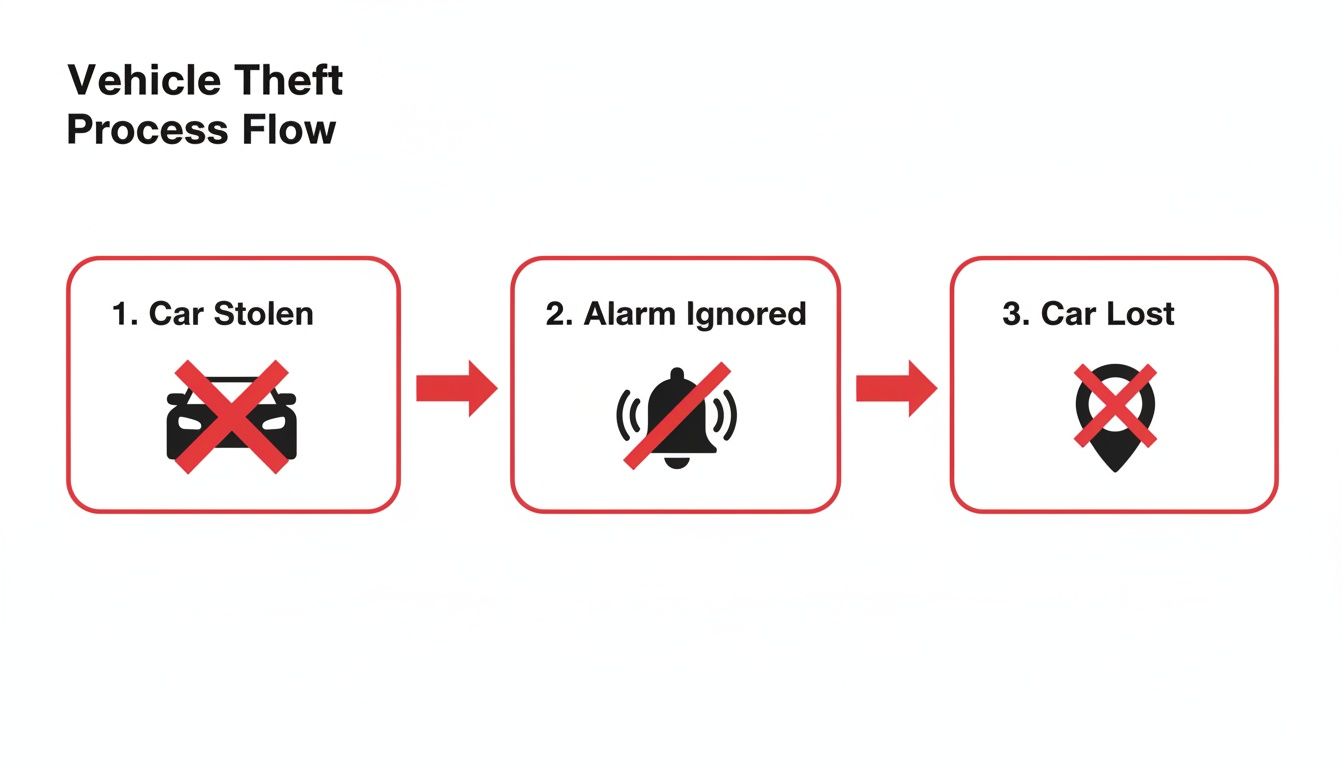
As you can see, traditional car alarms are often just noise. When a car is stolen, there's no way for it to tell you where it's going. Let's break down the three steps that modern tracking systems use to solve this problem.
Step 1: The Car Pinpoints Its Position Using Satellites
It all starts with a small GPS device installed in your vehicle. Inside this device is a GPS receiver that acts like a highly sensitive ear, constantly listening for signals from above. It doesn't transmit anything to space; it only listens.
These signals are broadcasted by the Global Positioning System (GPS), a U.S.-owned utility maintained by the U.S. Space Force. The system features a constellation of at least 31 operational satellites orbiting about 12,550 miles (20,200 km) above Earth. Each satellite continuously sends out a time-stamped signal that says, "I'm here, and this is the exact time."
To figure out where it is, your car's tracker needs to hear from at least four of these satellites at once. By comparing the time it received each signal to the time it was sent, the device can calculate its distance from each satellite. This process, called trilateration, lets it triangulate its own latitude, longitude, and altitude with incredible accuracy—often within 5 meters (16 feet).
Step 2: The Car Sends Its Location to the Cloud
Once the GPS device has its coordinates, it can't just keep them to itself. The next step is to report its position. This is where a built-in cellular modem comes in, which works just like a tiny cell phone dedicated to your car.
Using a cellular network (like 4G LTE), the device transmits its location data and other sensor readings to a secure, remote server—what we commonly call "the cloud."
This is the crucial hand-off that separates a simple location logger from a real-time security tool. Your car is essentially sending a steady stream of "I am here" pings to a central hub that is always listening.
This constant data communication is why systems like CarLock require a small subscription. It covers the cost of the cellular data plan that the device uses, much like the plan for your own smartphone. You can see how CarLock uses a highly reliable cloud-based notification system to make sure these messages get through without a hitch.
Step 3: The Cloud Alerts Your Phone
Now for the final leg of the journey: getting that information to you. Your smartphone's tracking app, such as the CarLock app, is always connected to that same secure cloud server.
When the server receives a new update from your car, it immediately pushes that location data to your app, updating your vehicle’s position on the map in near real-time.
But the server is more than just a relay station. It’s also programmed with intelligent rules. If it gets a signal that suggests a problem—like the engine starting without you, a sudden vibration, or the device being unplugged—it doesn't just update the map. It instantly triggers a high-priority alert and sends it directly to your phone as a push notification.
This seamless three-step process—from satellite to car, car to cloud, and cloud to phone—is what makes modern GPS device tracking software such a powerful and essential part of vehicle security.
The Essential Features of a Powerful Tracking System
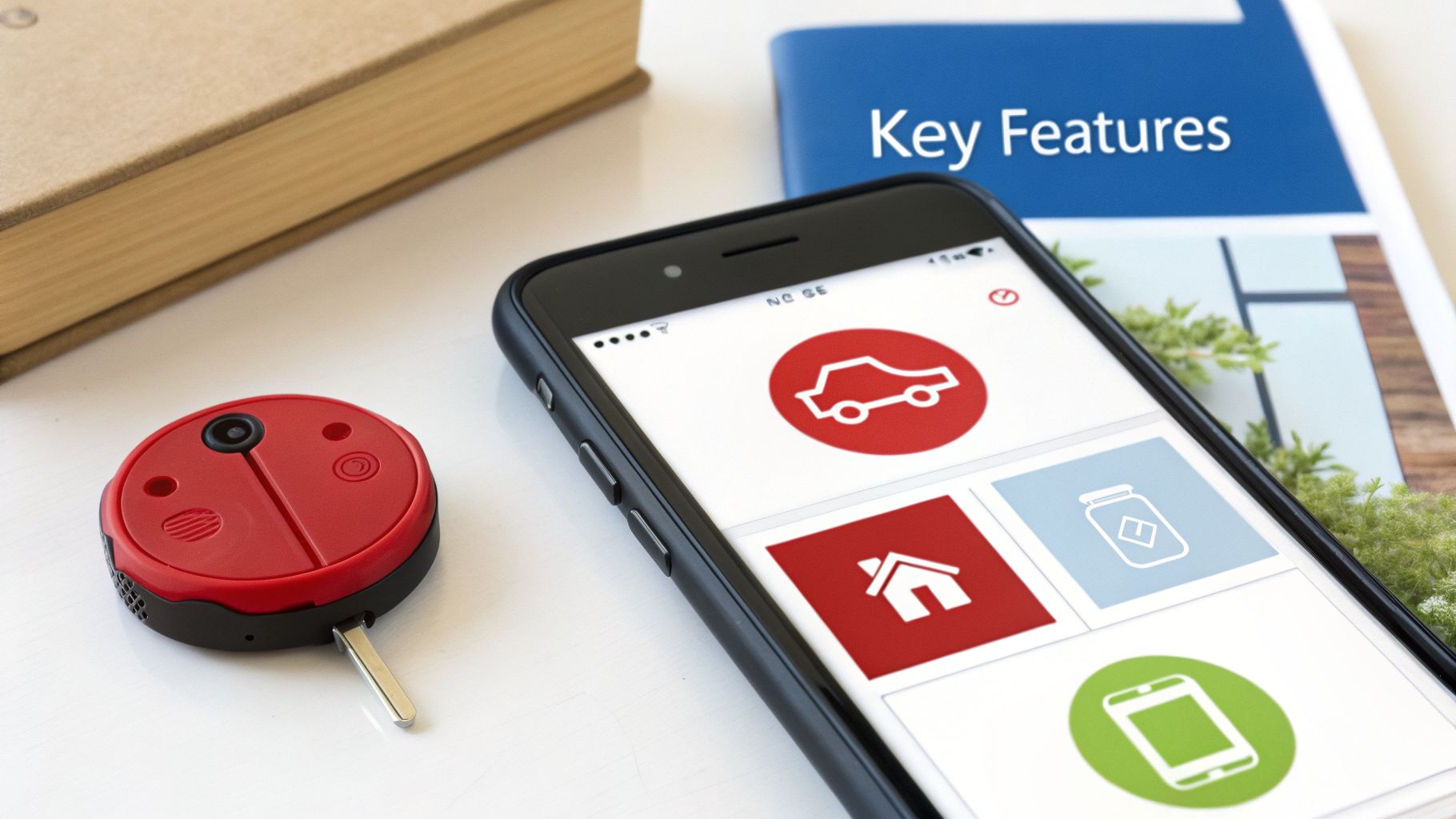
Not all GPS trackers are created equal. While a basic system might show you a dot on a map, a truly powerful gps device tracking software is more like a dedicated security guard for your vehicle. It's packed with smart features that give you real peace of mind and the power to act.
Understanding these core functions is the key to picking a system that actually protects your car, not just tells you where it was. These features work together to give you a complete, up-to-the-minute picture of your vehicle's safety, alerting you to threats as they happen, not hours later.
Real-Time Tracking with Pinpoint Accuracy
The absolute foundation of any good GPS system is real-time tracking. This isn’t just a pin on a map that updates every few minutes; it’s a live feed of your vehicle's exact location, typically refreshed every 15-30 seconds, right on your smartphone.
Think of it like this: a simple location ping is a photograph, showing you where your car was. Real-time tracking is a live video stream, showing you where it is right now. During a theft, that difference is everything. It’s what allows you to guide police directly to a moving vehicle, dramatically increasing the chances of a quick recovery.
Geofencing: Your Virtual Perimeters
This is where trackers get really smart. Geofencing lets you draw virtual boundaries on a map around important locations—your home, your office, or even your teenager’s school. The system then stands guard over these zones.
When your car crosses one of these invisible fences, either by entering or leaving, you get an instant notification on your phone. The practical uses are endless:
- Theft Prevention: Get an immediate alert if your car leaves your driveway in the middle of the night.
- Peace of Mind for Parents: Know the moment your teen driver arrives safely at their destination.
- Business Monitoring: Make sure company vehicles are staying within their assigned service areas.
Geofencing transforms your map from a passive display into an active watchdog, alerting you to important events without you needing to constantly check the app.
Smart Alerts for Suspicious Activity
The most advanced systems do more than just track location; they use built-in sensors (like accelerometers and gyroscopes) to detect specific events that could signal trouble. These "smart alerts" are what make a system like CarLock so effective at stopping a theft in its tracks.
The real value of a modern tracker isn’t just in finding a stolen car; it’s in getting the critical alert that helps you stop the theft before it’s completed.
These are the notifications that matter most. A quality system should provide instant alerts for:
- Vibration Detected: The sensor can pick up vibrations from someone breaking a window, prying a door, or even jacking up the car to steal wheels.
- Engine Started: You get an alert the second the ignition turns over, so you can immediately confirm if you know the driver.
- Device Disconnected: A thief’s first move is often to find and unplug the tracker. A good system sends a final alert if it loses power, giving you a crucial heads-up.
You can explore how these different alerts and other functions work in the CarLock features app.
Trip History and Driving Behavior Analysis
Beyond security, a top-tier GPS system also serves as a detailed logbook for your vehicle. It records every trip, showing you the exact route, start and end times, and distance traveled. This data is priceless for reviewing past activity or understanding how your car is being used.
The rise of GPS tracking software is backed by impressive adoption and tech integrations. The U.S. commercial telematics market size was valued at USD 21.16 billion in 2022 and is projected to grow significantly. This growth is driven by enhancements like geofencing and real-time dashboards, which boost vehicle recovery rates from an average of 52.1% for untracked cars to over 90% for tracked ones. For parents, theft victims, or luxury car owners, these features mean instant phone alerts for vibrations or engine starts, which is why insurers often offer 15-25% discounts for verified trackers. Discover more insights about these U.S. market trends on Market Research Future.
Furthermore, many systems can analyze how the car is being driven. They detect and log events like:
- Harsh acceleration
- Hard braking
- Sharp cornering
This is incredibly useful for parents of new drivers, giving them concrete data to help coach safer habits. For business owners, it helps ensure the company fleet is being driven responsibly, cutting down on fuel costs and vehicle wear. When combined, these essential features make GPS device tracking software a tool no modern car owner should be without.
See How GPS Tracking Solves Real-World Problems
All the technical specifications for GPS device tracking software are one thing, but where it really proves its value is in solving actual, everyday problems. The features we’ve covered aren’t just bullet points on a sales page; they’re tools that deliver security, boost efficiency, and offer some much-needed peace of mind.
To see what this means in practice, let's look at three scenarios that show how these systems empower everyone from nervous parents to small business owners.
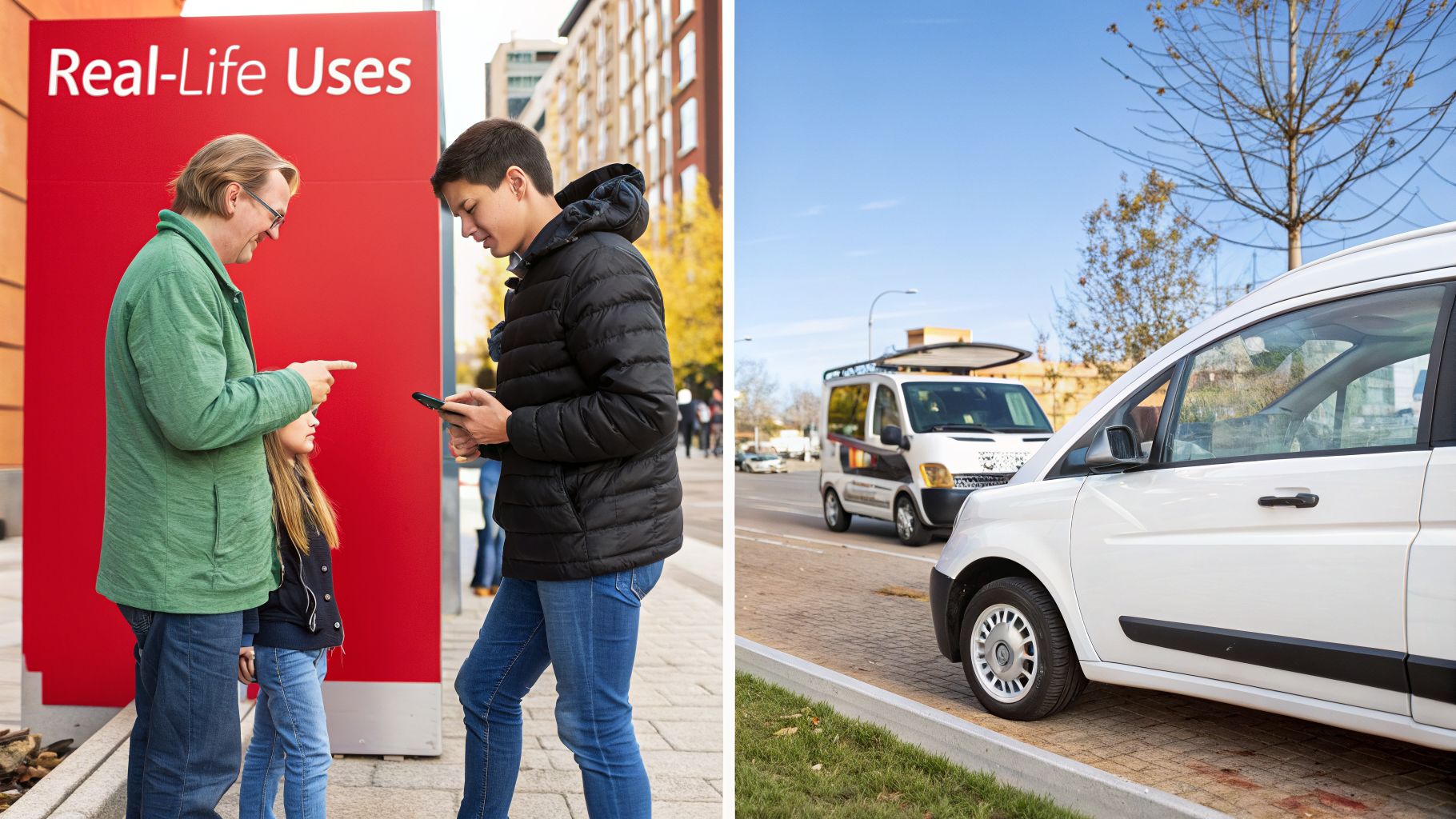
A Parent's Peace of Mind with a New Teen Driver
Sarah’s 16-year-old son, Ben, just got his license. This is a high-risk group; the CDC reports that motor vehicle crashes are the leading cause of death for U.S. teens. To get some reassurance without hovering, Sarah installed a CarLock device.
Her biggest anxieties were Ben's driving habits and making sure he was staying in familiar areas. She used the app to set up a couple of key features:
- Geofencing: Sarah drew a virtual fence around their town and another around Ben’s school. Now, she gets a quiet notification when he arrives at school and another when he’s back in the driveway. No need to text and ask; she just knows he's safe.
- Harsh Driving Alerts: The device’s accelerometer is sensitive to aggressive driving. During the first week, Sarah got a few alerts for sudden braking and speeding. This provided objective data for a calm conversation about driving responsibly, helping Ben see for himself where he needed to be more careful.
For Sarah, the GPS tracker isn't about spying. It's a safety tool that provides peace of mind while letting Ben enjoy his new freedom.
An Urban Professional Prevents a Break-In
Mark lives in a city where vehicle crime is a persistent issue. According to recent crime statistics, major U.S. cities have seen a significant spike in vehicle break-ins. Parking on the street was a nightly ritual that always left him with a knot of anxiety.
He chose CarLock specifically for its instant vibration alerts. One night, he’s on the couch watching a movie when his phone buzzes with a "Vibration Detected" notification. He glanced out his window and saw someone trying to jimmy his car door open.
Mark grabbed his keys and hit the panic button, blaring the horn and scaring the would-be thief off before they could do any real damage. Without that instant heads-up, he would have woken up to another broken window and a missing stereo.
This is a perfect example of moving from reactive to proactive security. A standard car alarm might have eventually gone off, but the CarLock alert gave Mark the crucial few seconds he needed to intervene before the crime was finished.
A Small Business Owner Improves Efficiency
Maria owns a local bakery with two delivery vans. As her business expanded, her fuel costs shot up and customer complaints about late deliveries started rolling in. She needed to get a handle on her small fleet without spending a fortune on a complex enterprise system.
By putting GPS trackers in her vans, Maria suddenly had a clear, real-time map of her entire operation. Using the trip history feature, she reviewed daily routes and quickly spotted the problem. One driver was consistently taking long, inefficient routes, burning extra fuel and racking up overtime.
This kind of practical value is exactly why the global GPS tracking market is projected to reach USD 7.7 billion by 2030, growing at a CAGR of 11.5%. Security concerns are a huge driver, with North America holding a 36.24% market share, largely thanks to commercial fleets and safety rules.
Beyond just security, businesses like Maria's are using these tools for smart operational wins. By applying last mile delivery route optimization tactics, she was able to cut fuel costs by 15% and improve on-time delivery rates. For Maria, the tracker paid for itself almost immediately through fuel savings and happier customers.
Your Checklist for Choosing the Right GPS Tracker
So, you’re sold on the idea of a GPS tracker. Great choice. But now comes the tricky part: sifting through a sea of options to find the one that’s actually right for you. How do you tell the real-deal security systems from the cheap map plotters?
It's about looking at the entire package—the device, the app, and the company’s promises. Let’s break down exactly what to look for so you can confidently pick a reliable GPS device tracking software solution that gives you genuine security, not just a dot on a map.
Hardware Durability and Installation
The physical tracker is the foundation of your entire system. If it’s flimsy, complicated, or easy to spot, it's a weak link in your security.
First, think about installation. For most people, the easiest and best option is an OBD-II (On-Board Diagnostics) plug-in device. Since the federal mandate in 1996, every car sold in the U.S. has this port tucked away under the dashboard. A plug-in tracker like CarLock literally installs in seconds with zero tools, making it a no-brainer for the average car owner. The alternative, a hardwired unit, requires splicing into your car's wiring and usually means a professional installation, adding extra cost and hassle.
Once it's installed, it needs to last. A car's interior is a rough environment with constant vibrations and temperature swings from below freezing to over 120°F (49°C). The tracker you choose should be small, tough, and discreet enough that it won’t get knocked loose or draw unwanted attention.
Software Intuitiveness and Feature Depth
The hardware is just a messenger; the software—your mobile app—is where the magic happens. This is your command center, so it absolutely must be easy to use while still being powerful enough to provide real protection.
When you're looking at the software, here’s what matters:
- Is it actually intuitive? You shouldn't need a user manual to find your car's location, check its trip history, or set an alert. A clean, logical layout is a must.
- Does it have the core security features? Don't settle. As we covered, real-time tracking, geofencing, and smart alerts for things like unusual vibrations, engine starts, and device removal are the bare minimum for a true security system.
- How fast are the alerts? This one is huge. A security alert that shows up five minutes after your car has been stolen is practically useless. Notifications have to be nearly instant—within seconds—to be effective.
The best apps strike a perfect balance, giving you all the control you need without feeling cluttered or confusing.
Subscription Cost and Transparency
Almost every real-time GPS tracker will require a subscription. This isn't a scam; it's a necessity. That monthly fee pays for the built-in SIM card and data plan that lets the device communicate over a cellular network, transmit data to the company’s servers, and send those critical alerts to your phone.
Be extremely skeptical of any company claiming "no monthly fees" for a real-time tracker. You'll often find these are just simple data loggers that can't send live alerts, or they come with major hidden costs and watered-down features.
Look for a company that is completely upfront about its pricing. A fair, clear subscription model means the company has the resources to maintain a reliable network and keep its software up-to-date. Also, try to avoid getting locked into a long-term contract. A flexible monthly or annual plan shows that a company is confident you’ll want to stick around because their product is good.
Finally, check the fine print on customer support, warranty, and data privacy. A reputable provider will back its hardware with a solid warranty and have an easy-to-understand privacy policy that explains how your sensitive location data is kept secure. Good customer support is also non-negotiable for those moments when you have a question or need help. When you choose a GPS device tracking software, you're not just buying a gadget; you're investing in a complete service you can trust.
How CarLock Delivers Total Vehicle Security and Peace of Mind
We've walked through the ins and outs of GPS tracking technology, from geofences to telemetry. Now, let's put it all together and look at how a system like CarLock applies these concepts to give you real, tangible security.
Let's be honest: traditional car alarms are broken. A blaring siren is ignored 95% of the time, becoming little more than neighborhood noise. CarLock was built to fix this fundamental problem by sending quiet, immediate alerts directly to your phone. You get specific information the moment something happens, giving you the power to actually do something about it.
Simple Hardware, Powerful Software
The CarLock system isn't just one piece of gear; it's a trio of components designed to work together seamlessly to keep an eye on your vehicle.
- The Hardware: It all starts with a small device that plugs right into your car’s OBD-II port—a process that takes just a few seconds. Inside, it houses a sensitive GPS receiver and an accelerometer, ready to detect any unusual movement or vibration.
- The Mobile App: This is where you connect with your car. The app is your window into your vehicle's location, trip history, and security status. It’s designed to be straightforward, showing you exactly what you need to know without any clutter.
- The Cloud System: Acting as the central nervous system, the cloud is what makes the magic happen. It takes the information from the device in your car and instantly pushes critical notifications to the app on your phone, making sure a crucial alert never gets lost.
This tight integration is what turns raw data into genuine security. CarLock doesn't just register a random vibration; it interprets it and warns you that someone might be trying to get into your car right now.
The ultimate benefit is not just tracking data, but actionable security intelligence. It empowers you to protect your car from anywhere in the world, turning anxiety into confidence.
Think about how outdated a classic car alarm feels in comparison. It’s a passive system that just makes noise and hopes for the best. CarLock, on the other hand, is a proactive defender. You’re alerted to suspicious vibrations, if the engine starts without you, or even if someone unplugs the device. You get the facts you need to stop a theft before it’s too late. If you want to see exactly how this modern approach stacks up, you can learn more about what sets it apart from a standard car alarm and why it brings total peace of mind.
Frequently Asked Questions About GPS Trackers
It’s completely normal to have a few questions when you’re looking into GPS device tracking software. From installation worries to how much it costs each month, getting clear answers is key. Let’s walk through some of the most common queries to clear things up.
Will It Drain My Car Battery?
This is probably the number one concern we hear: "Will this tracker kill my car battery?" The short answer is no, not if you have a well-designed device.
Quality trackers, especially the plug-in OBD-II types, are built to be incredibly efficient. They go into a low-power "sleep mode" when the ignition is off. The power they draw in this state is minimal—often less than 5 milliamperes (mA), which is far less than your car's own computer systems use while parked. For any healthy car battery, this draw is completely negligible.
Better yet, a premium system like CarLock will actually monitor your car’s battery and alert you if the voltage drops to a critical level, so you get a heads-up long before you’d ever be stranded.
How Hard Is It to Install?
Getting a tracker up and running can be either incredibly simple or require a bit more effort, all depending on the type of device you choose.
- Plug-and-Play (OBD-II): This is by far the most popular option for a reason. You just find your car’s OBD-II port (it’s usually located under your dashboard near the steering wheel) and plug the tracker in. The whole thing takes less than a minute, with zero tools needed.
- Hardwired Devices: These trackers are wired directly into your vehicle’s electrical system. This makes them more covert, but it almost always requires professional installation, which can cost anywhere from $50 to $150 and adds to the upfront cost. For most people, the dead-simple setup of a plug-and-play device is the perfect fit.
Why Are There Monthly Fees?
A monthly subscription is standard for any real-time GPS tracker, and it’s what makes the whole system work. Think of the device in your car as a tiny, dedicated cell phone. It has its own SIM card and needs a data plan to send its location coordinates up to the cloud and back down to your app.
That monthly fee covers the cellular data connection, the cost of running the secure servers, and all the ongoing software development and updates for your app. Be wary of trackers that promise "no monthly fees"—they're typically just offline data loggers that can't send you the instant alerts you need for real security.
That small fee is what enables the constant, reliable connection between your car and your phone. If you want to dive deeper, you can explore more questions about GPS car trackers.
How Accurate Is the Location Tracking?
You’d be surprised just how precise modern GPS trackers are. By communicating with multiple satellites, a good tracker can pinpoint your vehicle’s location to within 16 feet (about 5 meters) in areas with a clear view of the sky.
Of course, the environment can play a role. Being in a dense city with tall buildings (what experts call "urban canyons") or in underground parking garages can temporarily obstruct signals. However, quality systems use technologies like Assisted GPS (A-GPS), which leverages cellular network information to quickly re-acquire a lock and maintain accuracy even in challenging conditions.
For a complete security solution that brings together an easy-to-install device, a powerful mobile app, and instant alerts, CARLOCK delivers total peace of mind. Protect your vehicle today by visiting https://www.carlock.co.