

Driver’s Desk
Small GPS Tracking Device For Car: Ultimate Security
A car is stolen in the United States about every 39 seconds, with roughly 800,000 vehicles stolen each year and more than $8 billion in annual losses, according to this overview citing FBI data. That number shifts the common perspective on vehicle security. Theft isn’t a rare event that only happens to someone else. It’s a recurring, everyday risk.
That’s why so many owners start looking for a small gps tracking device for car use. They don’t just want a loud alarm. They want visibility. They want alerts on their phone. They want to know where the vehicle is, whether it moved, and whether they need to act right now or not.
The tricky part is that most buyers get flooded with product pages and feature lists before they understand the basics. Size, battery life, OBD-II, hardwire, geofencing, SIM cards, subscriptions, hidden installation. It can all blur together fast.
So let’s slow it down and make it practical.
Why Your Car Needs More Than Just a Standard Alarm
A standard car alarm can still do useful work. It can startle someone during a break-in and draw attention for a moment.
The problem is what happens after that first noise.
In a busy lot, people often treat alarms like background sound. At night, the owner may be too far away to hear it. And if the car is towed or driven off quickly, the siren may keep sounding while you are left with the one piece of information you need most. Where the car went.
A small gps tracking device for car security fills that gap by turning an isolated event into something you can act on. Instead of relying on strangers to notice a siren, you get direct updates about movement, location, and unusual activity on your phone.
Awareness changes the outcome
An alarm answers one question. Something happened.
A tracker can answer the next few questions that matter under stress. Did the car move? When did it move? Is it still nearby? Did it leave a boundary you set?
That extra context is what helps owners respond faster. Earlier in the article, we noted that tracked vehicles are often recovered at much higher rates than untracked ones. The reason is simple. Speed matters, and speed depends on getting useful information quickly.
A good way to picture the difference is a smoke detector versus a home security camera alert. The detector tells you there is a problem. The camera alert helps show what is happening and where to look first. Vehicle security works in much the same way.
Practical rule: An alarm creates noise. A tracker gives the owner direction.
Why small size matters in daily ownership
Size is not just about hiding the device. It affects how easy the tracker is to install, where it can fit, and whether you will keep using it.
That matters more than many buyers expect. A security tool only helps when it stays active, charged, connected, and attached to a plan that still makes sense six months from now.
This is also where true cost comes into the conversation. A low sticker price can look attractive until you add monthly service fees, charging habits, battery life limits, or installation time. Some compact trackers are easy to move from car to car, but they need regular charging. Others connect more permanently and reduce battery maintenance, but they may involve a different setup. Owners who compare options carefully, including a connected car alarm setup, usually make better long-term choices because they are comparing ownership costs, not just the box price.
There is another overlooked point. Consent matters. If you plan to track a family car, a shared vehicle, or a company vehicle, the owner or driver may need to know and agree, depending on the situation and local law. That legal side of tracker ownership is just as important as the hardware, because peace of mind should not come with legal trouble attached.
For a parent, that can mean knowing a teen arrived where expected. For a small business owner, it can mean spotting vehicle use outside approved hours. For someone protecting a collector car, it can mean getting an alert the moment the vehicle moves instead of discovering the problem the next morning.
How a Small GPS Tracker Works From Car to Phone
Hearing “GPS tracker,” one might assume it’s one piece of magic. It isn’t. It’s a chain.
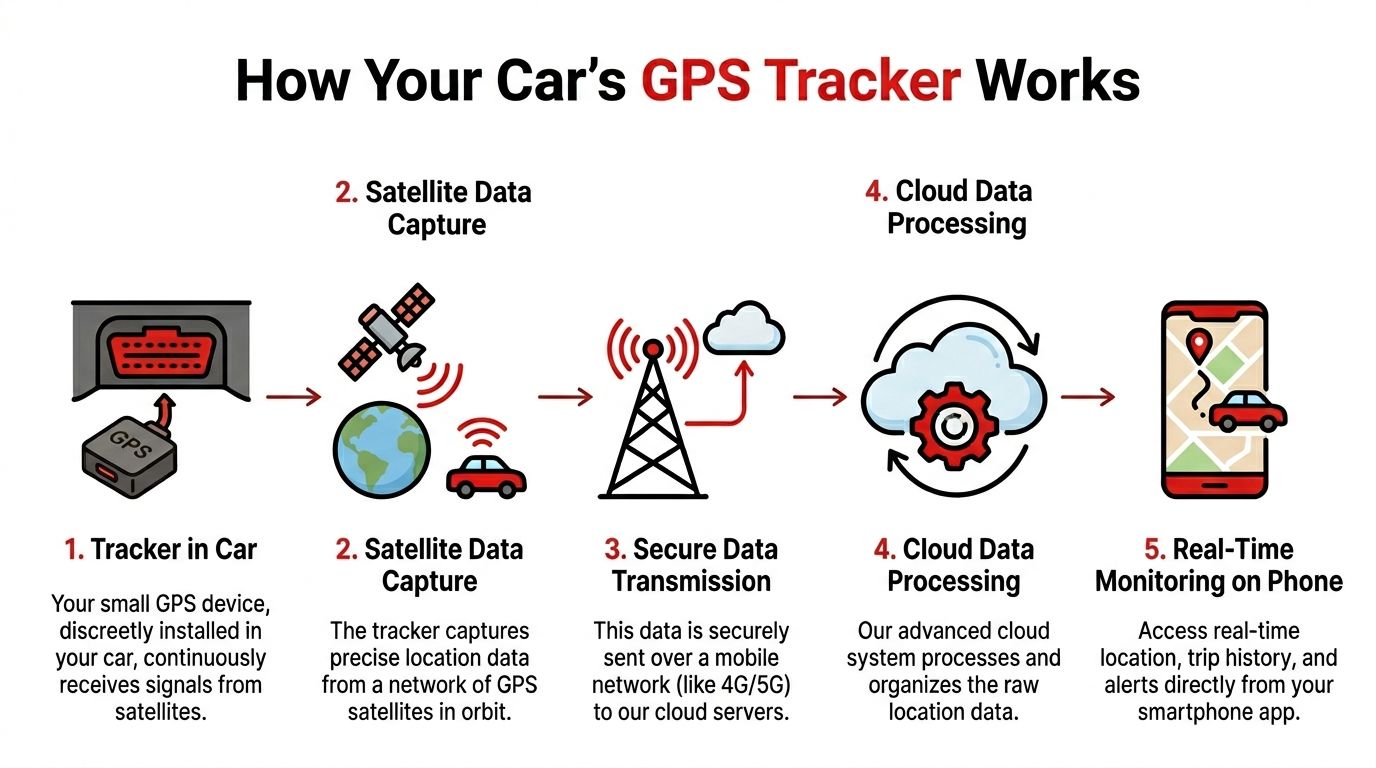
A small gps tracking device for car use does three separate jobs. It finds the car, sends the information out, and shows it to you in an app.
Step one gets the location
The tracker listens for signals from GPS satellites. That’s how it figures out where the vehicle is.
Think of this as the device checking its position on a map. It isn’t calling you yet. It’s just determining location.
Some small trackers also use WiFi and cellular assistance to improve positioning in places where satellite signals aren’t ideal, such as parking structures or dense urban areas. The important point for the owner is simple. The device first needs to know where the car is before it can report anything useful.
Step two sends a digital postcard
Once the tracker knows the location, it uses a cellular connection to send that information to a server. The easiest analogy is a postcard.
The device writes, “I’m here,” then sends that message over the mobile network.
This is why many real-time trackers need ongoing service. The hardware alone doesn’t complete the job. The device also needs a way to transmit data continuously.
Step three turns raw data into something you can use
The server receives those location updates and organizes them into a view that makes sense on your phone. That’s where the app comes in.
Instead of reading raw coordinates, you see:
- Current location: Where the car is now
- Trip history: Where it has been
- Alerts: Whether something happened that needs your attention
If you want to understand what this looks like in practice, a connected GPS car tracker app experience usually combines map views, movement alerts, and past-route review in one place.
Why update timing matters
Not every tracker reports the same way. Some devices send updates frequently. Others wait longer between pings to preserve battery.
That can confuse buyers, because “battery life” and “real-time” are often in tension. Fast updates give you more immediate visibility. Slower updates can stretch runtime on battery-powered units.
The app on your phone isn’t finding the car by itself. It’s displaying what the tracker located and transmitted.
That one idea clears up a lot of confusion. GPS finds. Cellular sends. The app shows.
Key Features That Define a Great GPS Car Tracker
A feature list doesn’t help much unless you know what problem each feature solves. That’s the part many buyers miss.
A great tracker isn’t the one with the longest list. It’s the one whose features match the risks you care about.
Real-time tracking and history serve different jobs
Real-time tracking helps when you need to respond now. Trip history helps when you need to understand what already happened.
If your vehicle moves unexpectedly, live location matters. If you want to confirm where a teen driver went after school or whether a work vehicle followed an approved route, history matters.
Both are useful. They just solve different questions.
Alerts are often more important than the map
Many owners focus on maps first because maps look impressive. In daily life, alerts usually matter more.
You don’t want to stare at a screen all day. You want the system to notify you when something changes.
Useful alerts often include:
- Movement alerts: Your car started moving when it should’ve been parked
- Engine start alerts: The vehicle was started outside expected use
- Geofence alerts: The car entered or left a defined area
- Tamper or disconnect alerts: Someone may have interfered with the device
- Vibration alerts: The car was bumped, disturbed, or touched
That’s why buyers should look beyond simple “location tracking.” The best systems tell you when to care, not just where to look.
Battery life is never a standalone number
Battery claims can sound impressive until you ask one question. “At what update rate?”
According to Tracki’s tracker product information, battery life falls as update frequency rises. A mini tracker might last 2 to 3 days with 1 to 5 minute updates, but it can stretch to 3 months or more in a low-power mode with less frequent pings. That’s the trade-off in plain language.
If theft response is your top concern, more frequent updates usually make more sense. If you’re monitoring a parked vehicle and only need periodic check-ins, a lower-power mode may be enough.
Buyer check: Don’t compare battery life without comparing reporting frequency. Those two numbers belong together.
Installation style changes how the tracker behaves
Installation type affects stealth, convenience, and maintenance.
Here’s the practical breakdown:
- OBD-II plug-in trackers: These plug into the vehicle’s diagnostic port. They’re quick to install and easy to move between vehicles.
- Hardwired trackers: These connect to power and ground and can be hidden more permanently.
- Battery-powered portable trackers: These don’t need vehicle wiring, but you’ll manage charging and update settings more carefully.
A small gps tracking device for car security should fit your routine. If you want something simple and fast, plug-in can be ideal. If concealment matters most, hardwiring may be the better fit. If you need portability, battery-powered units have a place.
What to evaluate before you buy
The checklist below keeps the decision grounded in real use, not marketing language.
| Feature | What It Does | Why It Matters for Security |
|---|---|---|
| Real-time tracking | Shows current vehicle location through the app | Helps you react quickly if the car moves unexpectedly |
| Trip history | Stores past routes and stops | Helps confirm use patterns and investigate incidents |
| Geofencing | Creates virtual boundaries | Warns you when a car leaves or enters approved areas |
| Movement and engine alerts | Notifies you when activity starts | Reduces the chance that unauthorized use goes unnoticed |
| Tamper or disconnect alerts | Signals interference with the device | Helps you catch attempts to disable tracking |
| Battery and power management | Balances runtime with reporting frequency | Affects how dependable the tracker is in real use |
| Installation type | Determines how the device is mounted and powered | Influences concealment, simplicity, and maintenance |
| Mobile app quality | Presents maps, alerts, and history clearly | Makes the system easier to use under stress |
A device-focused feature overview for car trackers is useful once you know which of these items matter most for your own situation.
Real-World Scenarios Where GPS Tracking Shines
Features make sense faster when you attach them to real life. A parent, a fleet manager, and the owner of a weekend car don’t use a tracker in the same way.

A parent watching over a new driver
Your teenager borrows the family car for an evening drive. You’re not trying to spy on every turn. You want reassurance.
A small gps tracking device for car use can help with exactly that. You can confirm that the car arrived where expected, check whether it left that area later than planned, and review the route afterward if a conversation is needed.
The key benefit here isn’t control. It’s context.
If the car is late, you’re not left guessing whether there was traffic, a stop at a friend’s house, or a detour. The information lowers uncertainty, which is what worries most parents in the first place.
A fleet manager trying to reduce confusion
Small business fleets often deal with ordinary problems, not dramatic thefts. A van leaves early. Another one sits longer than expected. A customer says no one arrived. A driver insists they did.
Tracking helps settle those moments with records instead of arguments.
The manager can see movement patterns, check route history, and get alerts if a vehicle is used at odd hours. That doesn’t just support security. It supports accountability.
Some businesses use systems that combine tracking with vehicle activity alerts. CARLOCK, for example, offers real-time tracking along with vibration, engine start, and movement notifications through a mobile app. In a work setting, those signals can help a manager notice use that doesn’t fit the schedule.
An owner protecting a car that isn’t driven every day
A collector car, project car, or high-value second vehicle creates a different kind of stress. It may spend long periods parked in a garage, storage facility, or side lot.
That means the owner may not have daily visual confirmation. A tracker becomes a quiet check-in tool. If the vehicle moves, the owner knows. If it leaves a defined area, the owner knows. If there’s unusual activity around it, the owner gets a prompt to look closer.
Video can make this easier to picture in day-to-day use:
A tracker doesn’t remove risk. It reduces the time you spend unaware.
That’s the common thread across these scenarios. Parents want fewer unknowns. Managers want fewer blind spots. Car enthusiasts want fewer vulnerable gaps between checks.
Understanding the Legal Rules of Vehicle Tracking
This is the part many articles skip, and skipping it creates real risk.
People often assume that if they own the vehicle, they can install a tracker however they want and say nothing. In many cases, that assumption is too simple.
According to SpaceHawk’s discussion of hidden tracker marketing and consent issues, in many jurisdictions, installing a tracker without the consent of all owners or primary drivers can amount to illegal surveillance. That’s a serious warning, especially because many product pages emphasize “hidden,” “undetectable,” or “invisible” installation without explaining the legal side.
Ownership doesn’t erase privacy questions
A vehicle can be your property and still be used by other people in ways that trigger privacy concerns.
That matters in situations like:
- Shared ownership: More than one owner may have legal rights tied to the vehicle
- Primary drivers: A regular user may have privacy interests that can’t be brushed aside
- Employer use: A company may own the vehicle, but employees still need clear notice and policy
- Family use: Parents may have broader authority, but secret tracking can still raise legal and trust issues depending on local rules
What responsible use looks like
The safest approach is straightforward. Be transparent.
That means:
- Confirm ownership details before installing anything.
- Tell regular drivers that tracking is in place.
- Put policies in writing if the vehicle is used for work.
- Check local law if there’s any uncertainty.
If you’re reviewing a provider’s public policy information, CARLOCK’s legal page is one place to start for terms and compliance-related context. For jurisdiction-specific legal advice, though, you should rely on a qualified attorney in your area.
Responsible advice: If your tracking plan depends on secrecy, stop and check the law before you install anything.
Hidden installation can still be legitimate
Discreet placement isn’t automatically wrong. There are good reasons for it. Theft prevention is one. Reducing tampering is another.
The legal issue usually isn’t “Is the device visible?” The legal issue is whether the monitoring is lawful and properly disclosed to the people whose use is being tracked.
That distinction matters. It lets you think clearly about ethics instead of getting distracted by marketing language.
Calculating the True Cost and Ease of Installation
The sticker price on the box is only part of the cost. With a small gps tracking device for car use, ownership usually includes three practical questions.
What does the hardware cost? What service does it need to stay connected? How much effort will installation and maintenance take?
The total cost isn’t just the device
Many buyers are drawn to “no monthly fee” language. That can make sense in some products, but there’s usually a trade-off.
Real-time trackers send data over cellular networks. That connectivity typically requires an active service plan. If a device doesn’t include that kind of connection, it may rely more on stored logs or less immediate updates.
So when comparing options, break the cost into parts:
- Device purchase: The upfront hardware cost
- Service plan: The ongoing fee for live data transmission
- Power management: Charging habits or battery replacement, depending on design
- Installation: Your own time, or professional help if needed
This way of thinking prevents a common mistake. A cheaper device can become less convenient over time if it needs frequent charging or doesn’t deliver the alerts you bought it for.
Installation is easier than many owners expect
For a lot of users, setup is simple.
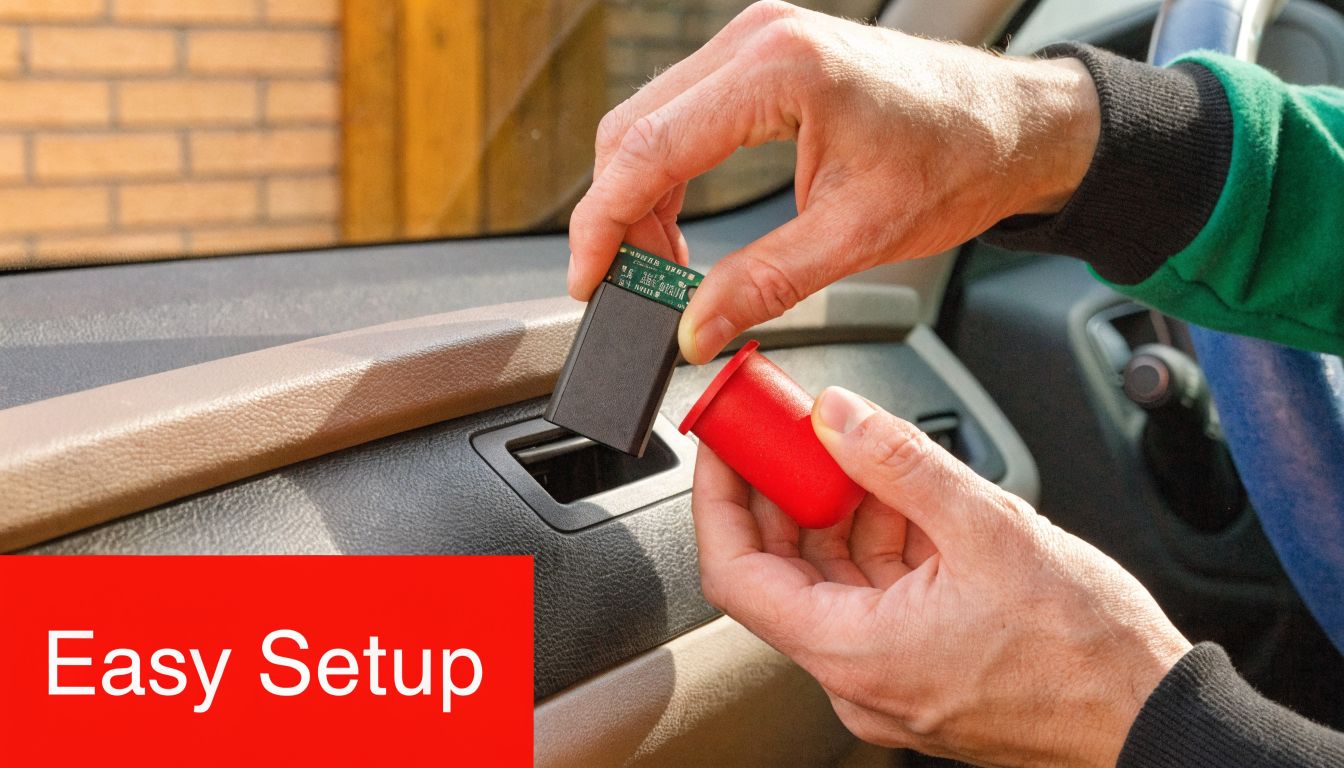
Trackers with a compact power design can work on nearly all 12V/24V vehicles and, with a simple 2-wire power/ground connection, can be installed in under 5 minutes, according to Tracker Systems’ 4G mini GPS tracker page. The same source states that OBD-II devices require no tools and are instantly operational, while plug-in designs reduce installation complexity and failure points by over 70% compared with units that require wire splicing.
That’s a useful dividing line:
- OBD-II plug-in: Fastest setup, no tools, easy for most drivers
- 2-wire hardwired unit: Still relatively simple, but more permanent
- Battery-powered portable: No vehicle connection needed, but charging becomes part of ownership
Match installation style to your actual use
Buyers often overcomplicate this decision. Start with your behavior, not the hardware.
Choose based on what you’re really doing:
- You want quick setup in a daily driver: OBD-II is often the cleanest answer.
- You want a less visible permanent installation: A hardwired device may fit better.
- You want flexibility across multiple vehicles or occasional use: A battery-powered unit may be easier to live with.
A simple ownership mindset
Think of a tracker the way you’d think about a phone plan. The device matters, but the ongoing service and convenience matter too.
A cheap phone with poor service isn’t helpful. A powerful phone with a battery that never lasts through the day is frustrating. GPS trackers follow the same logic.
What you’re buying is not just hardware. You’re buying a system you can keep running without annoyance.
How CARLOCK Delivers a Complete Security Ecosystem
By this point, the main decision points are clear. A good system needs to notify you quickly, show useful location data, fit your installation comfort level, and be used legally and transparently.
That’s why the strongest setups don’t act like a tracker alone. They work more like a connected security ecosystem.
Security works better when features support each other
A tracker without alerts can leave you checking the app manually. Alerts without a clear app can create confusion. Easy installation without reliable day-to-day monitoring doesn’t help much either.
The value comes from how the pieces work together:
- Vehicle activity monitoring tells you when something changed
- Location tracking tells you where the car is
- Trip history helps you understand what happened
- Mobile access puts all of that in one place
For many owners, that combination matters more than any one spec.
Practical design beats flashy claims
The everyday strengths of a connected car security system are usually simple. You install it without a major project. You receive alerts on your phone instead of hoping you hear a siren. You can check status whether you’re at work, asleep, or away from the vehicle.
That’s the logic behind a connected car security system built around GPS tracking and alerts. It treats theft prevention and vehicle awareness as an ongoing process, not a one-time event.
Peace of mind comes from clarity
Concerned car owners don’t need more jargon. They need answers to plain questions.
Did the car move? Was the engine started? Is the vehicle where it should be? Do I need to act right now?
A small gps tracking device for car security earns its place when it answers those questions clearly and fast. If it also respects legal boundaries, keeps installation simple, and makes the total cost easy to understand, it becomes much easier to trust and much easier to keep using.
If you want a clearer way to monitor your vehicle, get alerts on suspicious activity, and keep track of where your car is from your phone, take a look at CARLOCK. The goal isn’t more noise. It’s better information when it matters.