

Driver’s Desk
Advanced Truck Security Systems for 2026
Truck theft isn't a niche risk. It's a logistics problem, an operations problem, and for many owner-operators, an income problem. Global cargo theft reports indicate over 1.7 million incidents annually, with losses of up to $30 billion, and trucks are targeted in 70% of cases according to the referenced data summarized from TT Club and Verizon in this background source: cargo theft trends and GPS recovery findings.
That number changes how you should think about truck security systems. This isn't about buying one alarm and hoping it scares someone off. It's about building a layered defense that slows thieves down, exposes them early, blocks easy exits, and gives you a real recovery path if they still get through.
Basic hardware still matters. So do better parking habits. But today's risk environment includes organized cargo theft, keyless attacks, tampering during drops, insider involvement, and low-drama "phantom theft" where nothing looks broken until the load is gone. If you're responsible for a fleet, a service truck, a pickup used for work, or a high-value rig, the right question isn't "Which gadget should I buy?" It's "Which combination of controls fits the way this truck is used?"
The Growing Need for Advanced Truck Security
The market itself tells you what's happening on the ground. The global vehicle anti-theft system market was valued at USD 13.53 billion in 2023 and is projected to grow at a 8.5% CAGR through 2030, with commercial vehicles playing a major role in that expansion, according to Grand View Research's vehicle anti-theft system market analysis. That isn't growth driven by curiosity. It's growth driven by exposure.
North America held a 39.2% revenue share in 2024, and the same market report ties that demand to a massive vehicle base, including approximately 286 million vehicles on U.S. roads in Q1 2023. More connected vehicles on the road means more convenience, but it also means more attack surfaces. For trucks, the problem gets sharper because the vehicle often isn't the main prize. The cargo is.
Why trucks get targeted differently
A thief looking at a truck sees more than sheet metal.
They may see:
- A moving warehouse with tools, electronics, retail inventory, or controlled goods
- Predictable routines such as known rest stops, delivery windows, and drop yards
- Operational pressure because drivers and dispatchers can't afford long downtime
- Soft moments during loading, fueling, overnight parking, or trailer drop-offs
That changes what effective truck security systems need to do. A car alarm mindset focuses on intrusion after the fact. A truck security mindset focuses on delay, detection, control, and response.
Practical rule: If a system only makes noise after a door is opened, you're already late in the theft timeline.
Security is a system, not a device
The strongest setups combine physical barriers, access control, tracking, and fast alerts. That layered approach matters because thieves don't all work the same way. Some pry doors. Some relay keys. Some hook to a trailer. Some exploit routine and paperwork. Some wait until no one notices an unauthorized engine start.
Fast notification is what turns a theft event into a response event. That's the difference between finding out in the morning and finding out in seconds. A good example of why speed matters appears in this practical breakdown of fast stolen truck recovery when seconds count.
What basic measures still get wrong
Many trucks still rely on one or two familiar protections: factory locks, a standard alarm, maybe a camera. Those tools aren't useless, but on their own they're incomplete.
What usually fails in the field is simple:
- Single-point protection gets bypassed
- No real-time alerting leaves a long delay before anyone reacts
- No location intelligence makes recovery slower
- No layered physical security gives thieves a short path from approach to access
Truck security systems work best when each layer covers a different failure mode. That's how you start thinking like a fleet security manager instead of a retail buyer.
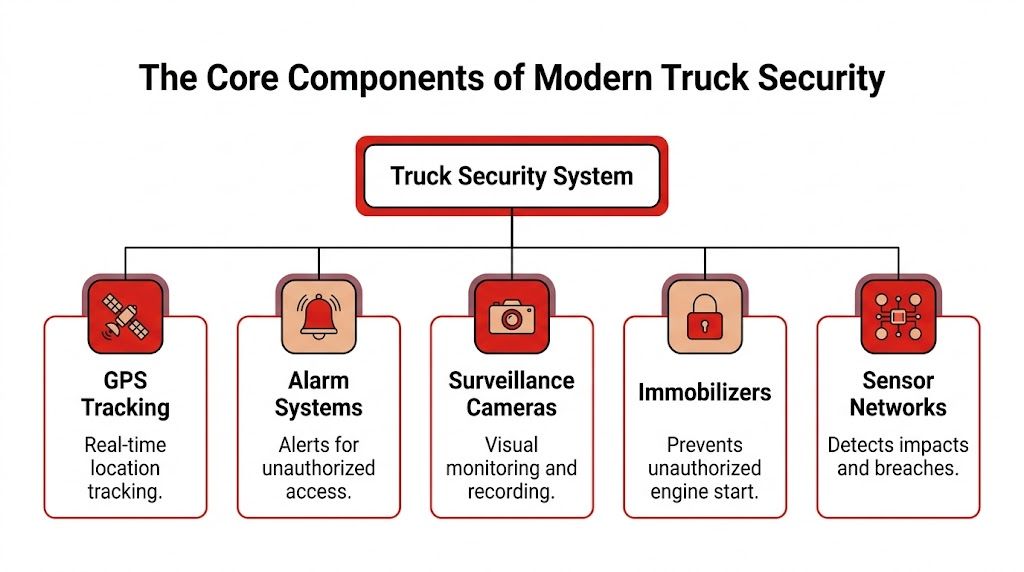
The Core Components of Modern Truck Security
A good truck security system works like a fortified site. You need an outer boundary, hardened entry points, a way to control who can operate the asset, and a method to alert the right person immediately when something goes wrong.
Physical barriers buy time
The least glamorous part of truck security is often the most important. If a thief can open the trailer quickly, the electronics barely matter.
TAPA's Trucking Security Requirements set a useful benchmark for high-value loads. TSR Level 1 calls for high-quality stainless steel locks on trailer doors that resist hand tools for at least 10 minutes. TAPA also notes that simpler options such as chains or cables can fail in under 2 minutes, and that the 10-minute resistance threshold correlates with a 40% to 60% reduction in successful break-ins in the referenced material: TAPA Trucking Security Requirements PDF.
That single comparison explains a lot. Hardware isn't just a checkbox. It changes the time equation.
What physical measures actually do well
- Door locks: They slow hand-tool attacks and force noise, effort, and exposure.
- Tamper-evident seals: They help identify interference, especially for full truckload operations.
- Trailer immobilization devices: They matter when a trailer is dropped and unattended.
- Protected lock placement: It reduces easy access for pry bars and cutters.
Weak lock hardware creates a false sense of security. Strong hardware creates delay, and delay is what every other layer needs.
Alarms are useful, but only in context
An alarm still has value. It adds attention and pressure. But not all alarms solve the same problem.
A basic siren reacts to entry. That's better than nothing. A better setup pairs the siren with triggers such as cab access, trailer door status, impact sensing, or unauthorized movement. The key is matching the trigger to the actual theft scenario.
Here's the practical distinction:
| Component | Best use | Common limitation |
|---|---|---|
| Audible alarm | Scares off opportunists and alerts nearby people | Doesn't help much if nobody hears it |
| Shock or vibration sensor | Detects tampering and impact attempts | Can be noisy if poorly tuned |
| Door sensor | Identifies actual entry events | Doesn't catch approach before contact |
| Tilt or movement alert | Useful for towing or trailer movement | May trigger late if used alone |
A lot of truck owners overestimate the value of "loud." Professional thieves care more about time and access than noise. Noise works best when it arrives early and is tied to remote notification.
Immobilizers control the most important action
If you want one component that changes the game, it's the immobilizer. An alarm says something is wrong. An immobilizer prevents the vehicle from being driven without authorization.
That distinction matters because many thefts turn into recovery races once the truck moves. If the engine can't be started or kept operable without valid authorization, you've shut down the cleanest theft path.
This is one reason many operators choose a more concealed installation rather than a simple plug-in tracker. Hardwired setups can be more difficult for a thief to spot and disable. This guide to a hard-wired GPS tracker setup and why it matters is useful if you're weighing visibility versus convenience.
Locks delay entry. Immobilizers deny use. Those are different jobs, and both matter.
Cameras and sensors provide context
Cameras help answer questions that trackers can't. Who approached the truck? Which side did they target? Was the event external tampering, driver error, or something more suspicious?
But cameras have trade-offs:
- They need good placement.
- They depend on power and storage.
- They often work better for evidence than for immediate intervention.
- They can miss events outside their field of view.
Sensors fill some of those gaps. Door, cargo, motion, light, vibration, and perimeter sensors can turn passive recording into active awareness.
GPS and telematics turn events into action
GPS tracking and telematics are the control tower of modern truck security systems. They show location, movement, route deviation, stop duration, and in better systems, event-triggered alerts.
Without that layer, you're mostly documenting risk. With it, you can respond.
The best setups don't treat GPS as a map feature. They treat it as the backbone that ties together alarms, immobilization logic, driver alerts, geofencing, and dispatch visibility.
Key Features That Define a Smart Security System
The difference between older truck security systems and smarter ones isn't just hardware quality. It's how the system interprets events and pushes useful information to the person who can act on it.
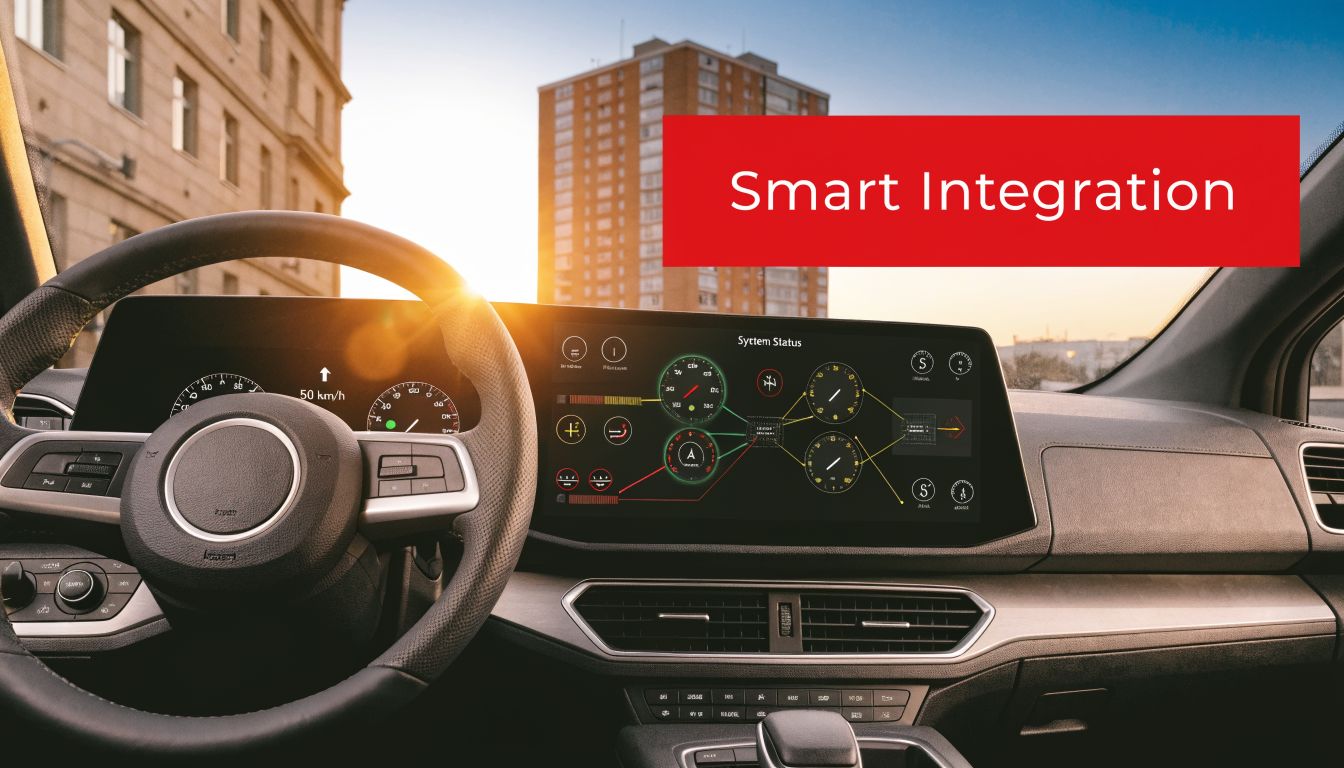
A smart system builds what I think of as a digital perimeter. It doesn't wait for a confirmed theft. It watches for the precursors. Unexpected vibration. An unauthorized engine start. Movement at the wrong time. A truck leaving a geofenced yard. A change in sensor state that doesn't match the planned operation.
Real-time alerts beat after-the-fact reports
Speed matters most when the signal reaches a phone or dispatch screen immediately and the alert itself is specific enough to act on.
A vague "security event detected" message isn't good enough. Useful alerts tell you what happened:
- Engine started
- Vehicle moved
- Exited geofence
- Impact or vibration detected
- Power interrupted
- Door or light status changed
That level of detail helps the recipient decide whether to call the driver, check camera access, contact yard security, or escalate to law enforcement.
A good example of sensor-driven awareness is this practical walkthrough on pairing and using a vehicle light sensor for security monitoring. The principle is simple. The more precisely you define the signal, the less time you waste guessing.
Geofencing creates rules, not just maps
A truck on a map is useful. A truck measured against expected behavior is much better.
Geofencing lets you define virtual boundaries around:
- Fleet yards
- Customer sites
- Rest stops
- Border crossings
- No-go zones
- Approved route corridors
When a vehicle enters or leaves those boundaries unexpectedly, the system creates an actionable event. That's the shift from passive tracking to active control.
According to TechSci Research's vehicle security system market report, the market is projected to grow from USD 12.74 billion in 2025 to USD 21.28 billion by 2031, with strong emphasis on AI-based intrusion detection, geo-fencing, and OTA updates to address threats such as keyless hacking and GPS spoofing. The same report says engine immobilizers are expected to hold a 45% market share by 2035, which tells you where buyers still see core defensive value.
Smart doesn't mean complex for the user
Good systems are complex in the background and simple at the point of use.
The operator should be able to answer these questions quickly:
- Is the truck where it should be?
- Did something happen that needs action now?
- Can I confirm whether the event is legitimate?
- What can I do remotely, if anything?
If the app or dashboard makes those answers hard to find, the system may be feature-rich but operationally weak.
OTA updates and cybersecurity matter more than many fleets think
A truck security device is now part of a connected environment. If the software goes stale, the protection does too.
That's why over-the-air updates matter. They let vendors patch vulnerabilities, improve detection logic, and refine performance without requiring manual rework on every unit. For fleets, that reduces maintenance friction. For owner-operators, it lowers the risk of buying a device that degrades gradually over time.
A smart security system doesn't just detect intrusion. It notices behavior that doesn't belong.
What to look for when evaluating "smart"
Use this short filter before you buy:
| Ask this question | Why it matters |
|---|---|
| Does it send immediate mobile alerts? | Delay kills response time |
| Can it define geofences and movement rules? | Static tracking isn't enough |
| Does it support software updates? | Security logic has to evolve |
| Can it distinguish event types clearly? | You need signal, not alert fatigue |
| Does it integrate with immobilization or access controls? | Notification without control has limits |
Many systems claim intelligence. Fewer provide clean, fast, usable intelligence under real operating conditions.
Matching the System to Your Specific Security Needs
Buying truck security by feature list usually leads to gaps. Buying it by theft scenario leads to better coverage.

A fleet manager, an owner-operator, and a parent lending out a pickup are protecting different things, facing different failure points, and responding on different timelines. The right question is not "Which system has the most features?" It is "What theft or misuse scenario am I trying to stop, detect, or recover from first?"
That shift matters because truck theft rarely happens in one clean pattern. Some losses come from organized cargo theft, where thieves know the route, wait for a stop, and move the load fast. Others are simple break-ins, tool theft, fuel theft, or unauthorized use by someone who already has some level of access. A good setup layers controls so one weakness does not decide the whole outcome.
Fleet managers need a system built around response time and exception handling
For fleets, the biggest mistake is spending heavily on visibility and lightly on control. A truck covered by cameras but missing live movement rules, trailer alerts, or after-hours exception reporting is still exposed.
Start with the operating reality. Can dispatch see unauthorized movement fast? Can someone tell the difference between a route deviation, a tow event, and a yard move? Can the team act before a tractor and trailer are separated?
For fleet use, the priority stack usually looks like this:
- Live GPS tracking with geofences for route, yard, and customer-site exceptions
- Ignition, movement, and tow alerts to catch theft before the vehicle disappears into normal traffic
- Trailer and cargo-door sensors for dropped trailers, staged loads, and quiet load access
- Driver and key-control policies so the system supports process instead of compensating for weak process
- Centralized reporting so managers review exceptions instead of staring at a map all day
If trucks return to a yard or service facility, vehicle security should line up with gate control, cameras, and access logs. That broader view matters, and resources on security systems for businesses can help frame how vehicle, building, and perimeter controls should support each other.
Owner-operators need reliable coverage they will actually monitor
An owner-operator does not need fleet complexity. They do need a setup that protects income and works every day without constant babysitting.
In practice, that usually means combining one hidden tracking method with one visible deterrent and one physical barrier. A concealed tracker helps with recovery. A visible alarm or camera sticker can discourage casual thieves. Better locks and trailer hardening slow down the fast overnight thefts that happen in truck stops, motel lots, and unsecured yards.
I usually advise owner-operators to focus on these points first:
- Fast mobile alerts that are easy to notice and easy to interpret
- A hidden or hard-to-disable tracker
- Door, cab, and trailer physical security
- Battery protection and tamper alerts
- Video evidence if the truck is parked regularly in exposed areas
A simpler stack that gets checked every day beats a more advanced stack that gets ignored.
Specialty trucks and high-value rigs need stronger tamper resistance
Custom trucks, equipment carriers, and rigs with expensive onboard tools attract a different kind of thief. In these cases, the target may be the truck, the mounted equipment, specific components, or the tools stored inside.
That changes the design. Recovery features still matter, but prevention and delay matter more because thieves may come prepared. Concealed wiring, multiple trigger points, siren placement, compartment sensors, and stronger lock hardware all carry more weight here than a polished dashboard.
A hardwired layout is often the better fit for this category because it is harder to spot and disconnect. If you're comparing approaches, this guide to the installation of GPS trackers in vehicles is a practical reference for deciding when hidden installation is worth the extra effort.
Shared-use pickups need clarity, not complexity
Family vehicles and shared-use pickups usually face unauthorized use, confusion, and low-skill theft more often than organized cargo crime. The best system for this case is usually the one that answers basic questions fast.
Focus on:
- Location visibility
- Movement notifications
- Unauthorized start alerts
- Driving behavior awareness
- Simple history logs
That gives the owner a clear record of where the truck went, when it moved, and whether the use matched expectations.
Match the system to the threat, not the marketing
The strongest truck security setups are layered around likely loss events.
| User type | Primary risk to plan for | Best first layer | Best second layer |
|---|---|---|---|
| Fleet manager | Unauthorized movement, trailer separation, cargo theft | GPS with rules and alerts | Trailer and cargo access monitoring |
| Owner-operator | Vehicle theft, overnight break-ins, downtime | Hidden tracker with mobile alerts | Physical locks and visible deterrence |
| Specialty truck owner | Tool theft, parts theft, targeted vehicle theft | Concealed hardwired system | Tamper alerts and compartment sensors |
| Family pickup use | Unauthorized use, misuse, low-skill theft | Start and movement alerts | Driving and location history |
After you've thought through your use case, it helps to watch how other operators discuss the trade-offs in real-world installs and monitoring workflows:
Practical Installation and Maintenance Considerations
A strong device can become a weak system if the installation is obvious, sloppy, or never maintained. Truck security systems succeed or fail in the small practical details.
OBD-II versus hardwired installs
Plug-and-play installation is attractive for a reason. It's fast, accessible, and easy to move between vehicles. For some users, especially those testing a system or protecting a personal truck, that's a reasonable starting point.
But convenience creates trade-offs:
- OBD-II installs are easier to deploy
- They can also be easier to spot and disconnect
- They may be less suitable in trucks where the port location is exposed
- Shared-use drivers may unplug them accidentally or intentionally
Hardwired installs usually take more effort up front, but they offer better concealment and often a cleaner long-term setup. If you're comparing both approaches, this guide on the installation of GPS trackers in vehicles is a practical reference point.
Build a maintenance routine before you need it
Security systems don't stay reliable just because they were installed correctly once. Fleets should treat them like any other operational control.
A sensible routine includes:
- Check alert delivery on a regular schedule so you know notifications still reach the intended phone or platform.
- Inspect power integrity because loose connections and weak batteries create silent failures.
- Review sensor behavior to catch nuisance alerts before users start ignoring the system.
- Confirm app and firmware status so software protections don't drift behind current threats.
- Look for tampering signs around wiring, mounts, access points, and visible accessories.
Key management is part of security maintenance
Many theft incidents begin with poor key control, not advanced hacking. Lost keys, untracked spares, and casual handoffs create avoidable risk.
For fleet policies, document:
- Who has which keys
- When a spare was issued
- When a lock or key should be reprogrammed after loss
- What happens after driver turnover
If you're dealing with van or truck key loss, a practical consumer-facing reference like this ultimate van key replacement guide is useful for understanding the replacement side of the problem. From a security standpoint, the bigger lesson is simple. Lost-key incidents should trigger a review, not just a replacement.
Install once, test often. Most security failures happen because a system stopped being monitored before the theft attempt started.
Keep the system usable
A setup that generates constant false alerts gets ignored. A setup that's hard to arm, disarm, or check becomes shelfware.
That means maintenance isn't only technical. It's operational. Ask your drivers and managers whether the system still fits the route, parking, and shift patterns you run. If the answer is no, tune it before the next incident forces the issue.
Navigating Costs Legal Issues and Privacy
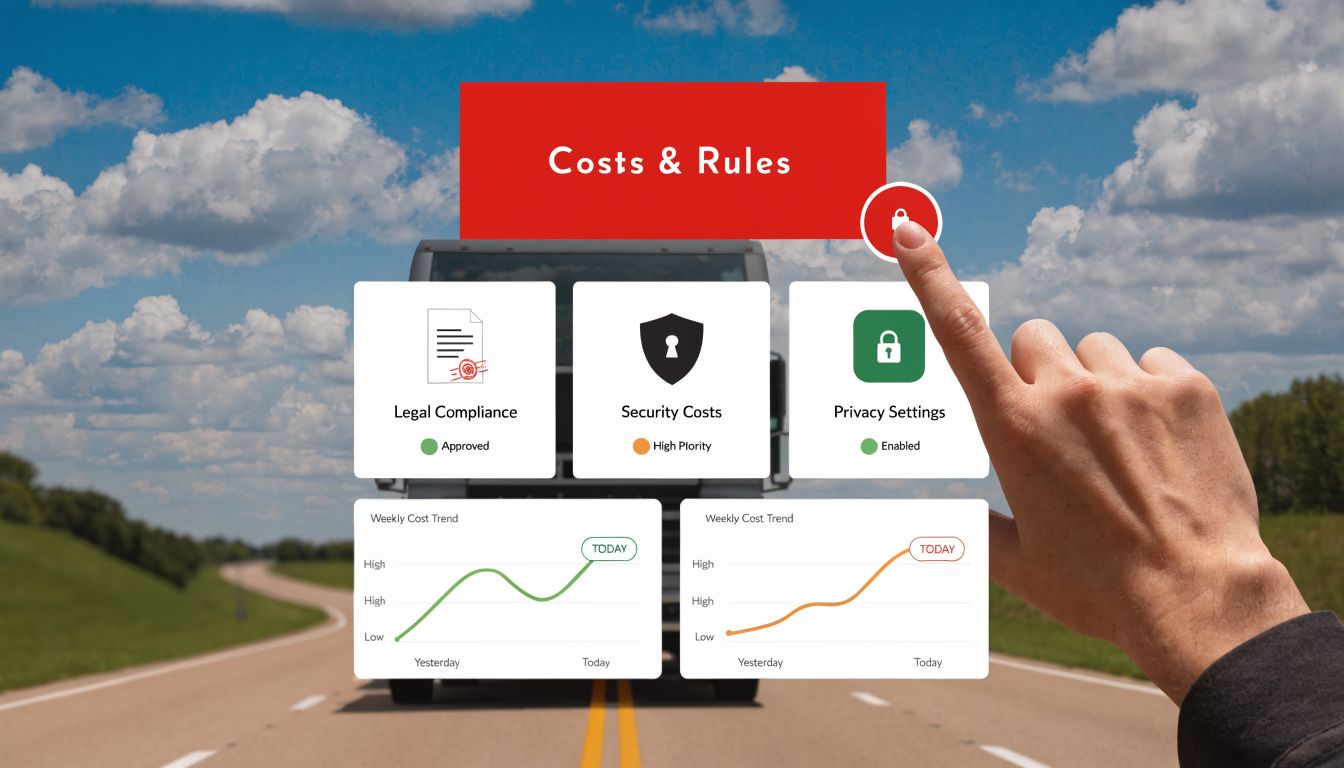
Every truck security decision has three price tags. The hardware cost. The ongoing operating cost. The organizational cost of using the system properly.
Total cost of ownership is bigger than the box price
Buyers often compare trackers, alarms, cameras, and telematics by sticker price alone. That's a mistake.
You need to factor in:
- Installation method, especially if hardwiring or multiple sensors are involved
- Subscription fees for connectivity, cloud access, and alerting
- Maintenance time for testing, updates, and troubleshooting
- Training effort so drivers and managers know what alerts mean
- Replacement planning for damaged hardware or vehicles cycling out of service
The lower-priced device isn't always cheaper over time if it creates poor alerts, weak support, or hidden replacement effort. This breakdown of GPS tracker cost considerations is a useful way to think beyond upfront pricing.
The hidden cost of ignoring insider risk
A lot of security plans focus only on external threats. That's incomplete.
According to the referenced Safety Track summary, driver collusion accounts for up to 25% of cargo thefts, and in-cab AI can detect 78% of unsafe habits often linked to theft opportunities: driver monitoring and insider-risk context.
That doesn't mean every fleet should rush to install inward-facing cameras everywhere. It does mean internal theft and fraud should be part of the discussion. Fuel siphoning, route deviation, unauthorized stops, staged incidents, and quiet handoff schemes don't look like classic break-ins, but they can create the same financial damage.
Privacy and monitoring need a policy, not assumptions
If employees drive the truck, don't treat monitoring as a purely technical decision. It's a policy and compliance decision too.
Good practice usually includes:
- Clear written notice that vehicles are monitored
- Defined business purpose for GPS, camera, or sensor data
- Limited access to who can view that data
- Retention rules so footage and location history aren't kept casually forever
- Rules for off-duty use, if personal use of the truck is allowed
What gets companies into trouble isn't usually the existence of monitoring. It's vague policy, inconsistent enforcement, and collecting more than they can justify.
The cleanest legal position is transparency. Tell drivers what is monitored, why it's monitored, and who can see it.
Balance control with trust
Fleet security can drift into surveillance culture if managers aren't careful. That's bad for morale and often bad for signal quality too.
Use monitoring to investigate real exceptions and protect assets, not to create constant low-value scrutiny. The best truck security systems support accountability without turning every trip into a dispute. If your system creates more internal friction than operational clarity, the program needs adjustment.
Your Checklist for Deploying a Truck Security System
Security planning goes better when you stop thinking like a shopper and start thinking like an operator. The right truck security system is the one that matches your theft exposure, your response capacity, and the way the truck is used.
Start with the risk, not the catalog
Ask a few direct questions first:
- Where does the truck spend the night
- Is the bigger risk the vehicle, the trailer, or the cargo
- Do you need live intervention or mainly post-event evidence
- Who must receive alerts, and at what hours
- How vulnerable is the current install to easy tampering
If you don't answer those questions first, it's easy to buy features that look advanced but don't solve your real problem.
Set your must-haves before comparing brands
Don't start by comparing every available feature. Start by defining the key requirements.
For many buyers, that short list will include:
- Real-time alerts for movement, start events, or tampering
- GPS visibility with useful app access
- A practical installation method for the truck's use case
- Some level of physical hardening on doors, trailer access, or dropped equipment
- Simple response workflow when an alert comes in
Then separate must-haves from nice-to-haves such as expanded camera systems, advanced reporting, or deeper analytics.
Vet the vendor like an operations partner
This part gets skipped too often. The product matters, but support matters too.
Check for:
- Clear installation documentation
- App usability
- Reliable alert delivery
- Update history
- Support responsiveness
- Hardware fit for your truck type
A truck security system becomes part of your operating routine. Choose accordingly.
Plan the rollout like a process
For one truck, that may mean a careful install and a week of testing.
For a fleet, it usually means:
- Pilot one or two vehicles first
- Tune alerts before full deployment
- Train dispatch and drivers
- Document response rules
- Review the first month of events for blind spots
The smartest deployment is usually the least dramatic one. It works because everyone knows what the system does, what it doesn't do, and what happens when it flags a problem.
Truck security works best when it gives you immediate awareness, dependable tracking, and a response path you can use. If you want a system built around real-time alerts for vibration, engine starts, and unexpected movement, take a look at CARLOCK. It's designed to help vehicle owners and fleet users know what's happening with their truck now, not hours later.