

Driver’s Desk
Anti Theft Devices Car Owners Need in 2026: A Full Guide
In 2025, more than 650,000 vehicles were stolen in the United States, according to NHTSA's vehicle theft prevention guidance. That number changes how car owners should think about anti theft devices car buyers usually compare. A more important question isn't just, “How do I stop a thief from trying?” It's, “What happens when the thief gets past the first layer?”
That gap between deterrence and recovery is where most security advice falls apart. A steering wheel lock can make a thief hesitate. An alarm can create noise. An immobilizer can block an unauthorized start. But if the vehicle is towed, electronically bypassed, or taken with a cloned signal, the owner still needs one thing above all else: real-time information.
That's also why vehicle security now overlaps with insurance planning. If you're reviewing coverage alongside prevention steps, Schneider Insurance auto policies are a useful reference point for understanding how protection, risk, and recovery planning fit together.
The Rising Tide of Modern Car Theft
Car theft is no longer a low-skill crime aimed only at older vehicles. More than 650,000 vehicles were stolen in the United States in 2025, and NHTSA's vehicle theft prevention resource points owners toward systems that support stolen-vehicle recovery through electronic location technology.
That recommendation reflects how theft happens now. Some crews still use force. Others use relay attacks, key cloning, diagnostic port access, or a flatbed tow. In each case, the first security question is different from the second. Can the thief get the car moving, and if they do, can anyone locate it fast enough to recover it?
Why older thinking breaks down
Older anti-theft advice treated theft as a single event. Protect the door, protect the ignition, make noise, and the problem is solved. That model fit an era when many thefts depended on breaking in and driving off immediately.
Current theft patterns are less linear. A vehicle may be opened electronically, started with spoofed credentials, or removed first and stripped later in another location. Once that happens, a device built only to slow entry has already finished its job.
Many of the anti-theft devices car owners buy are built for one of two jobs, and confusing those jobs leads to bad security decisions.
| Security job | What it tries to do | Typical tools | Main weakness |
|---|---|---|---|
| Deterrence | Increase time, effort, or visibility for the thief | Steering locks, alarms, clamps, kill switches | If defeated, they do not show where the vehicle went |
| Recovery | Help locate the vehicle after theft begins or succeeds | GPS tracking, live movement alerts, trip visibility | Depends on coverage, power, and fast action after the alert |
That distinction changes how you evaluate every device.
A steering wheel lock can still be useful. So can an immobilizer. But neither answers the question owners ask after the car is gone: where is it now?
Practical rule: If a device only signals interference, it belongs to deterrence. If it reports movement and location in real time, it supports recovery.
Owners comparing theft prevention with financial risk should also review Schneider Insurance auto policies, since insurance can reduce the financial hit but does not help recover the vehicle itself. For a clearer view of how suspicious movement, tampering, and live alerts work in practice, vehicle security awareness guidance from CarLock is a useful reference.
Visible Deterrents The First Layer of Defense
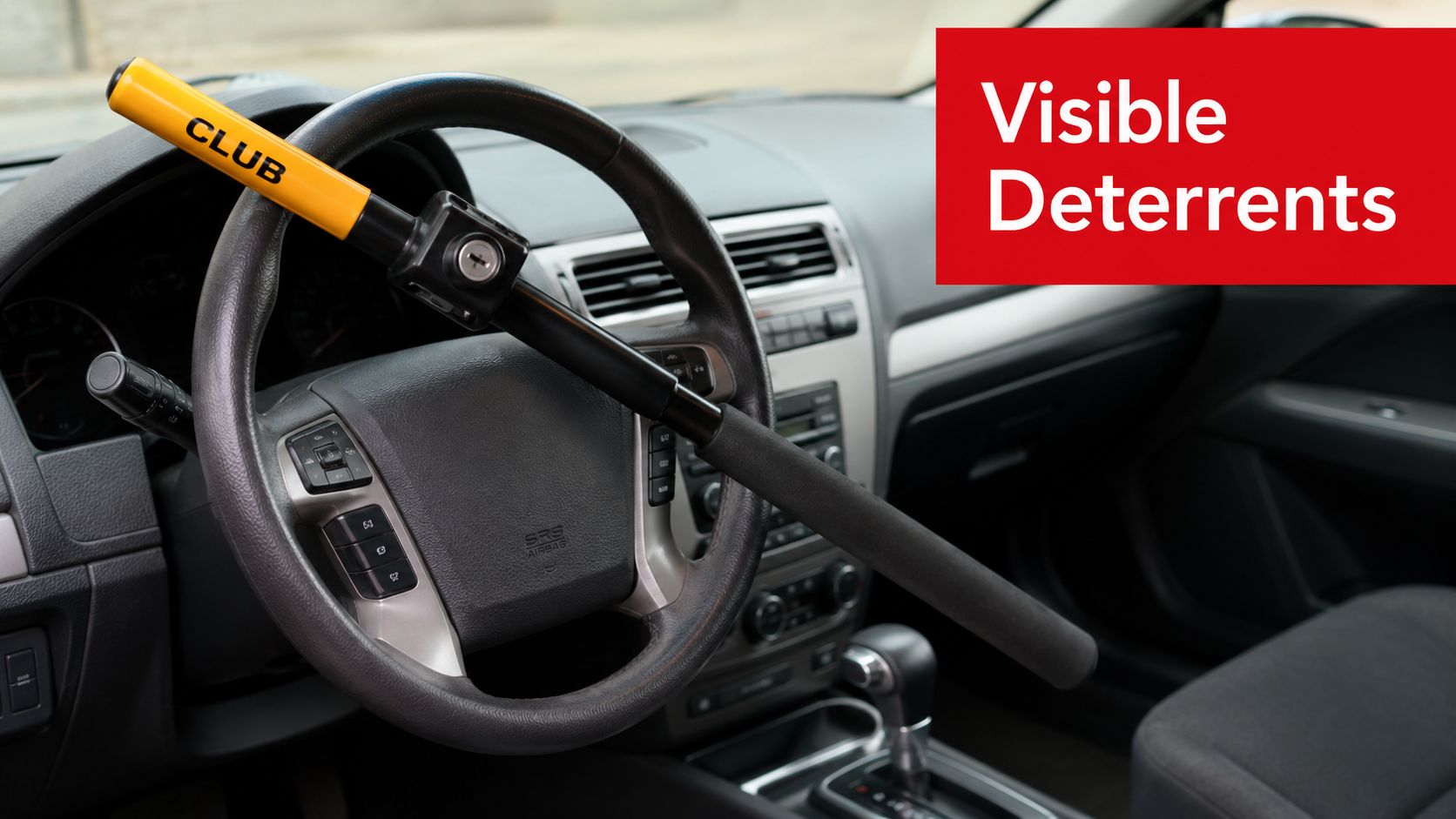
Thieves usually scan for speed, noise, and effort in the first few seconds around a parked car. Visible hardware changes that calculation. A steering wheel lock, pedal lock, or wheel boot signals that this vehicle will take longer to move and may require tools the thief does not want to use in public.
That matters more than many owners assume.
What visible locks actually do well
Visible deterrents work best against opportunistic theft. They raise friction before the engine starts, before the car rolls, and sometimes before the thief even touches the door. That early friction is their real value.
- Steering wheel locks create an obvious obstacle that can force extra cutting, sawing, or steering-wheel damage before the car can be driven.
- Wheel clamps or boots block movement and make sense for vehicles left parked for long periods, especially in predictable locations.
- Pedal locks interfere with control inputs and can slow a thief who expected a fast, low-skill grab.
Each device broadcasts the same message. This car is not the easiest one here.
For drivers comparing physical barriers with systems that notify the owner, CarLock's overview of car alarm behavior and alerts helps clarify the difference between visible resistance and live detection. Broader detection design principles in building security also appear in these expert alarm tips for South Wales, which are useful because alarms and deterrents succeed or fail on the same basic issue: how fast someone notices the event and responds.
Where visible deterrents fail
The weakness is straightforward. A visible lock can discourage a thief, but it cannot answer the recovery question once the vehicle is gone.
Prepared crews already expect to deal with physical barriers. Some cut the device. Some damage the steering wheel around it. Some tow the vehicle and remove the lock somewhere private. In each case, the deterrent may have done its job by adding time, but the owner still lacks the one piece of information that matters after a successful theft: the vehicle's current location.
That gap between deterrence and recovery is why owners often overrate physical protection. A lock can reduce risk at the curb. It does not create visibility after the theft moves off-site.
The honest pros and cons
| Device type | Strength | Weakness |
|---|---|---|
| Steering wheel lock | Clear visual warning and extra work for the thief | Can be removed or bypassed with tools and time |
| Wheel clamp | Strong barrier against immediate movement | Heavy, inconvenient, and impractical for daily use |
| Pedal lock | Slows quick drive-away attempts inside the cabin | Does not help locate the vehicle after theft |
A visible lock still has a place. Physical anti-theft devices that car shoppers trust can still be worth using, especially when the goal is to make the vehicle less attractive than the one parked beside it. The mistake is treating that first layer as a complete security plan.
Electronic Guards Alarms and Immobilizers
Electronic protection improved vehicle security because it shifted the fight away from pure force. Instead of only blocking a steering wheel or locking a pedal, electronic systems began controlling access to the vehicle's core functions.
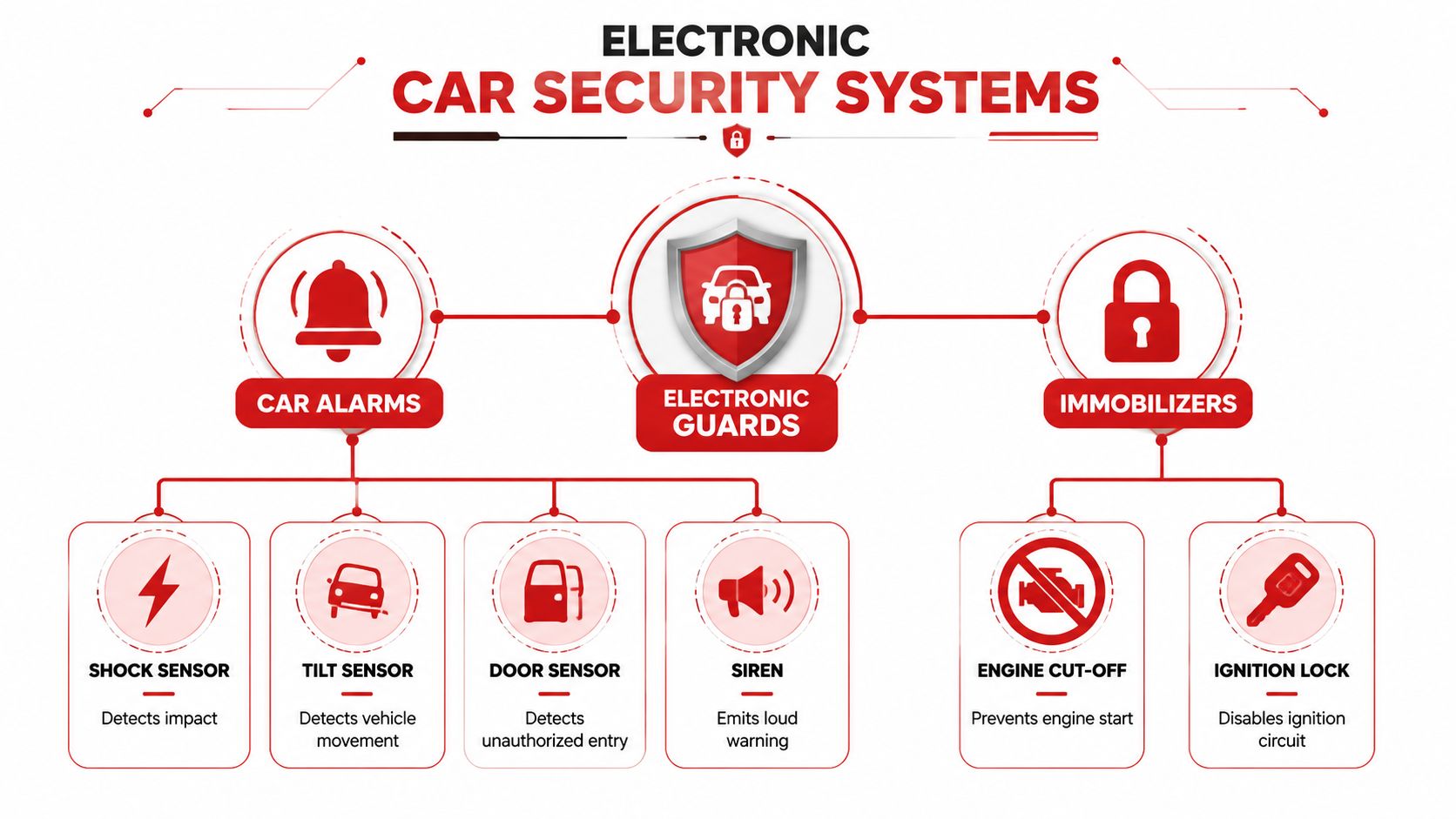
That includes alarms, which try to draw attention, and immobilizers, which try to stop the engine from starting at all.
Why alarms still have a role
Car alarms work by monitoring triggers such as impact, tilt, or door opening. When a threshold is crossed, the system activates a siren and sometimes flashes the lights.
That does two things well. It interrupts the thief's rhythm and increases the chance that someone nearby notices unusual activity. For owners thinking about sensor design and alert logic more broadly, some of the expert alarm tips for South Wales are useful because they frame alarms as detection systems, not magic shields.
But alarms also suffer from a familiar problem: people often hear them and assume it's a false trigger. In practice, a siren doesn't tell the owner where the vehicle is moving, whether it's being towed, or whether the theft is still in progress.
Immobilizers changed the game
Immobilizers are more serious. According to AutoNation Ford Frisco's explanation of the Ford Passive Anti-Theft System, modern electronic immobilizers use a transponder in the key that communicates a unique code with the engine control module. If the code doesn't match, the engine stays immobilized, even if the thief has already entered the vehicle.
In plain language, the car refuses to trust the wrong key.
That matters because it blocks old-school hot-wiring logic. The thief can gain physical access and still fail to start the engine if the cryptographic handshake doesn't happen.
The strongest evidence for immobilizers
The evidence on immobilizers is unusually clear. A Springer analysis of industry data found that theft of vehicles equipped with electronic engine immobilizers declined by 80 percent relative to a matched control group without them.
That's a major reduction, and it explains why immobilizers became standard security architecture rather than a premium add-on.
Why electronic guards still aren't enough by themselves
The weakness is not that immobilizers don't work. It's that thieves adapt.
A thief may attack the key path instead of the ignition path. Relay attacks target keyless systems by extending or exploiting the signal relationship between key and vehicle. Other attacks target programming access points or replace electronic components to sidestep the factory logic altogether.
That's why electronic guards should be understood in layers:
- Alarm systems announce disruption, but they don't recover the vehicle.
- Immobilizers stop many unauthorized starts, but they can be bypassed by advanced methods.
- Secondary hidden controls become important when the factory system is known to thieves.
Key point: Electronic security raised the bar. It didn't end the contest.
Owners often overestimate what a standard factory package can do because the technology sounds advanced. It is advanced. But factory systems are also widely studied by organized thieves. Once a method works on a common model, it spreads.
Advanced Hidden Layers Kill Switches and Port Blockers
The next tier of protection is less visible and much more personal. These tools don't rely on being seen. They rely on being unknown.
A kill switch interrupts something critical, usually the fuel pump, ignition circuit, or another system the engine needs to run. If installed well, it changes the theft sequence from “gain entry and start” to “gain entry, start, fail, diagnose, and search,” which is a very different risk profile for the thief.
Why hidden devices change the odds
A factory system is predictable. A custom-installed kill switch isn't.
That unpredictability is the point. A thief may know the vehicle model, understand the common bypass path, and still lose time because the car has one extra hidden dependency they didn't expect. The switch turns a smooth theft into a troubleshooting problem.
For owners looking at the hardware side of connected vehicle monitoring and installation context, CarLock's device feature overview helps show how hidden security hardware fits into a broader layered setup.
OBD port blockers solve a specific modern problem
An OBD-II port blocker protects the vehicle's diagnostic port. That matters because the port is a legitimate maintenance interface, but it can also become an attack surface. If a thief reaches it, they may try to program a new key or interfere with the vehicle's electronic trust chain.
Blocking access doesn't guarantee safety, but it forces the thief to spend more time and use a different plan. That can be enough to make the attempt collapse.
What these layers can and can't do
| Hidden layer | What it helps stop | Main limitation |
|---|---|---|
| Kill switch | Unauthorized engine operation | Useless if found and bypassed |
| OBD port blocker | Electronic key programming or port access | Doesn't help after the car is already moving |
These are strong layers. They're especially valuable for owners of theft-prone vehicles, enthusiast cars, and fleet assets that sit unattended for long windows.
But they still belong to the prevention side of the security equation. If the thief defeats them, they don't tell you where the vehicle went.
From Finding Items to Recovering Vehicles
Often, owners make the most expensive mistake: they confuse an item finder with a vehicle recovery tool.
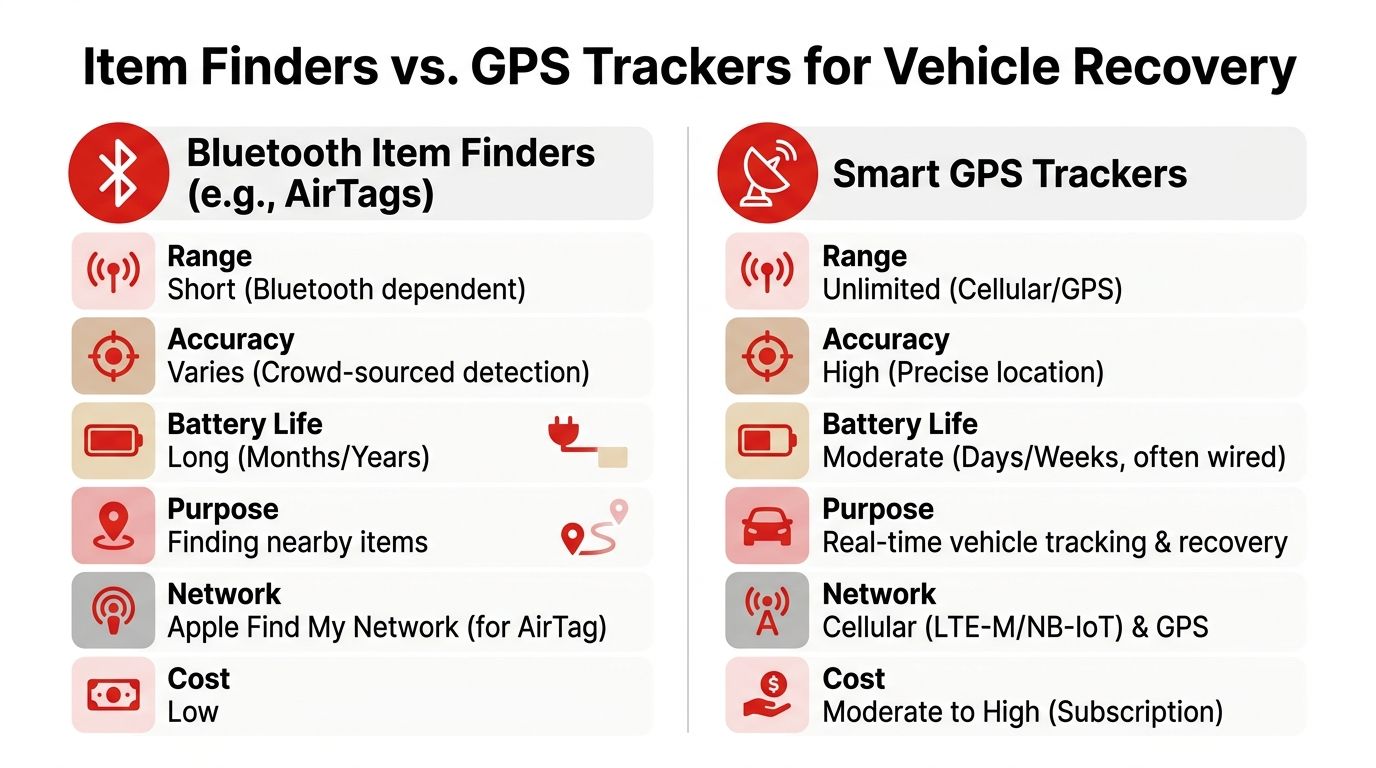
A Bluetooth tag can help you locate keys, bags, or other personal items. That's a different job from recovering a moving car. The technologies overlap in the public imagination because both appear on a phone screen, but under theft conditions they behave very differently.
Bluetooth tags are not built for vehicle theft
Bluetooth item finders depend on proximity and ecosystem participation. They don't maintain independent real-time location reporting the way a dedicated vehicle tracker does. If the car is moved somewhere isolated, shielded, or outside the right device network, the owner may get delayed, partial, or no useful location data.
That's why the comparison matters so much.
According to Lemonade's anti-theft device explanation, real-time GPS tracking devices with motion sensors and GSM connectivity provide the highest recovery rate because they transmit precise coordinates and support alerts for unauthorized movement, towing, or engine starts. That same source also distinguishes GPS systems from Bluetooth-based trackers, noting that Bluetooth tools rely on proximity and can fail in remote areas or underground garages.
True GPS trackers solve the recovery problem
A vehicle GPS tracker works differently. It uses satellite positioning to determine location and a cellular connection to transmit that data back to the owner or monitoring platform.
That combination matters because recovery depends on continuous visibility, not occasional sightings.
The strongest evidence here is practical. Strategic Market Research reports that vehicles fitted with GPS tracking devices have a recovery rate often exceeding 90%, with many recovered within hours of being reported stolen. The reason is straightforward: real-time coordinates let owners and law enforcement move from suspicion to location.
Side by side in plain terms
Bluetooth item finder
- Good for misplaced belongings
- Weak for moving-vehicle recovery
- Limited by nearby-device dependence
GPS vehicle tracker
- Built for vehicle location
- Designed for active theft response
- Useful when the vehicle is moving and time matters
If the tool can't reliably tell you where the car is while it's being moved, it isn't a theft recovery system.
Owners who want a clearer view of what real-time location, trip history, and live tracking look like in practice can review CarLock's vehicle locator functions.
Why a Smart GPS Tracker Is The Ultimate Solution
The most reliable anti theft devices car owners can buy in 2026 aren't the ones that only block, scream, or flash. They're the ones that turn a theft event into actionable information.
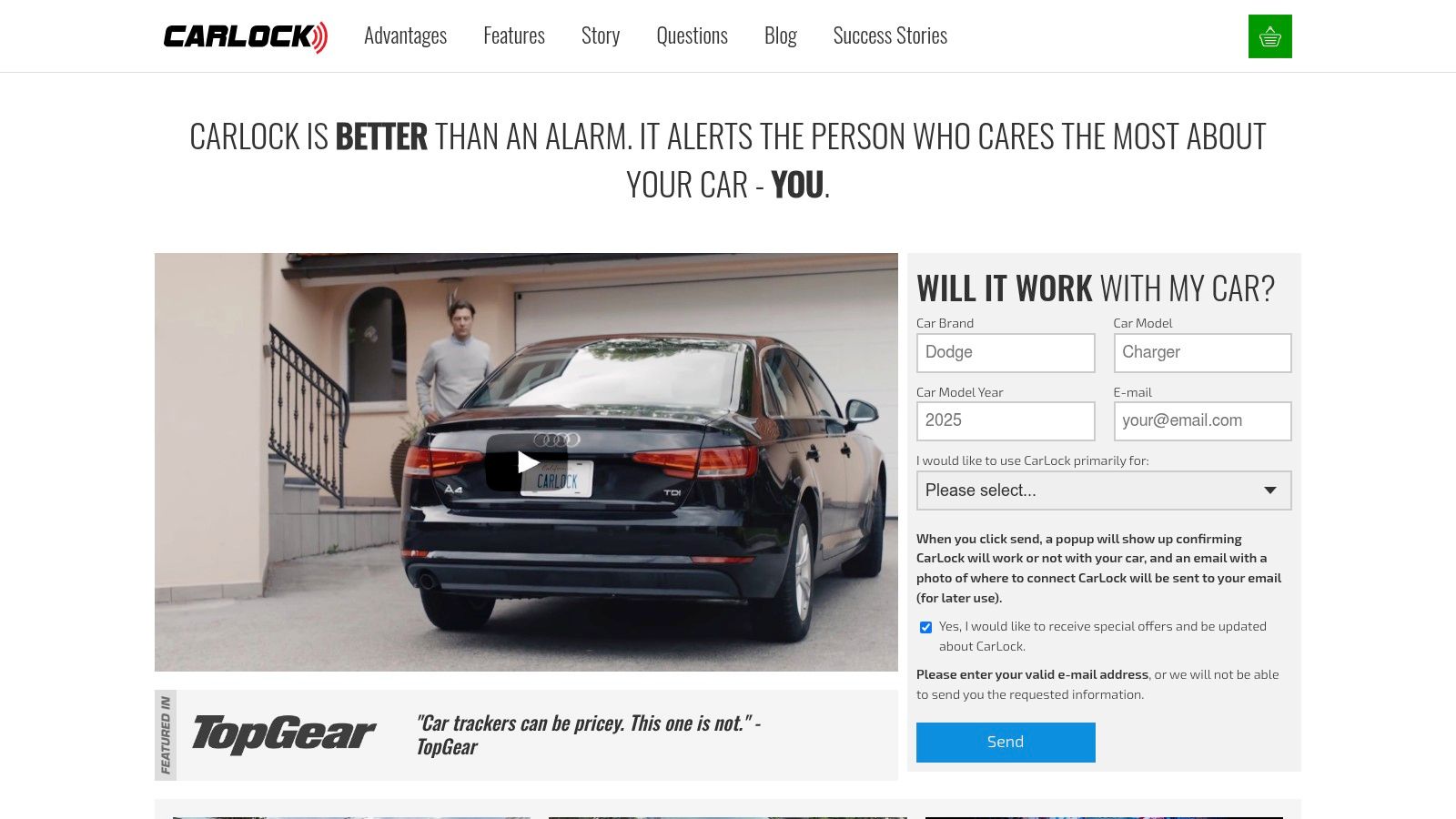
That's why the modern answer is a layered setup with a hidden recovery component. Louisville Metro PD's anti-theft guidance makes that point directly: the most effective strategy is a layered approach where a hidden GPS tracker serves as the recovery layer. The same guidance notes that traditional alarms only alert after a break-in, while GPS trackers such as CarLock provide pre-crime move alerts and continuous tracking that can help law enforcement intercept thieves.
What makes a tracker smart instead of basic
A basic tracker tells you location. A smart tracker gives context.
That means alerts for movement when the car should be parked, notification when the engine starts unexpectedly, warning signs of towing or unusual vibration, and tamper alerts if the device is disconnected. Those signals matter because the first minutes of a theft are usually the most important.
A system like CarLock fits this category because it combines real-time GPS tracking with smartphone alerts for movement, engine starts, vibration, disconnection, and battery issues. That changes the owner's role from passive observer to informed responder.
The real advantage is timing
Recovery depends on time, not just technology. If you learn about a theft long after the vehicle is gone, even good tracking may become a search problem. If you learn about suspicious movement as it starts, you can act while the event is unfolding.
That's the overlooked advantage of smart tracking. It doesn't wait for the owner to discover the loss hours later. It narrows the delay between theft attempt and owner response.
For a closer look at real-time monitoring and smartphone-based tracking workflows, CarLock's car tracking overview shows how this type of recovery layer is structured.
A short product demonstration makes the point more clearly than theory alone:
Why this matters beyond theft
Smart GPS systems also create value when the car isn't being stolen. Parents can monitor how a teenage driver uses the vehicle. Fleet owners can see when vehicles move outside expected patterns. Owners can spot towing, unauthorized use, or unusual battery behavior before those issues become bigger problems.
That's the reason recovery technology has become central to vehicle security. It doesn't only answer “where is my car now?” It helps answer “what is happening to my car right now?”
Recovery is the safety net. Without it, every other layer is a bet that deterrence will work perfectly every time.
If you want anti theft devices car owners can use as part of a modern recovery strategy, start with a system built for real-time alerts and live vehicle location. CARLOCK gives you that recovery layer by notifying you when your vehicle moves, starts, vibrates unusually, or is tampered with, so you can respond before a theft turns into a total loss.