

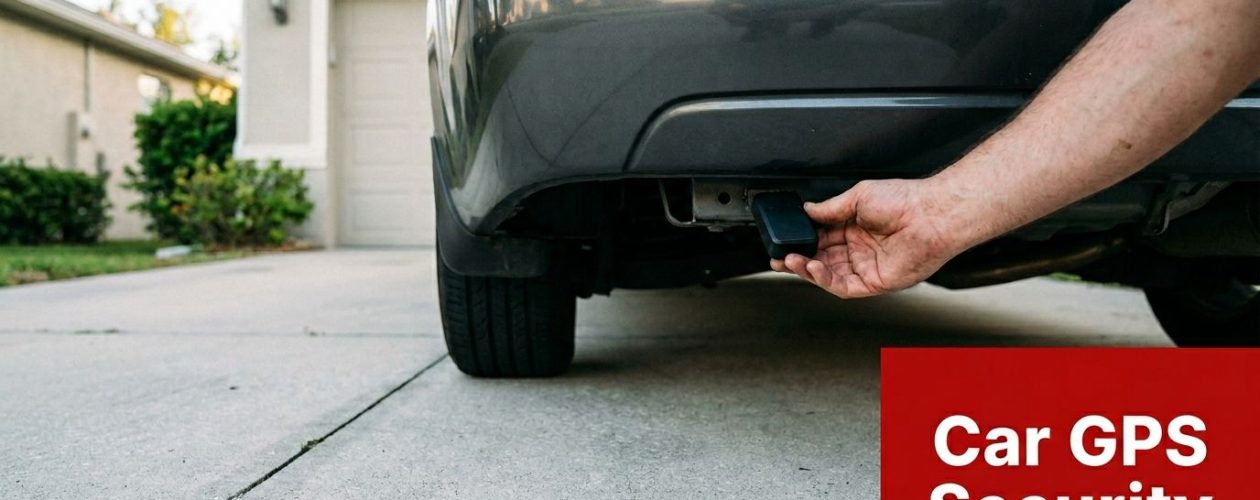
Driver’s Desk
GPS Tracker on Car: Your 2026 Security Guide
You walk back to where you parked, hit the key fob, and get nothing. At first you assume you forgot the row, the level, the side street. Then the possibilities narrow fast. It may have been towed. Someone may have taken it. Or someone may already be driving it somewhere you can't see.
That moment is exactly why people look for a gps tracker on car setups that do more than drop a pin after the fact. If a vehicle matters to your daily life, your family, or your business, waiting until it disappears is a weak plan.
That Sinking Feeling A GPS Tracker Can Prevent
Most drivers don't think about vehicle tracking when things are normal. They think about it when normal breaks. A missed parking spot turns into a long walk around the block. A late-night alert from a family member turns into a search for a car that should still be in the driveway. A shop owner locks up at closing and wonders whether every vehicle on the lot will still be there in the morning.
That anxiety isn't niche anymore. About 170 million Americans own at least one GPS or other location-tracking device besides a smartphone, roughly two-thirds of adults, and more than 27% plan to buy another within six months, according to SafeHome's GPS industry outlook. Tracking has become a normal part of protecting cars, equipment, and other valuable assets.
For businesses, the issue gets bigger than one vehicle. A stolen customer car, a missing service van, or an unauthorized after-hours move can become an insurance problem, a customer trust problem, and an operations problem at the same time. If you manage a garage or service location, this guide on protecting auto repair shops from theft is worth reading because it addresses the broader security side that many vehicle owners overlook.
A car alarm makes noise. A modern tracker gives you information you can act on.
That's the distinction that matters. Security starts improving the moment you stop treating tracking as a gadget and start treating it as visibility.
A proper system also changes how you respond. If the car was towed, you can verify movement quickly. If a family member took it outside expected hours, you can see where it went. If someone unauthorized moved it, you're not stuck guessing. A connected security setup paired with a smart car alarm system gives you a much earlier warning than relying on chance, memory, or a loud siren that nobody reacts to.
How a Real Car GPS Tracker Works
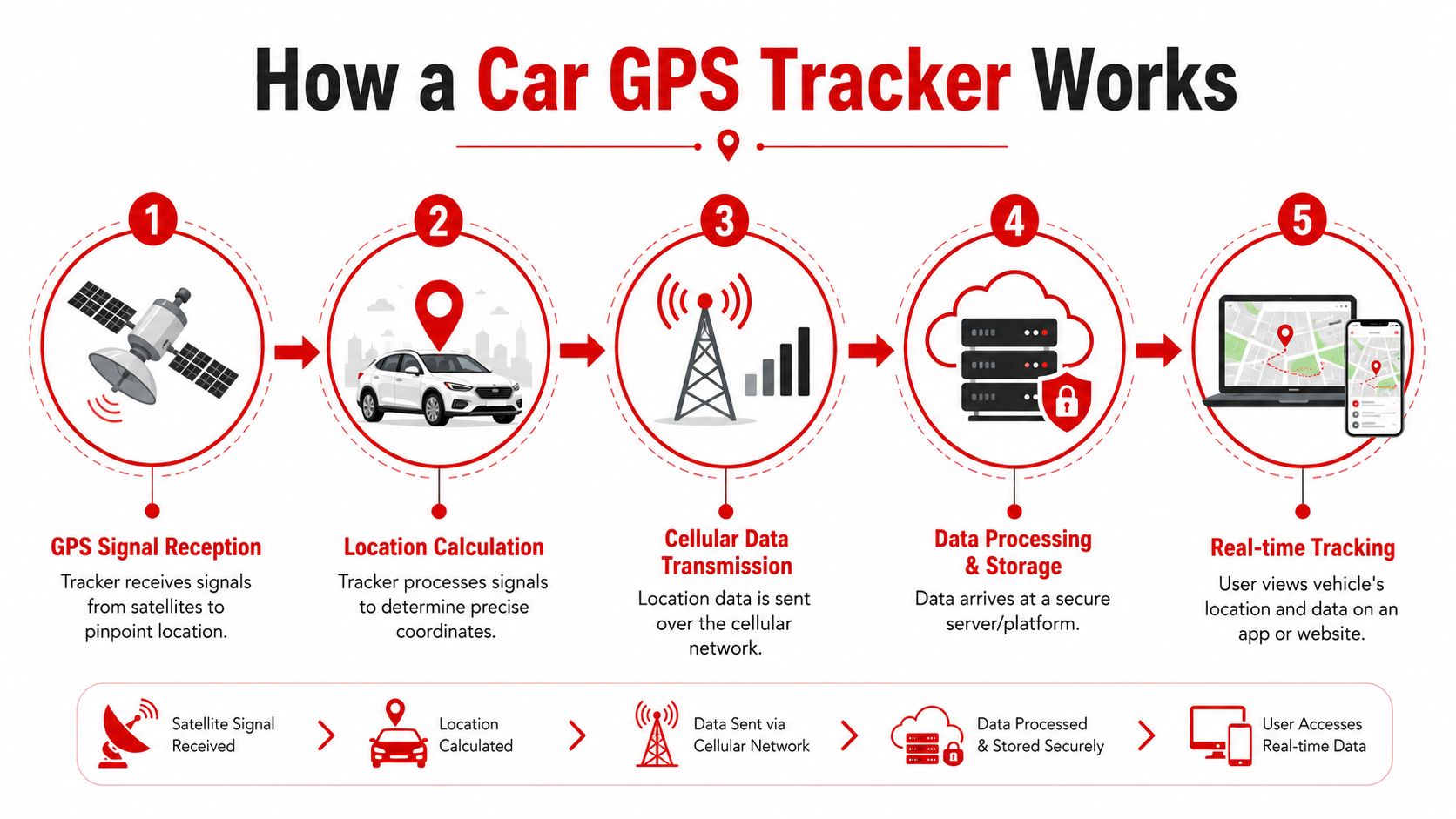
A real vehicle security tracker has three jobs. It has to determine where the car is, send that information somewhere useful, and present it in a form you can act on.
That's why a true system isn't just a tag. A complete GPS tracker for a car is a three-part telematics system combining onboard hardware, a software platform, and a connectivity network, as described in the vehicle tracking system overview. In practice, that means a device in the car, a network path to carry the data, and an app or web platform that turns raw coordinates into alerts, trip history, and live status.
The simple version
The easiest analogy is package tracking.
GPS or GNSS is the part that figures out the address. The cellular modem is the part that sends the update. The software platform is the part that shows you, “Your package is here, moving, and heading this direction.”
Without the first part, the tracker doesn't know where the car is. Without the second, it can't tell you. Without the third, the data isn't usable.
Why Bluetooth item finders are the wrong tool
A common error occurs when buyers make the wrong comparison. They look at a Bluetooth item finder and a dedicated car tracker and assume both solve the same problem.
They don't.
A Bluetooth finder is built for lost-property recovery. Keys. Bags. Luggage. Items that are usually misplaced within a short radius or found later by nearby participating phones. That's useful for everyday objects. It's weak for vehicle theft.
If someone steals a car, you don't want to depend on the chance that another person with a compatible phone passes near it. You want the vehicle itself to report back through its own connection. That's the core difference between a professional-grade gps tracker on car security setup and a consumer item tag.
Practical rule: If the device depends on nearby strangers' phones to help locate your vehicle, it isn't a primary anti-theft tool.
A purpose-built tracker uses its own satellite positioning and its own network path. That architecture supports movement detection, route history, and event alerts. It also keeps working in situations where a Bluetooth-only approach becomes uncertain or delayed. For readers interested in how different technologies serve different security roles, this overview of how NFC and GPS enhance property security gives useful context.
What actually matters in day-to-day use
When evaluating devices, look past marketing words and look at system design.
| Component | What it does | Why it matters |
|---|---|---|
| GNSS receiver | Determines vehicle location | A tracker can't protect what it can't accurately locate |
| Cellular modem | Sends data to the platform | Enables live reporting and remote alerts |
| Software platform | Displays trips, alerts, status | Turns raw data into decisions |
Some systems also support multi-constellation positioning, meaning they can use more than one satellite network. That helps a tracker hold location better in more difficult environments. A feature breakdown like the one on CarLock's device capabilities page is useful because it shows what the hardware and platform are intended to do together.
If you remember one point from this section, make it this: for actual vehicle protection, the right comparison isn't “tracker versus tracker.” It's self-reporting GPS plus cellular versus proximity-based item finding. Those are different categories, built for different risks.
Essential Features for True Vehicle Security
A dot on a map is not a security system. It's a record. Sometimes that's enough. Often it isn't.
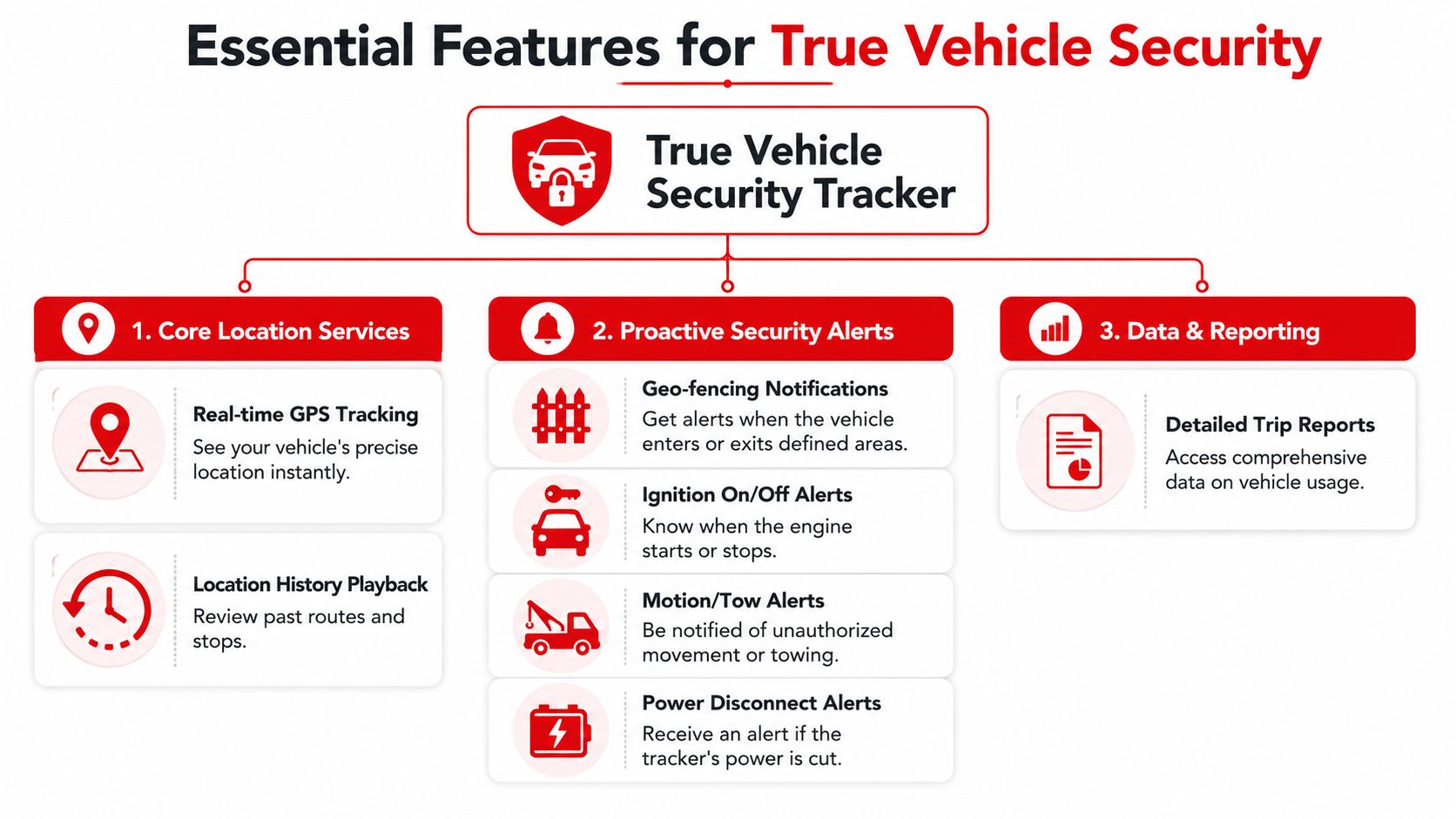
What helps recover a stolen car or stop misuse early is timing. You need to know that something happened while there's still time to respond. That's why the most important features aren't decorative extras. They're the features that turn location data into an alerting system.
Real-time means more than marketing
The word real-time gets used loosely, but it has a practical meaning in this category. Independent testing by Car and Driver says consumer GPS trackers typically refresh every 15–60 seconds, premium modes can reach 5–10 seconds, accuracy is usually around 8–15 feet in open sky, and cellular GPS trackers generally cost about $5–$25 per month per vehicle in its GPS tracker testing review.
Those details matter because a slow refresh can turn an active theft into a stale map trail. Faster updates usually give you better visibility during recovery, but they also come with trade-offs in power use and data consumption.
The features that actually earn their place
A serious vehicle tracker should help you answer immediate questions.
- Unauthorized movement alerts tell you the vehicle moved when it shouldn't have.
- Ignition alerts tell you the engine started, even if no one should be using the car.
- Tow or vibration alerts can signal loading, break-in activity, or a vehicle being shifted without permission.
- Geofencing lets you define where a vehicle should or shouldn't be.
- Power disconnect or tamper alerts matter because thieves often try to disable electronics first.
- Trip history gives you a record after the event, which helps with review, accountability, and handoff to law enforcement or internal operations.
That list is more important than a polished dashboard. A beautiful app with weak event detection won't help much when a car leaves a driveway at the wrong time.
The useful tracker isn't the one with the prettiest map. It's the one that interrupts your day when the car does something it shouldn't.
Security features versus convenience features
Many buyers mix these together. Route playback and trip logs are useful, but they are support features. Security features are the ones that create immediate awareness.
A good way to separate them is this short test:
| Question | If the answer is yes | Feature type |
|---|---|---|
| Does it notify me right away? | Movement, ignition, tamper, geofence | Security |
| Does it help me analyze what already happened? | Trip logs, route history, usage reports | Operational |
Both matter. They just solve different problems.
If you're comparing apps, the practical question is whether the platform surfaces these alerts clearly and quickly. A product page like CarLock's app feature overview is useful for seeing how alerts, trip records, and security events are handled from the user side.
For parents, fleet operators, and owners of high-risk vehicles, passive tracking alone is too late. The best systems act like a lookout, not just a notebook.
Installation Options and Getting Started
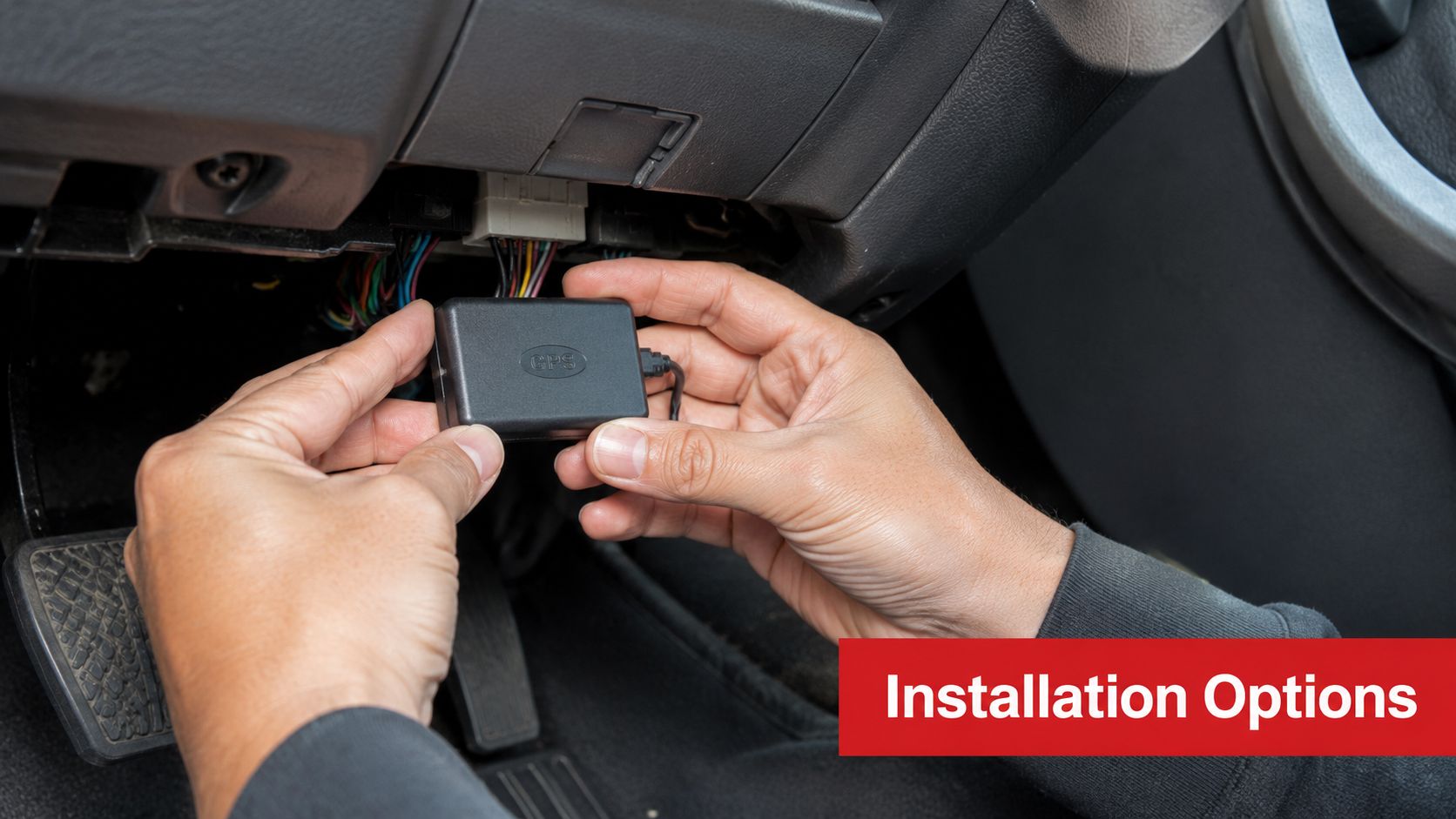
Once people decide they want a tracker, the next hesitation is usually installation. It sounds technical. In practice, the decision is mostly about trade-offs: how hidden you want the device to be, how much effort you want to spend installing it, and how reliably you want it powered.
Three common setups
Most car tracking installs fall into three categories.
| Type | Installation | Power | Main advantage | Main drawback |
|---|---|---|---|---|
| OBD-II plug-in | Plugs into diagnostic port | Vehicle power | Fast, simple setup | Easier to spot if someone checks the port |
| Hardwired unit | Wired into vehicle electrical system | Vehicle power | Better concealment | More complex install |
| Battery-powered unit | Portable, often magnetic | Internal battery | Flexible placement | Needs charging and may stop when battery runs down |
For most everyday drivers, an OBD-II tracker is the easiest entry point. It installs without tools, gets stable power from the vehicle, and can be running in minutes. That's a strong fit for parents monitoring a teen driver, owners who want fast deployment, and small businesses that don't want to book installation work for every vehicle.
Hardwired units make more sense when concealment is the top priority. They're harder to locate quickly, which can matter in a theft scenario. Battery-powered trackers are useful for temporary use, backup placement, or assets that don't have an easy power source.
Placement matters more than people think
People often focus on hiding spot first and signal second. That's backwards.
A tracker has to receive satellite signals and communicate over a cellular network. Placement that is too buried, too shielded by metal, or too isolated inside the vehicle can weaken performance. Taoglas explains how vehicle location technology works and notes that signal quality can degrade in urban canyons, under dense foliage, or when blocked by vehicle materials. The practical lesson is simple: the best spot balances concealment with a clean path for GPS and cellular communication.
Here's a straightforward setup sequence most users can follow:
- Choose the installation type based on whether simplicity, concealment, or portability matters most.
- Test the position before finalizing it so you know the device reports consistently.
- Pair the tracker with the app and confirm alerts are enabled.
- Set your first security rules such as movement alerts or location boundaries.
- Trigger a test event so you know notifications reach your phone as expected.
For a visual walkthrough of the process, this short installation demo is useful before you start:
What works for most people
In practice, the right answer is rarely universal.
- Daily driver and family car: OBD-II often gives the cleanest balance of speed and reliability.
- High-theft-risk vehicle: Hardwired concealment usually deserves stronger consideration.
- Temporary tracking need: Battery-powered units can work if you're disciplined about charging and placement.
If your main goal is easy setup without giving up active monitoring, an OBD-II solution such as CarLock fits the practical middle ground. It avoids the friction of a wiring job while still keeping the tracker connected to the car's power and data environment.
Subscriptions Privacy and Legal Rules
A lot of shoppers start with the same goal: avoid a monthly fee.
That instinct makes sense in plenty of categories. It's less helpful here. With vehicle tracking, “no subscription” often means “no dedicated cellular service,” “no active platform,” or “no continuous alerting.” In other words, you save the recurring bill by giving up part of the function you were trying to buy.
What the subscription actually pays for
A subscription-based tracker isn't charging you for the map icon alone. You're paying for the communication layer and the service behind it. That includes the cellular path that carries location data, the backend platform that processes events, and the app environment that stores and presents alerts and trip records.
That's why so many of the “no subscription” comparisons are misleading. A passive logger or Bluetooth-only finder may still have value. It just isn't the same category of protection.
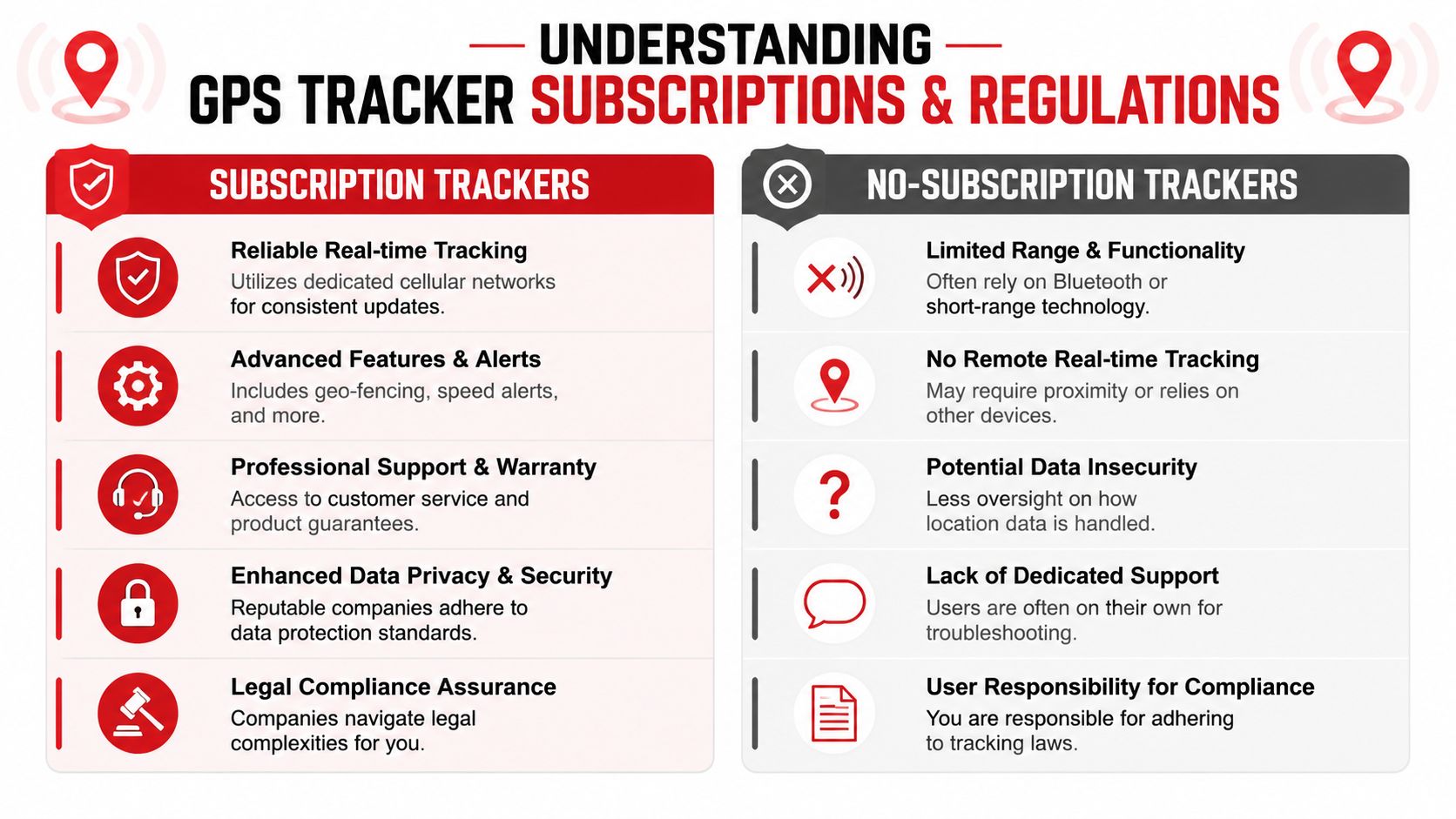
A simple way to think about it:
- No-subscription device: Usually better for finding a misplaced object or reviewing limited local data.
- Subscription tracker: Better for ongoing monitoring, live alerts, and remote visibility.
If your concern is theft, towing, or unauthorized use, the second category is usually the one that matches the risk.
Privacy is part of the product, not a footnote
A tracker collects location data. That means privacy practices matter.
You should know who stores the data, how the account is secured, and what controls exist for access. If the company publishes a clear privacy policy, read it before activation. CarLock, for example, provides its privacy policy here, and that's the kind of document every buyer should review regardless of brand.
Buying the hardware is easy. Trusting the data trail is the real long-term decision.
At a minimum, make sure you understand account access, password hygiene, and who in your household or company is allowed to view the vehicle.
The legal line is usually straightforward
You can generally track a vehicle you own or a vehicle your company owns, especially when users know tracking is in place. Problems start when someone installs a tracker on a vehicle they don't own or monitors another person without proper consent.
Good practice looks like this:
- Personal vehicle: You're usually on firmer ground tracking your own car.
- Teen driver or family use: Be direct. Tell the driver the vehicle is monitored.
- Employee or fleet vehicle: Put disclosure in writing and make the policy clear.
- Someone else's vehicle: Don't assume you have the right to track it.
Laws differ by jurisdiction, but the ethical standard is easy to understand. If the car isn't yours, or if another driver reasonably expects privacy and hasn't been told, stop and get legal guidance before you do anything.
The subscription question and the legal question are connected. The more capable the system is, the more seriously you should treat data handling, consent, and responsible use.
Putting Your Tracker to Use in the Real World
A gps tracker on car systems earns its value in small moments first, not only in a dramatic theft.
One owner gets a movement alert in the middle of the afternoon and realizes the car wasn't stolen at all. It was being towed for parking enforcement. That early notice gives them a chance to react before the vehicle disappears into storage and the cost and hassle grow.
A parent uses driving alerts and trip records to coach a new driver. The conversation changes when the feedback is concrete. The issue isn't “you drive too aggressively.” It's “this route shows repeated hard braking near the same turn, so slow down earlier.”
A small business owner checks route records after a customer disputes a missed visit. Instead of guessing, they pull up the vehicle's route history records and verify where the car went and when it stopped. That kind of visibility helps with operations as much as security.
A few practical troubleshooting habits
Even a good tracker has limits in practice.
- Garage or underground structure: Expect weaker reporting while the vehicle is heavily shielded.
- Dense urban streets: Tall buildings can make updates less clean or slightly delayed.
- Poor placement: If reports seem inconsistent, revisit installation position before blaming the whole system.
- Missed alerts: Check app permissions on your phone before assuming the device failed.
The larger point is simple. A real tracker is not just a location tool. It's an active layer of awareness that helps you respond sooner, supervise better, and recover faster when something goes wrong.
If you want a system built for actual vehicle security rather than lost-item finding, CARLOCK is worth a look. It uses GPS plus cellular connectivity, sends alerts for movement, ignition, vibration, and tampering, and gives you live tracking and trip history through a mobile app.