

Driver’s Desk
Anti Car Theft Device
Cars are stolen in two very different ways. One problem is getting a thief to walk past your vehicle. The other is getting your vehicle back after someone takes it. An anti car theft device can help with one, both, or neither, and that difference is where many buyers get misled.
A siren, blinking LED, or steering wheel lock can still discourage an opportunist. Those tools work like a strong front gate. They signal effort, delay access, and may push a thief toward an easier target. But deterrence is only the first layer. If a thief bypasses that layer, noise and visibility stop helping very quickly.
Modern car security works best when you separate three jobs clearly: deter the attempt, block the vehicle from being driven away, and track it for recovery if the first two fail. That last part is often missing from consumer advice. It is also the part that matters most once your parking space is empty.
This is also where marketing creates confusion. Bluetooth item finders are designed to help locate keys, bags, or luggage within a short shared network, not to protect a stolen car across towns, highways, or storage sites. A dedicated GPS and cellular tracking system is built for a different job entirely. It reports the vehicle's location remotely and supports real recovery instead of offering only a chance that another nearby phone might detect it.
If you want a clearer picture of how vehicle theft happens and why awareness changes outcomes, this guide on car theft awareness and modern risk patterns is a useful starting point.
The key question is not whether a device looks protective. It is whether it only tries to prevent theft, or also gives you a practical path to recover the vehicle. That distinction separates old-school deterrents from modern systems that still help after the theft has already happened.
Why Your Car Is More Vulnerable Than You Think
A common story goes like this. A driver parks outside overnight, locks the doors, hears no alarm, and assumes everything is fine until morning. The car is gone. No broken glass. No dramatic scene. Just an empty space and a long day of phone calls.
That disconnect is what catches people off guard. Many thefts don't look like movie thefts. They're fast, selective, and designed to avoid attention. A loud siren sounds protective in theory, but in real life many people hear alarms so often that they no longer react with urgency. Owners also tend to overestimate what a factory alarm does. In many vehicles, it alerts after an intrusion. It doesn't necessarily stop the engine from starting, and it certainly doesn't tell police where the vehicle has gone.
Why owners misread the risk
Drivers usually focus on the moment of break-in. They picture a smashed window or a forced door. Modern theft often centers on a different weak point: getting the vehicle moving before anyone responds.
Three assumptions create most of the trouble:
- “If it has a factory alarm, I'm covered.” An alarm may warn you after something happens, but warning and stopping are different things.
- “A visible lock will make thieves give up.” It may discourage an opportunist, but a determined thief can still move on to methods that don't depend on brute force.
- “I'll notice quickly if my car is taken.” You might. But minutes matter, especially if you have no live location data.
Security works differently when you separate prevention from recovery. A device that scares off one thief may still leave you helpless if another thief succeeds.
The better way to think about vehicle protection is as a chain. First, can the system make theft harder? Second, can it alert you immediately? Third, if the car still disappears, can it help get it back? That last step is where many buyers realize they've been evaluating the wrong products all along. If you want a broader look at how owners build awareness around these risks, CarLock's vehicle security awareness overview is a useful starting point.
The Evolution of Car Security From Locks to Electronics
Car security changed for a simple reason: thieves kept finding the gap in the last solution. Each generation of anti car theft device fixed one weakness, then exposed another. If you follow that progression, the difference between deterrence and recovery becomes much easier to see.
Mechanical locks slowed theft attempts
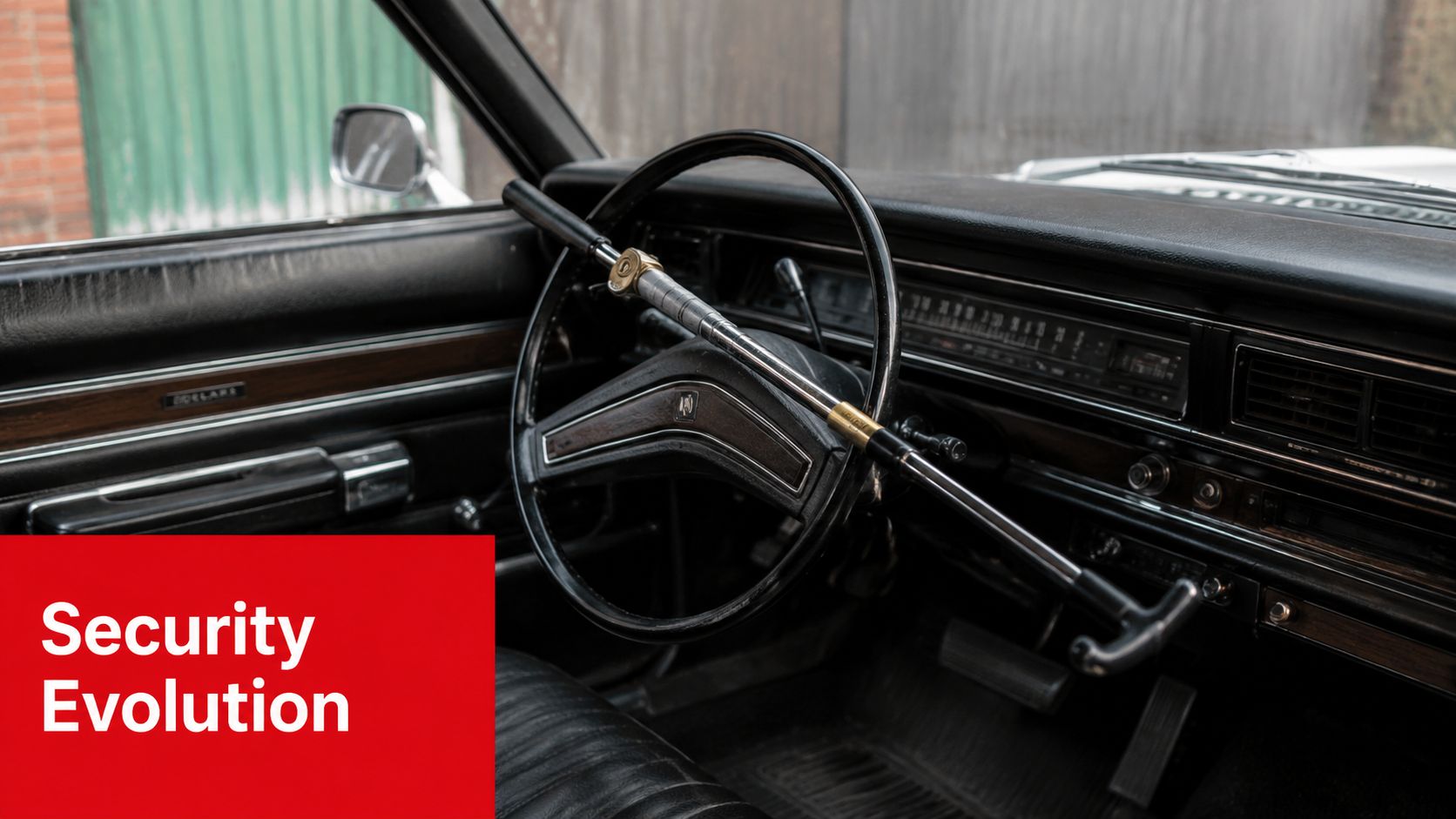
The first layer was mechanical. Steering wheel locks, pedal locks, and gearshift locks work like a deadbolt on a front door. They create delay, add effort, and make the car look less appealing to an opportunist.
That still has value.
A visible lock can persuade a thief to choose an easier target in a busy lot. But its role is narrow. It does not alert you, it does not show where the vehicle went, and it does not help police recover the car if someone defeats it or tows the vehicle away. Mechanical security is deterrence only.
Alarms taught owners an important lesson
Electronic alarms came next. Sensors could detect door entry, broken glass, impact, or cabin motion, then trigger a siren or flashing lights. For many owners, that felt like a major step forward because the vehicle could now signal trouble instead of sitting silent.
The weakness became clear over time. An alarm depends on human response. If bystanders ignore it, if the owner is too far away, or if the thief is gone before anyone acts, the noise changes very little. A useful car alarm system overview shows where alarms fit. They are one layer, not a complete plan.
The same pattern appears in other forms of access control. Older systems often fail once criminals understand the code or signal they need to mimic. That is why rolling security methods replaced simpler fixed-code systems in many garages, and this rolling code garage door opener guide explains that shift clearly.
Immobilizers moved security from warning to prevention
The next improvement was more meaningful because it changed the goal. Instead of announcing suspicious activity, immobilizers tried to stop the car from being driven at all. Factory systems usually do this by requiring the correct coded key or authorization before the engine will start.
As noted earlier, research on immobilizer adoption found a large drop in theft rates where these systems were present. The core lesson is straightforward: a device that blocks operation usually does more than a device that only makes noise.
This is a basic rule of anti car theft device design. Prevention is stronger than warning. But prevention still does not solve everything. If thieves bypass the system, clone credentials, relay a key signal, or load the vehicle onto a truck, the owner still faces the hardest question in vehicle security: where is the car now?
That question explains why electronics kept evolving. Mechanical locks try to discourage theft. Alarms try to expose it. Immobilizers try to prevent it. Modern GPS and cellular tracking systems add the missing function, active recovery, which is the part many buyers overlook until a vehicle disappears.
Comparing Anti Car Theft Device Categories
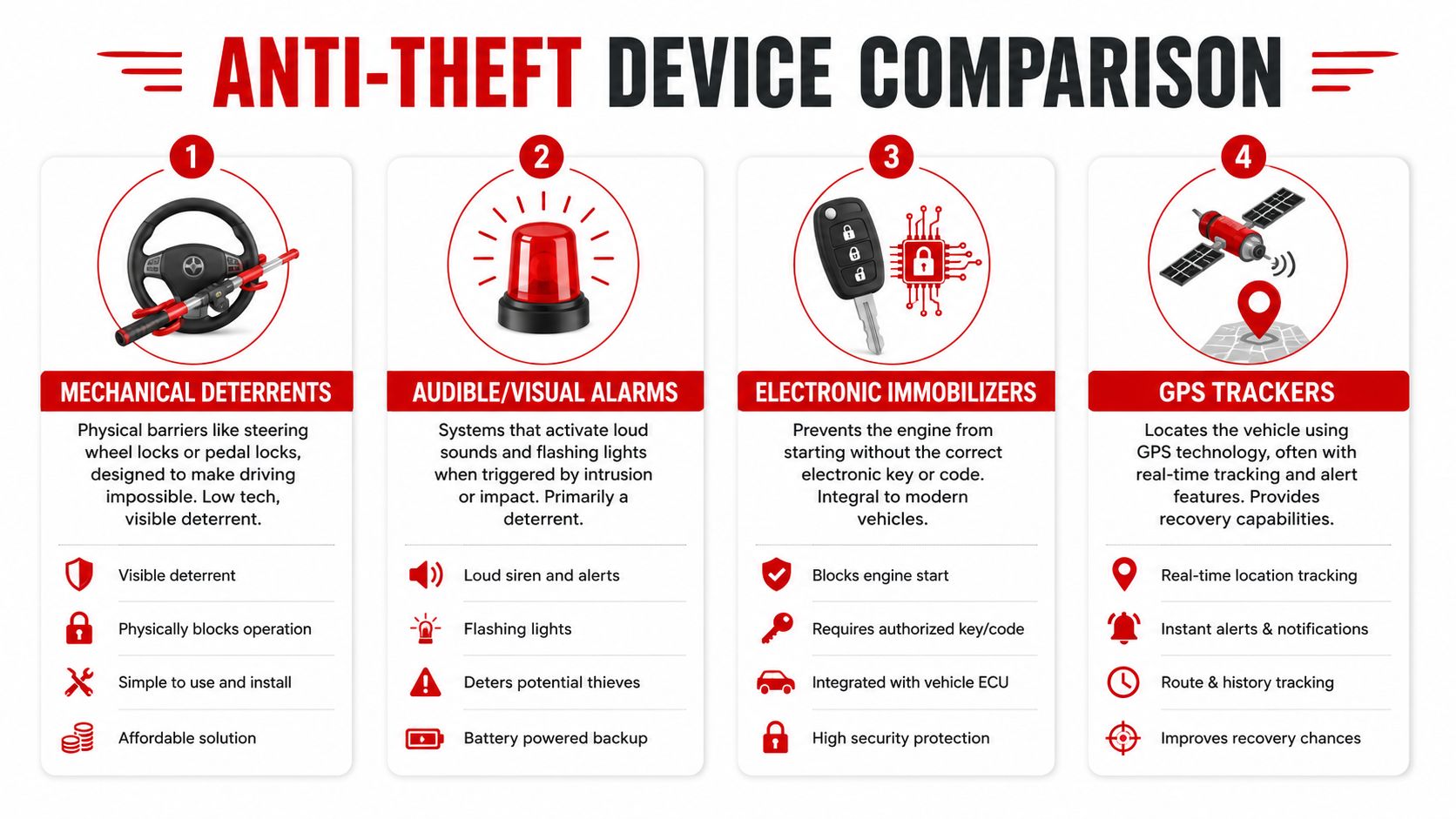
Most buyers compare devices by brand or price. That's a mistake. The better comparison is by function. Ask what each category does in three separate moments: before theft, during theft, and after theft.
The four main categories
Mechanical deterrents include steering wheel locks, pedal locks, and wheel clamps. Their strength is visibility. Their weakness is that they don't communicate with you and don't assist recovery.
Audible and visual alarms include sirens, flashing lights, and shock sensors. Their job is to attract attention or warn the owner. The trouble is that they depend on someone responding in time.
Electronic immobilizers stop the engine from starting without the correct authorization. Some factory systems do this through coded keys. More advanced digital systems add another verification layer.
GPS trackers focus on location, alerts, trip history, and real-world recovery support. They don't all work the same way, which becomes important in the next section.
One practical resource for anyone evaluating setup choices is this guide to car alarm system installation tips. It's useful because installation quality affects whether sensors and alerts behave the way you expect.
What advanced digital immobilizers do better
Some owners think all immobilizers are the same. They aren't. Digital immobilizers like the IGLA system block engine startup via CAN bus integration and require a PIN-to-drive authentication, which has been shown to reduce successful theft attempts by 85% compared to vehicles with only traditional alarms by defeating modern relay and cloning attacks, according to IGLA's product information on digital immobilization.
That difference matters because many newer theft methods don't rely on smashing anything. They exploit electronic trust. A stronger anti car theft device has to respond to that reality.
For readers comparing broader tracking and monitoring options, CarLock's vehicle tracking page lays out the security side of GPS-based systems.
Anti-Theft Device Category Comparison
| Device Category | Theft Prevention | Theft Alerting | Vehicle Recovery | Typical Cost |
|---|---|---|---|---|
| Mechanical Deterrents | Good against opportunistic theft | None | None | Varies by product |
| Audible/Visual Alarms | Limited, mostly deterrent | Strong at the moment of trigger | None | Varies by product and installation |
| Electronic Immobilizers | Strong, especially against drive-away theft | Limited to system-specific warnings | None on their own | Varies by vehicle and system |
| GPS Trackers | Limited as a physical barrier, but strong when combined with alerts | Strong with live movement and tamper alerts | Strongest category for locating the vehicle | Usually device cost plus subscription |
A steering wheel lock may help stop an attempt. An alarm may tell you something happened. An immobilizer may block the start. A tracker answers the question owners care about after a theft: where is the car right now?
This is the key mental shift. There is no single winner across every column. But once you weigh recovery properly, GPS systems stop looking optional and start looking central.
How Modern GPS Trackers Provide Real Security
A dedicated GPS security tracker and a Bluetooth item finder are not substitutes. They may both show dots on a map, but the underlying job is different.
GPS security versus Bluetooth item finding
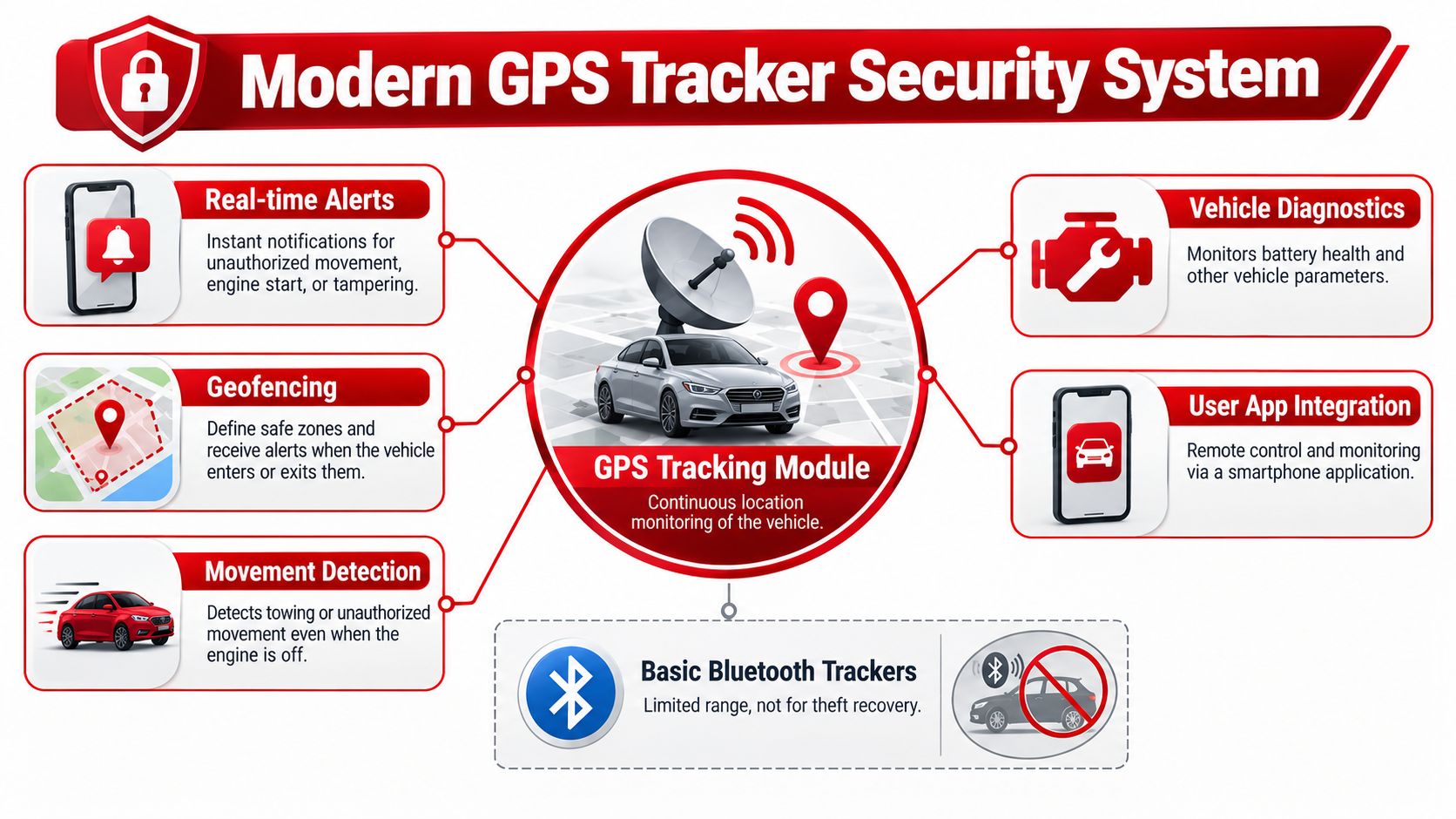
A Bluetooth finder depends on nearby phones to help report its location. That can work for keys in a café, luggage in a busy airport, or a backpack in a public place. It becomes unreliable for vehicle theft in remote areas, enclosed parking structures, or locations where there aren't enough nearby devices to relay a signal.
A purpose-built GPS and cellular anti car theft device works differently. It uses GPS satellites for positioning and a cellular network to send that location back to you remotely. That direct communication path is why dedicated vehicle trackers belong in a different category from consumer item finders marketed for lost belongings.
Why recovery changes the buying decision
Here's the number that matters most once a theft happens: GPS tracking devices, the core of modern systems like CarLock, achieve vehicle recovery rates exceeding 90%, according to information citing NICB recovery data in CarLock's anti-theft device explainer. That shifts security from passive prevention to active recovery.
That's the point many shopping guides miss. They spend too much time ranking locks and sirens, and not enough time on what happens after failure. A professional tracker doesn't just sit passively in the car. It creates a usable stream of information: movement alerts, tamper warnings, geofence events, and live location.
One example is CarLock's GPS car security system, which uses GPS and cellular connectivity rather than nearby phones. That matters if the vehicle ends up somewhere isolated or shielded from casual device networks.
This quick demo helps show how real-time vehicle security tools work in practice:
What “real security” looks like in use
A modern GPS system earns its place by doing several jobs at once:
- Immediate movement awareness so you know if the vehicle starts moving when it shouldn't
- Location visibility so you can share actionable information with police
- Tamper detection so disconnection attempts don't go unnoticed
- Trip history so patterns and unauthorized use are easier to review
Security that only warns you after the fact is incomplete. Security that helps you locate the vehicle gives you options.
This is also why “no-subscription” messaging can mislead buyers. The ongoing service isn't just a fee attached to the hardware. It funds the live communication layer that makes remote tracking possible. Without that connection, recovery becomes guesswork.
Key Features to Demand in a Modern System
A long feature list doesn't automatically mean strong security. The right anti car theft device should give you fast, usable information when something unusual happens. If a feature sounds impressive but doesn't change what you can do in the moment, it's secondary.
Features that change outcomes
Instant movement alerts matter because the first sign of theft may be towing, rolling, or unauthorized movement with the engine off.
Engine start notifications matter because they tell you the moment someone has progressed from tampering to operation.
Vibration or impact alerts matter because thieves often touch the car before they take it. A wheel theft attempt, a broken window, or repeated body impact can be the earliest warning.
Tamper alerts matter because some criminals try to disable the device before moving the vehicle. If the tracker is unplugged or disconnected and you receive a warning right away, you're not blind.
Features that improve recovery and oversight
Real-time GPS tracking is the centerpiece. According to GPX's discussion of advanced GPS anti-theft systems, advanced GPS systems provide real-time location accuracy within 2–5 meters and enable law enforcement to recover stolen vehicles in under 30 minutes on average, compared with 4+ hours for vehicles relying only on traditional alarms.
That isn't just a technical advantage. It changes the quality of the information you can hand to police.
Trip history helps in situations that aren't full thefts but still matter. A family vehicle used without permission, a company car taken off-route, or suspicious after-hours movement all become easier to verify.
Battery monitoring is easy to overlook until it saves you from a dead vehicle or tells you someone may be interfering with the electrical system.
A short buyer checklist
- Demand live alerts: If a system doesn't notify your phone quickly, it can't help you respond in time.
- Check tamper behavior: A security device shouldn't fail without notification when disconnected.
- Prioritize map visibility: You want current location and route history, not just a last-known ping.
- Look for practical monitoring: Engine starts, towing, and vibration are more useful than decorative app features.
A modern system should feel less like a gadget and more like an extra set of eyes on the vehicle.
Real World Scenarios for Advanced Protection
The value of an anti car theft device becomes clearer when you stop thinking like a shopper and start thinking like the person responsible for the vehicle.
A parent with a teen driver
Your teenager borrows the car for school, work, and weekends. Theft is one concern, but it isn't the only one. You also want to know if the car is being driven aggressively, taken somewhere unexpected, or moved late at night when it should be parked.
In that situation, instant alerts and trip history do more than support theft recovery. They give you context. If the car moves at an odd hour, you can check before a small problem becomes a larger one.
A small fleet owner
A fleet owner has a different problem. One missing van can disrupt a full day of jobs. A basic lock may discourage a casual thief, but it won't tell you whether the vehicle was moved after hours, unplugged, or taken off route.
The distinction between deterrence and recovery holds practical importance: as InsureOne's guide to car anti-theft devices notes, physical locks may deter opportunistic thieves, but they do little for recovery once a determined thief succeeds. GPS trackers are the category that actively aids law enforcement.
For business vehicles, “Where is it?” is often the most important question. If your system can't answer that quickly, it leaves the most expensive problem unsolved.
An urban driver in a higher-risk area
Street parking changes the equation. You may not hear an alarm from your apartment. You may not see a tow truck or a break-in. You need the phone to become the alarm.
For an urban resident, the most useful setup often combines layers with different jobs:
- A visible deterrent to discourage the easiest attempt
- An immobilizing layer to make drive-away theft harder
- A hidden GPS tracker to support real recovery if the first layers fail
That combination matches how modern theft works. A determined thief may defeat one layer. They're far less comfortable when the vehicle also reports movement, location, and tamper events in real time.
Installation Subscription and Privacy Considerations
Many buyers hesitate at the practical details, not the security logic. Installation, subscription cost, and privacy are the usual sticking points.
Installation is often simpler than expected
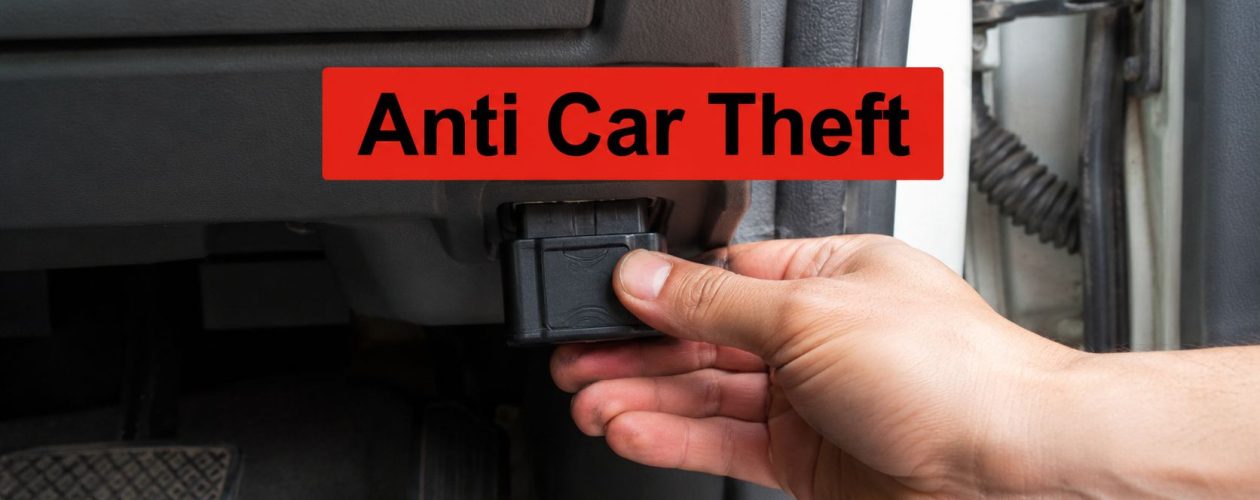
Some systems require professional installation, especially if they integrate extensively with vehicle electronics. Others use the OBD-II port and are far easier to set up. For many owners, plug-and-play hardware lowers the barrier enough that they keep the system active instead of postponing the project.
The right installation choice depends on the level of protection you want. A fully integrated immobilizer and a GPS tracker serve different purposes, so one doesn't replace the other.
Why subscriptions exist
A subscription can sound annoying until you remember what it pays for. You're not only buying hardware. You're paying for cellular communication, cloud connectivity, real-time notifications, and ongoing access to current location data. That's closer to a monitored home security model than a one-time accessory purchase.
Bluetooth item finders appeal to buyers because they avoid recurring fees. But that lower commitment also reflects a lower level of vehicle-specific protection. For active monitoring and remote recovery, an always-connected service is part of the product, not an extra.
Privacy deserves a direct answer
A reputable provider should be clear about what data it collects, how it stores it, and how users control access. Before buying, read the company's privacy terms in plain language. CarLock's privacy policy details are the kind of document worth reviewing before you install any connected vehicle device.
Choose a system you understand, not just one with the longest spec sheet. With vehicle security, clarity matters. You want to know what the device can detect, who receives the alert, and what you can do with the information the moment something goes wrong.
The strongest anti car theft device strategy isn't one product. It's the right combination of prevention, alerting, and recovery. If you want a system built around real-time GPS tracking, engine start alerts, movement detection, tamper warnings, and trip history, CARLOCK is a practical option to evaluate. It's designed for the part many drivers overlook until it's too late: knowing what's happening with the vehicle right now, and where it is if it moves without permission.