

Driver’s Desk
Teenage Driver Safety Guide: 7 Proven Practices for Parents
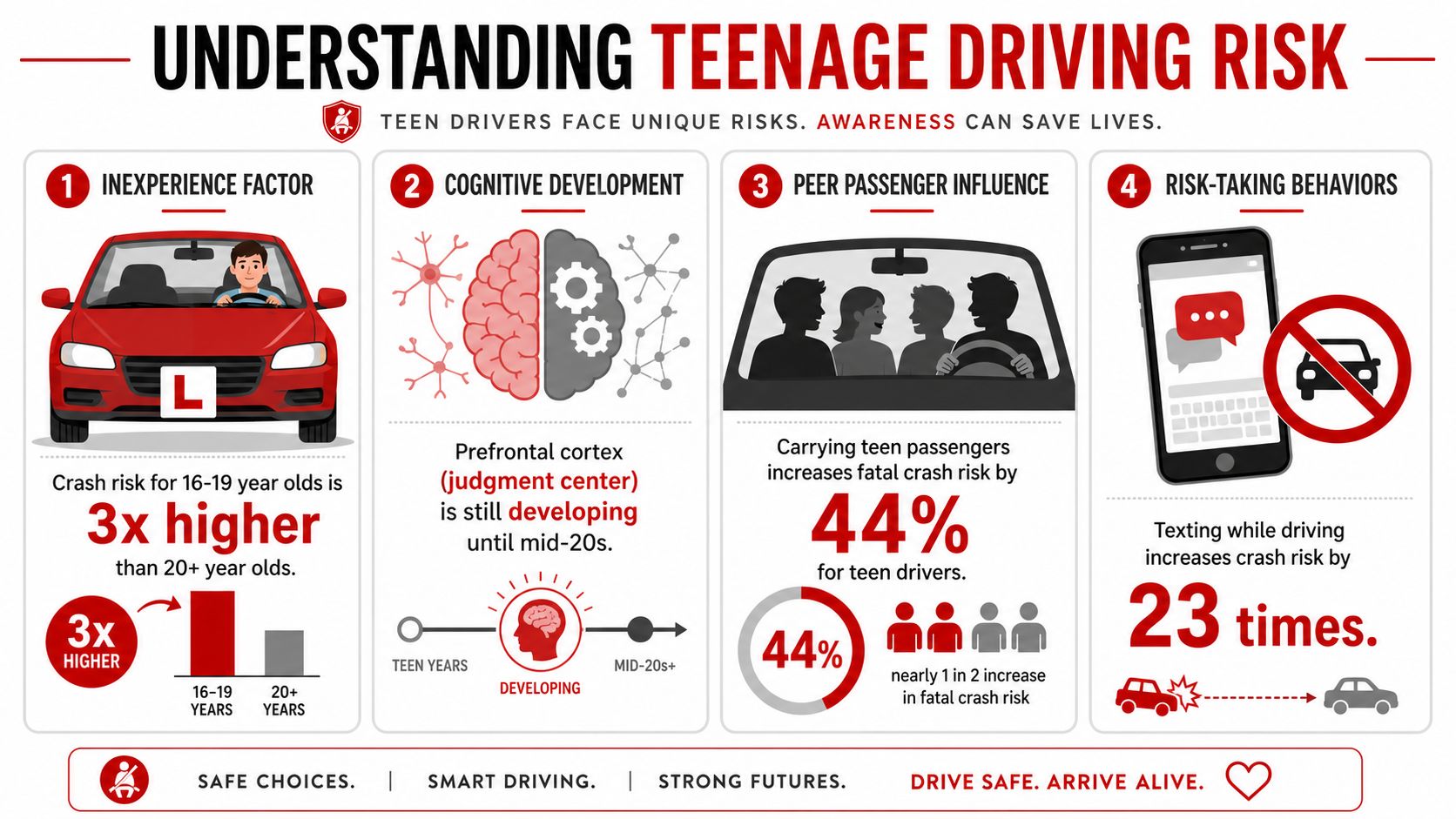
A teenager doesn't need to be reckless to be at risk. The national picture is sobering: the fatal crash rate per mile driven for drivers ages 16 to 19 is nearly three times higher than for drivers 20 and older, with danger highest at ages 16 to 17 according to the CDC's teen driver risk data. That gap changes how parents should think about driving. The issue isn't just freedom, convenience, or getting to school on time. It's risk management in one of the most complex tasks a teen does alone.
Many families focus on the obvious rules first: no texting, wear a seat belt, be home by curfew. Those rules matter. But teenage driver safety works best when parents build layers. Good instruction matters. Repetition matters. Clear household agreements matter. So does the vehicle itself, and increasingly, so does what the car can tell you through GPS and telematics.
That's where many guides stop short. They talk about broad rules but not how to spot the early signals of unsafe habits inside the vehicle. Hard braking, rapid acceleration, sharp cornering, late-night route patterns, unauthorized trips, and sudden changes in routine can all help parents coach earlier, before a mistake becomes a crash.
This guide takes a practical approach. It combines the basics parents already know with more specific, data-driven tools they can use.
Introduction to Teenage Driver Safety
Teen driving risk is easy to underestimate because most trips feel ordinary. School. Practice. Work. A friend's house. The roads are familiar, the distances are short, and the car may feel like a controlled environment. But familiarity can hide danger.
In 2023, 3,048 teenagers ages 13 to 19 died in U.S. crash injuries, and motor vehicle crashes remain the second leading cause of death for U.S. teens according to the CDC's overview of teen driver risk factors. That fact alone should reshape the conversation at home. Driving isn't just another milestone. It's a safety skill that requires structure.
Parents often get confused about why teen crashes happen at such high rates when many teens know the rules. The answer is that knowing a rule and applying it in real time are different things. A new driver has to scan mirrors, judge speed, watch traffic signals, notice pedestrians, read road conditions, and resist distraction, all at once. Adults do much of this automatically because they've repeated it for years. Teens usually haven't.
Practical rule: Treat the first year of independent driving like a training period, not a finished product.
A strong family plan includes three layers. First, build skill through supervised practice and realistic coaching. Second, reduce exposure to the riskiest situations with household rules and passenger limits. Third, use in-car technology to verify what is occurring on the road, not just what everyone hopes is happening.
That layered approach is what gives parents influence. Not fear. Not lectures. Influence.
Understanding Teenage Driving Risk
A teen crash usually starts before the moment of impact. It starts with a missed cue, a rushed decision, or a task load that became too heavy too fast.
For parents, that point matters because it changes the goal. The goal is not to ask whether your teen is a good kid or whether they know the rules. Instead, the question is whether they can apply those rules in traffic, in weather, at night, with passengers, and under time pressure. The CDC's teen driving risk page shows how serious that gap is. Drivers ages 16 to 19 have a fatal crash rate per mile driven that is nearly three times higher than drivers 20 and older, and the highest risk falls on ages 16 to 17. The same CDC source notes that teen crash deaths have dropped under graduated licensing policies, which is a strong sign that structure and limits reduce harm.
Why inexperience creates real danger
Driving works like juggling while solving small problems every few seconds. A teen has to judge distance, check mirrors, watch signal timing, read other drivers, and keep the car positioned correctly, all while staying calm. Adults often forget how much of that became automatic over time.
That is why inexperience matters so much. CDC researchers attribute much of teen driving risk to inexperience and immaturity, which often appear as weak hazard scanning, poor speed judgment for conditions, and distraction. Those are not vague traits. Parents can see them.
A teen may obey the posted speed limit and still enter a curve too fast for rain. They may look ahead and still miss a cyclist near the shoulder. They may check a phone for one second and fail to notice brake lights stacking up.
Why ages 16 to 17 need the closest guardrails
Parents sometimes assume the earliest licensing years are safer because teens are watched more closely. In practice, those years carry the highest risk because supervision does not replace repetition. A careful teen can still freeze when traffic gets complicated, much like a student who understands math homework but struggles during a timed test.
This is one place where monitoring can support teaching. Reviewing a teen's driving route history can show whether they are taking late-night trips, choosing fast multi-lane roads before they are ready, or making detours that add stress and decision load. That kind of information helps parents coach the next drive with specifics instead of guessing from memory.
What risky driving looks like in plain language
Parents do not need a long theory lesson. They need signs they can spot, measure, and discuss.
| Risk pattern | What it often looks like | What to monitor or discuss at home |
|---|---|---|
| Weak hazard scanning | Late braking, rolling through turns, missing pedestrians or cyclists | Ask what the teen saw 8 to 12 seconds ahead and check for repeated hard-braking events |
| Poor speed judgment | Taking curves too fast, following too closely, failing to slow for rain or congestion | Review speeding alerts, road type, and whether speed matched conditions, not just the posted limit |
| Distraction | Delayed starts at lights, drifting within the lane, uneven speed | Set phone rules and compare trip events with the time and place they occurred |
| Immature decision-making | Showing off with friends, rushing, taking unnecessary trips | Limit passengers, track trip timing, and review why the trip happened in the first place |
The useful shift is simple. Treat risk as observable behavior, not personality.
When families combine direct coaching with telematics signals such as hard braking, speeding patterns, trip timing, and route choice, they get a clearer picture of what needs work. Real-time GPS and trip records do not replace trust. They work like a dashboard warning light. They show where attention is needed before a close call turns into a crash.
A teen is safest when freedom expands at the same pace as demonstrated skill.
Proven Safety Practices
Parents don't need a perfect system. They need repeatable habits that build judgment before freedom expands.
One useful benchmark comes from the crash patterns themselves. About 75% of serious teen driver crashes stem from three errors: not scanning for hazards, going too fast for conditions, and distraction. Teen distraction also raises crash risk fourfold compared to adults, according to Safe Teen Driving statistics. That tells parents where to focus practice time.
Start with formal instruction
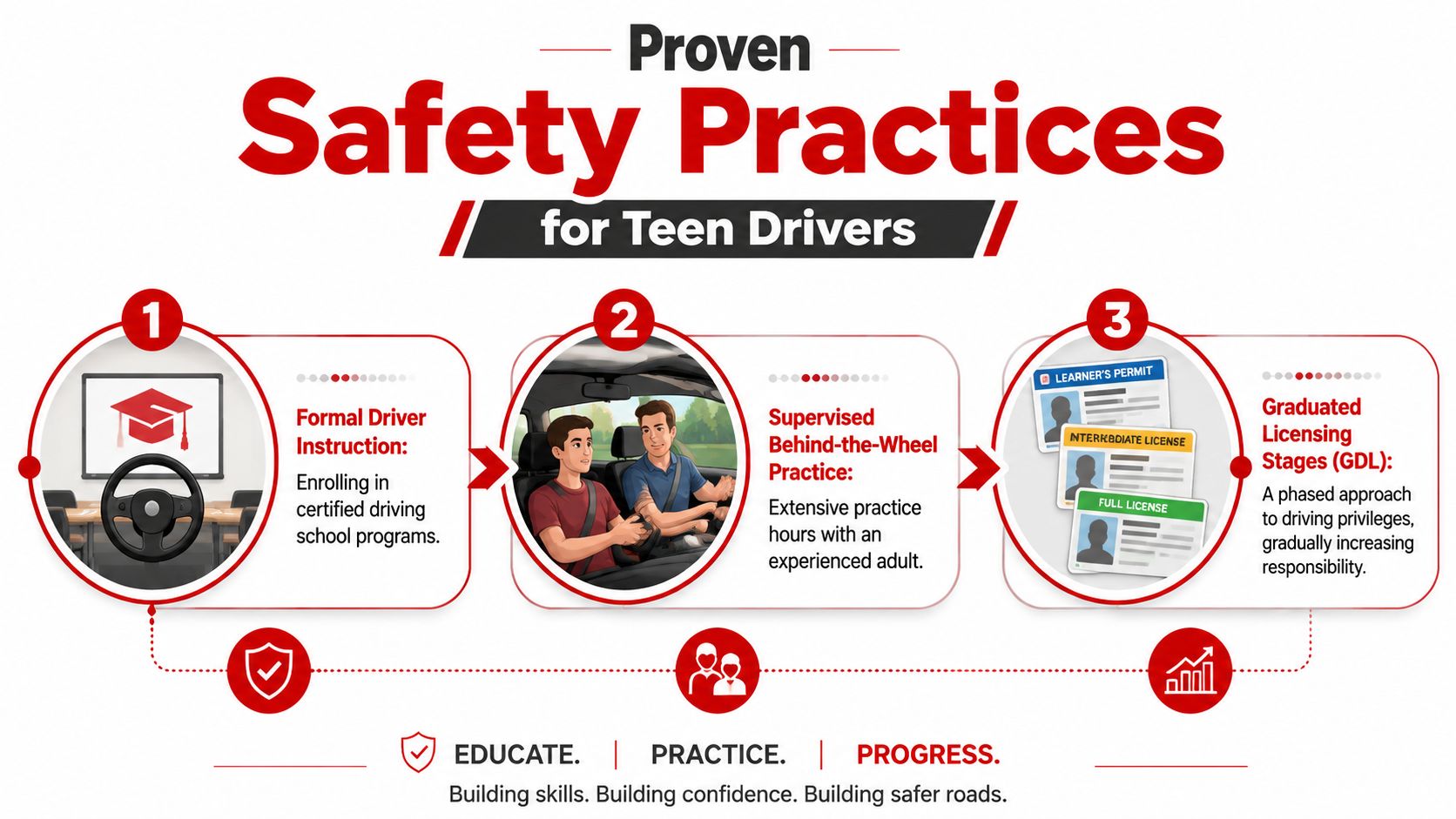
A good driving school does more than help a teen pass the test. It gives them a system for scanning, spacing, lane choice, and anticipating problems before they develop.
When you compare options, don't just ask whether the instructor is licensed. Ask how they teach hazard recognition, how they handle bad-weather instruction, and whether they cover parking lots, merges, left turns across traffic, and night driving. You want a program that teaches decision-making, not one that only drills the exam route.
Some families also look into insurance discounts with defensive driving because the course framework can reinforce the same habits teens need on the road: planning ahead, managing following distance, and reducing surprise.
Make supervised practice more specific
A lot of parent-supervised driving time is too passive. The teen drives. The parent watches. A correction happens only when something goes wrong. That's better than nothing, but it's not enough.
Use short, focused practice sessions. Each drive should have one main goal.
- Scan training: Ask your teen to narrate what they see every few minutes. Intersections, brake lights, parked cars, crosswalks, blind spots.
- Speed judgment: Practice the difference between posted speed and safe speed. A neighborhood hill, a wet curve, and a crowded school pickup line all teach this.
- Distraction control: Keep the cabin quiet during difficult maneuvers. No music changes, no food, no phone handling.
Coaching cue: If your teen makes a mistake, ask what they saw and when they saw it. That question teaches awareness better than “Why did you do that?”
Later, once the basics are steady, add more demanding environments. Busy arterials. Highway merges. Nighttime glare. Rain. Construction zones. Short, repeated exposures usually teach more than one long, exhausting drive.
A practical way to support that process is to keep the family vehicle under closer observation. Some parents pair supervised practice with tools that also monitor unauthorized movement, tampering, or vehicle use outside expectations through systems designed for car security monitoring.
Respect the graduated model
Graduated licensing works because it limits complexity while skill grows. That principle should continue at home even when the law becomes less restrictive.
A simple household progression often works well:
- Phase one: Solo drives only to school, work, and family errands.
- Phase two: Add familiar social trips during daylight.
- Phase three: Add night driving, passengers, and longer routes only after consistent safe behavior.
This video offers a helpful visual reminder of the habits that should stay central during every phase.
A teen usually experiences restrictions as limits. Parents should frame them differently. Restrictions are training wheels for judgment.
Real-World Success Stories
A household plan becomes easier to follow when parents can picture what it looks like in daily life. These examples are realistic composites, not statistical case studies. They show how families often apply the same principles in very different settings.
The suburban family that used a driving contract
One family with a newly licensed 16-year-old found that arguments kept starting over “quick trips” after dark. The parents stopped negotiating trip by trip and wrote a simple contract instead. School, practice, work, and errands were allowed. Social driving required advance approval. Night driving stayed limited until the teen showed consistency.
The most useful part wasn't the paper itself. It was the routine. Every week, they reviewed whether the teen followed the plan, handled time pressure well, and stayed honest about destination changes. The contract reduced emotional debates because the rule was already set before the keys came out.
The rural household that over-practiced on purpose
A rural parent knew their teen would soon face narrow roads, wildlife, poor lighting, and longer stretches without help nearby. Instead of rushing licensure, they kept supervised practice going well beyond the minimum expectations in their state.
They repeated the same routes in different conditions. Dry daylight first. Then dusk. Then rain. Then busier traffic days. That repetition built familiarity, and familiarity freed up mental attention for scanning and judgment. By the time the teen drove alone, fewer situations felt new.
The tech-focused parent who coached behavior, not just destination
Another parent cared less about where the teen was going than how the car was being driven. They used telematics alerts to flag hard braking and other aggressive inputs, then held short nightly conversations about what had happened. Not accusatory. Specific.
Sometimes the explanation was harmless. A cut-off driver. A missed turn. A sudden stop in traffic. Sometimes it revealed a pattern, like rushing to avoid being late or braking late because the teen wasn't looking far enough ahead. That's where technology helped most. It turned vague suspicion into a coaching moment tied to an actual trip.
A useful family rule is to review events while they're fresh and calm, not days later when nobody remembers the details.
Parental Agreements and Household Plan
A parent-teen driving agreement works best when it reads less like a threat and more like an operating manual. The goal isn't to control every move. It's to remove ambiguity before the stressful moment arrives.
Passenger rules deserve special attention. The presence of peers changes risk in a measurable way: fatal crash risk for teen drivers quadruples with three or more passengers under 21, while the presence of an adult passenger age 35 or older decreases risk by 62%, according to the AAA Foundation's research on teen drivers and passengers. That's why a vague rule like “don't overload the car” isn't enough. A precise limit is better.
What your agreement should include
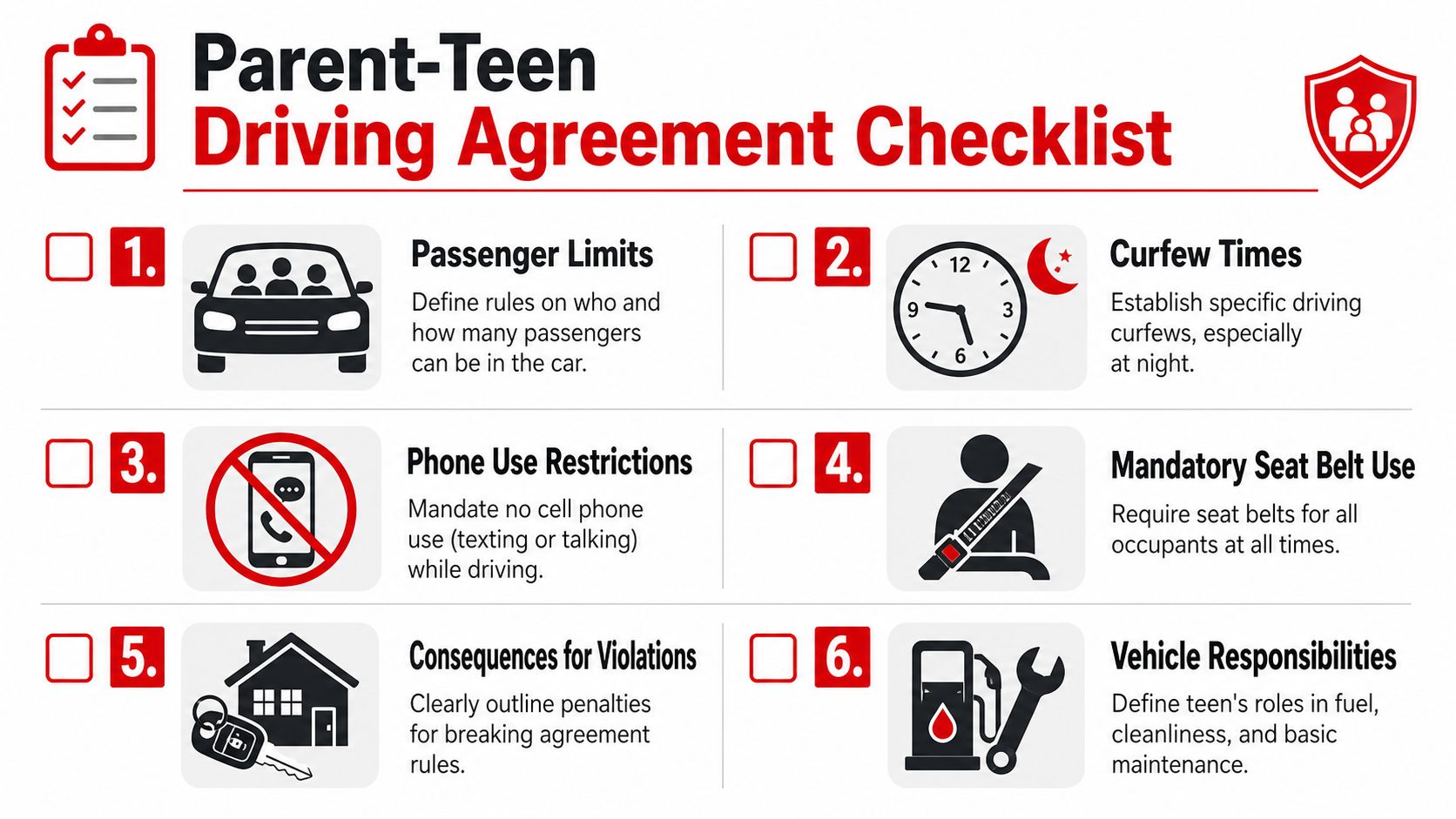
A useful agreement answers the questions that usually trigger conflict.
- Passenger limits: Specify who can ride, when, and under what conditions.
- Curfew: Set a return time, not just a departure time.
- Phone rule: Require the phone to stay untouched while the car is moving.
- Seat belts: Require every occupant to buckle before the car leaves.
- Destination changes: Make clear whether a new stop needs prior approval.
- Vehicle care: Assign responsibility for fuel level, cleanliness, and reporting warning lights.
If you're using app-based monitoring, include that too. State what will be reviewed, what triggers a conversation, and what counts as a serious violation. A parent who uses connected vehicle tools can review trips, alerts, and settings through a vehicle monitoring app rather than relying on memory or guesswork.
How to write rules teens will actually follow
Overly broad rules create loopholes. Overly harsh rules invite hiding. The middle ground is better: clear, simple, consistent.
Here's a stronger version of common household rules:
| Weak rule | Better rule |
|---|---|
| Don't stay out late | Be parked at home by the agreed curfew unless you call first |
| Don't drive distracted | Phone stays out of reach and unused for the entire trip |
| Don't pile in friends | No teen passengers unless specifically approved |
| Drive safely | No aggressive acceleration, hard braking from inattention, or sharp cornering for fun |
Build a review rhythm
The agreement matters less than the follow-through. A family check-in once a week is often enough. Keep it brief. Review whether the teen followed curfew, carried passengers, handled route changes responsibly, and stayed calm behind the wheel.
Consequences should also be predetermined. Not invented in anger. Losing night-driving privileges for a period is clearer than a lecture. Requiring extra supervised drives after repeated poor decisions is more educational than taking away the car indefinitely without a plan to earn trust back.
Household standard: The agreement should be easy to explain, easy to remember, and hard to argue with.
Parents sometimes worry that formal rules will damage trust. In practice, many teens prefer knowing exactly where the line is. Ambiguity creates more conflict than structure does.
In-Car Safety Tech and Monitoring
Good monitoring doesn't replace parenting. It sharpens it.
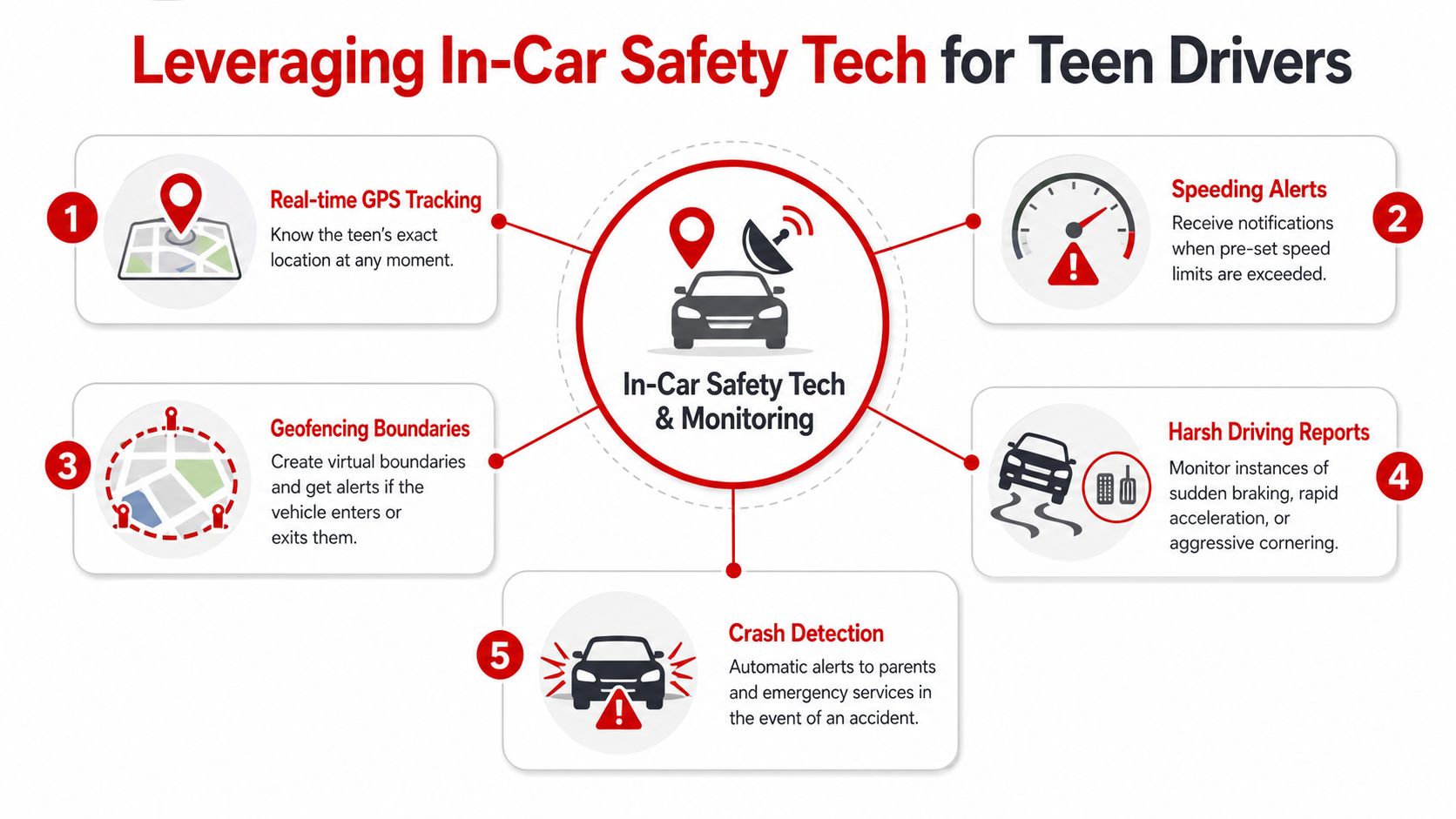
One of the biggest gaps in many teenage driver safety discussions is the lack of concrete, data-driven guidance on unusual driving behaviors such as harsh acceleration, hard braking, and aggressive cornering. These patterns can correlate with crash risk and are now measurable through modern telematics, as highlighted in the Young Driver Safety Fact Sheet from Safe Roads. That matters because risky driving often starts as a pattern, not a single dramatic event.
What telematics can reveal that parents usually miss
A parent may know the destination and still miss the behavior. The teen got to school. Fine. The teen came home on time. Also fine. But if the trip included repeated rapid starts, abrupt stops, or hard cornering, those are signs worth discussing.
That's where a device-based system can help. Features such as real-time alerts and device functions for vehicle monitoring can show engine starts, towing or vibration activity, tampering, trip history, and behavior-based driving alerts. Used well, those signals support coaching rather than surveillance for its own sake.
A simple setup strategy for families
Start narrow. Don't monitor everything at once or react to every alert like a crisis.
Use this order:
- Location awareness first: Confirm the car is where it should be and moving when it should be moving.
- Trip timing second: Notice late-night use, unplanned stops, and patterns that don't match the family agreement.
- Behavior alerts third: Review hard braking, acceleration, and cornering as learning signals.
The goal is pattern recognition. One hard brake could mean another driver cut in. A string of similar events across several days may mean the teen is following too closely or driving in a rushed state.
How to talk about alerts without turning tech into a fight
Families get the most value when they agree in advance on what the technology is for. Safety coaching is a better frame than punishment. If every alert becomes an accusation, teens start focusing on avoiding detection instead of improving judgment.
Try a short debrief formula:
- What happened on this trip
- What did you notice before the event
- What could you do earlier next time
That last question matters. It shifts the focus from blame to skill.
Monitoring works best when the teen knows the rules, knows the device is there, and knows each alert leads to a calm conversation first.
GPS insights can also help with curfew enforcement and unauthorized use. If a teen says they're driving straight home but the vehicle stops elsewhere, that's not just a trust issue. It may also reflect peer pressure, impulsive decision-making, or route choices that raise exposure to riskier situations.
Used carefully, telematics turns “How was driving?” from a vague question into a specific one.
Insurance Legal and Emergency Preparedness
The last layer of protection matters because prevention isn't perfect. A family should plan for the ordinary problems and the serious ones: a dead battery, a flat tire, a warning light, a minor crash, a legal issue, or a late-night call no parent wants to get.
Seat belts belong at the center of that plan. In 2024, 51% of teen drivers who died in traffic crashes were unbuckled, according to NHTSA's teen driving guidance. Parents often treat seat belt use as a basic habit that doesn't need discussion. The data says otherwise. It needs to be explicit, checked, and a strict requirement.
Insurance and legal planning at home
Insurance conversations usually focus on cost first. A better order is exposure, restrictions, and documentation. Make sure your teen understands the conditions under which they are allowed to drive the insured vehicle, what to do after a collision, and whom to call first.
Keep a printed glove-box card with these basics:
- Emergency contacts: Parent or guardian, roadside help, and insurer claim line
- Crash steps: Move to safety if possible, call emergency services when needed, exchange information, and avoid guessing fault at the scene
- Medical caution: Report pain, dizziness, or confusion, even if the crash seems minor
If your state uses graduated licensing restrictions, keep those rules visible at home. Curfews, passenger rules, and other limits are easy for teens to forget when plans change quickly.
Some families also prepare for the legal side of worst-case scenarios. If impairment ever becomes part of the picture, a practical resource like Steps after a teenager's DWI arrest can help parents understand what actions to take next.
Emergency readiness inside the car
A teen driver shouldn't have to improvise during a breakdown. Build a small emergency kit and show them how each item is used. Don't just place it in the trunk and assume that's enough.
A practical kit usually includes:
- Visibility items: Flashlight and reflective markers
- Basic support: Phone charging option, water, and weather-appropriate extras
- Documentation: Insurance card, registration, and emergency instructions
- Vehicle awareness: Simple guidance on warning lights, safe pull-over choices, and when not to continue driving
Vehicle condition matters here too. A parent who watches for low battery or abnormal behavior can often catch issues before they strand a teen. Tools that report vehicle health signals and battery-related issues can add another layer of awareness, especially for older family cars.
A short response plan every teen should know
When stress spikes, memory narrows. That's why teens need a script.
Teach them to remember this sequence:
- Stop safely
- Call for help
- Stay visible
- Share facts, not guesses
- Wait for instruction if unsure
That kind of planning may feel excessive when everything is going well. But emergency preparation is like a spare tire. Its value shows up when the normal plan breaks.
Conclusion and Next Steps
Teenage driver safety works best when families stop looking for a single fix. One rule won't do it. One app won't do it. One good driving lesson won't do it either.
The strongest approach is layered. Teach the skill carefully. Limit the highest-risk situations early. Write down the household rules. Review actual driving behavior, not just destinations. Prepare for legal, insurance, and emergency realities before a crisis forces the conversation.
Parents don't need to control every mile. They do need a system. When a teen knows the rules, understands the reasons behind them, and gets calm feedback tied to real trips, safer habits become much more likely to stick.
Start with one step today: write the agreement, schedule the next supervised drive, and decide what you'll monitor consistently.
If you want a practical way to connect household driving rules with real-time vehicle awareness, CARLOCK offers GPS tracking, trip history, tamper alerts, and harsh driving notifications that can help parents coach teenage drivers using actual driving data instead of guesswork.