

Driver’s Desk
Trailer Tracking Units Explained: How They Work
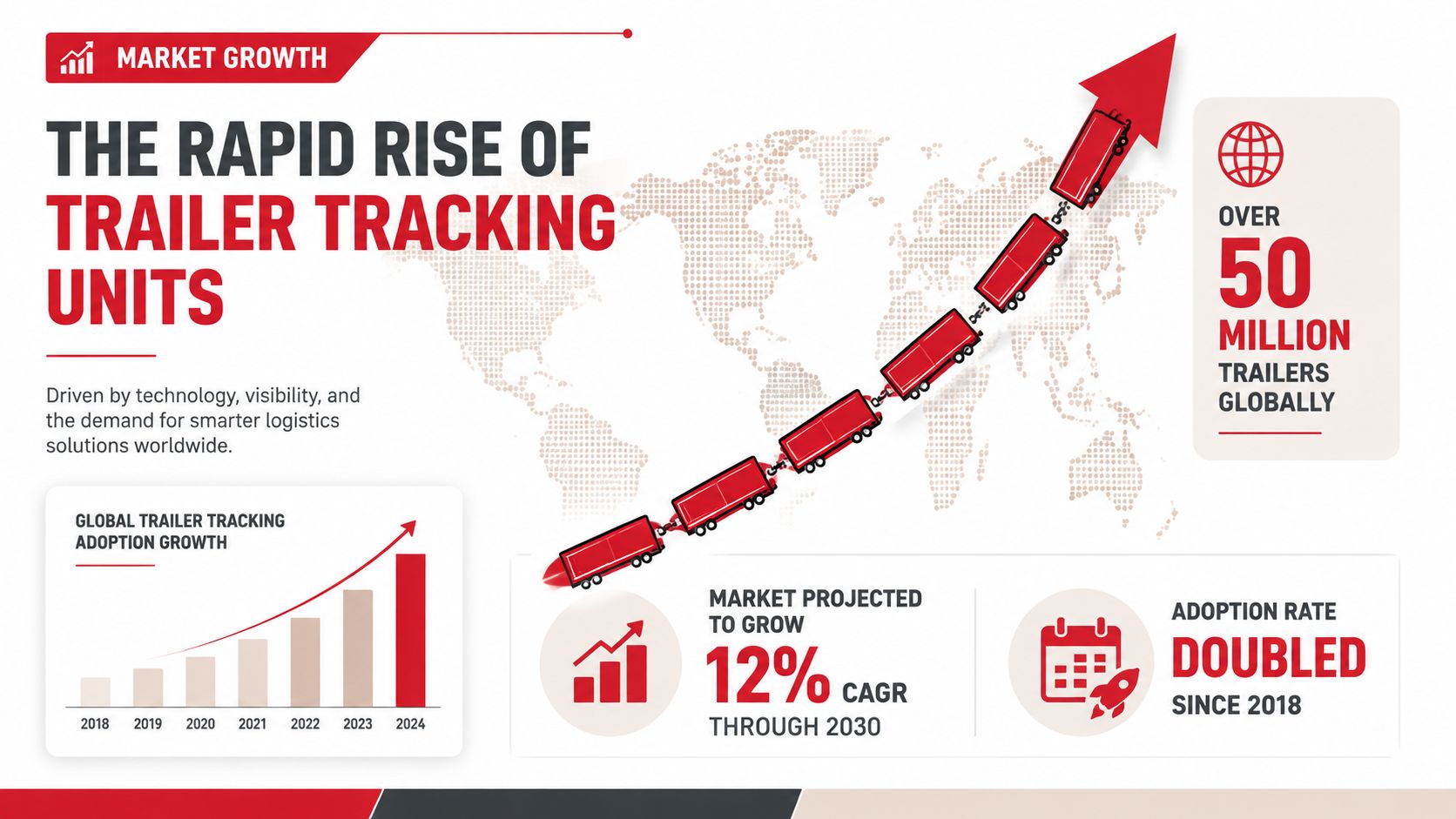
2.6 million remote trailer and cargo tracking units shipped worldwide in 2019, and Berg Insight projected that number to reach 9.3 million by 2024. That scale changes the conversation. Trailer tracking units are no longer a niche theft-recovery gadget, they're part of the operating system for freight visibility, yard control, and asset utilization across large logistics networks. Berg Insight's market report makes that shift plain.
A trailer sitting in a yard doesn't just need a dot on a map. It needs a power plan, a reporting cadence, a recovery strategy, and usually a broader set of signals than location alone. The wrong device can look fine on a spec sheet and fail the moment it's detached, parked for weeks, or moved through a weak-signal area.
The Rapid Rise of Trailer Tracking Units
Trailer tracking units moved into the operational mainstream because the use case became broader than theft recovery. Buyers now want the trailer to stay visible even when it is parked, dropped, hauled by a different tractor, or sitting outside cellular-quiet yards. That shift matters more than a market chart, because it changes how fleets think about power, maintenance, and control.
One practical reason the category has grown is that trailer visibility solves problems tractor telematics cannot touch. A tractor can tell you where the cab is. It does not help when a trailer is left behind at a cross-dock, turned over to a different carrier, or lost in a yard full of nearly identical assets. The tracker becomes part of daily dispatch discipline, not just a recovery tool.
The business case also changes once you start caring about how a trailer is used. High-turn trailers can tolerate more frequent reporting because they are moving often and getting charged or serviced more regularly. Low-utilization assets need a different power plan, longer battery life, and reporting logic that does not burn through reserves while the trailer sits idle. That trade-off is where a lot of buyer guides stay too vague.
Why fleets keep deploying them
The growth in cargo-carrying unit tracking reflects a simple reality. Fleets, shippers, and logistics operators want more than a location ping. They want to know whether the trailer is moving, parked, overdue for service, or sitting in a place where it should not be. Those are operational questions, not just security questions.
That is also why the buying criteria keep widening. A basic tracker may satisfy a theft-recovery use case, but a fleet running drop-and-hook operations usually needs a device that balances battery duty cycle, reporting latency, and condition monitoring. If the device reports too often, power drains faster. If it reports too rarely, the trailer is visible on paper but not useful in the yard. If it ignores temperature, door status, or motion events, the fleet still lacks the context that drives action.
For a plain-language contrast with consumer-facing asset awareness, see vehicle and asset awareness. Trailer deployments usually need tougher hardware and more careful power management, but the underlying idea is the same, you need awareness of where an asset is and whether it is behaving as expected.
The implication of market growth is not just more devices in the field. It is more pressure on fleets to choose the right tracker for the trailer's actual duty cycle, the reporting interval they can support, and the level of visibility the operation needs. A tracker that looks good in a procurement demo can still be the wrong choice if it cannot survive long idle periods or keep up once the trailer starts moving again.
How Trailer Tracking Units Actually Work
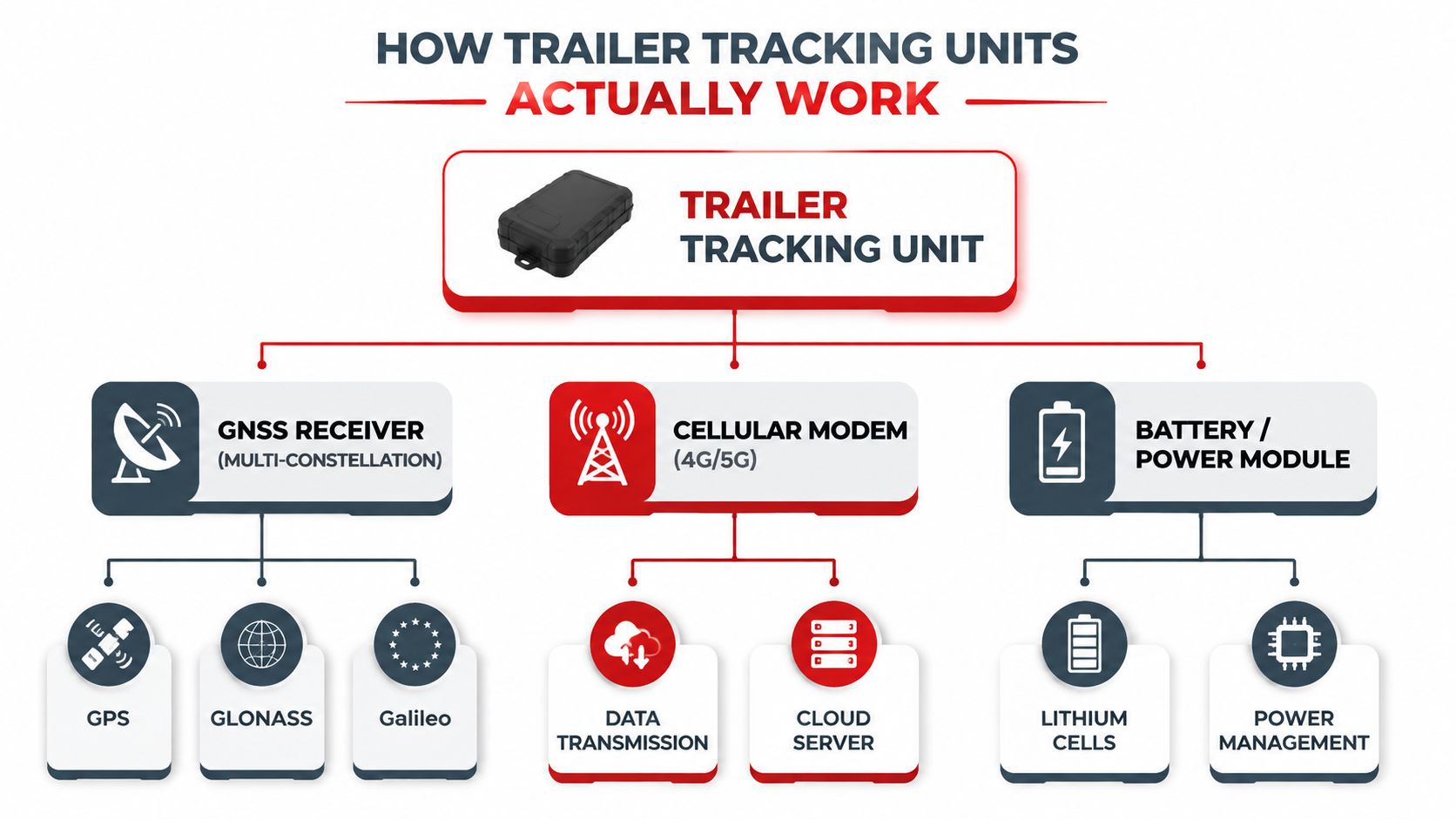
A trailer tracker is a field device, not a passive tag. It has to know where it is, send that information without help from a nearby phone, and survive long stretches without tractor power. That's why modern industrial units rely on GNSS, cellular connectivity, and a power system designed for idle time, not just motion. Representative hardware specs
The hardware stack that matters
The location engine is usually a multi-constellation GNSS receiver, which means it can use more than one satellite network to keep a fix in harder environments. Representative industrial hardware advertises tracking sensitivity around -162 to -167 dBm and hot-start performance near 1 second, which helps after tunnel exits, yard moves, or brief signal loss. That's not consumer-gadget territory. It's closer to industrial field equipment built to reacquire position fast.
The communications layer is just as important. Devices using LTE Cat 1 bis or CAT-M1 can report independently through the cellular network, so the trailer doesn't depend on a nearby smartphone or another device passing by. That distinction is why Bluetooth item finders fail for serious trailer control.
The power module is where deployment gets real. Industrial units commonly combine hardwired supply, solar assist, and large backup batteries, with examples in the 5,800 mAh to 9,600 mAh range and enclosures rated IP67 or IP69K. Some products claim standby operation of up to four months without external power. Power and enclosure examples
What the sensors actually watch
Location alone tells only part of the story. Better trailer units also watch motion, door status, connection and disconnection events, and tamper conditions. The U.S. Department of Transportation's research on an “Untethered Trailer Tracking and Control System” described near real-time trailer identification, accurate time of connection and disconnection, location and mapping of trailers, geo-fencing, and remote sensing of loaded or empty status. DOT research report
A trailer tracker has to behave like a self-sufficient field reporter. If it can't survive the yard, the weather, and the dead battery window after unhooking, it isn't doing the job.
For a product-level look at device features in a vehicle-security context, this internal page on device features shows how alerting and monitoring are usually packaged in connected security systems.
The practical takeaway is straightforward. A good trailer tracker isn't just a locator. It's a rugged reporting node that decides when to wake, what to transmit, and how long it can keep doing that when nobody's around to help it.
The Battery Life and Reporting Frequency Trade-Off
A trailer tracker that reports often gives you tighter control, but it also draws down battery power faster. A unit that sleeps longer conserves power, yet it can leave you blind during the exact window when a trailer is moved, stolen, or disconnected. The right choice depends on how the trailer is used, not on the longest battery claim in the brochure.
Why update intervals change the whole outcome
Teletrac Navman's Buyer guidance makes the trade-off clear. Faster reporting helps with theft response and asset recovery. Slower reporting extends battery life. Idle trailers, harsh weather, and unhitched storage can all shorten practical battery performance if the power plan does not fit the duty cycle.
That is the lens to use. The tracker has to match the trailer's rhythm, not the marketing copy.
In a drop-and-hook operation, a shorter reporting interval can be worth the power draw because the asset is moving through more handoffs and more risk points. In a storage yard, the same setting can be wasteful if the trailer sits in place for long stretches. A unit that works well on the road can become a weak fit once it spends most of its time parked.
The enclosure still matters. IP67 and IP69K ratings help a device survive washdown, road spray, and outdoor exposure on open trailers. Wide operating ranges such as -25°C to +70°C or -40°C to +85°C matter in freight because battery chemistry and electronics still have to function in the weather the trailer sees. Environmental examples
Questions to ask before you buy
- What happens when the trailer sits idle? Some devices look strong on the road but lose practical value during long parking periods.
- How fast does it report after movement starts? The first few minutes matter more than a polished dashboard.
- Does the battery spec assume low reporting frequency? Many specs do.
- Is the enclosure rated for the actual environment? Yard exposure is different from sheltered storage.
- Can the unit adjust intervals by motion state? That is often the cleanest compromise.
Practical rule: the right power model is the one that survives your trailer's quiet periods without making the active periods too fuzzy to use.
If you are comparing product families, the tag-based feature overview is a useful reminder that reporting logic and alert logic are part of the product, not just the battery size. The same point shows up in the business case for tracking hardware. A GPS tracker for truck ROI depends on whether the unit gives you usable alerts when the asset is in motion and enough endurance when it is not.
Battery life sounds simple until a theft happens during the exact window the device was asleep. That is why interval strategy matters more than the phrase “real-time.”
Beyond Location and Operational Visibility
Location is useful, but it's not the whole job. A trailer can be exactly where it should be and still be compromised, misused, over-opened, warm when it shouldn't be, or overdue for maintenance. That's why modern trailer telematics has moved toward condition-and-utilization monitoring, not just map pins. Geotab's trailer telematics overview lays out the broader sensor set clearly.
The signals that add real operational value
Door open and close events are often more important than a location update when cargo integrity is at stake. Cargo temperature matters in reefer operations. Tire pressure and brake health matter when the trailer is part of safety and uptime planning. Maintenance status and fault codes matter because a trailer with a hidden issue becomes a service problem later, usually at the worst possible time.
Geo-fencing adds another layer. If a trailer moves into a risk area or leaves a yard unscheduled, the alert is not just about theft. It can flag misuse, mistaken dispatch, or a broken handoff process. That's a better operational lens than waiting for a trailer to go missing entirely.
The USPS Office of Inspector General also treated Global Positioning System trailer visibility as an operational issue in postal logistics, with the report focused on improving knowledge of trailer locations and status. That's a strong reminder that this is a control problem, not only a security problem. USPS OIG report
What fleets should prioritize
Different cargoes call for different alerts. A yard trailer with high turnover may need door and movement events first. A cold-chain trailer needs temperature history and exception alerts. A fleet with expensive components or compliance exposure may care more about maintenance signals and connection status.
If the only dashboard question is “where is it,” you're leaving half the value on the table.
The vehicle health concept applies here even when the asset isn't powered by an engine. The thinking is the same. Condition signals make the system useful before failure, not after it.
Trailer tracking units have become more valuable because they don't just recover assets. They help operators prevent bad handoffs, spot misuse, and manage trailers as working equipment instead of stationary inventory.
Dedicated Vehicle Security Trackers Versus General-Purpose Alternatives
The comparison most buyers need is not between brands, it's between categories. A dedicated tracker, a general GPS unit, and a Bluetooth item finder all solve different problems. If you choose the wrong class, you'll end up with a device that looks clever and fails in the field.
What each category is built for
A dedicated vehicle security tracker is designed for continuous monitoring, motion alerts, tamper detection, and independent cellular reporting. That makes sense for trailers, cars, trucks, and other high-value assets that may be moved when nobody is nearby. A general-purpose GPS tracker may report location well, but often gives you less in the way of security logic and alert depth.
Bluetooth item finders are the weakest fit for trailer protection. They depend on nearby phones or compatible devices to relay location, so they're useful for keys, bags, and short-range recovery. They are not a serious answer for trailers parked in remote yards, underground garages, or cross-border routes.
The product class matters because the failure mode matters. If no one with a compatible phone passes close enough, a Bluetooth tag gives you nothing. If a dedicated tracker loses sight of the tractor, it still has its own GNSS and cellular link.
Where a dedicated system earns its keep
CarLock is one example of a dedicated connected security system that uses GPS and cellular connectivity, with app alerts for movement, engine start, vibration, towing, disconnection, and battery issues. It's a vehicle security product first, not a generic finder. That distinction is why it belongs in this comparison, even when the asset in question is a trailer rather than a car.
For a broader ROI perspective on connected asset tracking, the OnRoute analysis of GPS tracker for truck ROI is a useful companion read. It's especially helpful if you're trying to connect tracking features to utilization and cost control rather than only theft recovery.
Quick decision framework
- Choose a dedicated tracker when theft response, tamper detection, and continuous reporting matter.
- Choose a general GPS unit when you mainly want basic location history and can tolerate simpler alerts.
- Choose Bluetooth only for low-stakes consumer items, not for trailer security.
The cloud features view is the kind of page to study if you want to see how alert delivery and remote visibility are packaged in a security platform.
A trailer doesn't need a sentimental gadget. It needs a device that keeps working when the trailer is detached, moved without permission, or parked where no phone will ever pass close enough to help.
Selection Criteria, Costs, and Integration Considerations
A good purchase decision starts with total cost of ownership, not sticker price. Hardware is only one piece. Installation labor, data plans, mounting hardware, solar add-ons, replacement cycles, and support all affect what the system really costs over time. If a vendor can't explain those pieces clearly, that's a warning sign.
What to compare before signing
Start with coverage. A tracker that performs well in one region can be disappointing in another if cellular service is weak on the lanes you run. Ask vendors which networks they support and how the unit behaves when signal drops. Also ask how data is stored, who owns it, and whether you can export it cleanly.
Integration matters just as much. If you already use a fleet management platform, the tracker should fit that workflow instead of creating a second island of data. API availability, dashboard access, and alert customization decide whether the system saves time or creates another login that dispatchers ignore.
Installation should be practical, not fragile. Mounting points need to protect the unit from impact and tampering while still allowing reliable radio performance. Hardwired devices need clean wiring and weatherproofing. Solar assist can be useful, but only if the trailer spends enough time in conditions that recharge it.
A simple procurement checklist
- Ask for the reporting options. Verify whether intervals can change by motion state.
- Check the enclosure rating. Exposure on the road is different from indoor storage.
- Confirm the battery strategy. Backup capacity matters when trailers sit unhitched.
- Review alert types. Movement, tamper, door, and maintenance signals each solve different problems.
- Test the software flow. A strong tracker with a weak dashboard still causes missed action.
The cheapest device is often the one that gets installed and then ignored because the data is too slow, too noisy, or too hard to use.
This is also where data privacy and ownership need real attention. Dispatchers, maintenance teams, and security staff should know who sees what and how quickly. If a vendor can't explain permissions cleanly, expect confusion later.
Trailer tracking units are easier to justify when the system fits the fleet's actual workflow. Matching hardware, coverage, software, and installation quality is the difference between a tool that gets used and one that becomes shelfware.
Common Deployment Pitfalls and Frequently Asked Questions
Most bad deployments don't fail because the technology is weak. They fail because the settings, environment, or expectations are wrong. A tracker can be installed correctly and still disappoint if the reporting interval is too slow for the risk profile, the battery model doesn't fit the idle pattern, or the yard has patchy cellular coverage.
I've seen fleets assume a solar unit will "take care of itself" in every climate. That's not a safe assumption. Winter light conditions, parked orientation, and long dwell periods can all change how much value solar assist adds. The same goes for cross-border routes, where roaming behavior should be tested before the fleet depends on it.
Common questions from operators
What if thieves find and remove the tracker?
That's why tamper alerts and hidden mounting matter. The best response is layered visibility, not a single device in an obvious spot.
Can international fleets rely on one configuration?
Not always. Coverage and roaming need to be tested on the lanes that matter, especially if trailers cross regions with different carrier behavior.
Are solar-powered units reliable in northern climates?
They can help, but they're not magic. If trailers sit in poor light or harsh weather, the power plan needs to be evaluated against real usage, not hoped for.
Do legal issues matter when trailers are employee-driven?
Yes. Tracking policies should be clear, documented, and limited to business use cases that your organization can justify. That's an internal governance issue, not a hardware feature.
What's the biggest deployment mistake?
Assuming location data alone is enough. It isn't. Without the right reporting pace and alert logic, the system can tell you a trailer exists without helping you act in time.
The field lesson is simple. Trailer tracking units work best when they're set up around the trailer's real duty cycle, the yard's real coverage, and the business's real response time.
If you're evaluating trailer tracking for theft recovery, yard visibility, or condition monitoring, start with a system that matches the trailer's duty cycle and alert needs instead of chasing the biggest battery claim. CARLOCK brings real-time GPS tracking, tamper alerts, and cloud-connected visibility into one platform, which makes it a practical option to compare against other trailer security setups. Visit CARLOCK to review the system and decide whether it fits your fleet's operating pattern.