

Driver’s Desk
Inexpensive GPS Tracking Devices: A Complete Buyer Guide
The most popular advice about inexpensive GPS tracking devices is also the least useful: buy the cheapest tag and attach it to the car. That advice confuses finding a parked vehicle with protecting a vehicle in motion. A Bluetooth finder may help you locate a car in a familiar parking lot, but it isn't a substitute for a cellular GPS tracker that can report movement, detect tampering, and keep working after the vehicle leaves your phone's range.
The right question isn't, “What costs the least today?” Ask instead, “What costs the least over 12 to 36 months while still delivering reliable vehicle protection?” That distinction matters because subscriptions, charging, installation, cellular coverage, alert quality, and theft recovery determine the true value of a tracker.
The market has room to grow. Berg Insight estimated 12.5 million active consumer asset-tracking units in Europe and North America in 2022, with a market value of €1.6 billion and a projected rise to €3.8 billion by 2027, equivalent to an 18.4% CAGR. The installed base was projected to reach 29.2 million units by 2027, while overall penetration remained around 1.0 percent, according to Berg Insight market figures summarized by LiveViewGPS. Cheap trackers are becoming more accessible, but low price alone doesn't make a device suitable for vehicle security.
| Tracker category | Best use | Main strength | Main weakness |
|---|---|---|---|
| Dedicated hardwired or OBD GPS | Theft recovery, fleets, teen drivers | Continuous power, cellular reporting, vehicle alerts | Subscription and installation requirements |
| Portable battery GPS | Temporary monitoring, vehicles without accessible power | Flexible placement and cellular location | Charging gaps and shorter battery life |
| Bluetooth finder | Keys, luggage, locating a parked car | Low upfront cost and simple setup | Proximity limits, no dependable vehicle tracking |
Why Cheapest Rarely Means Best for Vehicle Tracking
A low-priced Bluetooth fob can appear to be a bargain until the car moves beyond the phone or crowd network that makes the fob useful. A purpose-built vehicle tracker costs more because it has to handle a harder job, locating a moving vehicle, transmitting data over cellular networks, monitoring events, and remaining powered when the owner isn't nearby.
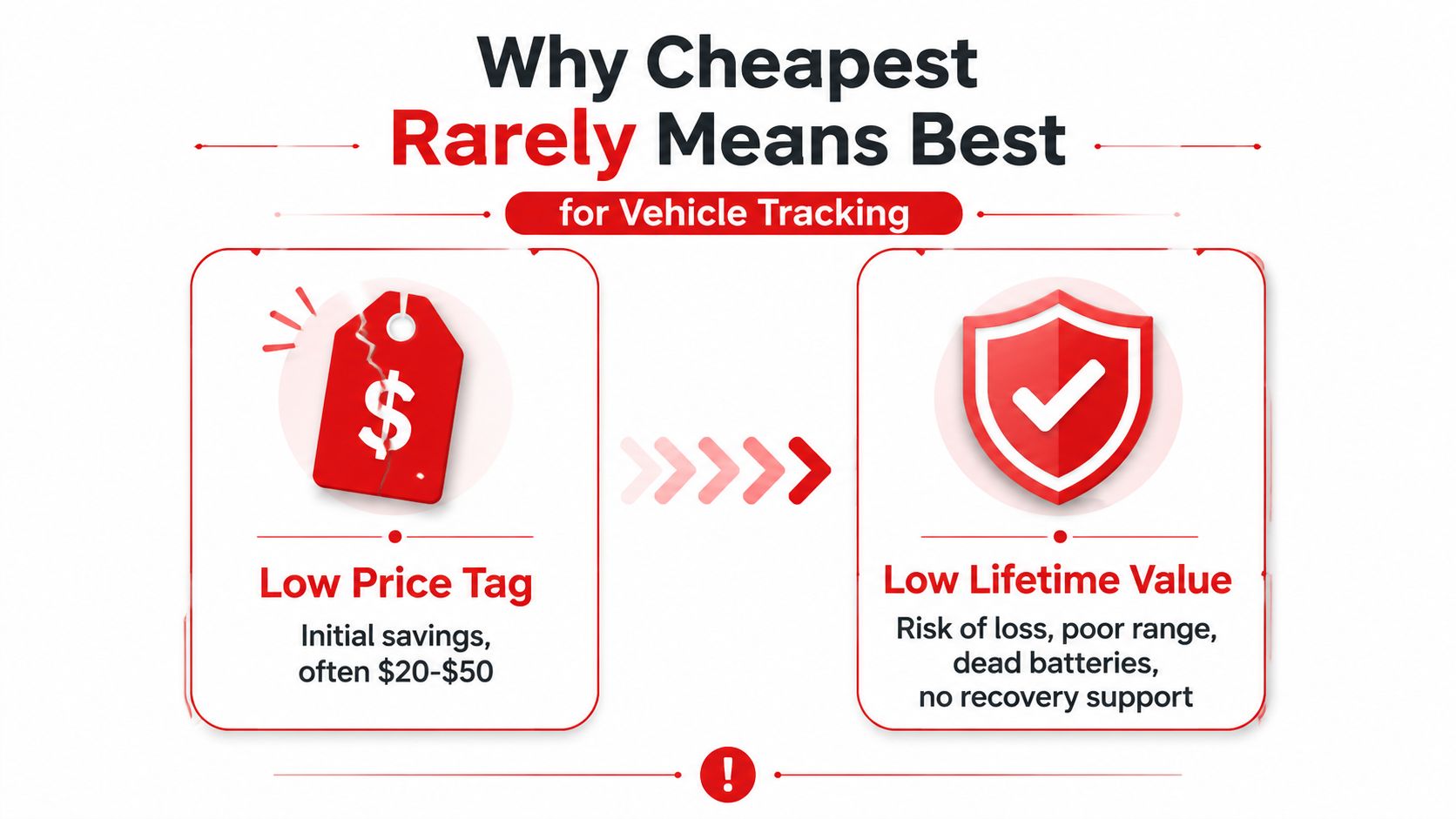
A $20 Bluetooth device might help identify where a car was last noticed by a nearby phone. It won't necessarily tell you that the vehicle was towed, started, moved outside a garage, or driven into an area with few participating devices. A hardwired unit costing more at purchase can draw power from the vehicle, send alerts through cellular service, and continue operating without depending on the owner's proximity.
The hidden price of a cheap device
The sticker price hides the costs that affect security most:
- Recurring service: Cellular GPS devices need a data connection to send location information to an app.
- Charging and maintenance: Portable devices create coverage gaps when owners forget to recharge them.
- Missed events: A finder that reports only after another phone detects it can't replace immediate movement or tamper alerts.
- Replacement risk: Devices can be misplaced, disconnected, exposed to water, or left without power.
- Recovery limitations: A location that is hours old is less useful than an alert received when the vehicle first moves.
Vehicle theft data explains why live location matters. A 2026 fleet survey reported that 80% of fleet professionals used GPS fleet tracking, up from 69% in the prior year, while roughly 850,708 vehicles were stolen in the United States in 2024, according to LiveViewGPS vehicle theft and fleet tracking data. The same industry summary reported that 85% of stolen passenger vehicles are eventually recovered, with 34% recovered the same day and 45% within two days. Those figures make speed important. A tracker that helps investigators locate a vehicle quickly serves a different purpose from a tag that merely helps an owner find a forgotten parking space.
Practical rule: Buy the least expensive device that can perform the security job you actually need. If the job includes theft recovery, a Bluetooth-only finder usually doesn't qualify.
GPS Versus Bluetooth and How Each Technology Works
The cheapest tracker can be the wrong security tool. GPS and Bluetooth solve different problems, so compare their total cost over a year or more against the protection each one provides, not the purchase price alone.
A GPS tracker calculates a position from satellite signals, then uses cellular service to send that position to an app or monitoring platform. A Bluetooth finder broadcasts a short-range signal and depends on a nearby phone or crowd-sourced network to report where it is. That makes Bluetooth useful for locating keys or a parked car, but weak for theft recovery after the vehicle leaves phone range.
Independent comparisons place typical Bluetooth direct-connect range at roughly 100 feet to 100 metres, depending on the environment. GPS and GNSS devices are built for outdoor coverage across long distances. The Bluetooth and GPS tool-tracking comparison from Milwaukee Tool identifies the practical divide: Bluetooth handles proximity, while GPS supports remote location tracking.
| Specification | GPS + Cellular Tracker | Bluetooth Finder |
|---|---|---|
| Position source | GPS or GNSS satellites | Bluetooth proximity or nearby network devices |
| Communication method | Cellular data connection | Paired phone or crowd-sourced phone network |
| Effective tracking model | Remote and long-distance | Nearby item finding |
| Vehicle movement | Can report routes and movement events | Can't reliably report a vehicle once out of range |
| Coverage limitation | Cellular dead zones and obstructed sky view | Short radio range and sparse nearby phones |
| Typical security alerts | Movement, ignition, towing, tampering, geofencing, depending on model | Proximity and separation notifications |
| Best fit | Cars, fleets, pets, and remote assets | Keys, bags, luggage, and parked-car location |
A GPS receiver can determine a location without cellular service, but it cannot deliver that location to your phone until a transmission path is available. iCarGPS explains how cellular coverage affects tracker reporting, including reporting delays in areas with poor or absent service. For vehicles that operate beyond cellular coverage, a specialized satellite device such as Maptrack's Iridium satellite tracker provides another communication route.
Security installations can combine location tracking with other identification technologies, as described in this overton security nfc gps guide. For a vehicle-focused example, CarLock device features show how dedicated hardware and app alerts support a car-monitoring setup.
Bluetooth is a finder. GPS with cellular transmission is a tracker. Choose Bluetooth when finding a nearby item is enough. Choose GPS with cellular service when the security job includes movement alerts, route visibility, or theft recovery. That distinction determines whether the lower sticker price remains inexpensive over the first year or becomes an expensive compromise.
Comparing Budget Trackers Across Vehicle Use Cases
The cheapest suitable category depends on the vehicle and the consequence of a missed update. A daily commuter that stays in a driveway needs a different setup from a landscaping fleet, a teenager's vehicle, or a classic car that sits unused for long periods.
Three categories, three operating models
A dedicated vehicle tracker connects to the vehicle's power system through an OBD port or a hardwired installation. It can remain active without routine charging and may support movement, ignition, tow, vibration, unplugging, battery, geofence, and route alerts. Hardwired devices can draw very little power, comparable to a vehicle clock or alarm system, and some include an internal backup battery that continues sending alerts after the main vehicle battery is disconnected, according to Quartix's hardwired tracking device information.
A portable GPS unit offers more placement freedom. You can hide it under a seat or mount it magnetically, but the owner must manage charging. Technical comparisons report that frequent live GPS and GSM updates can drain batteries in 1 to 7 days, while five-minute reporting can last 2 to 4 weeks and hourly reporting can last 1 to 3 months, as detailed by AirPinpoint's Bluetooth, GPS, and cellular comparison. A field study cited in the same source estimated about 42 days from a 2500 mAh battery at four location records per day.
A Bluetooth finder has the lowest maintenance burden and often no cellular subscription, but it can't provide dependable vehicle telemetry. It won't give you consistent speed, route history, ignition events, or reliable tow alerts once the vehicle leaves the relevant proximity network.
| Feature | Dedicated Vehicle Tracker | Portable Battery GPS | Bluetooth Finder |
|---|---|---|---|
| Accuracy | GPS location with event monitoring | GPS location when powered and connected | Proximity or network-assisted location |
| Power source | OBD, hardwired vehicle power, often backup battery | Rechargeable internal battery | Coin cell or rechargeable battery |
| Charging burden | Low when vehicle-powered | High relative to reporting frequency | Low |
| Connectivity | Cellular plus GPS | Cellular plus GPS | Bluetooth and nearby phones |
| Subscription | Usually required | Usually required | Often absent |
| Installation | Plug-and-play OBD or professional hardwire | Place and activate | Attach and pair |
| Theft recovery | High when alerts and power are reliable | Moderate, dependent on charging | Low for moving vehicles |
| Route history | Common feature | Common on suitable plans | Limited or absent |
| Best fit | Commuters, fleets, teen drivers | Temporary or shared vehicles | Keys, bags, and parked-car finding |
For fleet operators, an API can matter as much as the hardware. The Nimbio open API for smart fleet integration is an example of the kind of developer access teams may evaluate when they need tracking events to connect with existing software. For owners who need journey records rather than only a current location, CarLock route history illustrates the value of storing vehicle trips in an app.
Total Cost of Ownership Beyond the Sticker Price
A tracker that costs less at checkout can cost more over its useful life if it requires frequent replacement, manual charging, or a paid service. The cleanest comparison uses the total spend across the period you expect to keep the device, then asks whether the device delivered meaningful protection during that time.
Independent budget comparisons include a vehicle tracker priced below $90 with a $6.58 monthly fee, while other budget car trackers appear around $30 to $108 with subscription plans around $8 to $20 or more per month, according to Car and Driver's tested GPS tracker roundup. These figures show why a hardware-only comparison is incomplete. The recurring plan can become the larger expense.
| Tracker Type | Device Cost | Monthly Fee | Batteries per Year | 24-Month Total |
|---|---|---|---|---|
| Bluetooth finder | Low | Usually none | Coin-cell replacement varies by use | Hardware plus replacement batteries |
| Portable battery GPS | Moderate | Usually required | Recharge routine rather than simple battery swaps | Hardware plus 24 months of service |
| OBD GPS tracker | Moderate | Usually required | Vehicle powered | Hardware plus 24 months of service |
| Hardwired GPS tracker | Higher installation commitment | Usually required | Vehicle powered, often with backup cell | Hardware, installation, and 24 months of service |
Don't use unsupported model prices to create false precision. Instead, calculate the actual quote for your vehicle, include activation and installation, and ask whether the plan includes the alert types and history you need. A no-fee Bluetooth device may look cheapest, but its protection value can be close to zero if it can't report the vehicle after theft.
The value calculation that matters
Divide the total 12 to 36 month cost by the protection function you receive. A portable tracker that requires regular charging may be acceptable for a short-term rental or temporary observation. It becomes a poor security purchase when a dead battery creates an invisible period during which the vehicle can be stolen.
Cloud access also affects long-term usefulness. A tracker with CarLock cloud features can be evaluated not just by its hardware price, but by how the service handles stored trips, alerts, and remote access. The decision should be based on cost per year of dependable protection, not cost per box.
Real-World Scenarios Where Budget Trackers Fall Short
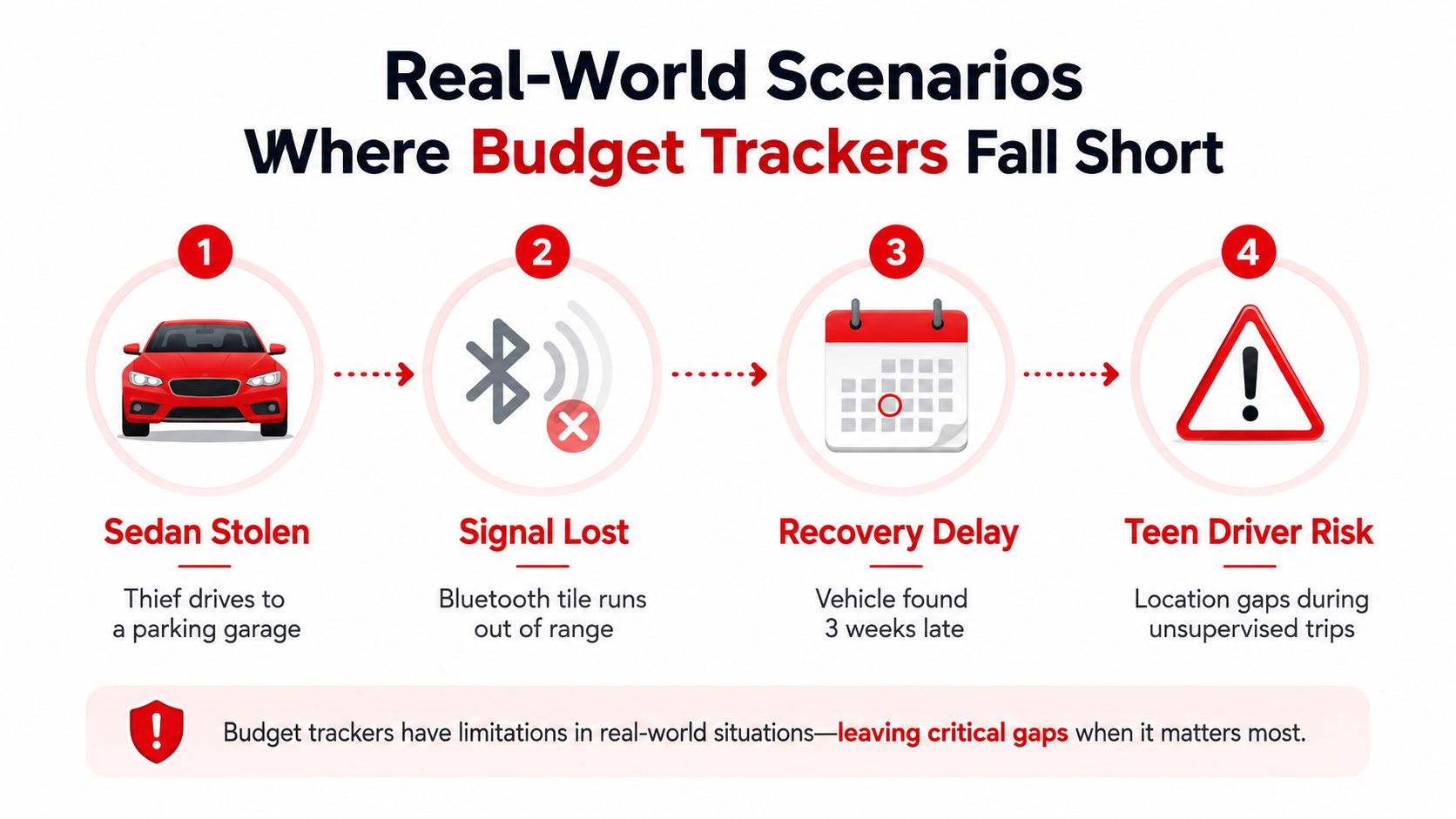
A low purchase price does not make a tracker affordable protection. Cheap hardware usually fails because it loses power, cannot transmit, misses the relevant event, or depends on a nearby phone. Judge it by the reliable protection it provides over the next 12 to 36 months, not by the box price.
Four tests that expose weak vehicle protection
A sedan leaves a parking garage. A Bluetooth tile may record its last contact with a nearby phone, then stop updating once the sedan enters a garage or a low-density area. Without an immediate movement alert, the vehicle can travel a long distance before the owner knows it is gone. A cellular tracker with concealed installation and geofencing can report movement through its own connection, subject to available cellular service.
A teenager makes short trips. A portable GPS puck can work properly on the first day and then stop reporting after its battery drains. Frequent short trips and location updates use more power than a slower check-in schedule. The owner must charge the unit, confirm that it remains mounted, and verify that alerts still work. A tracker that needs constant attention is a weak security purchase.
A landscaping fleet enters a rural job site. A cellular tracker may calculate its position from satellites while the app waits for a usable network connection. The device may know where it is, but the owner cannot see that location until transmission resumes. Check whether the tracker stores records and forwards them later, or leaves a reporting gap. That behavior affects its real protection value.
A vehicle is towed. A Bluetooth finder does not automatically recognize a tow unless its surrounding system can infer the movement. A purpose-built vehicle tracker can combine vibration, ignition, movement, unplugging, and geofence rules, depending on the model and installation. Those inputs turn a passive location tag into an event-detection system.
A security device should not require the owner to inspect its battery, mounting position, and last contact every morning. That routine puts the security burden back on the person who bought the device to reduce it.
Test the tracker before relying on it. Park in the locations the vehicle normally visits, trigger movement and ignition events, and confirm that notifications arrive. Disconnect the vehicle battery only when the manufacturer permits that test. A device that works on a desk but fails in your garage is not ready to protect the car.
For vehicle movement, tampering, and security notifications, compare the CarLock car security system with simpler item-finding devices. Calculate the total 12 to 36 month cost, including service, activation, charging effort, and installation. The cheapest option is the one that delivers dependable protection for the longest period, not the one with the lowest sticker price.
Why Purpose-Built Vehicle Trackers Outperform Consumer Devices
Consumer trackers are designed around convenience. Vehicle trackers are designed around continuity. That difference affects power, enclosure design, alert logic, installation, and the information the app can present after an incident.
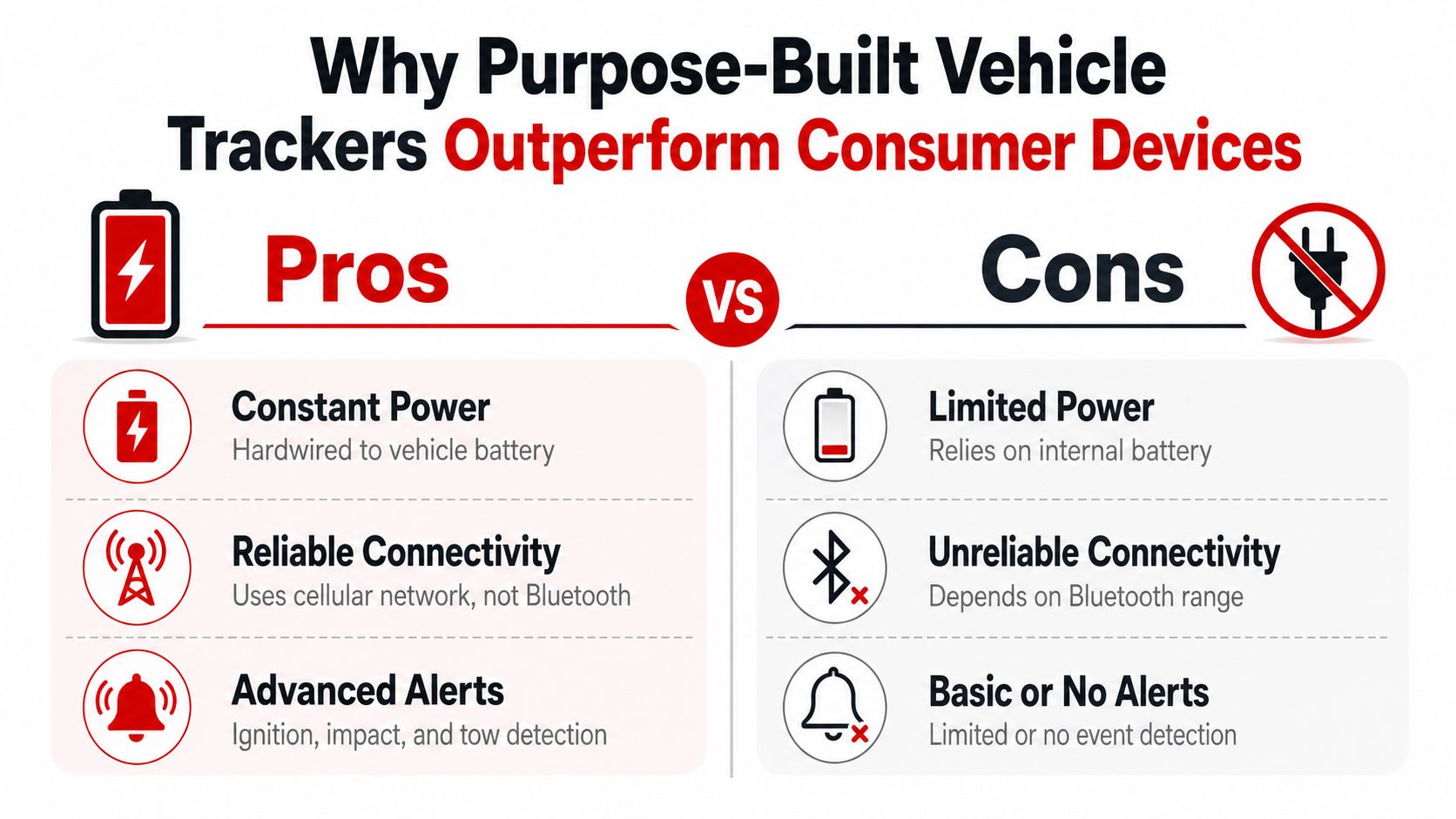
A purpose-built unit can use constant vehicle power, which removes the most common weakness of portable devices. A backup battery can preserve alerts if someone disconnects the vehicle battery. Tamper or unplug detection can notify the owner that the tracker itself has been disturbed, rather than waiting for the next scheduled location report.
What vehicle-grade hardware adds
The strongest distinction is event awareness. A dedicated system can monitor combinations of:
- Ignition activity: The app can distinguish an engine start from a vehicle that is only parked.
- Movement and vibration: The device can identify suspicious movement or impact patterns.
- Towing behavior: Unexpected movement without normal ignition activity can trigger an alert.
- Power interruption: An unplug or battery-disconnect event can indicate tampering.
- Trip history: Owners and managers can review where the vehicle traveled, not only its last known position.
- Driving behavior: Some platforms record harsh acceleration, hard braking, and aggressive cornering.
Cellular connectivity also matters in enclosed and remote environments. Bluetooth depends on short-range contact or nearby phones. Cellular GPS can continue transmitting in places where the owner's phone isn't present, although underground structures, heavy obstruction, and poor cellular coverage can still delay reporting. Satellite-backed products extend that model further by switching to satellite networks when cellular service disappears, but that capability belongs to a different product class and cost structure.
Hardwired systems aren't perfect. Installation may require access to the fuse box and a concealed mounting point. An OBD device is easier to install but can be visible and removable. Monthly service fees add to ownership cost, and some vehicles may require careful placement to avoid interference with other equipment.
The engineering environment is different too. A car exposes electronics to vibration, temperature changes, electrical fluctuations, and accidental contact. Purpose-built trackers account for those conditions more directly than a tiny consumer tag intended for a wallet or key ring.
The embedded video below provides another visual overview of vehicle tracking and security considerations.
The decision is simple: choose a consumer finder when you want to locate an object. Choose a vehicle tracker when you need the car to report its own condition and movement.
Choosing the Right Tracker and Getting Started
Start with the consequence of failure. If a missed update means you can't find your keys, Bluetooth is sensible. If it means losing a vehicle, missing a tow, or losing visibility of a teenage driver's trip, use a cellular GPS category with dependable power and event alerts.
| Buyer Profile | Recommended Tracker Type | Must-Have Features | Avoid |
|---|---|---|---|
| Teen driver household | OBD or hardwired vehicle tracker | Geofences, movement alerts, trip history, driving event monitoring | Portable units with uncertain charging |
| Small fleet operator | Hardwired or OBD fleet tracker | Multi-vehicle dashboard, route history, tamper alerts, cellular reporting | Bluetooth-only devices |
| Daily commuter | OBD or concealed hardwired GPS | Ignition, movement, towing, and power-loss alerts | A finder marketed as full anti-theft protection |
| Classic car owner | Hardwired or carefully hidden portable GPS | Low-power operation, backup battery, tamper detection | Devices that require frequent manual charging |
| Short-term rental owner | Portable GPS or OBD tracker | Easy activation, geofencing, trip records, simple removal | Permanent installation when vehicles change hands |
| Item and parking finder | Bluetooth finder | Separation alerts, nearby sound, phone-network location | Expecting live route or theft telemetry |
Use this pre-purchase checklist
- Subscription transparency: Confirm the monthly service, billing term, activation cost, cancellation rules, and what happens if the plan ends.
- Update behavior: Ask how often the device reports in live mode, not only its longest advertised battery setting.
- Power resilience: Look for vehicle power, backup battery operation, and a clear power-loss alert.
- Tamper detection: Confirm whether unplugging, removal, movement, towing, or ignition events generate separate notifications.
- Coverage: Check the cellular networks used in the places your vehicle travels. GPS calculates the position, but the service still needs a transmission route.
- Weather resistance: Match the device's protection rating to its mounting location, especially for exposed or underbody installations.
- App usefulness: Review whether the app provides route history, geofences, alert controls, and multiple-user access.
- Installation: An OBD unit can be connected quickly, while hardwired equipment needs fuse-box access and a concealed location. Use a qualified installer if you aren't comfortable working around the vehicle's electrical system.
Activation should take a deliberate three-step process. First, pair the device and confirm that the app shows the correct vehicle. Next, configure the vehicle profile, authorized users, geofences, and notification channels. Finally, test each alert threshold by moving the vehicle, starting the engine, and checking the response, then record the device's last reported location.
For app-based monitoring, CarLock app features offer an example of the controls buyers should examine before choosing a vehicle-security platform. Don't activate a tracker and assume it works. Test it in your driveway, garage, workplace, and regular travel areas before trusting it with theft recovery.
The best inexpensive GPS tracking device isn't always the one with the lowest price. For a car, it should be the least expensive option that remains powered, connected, difficult to remove, and capable of sending the alert you need when nobody is standing nearby.
CARLOCK offers a vehicle-focused GPS tracking and security system with smartphone alerts for movement, ignition activity, vibration, towing, tampering, and abnormal battery conditions. Visit CARLOCK to compare its vehicle-tracking features with inexpensive Bluetooth finders and portable GPS devices before choosing your protection setup.