

Driver’s Desk
Vehicle Theft Deterrent System: How Modern Protection Works
A motor vehicle is stolen every 48 seconds in the United States, so a vehicle theft deterrent system matters because theft is a recurring risk, not a remote possibility. Effective protection combines prevention, interruption, alerts, and recovery rather than relying on one alarm or lock.
A thief may attack the vehicle in stages. They may force entry, defeat a keyless system, start the engine, tow the car, or move it somewhere owners and police can't easily see. Each stage creates a different security problem, which is why the strongest approach uses several layers that work together.
Why Vehicle Theft Is Still a Daily Problem
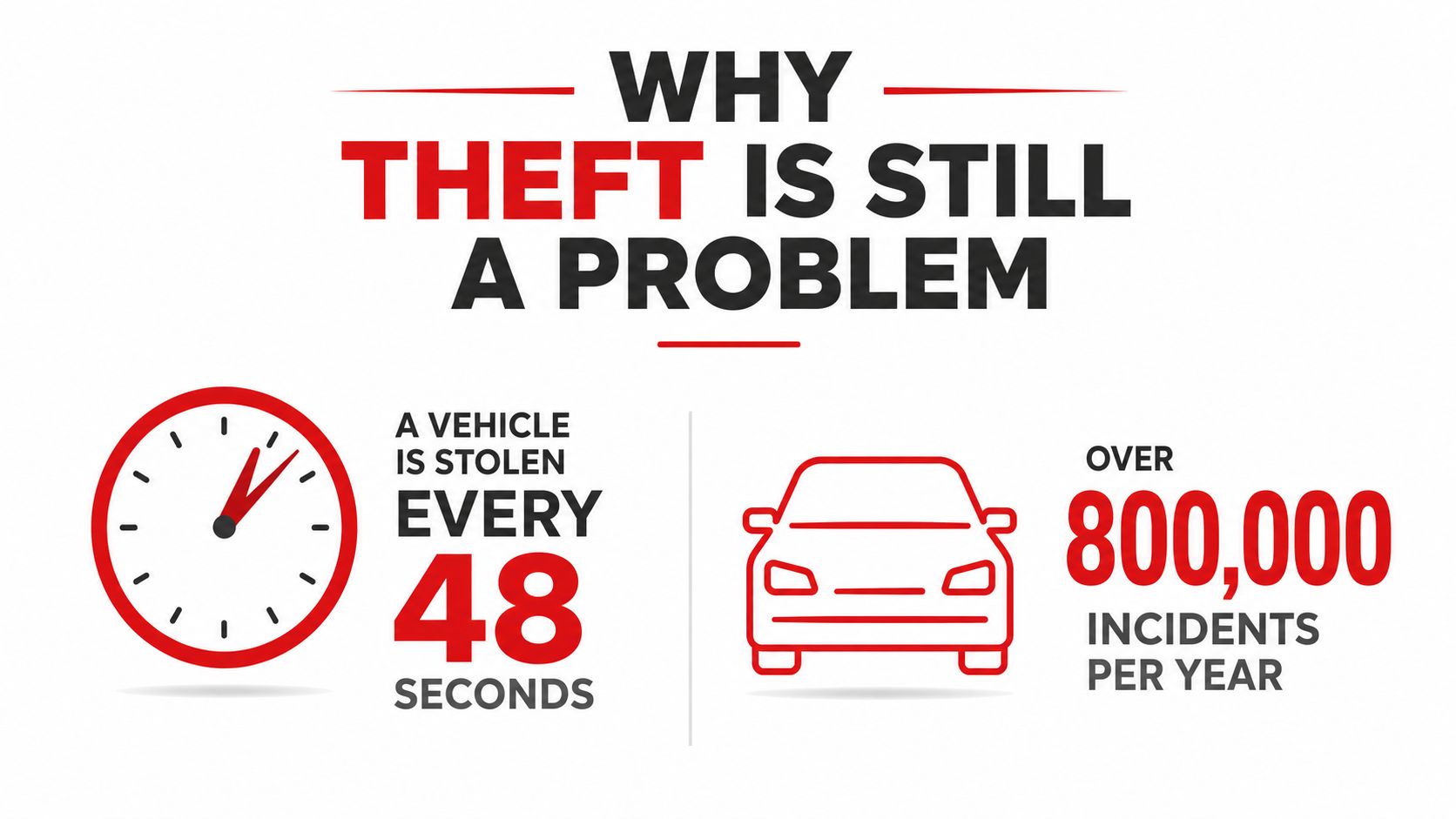
More than 650,000 vehicles were stolen in 2025. Based on the National Highway Traffic Safety Administration figure reported in the NHTSA-based 2025 vehicle theft statistics, that equals one stolen vehicle every 48 seconds. The frequency matters because a vehicle can become a target during an ordinary stop, not only in a dramatic break-in.
Risk varies by vehicle. Certain Hyundai and Kia models recorded sharply higher theft claims before software updates, according to the Highway Loss Data Institute's analysis of theft claims. The practical lesson is simple: vehicle vulnerability depends on the model, its security design, its software, and the tools available to thieves. A factory alarm may address forced entry, while an immobilizer addresses unauthorized starting. Neither one necessarily provides the location information needed after a car leaves.
Recovery isn't the same as getting your car back
A recovered vehicle may not be found quickly, intact, or near the place it was taken. Once thieves move it across state lines or into a shipping container, visibility declines and investigation becomes harder. Owners often discover the theft only after the vehicle has gained a substantial head start.
The first half of 2025 shows why a declining trend does not remove the risk. Insurance Journal's report on NICB data recorded 334,114 vehicle thefts, a 23% decline from the first half of 2024. The national theft rate also fell from 126.62 to 97.33 per 100,000 residents. Improvement at the national level still leaves individual vehicles exposed.
Modern theft can involve relay attacks, key-cloning tools, or OBD port exploits. A siren may draw attention without stopping a determined thief. An immobilizer may prevent the engine from running but offer little help if the vehicle is towed. A connected tracker, such as CarLock, addresses the later stage by reporting movement and location. Vehicle security therefore works like a chain: alarms discourage or expose the attempt, immobilizers interrupt the drive-away, and tracking supports recovery after the vehicle has moved.
What a Vehicle Theft Deterrent System Actually Does
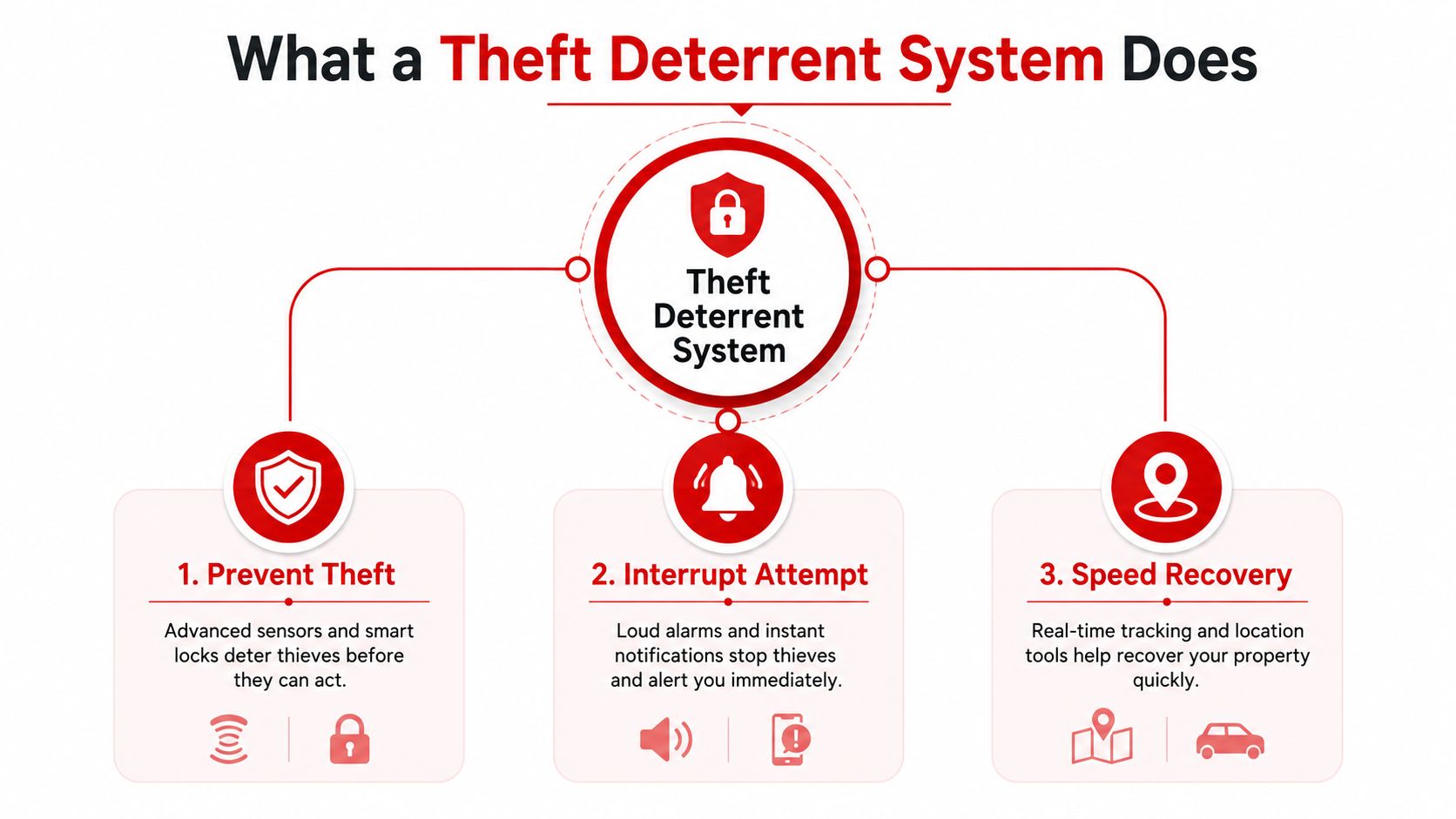
A vehicle theft deterrent system is a coordinated set of sensors, electronic locks, alarms, communication tools, and location services. Depending on its design, it can discourage an attempted break-in, prevent the engine from starting, notify the owner while the event is happening, or help locate the vehicle after it has moved.
A house offers a useful comparison. A deadbolt makes entry harder, a doorbell camera records activity, and a monitored alarm sends a warning when someone enters. Those devices don't perform the same job. Vehicle security works similarly. The alarm is not the lock, and the tracker is not the immobilizer.
Four jobs, four points of defense
A useful system can perform four distinct jobs:
- Deter entry: Flashing lights, warning labels, sirens, steering-wheel locks, and visible security hardware can make an easy target look inconvenient.
- Prevent drive-away: An immobilizer interrupts starting or fuel delivery unless the vehicle receives the correct credential.
- Detect tampering: Vibration, door, hood, tilt, ignition, voltage, and movement sensors can identify suspicious activity.
- Locate after movement: A connected recovery device can transmit the vehicle's position to an owner, monitoring service, or law enforcement.
NHTSA describes tracking devices as hidden electronic transmitters that signal police or monitoring stations after a vehicle is reported stolen, and its vehicle theft prevention guidance states that these systems are effective for recovering stolen vehicles. The agency also presents alarms, immobilizers, and recovery systems as different layers, not interchangeable products.
A deterrent system isn't insurance, and it can't guarantee recovery. It also doesn't replace sensible habits such as locking the vehicle, storing keys away from doors and windows, and choosing a visible parking location. Drivers comparing security with other ownership requirements can also review how Select Insurance Group helps DUI drivers understand insurance-related considerations, including specialized vehicle equipment.
For a closer look at how these components can work together, review this vehicle security system overview. The central idea is straightforward: prevention reduces opportunity, detection reduces delay, and tracking improves visibility after the vehicle moves.
The Three Main Types of Theft Deterrent Systems
Most products fall into three broad categories. The categories overlap in some vehicles, but each one addresses a different point in the theft chain.
Audible and visual alarms
Alarms use door, hood, glass-break, vibration, and tilt sensors to detect an intrusion or physical disturbance. The system responds with a siren, flashing lights, or both. That response can frighten off an opportunistic thief, attract attention, and tell nearby people that something is wrong.
The limitation is proximity. A siren only helps if someone hears it, recognizes it, and responds. Frequent false triggers can also cause people to ignore alarms. A vehicle alarm system is therefore best understood as an interruption layer, not a complete recovery solution.
Immobilizers
An immobilizer blocks the drive-away stage. Factory transponder keys, RFID chips, starter interrupts, and fuel-pump cutoffs all follow the same basic principle: the vehicle must receive an authorized credential or electrical condition before it will start or continue operating normally.
The long-term evidence for this technology is strong. A cross-country study found that uniform immobilizer application reduced overall car theft by about 40% on average in the Netherlands from 1995 to 2008, and estimated that 34 cars fitted with the device at a cost of about €50 each were needed to prevent one theft, according to the cross-country immobilizer study. Related analysis attributed around 43% of the vehicle-theft decline in England and Wales from 1992 to 2013 to electronic immobilizers.
An immobilizer can stop an unauthorized start, but it usually doesn't locate a vehicle that gets towed or loaded onto another vehicle.
GPS and connected trackers
Connected trackers add the visibility layer. They use positioning data and electronic transmission to report where the vehicle is, often through an app or monitoring center. Depending on the product and service, alerts can identify movement, ignition activity, tampering, or unusual behavior.
This category closes the gap left by alarms and immobilizers. The tracker doesn't need to scare the thief away, and it doesn't necessarily prevent the first intrusion. Its job is to tell the right person what happened and where the vehicle is moving.
| Type | Mechanism | Theft-Chain Stage It Disrupts | Primary Limitation |
|---|---|---|---|
| Audible and visual alarm | Sensors trigger a siren and flashing lights | Break-in and active tampering | Depends on nearby attention |
| Immobilizer | Blocks starting or fuel delivery without authorization | Drive-away | May not help against towing |
| Connected GPS tracker | Sends location and event data through a connected service | Post-movement detection and recovery | Requires power and network availability |
The strongest setup stacks these layers. Alarms deter, immobilizers prevent drive-away, and trackers support recovery. No single component covers every stage.
Why Real-Time Alerts Change the Math
The critical weakness in many thefts is delay. Owners often discover a missing vehicle only after they leave home, finish work, or return to a parking area. By then, the thief may have driven away, switched locations, or transferred the vehicle to another form of transport.
Think of theft as a clock. The longer the gap between intrusion and awareness, the more distance the vehicle can cover and the more difficult it becomes to identify its direction. A siren can interrupt that clock, but only when somebody nearby reacts. An immobilizer can stop an unauthorized engine start, but it can't provide location data if a tow truck moves the vehicle.
Alerts compress the response window
A connected alert changes the owner's position from discovering a result to responding to an event. If the owner receives a movement or ignition notification while the vehicle remains in a driveway or parking space, they can verify the event and contact law enforcement sooner. That doesn't guarantee intervention, but it removes the information gap that lets a thief operate unnoticed.
NHTSA's guidance explains that recovery systems transmit information to police or monitoring stations after a vehicle is reported stolen, which is why a tracker should be viewed as a recovery aid rather than a promise of prevention. Independent research gives the difference a measurable shape. A South African dissertation citing earlier empirical work reported that tracked vehicles had more than an 80% chance of recovery, compared with less than 10% for vehicles without tracking, as documented in the vehicle-tracking research.
The same source cited LoJack findings that auto theft fell 50% in Boston, 35% in Newark, and nearly 20% in Los Angeles and Long Beach after deployment. Those figures shouldn't be treated as a guarantee for every vehicle or location. They do show why rapid location visibility can change the expected risk for thieves and the recovery process for police.
| Deterrent Type | Theft Rate Reduction | Recovery Rate | Avg. Time to Owner Awareness |
|---|---|---|---|
| Immobilizer | Roughly 70% in the Netherlands and 80% in England and Wales within ten years of mandatory regulation, according to NHTSA's immobilizer review | Not a recovery device | Not specified |
| Vehicle tracking | Deterrence varies by market and deployment | More than 80% with tracking versus less than 10% without in cited research | Depends on alert configuration and event detection |
| Alarm alone | Not established in the verified data | Not a recovery device | Depends on whether someone hears and acts |
For owners evaluating connected features, CarLock cloud tracking features illustrate the distinction between a sound and a notification. A siren broadcasts locally. A connected alert sends information beyond the parking space.
Factory Security, Bluetooth Trackers, and Connected Trackers Compared
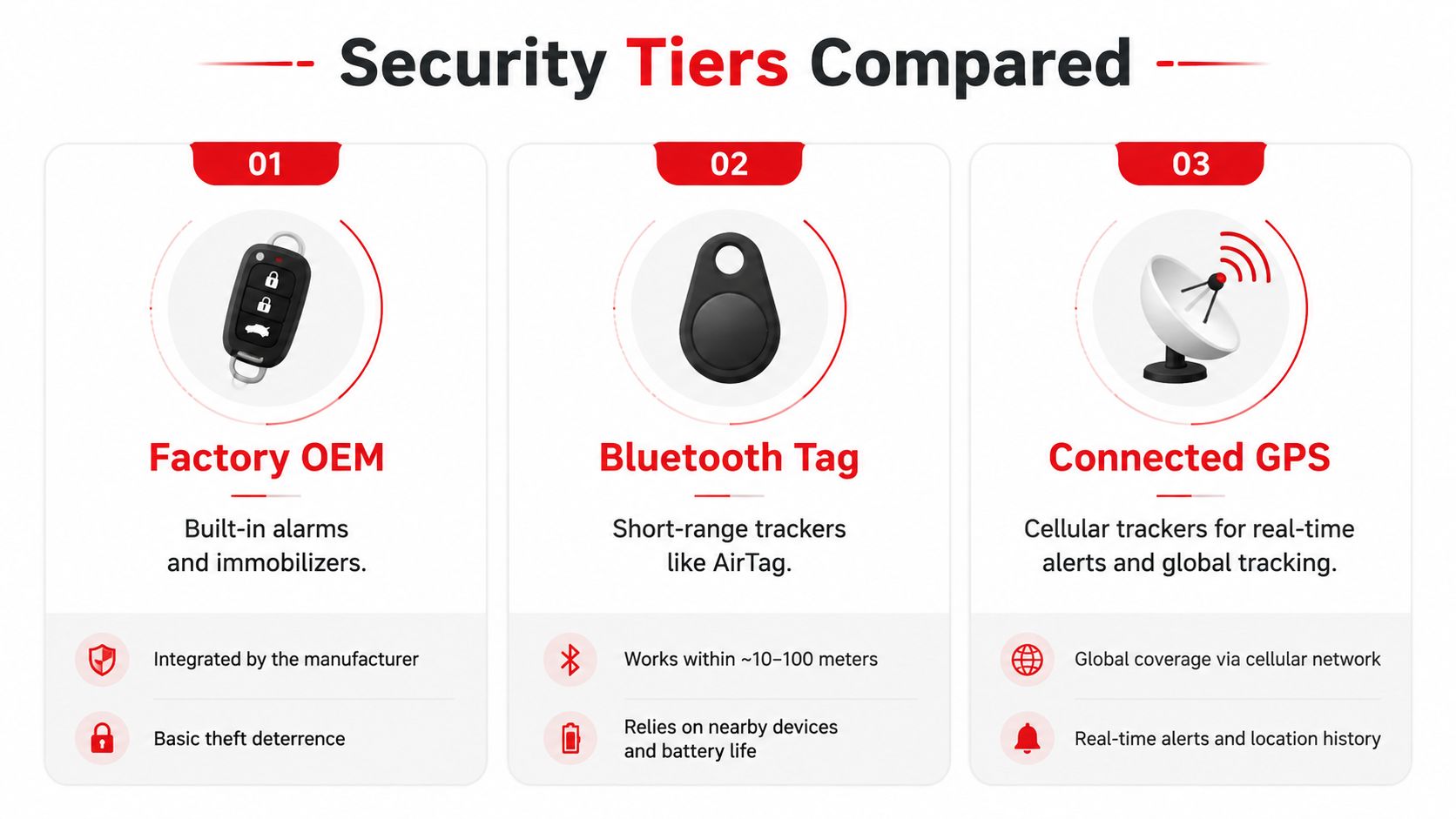
Factory security gives most vehicles a starting layer. OEM alarms, transponder keys, and immobilizers are integrated into the vehicle's electronics, so they don't require a separate installation decision. That integration can be convenient, but it doesn't automatically mean the owner receives a direct alert whenever the vehicle is moved.
Bluetooth tags solve a different problem. Products such as AirTag and Tile are designed to help locate personal items through nearby compatible devices. They can provide useful clues when a vehicle is parked near participating phones, but their performance depends on proximity, signal conditions, and the surrounding device network.
Connected cellular GPS trackers use a more independent path. They combine satellite positioning with cellular communication, allowing the device to report location without requiring the owner's phone to be close to the vehicle. That makes them more suitable for off-site monitoring, though network coverage and power still matter.
The right choice depends on the parking scenario
| Security tier | Visibility to thief | Alert speed | Range limitation | Phone dependency |
|---|---|---|---|---|
| Factory OEM | Usually integrated and less visible | Often limited to the vehicle's alarm behavior unless connected services are included | Vehicle electronics and service coverage | Depends on included connected service |
| Bluetooth tag | Small and easy to conceal | Depends on nearby compatible devices | Short-range Bluetooth plus surrounding-device availability | Relies on the tag's finding network |
| Connected GPS | Can be installed discreetly | Sends remote alerts through its service | Cellular dead zones and enclosed structures can interfere | Owner receives alerts remotely through the app |
An apartment garage highlights the difference. A local siren may echo through the building, but the owner could be too far away to hear it. A Bluetooth tag may not update reliably if nearby devices can't relay its signal. A connected tracker can send an alert to the owner indoors, provided the vehicle and device can communicate with the network.
Street parking creates another challenge. Factory immobilization can make the vehicle harder to drive away, while a connected tracker can report unauthorized movement. In a long-term lot, remote alerts matter because the owner may not visit the vehicle often enough to notice a problem.
The practical distinction is independent off-site awareness. Factory systems can protect the starting process, and Bluetooth tags can assist with item location, but connected trackers are designed to transmit vehicle status and location over distance.
Inside a Connected GPS Tracker Like CarLock
A connected tracker follows a simple path from vehicle event to owner notification. The device reads electrical and motion information from the vehicle, determines a location, sends data through cellular connectivity, and displays the result in a smartphone app.
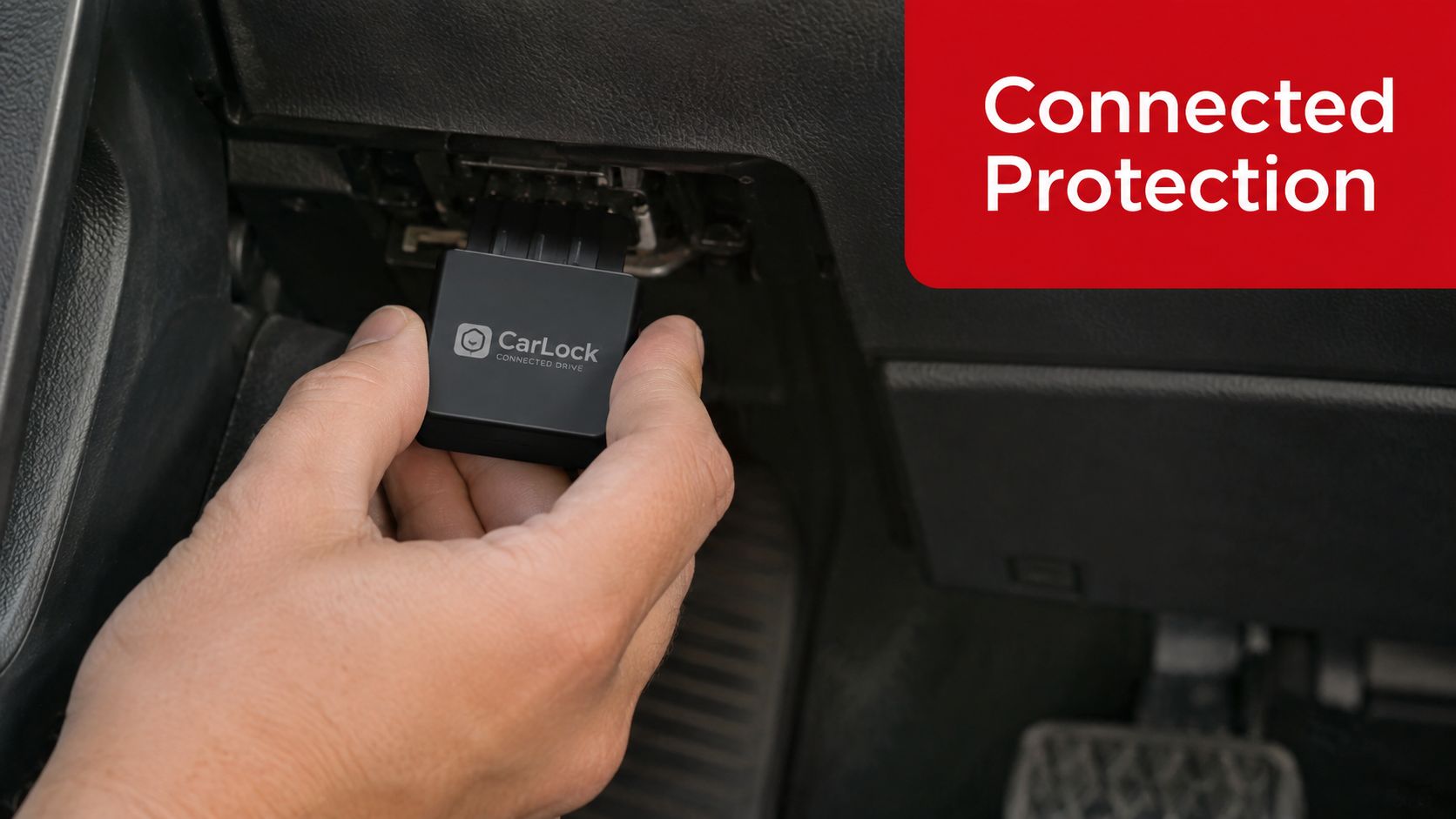
With a CarLock-style setup, installation begins at the vehicle's OBD-II port. That connection supplies power and access to relevant vehicle activity. The tracker then communicates with a cloud service, while the app presents alerts, location information, and trip history to the owner.
What the owner receives
The useful distinction is between a raw signal and an interpreted event. A vibration sensor doesn't merely report movement. The system can classify the event as unusual vibration or possible towing activity, then send an alert that tells the owner what deserves attention.
Common monitored events include:
- Movement: The vehicle moves outside an authorized context or geofenced area.
- Ignition: The engine starts when it shouldn't.
- Vibration: A disturbance may indicate entry, impact, jacking, or towing.
- Battery condition: Voltage changes can suggest a low battery or abnormal drain.
- Device connection: Unplugging or tampering can interrupt reporting.
- Driving behavior: Harsh acceleration, hard braking, or aggressive cornering can appear in trip records.
The CarLock device feature overview provides context for how hardware-level monitoring supports app-based notifications. Live location can also give law enforcement a current position rather than only a last-known parking location.
Connected tracking still has boundaries. Cellular dead zones can interrupt communication, an OBD device can be physically discovered, and subscription-based services add an ongoing ownership cost. A tracker also works best beside a visible deterrent or immobilizer, because avoiding the theft is preferable to recovering the vehicle afterward.
Choosing the Right Theft Deterrent for Your Vehicle
Start with the environment, not the product name. A vehicle parked behind a locked gate faces a different exposure pattern from one left on a public street, and a frequently borrowed family car creates different alert needs from a rarely driven weekend vehicle.
Match the layer to the risk
An apartment garage favors remote alerts. You may not hear a siren through several floors, so a connected system that reaches your phone is more useful than sound alone.
Street parking increases the value of tamper resistance and drive-away prevention. An immobilizer can address unauthorized starting, while a visible steering-wheel lock or warning indicator may make the vehicle less attractive before the thief commits to the attempt.
Owners of a vehicle model with a known theft vulnerability should place greater emphasis on location and recovery support, not just an audible alarm. The vehicle may need protection before entry, during the starting attempt, and after unexpected movement.
Your insurance requirements also matter. Ask whether the insurer recognizes a particular device or installation method, and confirm whether a subscription, professional installation, or proof of activation is required. Don't assume every alarm, immobilizer, or tracker receives the same treatment.
A practical buying checklist
- Coverage: Confirm cellular availability in the places where the vehicle is parked and driven.
- Power protection: Ask whether the device reports disconnection or unusual battery drain.
- Geofencing: Check whether you can define an authorized area and receive movement alerts outside it.
- Recovery access: Understand who can view location data and how law enforcement receives it.
- Installation: Compare OBD-II installation with hardwiring, including visibility and tamper resistance.
- Driving reports: Decide whether trip history and behavior alerts matter for family or fleet use.
- Ongoing cost: Include any subscription or monitoring charge in the ownership decision.
Practical rule: Choose one layer that makes theft harder, one that tells you quickly, and one that helps locate the vehicle if the first two fail.
Common Misconceptions About Theft Deterrent Systems
A factory alarm isn't automatically a complete security plan. Factory immobilizers can reduce unauthorized drive-away, but thieves may target weaknesses in keyless entry, communications, installation, or software rather than attacking the alarm itself.
A July 2026 report from UC San Diego described at least 1.4 million vulnerable vehicles, later revised to an estimated 2.2 million, even though dealer-installed anti-theft systems were present, according to UC San Diego's vehicle security findings. The finding matters because installation alone doesn't prove effective protection. Owners need to ask how the system handles tampering, how quickly it sends alerts, and whether it continues communicating in remote or low-signal environments.
More devices don't always mean more protection
Several weak layers can create confidence without closing the actual gap. A steering-wheel lock may provide a visible obstacle, but it doesn't notify the owner. An alarm may make noise, but it can't track a vehicle after a flatbed removes it. An immobilizer may block the ignition, but it doesn't address every method of unauthorized movement.
The better question is not, “Which single device is best?” Ask instead:
- What stops unauthorized entry or makes the vehicle less attractive?
- What prevents the engine from starting?
- What detects movement or tampering in real time?
- What helps locate the vehicle if it leaves?
Use the CarLock questions and answers to evaluate those capabilities against your vehicle, parking environment, and response needs. Then audit the security already installed, add a visible or audible obstacle, and consider a connected tracker for remote alerts and recovery support.
CARLOCK monitors vehicle movement, ignition activity, vibration, device disconnection, battery conditions, and driving behavior through connected tracking and smartphone alerts. Visit CARLOCK to review the system's features and choose a vehicle security layer that fits how and where you park.