

Driver’s Desk
Easy Car Security System Explained for Real Protection
You park outside work, lock the doors, and walk away with your phone in your pocket. Hours later, you return and discover that the car has moved, been towed, or had its battery drained. A traditional alarm may have sounded, but nobody nearby acted, and you had no way to know what happened while you were inside.
That's the practical problem behind an easy car security system. Most drivers aren't looking for another complicated device to configure every morning. They want quiet, continuous awareness, with an immediate phone alert when the vehicle moves, the engine starts, or someone tampers with the system. “Easy” should mean protection that works without constant attention, not a cheap alarm that makes noise after the damage begins.
Introduction Why Easy Security Matters More Than Ever
Car theft remains a serious risk even when national totals decline. The U.S. recorded 850,708 vehicle thefts in 2024, compared with 1,020,729 in 2023, a decline of 16.7%, according to the Insurance Information Institute's auto theft statistics. Germany's insurers also reported 14,162 comprehensively insured stolen vehicles in 2024, with approximately 293 million euros in payouts, showing that theft continues to create substantial losses in markets with strong vehicle security systems.
The latest U.S. figures make the risk easier to picture. The National Highway Traffic Safety Administration reported 659,880 vehicle thefts in 2025, down 23%, while stating that a motor vehicle was still stolen every 48 seconds that year in the United States. NHTSA's vehicle theft prevention guidance provides the context: a lower trend doesn't make an individual vehicle invisible to thieves.
A loud siren can still have a place, particularly as a visible deterrent. But an audible alarm depends on a nearby person hearing it, recognizing the sound, and deciding to respond. A phone notification reaches the owner directly, whether the car is parked outside an office, in a driveway, or somewhere unfamiliar.
Practical rule: The easiest security system is the one that notices abnormal activity for you and tells you what happened without requiring you to check the car constantly.
This guide focuses on that distinction. It explains what continuous monitoring involves, how GPS systems compare with alarms and Bluetooth item trackers, and which features matter for families, individual drivers, and small fleets. The aim isn't to promise perfect protection. No security device can guarantee that a determined thief won't attempt a vehicle. The aim is to help you choose a system that detects trouble early and gives you useful information while there's still time to act.
What Makes a Car Security System Truly Easy
Many people define easy installation as the absence of tools or complicated wiring. That matters, but it's only the first layer. A system can be simple to install and still be difficult to live with if its app is confusing, its alerts arrive late, or it produces so many false warnings that the owner starts ignoring them.
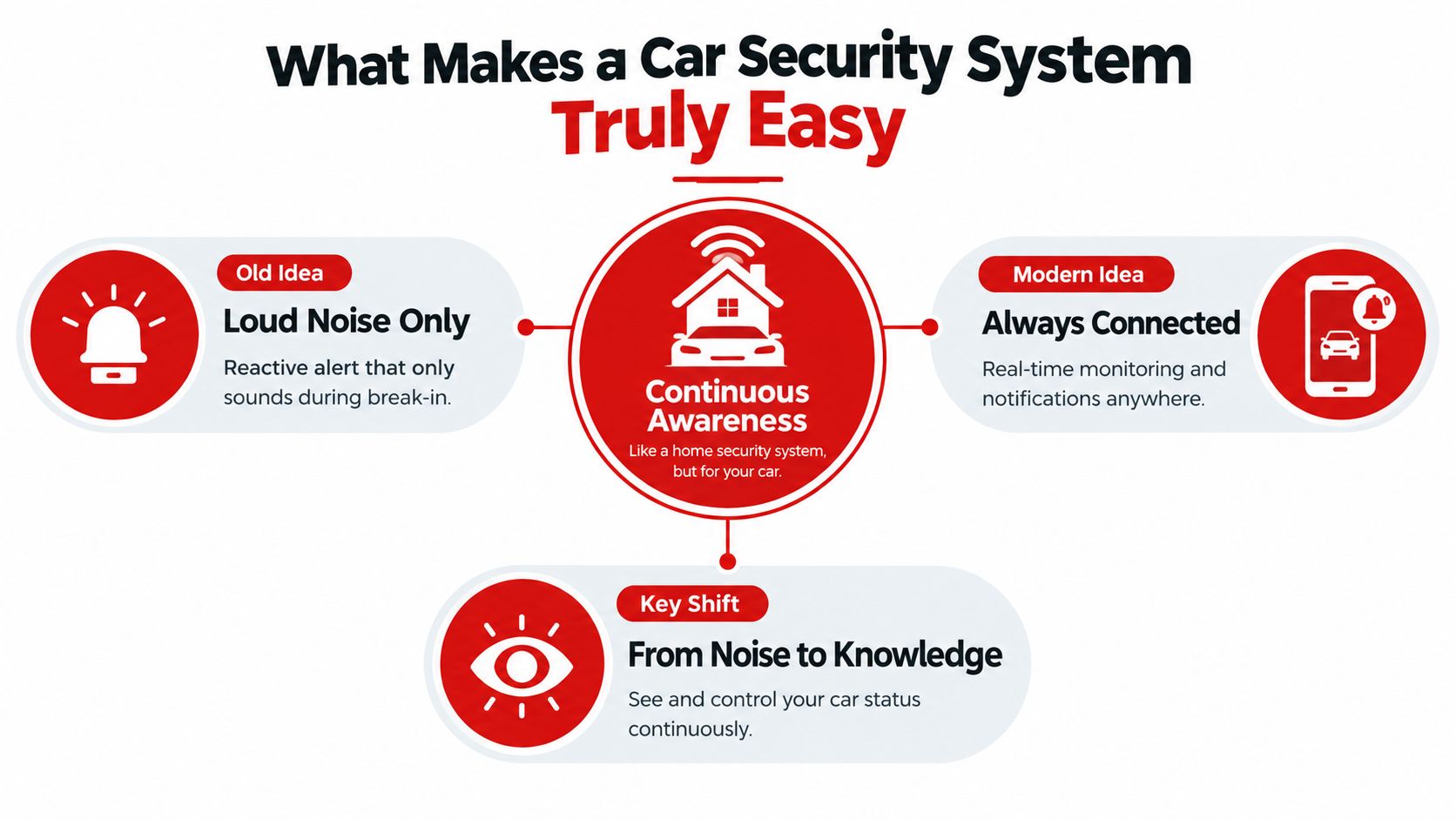
Think about the difference between a basic door alarm and a home security camera. The door alarm reacts when someone opens an entry point. A connected camera can show what happened, record a timeline, and send information to the person responsible for the property. A modern vehicle security system follows the second model. It turns the car from an object that waits for a break-in into a monitored asset that can report movement and changing conditions.
From noise to useful information
A siren answers one question, “Is something happening right now?” A connected tracker can answer several more:
- Where is the vehicle?
- When did movement begin?
- Was the engine started?
- Was the device disconnected?
- Did the car experience vibration, towing, harsh braking, or acceleration?
That timeline changes the owner's response. Instead of discovering a missing vehicle later and trying to reconstruct events from memory, the owner receives information while the event is unfolding. Research and testing discussed in this technical overview of vehicle tracking and monitoring emphasize the value of combining location data with geofencing, trip history, tamper alerts, speed logs, and harsh-brake or acceleration alerts.
Why connectivity changes the outcome
A GPS tracker uses satellite positioning to determine location. Cellular connectivity then sends that information to an app, even when the owner isn't close to the vehicle. That differs from a Bluetooth item finder, which generally depends on nearby compatible devices to relay an approximate location.
You can explore how a purpose-built vehicle location solution fits this model through the CarLock car locator. The central idea is simple: easy security means the vehicle communicates abnormal activity to you automatically. You shouldn't need to remember to activate a feature every time you park, interpret a technical log, or stand within short Bluetooth range to receive useful information.
The Four Pillars of an Easy and Reliable System
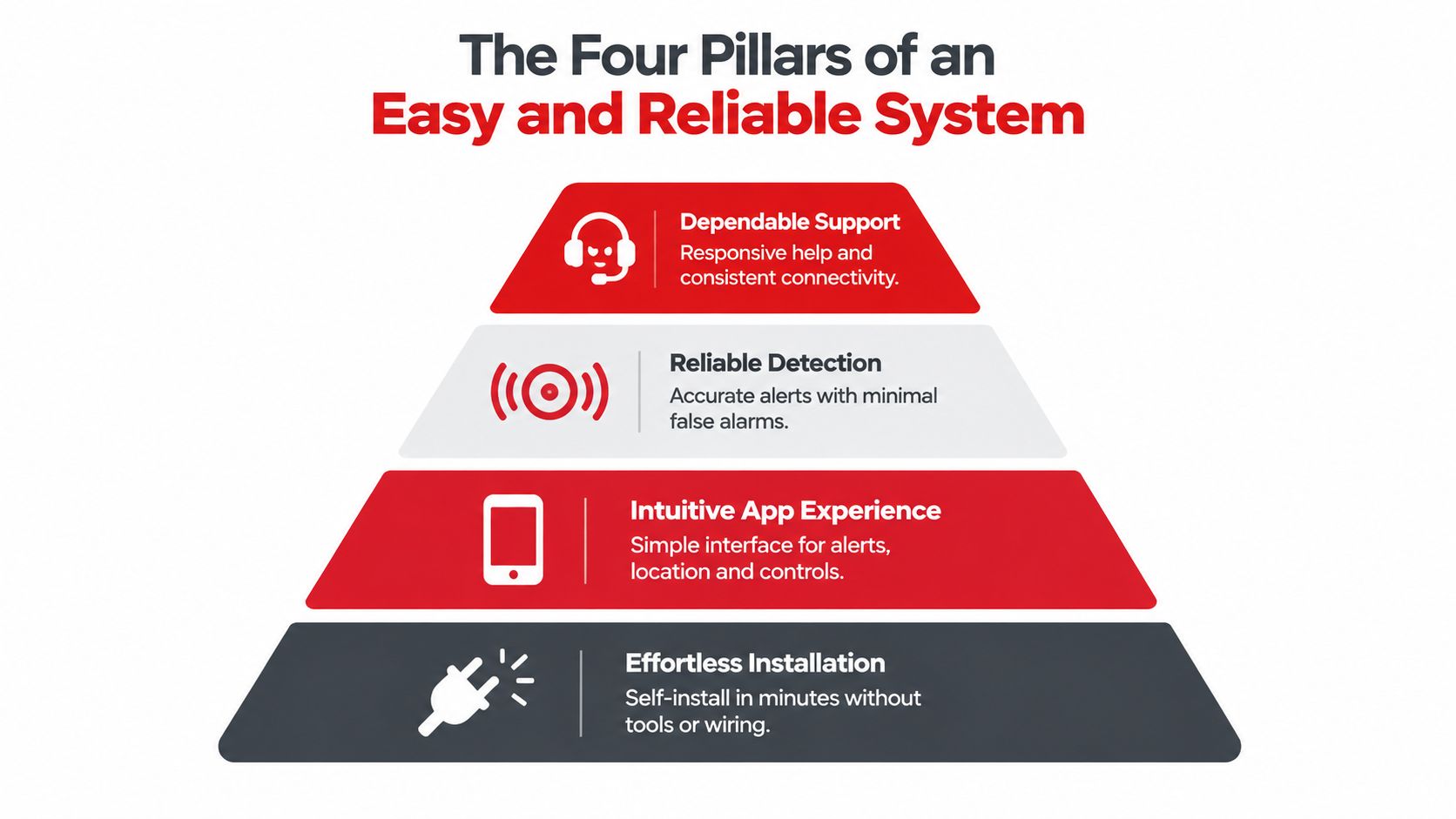
An easy car security system should pass four practical tests. Installation, app design, detection quality, and ongoing support all affect whether the system protects the vehicle in real life or becomes another device abandoned in a drawer.
1. Effortless installation
The first test is whether an ordinary owner can install the device correctly. A suitable system should explain where the device connects, how the app pairs with it, and what the first alert means. If installation requires extensive wiring or specialist knowledge, the product may still be valuable, but it isn't low-friction for the average driver.
Check compatibility before buying. The system needs a dependable power connection and should remain active when the engine is off. A device that works only while the car is running can't reliably report unauthorized movement from a parked position.
2. An app that makes decisions easier
The app shouldn't force you to interpret raw coordinates or scan a long event list. Important events should be easy to distinguish from routine journeys. Look for a clear map, trip history, movement notifications, engine-start alerts, battery warnings, and a way to review when an event occurred.
A practical overview of GPS tracker app features can help buyers identify whether an app supports monitoring or merely displays a location. Remote visibility is useful only when the information arrives clearly enough to guide a decision.
3. Reliable detection without alert fatigue
Security detection always involves a tradeoff. If the system reacts to every small vibration, it may generate warnings when a nearby truck passes or someone closes a neighboring door. If it waits for a large movement, it may notify you too late.
A vehicle self-surveillance study illustrates the problem. Tightening the decision threshold reduced illegitimate access to about 6%, but false alarms increased to 16%, as shown in the vehicle security false-alarm research. The lesson isn't that one threshold works for every car. It's that good systems combine signals, such as movement, ignition status, vibration, location, and device connection, before escalating an event.
4. Dependable support and low maintenance
The system should tell you when it loses power, detects abnormal battery drain, or is disconnected. Otherwise, the owner may assume the car is protected while the monitoring device is offline.
Look for clear subscription terms, software support, warranty information, and customer assistance. Review the product's installation instructions before purchasing, then test an alert while the vehicle is safely parked. A system is easy only when you can trust its status without repeatedly troubleshooting it.
Common Options Compared and Where They Fall Short
Car security tools solve different problems. A steering lock creates a visible physical obstacle. An audible alarm creates noise. A Bluetooth item finder helps locate an object through a nearby-device network. A GPS cellular system focuses on continuous vehicle monitoring and remote communication.
The differences become clearer when you compare the features that matter during an actual incident.
Easy Car Security Options Compared
| Security Option | Real-Time Alerts | Remote Tracking Coverage | Ease of Daily Use |
|---|---|---|---|
| Audible alarm | Usually alerts people nearby through a siren | None unless paired with another device | Simple to arm, but owners may miss or ignore the sound |
| Steering lock | No electronic alert | None | Easy to understand, but requires manual use every time |
| Bluetooth item finder | Limited movement or item notifications | Depends on nearby compatible devices | Easy to hide, but not designed for vehicle monitoring |
| GPS cellular system | Can report movement, ignition, tampering, and other configured events | Uses GPS and cellular connectivity rather than nearby phones | Requires setup and usually an ongoing service, but supports continuous remote visibility |
Bluetooth trackers are often attractive because they're small and familiar. Their limitation isn't only range. They're designed to find lost items, not to provide a vehicle's complete event timeline. Independent guidance on using an Apple AirTag as a car tracker notes that AirTag-style devices rely on short-range Bluetooth and crowdsourced pings. In an underground garage, remote area, or low-traffic location, a stolen vehicle may remain unreported for a long period if compatible nearby devices aren't available.
A purpose-built GPS system can provide movement alerts before the vehicle has traveled far from its parking location. It can also identify engine starts, towing or unusual vibration, device disconnection, and battery problems, depending on the product and its configuration.
Traditional physical and audible tools still have value as layers. A steering lock can make a vehicle less convenient to attack, while a siren can draw attention. Neither one tells you where the car is after it leaves. For vehicle operators who also need video evidence, a practical fleet dash camera guide can help separate camera functions from tracking and alarm functions.
A vehicle alarm system should therefore be judged by the information it delivers, not just the volume it produces. The CarLock car alarm represents the connected model, where smartphone notifications supplement rather than replace physical deterrence.
Real World Uses Beyond Theft Recovery
A tracker becomes more useful when you stop thinking of it as an emergency-only device. Continuous monitoring can help a family understand how a vehicle is being used, help a small business review trips, and help an owner confirm that a mechanic or valet has returned the car to the expected location.

Parents and teenage drivers
A parent may not need to follow every trip. They may want to know whether a young driver took the car outside an agreed area, drove aggressively, or arrived at the expected destination. Harsh-braking alerts, acceleration data, speed logs, and trip history can turn a difficult conversation into a specific review of what happened.
That visibility should support trust, not replace it. Families can agree in advance which events matter, when alerts should be reviewed, and how the information will be used.
Families, mechanics, and valets
Shared vehicles create ordinary uncertainty. One family member may take the car without updating everyone else. A mechanic may move it for a test drive. A valet may park it somewhere different from the expected location.
Geofencing helps define a boundary, while movement and engine-start notifications explain why the vehicle changed position. A car tracking solution can also provide trip history, which gives the owner a record instead of requiring several phone calls.
Small fleets and work vehicles
A small fleet owner may care about more than theft. They may need to confirm when a vehicle left a yard, review routes, identify harsh driving, or notice a battery problem before the next shift. Continuous visibility gives the owner operational context without requiring a driver to report every stop manually.
The same principle applies to personal cars. A low-maintenance system works in the background and surfaces unusual events. That's the useful meaning of “easy”, fewer routine actions for the owner, but better information when something changes.
How to Choose the Right Easy System for Your Needs
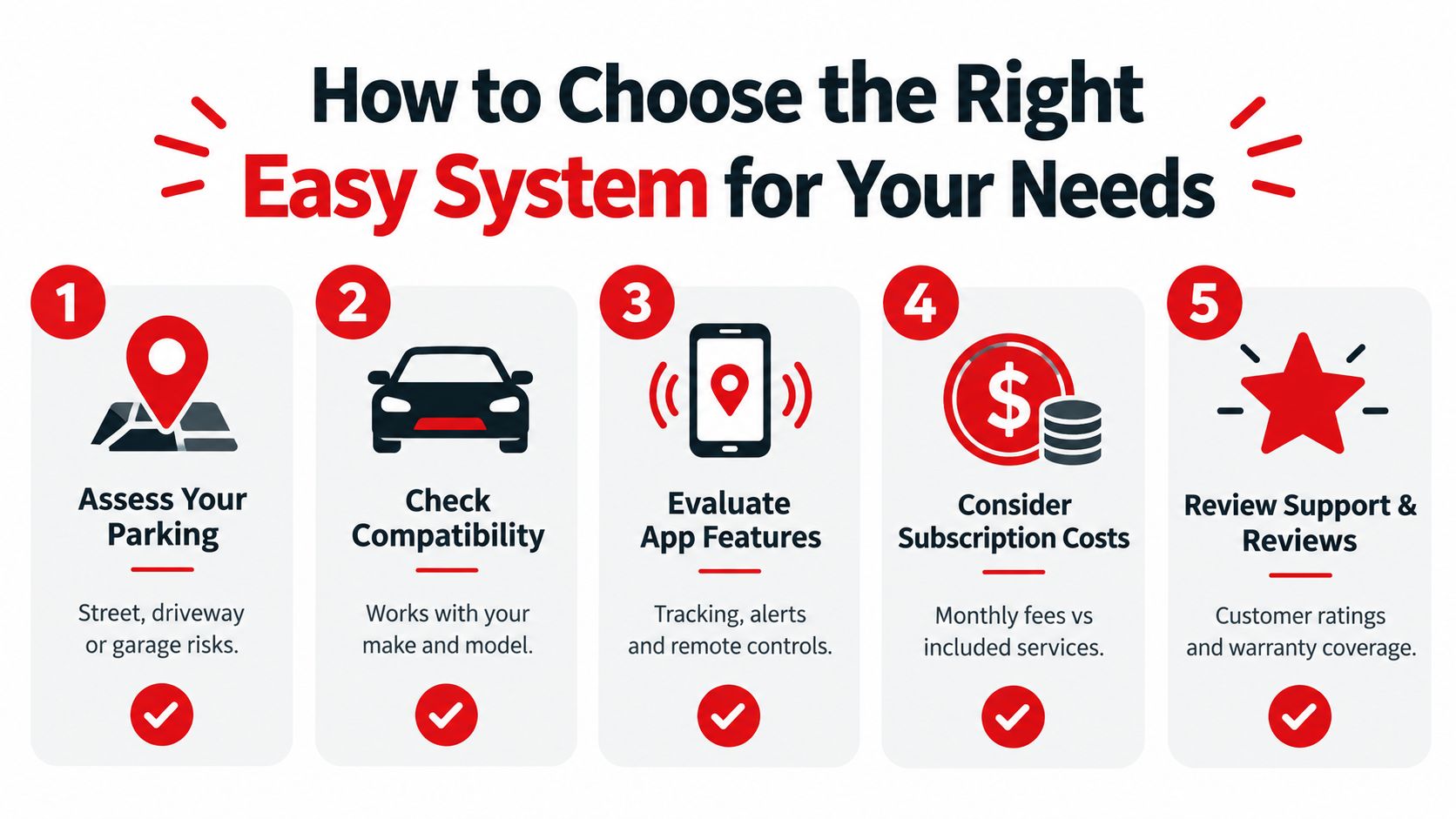
Start with the parking environment, not the feature list. A car parked on a busy street has different exposure from one stored in a private garage, but neither location eliminates risk. Consider whether the vehicle regularly sits outside work, at home, in public parking, or in places with weak connectivity.
Match the system to your monitoring need
Use these questions to narrow the shortlist:
- Where does the car spend most of its time? Choose a system that fits street parking, a driveway, a garage, or a mixed routine.
- What do you need to know first? If the priority is theft recovery, prioritize live GPS location and movement alerts. If it's family use, add trip history and driver-behavior events.
- How much setup will you tolerate? Confirm installation requirements, power connections, app compatibility, and whether the device stays active while parked.
- Can you accept a subscription? Cellular communication and cloud-based monitoring commonly involve an ongoing service. Compare the recurring cost with what the service includes, such as connectivity, storage, alerts, and support.
- Will you act on the alerts? Choose an app that presents urgent events clearly and lets you distinguish movement, ignition, towing, tampering, and battery conditions.
A product page should explain what happens during a real event. “GPS tracking” alone doesn't tell you whether the system sends an instant movement alert, stores trip history, detects disconnection, or works in the places where you park.
Check the device features for a GPS car tracker before committing. Look for compatibility information, power requirements, connectivity details, alert types, and support terms. If the system uses a subscription, read the cancellation and renewal conditions rather than judging the product from its hardware price alone.
Buying test: Ask, “What will appear on my phone if someone moves the car tonight?” If the answer is vague, the product probably doesn't match the promise of continuous awareness.
Final Takeaways for Effortless Vehicle Protection
An easy car security system isn't defined by a loud siren, a small device, or a quick installation alone. True ease means continuous visibility. The system watches the vehicle while you're working, sleeping, shopping, or away from home, then sends information you can understand and act on.
Electronic immobilizers demonstrate why built-in security can materially reduce theft rather than merely discourage opportunistic break-ins. The European Union required immobilizers in all new passenger cars sold in the EU from October 1998, followed by Australia in 2001 and Canada in 2007. Research associated those mandates with substantial theft declines in the Netherlands and in England and Wales during the decade after implementation, as described in the history of motor vehicle theft and immobilizer adoption.
Modern monitoring adds a different capability. A hidden live tracker can report movement, location, engine activity, tampering, battery conditions, and driving behavior. Geofencing and trip history help you understand the event timeline, while multi-sensor detection reduces the chance that every minor vibration becomes an emergency.
The right setup may combine layers. A steering lock can create a physical obstacle. An alarm can make noise. A GPS cellular system can tell you what is happening and where the vehicle is. The decision should depend on your parking habits, vehicle value, family or fleet use, technical comfort, and willingness to maintain a subscription.
Start by listing the events you need to know about, then compare systems by alert speed, location coverage, app clarity, installation, tamper detection, and support. Protection becomes easier to trust when you can verify that the system is connected and receive a meaningful test alert before a real incident occurs.
CARLOCK offers real-time GPS tracking, smartphone alerts for movement and engine starts, tamper and battery monitoring, trip history, and driving-behavior visibility in one connected vehicle security system. Visit CARLOCK to review how it can add low-friction, continuous awareness to your car, family vehicle, or small fleet.