

Driver’s Desk
IoT for Automotive Explained and How It Protects Cars
You check your driveway and notice the car is sitting at a different angle. The doors are locked, but something feels wrong. Maybe a family member moved it, a mechanic took it for a test drive, or someone attempted to tow it. Without connected monitoring, you may not know what happened until you find a broken lock, an empty parking space, or an unexpected charge.
Fleet operators face the same problem at a larger scale. A vehicle can leave a depot, take an unfamiliar route, or develop a warning condition while the manager is looking at a spreadsheet that's already out of date. IoT for automotive changes that situation by connecting the vehicle to sensors, communications networks, cloud software, and mobile alerts.
Introduction to Connected Vehicles and Why It Matters Now
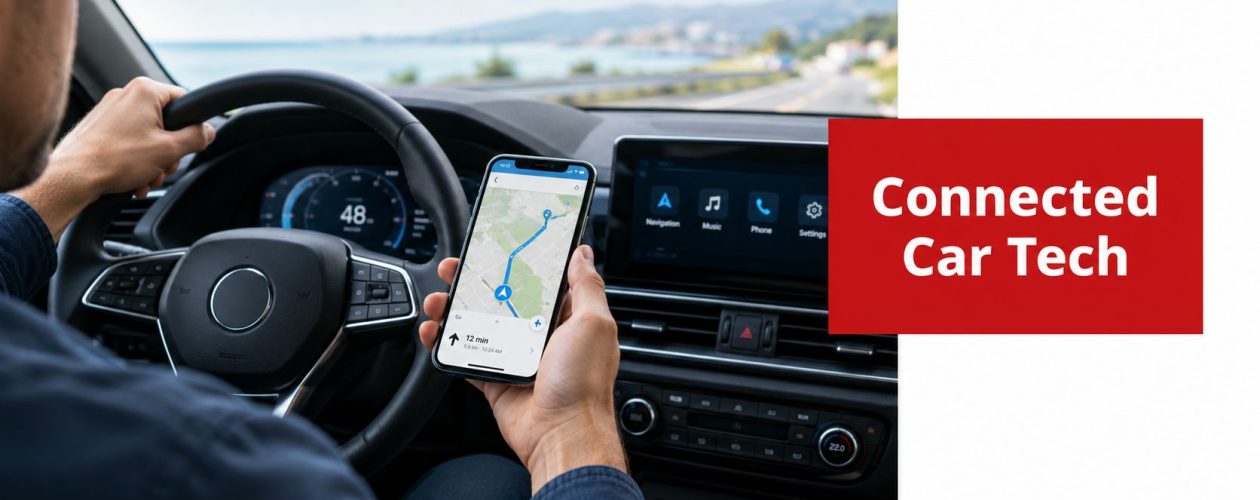
A connected vehicle doesn't need to be futuristic to be useful. It can be an ordinary family car that reports movement, engine starts, unusual vibration, location, or battery conditions to an app. For a small business, it can be a work vehicle whose trip history and operating status are visible without calling the driver. The important change is that the vehicle becomes observable between service visits and parking checks.
That shift matters because automotive IoT has moved well beyond a niche technology category. The automotive IoT market grew from an estimated USD 164.06 billion in 2023 to USD 194.04 billion in 2024, and it's forecast to reach USD 379.05 billion by 2030 at an 11.8% CAGR, according to Grand View Research's automotive IoT market analysis. The same forecast identifies North America as the largest regional market during the 2023 to 2025 period, which fits the strong demand for connected-car services in the United States and Canada.
Security pressure explains part of that adoption. The FBI reported 1,020,729 motor vehicle thefts in the United States in 2023, while automobiles represented 78.1% of stolen motor vehicles from 2019 through 2023 in its motor vehicle theft release. Even though theft declined later, the National Insurance Crime Bureau notes that fewer than one million vehicles were stolen in the United States in 2024, the first time since 2021 that thefts fell below that threshold, and the largest annual decrease in 40 years, as summarized by the Insurance Information Institute.
Why always-on visibility changes the response
A conventional alarm mainly announces that something is happening. A connected security system can tell you what changed, where the vehicle is, and when the event occurred. That difference matters when a car is being towed, driven by an unauthorized person, or moved from a familiar parking location.
For an owner comparing vehicle security options, CarLock's vehicle awareness features illustrate the broader principle. Real-time monitoring is valuable because it shortens the gap between an event and a decision. The rest of this guide explains the system behind that experience, the jobs automotive IoT can perform today, the hardware and connectivity choices involved, and the security and privacy questions buyers shouldn't overlook.
What Automotive IoT Really Means and How It Works
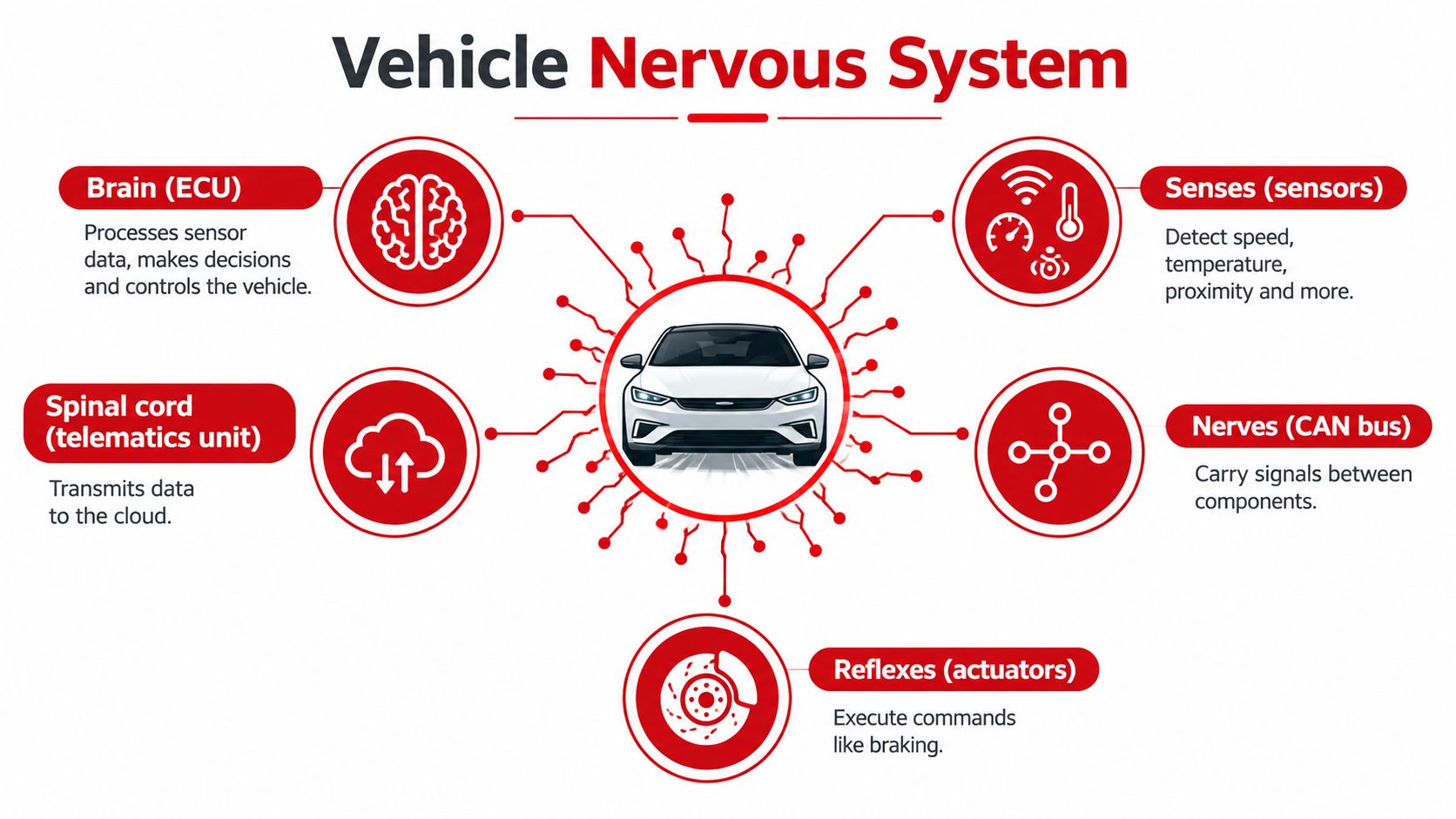
The easiest way to understand automotive IoT is to compare a vehicle with a nervous system. The comparison isn't perfect engineering terminology, but it provides a useful mental model.
Sensors are the senses. They detect conditions such as speed, temperature, position, proximity, vibration, battery state, and other operating signals. A sensor doesn't decide what an event means. It produces a measurement.
Electronic control units are local brains. An ECU processes information for a specific vehicle function. It may help manage the engine, braking, battery, or another subsystem. These computers exchange messages through the vehicle's internal networks.
The CAN bus acts like a spinal cord. It carries signals between components so that different systems can coordinate. This internal communication is fast and practical, but its original design prioritized reliable vehicle operation rather than modern cybersecurity.
From vehicle signal to phone alert
A telematics unit gathers selected information from the vehicle and prepares it for transmission. Think of it as the connection between the vehicle's internal systems and outside services. It may receive location data from GPS, read diagnostic information, detect movement, and identify an event worth reporting.
The communication path usually looks like this:
- Detection: A sensor, ECU, or tracking device records a change.
- Local processing: The telematics unit filters or interprets the signal.
- Transmission: Cellular or another wireless connection sends the relevant data.
- Cloud handling: A backend stores the event, applies rules, and delivers it to an application.
- Action: The owner or fleet manager receives an alert, reviews the vehicle's position, or schedules maintenance.
That sequence is why a connected tracker differs from a Bluetooth item finder. Bluetooth relies on nearby compatible devices to relay a location. A GPS and cellular system is designed to determine the vehicle's position and communicate it across a much wider area, subject to network and environmental conditions.
Practical rule: Choose the communication method based on the job. Finding keys in a room and monitoring a vehicle across roads, parking areas, and remote locations aren't the same problem.
Cloud software turns individual readings into useful context. A single vibration event may be harmless. A vibration followed by movement, an engine start, and a new route deserves immediate attention. The value of automotive IoT comes from connecting those signals into an understandable decision rather than exposing the driver to a stream of raw data.
Real World Use Cases That Deliver Value Today
Automotive IoT earns its place when it solves a repeated problem. Owners want to know whether a vehicle moved without permission. Fleet managers need to coordinate vehicles and understand how they're being used. Technicians want early warning of conditions that could become expensive failures.
Security and real-time tracking
A connected security device can monitor location, movement, engine activity, vibration, towing indicators, and device connection status. The owner benefits from faster awareness, while a fleet operator gains a record of where vehicles are being used and whether that use matches expectations.
The scale of theft makes this practical rather than theoretical. An Upstream Security report says keyless-entry car technology accounts for nearly 50% of all vehicle thefts, a finding available in its Global Automotive Cybersecurity Report. Electronic attack methods have therefore become a major part of the theft problem, which is why location tracking and tamper alerts complement mechanical deterrents.
Fleet visibility and driver awareness
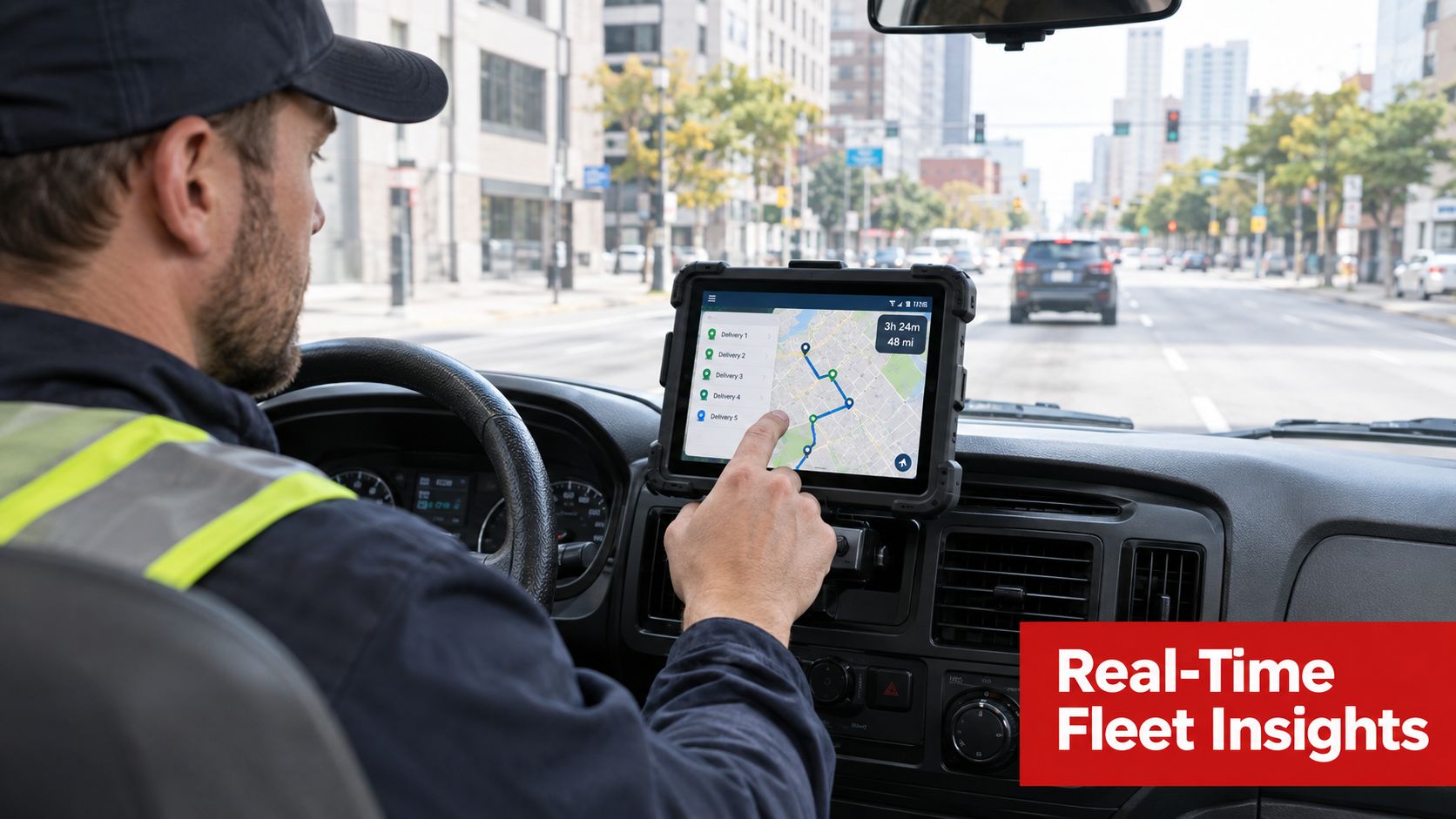
A dashboard can show vehicle locations, trip history, operating conditions, and driving patterns. That helps a delivery company assign work, helps a contractor confirm vehicle use, and helps a parent discuss harsh braking or aggressive cornering with a teenage driver using specific trip information rather than assumptions.
For vehicle condition monitoring, a system such as CarLock's vehicle health monitoring connects security awareness with maintenance-related signals. The practical outcome isn't a promise that every breakdown can be predicted. It's a clearer basis for deciding when a vehicle needs inspection.
Diagnostics and preventive maintenance
Remote diagnostics can identify changes in temperature, pressure, vibration, battery behavior, or diagnostic codes. A workshop can use that information to investigate a problem before the driver experiences a roadside failure. Fleet managers can also group service work more intelligently instead of waiting for every vehicle to follow the same calendar.
Connected data becomes operational data. The useful question isn't “What does the sensor read?” It's “What decision should someone make because of that reading?”
Safety communication and personalization
Vehicle-to-everything communication can support warnings involving other vehicles, roadside infrastructure, networks, and vulnerable road users. These systems may help a vehicle receive information it can't obtain from its own cameras or radar alone, although safety decisions still require careful system design and validation.
Connected infotainment provides a less dramatic but familiar use case. Drivers can access navigation, traffic information, hands-free communication, and personalized settings through a connected interface. Convenience matters, but it shouldn't distract from the stronger value of automotive IoT: protecting vehicles, reducing uncertainty, and supporting timely maintenance.
Choosing Hardware and Connectivity for Your Vehicle
The right IoT setup depends on where the vehicle parks, how often it moves, who installs the equipment, and what must remain visible when the engine is off. A simple plug-in device may suit a personal car, while a commercial fleet may need permanent power, tamper resistance, and deeper vehicle data.
OBD-II or hardwired equipment
An OBD-II tracker is easy to install and move between vehicles. It can provide useful diagnostic information through the port, but its location may make it visible and accessible. A device that can be unplugged is easier to remove, and port access varies by vehicle.
A hardwired unit typically needs professional installation, but it can offer permanent power and a less obvious installation position. It may also support deeper integration, depending on the vehicle and the product. The trade-off is installation time, vehicle compatibility, and the need to plan removal or servicing properly.
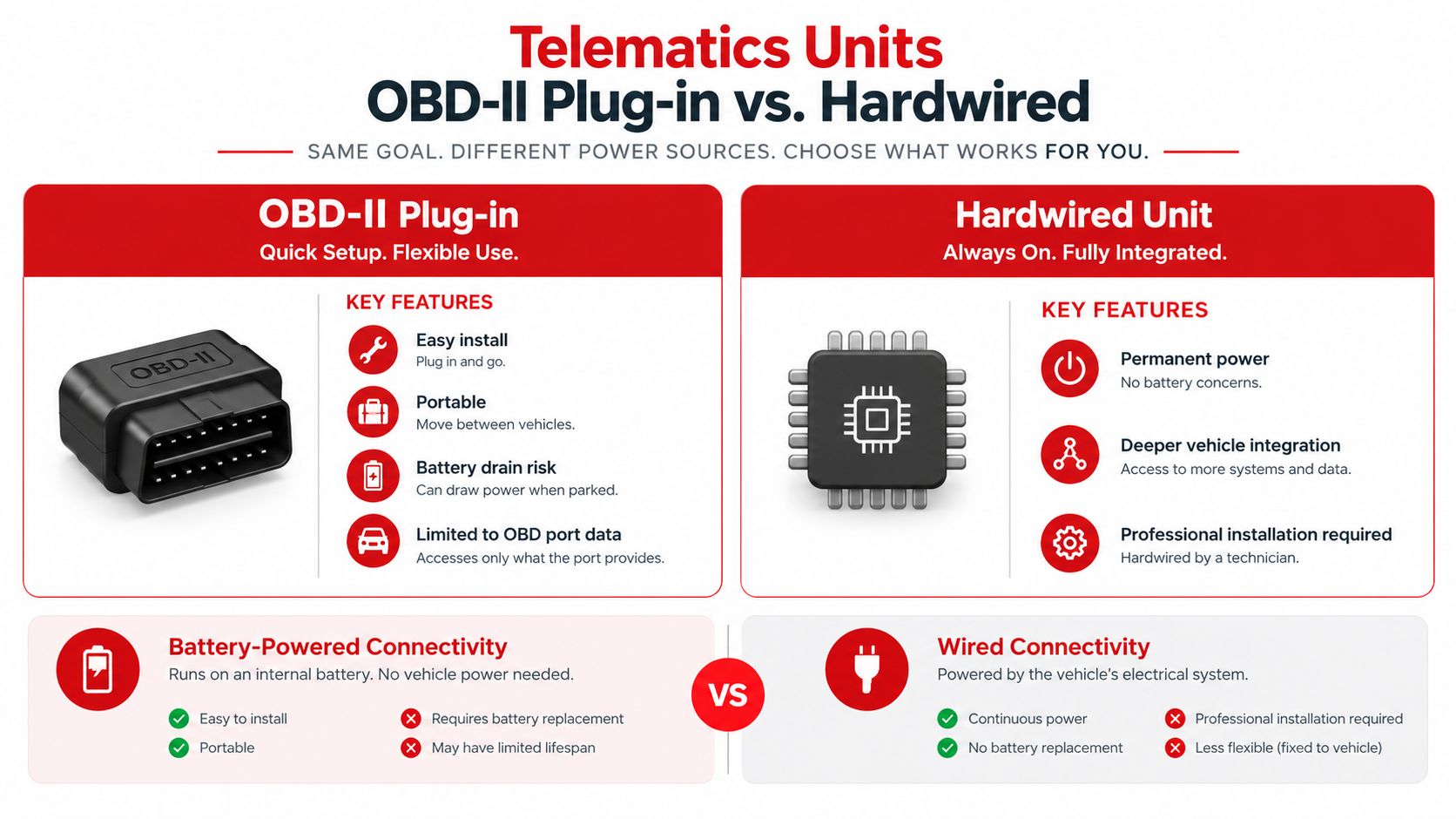
Battery-powered devices can simplify placement, but you must account for charging, battery depletion, and the possibility that reporting stops when the device loses power. Vehicle-powered systems are better suited to continuous monitoring, provided the installation manages abnormal battery drain and protects the device from tampering.
Connectivity choices in context
Cellular connectivity supports broad-area communication with a cloud service. GPS determines location, while the cellular network carries that information to the application. Wi-Fi can be useful around homes, depots, or service facilities, and Bluetooth works well for short-range device interaction. Emerging 5G deployments may support connected-vehicle services where coverage and device compatibility justify the choice.
| Connectivity Type | Coverage and Reliability | Power and Best Use Case |
|---|---|---|
| Cellular | Broad coverage, with gaps in tunnels, underground garages, and remote areas | Vehicle-powered tracking, alerts, fleet visibility, and cloud communication |
| Wi-Fi | Strong near configured networks, but not suitable for continuous road coverage | Depot data transfer, home connectivity, and large software transfers |
| Bluetooth | Short range and dependent on nearby compatible devices | Phone pairing, local access, and item-finding use cases |
| 5G | High-capacity connectivity where supported, with coverage depending on location and carrier | Data-intensive connected services and newer vehicle platforms |
Decision test: If the vehicle must report movement while parked away from your home network, Wi-Fi alone isn't enough.
Power planning also matters for electric vehicles and home charging. If your connected-car project involves installing charging equipment, a qualified resource on EV charger installation can help you evaluate electrical requirements separately from the vehicle-tracking system.
Before choosing a product, verify the supported vehicle, installation method, cellular coverage, subscription terms, offline behavior, and alert delivery. Product feature details may help you compare those capabilities through CarLock's device features, but the same questions apply to any vendor.
Data Management Cybersecurity and Compliance Essentials
Connectivity doesn't automatically create security. It creates a communications path, and every communications path needs protection.
The CAN bus is a central concern because it was designed for reliability rather than security. It lacks built-in authentication and encryption, which means a node that reaches the bus may observe or inject messages. The ENISA guidance on smart-car cybersecurity and resilience identifies the CAN bus, OBD-II access, wireless links, and telematics pathways as important areas for intrusion detection and hardening.
Protecting the vehicle and the backend
A connected system has several security boundaries:
- The vehicle gateway: Filters communications before they reach sensitive internal systems.
- Message authentication: Helps verify that a command or message came from an approved source.
- Encryption: Protects data while it travels and while authorized systems store it.
- Access control: Limits who can view location, change settings, or issue commands.
- Intrusion detection: Looks for unusual traffic or behavior rather than relying only on passwords.
- Device integrity: Detects removal, tampering, or unauthorized changes.
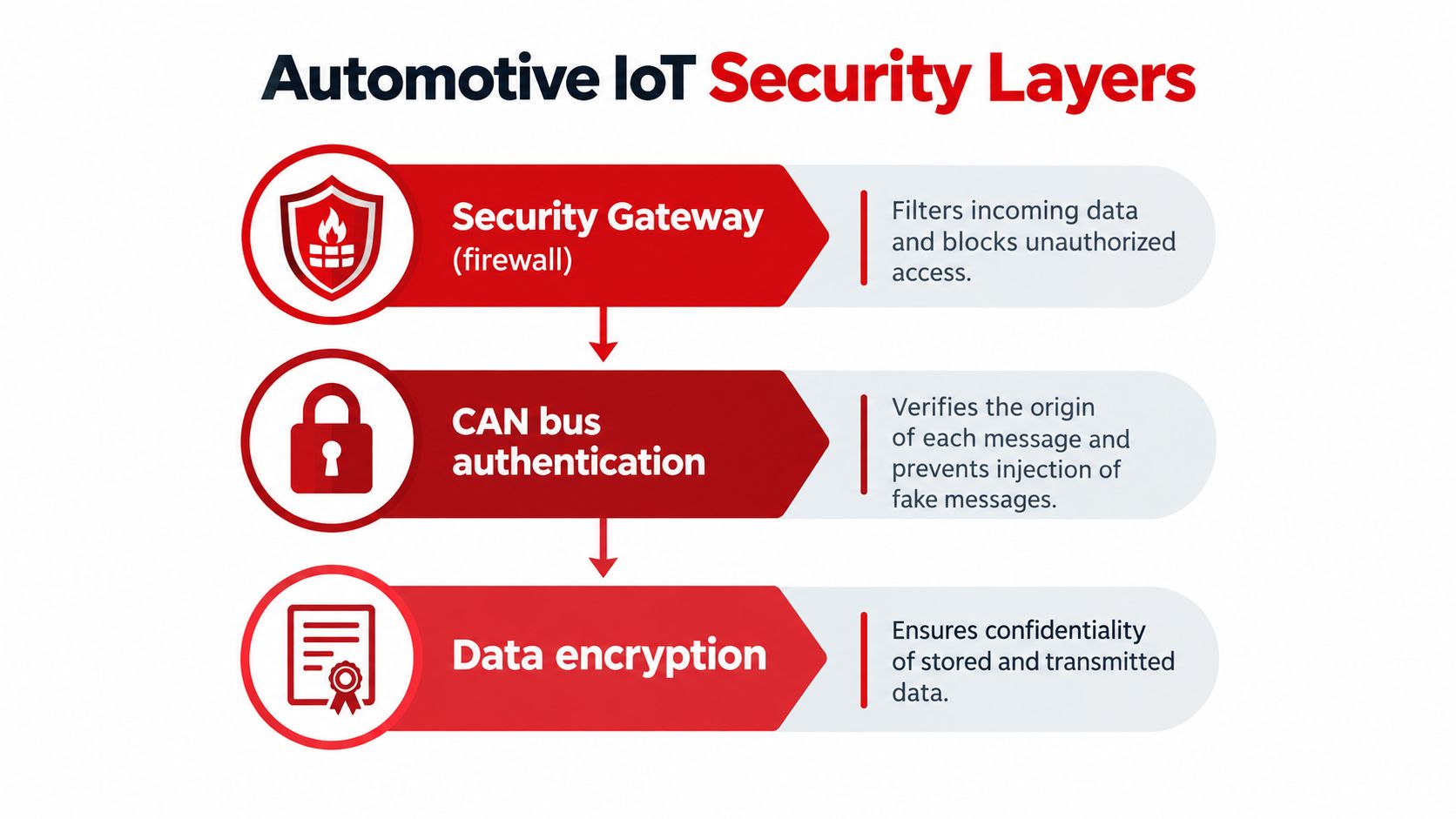
Cloud services and mobile apps need the same discipline. A secure device can still create risk if user accounts are poorly protected, if vendors retain unnecessary location history, or if an API exposes more data than the application requires. A cloud feature set should be judged by its controls, not just by the number of screens in the app. Cloud-based vehicle features are useful only when access and data handling are clearly managed.
OTA updates create a necessary tension
Over-the-air updates help manufacturers and vendors patch vulnerabilities without requiring every vehicle to visit a workshop. They also introduce another attack surface and create operational questions. A vendor should explain how firmware is signed, how the vehicle verifies it, what happens if installation fails, and how the system behaves when the vehicle is offline or parked underground.
UNECE Regulation R155 requires automakers to implement a certified Cyber Security Management System covering development, production, and post-production. The regulation became mandatory for new vehicle types on 6 July 2022 and for new vehicle registrations from 7 July 2024 in UNECE markets, while one industry summary states that the certificate is valid for three years, as described in this UNECE R155 and R156 overview.
A later EU coordinated assessment identified 107 risks for connected and automated vehicles, including 14 top risks, and highlighted vehicle control systems plus communication and backend systems as especially critical because of their public-facing interfaces, according to ENISA's smart-car assessment.
Privacy deserves equal attention. Connected vehicles can collect location, trip history, and in-cabin information. Consent given at handover may not clearly cover a later owner or another driver, so vendors should explain who can access data, how long it's retained, how it can be deleted, and how collection is minimized across GDPR, CCPA/CPRA, Brazil's LGPD, and India's DPDP Act environments. Coverage of these concerns appears in reporting on connected-car data protection risks.
How to Evaluate Solutions and Avoid Costly Mistakes
Start with the event you need to detect, not the feature list you want to collect. If theft is the concern, ask whether the product can report unauthorized movement, engine starts, towing or vibration, disconnection, and unusual battery behavior. If driver oversight matters, look for trip history and information about harsh acceleration, hard braking, or aggressive cornering.
A practical buying checklist
- Confirm location technology. A GPS and cellular tracker serves a different purpose from a Bluetooth item finder. Ask where the system can report and what happens when nearby phones or Wi-Fi networks aren't available.
- Test the alert path. Find out whether alerts arrive through a smartphone application, text message, email, or another channel. Ask whether you can distinguish movement from an engine start or a tampering event.
- Check installation security. Portable battery trackers may fall off, lose power, or stop reporting when a vehicle is switched off. Compare that with an OBD-II or hardwired design and consider who could physically access it.
- Review the history. A location dot is less useful than a clear trip record that shows where the vehicle has been and when events occurred.
- Ask about drivers and privacy. Tell family members, employees, or other authorized drivers what the device collects. Clarify who sees location history and how long the vendor retains it.
- Calculate operational value. For a fleet, compare the subscription and installation cost with the value of faster theft response, fewer unnecessary trips, better dispatch information, and earlier maintenance decisions.
Before you buy: Ask the vendor to describe a failed update, a lost connection, a disconnected device, and an unauthorized account login. The answers reveal more than a list of headline features.
A common mistake is choosing a product that reports well during a test drive but doesn't fit the parking environment. Underground garages, rural routes, long periods of inactivity, shared vehicles, and multiple drivers all change the requirements. Read independent customer feedback, including CarLock reviews, and compare the reported experience with your own use case.
The other mistake is treating privacy as paperwork after installation. A connected vehicle may be used by people who didn't choose the device, so clear notice, limited access, sensible retention, and an easy way to manage permissions should be part of the purchase decision.
Future Trends Shaping the Next Generation of Connected Cars
Automotive IoT is moving toward security operations at scale. The question is no longer only whether a vehicle can send data. Manufacturers, fleet operators, and security vendors must manage devices, identities, updates, incidents, privacy requests, and support over the entire operating life of the vehicle.
Incident size makes that challenge visible. Independent data reported in the 2025 automotive connected-car cybersecurity index says that 60% of cybersecurity incidents in automotive and smart mobility in 2024 affected thousands to millions of assets, while incidents affecting millions of vehicles rose from 5% in 2023 to 19% in 2024, according to Automotive IQ's cybersecurity index. A vulnerability can therefore become an operational problem across a fleet rather than an isolated device issue.
Trust will compete with autonomy hype
Future systems will continue to develop connected driver assistance, vehicle-to-everything communication, edge processing, and software-defined vehicle functions. Those capabilities matter, but basic trust controls may deliver more immediate value to most owners:
- Data minimization: Collect only what the service needs.
- Clear consent: Explain monitoring to owners, secondary drivers, and future users.
- Retention controls: Delete location and trip data when there's no operational reason to keep it.
- Resilient updates: Verify firmware, handle failures safely, and maintain protection when connectivity drops.
- Lifecycle accountability: Keep security processes active after the vehicle leaves the factory.
Regulatory requirements will also make cross-border data handling harder to explain. A vendor serving drivers in multiple regions needs policies that address access, storage, retention, security incidents, and user rights rather than burying those details in an unreadable notice.
For buyers, the next step is practical. Choose the monitoring outcome first, verify GPS and cellular behavior, examine power and tamper protection, ask how updates and offline events work, and confirm who controls the data. A connected car should provide more than a stream of information. It should give the right person a trustworthy signal and a clear action when something changes.
CARLOCK provides real-time GPS vehicle tracking, smartphone alerts, trip history, movement and engine-start notifications, vibration and tamper detection, and monitoring for battery-related issues. Visit CARLOCK to compare a connected security approach with your vehicle's theft, driver-monitoring, and fleet-visibility needs.