

Driver’s Desk
Your Guide to Finding the Best Hidden Car Tracker
A hidden car tracker is a compact, covert device that uses a combination of Global Positioning System (GPS) and cellular technology to transmit your vehicle's precise location in real time. It's a critical component of modern vehicle security, acting as a silent guardian against theft.
Think of it as a dedicated, silent cell phone for your vehicle. It has one job and one job only: to tell you where your car is, whenever you ask. With car thefts on the rise in many urban areas, this device is your ultimate safeguard, standing guard 24/7. In 2023 alone, the National Insurance Crime Bureau (NICB) reported over one million vehicles stolen in the United States, underscoring the urgent need for effective anti-theft solutions.
Decoding the Technology Behind Your Hidden Car Tracker
To truly appreciate why a hidden car tracker is such a game-changer for vehicle security, it's essential to understand the powerful yet elegant technology operating within it. The entire system functions much like a smartphone, relying on a few key components to determine its location, process that information, and transmit it directly to you.
Picture the tracker as a tiny, automated messenger. First, it needs to get its bearings. It does this with a built-in GPS receiver that's in constant communication with a network of satellites orbiting the Earth. By triangulating signals from at least four of these satellites simultaneously, it can calculate its precise coordinates—latitude and longitude—with remarkable accuracy, often within a few meters.
Once the tracker knows its location, it has to phone home. That's where the cellular modem comes in. Just like your phone connects to a cell tower to send a text message or use data, the tracker’s modem transmits its location data over a cellular network (such as 4G LTE) to a secure server. From there, the information is instantly pushed to an application on your smartphone or computer, showing up as a clear pinpoint on a detailed map.
The Core Components Working in Harmony
The magic of any hidden GPS tracker is all about teamwork. Each internal part has a critical job, and they all have to work together perfectly to deliver the real-time security you’re counting on. These components are the unsung heroes of vehicle protection.
Let's break down the essential pieces that make these devices tick:
- The GPS Receiver: This is the device’s "ears." It’s constantly listening for signals from the Global Positioning System satellites. Its sole mission is to determine the tracker's physical location on the planet.
- The Cellular Modem: Think of this as the "voice." It transmits the location data collected by the receiver. To do this, it needs a SIM card and a data plan to communicate over the mobile network, just like a phone.
- The Power Source: To stay operational, the tracker needs power. This can come from a rechargeable internal battery, a direct hardwired connection to the car's own battery, or by simply plugging into the vehicle's OBD-II port.
A common misconception is that these trackers are incredibly complex. In reality, their strength lies in their focused simplicity. They are purpose-built for one dedicated function: to locate and report. This specialized design is precisely what makes them so reliable when it matters most.
This elegant blend of technologies is what turns a small electronic box into a formidable anti-theft tool. The real secret is how these parts work together to create a seamless security experience.
Core Components of a Modern Hidden Car Tracker
The effectiveness of a hidden tracker isn't just about one piece of tech; it's about the seamless integration of several key components. Each part plays a vital role, from pinpointing the location to sending you an alert. Here’s a look at the essential trio that makes modern vehicle tracking possible.
| Component | Function | Importance for Covert Tracking |
|---|---|---|
| GPS Receiver | Listens for signals from satellites to calculate the device's precise geographic coordinates. | This is the foundation of tracking. Without accurate location data, the device is useless. |
| Cellular Modem | Transmits the GPS location data over a cellular network to a central server and then to your phone. | This is the communication link. It allows the tracker to report its location from almost anywhere with cell service. |
| Power Source | Provides the necessary electricity for the GPS and cellular components to operate continuously. | Consistent power ensures the tracker is always on and ready to report, especially during a theft. |
Together, these components create a reliable system that keeps you connected to your vehicle, no matter where it is. It's a simple, yet powerful, combination that forms the backbone of modern vehicle security.
This fusion of location, communication, and power is what makes these devices so effective. The demand for this kind of security is exploding, with the global automotive telematics market valued at around USD 35.5 billion in 2024. The hardware alone—the physical trackers—accounted for over USD 20 billion of that market. You can see more on these trends at gminsights.com.
Understanding these basics helps you see what truly matters when you're looking at the various features and device specifics that different models offer. At the end of the day, this system works silently in the background, giving you a direct line to your vehicle’s location whenever you need it most.
Choosing the Right Type of Hidden Car Tracker
Picking the right hidden car tracker isn't a one-size-fits-all deal. The optimal choice depends entirely on your specific needs and security goals. Not all trackers are created equal; they differ in how they're installed, where they get power, and their level of stealth. Understanding these differences is key to selecting a device that provides the protection you require.
The market for these devices is experiencing significant growth. The global GPS tracking device market is projected to expand from roughly $2.5 billion in 2024 to an expected $5.7 billion by 2033, a compound annual growth rate (CAGR) of over 9%. This isn't just about more trackers; it's about better ones. Innovations in hardwired, portable, and plug-in models now incorporate Wi-Fi, Bluetooth, and smarter analytics, making them more powerful and versatile than ever.
All these options are fantastic for consumers, but it does mean you have a choice to make. Let's walk through the main types to determine which one is the perfect fit for your situation.
OBD-II Plug-In Trackers
If you're looking for sheer simplicity and ease of installation, the OBD-II tracker is your answer. These devices are truly "plug-and-play." Every car manufactured since 1996 is equipped with an On-Board Diagnostics (OBD-II) port, typically located under the dashboard near the steering column. Installing one is as straightforward as plugging in a phone charger.
This type of tracker draws power directly from your vehicle, so you never have to worry about charging a battery. It’s a solid choice for monitoring a new driver in the family or for basic vehicle security where a quick, no-fuss setup is the priority.
However, its greatest strength is also its biggest weakness. Because the OBD-II port's location is standardized, it’s one of the first places a knowledgeable thief will check. This makes it the least covert option of the bunch, easily discovered and disabled.
Battery-Powered Magnetic Trackers
When you need total flexibility and maximum stealth, it's hard to beat a battery-powered magnetic tracker. These are compact, self-contained units equipped with powerful magnets, allowing them to be attached to almost any metal surface of your vehicle, both inside and out.
The primary advantage here is placement freedom. You can hide one deep in the undercarriage, inside a bumper, or tucked into a corner of the trunk. This makes them incredibly difficult for anyone to find accidentally. And since they have no wires, there's zero evidence of installation.
The trade-off is battery life. While modern devices can last for weeks or even months on a single charge thanks to power-saving sleep modes, they do require periodic removal for recharging. This makes them perfect for short-term monitoring or for situations where wiring a device into your car is not feasible.
Hardwired Hidden Car Trackers
For the ultimate in security and a true "set it and forget it" solution, nothing tops a hardwired tracker. These devices are wired directly into your vehicle's electrical system and concealed deep within the dashboard or another hidden location.
A hardwired installation is the gold standard for covert tracking. Because it's integrated with the vehicle’s wiring and hidden from plain sight, it is virtually undetectable to the average car thief, ensuring it remains active and reporting even if other systems are tampered with.
This approach provides a constant, reliable power source and the highest possible level of security. It does, however, typically require professional installation to ensure it's done correctly and safely. For anyone serious about theft prevention, the one-time installation cost is an investment that pays for itself in peace of mind.
The numbers below paint a clear picture of just how much of a difference a hidden tracker can make when it comes to recovering a stolen vehicle.
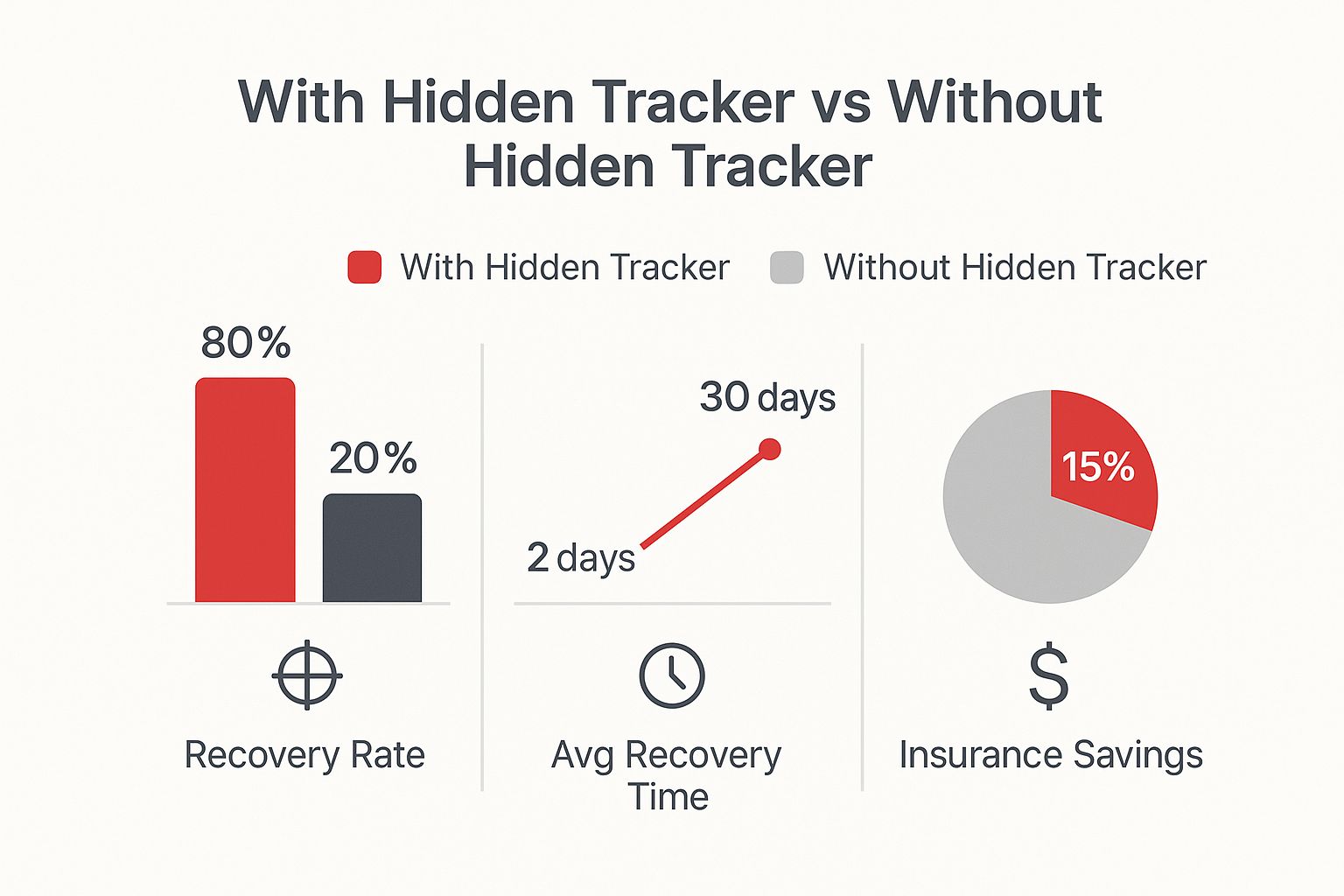
The data speaks for itself. Vehicles equipped with a hidden tracker are recovered far more often and significantly faster. This has a direct impact on insurance costs and, more importantly, your stress levels. As you consider your options, think about how each type of tracker plays into these powerful results. You can also see how a car locator can become your most important tool in an emergency.
Key Features That Define a Great GPS Tracker
Let's be honest, just knowing your car's location is only half the battle. A truly great hidden car tracker does more than put a dot on a map; it provides a comprehensive suite of tools for robust security and, just as importantly, peace of mind. These features are what elevate a simple gadget into a powerful anti-theft system. Knowing what to look for is the key to choosing a device that actually delivers when you need it most.
Modern hidden trackers have come a long way. They are now incredibly compact and powerful, designed for covert tracking without sacrificing battery performance. Some of these devices are remarkably small, measuring just 1.81 x 1.5 x 0.6 inches, and use powerful magnets to stay securely in place. While the battery might last for several days in active use, intelligent power-saving modes can extend that to nearly a year on standby, ensuring it's ready when you need it most.
This combination of stealth and endurance is the foundation, but the real magic is in the features that bring it all to life.
Real-Time Tracking and Frequent Updates
The most fundamental function of any GPS tracker is to report its location in real time. But what does "real-time" actually mean? In a theft scenario, an update every five minutes is practically useless. An update every five seconds? Now you're talking. The higher the update frequency, the more accurately you and law enforcement can track a moving vehicle.
Look for a tracker that allows you to adjust the update intervals. This gives you the flexibility to balance precision with battery life—you can use slower updates for routine monitoring and then increase the frequency to its maximum during an emergency.
Geofencing: Your Virtual Boundaries
Geofencing is easily one of the most practical features for day-to-day security. It allows you to draw virtual "fences" on a map around important locations, such as your home, office, or your child's school.
Think of it like setting up a digital tripwire. If your vehicle enters or leaves one of these predefined zones, you receive an instant alert on your smartphone. This is incredibly useful for several reasons:
- Theft Prevention: Get an immediate notification if your car leaves the driveway in the middle of the night.
- Monitoring New Drivers: Ensure your teenager is staying within an approved geographical area.
- Workplace Security: Confirm a company vehicle isn't leaving a job site during work hours without authorization.
Critical Motion and Vibration Alerts
Thieves don't always jump in and start the engine immediately. They might smash a window, attempt to tow the vehicle, or simply jostle it while trying to gain entry. A quality hidden tracker has sensitive accelerometers built in to detect even these subtle movements.
An immediate vibration alert is your first line of defense. It notifies you of a potential break-in or tampering before the car is even stolen, giving you a critical head start to react and contact the authorities.
These motion-activated alerts mean you're aware of suspicious activity the second it happens. This single feature transforms your tracker from a simple recovery tool into a proactive security system.
Route History and Playback
If the worst happens and your car is stolen, its live location is vital, but so is the historical data of where it's been. Being able to review your vehicle's path over the last few hours, days, or weeks can be a game-changer for a police investigation.
Route history playback provides a detailed log of the car's journey, showing every stop, travel time, and speed. This information helps law enforcement identify patterns, discover potential drop-off points, or locate the thief's final destination. It's also a practical tool for business owners tracking mileage or parents who want to review a teen's driving habits. The best systems have a user-friendly app that makes this data easy to access and understand. For a closer look, check out our guide on the features and app usability that truly set the best trackers apart.
Finding the Best Hiding Spot for Your Tracker
Let's be blunt: a hidden car tracker is completely useless if it’s not actually hidden. Where you decide to place your device is the single most critical factor in its effectiveness during a theft. A poorly chosen hiding spot can be found in seconds, rendering your investment worthless. The primary goal is to find a location that’s both invisible to a thief and functional, allowing the tracker to work without giving away its position.
Finding that sweet spot is a balancing act between stealth and performance. You need a location that a thief is unlikely to check, but that also allows the GPS and cellular signals to transmit effectively. This means avoiding any spot that’s completely enclosed by metal, which can create a Faraday cage effect and block signals. Think of it like a sniper's nest—it needs a clear line of sight to the sky for GPS and a way to communicate with the cellular network.
Strategic Interior Hiding Places
Placing your tracker inside the car protects it from the elements—rain, mud, and road grime. It also makes it much harder for a thief to find, especially when they're operating under pressure. The key here is to think beyond the obvious. While the OBD-II port is incredibly easy for plug-in models, it's also the very first place any thief with a clue will look.
Instead, consider these smarter interior locations:
- Under the Dashboard: Deep within the complex network of wires behind the dash, there are numerous empty spaces perfect for a small tracker. This spot keeps the device completely out of sight and often provides easy access to power for a hardwired setup.
- Beneath the Seats: Tucking a tracker under a seat, secured tightly to the metal frame or even hidden inside the upholstery, is another excellent option. It’s a location almost no one bothers to check thoroughly.
- Inside Door Panels or Pillars: For a more advanced installation, concealing a device inside a door panel or behind the plastic trim of an A-pillar or C-pillar makes it nearly impossible to find without dismantling parts of the car.
- In the Trunk: The trunk offers a multitude of nooks and crannies. Think inside the spare tire well, behind the trunk carpeting, or secured near the rear taillight assemblies.
Effective Exterior Hiding Places
If you're using a magnetic, battery-powered tracker, the outside of your car opens up a whole new world of possibilities. The main benefit here is the sheer number of potential placement spots, but you must use a tracker specifically built to be durable and waterproof.
When hiding a tracker outside, your goal is to find a spot that’s inconspicuous and protected from flying road debris. A powerful magnetic mount is non-negotiable here; it has to stay put on bumpy roads and at highway speeds.
Look for places that offer cover and a solid metal surface to adhere to:
- Inside the Bumper: The hollow space inside a plastic front or rear bumper is an ideal location. It conceals the tracker completely, and the plastic material won’t block the signal.
- On the Vehicle Frame: The car’s undercarriage frame has countless potential spots. Choose a place high up, away from the hot exhaust system and moving suspension parts, to protect it from heat and damage.
- Behind the Front Grille: A small, black tracker tucked behind a complex front grille can become virtually invisible, blending in with the other components.
A Note on Hardwiring
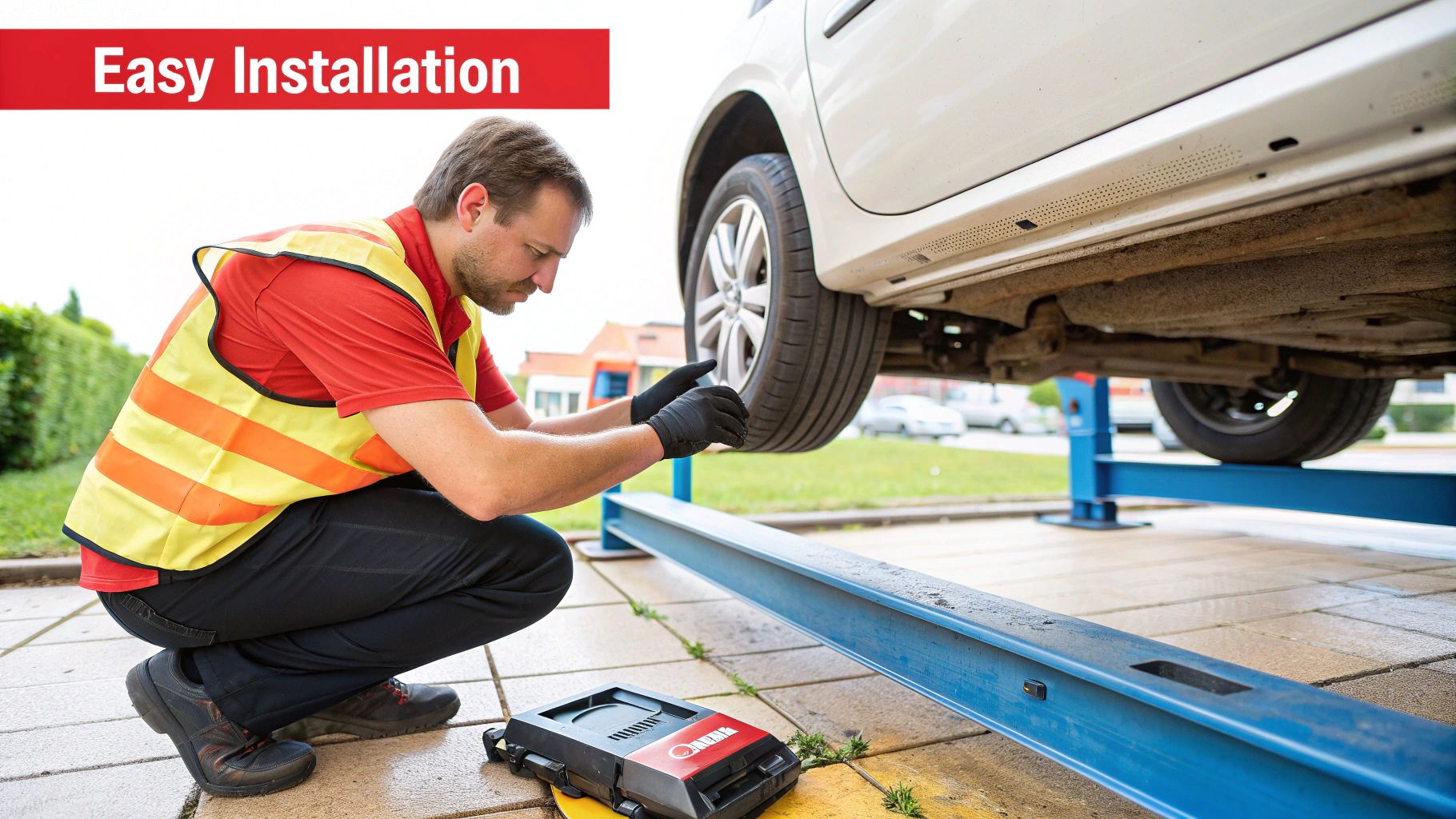
For the ultimate in covert security, a hardwired tracker is the superior choice. This involves connecting the device directly to your car's electrical system, providing a constant source of power and allowing for a truly secret installation. However, this is not a job for amateurs; it requires a solid understanding of automotive wiring.
An incorrect installation can drain your battery, cause electrical shorts, or even damage your car’s sensitive electronic control unit (ECU). For this reason, we strongly recommend professional installation for any hardwired tracker. An expert knows exactly where to safely tap into power and the best places to hide the device so it's both reliable and truly hidden.
Navigating the Legal Rules of Vehicle Tracking
Using a hidden car tracker to protect your property is a smart, proactive measure, but it comes with significant legal responsibilities. The tracker itself is merely a tool; it's how you use it that determines whether you are lawfully protecting your assets or illegally infringing on someone's privacy. Understanding the fundamental principles of ownership and consent is crucial to using your device ethically and legally.
At its core, the law regarding vehicle tracking is straightforward: you have the right to monitor property that you own. This principle is the foundation for almost all related legislation.

When You're in the Clear
For the most part, the law is on your side when you're tracking assets that belong to you. This provides a clear framework for protecting your investments and loved ones without entering a legal gray area.
Here are the scenarios where using a hidden tracker is generally considered legal in most jurisdictions:
- Tracking Your Own Vehicle: This is the most common and legally sound application. Placing a tracker on your personal car for anti-theft protection is your right as the owner.
- Monitoring Your Minor Child: Parents and legal guardians can legally track a vehicle being driven by their child who is under the age of 18. This is widely recognized as a reasonable measure to ensure their safety.
- Tracking Company Vehicles: An employer has the right to install trackers on company-owned vehicles used for business purposes. That said, it is always a best practice—and in some states, legally required—to obtain written consent from the employees who operate them.
What Is Strictly Illegal
The legal boundaries become very distinct when it involves tracking a vehicle you do not own without the explicit permission of the owner. At that point, you are moving from asset protection into the realm of surveillance, which is heavily regulated and can carry severe penalties.
Tracking someone else’s car without their knowledge is not a gray area; it is illegal. This act can be classified as stalking or harassment and may lead to serious consequences, including substantial fines and imprisonment.
It is crucial to remember that consent must be clear and given willingly. Simply being a spouse or family member does not automatically grant you the right to track another adult’s car if your name is not on the vehicle's title. Ownership is the key legal determinant.
Because tracking laws can vary significantly from state to state and country to country, staying informed is vital. For a deeper dive into the specifics, you can review a detailed breakdown of the legal considerations for GPS tracking to ensure you're always on the right side of the law. This knowledge empowers you to use your tracker responsibly, reaping all the security benefits while staying firmly within your legal rights.
Your Action Plan If Your Car Is Stolen
That gut-wrenching moment you realize your car is gone is something no one should experience. Panic sets in, and it's easy to feel completely helpless. But if you have a hidden car tracker, the script flips entirely. You're no longer a victim waiting for news; you're an active part of the recovery.
However, your first instinct might be to race to the location your tracker is showing. Stop. That's the single most dangerous thing you could do. Your safety is paramount. Never, ever try to recover the vehicle or confront the thieves on your own.
Step 1: Contact Law Enforcement Immediately
Before you do anything else, call the police. Provide them with all the essential details: your car's make, model, color, and license plate number. Then, deliver the most critical piece of information: "My car has a hidden GPS tracker, and I have its live location right now."
This single statement is a total game-changer for law enforcement. They are no longer initiating a cold search across the city; they have an active, moving target to intercept. Be prepared to give them the crucial data points from your tracking app:
- Current Coordinates: The precise latitude and longitude of your vehicle.
- Direction of Travel: Which way it's headed (e.g., "northbound on Highway 101").
- Current Speed: How fast the car is moving at that moment.
Step 2: Provide Continuous, Calm Updates
Stay on the phone with the police dispatcher or the officer handling your case. Your role is now to act as their eyes in the sky, calmly feeding them real-time updates as the car moves. You are their intelligence source, not a participant in the pursuit.
The fastest, safest recoveries happen when a car owner and the police work together. Your tracker provides the precise data they need to plan an interception that minimizes risk to everyone.
The accurate, real-time data from your hidden tracker dramatically increases the probability of a swift and successful recovery. The police can anticipate the thief's path and coordinate a response safely and effectively, often leading to an arrest and the recovery of your undamaged vehicle.
Step 3: Utilize Historical Route Data
Even after the initial report, your tracker's data remains incredibly valuable. If the car stops somewhere for a period or after it's recovered, its route history can offer a treasure trove of information for the investigation.
This data might reveal other locations the thief visited, point to potential accomplices, or uncover the location of a "chop shop" or other stolen vehicles. By following these steps, you are leveraging your tracker's technology to its full potential and empowering law enforcement to do their job effectively. You become the crucial link in the chain that leads them right back to your car.
Still Have Questions? Let's Clear Things Up
Even after digging into all the features and tech, a few practical questions always pop up. It's completely normal. Getting these common concerns ironed out is the final step to feeling 100% confident in using a tracker to protect your car.
Let's tackle a few of the big ones we hear from customers all the time.
Will a Hidden Tracker Kill My Car Battery?
This is easily the most common worry, but the answer should put your mind at ease. Modern trackers, whether they're hardwired or plugged into the OBD-II port, are engineered for extremely low power consumption.
When your car is parked and the tracker is in standby mode, it typically draws less than 10 milliamperes of current. To put that in perspective, that’s about the same tiny amount of power your car’s clock or radio memory uses. On a healthy vehicle battery, a quality tracker can operate for months without any noticeable impact.
Can a Thief Actually Find My Hidden Tracker?
A tracker's greatest strength is its secrecy. While a professional thief with specialized electronic detection gear and unlimited time might eventually find anything, the goal is to make it so difficult and time-consuming that they either give up or get caught in the act.
The likelihood of a tracker being found really boils down to two factors:
- Placement: A clever hiding spot is your best defense. Tucked away deep inside a dashboard, behind a bumper, or within the undercarriage makes it dramatically harder to find than one in an obvious location.
- Installation: A professionally installed hardwired tracker is practically invisible. There are no obvious wires to follow, making it far more secure than an easy-to-spot OBD-II device.
A well-hidden tracker uses a thief's own sense of urgency against them. The more time they waste searching, the more time you have to get law enforcement a precise location.
Do Trackers Work Without Cell Service?
Excellent question. This gets right to the heart of how these little gadgets phone home. Most real-time GPS trackers require a cellular signal to transmit location updates to your phone. If your vehicle enters a cellular "dead zone"—like a deep underground parking garage or a remote rural area—those live updates will temporarily pause.
But here’s the clever part: many advanced trackers feature a "store and forward" capability. They don't just stop working; they continue to record and save GPS data to their internal memory. The moment your car drives back into an area with cell coverage, the device automatically uploads all that stored history, filling in the blanks on your map so you have a complete record of its journey.
Investing in a real security system is one of the smartest moves any car owner can make. With CarLock, you're getting more than just a dot on a map; you're getting a complete vehicle security system that pushes real-time alerts straight to your phone. Protect your ride and get true peace of mind by visiting www.carlock.co today.