

Driver’s Desk
What Are Anti Theft Devices For Cars? A Complete Guide
At their core, anti-theft devices are your car's personal security detail. They are engineered to do three things: deter a potential thief, prevent a theft in progress, and help you recover your vehicle if the worst happens. These aren't just one-size-fits-all gadgets; they're layers of defense, from high-decibel alarms and hardened steel locks to sophisticated electronics that can disable the engine or track your car's exact location in real-time.
Why Your Car's Factory Security Might Not Be Enough
It's a common assumption that the security system that came with your car is sufficient. Unfortunately, in today's landscape, that's an increasingly risky bet. Professional car thieves constantly evolve their methods, utilizing advanced technology to exploit vulnerabilities in standard factory-installed systems. Relying solely on that basic protection is akin to leaving your front door unlocked.
Think of it this way: you wouldn't secure your home with just the flimsy lock on the doorknob. You add a deadbolt, maybe an alarm system, and security cameras. The exact same logic applies to your vehicle. A robust security strategy isn't about one single device—it's about creating multiple, redundant hurdles for a thief to overcome.
The Modern Threat Landscape
The statistics paint a clear picture of the growing threat. According to the National Insurance Crime Bureau (NICB), vehicle thefts in the U.S. have been on a significant upward trend, with over one million vehicles stolen in 2022, the highest number since 2008. Globally, the market for car security systems hit USD 9.1 billion recently and is projected to jump to USD 15.6 billion by 2034. This growth isn't just corporate expansion; it's a direct response to rising theft rates and more owners realizing they need to enhance their protection. You can see a full breakdown of the trends driving the car security market for more details.
A solid security setup is all about layers—it should deter, prevent, and help you recover. Every layer you add increases the time, effort, and risk for a thief, making them far more likely to abandon the attempt and look for an easier target.
To build an effective defense, you must understand the tools available. Anti-theft devices generally fall into four main categories, each playing a distinct role in combating car theft.
- Alarms: These are audible and visual deterrents. Their goal is to create a loud, public disturbance to scare a thief off before they can gain entry or start the vehicle.
- Immobilizers: These are electronic security devices that prevent the engine from starting unless the correct transponder key or fob is present. No valid key, no ignition.
- Tracking Systems: Your asset recovery tool. Using GPS or other radio technologies, these systems pinpoint your car's exact location, making police recovery significantly more likely.
- Physical Locks: These are mechanical barriers that are highly visible and require physical force to defeat, such as steering wheel clubs or pedal locks.
Building a Fortress: Four Layers of Vehicle Protection
Securing your vehicle is analogous to defending a fortress; a single wall is insufficient to stop a determined adversary. The most effective anti-theft strategy involves creating multiple layers of defense that work in concert. Each layer adds another obstacle, making the act of stealing your car progressively harder, riskier, and more time-consuming for a criminal.
Thinking about security in layers helps clarify the purpose of each device. Instead of relying on a single gadget, you’re constructing a comprehensive defense where each component reinforces the others. This approach transforms your car from an easy target into a high-risk, low-reward proposition for criminals.
The infographic below breaks down these core defensive layers, showing how alarms, immobilizers, trackers, and physical locks each play a unique role in protecting your asset.
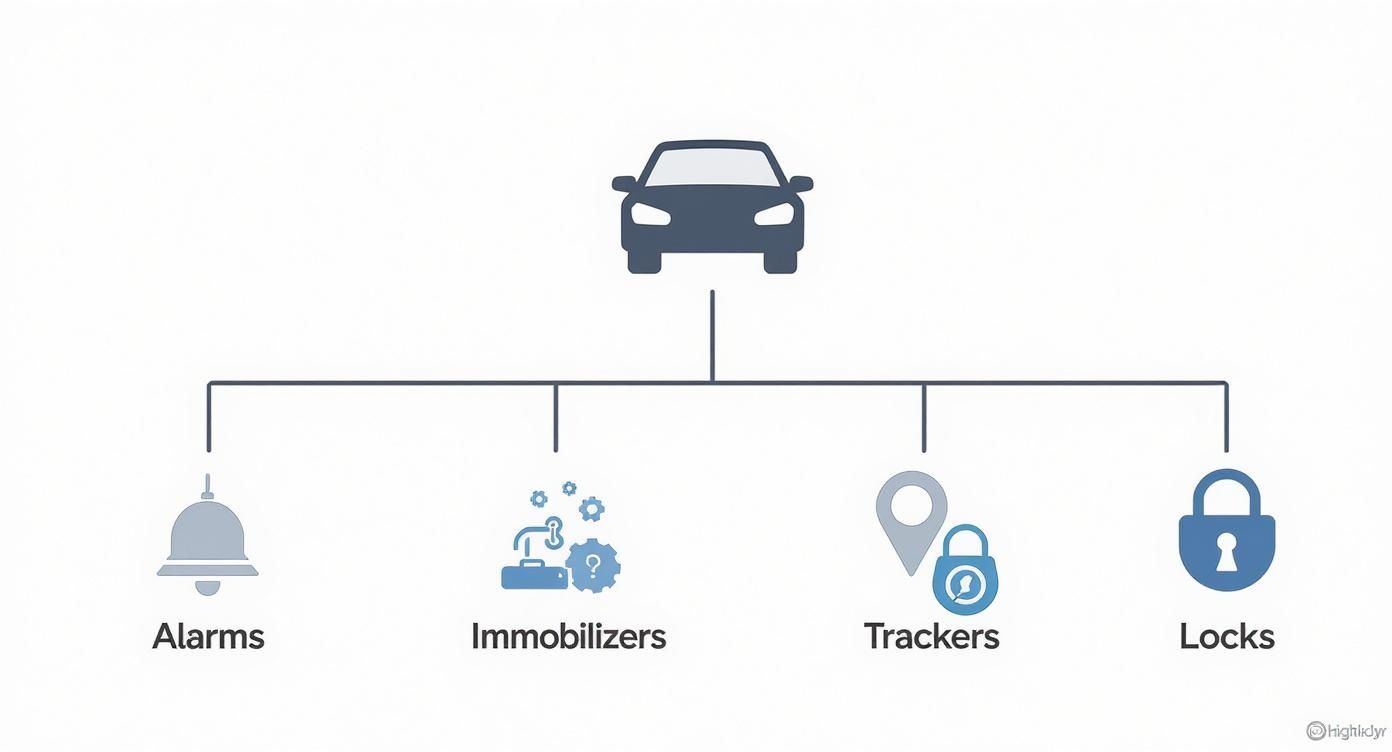
As you can see, a truly secure vehicle combines deterrence, prevention, recovery, and old-school physical strength into one cohesive strategy.
The Four Essential Layers
To adequately protect your investment, you should consider implementing devices from each of these four categories. Each is designed to thwart a thief at a different stage of an attempted theft, from their initial approach to the final getaway.
Here's how they break down:
-
Deterrence (Alarms): This is your first line of defense, designed to make your car an unattractive target from the outset. Loud sirens (often exceeding 120 decibels) and flashing lights draw immense unwanted attention. That pressure is often enough to scare off an opportunistic thief before they even touch your vehicle.
-
Prevention (Immobilizers): If a thief bypasses the audible alarm, this next layer prevents them from actually driving away. Engine immobilizers act as a digital gatekeeper, requiring a specific transponder key or fob to authenticate with the engine control unit (ECU). Without this "digital handshake," the car's fuel pump or starter motor is disabled, rendering it nothing more than a metal box.
-
Recovery (Trackers): This is your ultimate safety net. If a professional manages to bypass the first two layers and gets your car moving, a GPS tracker is your most critical asset. It gives you the power to see your vehicle's location in real-time, which massively increases the odds of law enforcement recovering it—often within just a few hours. You can see a full breakdown of how a modern car security system brings all these features together.
-
Physical Reinforcement (Locks): The final layer is a traditional mechanical obstacle. Devices like steering wheel clubs or pedal locks serve as a powerful visual warning. More importantly, they require significant physical force, specialized tools, and precious time to defeat, making a quick, quiet getaway impossible.
To help you see how these layers work together, the table below gives a quick comparison of their roles.
Comparing The Four Layers of Car Security
| Security Layer | Primary Function | Key Benefit | Best For |
|---|---|---|---|
| Deterrence | Scares thieves away with noise and light | Prevents the break-in from happening in the first place | Fending off casual, opportunistic thieves in public areas |
| Prevention | Electronically blocks the engine from starting | Stops the car from being driven, even if broken into | Defeating hot-wiring and modern electronic theft techniques |
| Recovery | Pinpoints the vehicle's location after a theft | Dramatically increases the chances of getting the car back | The ultimate backup plan against professional, determined thieves |
| Physical Reinforcement | Creates a tough, mechanical barrier | Buys time and requires special tools to overcome | Adding a strong visual deterrent that makes theft more difficult |
Ultimately, a layered security approach forces a thief to defeat multiple, distinct challenges. The more obstacles you put in their way, the more likely they are to give up and look for an easier target.
Your Car's Electronic Bodyguards
When we talk about electronic anti-theft devices, we're referring to the digital nervous system of your car's security. These systems work silently in the background, standing guard to stop a theft before it can be successfully executed.
The one everyone knows is the classic car alarm. But modern alarms are far more than just a loud siren. They are a smart network of sophisticated sensors that create an invisible shield around and within your vehicle.
Think of these sensors as your car's own set of senses, always on alert for trouble:
- Shock Sensors: These detect sudden impacts. A window breaking or another car hitting yours? The shock sensor detects the vibration and triggers the alarm.
- Tilt Sensors: If a thief attempts to tow your car or jack it up to steal the wheels, the tilt sensor will detect the change in angle and sound the alarm.
- Proximity Sensors: This is your car's personal space bubble. It emits a warning chirp if someone lingers too close for too long, often enough to scare them off before they attempt a break-in.
This web of sensors turns your car from a passive object into an active defender. Some of the newest systems are even using AI-powered anti-theft alerts to more intelligently distinguish between real threats and false alarms, a significant step up from traditional systems.
The Unsung Hero: Engine Immobilizers
While an alarm's job is to make a scene, the engine immobilizer is your car's silent, stealthy protector. It's the unsung hero of car security and has been credited by the Highway Loss Data Institute (HLDI) with significantly reducing car theft rates since its widespread adoption.
The best way to think of it is a secret digital handshake. Your key fob contains a transponder chip that sends a unique, encrypted code to a receiver in your car’s ignition system. If the code is not recognized by the engine control unit (ECU), it will refuse to engage the fuel system or starter motor. No handshake, no start.
An engine immobilizer doesn't just make stealing a car harder; for a thief without the correct key, it makes it electronically impossible to start the engine via traditional methods like hot-wiring.
This single piece of technology is a primary reason why professional car theft has become so much more complex, shifting thieves' focus to methods like key fob signal relay attacks. It's no surprise the market for these systems, which was valued at USD 18.60 billion, is expected to skyrocket to USD 28.34 billion by 2034. This demonstrates the industry's reliance on smart technology to secure vehicles.
To see how these different technologies come together, our deep dive on how a modern car alarm integrates all these features is a great place to go next.
The Ultimate Safety Net: GPS and RF Trackers
When alarms and locks fail to stop a determined thief, recovery becomes your number one priority. This is the moment a tracking device proves its immense value, acting as the ultimate safety net for your car. These devices can turn a potential total loss into a recoverable asset, drastically increasing the probability of getting your vehicle back.
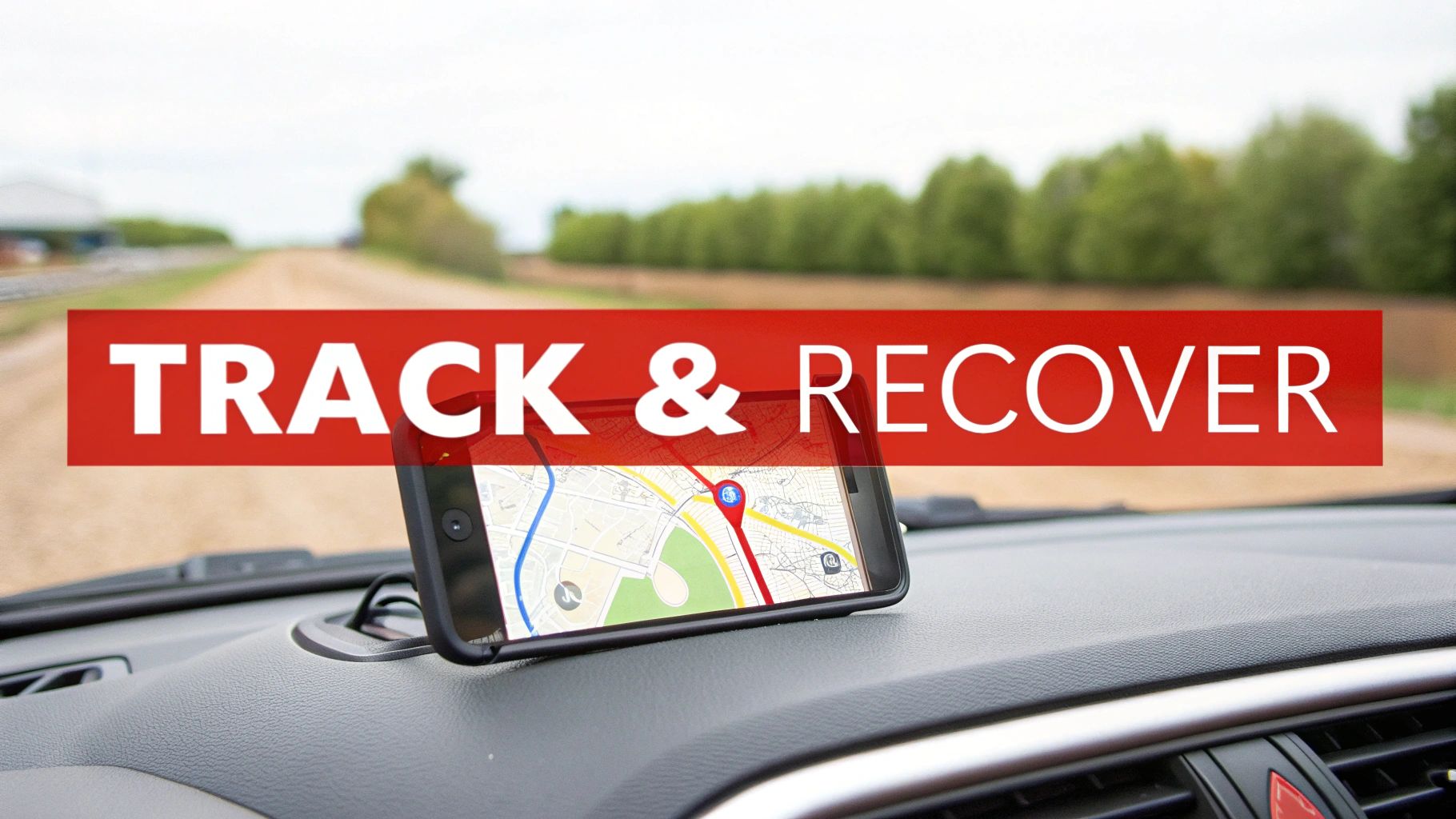
The most familiar device is the GPS tracker. It's like having a tiny satellite link hidden within your vehicle, providing constant surveillance. Using the Global Positioning System, it pinpoints your car's exact coordinates and transmits that data to an application on your smartphone in real-time.
The real power of a tracker isn't just knowing where your car is, but knowing the moment it's somewhere it shouldn't be. This immediate alert is what transforms you from a victim into an active participant in your car's recovery.
Advanced Tracking Capabilities
Modern trackers go far beyond simply dropping a pin on a map. The best systems offer features that create a virtual perimeter around your car, which is absolutely critical for a rapid response. When your car is stolen, every second counts. You can learn more about how today’s advanced car tracking technology works to give you the upper hand.
Here are a few key features to look for:
- Geofencing: This allows you to draw virtual boundaries on a map—for instance, around your home or workplace. If your vehicle crosses that line outside of designated hours, you receive an instant alert.
- Real-Time Alerts: Get immediate notifications for suspicious activity, such as the engine starting when you're not in the car, a sudden vibration from a window being smashed, or if a thief attempts to disconnect the tracker itself.
- Remote Engine Immobilization: Some of the most advanced systems even allow you to remotely disable the engine. This can stop a thief dead in their tracks, making it much easier for police to apprehend them and recover your vehicle safely.
What Happens When GPS Goes Dark?
For all its power, GPS has one critical vulnerability: it requires a clear line of sight to orbiting satellites. Professional thieves know this and will often stash stolen vehicles in locations designed to block that signal, such as underground parking garages, steel shipping containers, or dense urban canyons.
That's where Radio Frequency (RF) trackers come in. Instead of satellites, an RF device emits its own powerful, silent radio signal. This signal can penetrate concrete, steel, and other obstructions that block GPS. Law enforcement can then use specialized receivers to home in on that signal, following it like a digital bloodhound directly to your car's hiding spot.
Why Physical Locks Still Matter in a Digital World
In an age of silent immobilizers and GPS trackers pinging locations in real-time, it's easy to dismiss an old-school steering wheel lock as a relic. However, that would be a mistake. The simple, highly visible nature of a physical lock provides a crucial layer of security that high-tech gadgets cannot replicate.
Their real power isn’t in being unbreakable; it’s in being an unmissable warning sign to any thief scoping out their next target.
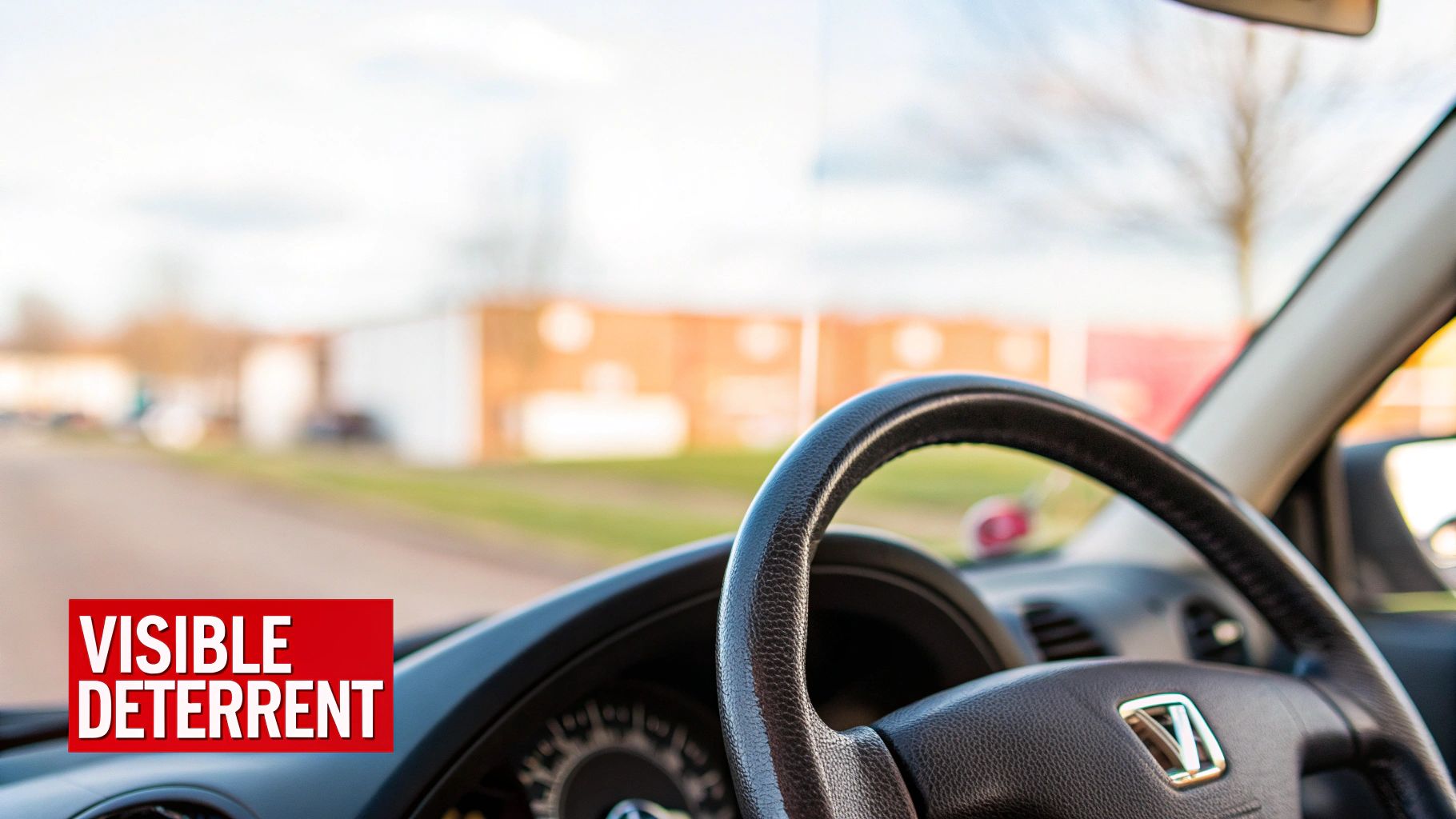
Most car thefts are crimes of opportunity. A criminal casing a parking lot is looking for the path of least resistance—a target that promises a quick, quiet, and low-risk theft. A bright yellow steering wheel club or a hefty wheel clamp immediately signals that your vehicle is none of those things.
This visual deterrence is incredibly powerful. It forces a thief to perform a risk-reward calculation: Is it worth the extra time and effort to defeat this lock? Am I willing to make significant noise with a power tool and attract attention? In the vast majority of cases, the answer is no. They will simply move on to the next, unprotected car.
The Mechanics of Mechanical Defense
Physical anti-theft devices work by creating a tangible, brute-force barrier that prevents a car from being operated. Unlike electronic systems that can potentially be bypassed with sophisticated hacking tools, these demand raw power, specialized equipment, and time to defeat.
Here are the most common types and how they function:
- Steering Wheel Locks: Often called "clubs," these devices are made of hardened steel and lock the steering wheel in place, making it physically impossible to turn the car.
- Pedal Locks: These clamp onto the brake or clutch pedal, preventing them from being depressed. No pedals, no driving.
- Wheel Clamps: You've probably seen these heavy-duty "boots" used by parking enforcement. They attach directly to the wheel, immobilizing it and preventing rotation.
The greatest strength of a physical lock is its simplicity. It needs no power, can’t be digitally jammed, and sends a crystal-clear message: "This car is protected. Go find an easier target."
Sure, a determined professional with an angle grinder could eventually cut through a lock, but the time and noise involved are massive deterrents. For the vast majority of opportunistic thieves, that extra hassle is a complete dealbreaker. This makes physical locks an affordable and surprisingly effective component of any comprehensive security strategy.
Choosing the Right Anti-Theft System for You
Now that we’ve broken down the different layers of protection, you can start building a security plan that is tailored to your car and your specific circumstances.
Picking the right anti-theft setup isn’t about buying the most expensive gadget available. It’s about being strategic and matching your defenses to your personal risk level. There is no single "best" system for everyone—only the one that’s best for you.
Take a moment to assess your situation. A brand-new luxury SUV parked on a busy city street every night faces a completely different threat profile than a ten-year-old sedan kept in a locked garage in a quiet suburb. Your security strategy must reflect that reality.
Key Factors to Consider
Before purchasing any device, ask yourself a few key questions. Your answers will guide you toward the most effective—and cost-effective—security layers for your vehicle.
- Vehicle Value and Desirability: Is your car a high-demand model for professional thieves (like a Ford F-150 or Honda CR-V), or an older model more likely to be stolen for a joyride? High-value vehicles warrant advanced electronic systems like trackers and immobilizers.
- Parking Location: Where does your car spend most of its time? A secure, private garage is low-risk; a poorly lit public street or a large, anonymous parking structure is high-risk. The riskier your typical parking spot, the more layers of security you need.
- Local Theft Rates: Is vehicle theft a common problem in your neighborhood or city? A quick search of local police data or NICB reports can be a real eye-opener, telling you if you’re living in a high-risk area.
- Your Budget: Think of security as an investment in protecting a valuable asset. While a top-of-the-line system can be expensive, even a simple physical lock provides a significant return on investment in terms of deterrence.
A layered approach is always your best bet. For a new, high-value vehicle in an urban area, combining an advanced immobilizer with a real-time GPS tracker offers the strongest defense against sophisticated theft. Finding your car quickly is critical, and a quality car locator can make all the difference.
Conversely, if you have an older car in a low-risk area, a highly visible steering wheel lock might be all it takes to make an opportunistic thief move on.
For electronic systems like trackers and alarms, professional installation is crucial. This ensures they function correctly and are concealed in locations that are difficult for a thief to find and disable. Finally, contact your insurance provider. Many offer significant discounts for vehicles equipped with approved anti-theft devices, which can help offset the initial cost.
Frequently Asked Questions About Car Anti-Theft Devices
Diving into the world of vehicle security can feel overwhelming. Let's address some of the most common questions car owners have when trying to determine the best way to protect their vehicle.
Can Thieves Really Bypass Modern Factory Alarms?
Unfortunately, yes. Professional thieves frequently use sophisticated tools like relay attack devices to capture and amplify your key fob's signal, even from inside your house. This "keyless entry" theft allows them to unlock and start your car without ever triggering the factory alarm. They also use code grabbers to intercept the signal. This is precisely why adding an independent, aftermarket layer of security is so critical.
Do Anti-Theft Devices Lower Car Insurance?
In many cases, they absolutely can. Most insurance companies offer discounts for vehicles equipped with approved anti-theft devices. They particularly favor passive systems that arm automatically, such as immobilizers, and active recovery systems like GPS trackers. The specific discount varies by provider and the type of device, so it's always worthwhile to call your insurer to confirm their policy.
Think of it this way: insurance providers see these devices as a huge reduction in risk. If you can prevent a theft or facilitate a quick recovery, you're saving them a potential total loss payout. They are often willing to pass a portion of those savings back to you as a premium discount.
Are Steering Wheel Locks Still Effective Today?
While it is true that a determined thief with the right tools can eventually defeat a physical lock, its primary power lies in being a strong visual deterrent. Thieves operate on a risk-versus-reward basis and prioritize speed and stealth. The sight of a large, brightly colored lock on the steering wheel immediately increases the perceived time, effort, and risk of stealing that car. This is often more than enough to convince them to move on to an easier target. It is an affordable and highly effective part of a layered security plan.
What Is the Difference Between GPS and RF Trackers?
A GPS tracker uses a network of satellites to pinpoint your car's exact location on a map, providing real-time updates to your smartphone. An RF (Radio Frequency) tracker emits a silent, powerful radio signal that law enforcement can use specialized direction-finding equipment to home in on.
GPS is excellent for live tracking when your car is in the open. RF has an advantage if a thief has hidden your car somewhere a GPS signal cannot penetrate, such as deep inside a concrete parking garage or a steel shipping container. Some premium systems combine both technologies for maximum recovery potential.
For a deeper look into how this technology works, you can explore more questions about GPS car trackers.
Ready to add a powerful, real-time recovery layer to your vehicle's defense? CarLock provides instant alerts for suspicious activity and live GPS tracking, giving you the ultimate peace of mind. Secure your vehicle today by visiting https://www.carlock.co.