

Driver’s Desk
Your Guide to a Motion Detector for Car Security
A motion detector for car security is a significant leap beyond the classic car alarm. It’s a smart security device that utilizes advanced sensors to detect threats before a thief can break in or drive away with your vehicle. Rather than merely sounding a siren when a door is breached, it actively monitors for preliminary signs of trouble—such as suspicious vibrations, unauthorized tilting, or movement inside the cabin—and sends an immediate, detailed alert directly to your phone.
The Evolution of Car Security Beyond the Alarm
The traditional blaring car alarm has largely become a relic of the past. For decades, it was the primary vehicle security tool, designed to create a loud noise and deter criminals. However, its effectiveness has diminished significantly. Society has become desensitized to the sound, a phenomenon known as "alarm fatigue," often assuming it's another false trigger. In fact, comprehensive studies have shown that a staggering 95% to 99% of car alarm triggers are false positives, rendering the alarms ineffective as a public deterrent.
This is where a modern motion detector for car security system fundamentally changes the approach to vehicle protection.
Think of a traditional alarm as a simple tripwire; it only activates after a boundary has been crossed, such as a door being forced open. It's a reactive, single-function device. A motion detection system, by contrast, acts as a vigilant, 24/7 guard, providing real-time intelligence directly to you instead of just generating noise.
A Smarter Approach to Vehicle Protection
Instead of waiting for damage to occur, these advanced systems employ a suite of sophisticated sensors to identify suspicious activity at its inception. This intelligent, multi-layered monitoring is what separates contemporary security technology from outdated alarms.
Here are a few key threats a high-quality motion detector can identify:
- Vibrations and Impacts: Advanced algorithms allow the system to differentiate between ambient vibrations (like a passing truck) and the specific frequencies associated with a window being smashed, a lock being tampered with, or even someone attempting to drill into the vehicle.
- Tilting and Towing: Catalytic converter theft is rampant, with the National Insurance Crime Bureau (NICB) reporting a 1,215% increase in thefts between 2019 and 2022. An internal accelerometer instantly senses any change in the vehicle's angle, sending an alert if it's being jacked up or towed away.
- Unauthorized Engine Starts: The device detects when the engine is started without authorization, a clear indication that a theft is in progress.
The real power of a motion detector is its ability to provide real-time, actionable intelligence. It transforms car security from a loud public nuisance into a private, immediate notification that puts the owner back in control.
This represents a fundamental shift in security philosophy. You receive a discreet notification on your phone the moment a threat is detected. This allows you to immediately verify the situation or contact law enforcement, a far more effective response than hoping a siren will prompt a neighbor to investigate.
To understand the full scope of these modern systems, you can learn more about the features of an advanced car alarm system in our detailed guide. This evolution is centered on making your car's security smarter, more responsive, and genuinely effective at providing peace of mind.
Decoding the Technology Inside a Motion Detector
How does a vehicle security system know it's being tampered with? The answer lies in a combination of highly sensitive electronic sensors working in concert. To fully appreciate what a modern motion detector for car can do, it’s essential to examine the different technologies integrated within these compact yet powerful devices.
Each sensor type functions as a unique sense, giving the security system a layered awareness of its environment. Let's break down the primary technologies that form the backbone of these systems.
This image effectively illustrates the technological leap from simple, audible alarms to the smart, connected motion detectors that represent the current gold standard in vehicle security.
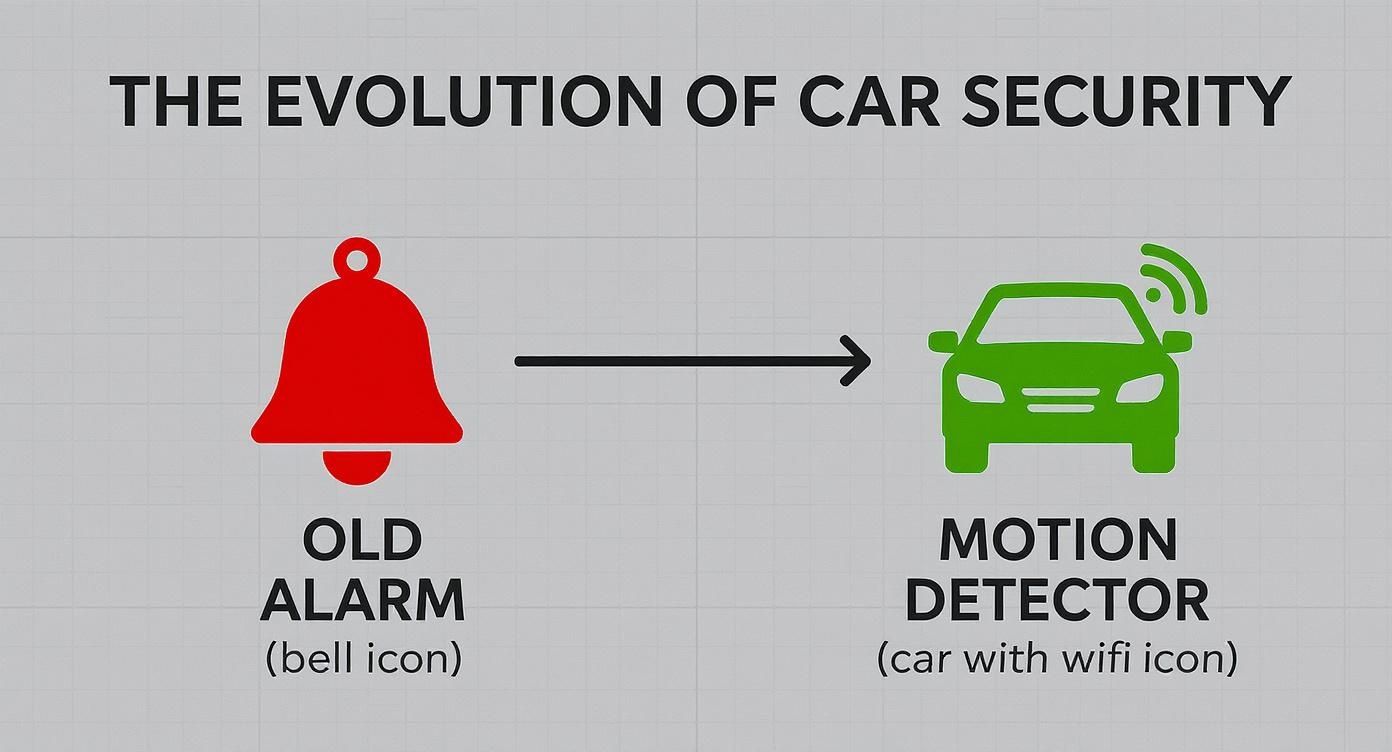
The visual progression from a basic bell icon (representing an old-school alarm) to a vehicle emitting a wireless signal highlights the shift towards the instant, intelligent alerts that define modern systems.
MEMS: The Unseen Sentinels
At the core of most advanced motion detectors are Micro-Electro-Mechanical Systems (MEMS). These are microscopic devices with moving components capable of sensing minute physical changes. For vehicle security, the most crucial of these is the accelerometer.
An accelerometer functions much like the inner ear, constantly measuring the vehicle's orientation and motion relative to gravity. If a thief attempts to jack up the car to steal wheels or the catalytic converter, or tries to tow it, the accelerometer instantly detects the change in tilt and G-force, triggering an alert.
These sensors are incredibly precise—it's the same technology that enables your smartphone to rotate its screen. Their role in automotive safety and security is so critical that the market is experiencing explosive growth. The global automotive MEMS sensor market is projected to grow from USD 3.65 billion in 2023 to USD 8.24 billion by 2030, according to a report by Fortune Business Insights. Accelerometers are a cornerstone of this market.
A high-fidelity MEMS accelerometer is the first line of defense against physical threats like towing, jacking, and the subtle vibrations from power tools. It captures movements that a simple door or contact sensor would completely miss.
Passive Infrared: The Heat Detectors
Next are Passive Infrared (PIR) sensors. These sensors do not emit energy; instead, they passively detect infrared radiation—body heat. They essentially provide the vehicle's interior with a form of heat-vision.
A PIR sensor continuously scans the cabin for the thermal signature of a human body. If a window is smashed and an intruder leans inside, the sensor immediately detects their body heat against the cooler ambient temperature of the car's interior. This sudden differential in infrared energy is what triggers an alert.
- How it Works: The sensor is typically split into two or more zones. When a warm body moves across its field of view, it causes a sequential change in the infrared energy detected by the zones, which the system registers as motion.
- Best Use Case: It is exceptionally effective for detecting intrusions into the confined space of a vehicle's cabin, particularly when a thief bypasses door sensors.
This technology is a powerful tool for catching break-ins where entry is gained through a broken window or sunroof.
Comparing Car Motion Detector Technologies
To provide a clearer understanding of how these technologies function together, this table compares their detection methods, primary applications, and potential limitations.
| Sensor Type | Detection Method | Best For | Common Weakness |
|---|---|---|---|
| Vibration/Accelerometer | Senses physical movement, tilt, and G-force changes. | Detecting towing, jacking up the car, impacts, or drilling. | Can require careful calibration to avoid false alarms from heavy traffic. |
| Passive Infrared (PIR) | Detects body heat (infrared radiation) inside the car. | Catching a thief who has already entered the cabin. | Can be triggered by rapid temperature shifts or direct sunlight. |
| Ultrasonic | Emits sound waves to map the car's interior. | Covering the entire cabin volume, leaving no interior blind spots. | An open window can disrupt the sound wave pattern and affect accuracy. |
| Radar | Sends out radio waves to create a protective "bubble." | Monitoring the area around the car for early warning deterrence. | High-end systems; can be triggered by non-threatening movement. |
Each sensor offers a distinct layer of protection. By integrating them, a system like CarLock provides a far more robust and reliable defense than any single technology could achieve alone.
Ultrasonic Sensors: Mapping with Sound
Ultrasonic sensors operate on a principle similar to a bat's echolocation. They emit high-frequency sound waves—inaudible to humans and pets—that bounce off the interior surfaces of your car.
These sound waves create a stable, baseline "sound map" of the cabin. If an intruder enters the vehicle, their presence disrupts this established pattern. The sensor detects the disturbance in the returning sound waves and triggers an alarm. The primary advantage of ultrasonic sensors is their ability to provide comprehensive coverage of the entire cabin volume, leaving no blind spots. You can see how the CarLock device integrates these alerts with its other features for complete protection.
Radar Sensors: A Protective Bubble
Finally, the most advanced systems often incorporate Radar sensors. Radar (Radio Detection and Ranging) technology sends out radio waves and analyzes the reflected signals.
In a vehicle security context, a radar sensor can establish an invisible protective field, or "bubble," around the vehicle. If an individual lingers too close to a door or window, the sensor can detect their presence and trigger a pre-alarm or warning chirp. This serves as a powerful deterrent, often scaring off potential thieves before they even touch the car.
- Interior Radar: Can detect even minute movements inside the car, making it difficult for an intruder to hide.
- Exterior Radar: Monitors the perimeter of the vehicle for suspicious loitering or proximity.
By understanding how these diverse technologies work, you can see how a modern motion detector for car offers such comprehensive and layered security.
How to Choose the Right Motion Detector for Your Car
Selecting the ideal motion detector for your car is not about choosing the product with the most features, but about finding the system that best fits your vehicle, daily routine, and specific security concerns. This section translates technical specifications into a practical checklist to guide you toward an informed decision.
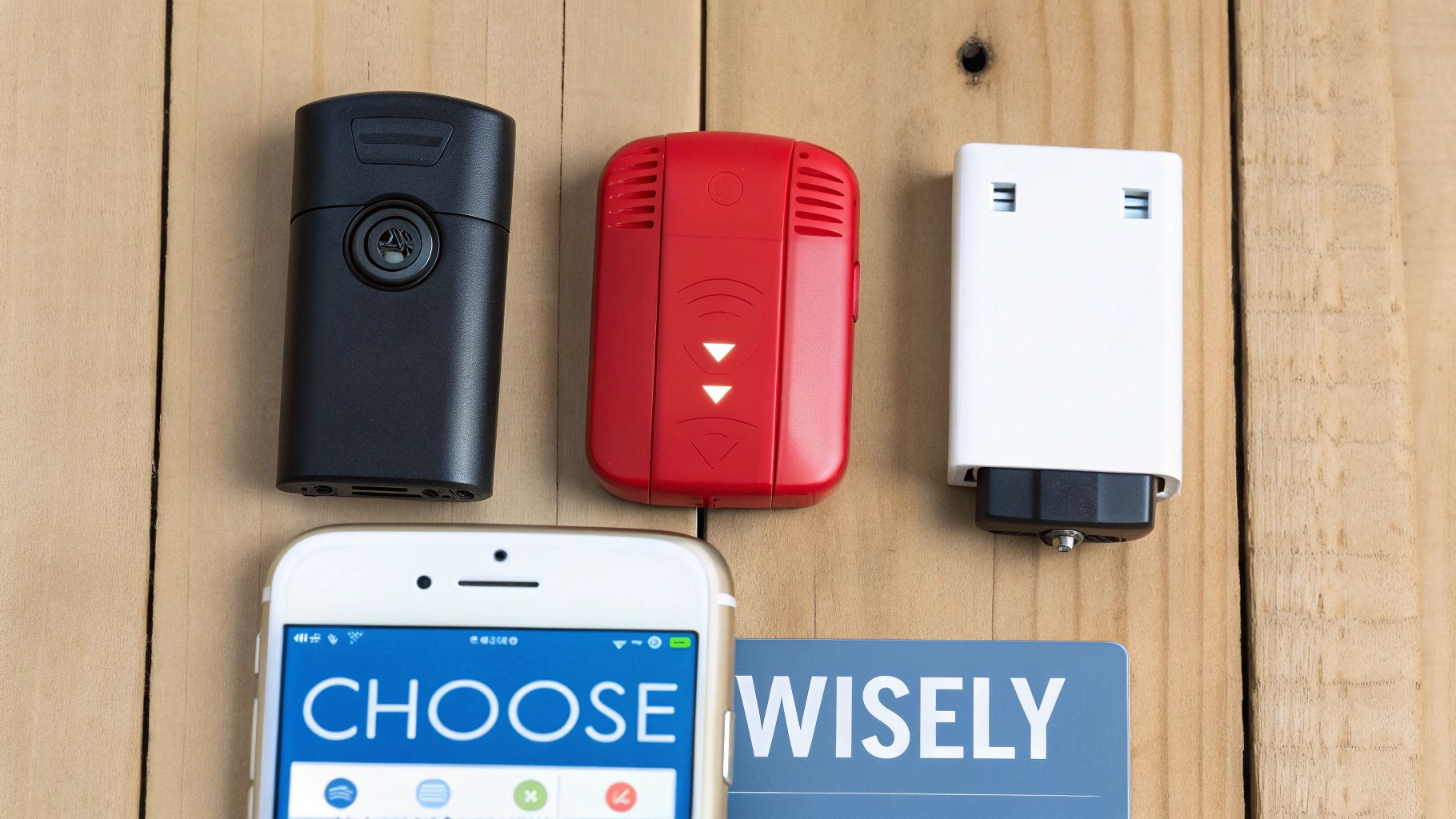
Let's break down the essential criteria to consider before making a purchase.
Power Source: Simplicity vs. Permanence
Your first major decision point is how the device will be powered. This choice directly impacts the ease of installation and how discreet the unit is.
-
Plug-and-Play (OBD-II): These devices offer maximum user-friendliness. You simply locate your vehicle's On-Board Diagnostics (OBD-II) port—standard on all cars manufactured since 1996 and typically found under the dashboard—and plug the unit in. The installation takes less than a minute, requires no tools, and draws minimal power from the car's battery. For the majority of drivers seeking high-level security without complex installation, this is the optimal solution.
-
Hardwired Units: These detectors are wired directly into the vehicle's electrical system. This is a more permanent and involved installation, often best handled by a professional. The primary advantages are that the device is completely concealed and cannot be easily unplugged by a thief. This is ideal for classic cars without an OBD-II port or for commercial fleet applications requiring a tamper-proof setup.
For most consumers, the convenience and effectiveness of an OBD-II device provide the perfect balance of robust security and effortless installation.
Connectivity: The Lifeline to Your Phone
A motion detector's value is directly tied to its ability to communicate alerts to you reliably. The type of connectivity determines the range and speed of these critical notifications.
A Bluetooth-only system, for example, has a very limited range, often effective only within 30-50 feet of the vehicle. This provides virtually no protection if your car is parked down the street or in a large parking structure.
The superior choice is a device with cellular (GSM) connectivity. By utilizing mobile networks, it can transmit alerts to your smartphone regardless of your location. Whether you are at home, in the office, or traveling internationally, a GSM-enabled motion detector for car ensures you receive notifications the instant an event is detected.
A reliable cellular connection is a non-negotiable feature for true peace of mind. It eliminates distance as a barrier, transforming your car's security into a system you can monitor from anywhere, anytime.
Custom Alerts and Sensitivity Control
The world is a dynamic environment, and not every vibration is a threat. A high-quality motion detector allows you to fine-tune its sensitivity to prevent "alarm fatigue"—the tendency to ignore alerts due to frequent false positives.
Look for a system that offers adjustable sensitivity levels to filter out environmental noise, such as:
- Heavy rain or hail
- Loud exhaust from a passing truck
- Strong winds or minor bumps in a crowded parking lot
The ability to customize these settings ensures that when you receive an alert, it is highly likely to be a genuine threat. A well-designed system finds the optimal balance between accuracy and minimizing false alarms, ensuring you pay attention when it matters most. To see how these elements combine, review our overview of comprehensive car security systems.
The demand for such intelligent features is driving market growth. The global motion sensor market, valued at USD 6.8 billion in 2024, is projected to reach USD 12 billion by 2033, according to Precedence Research. This growth reflects the shift from basic alarms to smart, essential components of modern vehicle ownership.
The Mobile App: Your Security Command Center
Finally, do not underestimate the importance of the mobile application. The app serves as your command center for the entire security system. Even the most sophisticated hardware can be rendered frustrating by a poorly designed user interface.
A great app should be:
- Intuitive: Clean, well-organized, and easy to navigate.
- Informative: Providing clear, detailed alerts (e.g., "Vibration Detected," "Engine Started," "Vehicle Tilted").
- Reliable: Delivering push notifications instantly without crashing or lagging.
The app is where you will arm/disarm the system, check your vehicle's location, review alert history, and adjust settings. A seamless and responsive app experience is the final, crucial component in choosing a motion detector for car that is not only powerful but also practical for daily use.
A Simple Guide to Installing Your Motion Detector
One of the most significant advantages of modern vehicle security is the ease of installation. You don't need to be a mechanic or have specialized tools. Thanks to intelligent plug-and-play designs, you can have a powerful motion detector for car security system operational in minutes.
This guide outlines the simple, four-step process for installing a typical OBD-II device.
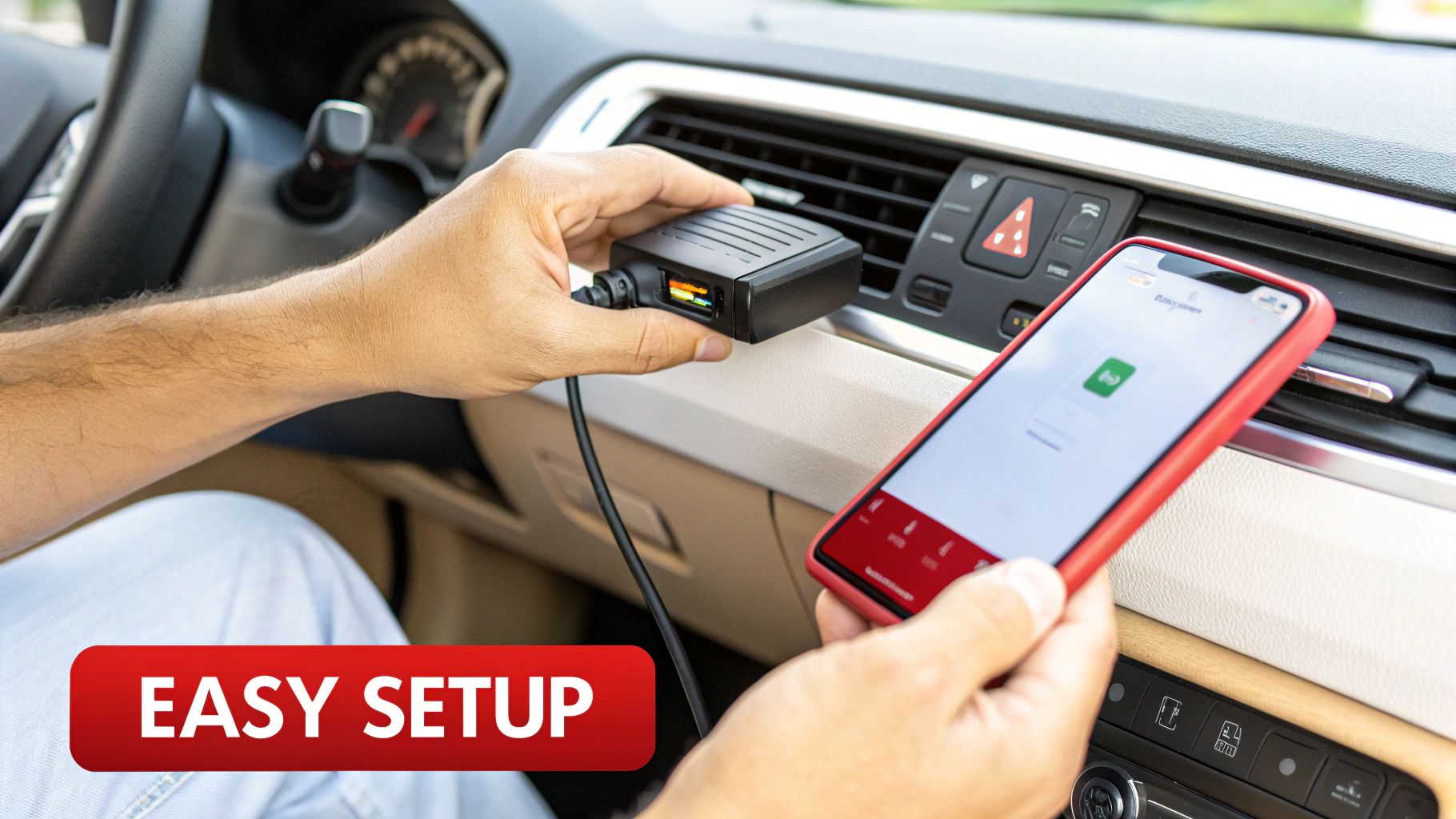
Your Four-Step Installation Process
Follow these instructions to activate your motion detector and begin protecting your vehicle immediately. The entire process typically takes less than five minutes.
-
Find Your Car's OBD-II Port: Every vehicle manufactured for sale in the U.S. since 1996 is equipped with an On-Board Diagnostics (OBD-II) port. It is almost always located under the dashboard on the driver's side, often near the steering column or above the pedals. A quick internet search for your vehicle's model plus "OBD port location" will provide a precise diagram if needed.
-
Plug in the Device: Once you have located the port, align the pins on the device and insert it firmly until it clicks into place. It is designed for a secure fit. The device draws a minimal amount of power directly from this port, eliminating the need for batteries.
-
Download the Companion App: Using your smartphone, navigate to the Apple App Store or Google Play Store and download the companion application for your device. This app will serve as your interface for receiving alerts, monitoring your vehicle's location, and configuring settings.
-
Activate Your Device: Open the app and follow the on-screen prompts to create an account and activate your device. This process typically involves scanning a QR code or entering a serial number found on the device. Once completed, your motion detector for car is active and monitoring your vehicle.
That's it. In four simple steps, you have installed an advanced security system that links your vehicle directly to your smartphone, providing 24/7 peace of mind.
Troubleshooting Common Installation Hiccups
Even with a straightforward setup, minor issues can arise. Here are solutions to the most common problems.
-
Device Not Connecting: If the app cannot find your device, first check the physical connection. Unplug the device from the OBD-II port and reinsert it to ensure it is seated correctly. Also, verify that your smartphone has a stable cellular or Wi-Fi connection, as the initial setup requires communication with the device's servers.
-
Inaccurate Location Data: Upon first activation, the device may need a few minutes to acquire a GPS signal. If your vehicle is parked in an underground garage or area with an obstructed view of the sky, the signal may be weak. A short 5-10 minute drive in an open area will allow the device to establish a strong satellite lock.
-
Getting False Alerts: If your sensor seems overly sensitive, it may be triggered by ambient environmental factors. A high-quality system like CarLock allows you to adjust the sensitivity level within the app's settings, enabling you to calibrate it to your typical parking environment and ensure you only receive notifications for genuine threats.
How Motion Detectors Solve Real-World Problems
Technical specifications are important, but the true value of a motion detector for your car is demonstrated by its ability to provide security and peace of mind in real-world scenarios. Let's explore how this technology offers practical solutions to common challenges faced by vehicle owners.
The Urban Commuter Parking on the Street
Consider an individual living in a dense urban area where street parking is the only option. Each night, their vehicle is exposed to risks ranging from minor bumps to break-in attempts. For this commuter, a vibration alert is a critical first line of defense.
One evening, a thief attempts to pry open the driver's side door. The moment the tool makes contact, the sensitive accelerometer detects the specific, high-frequency vibration. Instantly, a notification is pushed to the owner's phone: "Vibration Detected." This allows them to look out the window, check a security camera, or even trigger a car's horn remotely, often deterring the thief before any significant damage is done.
This is the essence of proactive security. Instead of discovering a broken window and stolen property in the morning, the owner is empowered to intervene at the very first sign of trouble, turning a potential crime into a prevented incident.
The Small Business Owner Protecting Their Fleet
For a small business, company vehicles are vital assets. Unauthorized use after hours can lead to increased liability, fuel costs, and accelerated vehicle depreciation. A motion detector combined with GPS tracking provides an effective management solution.
Imagine a landscaping company with several work trucks. The owner configures alerts to be notified if any vehicle's engine is started outside of operational hours (e.g., 7 AM to 6 PM). At 10 PM, they receive a notification: "Engine Started – Truck #3." A quick check of the app's map confirms the vehicle is moving away from its designated parking area. This allows the owner to immediately contact the employee, address the unauthorized use, and enforce company policy, preventing a minor infraction from becoming a recurring problem.
This level of intelligent vehicle management is a key driver behind the growth of the automotive sensor market, which is projected to expand from USD 42.9 billion in 2025 to nearly USD 99 billion by 2034. Businesses and individuals are increasingly seeking smarter ways to protect and manage their automotive assets. You can explore the future of automotive sensor technology in this market analysis.
The Concerned Parent of a New Driver
Entrusting a vehicle to a newly licensed teenager is a significant and often stressful milestone for parents. A motion detector integrated with GPS tracking can provide a powerful tool for promoting safe driving habits without being intrusive.
A parent can establish "geo-fences" around locations like their child's school and home. If the vehicle leaves these zones during school hours, a discreet alert is sent. The system can also monitor and log driving behaviors such as harsh braking, rapid acceleration, and sharp cornering. This provides parents with objective data to facilitate calm, constructive conversations about responsible driving. Our guide on advanced car tracking for families details how these features can help build trust and encourage safer habits.
These scenarios illustrate the practical, real-world benefits of a motion detector. Whether it's preventing theft, managing assets, or ensuring the safety of a loved one, this technology provides actionable, real-time awareness when it matters most.
Got Questions About Car Motion Detectors? We've Got Answers.
Adopting new technology for your vehicle naturally raises questions. When it comes to security, it's crucial to have clear, accurate information. Let's address the most common concerns car owners have about motion detectors for cars and provide the straightforward answers you need.
Here are the top three questions we frequently encounter.
Will a Motion Detector Drain My Car Battery?
This is the most common concern, and it's a valid one. No one wants their security device to be the cause of a dead battery. The definitive answer is no, a modern, well-engineered device will not drain your battery. This fear stems from older, inefficient aftermarket accessories.
Contemporary devices that connect via the OBD-II port, such as CarLock, are designed for extreme energy efficiency.
Think of the small standby light on your television; it remains active but consumes a negligible amount of power. Your motion detector operates on a similar principle. When the vehicle is parked, the device enters a low-power "sleep" mode, drawing only a few milliamps of current to keep its sensors active. This power draw is so minimal that it will not impact your battery's health, even if the vehicle remains parked for several weeks.
A properly designed OBD-II motion detector is engineered to be a guardian, not a parasite. It protects your vehicle without compromising its ability to start.
How Do These Systems Deal With False Alarms?
You don't want your phone inundated with notifications for every minor event. Frequent false alarms lead to "alert fatigue," causing users to eventually ignore their security system. The intelligence of a modern motion detector for car system is specifically designed to mitigate this issue by distinguishing between genuine threats and ambient environmental noise.
These devices utilize sophisticated algorithms tuned to recognize the unique vibrational "signatures" of a break-in attempt—like the sharp, high-frequency jolt of breaking glass—while ignoring the low-frequency rumble of a passing truck.
Furthermore, a premium system gives you control. Through the mobile app, you can customize the settings to suit your environment:
- Adjust Sensitivity Levels: If you park on a busy street, you can decrease the sensitivity. If your car is in a quiet garage, you can increase it for maximum protection.
- Enable Smart Alerts: Some advanced systems can learn the typical environment of your vehicle over time, becoming more adept at filtering out non-threatening events and further reducing false positives.
The objective is to deliver alerts that are both timely and meaningful. When your phone buzzes, you should have a high degree of confidence that the event requires your attention.
Can a Motion Detector Actually Help Get My Stolen Car Back?
This question addresses the ultimate goal of a comprehensive security solution. A motion detector, by itself, is an early warning system. It is the digital watchdog that alerts you the moment a thief tampers with your vehicle, providing a critical head start.
However, the key to vehicle recovery lies in pairing motion detection with GPS tracking.
Consider them a two-part system for protection and recovery:
- The Motion Sensor Detects: As soon as an unauthorized vibration, tilt (from a tow truck), or engine start is detected, the system sends an instant alert to your smartphone.
- The GPS Tracker Locates: If a thief successfully drives the vehicle away, the integrated GPS provides its real-time location on a map within your app.
This combination is what makes these systems so effective. The motion alert gives you the immediate notification needed to contact law enforcement, while the live GPS tracking provides them with the precise location data required to intercept and recover your vehicle. The motion sensor sounds the alarm; the GPS leads to its recovery. For a deeper dive into this technology, see our answers to frequently asked questions about GPS trackers.
When you have a system that is power-efficient, intelligently filters out false alarms, and combines instant alerts with live tracking, you have true, comprehensive security. CarLock is engineered to deliver precisely that, providing complete peace of mind that your vehicle is protected around the clock.