

Driver’s Desk
How Modern Sensor Car Alarms Protect Your Vehicle
That familiar, wailing siren of a car alarm is a sound we've all learned to ignore. For decades, these were the go-to for vehicle security, but let's be honest—today, they're mostly just noise pollution. The simple truth is that a basic, screaming alarm doesn't stand a chance against a modern, determined car thief.
The Problem with Old-School Car Alarms
The thinking behind traditional alarms was straightforward: make a ton of noise to scare off a thief and get the attention of anyone nearby. The problem? It just doesn't work anymore. According to the National Insurance Crime Bureau (NICB), vehicle theft has seen a significant surge, with over one million vehicles stolen in the U.S. in 2022, marking a 7% increase from the previous year. Clearly, thieves aren't scared off by a siren.
The real issue is the high rate of false alarms. We’ve all heard them go off for the silliest reasons:
- A loud truck rumbling down the street.
- A strong gust of wind or a heavy downpour.
- Someone accidentally bumping it in a tight parking spot.
- Even a cat jumping on the hood.
This constant crying wolf has created a phenomenon called "alarm fatigue." We're so used to hearing them for no reason that we automatically tune them out. When a real theft is happening, people just assume it's another glitch. A traditional alarm is just screaming into the void, offering zero real information to the one person who actually cares—you, the owner.
Moving From Noise to Intelligence
This is exactly why the game has shifted to sensor car alarms. Instead of just reacting when a door is forced open, these modern systems are more like a digital nervous system for your vehicle. They don't just make noise; they intelligently detect specific threats and, most importantly, talk directly to you.
A basic car alarm is like a dumb doorbell that anyone can ring. A modern sensor-based system is a complete smart security setup for your car, packed with intelligent detectors that know the difference between a real threat and a random bump in the night.
This move from a simple noisemaker to an intelligent, multi-layered defense is the heart of modern vehicle protection. It’s no longer about scaring someone off. It's about getting real-time, actionable information the moment a threat is detected. These systems use a whole suite of sensors—monitoring for impacts, tilt from a tow truck, or even just someone lurking too close—to give you a heads-up long before the damage is done. To really grasp how this technology works, it's worth exploring the fundamentals of modern car security systems.
Decoding the Technology Inside Sensor Car Alarms
If you think a modern car alarm is just a noisy siren, you're in for a surprise. Today's systems are less about making a racket and more about creating a smart, digital perimeter around your vehicle. Think of it as your car's own personal security team, with each sensor acting as a specialist trained to detect a specific kind of threat. Together, they offer a sophisticated defense against everything from a careless bump in a parking lot to a professional theft attempt.
This shift toward intelligent security isn't just a minor upgrade; it's completely reshaping the industry. The global market for car alarm systems was already valued at a massive USD 13.8 billion in 2022 and is on track to hit an incredible USD 37.66 billion by 2032. This explosion in growth is a direct answer to the rising tide of vehicle theft, making smarter security less of a luxury and more of a necessity for today's car owners.
The image below paints a clear picture of this evolution, showing how we've moved from simple noisemakers to the intelligent, connected sensor systems that protect our cars today.

This really drives home the point: we've gone from a basic deterrent (the old-school bell) to a proactive, always-on monitoring system (the shielded icon with connectivity). It's a whole new ballgame.
To help you understand how these different pieces of tech work together, we've put together a quick comparison table. It breaks down the most common sensors, what they do, and where they shine.
Comparison of Car Alarm Sensor Technologies
| Sensor Type | How It Works | Best For Detecting | Common Use Case |
|---|---|---|---|
| Shock/Vibration | Measures physical impacts and vibrations. | Bumps, window smashing, forceful entry attempts. | General-purpose security in parking lots or on the street. |
| Tilt/Accelerometer | Detects changes in the vehicle's angle or orientation. | Being jacked up or loaded onto a tow truck. | Preventing tow-away thefts and catalytic converter theft. |
| Proximity/Microwave | Creates an invisible energy field around the car. | Someone reaching into an open cabin or loitering nearby. | Protecting convertibles, jeeps, or triggering warn-away chirps. |
| Ultrasonic/Motion | Emits sound waves to map the car's interior. | Movement inside a locked car after a window break. | Securing the interior cabin space against intrusions. |
This table gives you a good overview, but let's dig into the details to see how each one contributes to your car's safety net.
Shock and Vibration Sensors: The First Line of Defense
At the heart of almost every modern alarm is the shock sensor. You might also hear it called a vibration or impact sensor. Its job is straightforward but absolutely vital: detect physical force against the car. It works a lot like the technology in your smartphone that knows when you've tilted or shaken it.
Picture your car squeezed into a tight parking spot. If someone dings your door or a thief tries to shatter a window, the shock sensor picks up that jolt. A good system is smart enough to tell the difference between a passing garbage truck and a real threat, triggering an alert only when it's necessary.
But a shock sensor is just the starting point. It's great at detecting impacts, but it's blind to other threats, like your car being silently lifted onto a tow truck. For that, you need a different kind of specialist.
Tilt Sensors: The Anti-Tow Truck Guardian
One of the sneakiest ways thieves steal cars is by simply towing them away. A standard door or shock sensor would be completely useless in this scenario. That’s where the tilt sensor steps in, acting as your car’s personal anti-towing bodyguard.
Using an accelerometer—the same tech that keeps your phone’s screen oriented correctly—a tilt sensor memorizes your car’s angle when you park it. If a thief tries to jack up the vehicle or hoist it onto a flatbed, that angle changes.
The moment the sensor detects a shift of even a few degrees, it knows something is wrong. It immediately flags the movement as an unauthorized towing attempt and sends an alert straight to you. This is a game-changer for preventing catalytic converter theft, which almost always involves jacking up the car.
This one sensor effectively shuts down one of the quietest and most effective methods of car theft, offering a layer of protection that older alarms just can't match.
Proximity and Ultrasonic Sensors: Detecting Threats Before They Touch
What if your car could warn a thief off before they even laid a hand on it? That's precisely what proximity and ultrasonic sensors are designed to do. They create an invisible shield around your vehicle, acting as an early warning system.
- Proximity Sensors: These typically use microwave fields to detect movement near the vehicle. They’re perfect for convertibles or open-top jeeps because they can secure the cabin space without a physical roof. If someone reaches in, they break the field and trigger the alarm.
- Ultrasonic Sensors: These sensors fill your car's interior with sound waves that are too high-pitched for humans to hear. The waves bounce around, creating a stable pattern. If a window is smashed and someone climbs in, their body disrupts that pattern, instantly setting off the alarm.
Many of these systems can be set up with a two-stage response: a simple "warn-away" chirp if someone gets too close, followed by the full-blown siren if they don't back off. This proactive defense is often enough to scare away opportunistic thieves. You can get a better sense of how these fit into a larger security ecosystem by exploring the full range of features available with modern devices.
Specialized Sensors for Total Coverage
To build a truly bulletproof security system, you need to cover every possible angle of attack. That’s why advanced alarms often include even more specialized sensors to patch any remaining vulnerabilities.
- Glass Break Sensors: These aren't just simple microphones. They're tuned to listen for the specific acoustic frequency of shattering glass. This brilliant bit of engineering prevents false alarms from other loud noises, like thunder or a car backfiring.
- Pressure Sensors: A pressure sensor keeps tabs on the air pressure inside your car. If a door, trunk, or window is opened, the interior pressure changes in a split second. The sensor detects this tiny fluctuation and signals the alarm.
By layering all these different technologies, a modern sensor car alarm creates a comprehensive, multi-layered defense. It no longer waits for a single trigger. Instead, it monitors your vehicle’s entire environment—impact, angle, proximity, and interior space—to deliver truly intelligent and reliable security.
Connecting Your Car to Your Phone with GPS and Mobile Alerts
A modern sensor car alarm does way more than just blast a siren—it creates a direct link between your vehicle and your smartphone. This connection is what turns your security system from a simple noisemaker into an active, intelligent guardian for your car. By bringing GPS tracking and mobile app alerts into the mix, you get a level of control and awareness that was unthinkable with old-school alarms.
The days of nervously peeking out the window to check on your car are over. With this tech, your vehicle can tell you exactly where it is and what's happening to it, right now. This instant feedback loop is the single biggest advantage over traditional alarms, which, let's be honest, are mostly ignored by passersby.

Pinpoint Location with Real-Time GPS Tracking
At the heart of all this is a powerful GPS tracker. Think about it: a basic alarm is totally useless once a thief drives off. But a GPS-enabled system lets you pull up a map and see your car's exact location in real time. For vehicle recovery, this is a complete game-changer.
Law enforcement agencies confirm that vehicles with real-time GPS tracking devices have a significantly higher recovery rate, often exceeding 90%. Why? Because a GPS tracker gives them the live data they need to act fast, often helping them get a car back in hours instead of it being gone for good.
A car alarm without GPS is like a smoke detector that doesn't call the fire department. It makes noise, but it doesn't give anyone the information needed to solve the problem. GPS bridges that gap, turning a simple alert into actionable intelligence.
This isn't just for theft, either. Constant location monitoring brings incredible peace of mind to parents of teen drivers or fleet managers who need to know where their company vehicles are at all times. To see this in action, you can check out the features of a modern car locator feature.
Geofencing Your Vehicle for Virtual Boundaries
One of the coolest and most practical uses for GPS is geofencing. Imagine drawing an invisible fence around a specific area on a map, like your home, office, or your kid's school.
The second your vehicle crosses that virtual line—whether it's leaving or arriving—the system shoots an instant alert straight to your phone. This is incredibly handy in a few real-world situations:
- Theft Prevention: If a thief tries to tow your car from your driveway, you'll know the moment it leaves your property.
- Monitoring Unauthorized Use: Fleet managers can ensure company vehicles aren't being taken for a joyride and are staying within their designated service areas.
- Parental Peace of Mind: Get a notification when your teen driver gets to their destination safely, or if they head into an area that's off-limits.
Geofencing basically turns your alarm into a proactive guard that watches over your car's location when you can't.
The Power of Instant Mobile Alerts
The final piece of the puzzle is the mobile app, which is your security command center. It pulls together all the information from your car's sensors and GPS into one simple interface right on your phone.
Instead of just triggering a siren, a modern sensor car alarm sends a detailed push notification to your phone the instant something happens. Whether it's a vibration from a bump, a tilt from a tow truck, or the engine starting when it shouldn't, you're the first to know.
This immediate information lets you react instantly. You can check your car's status, see its location on a map, and give the police precise details. Most systems even let you arm or disarm your alarm remotely, giving you full control no matter where you are. Since this whole system relies on your phone, keeping it charged is crucial. For some great tips, check out how to extend your phone's battery life.
How to Choose the Right Sensor Car Alarm System
Picking the right sensor car alarm can feel overwhelming, but it doesn't have to be. The trick is to break it down into a few simple steps. You're looking for that sweet spot—a system that fits your car like a glove, matches your security concerns, and doesn't get in the way of your daily life.
It's all about finding the perfect balance between serious protection and everyday convenience. And the very first thing you need to think about isn't features or price; it's your car itself.
Assess Your Vehicle’s Compatibility
Before you get lost in the sea of options, you have to know what your car can handle. Modern cars are packed with technology, with complex wiring and computer networks running everything. This is where compatibility becomes make-or-break.
Many cars built in the last couple of decades use a CAN bus (Controller Area Network). Think of it as your car's central nervous system, letting all the electronic parts talk to each other. A good alarm system can tap directly into this network, which makes for a cleaner installation and a much smarter, more integrated system.
If you choose an alarm that isn't built for your car's wiring, you're asking for trouble. You could end up with electrical gremlins, constant false alarms, or a system that just plain doesn't work. Always, always check the alarm manufacturer's specs to make sure it's designed for your car's specific make, model, and year.
Choosing a sensor car alarm is like picking the right tool for a job. A basic wrench might work for simple tasks, but for a complex engine, you need a specialized instrument that fits perfectly. Your car's security is no different—the right fit ensures optimal performance.
Decide on Essential Features
Not everyone needs a Fort Knox-level security system. If you park your daily driver in a locked garage, your needs are worlds apart from someone with a classic convertible parked on the street in a high-theft neighborhood.
Think about the real threats you're facing and choose your features accordingly:
- GPS Tracking: Is getting your car back after a theft your number one priority? Then GPS is non-negotiable. It turns your alarm from a simple noisemaker into a powerful recovery tool.
- Specific Sensors: Got a convertible or a soft-top Jeep? A proximity sensor is a must. Worried about thieves stealing your catalytic converter? You’ll want a tilt sensor.
- Mobile App Control: How important is it to stay connected to your car? A good app lets you arm or disarm the system, check its status, and get instant alerts, no matter where you are. To see what a modern system can do, check out our guide on app features for GPS trackers.
By focusing on what you actually need, you'll invest in protection that truly works for you, instead of paying for bells and whistles you'll never use.
Professional Installation vs DIY
So, you've picked out a system. Now, how do you get it in your car? While doing it yourself might seem like a good way to save a few bucks, it’s a risky path unless you really know what you’re doing. A simple wiring mistake can lead to false alarms, a dead battery, or even serious damage to your car's electronics.
Professional installation is highly recommended, especially for more advanced systems that connect to the CAN bus. A certified tech has the experience and the right tools to calibrate each sensor perfectly, making them sensitive enough to catch a real threat without going off every time a loud truck rumbles by. They also know the best, most discreet spots to place sensors for maximum coverage. A little extra investment upfront can save you a world of headaches later.
The demand for these advanced security systems is exploding. The market is projected to skyrocket from USD 17.5 billion in 2025 to USD 50.3 billion by 2035, a huge jump driven by rising theft rates and new vehicle security regulations. This growth is a testament to how effective these modern alarms are. Features like impact detection and GPS are proven to help thwart 31.6% of theft attempts. You can dig deeper into the car security system market trends by reading the full report.
Solving Common Problems with Sensor Car Alarms
Even the best tech has its off days, and sensor car alarms are no different. While they’re built for accuracy, you might run into the occasional hiccup. Let's walk through how to troubleshoot the most common issues so you can keep your security system running smoothly.
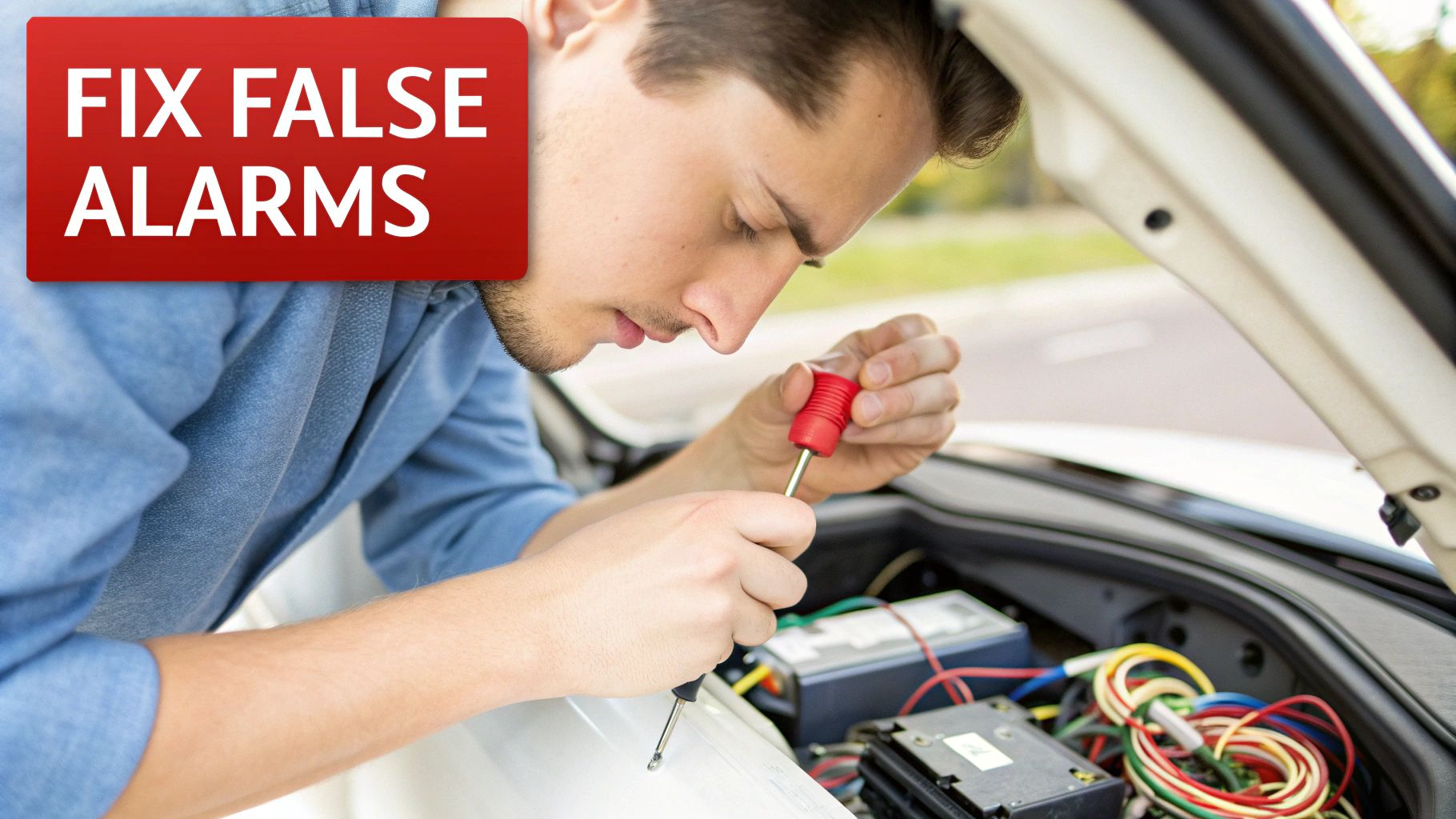
The number one headache for any alarm owner is the dreaded false alarm. Nothing makes you lose faith in your security system faster than it crying wolf every time the wind blows. The good news is, most false triggers from a sensor car alarm can be traced back to just a few usual suspects.
Diagnosing and Fixing False Alarms
More often than not, a sensor that's just too sensitive is the root cause. A shock sensor cranked up to its highest setting might go off from heavy rain, a strong gust of wind, or even a big truck rumbling by your house. Most aftermarket systems let you dial down the sensitivity, and finding that sweet spot is crucial.
Start by lowering the sensitivity setting and then test it out. A light tap on the window shouldn't set it off, but a solid, firm knock should. This simple calibration helps it ignore everyday disturbances while still being ready for a genuine threat.
Other common culprits behind false alarms include:
- Faulty Wiring: A loose connection or a corroded wire can send scrambled signals to the alarm's brain.
- Dying Car Battery: As a battery gets weaker, the voltage can fluctuate and sometimes trick the alarm into thinking something's wrong.
- Environmental Factors: Extreme hot or cold snaps can cause metal parts to expand or contract, which can occasionally trigger hyper-sensitive door or hood latch sensors.
The real magic of modern sensors is their precision. The booming automotive sensors market, which is expected to jump from USD 42.9 billion in 2025 to USD 98.8 billion by 2034, is all about this need for accuracy. A properly calibrated sensor can slash false alarms from over 40% in basic systems to less than 5% in advanced ones. You can check out more stats about the automotive sensors market on forinsightsconsultancy.com.
Addressing Battery Drain and Connectivity
Another potential frustration is a battery that seems to die out of nowhere. Modern sensor alarms are designed to sip power, but a bad installation or a malfunctioning part can slowly drain your car's battery. If you find your car struggling to start, it's a good idea to have a professional technician check the wiring for any shorts or bad connections.
Finally, you might occasionally run into mobile app connectivity issues. If you’re not getting alerts on your phone, the first thing to check is your phone's notification settings and make sure the app has a good internet connection. Often, simply restarting the app and your phone will fix minor communication glitches. For more specific solutions, you can find answers to many frequently asked questions about GPS trackers and connectivity.
Your Top Questions Answered
Even after getting the hang of how these systems work, you probably still have a few questions floating around. It's completely normal. Let's tackle some of the most common things people ask when they're thinking about upgrading to a sensor-based car alarm.
Will an Aftermarket Alarm Void My Car's Warranty?
This is a big one, and the short answer is no, it shouldn't. In the U.S., you're protected by something called the Magnuson-Moss Warranty Act. Essentially, it says a dealer can't just void your warranty because you installed an aftermarket part. They have to prove that specific part caused the failure you're trying to claim.
So, as long as your sensor car alarm is installed correctly (this is why we always recommend a pro) and doesn't directly fry something, your factory warranty stays safe and sound.
How Much Battery Does a GPS Alarm Actually Use?
You're right to be concerned about battery drain, but modern sensor alarms with GPS are incredibly smart about power. They're designed for efficiency and most have a "sleep mode" that sips a tiny amount of power when your car is parked for a while.
The exact draw varies by model, of course, but a well-designed system hooked up to a healthy car battery won't leave you stranded. You shouldn't notice any drain or have trouble starting your car.
Can These Alarms Really Stop Catalytic Converter Theft?
Absolutely. In fact, this is one of the things they do best. Think about how a thief steals a catalytic converter: first, they have to jack up the car. That movement is immediately picked up by a tilt sensor.
Then, they have to use a saw or cutting tool, which creates a ton of vibration. Boom—the shock sensor goes off. This double-whammy of triggers sends an alert straight to your phone, often giving you critical seconds to scare them off or call the police before they can finish the job.
Ready for a complete security system that bundles these advanced sensors with instant GPS tracking and mobile alerts? See what real peace of mind looks like with CarLock. Check out all the features at https://www.carlock.co.