

Driver’s Desk
How Does a GPS Tracker Work: A Detailed Guide to Vehicle Security
Ever wondered how a GPS tracker for your car actually works? In essence, it's a sophisticated device that uses signals from a network of satellites to calculate its precise location. It then leverages a cellular connection to transmit that location data directly to an application on your smartphone. This system provides a constant, vigilant watch over your vehicle, giving you the ability to know exactly where it is at any moment.
How GPS Pinpoints Your Car's Location
At its core, a GPS tracker is an incredibly sophisticated radio receiver. Instead of tuning into music, it's designed to listen for extremely faint, precisely timed signals broadcasted by a constellation of satellites orbiting thousands of miles above the Earth's surface.
The fundamental principle behind this technology is a mathematical process called trilateration. To understand it, imagine you’re standing in a massive, open field and you shout. Three friends, positioned at different known points around the field, all hear your voice. By comparing the minute differences in the time it took for the sound to reach each of them, they could triangulate your exact position.
A GPS tracker performs this same calculation, but with mind-boggling precision using radio waves traveling at the speed of light. The tracker in your car is the "listener," and the satellites are the "shouters." Each satellite in the Global Navigation Satellite System (GNSS) continuously broadcasts a signal containing its precise orbital location and a highly accurate timestamp from an onboard atomic clock. To establish a reliable position, your tracker’s built-in GPS receiver must acquire signals from at least four of these satellites simultaneously.
By measuring the time delay between when the satellite sent the signal and when the tracker received it, the device calculates its distance from that specific satellite. With distance data from three satellites, it can determine its latitude and longitude. The signal from a fourth satellite is required to resolve timing discrepancies and calculate altitude, resulting in a full 3D position fix.
To make this complex process easier to digest, here's a breakdown of the three key steps involved in tracking your vehicle.
How GPS Tracking Works in 3 Simple Steps
| Step | Action | What Happens |
|---|---|---|
| 1 | Signal Transmission | Satellites in orbit continuously broadcast radio signals containing precise timing and location data toward the Earth. |
| 2 | Signal Reception & Calculation | The GPS tracker in your car receives these signals from at least four satellites and calculates its distance from each based on the signal's travel time. |
| 3 | Location Pinpointing | Using the distance data from multiple satellites, the tracker applies the principle of trilateration to determine its exact location (latitude, longitude, and altitude). |
Once the tracker knows its position, the final critical step is transmitting that information to you, which is where the device's communication module comes into play.
The Three Key Players in Tracking Your Car
To fully grasp how the system functions, it's helpful to understand the three essential components. Each plays a critical role in maintaining the security of your vehicle.
- The Satellite Network: This is a fleet of at least 31 operational GPS satellites, maintained by the U.S. government, that are constantly circling the planet. They are the bedrock of the entire system, providing the crucial timing and location signals that make global positioning possible.
- The GPS Receiver: This is the hardware inside your CarLock device. Its primary function is to lock onto those satellite signals and perform the high-speed calculations needed to determine its own precise coordinates.
- The Communication Module: Once the receiver knows its position, it needs a way to report that data to you. This module functions like a miniature cell phone, utilizing 4G/LTE networks to send the location coordinates from your car directly to the CarLock cloud and then to the app on your smartphone.
This infographic neatly illustrates that simple, three-step journey of how location data gets from outer space right to your screen.

This seamless flow of information—from satellite, to tracker, to your phone—is what enables real-time monitoring and forms the backbone of modern vehicle security. The concept of using sensors to detect activity and send remote alerts is also fundamental to many smart home security systems, which operate on similar principles.
The demand for this technology is growing rapidly. The GPS tracking device market, valued at USD 2.8 billion in 2022, is projected to expand to USD 7.4 billion by 2030, according to Grand View Research. With vehicle theft remaining a persistent issue—the National Insurance Crime Bureau (NICB) reported over one million vehicle thefts in the U.S. in 2022—this technology is more a necessity than a luxury. Effective car tracking solutions are more critical today than ever before.
Tracing the Data from Your Car to Your Phone

Knowing your car’s exact location is only part of the solution. The true power of a modern vehicle security system lies in its ability to deliver that critical information to you instantly, regardless of your location.
So, how does a pinpointed coordinate travel from your vehicle's tracker all the way to an immediate alert on your smartphone? This journey is a high-speed relay, transforming raw satellite data into actionable intelligence.
It all begins the moment your tracker calculates its position. From there, it requires a reliable method to "phone home," and this is where cellular technology becomes indispensable. A GPS tracker like CarLock doesn't just receive satellite signals; it also contains a built-in cellular module, similar to the one in your smartphone, enabling it to communicate over mobile networks.
The Cellular Bridge from Vehicle to Cloud
Think of the tracker’s data transmission process as sending a highly efficient text message. The tracker bundles its location coordinates, speed, direction, and other sensor readings into a small data packet. It then transmits this packet to the nearest cell tower using the 4G/LTE network.
From the cell tower, the data travels securely across the internet to CarLock's cloud servers. These servers act as the central processing unit of the operation, receiving, interpreting, and storing the continuous stream of information from your vehicle. This entire process typically occurs in a matter of seconds.
This real-time link is the absolute backbone of effective vehicle security. Without it, you’d only have historical data—not the live tracking and instant threat alerts needed to stop a theft in progress. When a vehicle is stolen, every second counts, and this cellular bridge ensures there are no critical delays.
The Complete Data Journey, Step-by-Step
To fully appreciate how a GPS tracker sends you alerts, let's follow that data packet from its origin to your screen. The entire system is engineered for speed and reliability, ensuring you are notified the moment something is amiss.
- Data Collection: Your CarLock device continuously monitors signals from GPS satellites to maintain an accurate location fix. Simultaneously, its internal sensors are on alert, monitoring for vibrations, ignition starts, and other potential threats.
- Cellular Transmission: The device uses its integrated 4G module to send this data packet over a cellular network. This is the same reliable network your phone uses for calls and internet access.
- Cloud Processing: The data is routed from the cellular network to CarLock’s secure cloud platform. Here, sophisticated software analyzes the raw coordinates and sensor data, checking it against security rules to identify potential breaches, like unauthorized vehicle movement.
- Instant Notification: If the software detects a security trigger—such as the engine starting without you present or an unusual vibration—it immediately sends a push notification directly to the CarLock app on your smartphone.
This four-step cycle repeats constantly, providing a seamless and vigilant watch over your vehicle.
The technology enabling this constant communication has evolved dramatically since the full deployment of GPS post-1995. Today, devices use GSM/4G modules to relay not just latitude and longitude but also speed accurate to 0.1 km/h and heading data to servers every 5-30 seconds.
This sophisticated communication isn't just a one-way street. The network allows for commands to be sent back to the vehicle, such as remote engine immobilization—a feature proven effective in over 80% of recovery scenarios for high-value assets. This powerful technology underpins a global market projected to reach USD 10.88 billion by 2033.
Why Real-Time Communication Matters
The difference between a passive GPS logger and a real-time security system like CarLock is this constant, two-way communication. A logger might record a car's journey, but you would only be able to review the data after retrieving the device. A real-time tracker, however, puts you in control during a critical event.
This immediate connection is what enables the powerful features that define modern car security. By understanding this flow of data, you can better appreciate the technology working around the clock to protect your vehicle. You can discover more about how these capabilities are integrated into the CarLock features and app to provide a complete security solution.
Using Smart Sensors to Detect Threats Instantly
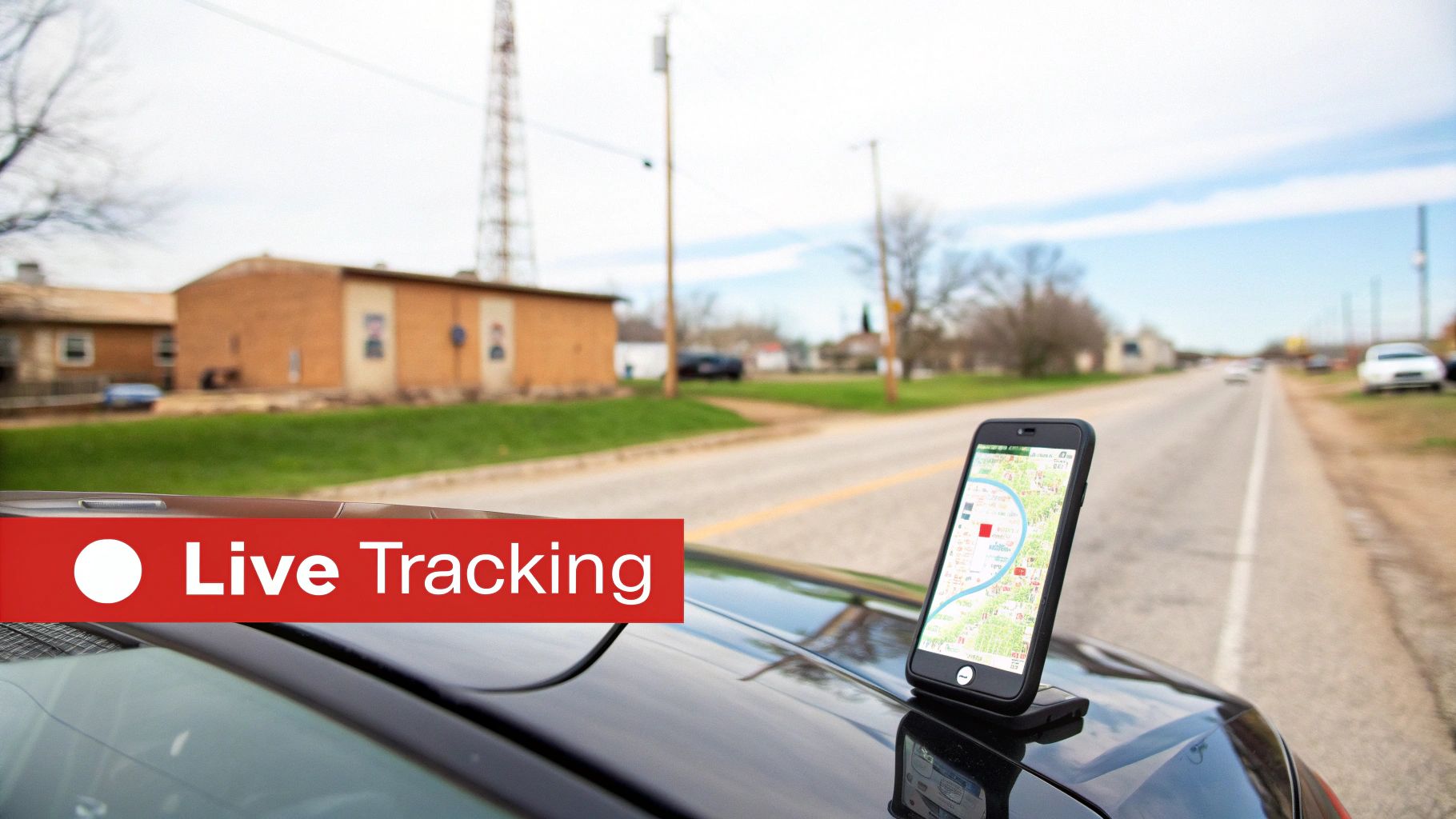
A top-tier vehicle security system does far more than just report a location on a map. It’s a vigilant watchdog, sensing trouble before a thief even manages to start the engine. While GPS tells you where your car is, it’s the array of smart sensors integrated into the tracker that tell you what is happening to it. These components are the digital nervous system of your car’s security, detecting threats the instant they occur.
This capability is what elevates a GPS tracker from a simple mapping gadget to a proactive guardian. Without these sensors, you would only see the route a thief took after your car was already stolen. With them, you receive an instant alert if someone so much as tampers with your vehicle.
Detecting Bumps and Breaks with Accelerometers
The most fundamental of these sensors is the 3-axis accelerometer. Functioning much like the balance system in your inner ear, it is incredibly sensitive to any changes in motion, orientation, or acceleration. This allows it to detect even the slightest physical disturbances.
When your car is parked and the system is armed, the accelerometer establishes a baseline of complete stillness. If a thief bumps your car, smashes a window, or attempts to hook it up to a tow truck, the sensor immediately registers the jolt or vibration. This triggers an instant 'Vibration Detected' alert in your CarLock app, providing a critical early warning.
This is the technology that allows your security system to differentiate between normal operation and a potential threat. It recognizes the tell-tale signs of tampering long before the vehicle actually moves an inch.
Monitoring Unauthorized Engine Starts
Beyond physical disturbances, the next major threat is a thief gaining entry and starting the engine. A basic location ping won't tell you if the engine is running, but a dedicated ignition sensor will. By connecting to the vehicle's onboard diagnostics, the tracker can monitor the engine status in real time.
If your car's engine starts and your phone—which is securely paired to the CarLock system—isn't nearby, the system immediately flags it as a suspicious event.
This simple but powerful logic is a core security feature. It operates on the principle that if you are not in or near the car, the engine should not be running. An unauthorized start triggers a 'Vehicle Started' notification, alerting you to a potential hot-wiring or key-cloning scenario.
This intelligent monitoring means you’re not just tracking a stolen vehicle after the fact. You’re alerted the very second it’s compromised, giving you the best possible chance to react and notify law enforcement.
Protecting Against Power Disconnection
Sophisticated thieves know that many electronic devices can be disabled by cutting their power source. That’s why advanced trackers like CarLock are engineered to monitor the vehicle's battery connection. If a thief tries to disconnect the car's main battery to neutralize its electronics, the system detects the power loss immediately.
This action triggers two critical security measures:
- An Immediate Alert: You will receive a 'Device Disconnected' notification, warning you that someone is tampering with your security system.
- Internal Battery Activation: The tracker automatically switches to its own small, internal backup battery. This keeps it transmitting its location for a period of time, even with the main power cut.
This multi-layered defense ensures the tracker remains operational during the most crucial moments of a theft. You can learn more about all the specific alerts and protections included in the CarLock device features that keep your vehicle safe. Together, these smart sensors create a comprehensive shield, turning your car into an intelligent asset that can report threats the moment they happen.
Turning Raw Data into Actionable Security Alerts
A continuous stream of GPS coordinates and sensor readings is just raw data. Without intelligence to interpret it, it's useless noise. This is where sophisticated software algorithms step in, transforming those raw numbers into your car's personal security guard.
The real magic behind how a GPS tracker works isn't just data acquisition—it's about understanding what that data means in a real-world context. This is what separates a simple location dot on a map from a true security system. It's the brain of the operation, constantly analyzing information to distinguish between normal activity and a potential threat.
For a system like CarLock, this central brain resides on a secure cloud platform. It processes every piece of data—from location pings to vibration alerts—and checks it against a set of predefined security rules. This is how you get meaningful, actionable alerts that provide genuine peace of mind.
Setting Virtual Boundaries with Geofencing
One of the most powerful tools in the software arsenal is geofencing. This feature allows you to draw a virtual perimeter on a map around a specific area, such as your home, office, or a mechanic's shop.
Think of it as a digital tripwire. The second your vehicle crosses this boundary—either entering or exiting—the system flags the event. If your car is supposed to be securely parked at work, but the CarLock platform detects that it has left the geofenced zone, you receive an instant alert on your phone. It’s a simple concept, but incredibly effective for detecting unauthorized movement.
Geofencing is a cornerstone of modern asset protection. Its application in commercial fleet management has been shown to reduce fuel costs by up to 20% by preventing unauthorized trips, demonstrating its effectiveness in enforcing location-based rules.
Creating Smart Rules for Smarter Alerts
Beyond simple location boundaries, a truly intelligent system combines multiple data points to understand the broader context. It’s not just about where the car is, but what it’s doing and, crucially, who is with it. This is how the tracker can differentiate between you driving your car and a thief making off with it.
The 'Engine Started' alert is a perfect example of this. The system's logic follows a simple but powerful rule: if the engine turns on, but your phone (which acts as your digital key) isn't within Bluetooth range, it’s flagged as a high-priority threat. This type of rule-based analysis prevents you from being inundated with false alarms while ensuring you are notified of genuine dangers.
This intelligent synthesis of sensor data, location, and your phone's proximity is what elevates a tracker from a passive dot on a map to an active security partner. It's this proactive analysis that alerts you to a problem the moment it happens, not after it's too late.
These kinds of security alerts are critical for protecting your car, much like how advanced smart home security systems safeguard your house. This connected approach to security is quickly becoming the standard for protecting your most valuable assets.
How CarLock Translates Data into Security
To fully understand how a GPS tracker works to protect your car, it is helpful to see how specific data points trigger real-world alerts. The CarLock system is engineered to translate every piece of sensor data into a clear, understandable notification on your phone.
Here’s a summary of how CarLock’s technology aligns with the alerts you receive and the threats they are designed to stop.
CarLock Alerts and the Technology Behind Them
| CarLock Alert Type | Triggering Technology | Example Threat Scenario |
|---|---|---|
| Vibration Detected | 3-axis accelerometer | A thief smashes a window, tries to jack up the car, or attaches a tow hook. |
| Vehicle Moved | GPS & Accelerometer | Your car is being towed away or pushed from its parking spot without the engine running. |
| Engine Started | Ignition monitoring & phone detection | The engine is hot-wired or started with a stolen key while you're nowhere near the car. |
| Device Disconnected | OBD-II power monitoring | A thief finds the tracker and unplugs it from the car's diagnostic port to disable it. |
| Trip Started/Ended | GPS location tracking | Monitors every single journey your vehicle takes, giving you a complete log for your records. |
As you can see, each alert is a direct result of the system’s ability to process raw data and apply a layer of security logic.
This seamless integration of hardware, software, and a user-friendly app is what turns complex technology into straightforward, actionable peace of mind. To dig deeper into how these notifications work, you can explore the CarLock cloud features that power the entire system.
Keeping Your Tracker Powered and Ready to Go
A security device is only as effective as its uptime. The most advanced sensors and instant alerts are rendered useless if the tracker’s battery dies at a critical moment. Therefore, ensuring a GPS tracker remains a reliable, 24/7 guardian for your car comes down to two key factors: straightforward installation and intelligent power management.
How a GPS tracker works reliably is directly linked to its power source and how efficiently it consumes that power. The installation method plays a significant role, with options ranging from complex hardwired setups to simple plug-and-play devices.
Simple Installation for Constant Power
Hardwiring a tracker into your vehicle's electrical system is a viable option, but it often requires professional installation and can be complicated. A far more user-friendly—and equally reliable—alternative is the OBD-II (On-Board Diagnostics) port. This port, standardized on all vehicles manufactured since 1996 in the US (and 2001 for petrol/2004 for diesel in Europe), provides a direct line to both power and vehicle data.
A plug-and-play device like CarLock is designed for anyone to install in seconds. You simply locate the OBD-II port (typically located under the dashboard near the steering column) and plug the tracker in. This single action provides a constant, stable power supply directly from your car’s main battery, eliminating the hassle of managing separate batteries or frequent recharging.
Smart Power Management to Protect Your Battery
A common concern is whether a GPS tracker will drain the car's battery. This is a valid question, but modern trackers are engineered to be incredibly power-efficient. They draw a minuscule amount of electricity, often less than the vehicle's own onboard computers consume while in standby mode.
To provide additional protection for your battery, advanced trackers utilize intelligent sleep modes. When your car is parked for an extended period, the tracker enters a low-power state. It "wakes up" instantly to report its location if the accelerometer detects a vibration or the engine starts, but otherwise, it sips power to conserve your battery's charge.
This intelligent power cycling is the key to long-term reliability. A quality tracker can remain connected and on guard for weeks without placing any significant drain on a healthy car battery, ensuring it’s always ready to report suspicious activity.
The Ultimate Fail-Safe: A Backup Battery
Even with a direct power source, a determined thief might attempt to disable a tracker by disconnecting the car’s main battery. This is where the final layer of power reliability comes into play. Premium trackers, including CarLock, feature a small internal backup battery.
This integrated battery has one critical function: to keep the device transmitting its location even if its primary power source is severed. If a thief disconnects your car battery, two things happen immediately:
- You receive a "Device Disconnected" alert on your phone.
- The tracker seamlessly switches to its internal battery and continues to report its location.
This fail-safe ensures your connection to your vehicle remains live during the most critical moments of a theft attempt. This combination of simple installation, intelligent power conservation, and a backup power source is how a GPS tracker provides unwavering protection, giving you peace of mind that your car is always being monitored.
Your Car Is More Than Just a Dot on the Map
It’s easy to perceive a GPS tracker as just a small icon on a screen, but that dot represents an incredible technological journey. Data travels from satellites orbiting thousands of miles above Earth, down to a compact device in your car, then out through cellular networks to the cloud, and finally arrives on your phone as an intelligent alert. It's a constant, protective stream of information.
This entire process transforms your vehicle from a passive asset into a connected and intelligent one.
A modern security system like CarLock is far more than a simple tracking tool. It’s an active, vigilant guardian that integrates multiple technologies—GPS for location, sensors for threat detection, and cellular for instant communication—all into one powerful shield. This is what distinguishes reactive tracking from true, proactive security.
A Fusion of Technologies for Total Peace of Mind
Consider this: traditional car alarms merely create audible noise, hoping to deter a thief. In reality, they are often ignored as false alarms. A smart GPS tracker, by contrast, puts you in direct control with real-time situational awareness.
- GPS Pinpoints: It knows exactly where your car is, down to the street address.
- Sensors Detect: It feels physical events—suspicious vibrations, an unauthorized engine start, or even an attempt to unplug the device.
- Cellular Communicates: It reports every one of these events directly to your phone, the second they occur.
This fusion delivers a level of security that older technologies simply cannot match. It combines precise location data with on-the-ground intelligence from its sensors, giving you a complete picture of your car's safety. It's about turning raw data into genuine peace of mind.
This integrated approach isn't just for preventing theft. The same technology that sends you security alerts can also keep you updated on other important information, such as your car's battery voltage and trip history, giving you a full picture of your vehicle health. For anyone serious about protecting their vehicle in today's world, investing in this kind of smart technology is an essential step.
Got Questions? We've Got Answers
Even after understanding the technology, you likely have some practical questions. Let's address some of the most common inquiries we receive from car owners.
Just How Accurate Is a Car GPS Tracker, Really?
Modern GPS trackers are remarkably precise. Under optimal conditions with a clear view of the sky, a quality tracker like CarLock can pinpoint your car's location to within 5-10 meters (approximately 16-32 feet). This level of accuracy is more than sufficient to locate your vehicle on a specific street or even within a large parking structure.
However, in dense urban environments, accuracy can be affected. Tall buildings can create "urban canyons" that may block or reflect satellite signals, a phenomenon known as multipath interference, making it more challenging to obtain a perfect fix. To counteract this, advanced trackers use Assisted GPS (A-GPS), which supplements satellite data with information from nearby cell towers to achieve a faster and more reliable location lock, especially in difficult signal areas.
Will a GPS Tracker Kill My Car Battery?
This is a significant and valid concern. The good news is that a well-designed tracker is engineered for extreme power efficiency. A device like CarLock that plugs into your car's OBD-II port consumes a very small amount of power—often less than the vehicle's own onboard computers use in standby mode.
For added protection, these trackers feature a smart "sleep mode." When your car is parked and idle, the device enters a deep low-power state. It wakes up instantly if it detects movement or if the engine starts. Many also include a small internal backup battery, enabling them to continue reporting their location for a period even if a thief disconnects the main car battery.
To put it in perspective, a typical OBD-II tracker pulls only about 5-10 milliamperes (mA) in sleep mode. A healthy car battery has a capacity of around 50 Ampere-hours (Ah). The tracker's draw is so minimal it's practically a rounding error—it won't drain your battery under normal use.
Do GPS Trackers Work Without a Cell Signal?
This question gets to the heart of how these devices operate. A tracker's ability to determine its location via GPS satellites works anywhere on Earth, regardless of cellular service. The GPS receiver component is entirely independent of any mobile network.
However, to transmit that location to your phone in real time, it absolutely requires a cellular connection. So, what happens if your car is driven into a remote area with no service, like a national park or a deep underground garage?
The tracker simply continues to record its location points and stores them in its internal memory. The moment your vehicle returns to an area with cell coverage, the tracker reconnects to the network and uploads the entire backlog of stored data. This means you might temporarily lose the live view, but you will not lose the trip history. The complete journey will appear in your app as soon as the device is back online.
For a complete security solution that brings together pinpoint-accurate GPS tracking with intelligent alerts and smart power management, you can trust CarLock to keep your vehicle safe. See how our advanced features deliver total peace of mind by visiting https://www.carlock.co.