

Driver’s Desk
How to protect your car from theft: A data-driven guide
Protecting your car from theft isn't about one magic bullet solution. It's about building layers of security that combine smart habits, proven physical deterrents, and modern technology. Your goal is simple: make your car such a difficult and high-risk target that thieves will move on to an easier victim. According to the National Insurance Crime Bureau (NICB), over one million vehicles were stolen in the U.S. in 2022, a 7% increase from 2021, underscoring the urgency of a robust security strategy.
Understanding Modern Vehicle Theft Threats

Forget the old movie trope of a thief smashing a window and hot-wiring an ignition. Today’s car thieves are more likely to be tech-savvy criminals exploiting the very features designed for our convenience. The proliferation of keyless entry systems, for example, has created a massive vulnerability known as a relay attack.
Here’s how it works: thieves use a relay amplifier to capture the signal from your key fob, even if it's sitting safely on your kitchen counter up to 50 feet away. A second device near your car receives this amplified signal, tricking your vehicle into thinking the key is present. In seconds, they can unlock the doors, start the engine, and drive away without making a sound. It's silent, fast, and alarmingly effective.
The New Targets on a Thief's Radar
It's not always the entire car they're after. The market for stolen car parts is booming, and catalytic converters are at the top of every thief's list.
So, what makes these exhaust components so valuable? They contain precious metals like platinum, palladium, and rhodium, whose values have skyrocketed. According to the NICB, reports of catalytic converter theft increased by an astounding 1,215% between 2019 and 2022. A skilled thief can slide under a car and cut one out in less than 60 seconds, walking away with a part that can be sold for hundreds of dollars, leaving you with a repair bill that can easily exceed $2,000.
A vehicle is reported stolen approximately every 32 seconds in the United States. That staggering number makes it clear that factory alarms, which most people now ignore, just aren't cutting it anymore.
Moving From Fear to Empowerment
Learning about these new threats isn't meant to scare you—it's about empowering you to fight back intelligently. Relying solely on your car's built-in security features is a recipe for disaster. The only truly effective way to protect your car from theft is with a layered security approach.
Think of it like securing a castle. You don't just have one big wall; you have a moat, a drawbridge, and guards on the towers. For your car, these layers look like this:
- Behavioral Habits: Simple, consistent routines that make your car less attractive to thieves.
- Physical Deterrents: Visible locks and shields that signal "this car is protected."
- Electronic Monitoring: Smart systems that provide real-time alerts and tracking.
This is where a modern GPS tracker like CarLock becomes essential. It’s designed to counter these exact threats. For instance, its built-in vibration sensor will instantly send an alert to your phone if it detects someone trying to jack up your car or saw off the catalytic converter. You can learn more about how to build security awareness for your vehicle and see these tools in action.
By combining these strategies, you stop being a potential victim and become a proactive defender of your property. The next sections will give you concrete, actionable steps to build each of these layers, turning your car into a fortress on wheels that most thieves will wisely avoid.
Building Foundational Security Habits
You can have the best anti-theft technology money can buy, but it won't do a thing if you make a simple mistake—leaving your keys in the ignition, a laptop bag on the passenger seat, or parking in an unlit, isolated spot. Technology is a fantastic safety net, but your daily habits are the real foundation of your car's security.
Car thieves are, by nature, opportunists. They're looking for the easiest target and the path of least resistance. Your routine can either roll out the welcome mat for them or convince them to move on. It’s all about making your car more trouble than it's worth.
Make Your Car an Unappealing Target
This first one might sound like a no-brainer, but FBI data shows that in 2021, over 97,000 vehicle thefts were a result of the keys being left inside. Always take your keys with you. That "just a minute" trip to pay for gas or run into a store is all the time a thief needs to turn a difficult break-in into a joyride.
Next, get into the habit of doing a quick "clean sweep" every single time you get out. Thieves are window shoppers. They see a GPS mount on the windshield, a charging cable on the seat, or even loose change in the console, and they start wondering what else might be hidden in the glove box. When you remove those visual temptations, your car becomes a mystery box. Thieves would much rather hit the car that’s openly advertising its potential loot.
"A car thief doesn't want to work hard. They're looking for the low-hanging fruit—the unlocked door, the visible purse, the dark corner. Your job is to make your car look like it's not worth the effort or the risk."
This is the mindset that keeps your car safe. The goal is to make a thief glance at your car and immediately think, "Nope, too much work."
Your Parking Spot Is a Security Choice
Where you park is every bit as important as what you do inside the car. Thieves love darkness and isolation because it gives them time and cover to work unseen.
Whenever possible, pick parking spots that are well-lit and have plenty of foot or vehicle traffic. A spot right under a streetlight on a busy road is a far less attractive target than a dark, forgotten corner of a massive parking lot.
And don't assume your driveway is a safe haven. Wheel and tire thefts are skyrocketing, with some U.S. cities seeing a spike of over 30% in recent years. These thefts often happen between midnight and 5 AM in quiet, dimly lit neighborhoods. National reports show that over 1 million vehicles were stolen or broken into across North America this year, with the average loss hitting $8,886 per vehicle.
If you have a garage, use it and lock it. If you must park on the street, get as close to a streetlight as you can and consider installing motion-activated security lights on your house. You can dig into the data and explore the rising trends in vehicle-related theft to see just how much location impacts the risk.
Secure Your Identity, Not Just Your Car
One of the most valuable things a thief can find in your car isn't your stereo—it's your personal information. Your glove compartment is not a secure filing cabinet.
Think about what's in there:
- Vehicle Registration and Insurance: A thief can use this to commit identity fraud or even try to sell your car using what looks like legitimate paperwork.
- Mail or Receipts with Your Address: This hands a criminal your home address on a silver platter, letting them know exactly where you live and when you're not there.
Instead of leaving the originals in your car, keep digital copies on your phone or only carry photocopies of the documents you’re legally required to have (check your local state laws). This simple change protects you from the nightmare of identity theft that can follow a car break-in, stopping a major inconvenience from spiraling into a full-blown personal crisis.
Using Physical Deterrents to Fortify Your Vehicle
High-tech security systems and smart habits are fantastic, but you should never underestimate the power of a good, old-fashioned physical deterrent. Think like a car thief for a second: you want a target that’s quick, quiet, and easy. Physical locks and shields attack that motivation directly, making your car look like a noisy, time-consuming, and difficult job.
Often, the simple sight of a bright yellow steering wheel lock is all it takes for a criminal to skip your car and move on to the next. The goal isn't to make your vehicle an impenetrable fortress; it's just to make it a less appealing target than the one parked down the street.
The numbers really drive home why these visible, physical measures are still so important. Car theft is a massive, costly problem that's only getting worse.

This isn't just an inconvenience; it's a widespread issue with significant financial consequences, hammering home the need for proactive security that goes beyond just locking your doors.
Old-School Locks That Still Work Wonders
Sometimes the simplest solutions are the most effective. While experienced thieves might find ways around some electronic systems, a thick bar of hardened steel is a universal sign for "this is going to be a hassle."
The classic steering wheel lock—think of brands like The Club—is a perfect example. It's impossible to miss from outside the car, serving as an immediate visual warning. A thief instantly knows they'll need special tools and will have to make a lot of noise cutting through it.
Then there are brake or clutch pedal locks. These gadgets physically block the pedals, making the car undrivable. While they aren't as visually obvious from a distance, they're an excellent mechanical barrier that will stop a thief in their tracks once they're inside.
To help you decide, here's a quick comparison of some of the most common physical locks you can get.
Comparing Physical Anti-Theft Devices
| Device | Effectiveness Rating (1-5) | Average Cost | Best For |
|---|---|---|---|
| Steering Wheel Lock | 4 | $30 – $100 | High-visibility deterrence; stopping drive-away theft. |
| Brake/Clutch Pedal Lock | 4 | $40 – $120 | Strong mechanical security; less visible but very effective. |
| Tire/Wheel Locks | 3 | $30 – $70 | Preventing theft of expensive custom rims and tires. |
| Catalytic Converter Shield | 5 | $150 – $500 | Directly protecting the #1 most stolen car part. |
Each of these devices adds a significant physical hurdle, forcing a thief to waste time and make noise—two things they absolutely want to avoid.
Protecting Your Most Vulnerable Parts
These days, thieves aren't always after the whole car. They often target valuable components they can steal in under a minute, and the catalytic converter is at the top of their list because of the precious metals inside.
A catalytic converter shield is essentially a metal plate that a mechanic bolts over the converter. Suddenly, a theft that would have taken 60 seconds with a portable saw turns into a 10-minute, ear-splitting ordeal. That's exactly the kind of frustration that sends thieves packing.
A few other specific measures can make a huge difference:
- Catalytic Converter Cages or Shields: These are the best direct defense. It's a job for a professional, but the investment is well worth it, often being less than the cost of one replacement.
- VIN Etching: Ask your local police department or mechanic if they offer this service. Engraving your Vehicle Identification Number (VIN) on your converter makes it traceable and much harder for a thief to sell.
- Tire and Wheel Locks: If you have expensive rims, these special locking lug nuts are a must. They require a unique key to remove, stopping thieves cold.
A marked or shielded car part sends a clear message. It tells a thief that you're security-conscious, and that the parts will be tough to steal and even harder to unload on the black market.
The Power of Visual Deterrents
You don't always need a heavy-duty lock to make a crook think twice. Sometimes, just creating the illusion of high security can be incredibly effective and costs next to nothing.
Take a simple flashing LED light on your dashboard. It perfectly mimics an active car alarm. A thief peering through the window can't tell if it's a sophisticated system or just a $5 decoy. That flicker of doubt is often all you need.
Another great trick is using security system window decals. A sticker that warns of a GPS tracker or a high-decibel alarm might be enough to make a thief skip your car. They don't know for sure if you have an advanced electronic car alarm, but they do know the car next to yours doesn't have that warning sticker. Given the choice, they'll almost always take the path of least resistance.
Add Smart Technology for 24/7 Monitoring
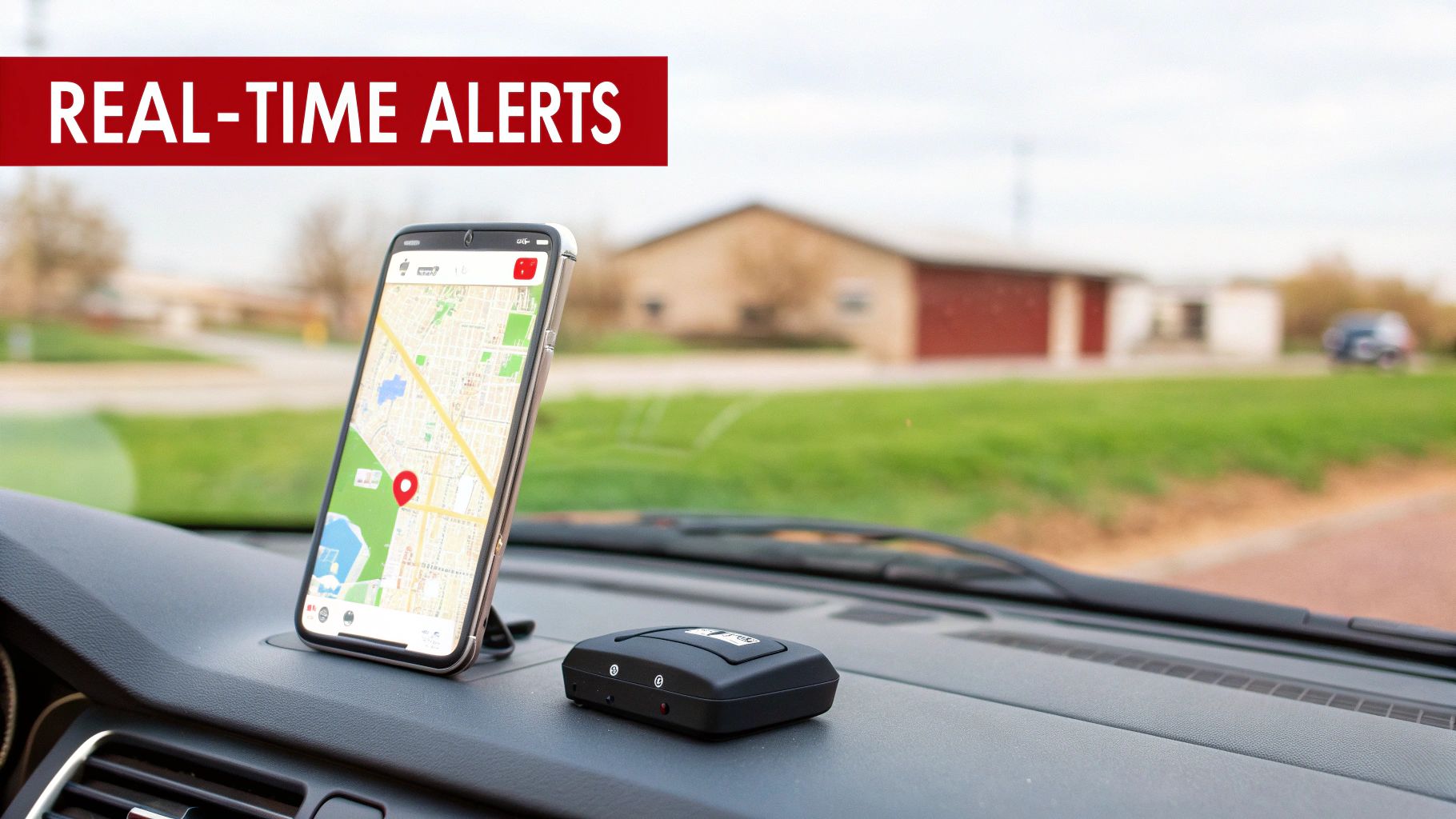
While physical locks and smart habits are great first lines of defense, the best way to secure your car today is with active, real-time monitoring. For years, the standard car alarm was the go-to solution. But let's be honest—most of us just tune out the sound of a blaring car alarm these days. It’s a passive system that hopes a bystander will intervene, which rarely happens.
The game has completely changed. Modern security has moved beyond just making noise. Advanced GPS trackers turn your car's security from a passive hope into an active, 24/7 surveillance system that feeds information directly to your phone. This is your best defense against sophisticated modern theft, from silent relay attacks on keyless entry fobs to a thief with a power tool trying to steal your catalytic converter.
The Power of Instant Alerts
The single biggest advantage of a smart tracker is getting notified the second a threat is detected. A system like CarLock uses sensitive sensors to give you a variety of real-time alerts, giving you that critical head start to stop a theft or recover your car fast.
These aren't just vague pings, either. They’re specific, actionable alerts telling you exactly what's going on:
- Vibration Detected: The system can feel unusual vibrations from things like a power tool cutting into your exhaust, a window being smashed, or the car being jacked up. You get an alert before the thief is even inside.
- Engine Started: You’ll get a notification the moment your car's engine fires up without you. This is a lifesaver against keyless relay attacks.
- Device Disconnected: If a thief finds the tracker and yanks it out, you're notified instantly. That alert alone tells you something is seriously wrong.
- Vehicle Moved: The tracker knows when your car is parked. If it starts moving without the engine running—a classic sign of being towed—you'll know right away.
This kind of detail puts you back in control. You’re no longer waiting to discover your car is gone; you’re being told the moment it’s happening.
When you're looking for serious protection, intelligent security systems provide the kind of real-time monitoring and immediate alerts that have become essential for vehicle owners.
Geofencing and Keeping Tabs on Location
Beyond just detecting threats, a good GPS tracker gives you powerful location-based security tools. One of the most practical features is geofencing. It lets you draw a virtual boundary around a specific place, like your home, office, or a parking garage.
If your car ever crosses that "safe zone" line without you, you get an alert on your phone. It’s an invaluable tool for protecting your car when it's parked for a long time, like at the airport or just overnight on the street.
A Real-World Recovery Scenario
Let’s walk through how this works in a real-life situation. Imagine your car is parked on the street overnight. A thief in a tow truck quietly hooks it up, planning to drag it to a chop shop to be stripped for parts.
- The First Alert: The moment the tow truck starts pulling your car, the GPS tracker detects movement without the engine being on. Your phone immediately buzzes: "Vehicle Moved."
- Live Tracking: You open the app and see a map with your car's icon moving down the street in real-time. There’s no panic or guessing—you have live, actionable data right in your hand.
- Calling the Police: You dial 911, report the theft in progress, and give the dispatcher the car's exact location, speed, and direction of travel.
This completely changes the police response. Instead of just filing a report and looking for a needle in a haystack, they have a live homing beacon to follow. For anyone serious about protecting their vehicle, this technology dramatically boosts the odds of getting it back quickly and with minimal damage. You can find out more about the benefits of a dedicated real-time car tracking system right here.
Creating Your Action Plan for a Stolen Vehicle
No matter how many precautions you take, car theft can still happen. The sinking feeling when you walk out to an empty parking spot is something no one wants to experience. It’s disorienting, and it’s easy to panic.
But in that high-stress moment, having a prepared plan is your best asset for getting your car back. Panic is the enemy. A clear, methodical response will make all the difference, dramatically increasing the odds that police find your car before it’s stripped for parts or gone for good.
Immediate First Steps After a Theft
The second you confirm your car is gone, file a police report immediately. Don't wait around or second-guess yourself. Time is absolutely critical. The faster law enforcement gets your car's details, the quicker they can get it into the national crime database and put out an alert.
Before you make that call, take a deep breath and gather this information:
- Your car's make, model, year, and color.
- The license plate number.
- The Vehicle Identification Number (VIN). This is critical. Keep a photo of it on your phone.
- Any unique marks—dents, bumper stickers, aftermarket wheels, or scratches.
This is exactly where a GPS tracker like CarLock pays for itself. If you have one, you can give the police its real-time location. You’ve just turned a massive city-wide search into a precise recovery operation. Nothing is more powerful for getting a stolen car back quickly.
According to the National Highway Traffic Safety Administration, a vehicle is stolen roughly every 32 seconds in the U.S. That first hour is your best window of opportunity, and acting fast with the right info is everything.
Notifying Key Organizations
Once the police report is filed, make two more important calls: one to your insurance company and one to the DMV.
Getting your insurance agent on the line right away gets the claims process rolling. They’ll need the police report number and will walk you through what to do next.
You'll also want to report the theft to the DMV. This flags the vehicle in their system, making it incredibly difficult for a thief to sell it or try to re-register it. It's a simple step that protects you from a world of potential liability headaches down the road.
Don't Overlook Local Impound Lots
It’s a long shot, but it happens: sometimes a car isn’t stolen, just towed. Before you spiral, it's worth making a few calls to local towing companies and impound lots, especially if you were parked somewhere with tricky restrictions.
A quick phone call with your license plate number can rule this out for certain. It's a simple check that ensures you've covered all your bases before moving forward. For more tips on what to do when your car goes missing, check out our guide on using a modern car locator to find your vehicle.
Answering Your Top Car Security Questions
Even with the best plan, you're bound to have some questions. It's totally normal. Trying to figure out which new tech is worth it and which classic security advice still holds up can feel a bit overwhelming. Let's cut through the noise and tackle some of the most common concerns, giving you straight answers to help you feel confident in your car's security.
Ultimately, making smart decisions is what this is all about. When you understand the real-world risks your car faces and which solutions actually work, you can put your energy and money where they'll do the most good.
Are New Cars With Keyless Entry Systems Easier to Steal?
In some ways, yes, and it all comes down to something called a "relay attack." It’s a trick where thieves use a special device to capture the signal from your key fob—even while it's sitting safely inside your house. They then amplify that signal to another device next to your car, fooling it into thinking the key is right there. The car unlocks, the engine starts, and they drive away without making a sound.
The best defense is surprisingly simple and cheap: a Faraday pouch or box. When you get home or to the office, just drop your key fob inside. These pouches block the radio frequency signals, making a relay attack completely impossible. It’s a tiny change in your routine that shuts down one of the biggest threats to modern cars.
A Faraday pouch is basically a small, signal-proof bag. It creates a metallic shield around your key fob that electromagnetic signals can't penetrate. Think of it as a mini-vault for your key's signal, stopping thieves from listening in.
This is a perfect example of how a simple, smart habit can defeat a high-tech threat.
Will a GPS Tracker Actually Help Police Recover My Car?
Absolutely. A real-time GPS tracker is probably the single most effective tool you can have for vehicle recovery. Think about it from the police's perspective. Without a tracker, a stolen vehicle report means they’re looking for one specific car in a massive haystack, and the clock is ticking. The national recovery rate for stolen vehicles is only around 46%.
But with a system like CarLock, everything changes. Instead of a vague report, you can give officers the car's exact location, live on a map. They see where it is, where it's headed, and how fast it's going. This turns a slow, frustrating search into a targeted recovery mission. It massively boosts the chance of getting your car back—often before it's damaged or stripped for parts.
What Is the Most Stolen Car Part and How Can I Protect It?
Hands down, it's the catalytic converter. Thieves are after them because they contain precious metals like platinum and rhodium that are worth a lot of money at a scrap yard. A thief with a battery-powered saw can get under your car and cut one off in under a minute.
Here’s how you can fight back:
- Install a Protective Shield: These are custom-fit metal cages or plates that bolt over the converter. They make it much harder and louder to cut off, which is usually enough to make a thief give up and move on.
- Park Smart: Thieves love darkness and cover. Always try to park in well-lit, visible areas. If you have a garage, that's the safest place for your car, period.
- Engrave Your VIN: Etch your Vehicle Identification Number onto the converter itself. This makes it traceable and much harder for a thief to sell to a legitimate scrap dealer. Many local police departments or mechanics will do this for you.
Each of these steps adds another layer of difficulty and risk for the thief, making your car a far less attractive target.
Does My Car Insurance Cover Theft?
This is a huge one that trips a lot of people up. Theft is only covered if you have comprehensive insurance coverage. The basic liability insurance required by law only covers damage you do to others—it offers zero protection if your own car gets stolen.
Pull out your insurance policy and double-check that you have comprehensive coverage. Many insurance providers even offer a discount for vehicles equipped with an anti-theft device like a GPS tracker. While you're at it, look at your deductible—that's the amount you'll have to pay out-of-pocket before the insurance kicks in. It’s a good idea to keep your insurance info handy, but never leave it in the glove compartment where a thief can easily find it. You can dig into more frequently asked questions about GPS trackers and security to make sure you've got all your bases covered.
For true peace of mind, CarLock gives you the real-time alerts and live GPS tracking needed to stay one step ahead. Don’t wait until it’s too late—secure your vehicle today by visiting https://www.carlock.co.