

Driver’s Desk
What Does a Car Tracking Device Look Like? A Factual Guide
If you're picturing a bulky gadget with blinking lights straight out of a spy movie, that image is outdated. The reality of modern car trackers is far more subtle. They are masters of disguise, often just small, discreet black boxes no bigger than a matchbox, designed to be completely overlooked.
The Modern Car Tracker: A Visual Introduction
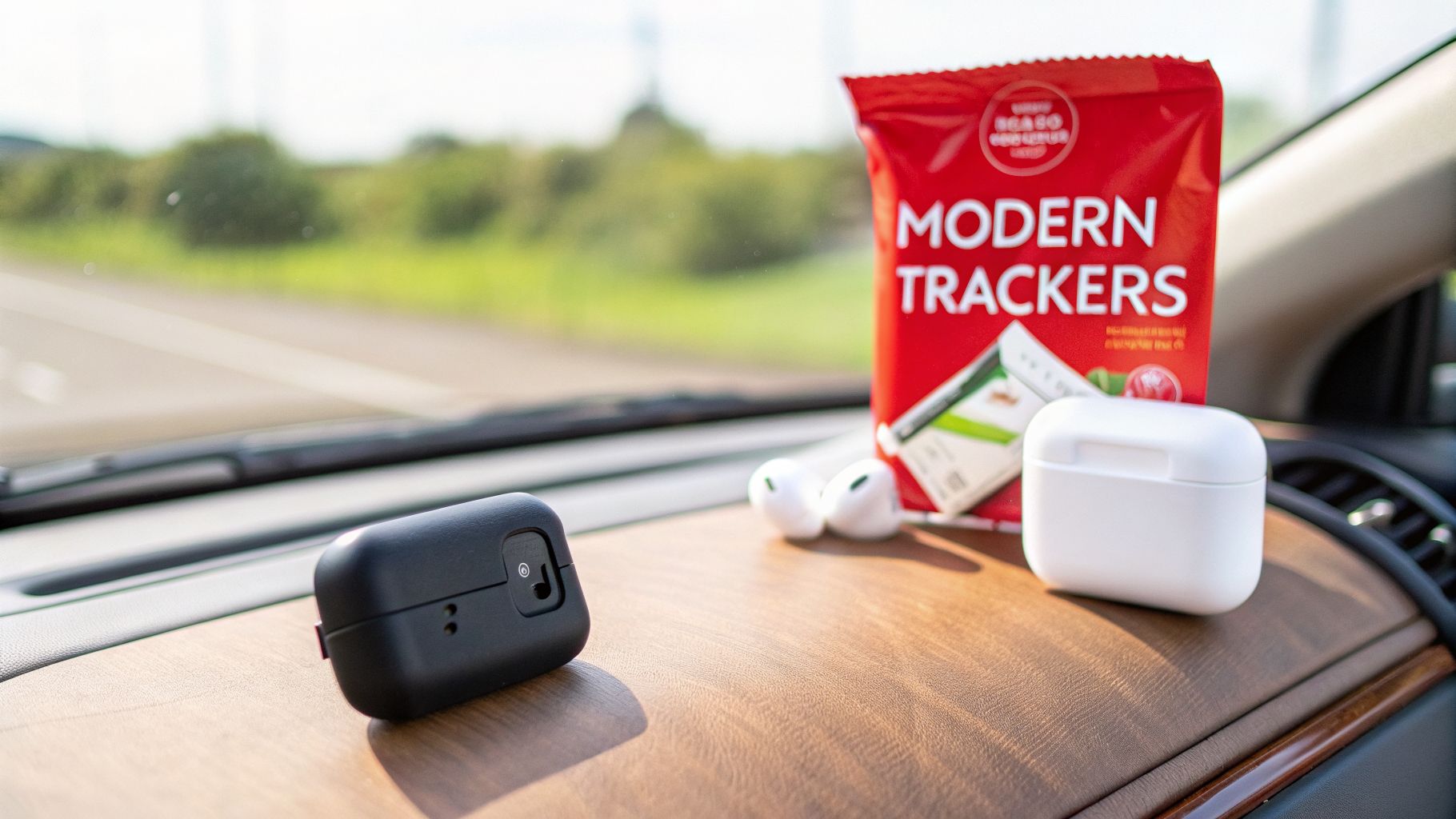
Whether it’s used for legitimate security or for unauthorized surveillance, a tracker has one primary job: to stay hidden. This simple goal has pushed manufacturers to create tiny, powerful devices that blend in seamlessly.
This push for smaller, stealthier tech is fueled by a massive and growing industry. The global vehicle tracking market was valued at $26.08 billion in 2026 and is expected to rocket to $57.7 billion by 2030. That incredible growth means more money is being poured into making these devices smaller, more powerful, and harder than ever to find.
What to Look For: The Basic Appearance
When you start your search, you aren't looking for something that screams "tracker." In fact, their plain, unassuming look is a key feature.
Most trackers you'll come across share a few common traits:
- Color: Almost always matte black or a dark gray. This helps them blend in with the dark plastics, wiring, and shadows of a car's interior and undercarriage.
- Size: They are incredibly small. A typical device is just 2-3 inches long and about an inch wide—roughly the size of a matchbox or a car key fob.
- Material: Most are made from durable ABS plastic. You’ll rarely find any branding or logos that would give away their purpose.
A tracker is designed to be camouflage. Its entire purpose is to look like just another anonymous part of your car’s complex machinery.
To give you a quick overview before we dive deeper, here’s a look at the main types of trackers you might encounter.
Car Tracker Types at a Glance
This table summarizes the different forms these devices take, which should help you narrow your search.
| Tracker Type | Common Appearance | Power Source | Typical Location |
|---|---|---|---|
| OBD-II Plug-In | Small rectangular box | Plugs into the OBD-II port | Under the dashboard, near the steering wheel |
| Hardwired | Small box with attached wires | Connected to the car’s electrical system | Behind the dashboard, fuse box, or interior panels |
| Magnetic/Battery | Weatherproof box, often with magnets | Internal, rechargeable battery | Undercarriage, wheel wells, bumpers, inside seats |
Understanding these different types is the first step. For example, some devices are simple plug-ins, while others require a more invasive installation. To see what a legitimate, modern security solution looks like, you can learn more about the features of a dedicated GPS car tracker like CarLock.
Next, we'll break down each of these types in more detail so you know exactly where to look and what you’re looking for.
Plug-In OBD-II Trackers: The Easiest to Spot
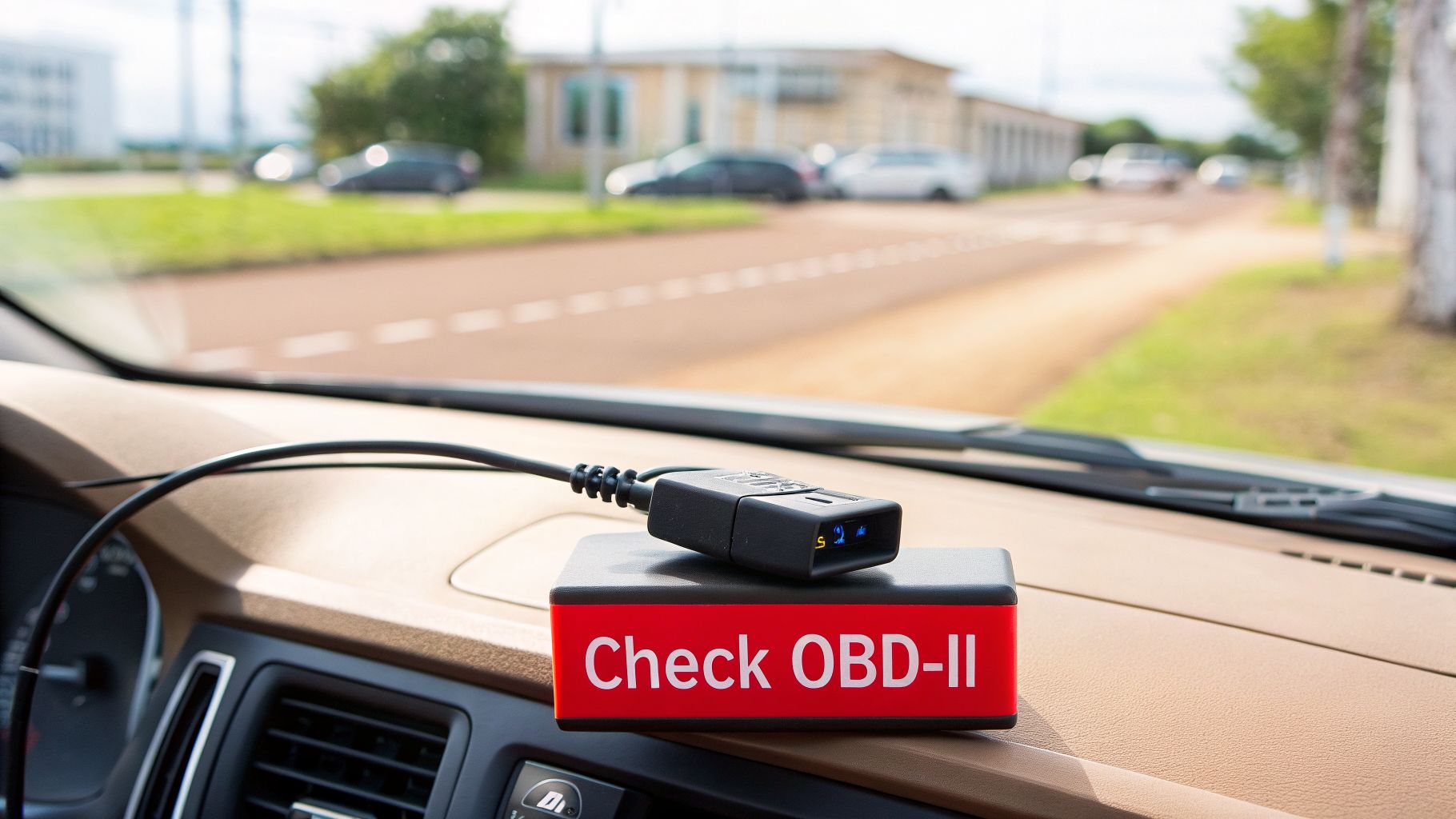
If you suspect someone is tracking your car, the OBD-II port is the very first place you should look. This port serves as the car's primary diagnostic interface. Its universal design in modern vehicles makes it the perfect target for a plug-and-play tracking device.
These trackers are almost always small, rectangular plastic boxes—not much bigger than a thumb drive or a Wi-Fi dongle. What gives them away is the 16-pin connector on one end, built to slot right into your vehicle's port. No wires, no complex installation, just plug it in.
Finding and Identifying an OBD-II Device
So, where do you find this port? The good news is that in almost any car made since 1996, it's legally required to be within three feet of the driver. You just have to know where to look.
Check these common hiding spots:
- Under the dashboard: This is the most popular location. Look directly below your steering wheel, often near your shins or knees.
- Near the fuse box: Sometimes, it’s tucked behind a small plastic panel on the driver's side of the dash.
- In the center console: It's less common, but a few models have it hidden near the gear shifter or inside the ashtray compartment.
Once you’ve located the port, just run your hand over and around it. If a tracker is plugged in, you'll immediately feel a small box that shouldn't be there. Because these devices pull power straight from the car, they are a true "set it and forget it" tool, which makes them a favorite for both legitimate security and unauthorized spying.
The sheer simplicity of an OBD-II tracker is its greatest advantage and its biggest vulnerability. Anyone can install one in seconds, but it is also the easiest type for a vigilant owner to find and remove.
This plug-and-play approach is exactly why security solutions like CarLock are so easy for owners to install themselves. Unfortunately, that same simplicity makes them the go-to choice for anyone trying to plant a tracker quickly and without getting caught.
The device itself will likely be a plain, black plastic box with no obvious branding. You might see a tiny, dim LED light blinking, which usually means it has power and is connected to a satellite. These lights are often faint on purpose to avoid being noticed.
Knowing what this common type of car tracking device looks like is your first line of defense. By spotting an unwelcome gadget in your car's diagnostic system, you can take back control. You can also see how a legitimate device uses this same port to help you find your car by exploring the CarLock car locator feature.
Hardwired Trackers: The Covert Professional Installation
If an OBD-II tracker is the easy-to-spot amateur, the hardwired tracker is the seasoned professional. This is the kind of device you install when you want permanent, deeply hidden surveillance, which is why it's the go-to for fleet management companies and car owners who are serious about security.
A hardwired tracker is built for stealth. You’re typically looking for a small, sealed black box with no obvious markings. What gives it away is the wiring harness—a bundle of wires coming out of the unit. These aren't for plugging into a port; they're meant to be spliced directly into your car's electrical nervous system.
Professional Installation for Maximum Stealth
Unlike a simple plug-in device, a hardwired tracker requires a bit of electrical know-how to install. A technician will tap the device into your car's power source, ignition wire, and a ground, integrating it seamlessly. This hardwired connection means it has a constant supply of power from the car's battery, so it never needs to be recharged.
This installation method also opens up a world of hiding spots that are nearly impossible to find without tearing the car apart. Common places to stash these trackers include:
- Behind the dashboard: Tucked away in the dense wiring behind your instrument cluster.
- Inside an A-pillar: Concealed in the plastic trim running up the side of the windshield.
- Under the center console: Buried deep beneath the gear shifter and surrounding panels.
- Near the vehicle's fuse box: Camouflaged among dozens of other wires and relays.
Once installed, the tracker just looks like another anonymous electronic part of your car. Plus, many are designed to be tamper-proof. If a thief gets smart and tries to disconnect the car battery, a small internal backup battery often kicks in, sending out one last alert with its location.
Imagine a tiny black box, maybe 2.5 inches by 1.8 inches by 0.8 inches, with a few simple wires. That's it. This small package is the backbone of a huge industry, with over 200 million units shipped in 2023 as vehicle theft continues to rise. To see just how big this market has become, you can check out the latest research on the car GPS tracker sector.
The "set it and forget it" nature of hardwired trackers makes them a powerful tool for long-term asset protection. For a business with a fleet of vehicles, it means uninterrupted monitoring. For a car owner, it provides a robust, always-on defense against even sophisticated thieves. This kind of deep integration is a key part of a truly effective car security system, giving you confidence that your vehicle is being watched over around the clock.
Battery-Powered Magnetic Trackers: The Spy Movie Classic
When you think of a car tracker, you’re probably picturing something straight out of a spy movie. That device is almost always a magnetic, battery-powered tracker, and they are very real. These are self-contained, weatherproof little boxes with absolutely no wires.
What really sets them apart are the powerful magnets built right into the housing. This simple feature is a game-changer, allowing someone to attach the device to any metal part of your car in just a few seconds. No tools, no technical skills required. Inside the box is a GPS receiver, a tiny cell modem to send its location, and a battery to keep it all running.
What to Look For and Where to Look
So, what does one of these trackers actually look like? Most are simple, nondescript black or gray pods, often about the size of a deck of cards—think 3x2x1 inches. They're designed to be boring and blend in with the grime and shadows under a vehicle. This stealthy design is no accident, as the demand for these devices has exploded. The GPS tracking market is on track to more than double, projected to hit $7.34 billion by 2030, up from $3.6 billion in 2026. You can get a sense of this rapid growth by looking at the latest GPS tracking market trends.
Because they are so easy to hide, you need to be thorough when checking your car. Some of the most common spots include:
- Under the car frame: Clamped directly to the thick steel beams that run the length of the vehicle.
- Inside the bumper: Tucked up behind the plastic bumper cover, completely hidden from a casual glance.
- In a wheel well: Placed high up in the arch, well away from the tire and suspension components.
- Beneath the subframe: Stuck to the metal structures holding the engine or rear axle.
The biggest selling point of a magnetic tracker is its grab-and-go nature. It can be moved from car to car in an instant, making it the go-to choice for private investigators or anyone needing temporary, covert tracking.
But this flexibility comes at a cost: battery life. Since the device isn't wired into your car’s electrical system, its battery will eventually run out. The person who placed it has to come back to retrieve it for a recharge. Depending on the model and how often it reports its location, a battery might last anywhere from a few days to several months.
This is exactly why a permanent, professionally installed system like CarLock connects directly to your vehicle's power, offering uninterrupted security. If you're looking for a more dependable security solution, exploring a feature like the CarLock Tag accessory can give you layered protection without the battery headaches of a hidden tracker.
How to Find a Hidden Tracker in Your Car
If you suspect that someone put a tracker on your car, the most reliable method to confirm your suspicion is with a thorough physical search. You don’t need to be a professional mechanic to do this. With patience and a couple of simple tools, you can systematically check all the common hiding spots yourself.
All you really need to get started is a bright flashlight and an extendable inspection mirror. These will be your best friends for peering into your car's nooks and crannies.
Your Interior Inspection Checklist
Let's start inside the car. We'll work our way from the most common hiding places to the less obvious ones.
- Check the OBD-II Port First: This is, by far, the most popular spot for plug-and-play trackers. The port is usually located under the dashboard on the driver's side. Feel around it. If you find something plugged in that isn't for a dealership service or emissions test, that's a major red flag.
- Inspect the Glove Box and Center Console: Don't just peek inside—empty them completely. Run your hands along the inner walls, top, and bottom. You're feeling for any small, unfamiliar boxes that might be taped or velcroed out of sight.
- Search Under the Seats: Grab your flashlight and slide both front seats all the way back, then all the way forward. This gives you the best possible view underneath. Feel along the metal seat frames and check for any small devices tucked into the upholstery or attached to the floor. Don't forget the back seats!
- Examine the Trunk: Pop the trunk and lift up the floor cover to check the spare tire well. This is a classic hiding place. Also, take a close look behind any removable plastic panels or inside storage cubbies.
Magnetic trackers, which are often hidden on the vehicle's exterior, have some distinct features you should know about.
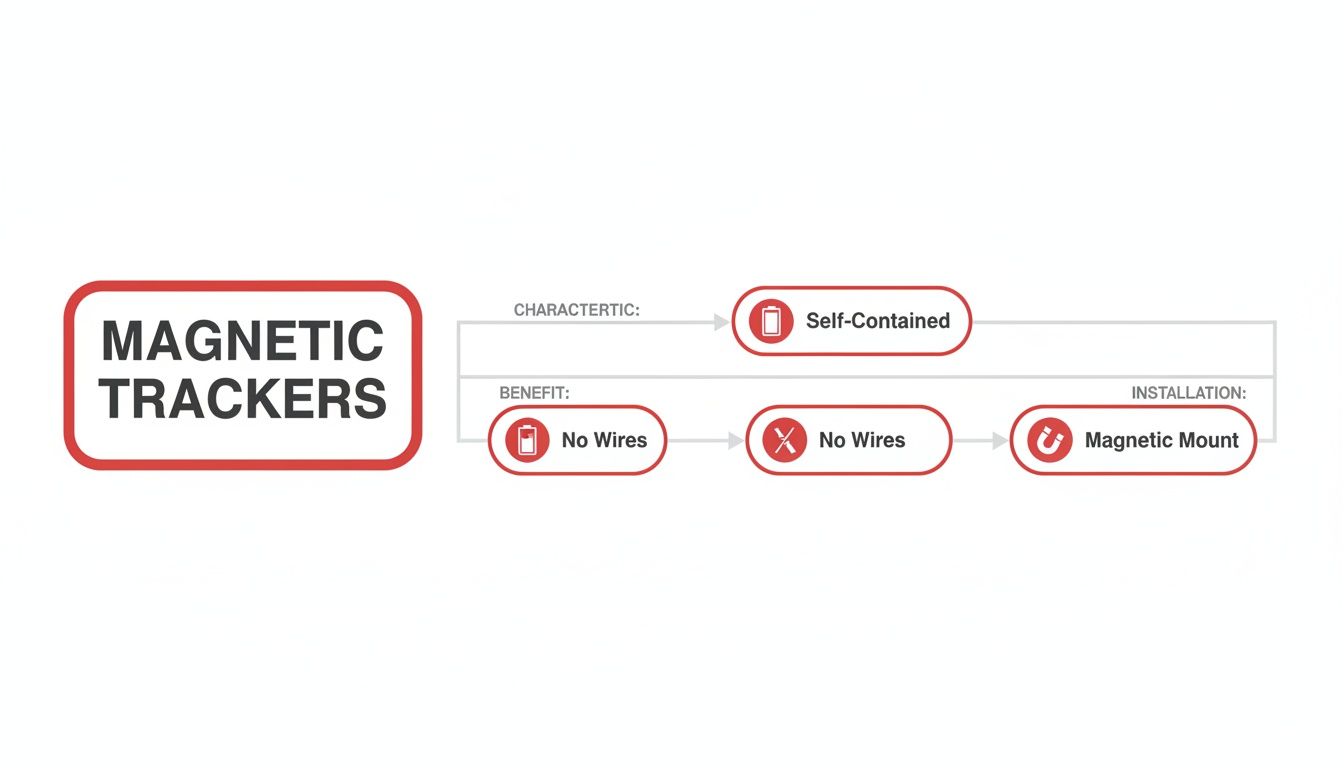
As you can see, these devices are completely self-contained. They have their own battery, so they don't need any wires, and they attach with a powerful magnet, making them easy to place on any metal surface.
Taking Your Search to the Exterior
Once you've given the interior a thorough sweep, it's time to check the outside of your car. This is where you're most likely to find one of those magnetic, battery-powered units.
Be prepared to get a little dirty. The best hiding spots for magnetic trackers are underneath the car, where they can be tucked away on the frame and blend in with the shadows.
Get on the ground and use your flashlight to carefully inspect the vehicle’s undercarriage. Run your hand along the main frame rails, paying special attention to flat metal surfaces. You're searching for a small, hard box that feels out of place. Also, check inside the wheel wells and behind the plastic of the front and rear bumpers, as these spots offer great concealment.
If you've searched everywhere and still come up empty-handed but your gut tells you something is wrong, it may be time to call in a professional. They have specialized tools like RF signal detectors that can find what the naked eye can't.
And if you're looking to take back control and proactively monitor your vehicle's security yourself, you can learn more about CarLock's total awareness features.
You Found a Tracker. Now What Do You Do?
Finding a strange electronic device tucked away in your car is a jarring experience. Your gut reaction might be to rip it out and smash it, but that's the last thing you should do. Acting rashly could put you at greater risk or destroy critical evidence.
First things first: do not remove the device. If someone planted it with malicious intent, they’ll get an instant alert the second it goes offline. This not only tips them off but could cause them to escalate their behavior or simply hide a new, better-hidden tracker somewhere else. Your priority right now is to gather evidence.
Before you touch a thing, pull out your phone and start taking pictures. Get clear photos of the device from every angle, showing exactly where it’s located and how it's attached. If you can see any brand names, logos, or serial numbers, get detailed close-ups. This documentation is absolutely essential.
Taking the Right Steps
With photos in hand, your next call should be to the police. Explain what you found, but don't drive the car to the station. The person tracking you would see exactly where you're going. Let the authorities tell you how to proceed; they will treat the device as evidence and handle it properly.
- Document Everything: Photograph the tracker and its precise location before you do anything else.
- Contact Law Enforcement: Call the police, report your discovery, and follow their instructions to the letter.
- Avoid Confrontation: Let the professionals handle the investigation and figure out who is behind this.
Discovering an unauthorized tracker can make you question your car’s overall security. If this incident has you worried about other vulnerabilities, getting advice from professional automotive locksmith services can help you explore options for better locks, keys, and overall protection.
Shift from Reactive to Proactive Security
This whole ordeal highlights a critical lesson: it’s far better to be in control of your vehicle's security than to react to a threat you didn't see coming. Instead of worrying about a hidden device, you can install a monitoring system that you own and control. This is where a solution like CarLock completely flips the script.
By installing your own trusted tracker, you are the one who gets instant alerts for suspicious activity—like unusual vibrations, engine starts, or if your vehicle is moved. You regain control and peace of mind, turning the tables on potential thieves or stalkers.
Frequently Asked Questions About Car Trackers
Let's address some of the most common questions about car tracking devices to provide you with a complete and factual understanding.
Can a Car Tracking Device Drain My Car Battery?
That’s a common worry, and for good reason. The short answer is: a high-quality tracker won't, but a cheaply made one can.
Quality devices, like a CarLock OBD-II unit or a professionally installed hardwired tracker, are engineered with power-saving "sleep modes." They draw only a negligible amount of power (typically under 2mA) when the vehicle is off, waking up only when triggered by an event. This prevents any meaningful drain on your car's battery.
On the flip side, a poorly made or incorrectly installed device can be problematic. These often lack proper power management and can create a constant parasitic drain that can leave you with a dead battery. Of course, magnetic battery-powered trackers are completely self-sufficient and won't affect your car's battery at all.
Are All Car Tracking Devices Legal to Use?
This is a critical question, and the legality boils down to two things: ownership and consent.
It is perfectly legal to install and use a tracking device on a vehicle that you own. It is your property, and using a tracker is a powerful method to protect it from theft or monitor its use by family members.
However, it is illegal in most jurisdictions to place a tracker on a car that does not belong to you without the owner's explicit consent. Doing so can lead to serious legal consequences, including charges for stalking or invasion of privacy. If you find an unknown tracker on your car, the best course of action is to leave it in place and contact the police.
The accuracy of modern GPS trackers is remarkable. They generally pinpoint a vehicle’s location to within 5 to 10 meters (about 16 to 32 feet). This precision is achieved by combining signals from multiple satellite systems like GPS and GLONASS, ensuring a reliable lock on your car's position even in dense urban areas.
Do All Trackers Need a Monthly Subscription?
For a tracker to provide its location in real-time, it must communicate over a cellular network. Most modern GPS trackers contain a built-in SIM card and use the same mobile networks as your smartphone to transmit location data and alerts.
This is why a small monthly subscription is usually required. That fee covers the cost of the SIM card and the data plan used by the tracker. It’s a necessary cost for enabling the live tracking, instant alerts, and other security features that provide peace of mind.
Don't leave your car's safety to chance. With CarLock, you get a powerful, easy-to-use security system that you control. Protect your vehicle from theft and get instant peace of mind by installing a solution trusted by thousands of car owners. Learn more and secure your car today.