

Driver’s Desk
Car Security and Remote Start System: A Complete Guide
A lot of drivers still think of remote start as a comfort feature. Warm cabin. Defrosted windows. Cooler interior in summer. That’s part of the story, but it’s no longer the whole story.
The bigger shift is this. The global remote start system market reached USD 5.3 billion in 2024 and is projected to grow at a 7.2% CAGR through 2033, driven by demand for convenience and security as vehicle theft concerns rise, according to Dataintelo’s remote start system market report. That matters because it shows how buyers now expect one system to do two jobs at once. Make daily driving easier, and make theft harder.
That’s what a modern car security and remote start system is really about. It isn’t just a button that starts the engine from your kitchen window. It’s a layered setup that can lock down the vehicle, verify status, detect tampering, and in the best cases work alongside live monitoring tools that keep you informed after a thief gets past the first barrier.
The Modern Answer to Rising Vehicle Theft
Vehicle theft rarely looks like the old movie version anymore. A smashed window and a screaming siren still happen, but many theft attempts now start stealthily, with signal tricks, fast entry, or a thief testing whether a car will respond before anyone notices. That shift has changed what a smart owner should expect from a car security and remote start system.
As noted earlier, demand for remote start keeps growing for a simple reason. Drivers no longer see it as a comfort-only add-on. They want one setup that makes daily use easier and also adds real protection.
Why remote start belongs in a security plan
Remote start has matured into part of a larger control system. The better setups connect engine authorization, door lock status, alarm activity, shock or tilt sensing, and alerts into one coordinated package. It works a lot like a front door with a smart lock, camera, and motion sensor. Each part does a different job, but the true value comes from how they work together.
That matters most for drivers who need more than a loud warning after the fact. Parents may want to know when a vehicle starts unexpectedly. Fleet operators may need stronger oversight of parked vehicles. Owners of trucks, performance cars, or other high-value vehicles often want more than factory security alone can give them.
Practical rule: A safer vehicle uses layers of protection. If one layer is bypassed, another one still has a chance to slow the theft, interrupt it, or alert you.
That same principle applies beyond personal vehicles. Professional risk planning often starts by removing weak points and adding overlapping safeguards, which is why these cargo theft prevention strategies are a useful parallel.
What complete protection looks like now
A modern setup should cover three jobs at once:
Deter the attempt
Visible security indicators, locked entry points, and alarm responses can convince a thief to move on.Control vehicle access
Integrated logic can limit when the engine starts, how the system responds to unauthorized entry, and whether the vehicle can be driven away easily.Keep you informed
You need timely notice when something unusual happens, especially if the vehicle is out of sight.
That third piece is where many older systems come up short. A remote fob can tell you the doors locked when you are nearby. It cannot always tell you that the car was bumped at 2 a.m., moved without permission, or started in a different location. For a clearer picture of how suspicious activity develops before a theft is complete, review these vehicle theft awareness and warning signs.
This is also where the combination of remote start, built-in security, and a dedicated GPS tracker becomes much stronger than a legacy alarm by itself. Remote start adds convenience and controlled vehicle access. Security hardware adds deterrence and interruption. A tracker such as CarLock adds live awareness after the first line of defense is tested. Together, they form a practical protection system for the way vehicles are targeted now, not the way they were targeted years ago.
How These Integrated Systems Actually Work
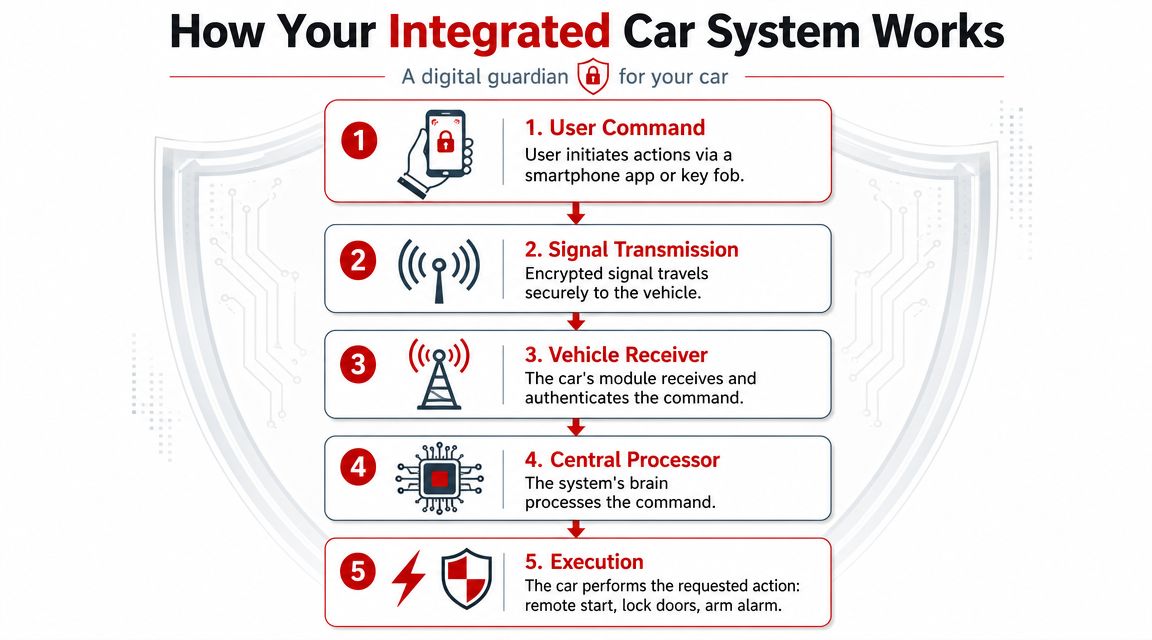
An integrated car security and remote start system follows a clear sequence. You send a command from a fob or app, the vehicle checks whether that command is legitimate, and the system carries out the request only if the right conditions are in place.
That order matters.
A good setup does far more than start the engine from a distance. It verifies the request, checks vehicle status, and decides whether the action is safe. The easiest way to understand it is to picture a locked front door with several checks behind it. One key opens the door, another confirms you belong there, and a final check makes sure nothing unsafe happens once you get inside.
The five-part chain inside the system
Most integrated setups rely on five connected parts working together:
Input device
Your key fob or smartphone app sends the request.Signal path
The command travels to the vehicle through radio signal or cellular connection, depending on the system.Receiver module
The installed hardware receives that signal and checks whether it matches an authorized request.Control module
This module acts as the decision-maker. It reviews the command and checks vehicle conditions.Vehicle response
The system locks or unlocks doors, starts the engine, arms the alarm, or rejects the command.
When drivers say they want a system that "just works," this is what they are asking for. They want each link in that chain to respond the same way every time, without guesswork.
The safety checks that confuse many drivers
A common concern is simple. If the engine is running by remote start, can someone jump in and drive away?
Modern systems are built to separate engine warm-up from drive-away access. As explained in TA Selectronics' overview of remote starter safety, properly installed remote start systems use safeguards such as checking for park status and shutting the engine off if the brake is pressed without the proper key or takeover sequence.
That distinction clears up a lot of confusion. Remote start gives you comfort and convenience, but the security side still controls whether the vehicle can be driven normally. In other words, the engine may be on, yet the car is still waiting for proof that the authorized driver is present.
Why confirmation matters after you send the command
One-way systems send instructions. Two-way systems send information back.
That difference is easy to overlook until you are parked far away, dealing with bad weather, or standing inside a building that blocks signal strength. A button press means very little if you cannot confirm whether the doors locked or the remote start cycle succeeded.
This is one area where integrated security and a dedicated tracker work better together than older systems do on their own. The remote start system handles command and control. A GPS-based tool adds live visibility, including alerts and status details that help you verify what happened after the command was sent. Features like movement alerts, trip history, and location-aware notifications in connected security tools are a good example, as shown in these vehicle security app features.
That combination closes a gap that legacy alarms often leave open. An alarm can make noise. A connected system can also tell you whether the vehicle moved, where it went, and whether the event matches normal use.
Installation quality shapes everything
The smartest hardware can still behave poorly if the install is sloppy. Loose connections, weak programming, or poor vehicle integration lead to false alarms, missed commands, and confusing behavior.
A proper installation makes the system feel calm and predictable. You press the button, the modules check their conditions, the security logic stays in control, and the vehicle responds the same way each time. Add a dedicated tracker such as CarLock to that foundation, and you get both convenience up front and real-time awareness if trouble starts later. That is a key advantage of an integrated setup. It does not force you to choose between remote start comfort and modern theft protection.
Essential Security Features That Counter Modern Thieves
Convenience sells remote start systems. Security is what justifies them.
The reason is simple. Thieves don’t attack cars the way they did years ago. They use signal tricks, weak app security, and fast entry methods that can bypass older assumptions about what “locked” means.
According to Upstream’s analysis of key fob and automotive cyber risk, relay attacks on keyless entry systems have effectiveness rates over 90% on some models. These attacks exploit the radio communication between the key fob and the vehicle to trick the car into disarming its security and starting as if the key were nearby.
That one fact changes the conversation. If a thief can impersonate proximity, the system has to do more than just grant access on command.
Starter-kill and immobilization logic
A starter-kill or starter interrupt feature is one of the most valuable security upgrades because it addresses the theft attempt at the engine-control level. If the system is armed and the wrong sequence occurs, the vehicle won’t continue as expected.
Thieves often count on speed. They don’t want to troubleshoot. They want to enter, start, and leave. When the vehicle refuses to behave normally, you force them into noise, delay, and risk.
Some setups also work with motion-sensing immobilizers or related anti-drive-away logic. These systems aren’t just looking for a door opening. They’re looking for suspicious movement, impact, or other activity that suggests the vehicle is being tampered with.
Sensors that detect more than door opening
Basic factory alarms often react to a narrow set of events. Modern security systems can watch for more:
- Shock sensing helps detect impact from forced entry or glass break attempts.
- Tilt sensing can catch towing or wheel theft attempts.
- Monitored zones such as the hood, doors, trunk, or cabin help the system react when someone accesses a protected area.
- Siren output adds a deterrent layer that can draw attention and pressure the thief to leave.
Some advanced setups pair shock and tilt detection with sirens above 105 dB, based on the verified market data cited earlier from Dataintelo. That matters because many theft attempts are opportunistic. A thief who wanted a quiet job often moves on when the car becomes difficult and loud.
Security takeaway: A useful alarm doesn’t just make noise. It detects the right event early enough to interrupt the theft sequence.
Two-way communication changes the owner’s role
A lot of owners still use systems that only transmit commands. That leaves a blind spot. Did the vehicle lock? Did the command fail? Did interference block it?
Two-way systems reduce that uncertainty by sending confirmation back to the owner. In practical terms, that means you don’t stand at the edge of a parking lot clicking the fob again and again, hoping the car responded.
This short video gives a good visual sense of how vehicle security systems pair convenience functions with anti-theft logic:
Steering lock and shutdown behavior
One of the most reassuring parts of a correctly integrated remote start system is what happens when someone tries to convert a remote idle into a theft. As covered earlier, the engine may be running, but the vehicle still isn’t in a normal drive-ready state without the proper key presence and handoff.
On many systems, pressing the brake pedal, opening protected entry points under the wrong conditions, or violating programmed rules causes shutdown. That means the system is designed around controlled access, not mere engine activation.
Factory convenience vs real theft resistance
Factory remote start can be convenient, but convenience isn’t the same as layered theft protection. A lot of owners assume that because the vehicle came with keyless entry and app control, it must already be secure enough. That’s not always true, especially against relay-style attacks or more deliberate break-in methods.
Independent security tools also matter because they can add another alert layer beyond what factory systems provide. If you’re comparing what a basic OEM alarm does versus what a more active monitoring setup can add, this overview of car alarm functions and theft alerts is a helpful benchmark.
Layering Protection with a Real-Time GPS Tracker
Even a strong remote start and alarm setup has a built-in limitation. Most of its power is concentrated at the vehicle itself. It can detect, block, shut down, and scream for attention. But once the car is gone, many traditional systems become much less useful.
That’s where a second layer matters. A real-time GPS tracker doesn’t replace the security system in the car. It extends it beyond the parking spot.
What the remote start system can’t do well on its own
A remote start security system is best at three jobs: deterrence, local response, and control over authorized vehicle functions. It’s weaker at ongoing awareness after the event has already started.
For example, a thief may bypass one layer, tow the vehicle, or exploit a weakness outside the normal lock-and-start sequence. In those cases, the owner needs more than a siren. The owner needs information.
That’s the core advantage of a dedicated tracker. It keeps reporting when the vehicle is moved, started, or disturbed. Instead of wondering whether something happened, you get alerts you can act on.
Why GPS tracking changes the outcome
A live tracker shifts the owner from passive victim to informed responder. Depending on the device, that can include alerts for:
- Engine start events
- Vibration or impact
- Vehicle movement
- Location changes
- Driving activity that looks unusual
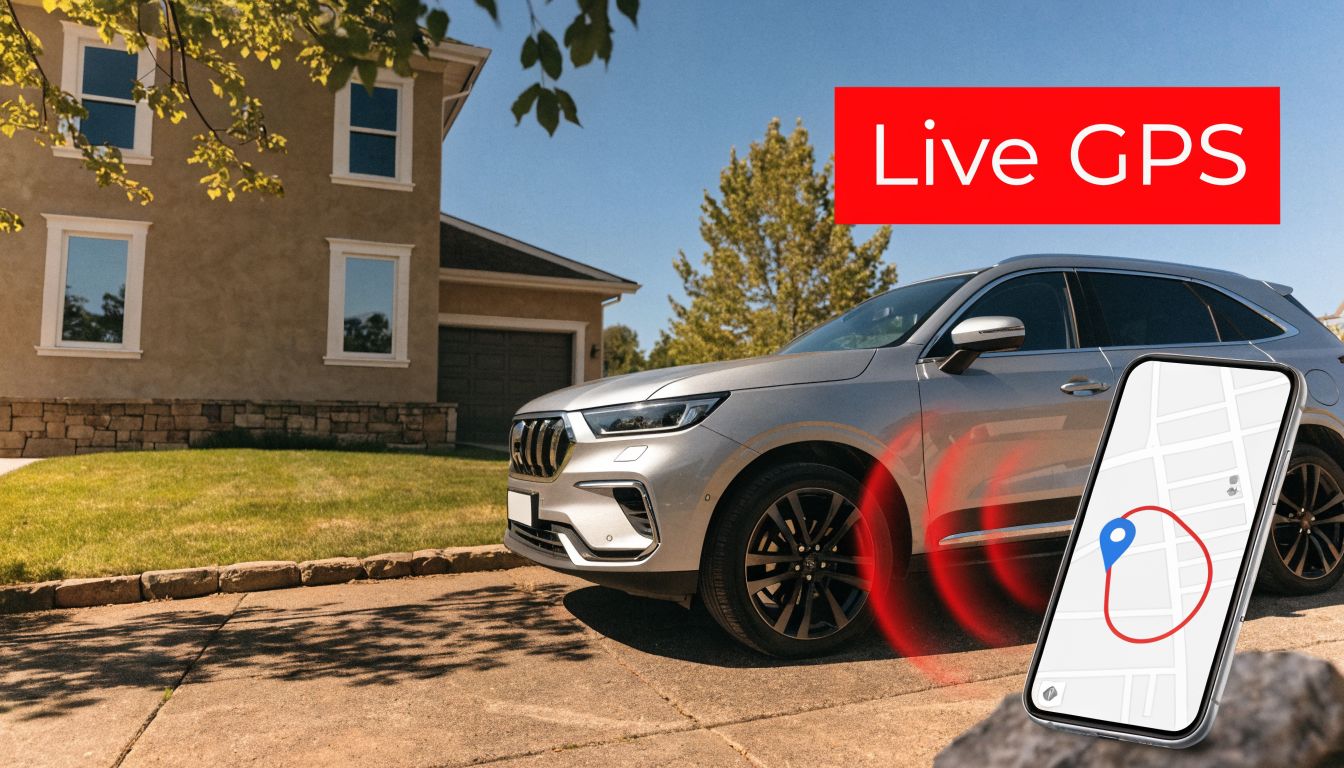
That matters for ordinary owners, but also for parents and fleet operators. A parent may care about unexpected nighttime movement. A fleet manager may care about off-hours engine starts. A driver in a theft-prone area may care about any movement from the curb before dawn.
A layered setup works best when one system tries to stop the theft and another makes sure you know, in real time, if the first layer was challenged.
The practical gap it closes
Range is one of the biggest weaknesses in legacy remote systems. A fob works brilliantly until the vehicle is farther away than the radio link can handle. Even app-connected remote start systems may focus more on command capability than detailed security awareness.
A dedicated tracker fills that gap by acting as a separate witness. It isn’t waiting for you to check the vehicle. It reports what the vehicle is doing. That’s especially useful if the theft attempt begins with towing, door tampering, or unauthorized engine activity rather than a classic smash-and-grab.
If you’re evaluating that kind of second layer, this breakdown of GPS tracker device features for vehicle monitoring is useful because it focuses on what owners need day to day: movement alerts, trip visibility, and immediate notification when something changes.
The right way to think about “complete” protection
No single box can promise perfect safety. The better question is whether your setup creates enough friction, noise, delay, and visibility to make theft harder and recovery faster.
That’s why the strongest car security and remote start system strategy usually combines two ideas. First, prevent and interrupt. Second, monitor and respond. When those two layers work together, the owner is no longer relying on hope or hearing distance.
A Practical Checklist for Buying and Installation
The best buying decision usually comes down to one question. Are you buying a convenience feature that happens to include security, or a security system that also gives you convenience?
That distinction affects everything from range to app design to how the system is installed in your vehicle.
OEM vs aftermarket
Factory-installed systems have one clear advantage. They’re built into the vehicle from day one. They often work smoothly with the original key fob and don’t require an extra device on your keychain.
But factory systems can also be limited. Many prioritize convenience and tidy integration over deeper customization. They may not offer the sensing, confirmation, or independent alert layers that owners in higher-risk situations want.
Aftermarket systems are usually the better fit when you care about tailoring the setup to your vehicle and your threat level. They can add two-way remotes, starter interrupt logic, stronger alarm behavior, and broader sensor coverage. The tradeoff is that quality depends heavily on product choice and installer skill.
One-way vs two-way vs smartphone control
Here’s the comparison most buyers need.
| System Type | Typical Range | Communication | Primary Benefit | Key Consideration |
|---|---|---|---|---|
| One-way remote start | Shorter practical range | Sends commands only | Simple operation and lower complexity | You may not know whether the car received the command |
| Two-way remote start | Longer practical range than basic one-way systems | Sends commands and receives confirmation | Better feedback on lock and start status | Hardware quality and interference handling still matter |
| Smartphone-controlled system | Depends on system design and connectivity | App-based control and status access | Control from farther away and better visibility | Security architecture matters more than convenience promises |
Notice that the table avoids hard numbers except where verified earlier in the article. That’s deliberate. Real-world range varies with buildings, interference, and installation quality.
A critical warning about BLE-based systems
Some smartphone-controlled products look modern because they use Bluetooth Low Energy. That doesn’t automatically make them secure.
According to VerSprite’s analysis of a BLE remote start vulnerability, some aftermarket systems are vulnerable because the mobile app itself handles encryption keys. That can allow an attacker within range to replicate keys and send unauthorized commands such as opening doors or starting the engine. VerSprite notes that systems with server-side validation, including many cellular-based trackers, mitigate this type of risk more effectively.
That’s one of the most important buying questions you can ask: where is trust enforced? Inside a phone app alone, or on a system that validates commands beyond the client?
Don’t buy a connected security product just because the app looks polished. Ask how commands are authenticated.
Questions to ask before you commit
Use this checklist when comparing products or talking with an installer:
- Vehicle compatibility: Confirm that the system is designed for your exact year, make, model, and transmission type.
- Security logic: Ask whether it includes starter interrupt, monitored entry points, and tamper sensing.
- Feedback: Find out whether it’s one-way or two-way, and whether the app or remote confirms actual vehicle status.
- Signal security: Ask how commands are authenticated and whether the system relies heavily on BLE.
- Installer experience: Choose a shop that regularly works on modern immobilizers, keyless systems, and data-bus integration.
- Future conflicts: If your vehicle uses a digital key ecosystem, ask about compatibility with OEM apps and future updates.
- Second-layer monitoring: Decide whether you also want independent movement and engine-start alerts outside the remote start platform.
Why professional installation is usually the right call
Modern vehicles are full of interconnected electronics. A poor splice, bad ground, or incorrect software programming can cause strange lock behavior, false alarms, no-start conditions, or battery drain.
Professional installers know where the vehicle’s critical circuits are and how to integrate without creating new problems. They also understand handoff behavior between the factory key, immobilizer, and remote start logic. That matters even more on newer vehicles with push-button start and app-connected features.
If you want a simple pre-purchase filter, these common GPS tracker and car security questions are a useful companion when you’re comparing systems, installers, and ongoing monitoring options.
Securing Your Vehicle for the Road Ahead
Vehicle protection has changed. The old model was simple: lock the doors, maybe add an alarm, and hope noise was enough. The modern model is layered. You want prevention at the vehicle, smart control over who can start or move it, and independent awareness if something still goes wrong.
That’s why the best car security and remote start system isn’t just the one with the longest feature list. It’s the one that closes the right gaps for your situation. A city commuter may care most about relay-resistant thinking and movement alerts. A parent may care about engine-start awareness. A fleet manager may care about consistent monitoring across many vehicles.
There’s another reason to think in layers. Integration challenges with digital keys in post-2025 vehicles are becoming more important. Some OEM apps can conflict with aftermarket remote starts, and few systems effectively counter the 35% global surge in relay theft seen in 2025, as noted in this Viper discussion of remote start and digital key trends. That points to a practical conclusion: hybrid setups that combine remote start with independent, real-time GPS monitoring are becoming the safer long-term approach.
Buy for the way theft happens now, not the way it happened a decade ago.
If you’re shopping for a used car before upgrading its protection, it also helps to review theft checks auto reports so you understand a vehicle’s theft-related history before you invest in accessories and installation.
The right next step is simple. Look at what your current setup can do. Can it interrupt a theft attempt? Can it confirm vehicle status? Can it alert you if the car moves when you’re nowhere nearby? If the answer to any of those is no, you’ve found the gap that needs attention.
If you want a practical way to add real-time awareness to your vehicle security setup, CARLOCK offers GPS tracking, engine start alerts, vibration detection, and movement notifications through a smartphone app. It’s a strong fit for drivers who want more than a traditional alarm and need visibility into what their car is doing when they’re not standing next to it.