

Driver’s Desk
Car Alarm Sensor: A Guide to Protecting Your Vehicle
A car alarm sensor used to mean one thing to most drivers: a siren that goes off when somebody hits the car. That picture is outdated. The hardware inside modern vehicle security systems has become a large, fast-growing category. In 2024, the global vehicle security sensor market was valued at USD 663.5 million and is projected to reach USD 1,018.3 million by 2032, growing at a CAGR of 5.5% according to Credence Research's vehicle security sensor market report.
That growth matters because it reflects a change in how cars are protected. A modern car alarm sensor isn't just a noise trigger. It's part of a system that can detect forced doors, broken windows, unusual movement, and unauthorized tampering before a thief drives away.
The easiest way to think about it is this: sensors are your car's digital nervous system. They feel the outside world. They notice when something is wrong. Then they send that information to the alarm, immobilizer, or connected monitoring device that decides what happens next.
Most confusion starts here. Drivers hear terms like shock sensor, tilt sensor, motion sensor, and vibration sensor, then assume they're all doing the same job. They aren't. Each one watches a different threat, and each one has tradeoffs.
Your Car's First Line of Defense
A car alarm system only works if it can notice trouble early enough to matter. That's the job of the sensor. It operates in the background, always listening, measuring, or monitoring some physical event such as impact, movement, entry, or vibration.
Why sensors matter more than the siren
Many people focus on the loudest part of the system, the horn or siren. That's understandable, but it's backward. The siren is just the output. The sensor is the decision point. If the sensor is too insensitive, the alarm won't react when it should. If it's too sensitive, the system will cry wolf and you'll stop trusting it.
That tension explains why vehicle security has moved toward smarter detection. Sensor makers aren't only trying to make alarms louder. They're trying to make them more accurate.
Practical rule: A useful alarm doesn't just make noise. It notices the right event at the right time.
A connected system builds on that idea. Instead of stopping at a local siren, it can also send a direct alert to the owner. That's where tools such as a real-time car alarm system fit into the broader picture. They use sensor input as the starting point, not the final step.
What drivers usually get wrong
Three misunderstandings come up constantly:
- Assuming one sensor can do everything: It can't. A sensor that detects a hard impact may miss a tow attempt or subtle door tampering.
- Treating factory alarms as complete protection: Factory systems often cover basic entry points well, but they may not address every theft method that matters in your parking environment.
- Ignoring setup: Even good hardware performs poorly when it's badly placed, badly calibrated, or mismatched to the car's real-world use.
The practical question isn't whether you need a sensor. You do. The primary question is which kinds of sensing your vehicle needs.
Understanding Your Car's Security Perimeter
A car is easier to protect when you stop thinking of it as one object and start thinking of it as a set of layers. That's how security professionals evaluate risk. They don't ask only, "Can someone steal this car?" They ask, "Where does an intrusion begin, and what should detect it first?"
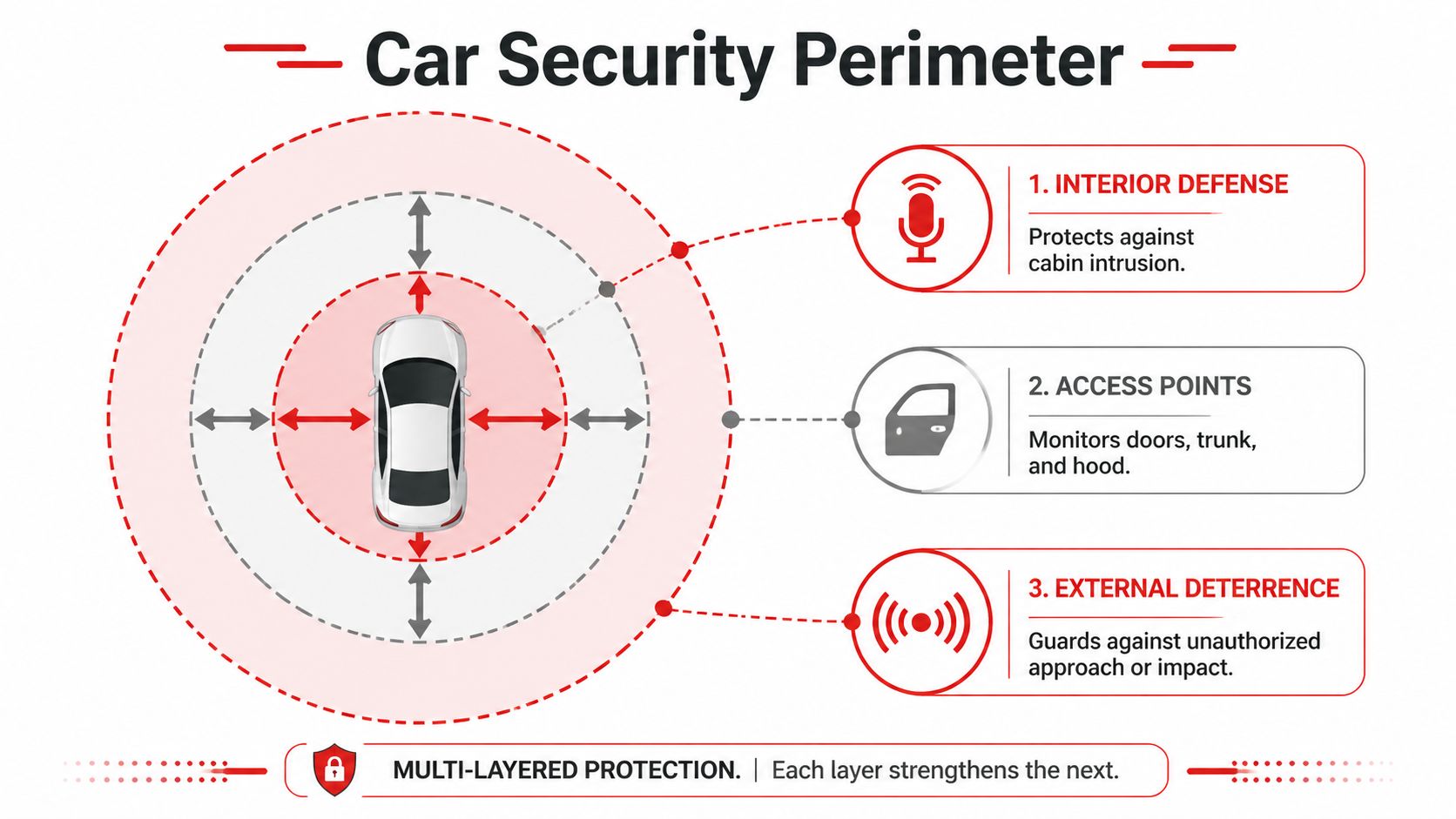
The three layers around your vehicle
Think of your car like a castle with rings of defense.
The outer layer watches for approach, impact, or suspicious disturbance near the vehicle, encompassing proximity-style sensing, impact sensing, and some vibration detection. These sensors don't always prove a theft is happening, but they can tell you that something abnormal is starting.
The middle layer focuses on access points. Doors, hood, trunk, and windows are the obvious targets because thieves usually need an entry path before they can steal property inside the cabin or access critical vehicle parts. Central locking and door monitoring are fundamental here.
The inner layer protects the cabin itself. Interior motion or presence detection matters when someone gets inside without authorization, especially in vehicles that carry tools, bags, electronics, or other valuables.
What a car alarm sensor actually is
A car alarm sensor is a device that detects a physical condition linked to tampering, intrusion, or theft. It doesn't work alone. It feeds a signal into a larger security system, which may then sound an alarm, lock down the vehicle, record the event, or send a remote alert.
That distinction helps clear up a common misconception. The sensor is not the whole alarm. It's one input in a chain:
- Detection: The sensor notices an event.
- Interpretation: The control unit decides whether that event is normal or suspicious.
- Response: The system triggers a siren, notification, immobilizer, or tracking action.
Why layered thinking works better
A single sensor creates a single point of failure. Layered sensing covers more theft methods and reduces blind spots. A thief who avoids triggering one type of sensor may still trip another.
For example, someone may open a door without causing a major impact. A pure shock sensor may not react, but a door trigger will. A tow-away attempt may not involve forced entry at first, but a tilt or movement sensor can notice the car changing position.
A strong system protects the space around the car, the openings into the car, and the inside of the car.
Parking environment matters too. A driver who leaves a vehicle on a busy street deals with different risks than a driver who parks in a locked garage. If you're also thinking about situational habits around parking lots and low-visibility areas, these safety tips for Florida drivers are a useful companion to sensor-based security because behavior and technology work best together.
A broader car security system overview makes more sense once you see this perimeter model. You're not buying a gadget. You're deciding how many layers of warning you want between your vehicle and a thief.
A Deep Dive Into Common Car Alarm Sensor Types
Not all car alarm sensors "feel" the same kind of threat. Some are looking for impact. Others look for movement, angle changes, or the sound pattern of breaking glass. The easiest way to compare them is to ask four simple questions: What does the sensor notice, what threat is it best at detecting, what usually triggers it by mistake, and where does it fall short?
Shock and impact sensors
Shock sensors are the classic alarm trigger. They react when the car experiences a sudden physical hit. Think of them like a person who notices a sharp shove. A fist on the window, a kick to a door, or a hard strike to the body can trigger them.
They're useful because they can react early in a break-in. But they're blunt instruments. A passing truck, a slammed nearby door, or rough parking-lot contact can sometimes set them off if sensitivity is high.
Many systems use two-stage logic here. A lighter hit may generate a warning chirp, while a harder hit triggers the full alarm response. That setup helps, but calibration still matters.
Tilt and inclination sensors
Tilt sensors watch angle changes. If you've ever rotated your smartphone and watched the screen respond, you've already seen the basic idea. The sensor notices that the vehicle is no longer sitting at the same angle.
This matters for two common theft scenarios: towing and wheel theft. A criminal lifting one corner of the vehicle with a jack changes the vehicle's position before the car ever moves down the road.
Tilt sensors are less helpful for smash-and-grab break-ins. They're not designed to detect subtle cabin intrusion. Their strength is noticing that the whole vehicle is being lifted, loaded, or repositioned.
Glass-break and acoustic sensors
These sensors listen for sound signatures linked to shattered glass or forced entry noise. The microphone doesn't just react to any loud sound. Better versions are tuned for a pattern that resembles the acoustic profile of breaking automotive glass.
They're valuable for vehicles where window entry is a realistic threat, but they can be tricky in noisy environments. Thunder, construction noise, or nearby metallic crashes can complicate tuning if the system isn't well designed.
A common misunderstanding is assuming a glass-break sensor replaces impact sensing. It doesn't. A thief may pry, force, or enter in ways that don't create the exact acoustic event the sensor expects.
Proximity and microwave sensors
Proximity sensors create a bubble around the vehicle. If something enters that bubble, the system can issue a warning or trigger an alarm depending on how it's configured.
These can be useful on convertibles, vehicles with exposed cargo, or situations where you want early warning before someone touches the bodywork. But they also have one obvious weakness. Busy spaces create lots of harmless movement. Pedestrians, shopping carts, and close-passing traffic can all become a nuisance if the perimeter is too wide.
That makes them powerful in some settings and frustrating in others.
Pressure and interior sensing
Interior sensing looks for changes inside the cabin. Depending on system design, this may involve air pressure change, cabin motion, or presence detection. The basic idea is to notice that someone has entered the protected space.
These sensors help after the exterior barrier has been breached. If a thief gets a door open or enters through a broken window, interior sensing can provide the next layer of detection.
They're less useful if your main concern is tow-away theft or underbody part theft. They don't usually watch what's happening beneath the car or outside its shell.
Advanced vibration sensing
Vibration sensors deserve special attention because they're often confused with basic shock sensors. They aren't always the same thing.
According to CarLock's explanation of automotive motion and vibration sensing, modern vibration sensors in advanced alarm systems are calibrated to detect high-frequency vibrations associated with criminal activity, including the sound signatures of power tools used when thieves drill locks or cut off catalytic converters. The same source notes that multi-sensor approaches can reduce false alarms by 30 to 40 percent compared to single-sensor systems.
That difference matters. A basic shock sensor asks, "Was the car hit?" A more advanced vibration sensor can ask, "Does this vibration pattern resemble a tool attack?"
Key distinction: Shock sensing reacts to force. Advanced vibration sensing tries to recognize the character of the disturbance.
If you're evaluating devices that combine motion, vibration, and movement detection, it's worth reviewing specific device features for car security monitoring so you can separate broad marketing terms from actual sensing functions.
Comparison of Common Car Alarm Sensor Types
| Sensor Type | Detection Method | Best For Detecting | Common False Alarm Triggers |
|---|---|---|---|
| Shock or impact sensor | Sudden physical impact to the vehicle body | Kicks, strikes, forced impact on doors or windows | Heavy traffic vibration, nearby door slams, rough contact in parking areas |
| Tilt or inclination sensor | Change in vehicle angle or position | Towing, wheel theft, jacking | Parking on steep shifts, service lifting, uneven loading |
| Glass-break or acoustic sensor | Sound pattern linked to breaking glass | Window smash entry attempts | Loud metallic noise, construction sounds, some sharp environmental noises |
| Proximity or microwave sensor | Movement within a detection field around the vehicle | Unauthorized approach near the car | Pedestrians, close traffic, carts, crowded parking areas |
| Interior motion or pressure sensor | Movement or pressure-related change inside cabin space | Cabin intrusion after entry | Pets, open windows, environmental disturbance inside the cabin |
| Advanced vibration sensor | Pattern-based vibration detection, including tool-like signatures | Tampering, drilling, catalytic converter theft attempts | Poor calibration, complex environmental vibration near the vehicle |
How to Choose the Right Car Alarm Sensor Setup
The right setup starts with one honest question: what are you trying to stop? Many drivers buy based on feature lists, but protection works better when you choose sensors around risk.
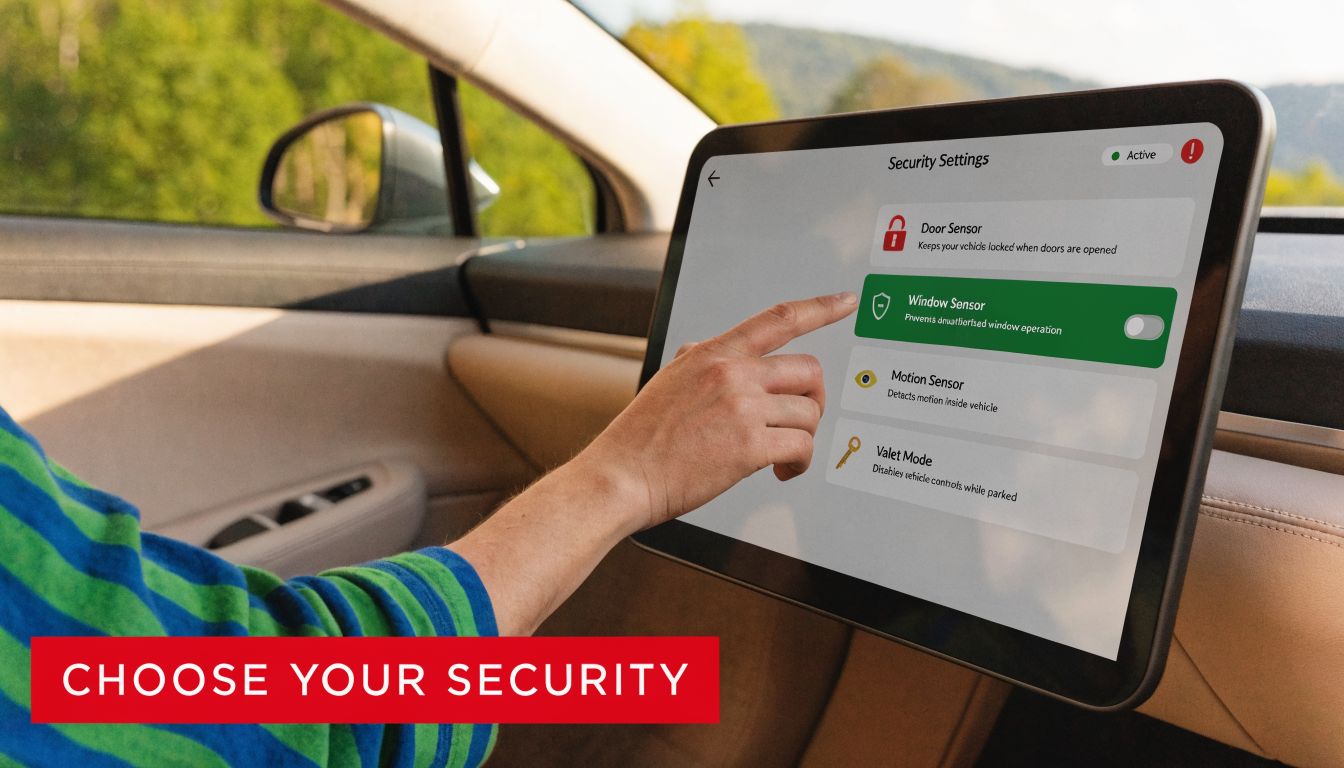
Start with your parking reality
A car that spends nights in a private garage doesn't need the same tuning as one parked on a busy curb. Street parking exposes the vehicle to more harmless vibration, more passersby, and more opportunities for tampering. A suburban driveway creates a different pattern. A public lot at work introduces another.
That's why "maximum sensitivity" is rarely the right answer. Better detection comes from matching the system to the environment, not from turning every setting to its highest level.
Match the sensors to the threat
Use your main risk to decide the first layer.
- If break-ins worry you most: Prioritize access-point monitoring and cabin intrusion detection.
- If wheel or tow theft is the bigger concern: Tilt and movement awareness matter more.
- If your area has frequent tampering or underbody theft concerns: Advanced vibration detection becomes more relevant.
- If you own a convertible or carry visible gear: Early-warning perimeter sensing may help.
Vehicle type matters too. A work truck carrying tools has different exposure than a compact commuter car. A collectible car that's rarely driven may need stronger movement and location awareness than a daily driver parked near its owner.
Don't ignore your tolerance for alerts
Some owners want the earliest possible warning and are willing to tune the system carefully. Others want fewer notifications and only care about serious events. Neither approach is wrong. But you should decide that up front.
A practical way to choose is to think in terms of response:
- What event do you want to know about immediately?
- What event is annoying but not urgent?
- What event can the system ignore?
That framework makes app settings and sensor thresholds much easier to manage.
The best setup isn't the one with the most sensors. It's the one you'll keep armed because it fits your real life.
If remote alerts matter to you, app behavior matters just as much as hardware. A look at mobile app features for vehicle alerts and monitoring can help you judge whether a system records events or tells you something useful in the moment.
Installation Basics and Troubleshooting False Alarms
The hardest part of owning a vehicle alarm system usually isn't buying it. It's living with it. A setup that constantly triggers for harmless reasons doesn't feel protective. It feels exhausting.
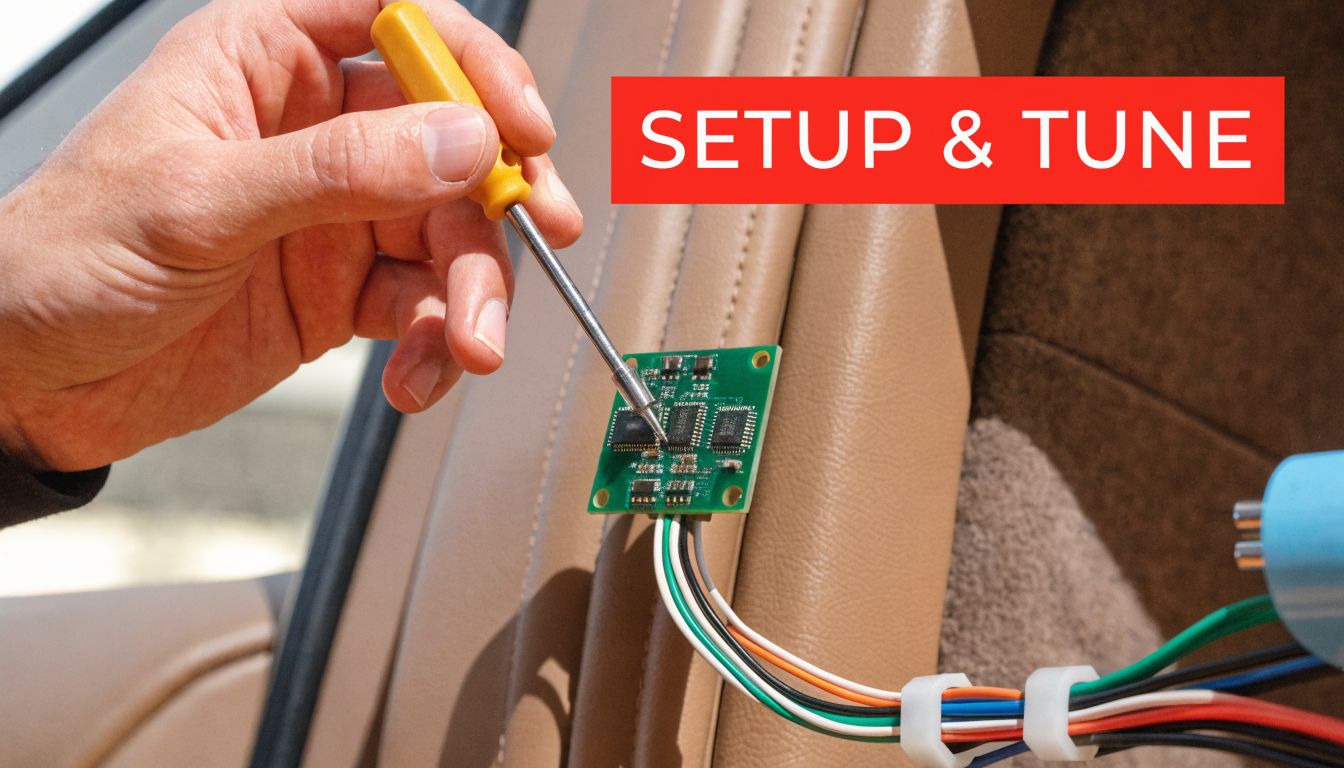
Simple installation versus hardwired installation
Some modern devices plug into the car's OBD-II port and start monitoring without cutting wires. Those are usually easier for ordinary drivers to install and remove. Traditional alarms often require hardwiring sensors, sirens, power connections, and control modules into the vehicle.
Neither approach is automatically better. Hardwired systems can be fully integrated. Plug-in systems are often simpler to deploy and easier to move between vehicles where appropriate. What matters most is whether the chosen setup is compatible with the car and installed cleanly.
Poor installation creates fake "sensor problems." Loose mounting, bad placement, and poor electrical connections can all mimic a bad sensor.
Why false alarms happen
Research cited by CarLock's guide to motion sensor calibration states that "false alarms are the leading cause of user frustration with car security systems." That's exactly right.
A sensor doesn't operate in a vacuum. It reacts inside a physical environment. A quiet garage, a windy driveway, and a downtown curb all produce different vibration, noise, and movement patterns. If you tune a system for one environment and then use it in another, you may get poor results.
Common causes include:
- Over-sensitive settings: The system treats ordinary disturbance as a threat.
- Bad sensor placement: Mounting points can amplify harmless vibration.
- Mixed environments: The car sleeps in one place but spends days in another with very different conditions.
- Incomplete testing: Owners arm the system without checking how it reacts to normal use.
A practical calibration routine
The same source recommends a methodical process: start with low sensitivity, test for normal activity, then gradually raise sensitivity while simulating suspicious behavior. That's better than random trial and error.
Use this sequence:
- Begin low: Set sensitivity conservatively, especially if the vehicle is parked outside or near regular traffic.
- Test normal events: Close the doors. Walk around the car. Let a nearby vehicle pass if that's common in your area. Confirm the system stays calm.
- Simulate minor tampering: Try gentle rocking or light disturbance that shouldn't trigger a full response unless the system is intended to be very aggressive.
- Increase gradually: Raise sensitivity one step at a time rather than making a large jump.
- Test a realistic threat: Simulate a more suspicious action such as stronger jostling or repeated tampering.
- Repeat by location: If you park in multiple places, test in the setting that causes the most nuisance activity.
Tune for the noisiest place you regularly park, not the quietest place you wish you always used.
A short visual walkthrough can help if you're trying to picture the process in practice:
When to troubleshoot and when to rethink the setup
If false alarms continue after careful calibration, don't just keep lowering sensitivity until the system becomes useless. Revisit the sensor mix itself. A different parking environment may call for a different combination of sensors, or for a connected system that sends alerts rather than relying only on public siren noise.
For basic ownership questions, compatibility concerns, and setup expectations, a vehicle security FAQ page is often more useful than generic forum advice because it keeps you focused on actual operating conditions instead of guesses.
Traditional Sensors vs Modern GPS Tracking Systems
A traditional alarm has one core idea: detect a problem locally and make noise nearby. That still has value. It can startle a thief, attract attention, and mark the vehicle as protected. But it also has a built-in weakness. The person who most needs the warning, the owner, may be nowhere close enough to hear it.
The limit of local-only alarms
This limitation becomes more obvious as more vehicles use sensor-based protection. According to SNS Insider's car alarm system market analysis, the global car alarm system market was valued at USD 15.40 billion in 2023 and is forecast to reach USD 42.08 billion by 2032. The same source says growth is being driven by rising vehicle thefts, including over 1 million vehicles stolen in the United States alone in 2022, along with increased adoption of GPS-enabled trackers and connected alarms.
That sentence tells the story clearly. The industry isn't moving away from sensors. It's building on them.
A traditional sensor answers one question: "Did something happen?" A connected GPS system adds two more: "Where is the vehicle?" and "Can the owner act on this now?"
Why direct alerts change the value of detection
A siren creates a public event. A connected system creates a private, actionable alert. That's a big difference.
If your car is parked several blocks away, inside a garage structure, or at the airport, a horn doesn't help much. A smartphone alert does. You know there was vibration, unauthorized movement, or engine activity, and you can respond based on the event rather than hoping a bystander cares.
This is also why GPS matters alongside sensors. Detection without location can leave you informed but stuck. Location without detection can leave you reactive rather than early. Combined, they shift security from passive noise to active monitoring.
Sensors are still the foundation
Connected systems don't replace car alarm sensors. They depend on them. Motion, vibration, entry, and movement events are still the raw input. The difference is that a connected platform adds a communication layer and a decision layer on top of that foundation.
One example is CARLOCK, which combines vehicle monitoring with smartphone alerts based on events such as vibration, engine start, and vehicle movement. That's a different security model from a siren-only alarm because the system is designed to tell the owner directly when something suspicious happens.
If you're comparing this broader category, GM GROUP Services' GPS insights offer a useful outside perspective on how GPS-based monitoring changes response time and visibility compared with local-only security tools.
A loud alarm asks strangers to care. A connected alert asks the owner to decide.
That doesn't make traditional alarms obsolete. It means they're often incomplete on their own, especially for owners who park out of earshot, manage multiple vehicles, or need confirmation that an event occurred in real time.
Who Benefits Most from Advanced Security
The value of advanced security becomes clearer when you stop looking at features and start looking at people.
The parent with a new teenage driver
A parent hands over the keys and immediately loses one thing: visibility. They can't sit in the passenger seat every time the car leaves the driveway. A basic alarm helps only when the parked car is disturbed. It doesn't say much about unusual movement, late-night use, or suspicious activity around the vehicle when the teen is away from home.
A connected setup changes the conversation. The parent gets an alert if the vehicle starts moving unexpectedly or if there's tampering while it's parked. The system becomes less about punishment and more about awareness.
The fleet manager after business hours
A fleet manager doesn't have one car to worry about. They have several, often parked in different places and used by different people. A local siren on a vehicle in a far corner of a lot isn't much of a management tool.
What they need is notice. If a van moves outside approved hours, if vibration suggests tampering, or if a vehicle starts when nobody should be using it, they can act. In that setting, advanced security isn't just anti-theft equipment. It's operational visibility.
The owner of a high-value or seldom-driven car
Classic cars, luxury vehicles, project cars, and collector vehicles create a unique problem. They may spend long periods parked, which means theft or tampering can go unnoticed if the owner isn't physically nearby. They may also attract more deliberate attention than ordinary commuter cars.
For that owner, an early vibration alert matters because it can arrive before the event becomes a full theft. A movement alert matters because the vehicle shouldn't be moving at all without a clear reason. And a location function matters because recovery depends on knowing where the car is.
Security feels different when the system reports a problem to you instead of only reacting at the vehicle.
These aren't edge cases. They're everyday examples of why modern vehicle security has moved toward direct notification and actionable data instead of relying only on noise and luck.
The Future of Your Vehicle's Security
The humble car alarm sensor has become much more than a trigger for a siren. It now serves as the sensing layer in a broader security system that can watch for impact, entry, lifting, vibration, and unauthorized movement.
That's the key shift. Older systems were mostly reactive and local. Newer systems are increasingly intelligent and connected. They still depend on sensors, but they don't stop at detection. They pass useful information to the owner in real time.
If you're deciding how to protect your vehicle, don't focus only on whether an alarm will sound. Ask whether the system detects the threats that matter in your parking environment, whether it can be calibrated to avoid constant false alarms, and whether it tells you something you can act on.
A siren still has a role. But in practice, a silent alert on your phone is often more useful than a loud alarm that everyone nearby ignores.
If you want to move beyond noise-based protection, CARLOCK offers a connected approach that monitors vehicle events and sends alerts to your smartphone, giving you a practical way to respond when your car alarm sensor detects something unusual.