

Driver’s Desk
Modern Alarm System on Car: Your 2026 Protection Guide
In 2025, analysts valued the global car security system market in the billions, with steady growth projected through 2034. The growth points to a clear shift in what buyers want. Drivers are no longer paying only for a siren. They are paying for immobilizers, motion and entry sensors, phone alerts, and tools that improve the odds of recovery after a theft.
That change happened for a reason. Traditional alarms were built around deterrence. Make enough noise and hope the thief backs off. In real use, that approach has limits. People ignore sirens, false alarms train neighbors to tune them out, and a loud alert does nothing once a vehicle is already moving.
A better question for anyone shopping for an alarm system on car protection in 2026 is simple. What happens after the first suspicious event?
The systems worth considering now do more than sound off. They detect movement, unauthorized starts, towing, or impact, then send that information directly to the owner. Some also add location visibility through car tracking tools for theft alerts and location monitoring, which changes the goal from pure deterrence to monitoring and recovery.
That distinction matters in practice. A siren may stop a casual break-in. A connected security system gives you a chance to respond fast, verify what happened, and track the vehicle if the first layer fails.
Why Your Car Needs More Than Just a Loud Noise
The worst moment in vehicle security isn't hearing an alarm. It's walking back to where you parked and seeing an empty space.
Most drivers know the old pattern. A siren goes off somewhere nearby, nobody looks up, and life continues. That's exactly why basic alarms lost so much practical value. A loud alert can still scare off a casual thief, but it does very little if nobody connected to the vehicle gets useful information.
That's the key shift. Modern security is about actionable awareness. If a vehicle moves, gets bumped, starts unexpectedly, or gets towed, the owner needs a direct alert, not just a sound for strangers to ignore. That's why more owners now look for systems that combine an alarm with tracking and live notifications, such as dedicated car tracking tools for theft alerts and location monitoring.
What owners actually need now
A practical setup should answer four questions fast:
- Was the event real: Was it door access, movement, vibration, towing, or an engine start?
- Did I get notified directly: A phone alert matters more than hoping a bystander reacts.
- Can I see where the vehicle is: If the thief gets past the deterrent layer, recovery becomes the next priority.
- Can the system keep reporting after the first trigger: One alert without follow-up location data leaves a big gap.
Practical rule: A siren is a deterrent. A security system should also tell you what happened and what to do next.
That's why an alarm system on car protection needs to be judged as a full security workflow, not a single noise event. Owners who still think in terms of “alarm equals protection” usually find out too late that deterrence and recovery are not the same thing.
The Evolution from Audible Alarms to Immobilizers
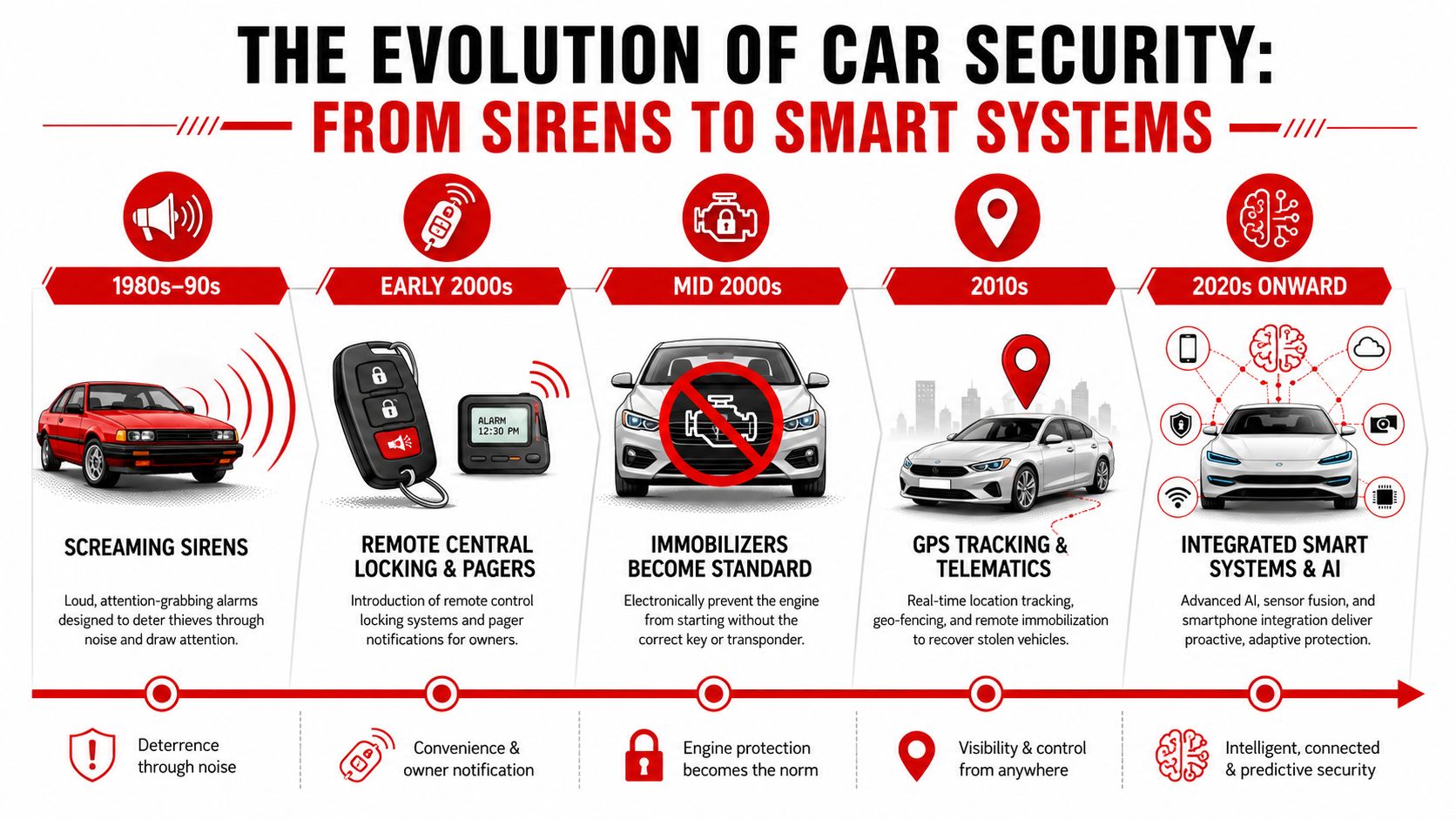
Car alarms became common in the 1980s and 1990s, when the main idea was simple: trigger a loud noise and attract attention. In practice, that approach ran into a predictable problem. Too many alarms went off when no crime was happening.
By 1994, the New York City Police Department argued that car alarms had become so ineffective from false alarms that people stopped reacting to them, according to the historical summary on Wikipedia's car alarm entry. That same summary notes the industry's next move: manufacturers shifted more attention to silent immobilizers because skilled thieves could bypass audible alarms quickly.
Why the old model broke down
A classic siren-based alarm had three weaknesses.
- False triggers were common: High sensitivity meant wind, vibration, or minor bumps could set it off.
- The response depended on strangers: If nearby people ignored it, the alarm had little force.
- Experienced thieves adapted: Once criminals knew the pattern, they worked around it.
That doesn't mean old alarms were useless. They were an important stage in vehicle security. They taught the industry that noise alone isn't a complete defense.
Why immobilizers changed the game
An immobilizer doesn't care whether anyone is listening. Its job is to stop the vehicle from starting without the correct key or signal. That's a different kind of protection. It's passive, usually silent, and focused on prevention rather than public attention.
For many drivers, that was the first major improvement over a basic alarm system on car setups. It moved security from “announce the theft attempt” to “make the theft harder to complete.”
Still, immobilizers have limits. They're strong on prevention but weak on visibility after the fact. If the vehicle is moved in another way, or if the event involves tampering that doesn't require a normal start sequence, you still need better awareness around the car. That's where integrated systems described on modern car security system pages fit the current market.
Silent protection works better than loud protection when the real goal is stopping the vehicle from leaving.
Decoding Modern Car Security System Types
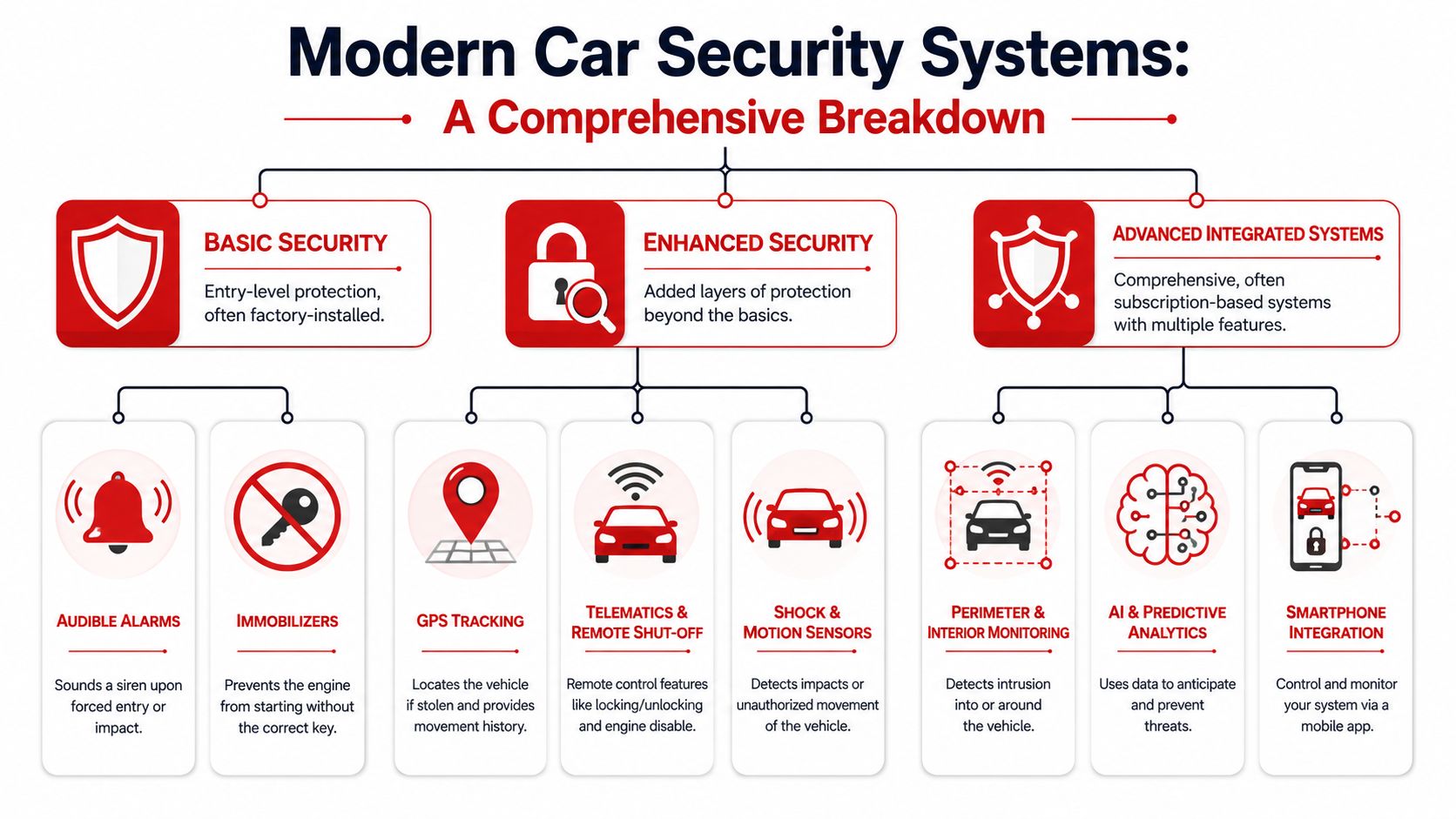
Today's market is crowded because “car alarm” now covers several different tools. Some are deterrents. Some are monitoring tools. Some are recovery tools. They're not interchangeable.
Advanced alarms with two-way alerts
A modern aftermarket alarm usually includes a control module, security sensors, and a siren, with optional starter-kill, two-way remotes, or smartphone connectivity. The key technical improvement is direct owner communication. A two-way system doesn't just make noise at the car. It also tells the owner that something happened. Compustar's overview of car alarm features and two-way notification explains why this matters: direct notification is more actionable than relying on someone nearby to hear a siren.
That changes response time in practice. If you know immediately that your car is being disturbed, you can check the app, call someone nearby, contact authorities, or move into recovery mode.
A quick visual overview helps if you're comparing feature stacks:
Bluetooth finders versus GPS trackers
Many buyers tend to get confused.
A Bluetooth item finder works more like a lost-and-found tool. It's useful for objects, especially when other phones in the network happen to be nearby. But a car isn't a set of keys. Vehicle theft often involves movement across areas where that passive phone network may not help when you need it most.
A dedicated GPS and cellular tracker is different. It's built for continuous vehicle monitoring and location reporting. Independent consumer guidance on choosing the right car alarm features and GPS benefits notes that GPS-enabled alarms can help locate a stolen vehicle and continue reporting location after the original trigger event.
If you're also worried about relay attacks and smart-key vulnerabilities, this guide on preventing keyless car theft is worth reading because it addresses a threat category that sirens alone don't solve well.
Sensor choice matters more than most buyers realize
Not all sensors detect the same threat.
According to CarLock's article on motion sensors and modern vehicle monitoring, tilt sensors are important for detecting a car being lifted for towing or wheel theft, while advanced motion sensors can monitor suspicious activity around a parked vehicle more effectively than a simple shock sensor.
A practical breakdown looks like this:
- Shock sensor: Good for impacts or forced contact. Can also produce nuisance alerts if set too aggressively.
- Tilt sensor: Useful when thieves jack up the vehicle, steal wheels, or tow it.
- Motion sensor: Better for monitoring movement around or inside the vehicle.
- Engine-start alerting: Important when the threat is unauthorized use, not just break-in damage.
The best alarm system on car protection matches the sensor to the theft method, not just the product brochure.
Feature Comparison What Really Protects Your Vehicle
The easiest way to compare systems is to judge them against what happens during theft. Does the system discourage the attempt? Detect it quickly? Tell you directly? Help recover the vehicle afterward?
Here's a practical decision table.
Car Security System Feature Comparison
| Feature | Basic Audible Alarm | Engine Immobilizer | Bluetooth Tracker (e.g. AirTag) | Connected GPS System (e.g. CarLock) |
|---|---|---|---|---|
| Theft deterrence | Moderate for opportunistic theft | Strong against unauthorized starting | Low as a visible deterrent | Strong when paired with alerts and sensors |
| Theft detection | Basic, usually after intrusion | Limited by itself | Limited | Strong, especially with movement and start alerts |
| Post-theft recovery | Weak | Weak | Situational | Strong |
| Real-time alerts | Usually local only | Usually none | Limited | Direct to owner |
| False alarm control | Can be an issue if poorly tuned | High, because it's passive | Not an alarm tool | Better when based on event-specific monitoring |
| Towing or lift detection | Only if paired with proper sensors | No | No | Possible with the right sensor setup |
| Driver monitoring | No | No | No | Yes, in many connected systems |
| Best use case | Basic deterrence | Theft prevention at start | Item finding | Monitoring plus recovery |
Why direct alerts matter most
The biggest line in that table is real-time alerts. If the system can communicate directly with you, the event becomes actionable. That's the practical advantage of connected security. You're not hoping someone hears a siren. You know the vehicle was moved, started, or tampered with.
This is also why feature pages for connected GPS security devices and alert functions deserve more attention than spec sheets that focus only on siren volume.
What each option does well, and where it falls short
- Basic audible alarm: Still useful as a first layer. It may discourage a hurried thief. It won't tell you where the car is after it's gone.
- Immobilizer: Excellent when the theft depends on starting the engine normally. It's less useful for recovery.
- Bluetooth tracker: Better than nothing for casual location checks, but it isn't purpose-built as an active vehicle security system.
- Connected GPS system: Best suited to owners who care about both suspicious activity alerts and post-theft visibility.
A deterrent tries to stop the thief before the car leaves. A recovery tool matters after the thief ignores the deterrent.
For most real-world owners, the strongest setup is layered. Visible deterrence, passive prevention, and direct reporting each solve a different problem. Relying on one alone creates blind spots.
How to Choose the Right System for You
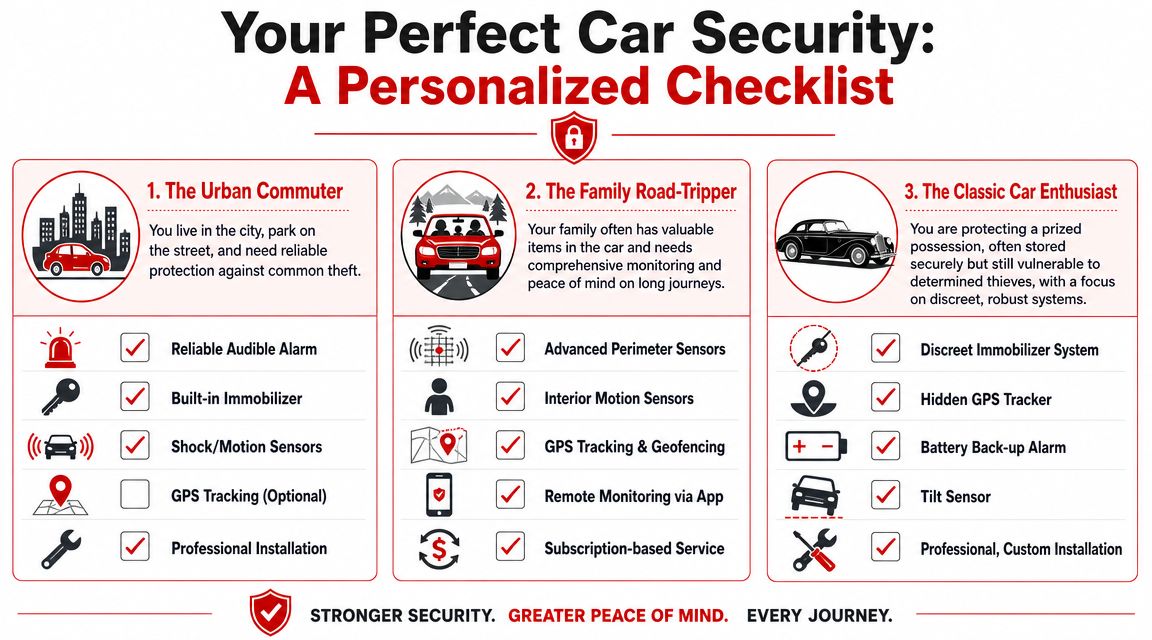
The right setup depends less on the car's sticker price than on how the vehicle is used, where it's parked, and who drives it. That's where buyers often go wrong. They shop by feature list instead of risk pattern.
The clearest dividing line is this: traditional alarms are deterrents, while GPS tracking systems are recovery tools, and an effective setup usually combines both ideas, as discussed in GPX's piece on the difference between deterrence and recovery in anti-theft devices.
The concerned parent
A parent of a teen driver usually has two worries at once. One is theft. The other is how the car is being used.
In that situation, a plain siren doesn't provide much value beyond basic deterrence. A connected system that logs trips, reports movement, and sends alerts on unusual driving behavior is often the more useful fit. That's because the security question and the supervision question overlap.
Features to prioritize:
- Movement alerts: Helpful when the vehicle moves at unexpected times.
- Trip history: Useful when you need to verify where the car went.
- Driving event visibility: Hard braking or harsh acceleration can matter as much as theft prevention.
- Geographic boundaries: A system with location-based awareness can support house rules and fast follow-up.
For buyers comparing options, this car security FAQ resource is helpful because it deals with the practical questions owners usually ask before choosing a connected setup.
The small business fleet manager
Fleet theft isn't the only problem. Unauthorized use, route drift, towing, and after-hours movement can all create losses.
A fleet manager needs consistency more than drama. That usually means direct alerts, location visibility, and records that don't depend on a driver noticing anything. In this category, CARLOCK is one example of a system designed for real-time movement alerts, engine-start notifications, towing or vibration detection, and trip tracking. That kind of setup fits businesses that want both anti-theft protection and day-to-day visibility.
The everyday commuter in an urban area
Street parking changes the threat model. The issue may be break-ins, wheel theft, towing, or quiet electronic attacks rather than a dramatic smash-and-grab.
For that owner, I'd look for a layered setup built around:
- An audible alarm for visible deterrence.
- An immobilizer for passive theft prevention.
- Tilt or motion sensing for towing and parts theft.
- A connected tracking layer if recovery matters.
No single feature covers all of those scenarios. That's why the best alarm system on car strategy isn't about one perfect gadget. It's about covering the failure points of the other layers.
Installation Costs and Subscription Models
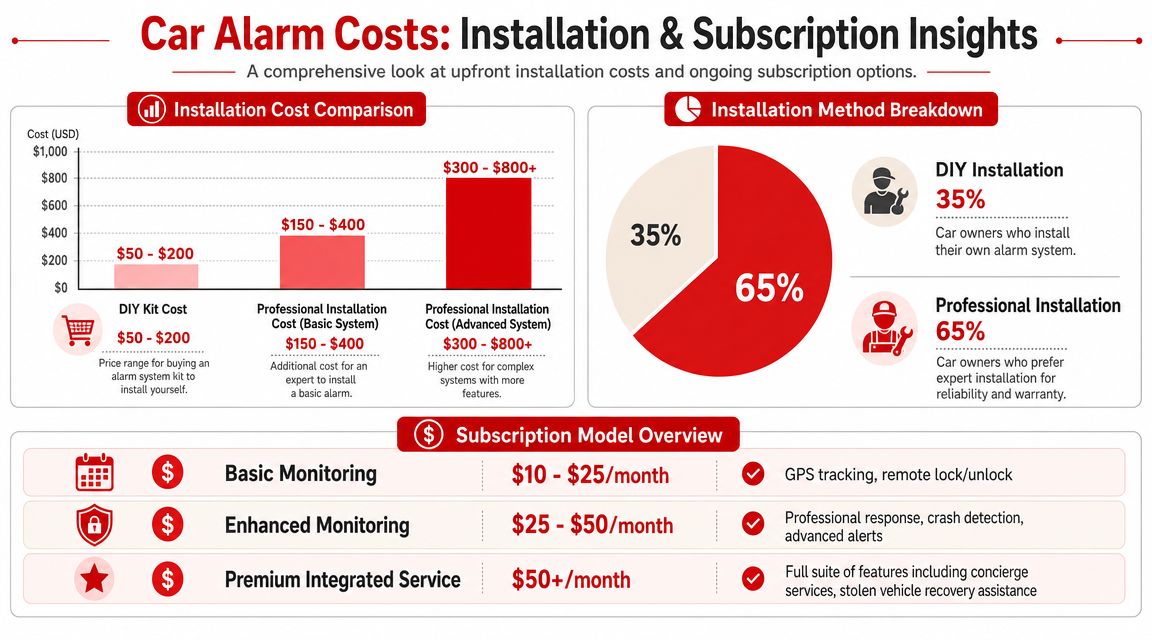
Car alarm pricing only makes sense when you separate deterrence from monitoring. A siren-only setup is usually a one-time hardware purchase. A connected system adds an ongoing service because it has to send alerts, process data, and keep location history available when something goes wrong.
DIY versus professional installation
Installation cost depends less on the box itself and more on how thoroughly the system ties into the vehicle.
- DIY plug-in devices: These fit owners who want a fast setup, minimal labor cost, and the option to move the device between vehicles.
- Professional installations: These suit hidden modules, hardwired power, starter-disable functions, glass-break or tilt sensors, and vehicles where concealment matters.
I usually advise owners to be honest about the threat they are trying to address. If the goal is basic visibility and movement alerts, DIY can be enough. If the goal is to slow a thief down, hide the hardware, and reduce installation mistakes that create battery or wiring problems later, professional work is usually money well spent.
A poor install can undermine an otherwise good system.
Why subscription plans exist
Monthly fees make sense once a system shifts from making noise to reporting events. Cellular data, cloud storage, push alerts, and app access all carry ongoing costs. That service layer is what turns a theft attempt into an immediate notification and, in some cases, a realistic recovery effort.
That difference matters in practice. A one-time alarm may scare off an opportunist. A connected system gives you a record of movement, location data, and alerts if the vehicle is towed, started, or moved without permission.
If you want a clear example of what owners are paying for, review these cloud vehicle tracking and alert features.
What the price really buys
Older alarm pricing was easy to understand because you were buying hardware and installation. Modern pricing is split between hardware, labor, and service. That can frustrate buyers at first, but it reflects a genuine change in what the product does.
As noted earlier, analysts project steady growth in the car security market over the next several years. That demand is being driven by owners who want more than a horn and flashing lights. They want to know the moment something happens, and they want a better chance of finding the vehicle if deterrence fails.
Frequently Asked Questions About Car Alarms
Will a modern car alarm drain my battery
It can if the system is poorly installed or poorly designed, but that's not how most current systems are intended to operate. A well-built vehicle security device should use power carefully and monitor the vehicle without creating constant battery strain.
The practical rule is simple. Choose hardware designed for vehicle use, and if you're adding a more complex alarm system on car wiring, don't cut corners on installation quality.
Are modern alarms effective against keyless theft
They can help, but it depends on the type of system. A siren alone won't solve a relay or electronic theft problem. What helps more is a layered setup that can still alert you when the vehicle moves or starts unexpectedly.
That's one reason many owners now combine passive protection with active monitoring. The first layer tries to block the theft. The second layer tells you immediately if the first layer was defeated.
Can I just use a Bluetooth tag to protect my car
You can place one in a car, but that doesn't make it a dedicated vehicle security system. Bluetooth tags are better thought of as item-finding tools. They don't replace purpose-built monitoring, direct event alerts, or continuous tracking designed around theft and recovery.
For a vehicle, the standard should be higher than “I might see it later.” You want to know that something happened, and you want a way to follow up quickly.
Are car alarms still worth installing
Yes, but not as a standalone answer. A modern car alarm still has value as part of a layered setup because visible and audible deterrence can push some thieves away. The mistake is expecting the alarm by itself to handle detection, response, and recovery.
That's the key distinction smart buyers should keep in mind. Noise may deter. Monitoring and tracking create options after deterrence fails.
If you want an alarm system on car setup that goes beyond a siren, CARLOCK is built around real-time GPS tracking, smartphone alerts for movement and engine starts, towing and vibration detection, trip history, and tamper notifications. It fits owners who want direct alerts and recovery visibility, not just noise after the fact.