


Driver’s Desk
Advanced Car Security with Suspicious Activity Detection
You park at the far end of a dim lot because it's the only space left. You lock the doors, walk away, and do that small double-check every driver knows. Did it beep? Did the mirrors fold? Did anyone just notice the car?
That uneasy feeling is why car security matters. But for a lot of drivers, the old answer was a loud siren that might go off for no good reason and get ignored by everyone nearby. Noise doesn't tell you much. It doesn't tell you whether someone bumped the bumper, started towing the car, opened a door, or unplugged the security device itself.
Modern suspicious activity detection changes the job of vehicle security. Instead of shouting into the parking lot, it monitors for patterns that matter and sends information to the person who can act on it. You. If you've ever wondered why a smart car alarm system feels more useful than a traditional alarm, this is the reason. Good security today is less about making a scene and more about getting the right alert at the right moment.
Beyond the Blaring Siren An Introduction
A parked car is vulnerable in ways people often underestimate. Theft is the obvious concern, but it's not the only one. A tow truck can move a vehicle without ever opening a door. A thief can test the handle, jack up the car, or tamper with a device before the engine ever starts.
Traditional alarms treat many of these moments badly. They often react late, and when they do react, they produce the same blunt signal for everything. A hard rainstorm, a passing truck, or an actual break-in can all sound the same to the neighborhood.
A useful alert answers a question. What happened, where did it happen, and do you need to respond now?
That's the fundamental shift behind suspicious activity detection. It turns car security from a simple trigger into an observation system. Instead of asking, “Did the siren go off?” you start asking better questions. Was the car moved? Was the ignition turned on? Was there repeated vibration that suggests tampering?
For a concerned owner, that distinction matters because it changes your role from helpless listener to informed decision-maker. If your phone tells you the car moved while it should be parked, you know that's not random noise. If it tells you the engine started unexpectedly, you know the event deserves attention. Security becomes less emotional and more actionable.
What Is Suspicious Activity for a Vehicle
When people hear suspicious activity detection, they often imagine a vague AI system looking for “something unusual.” That's too abstract to be useful. For a vehicle, suspicious activity is easier to understand when you break it into specific events that can be sensed and checked.
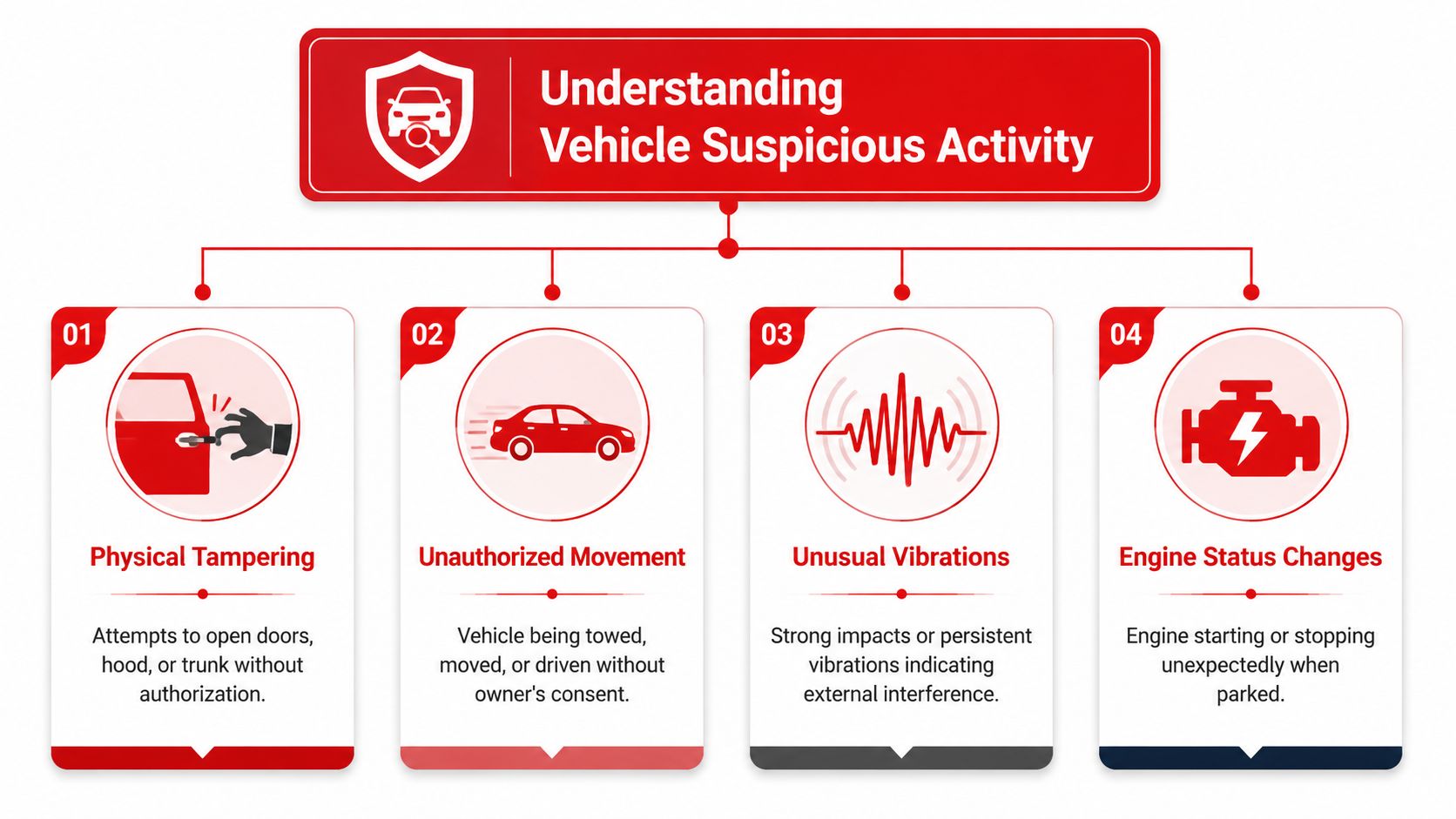
Physical tampering
This includes attempts to open a door, hood, or trunk without permission, or signs that someone is interfering with the vehicle. It can also include efforts to unplug a monitoring device or cut off its access.
Tampering matters because many thefts start small. A person may test entry points first, check whether the car is protected, or try to disable tracking before moving the vehicle.
Unauthorized movement
A parked car shouldn't drift across a map on its own. If it starts moving when you didn't authorize it, that's one of the clearest suspicious signals.
This can mean towing, pushing, rolling, or driving. A system tied to real-time vehicle tracking doesn't just note that movement happened. It helps show whether the car left the place where it should still be.
Unusual vibrations
Vibration sounds minor until you think about what causes it. A thief prying a door, a jack lifting the frame for wheel theft, or repeated impact against the body can all create motion patterns that don't look like normal parking conditions.
The key word is unusual. Cars experience harmless bumps all the time. The challenge is noticing the difference between background disturbance and a pattern that suggests interference.
Engine status changes
An engine starting while your car is supposed to be parked is a major event. So is an unexpected ignition change that doesn't match your own use.
This type of alert is valuable because it catches a different stage of theft risk. By the time a loud alarm reacts, the vehicle may already be in motion. Engine-related monitoring can surface a problem earlier.
At a glance: suspicious activity around a vehicle usually falls into four practical buckets: tampering, movement, vibration, and engine changes.
That framework helps take the mystery out of the term. It's not about a machine guessing your feelings. It's about a system watching for concrete signals that often appear before theft, break-ins, towing, or unauthorized use.
The Technology Behind Instant Alerts
A smart vehicle security system works like a very attentive co-driver that never looks away. It listens to movement, orientation, and location all at once, then decides whether those signals add up to something routine or something worth your attention.
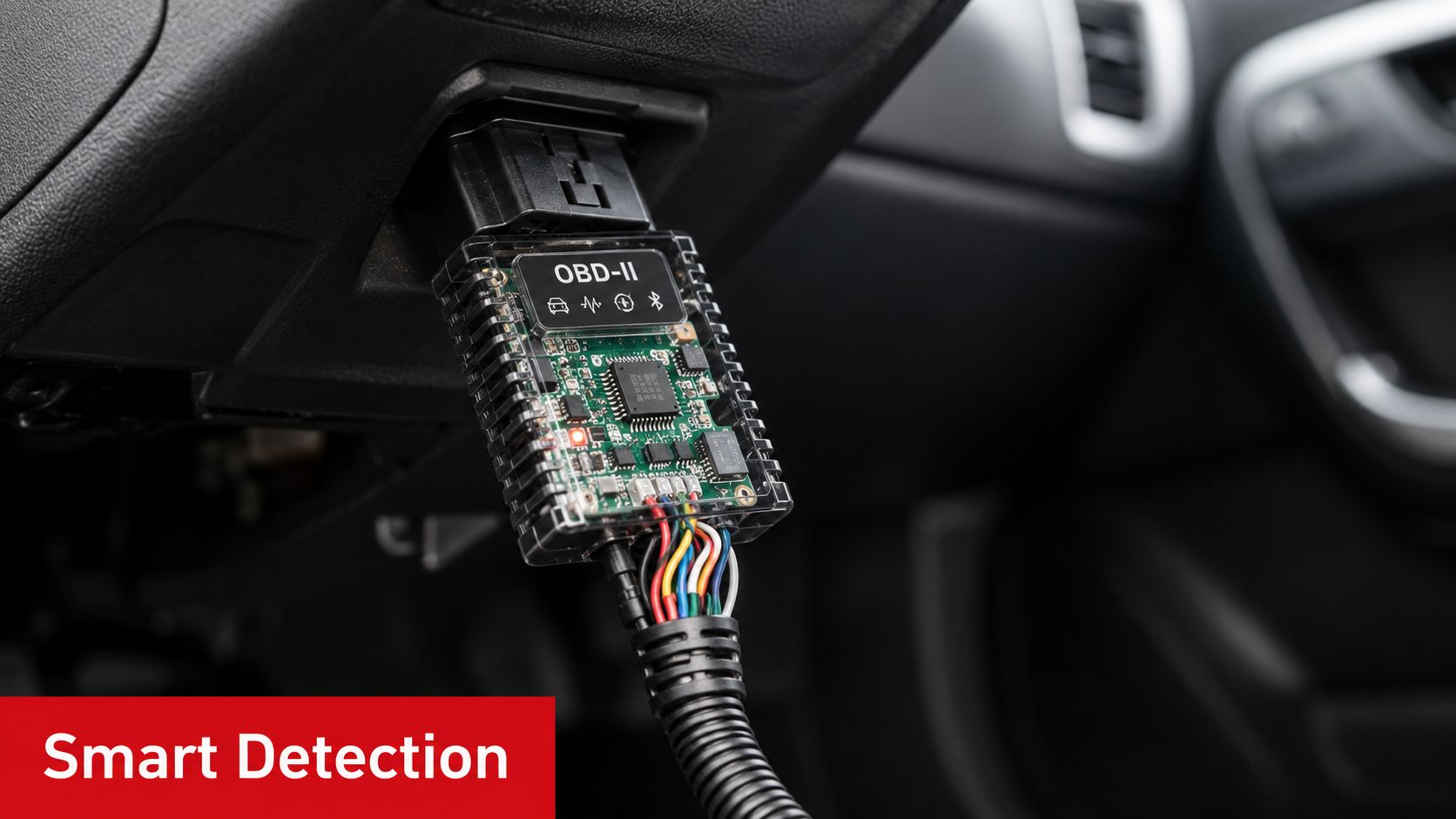
Sensors act like the car's senses
An accelerometer measures changes in motion. Think of it as the part of the system that feels jolts, starts, stops, and impacts. If someone bumps the car hard enough or begins towing it, the accelerometer notices that physical change.
A gyroscope adds orientation. If the car tilts because someone is lifting it with a jack, or shifts angle in a way that doesn't match normal parking, the gyroscope helps capture that. It's similar to your inner ear telling you when your body leans or turns.
A GPS receiver answers the location question. It doesn't care whether the motion came from driving, towing, or rolling downhill. It reports that the vehicle's position changed. In a connected setup with cloud-based GPS tracking features, that location data becomes part of a live security picture rather than a static breadcrumb trail.
Algorithms decide whether the event matters
Sensors alone are noisy. A passing truck can shake the ground. A rough parking garage can create odd echoes. Wind, road vibration, or a door slammed nearby can all create motion that looks dramatic in raw data.
That's why the second half of the job belongs to algorithms. They compare multiple signals at once instead of trusting one event in isolation. A brief vibration with no location change may be harmless. Vibration followed by tilt and then movement is a different story.
A useful analogy is a smoke detector that also checks heat and air flow before sounding the alarm. One signal can mislead. Several aligned signals are far more convincing.
Speed matters because delay matters
Research on AI-based suspicious activity detection using data fusion found that a decision tree model reached 98.867% classification accuracy with 0.005 ms per-sample prediction speed, which helps explain how security systems can surface alerts almost immediately after unusual events begin (study on data-fusion suspicious-activity detection).
That matters for vehicles because timing changes what you can do. An alert that arrives while a tow begins is different from a notification that shows up after the car is already gone. Fast analysis lets the system move from “recording what happened” to “warning you while it's happening.”
Practical rule: the best security systems don't react to a single twitch. They compare motion, orientation, and location together.
Another strand of research helps explain why sequence matters. A CSUSB study on video-based suspicious behavior detection used an LRCN model and reported 86% accuracy, drawing on 600 frames of walking and running plus 100 training videos. Its key point was that temporal information matters because behavior makes more sense over time than in isolated snapshots (CSUSB research on temporal suspicious-activity classification).
That same idea applies to cars. One bump is just one bump. A pattern over several moments tells a richer story. Systems get smarter when they evaluate not only what happened, but also what happened just before and just after it.
How CarLock Implements Smart Detection
Turning all of that theory into something usable comes down to system design. The device has to sense the event, the network has to carry the signal, and the app has to present the alert in a way that helps a real person respond quickly.
A vehicle-focused device also has to live with the realities of daily driving. It can't be so sensitive that every environmental shake becomes a panic notification, and it can't be so relaxed that meaningful events slip through.
For a concrete example, CarLock's device features are built around vehicle-specific monitoring such as unauthorized movement, engine starts, unusual vibration, device tampering, and battery-related alerts. That makes suspicious activity detection feel practical instead of abstract, because the system is tuned to the kinds of events car owners worry about.
A phone alert makes the whole chain visible.
What the full loop looks like
The process is simple from the driver's point of view:
- The device detects an event. Motion, ignition status, or tampering creates a signal.
- The system evaluates context. It checks whether the event fits an expected pattern.
- The app delivers the alert. You receive information on your phone instead of hoping someone nearby hears a siren.
That last step is where modern security feels different. The system isn't only making noise. It's creating awareness.
Here's a side-by-side view of how different approaches handle the same job.
Vehicle Security Methods Compared
| Feature | CarLock System | Traditional Car Alarm | Bluetooth Tracker (e.g., AirTag) |
|---|---|---|---|
| Suspicious activity alerts | Yes, focused on vehicle events such as movement, vibration, ignition, and tampering | Limited, usually audible alarm behavior | Not built for vehicle-specific threat detection |
| How you're informed | Smartphone notifications | Nearby siren or horn | Location updates depend on nearby devices |
| Vehicle movement awareness | Designed to monitor vehicle movement | Often reacts only after stronger triggers | Primarily for finding items, not monitoring security events |
| Tracking approach | GPS and cellular connectivity | Usually no live tracking | Bluetooth-based finding network |
| Anti-tampering awareness | Can alert if the device is disconnected | Typically no device-level tamper notice | Not purpose-built for vehicle tamper monitoring |
| Fit for parked-car security | Built for active monitoring | Reactive deterrent | Limited for this use case |
A short product demo helps make that flow easier to picture in real life.
The main lesson isn't just that one device has more features than another. It's that suspicious activity detection works best when tracking, sensing, and notification are designed as one connected system rather than separate pieces.
Tuning the System Reducing False Alarms
The biggest complaint people have about security technology isn't usually lack of alerts. It's too many bad alerts.
If your phone warns you every time a bus rattles the curb or a cat hops onto the hood, you stop trusting the system. That's dangerous, because the alert you ignore next week may be the one that matters.
Research on suspicious activity detection points directly at this problem. It highlights that reducing false alarms without missing real threats is a central challenge, and that what counts as suspicious is highly context-dependent. The same research notes the importance of site-specific tuning and confidence scoring so users get alerts that are actionable rather than overwhelming (review of false alarms and context in suspicious-activity systems).
Why context changes everything
A strong vibration in a quiet driveway at night means one thing. The same vibration in a crowded downtown garage during business hours may mean something else. Good systems don't pretend every parking environment is identical.
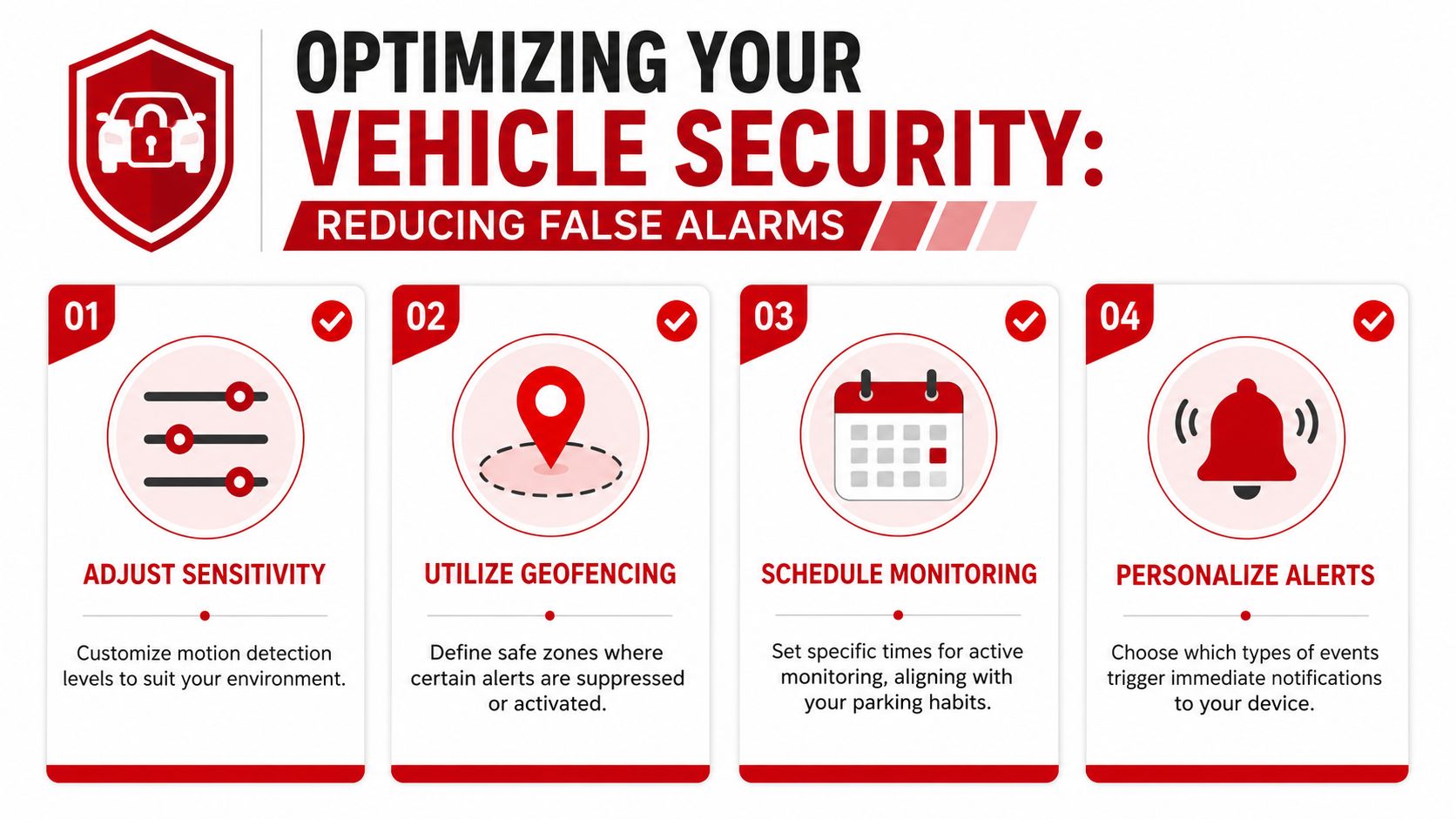
That's why tuning matters. Sensitivity, timing, location context, and alert preferences all shape whether a system feels smart or noisy.
“Suspicious” isn't a fixed property. It depends on where the vehicle is, what time it is, and what normally happens around it.
The same logic shows up in a different field too. If you want a plain-language example of how detection systems are judged in practice, this overview of the accuracy of AI video detectors is useful because it frames a familiar tradeoff. The tool has to identify meaningful patterns without overreacting to harmless edge cases.
What reduces unnecessary alerts
A well-tuned vehicle security setup usually relies on several control points rather than one hard threshold.
- Sensitivity settings: If your car is parked on a busy street, you may want stronger filtering for minor vibration than someone who parks in a private garage.
- Location awareness: Some owners treat home, work, and public parking differently because the expected background activity changes.
- Alert type selection: Not every event has to interrupt you in the same way. Critical alerts should feel different from informational updates.
- Hardware quality: Better sensors capture cleaner signals. Cleaner signals make smarter decisions possible.
A helpful way to think about this is noise-canceling headphones. They don't make the world silent. They separate the signal you care about from the background you don't.
What this looks like in daily use
Users often don't need a dashboard full of expert settings. They need a system that can adapt to their actual parking habits and notify them through an app when an event crosses the line from normal to concerning. That's where vehicle security app features become part of the security story, not just a convenience layer.
The goal isn't zero alerts. It's credible alerts. If your system interrupts you less often but with better reasons, you're more likely to respond quickly when something is wrong.
Suspicious Activity Detection in Your Daily Life
The value of suspicious activity detection becomes clearer when you stop thinking like an engineer and start thinking like an owner with a routine, a family, or a business to run.
A parent with a new teenage driver
A parent hands over the keys for school, practice, and part-time work, but the deeper worry isn't only theft. It's not knowing what's happening when the car is out of sight.
Harsh acceleration, hard braking, and other driving events can act as a kind of suspicious activity signal for driver behavior. A parent can use those alerts as a coaching tool instead of a punishment tool. The conversation changes from “Were you driving too fast?” to “I saw a hard braking event after school. What happened there?”
A small business owner with a few vans
A local business owner doesn't need enterprise fleet software to care about unauthorized use. If a van moves after hours, starts unexpectedly, or takes an unplanned trip, that's a business issue right away.
In that setting, suspicious activity detection is about accountability as much as theft prevention. The owner wants to know whether a vehicle is where it should be, being used when it should be, and staying within normal patterns. Many owners who think about vehicle security this way also end up reviewing broader home and property protection choices, which is why a practical 2026 smart home security guide can be useful for comparing how alert-driven systems fit into everyday life.
An urban driver parked on the street
Street parking creates a different kind of stress. You don't worry only about theft. You worry about towing, break-in attempts, wheel theft, and random tampering.
For that driver, peace of mind often comes from speed and clarity. If the car moves when it shouldn't, the owner wants to know quickly. If repeated vibration suggests interference, the owner wants to check before the situation escalates. The technology matters, but the emotional benefit is simple. You no longer have to rely on luck, a passerby, or a siren nobody hears.
The best security feature for many drivers isn't louder sound. It's faster awareness.
The Future of Car Security Is Information
Car security has changed. The old model was reactive and public. A siren went off, people glanced over, and the owner usually learned about the problem late. The newer model is quieter and more useful.
Suspicious activity detection works because it treats your vehicle like a stream of signals that can be interpreted in context. Movement, tilt, vibration, engine changes, and tampering don't mean much alone. Together, they can tell a clear story about risk.
For car owners, that means more than theft protection. It means better awareness of towing, unauthorized use, device interference, and unusual driving events. The upgrade isn't solely hardware. It's information delivered in time to matter.
That's why modern car security feels less like an alarm and more like a live status connection to your vehicle.
If you want that kind of visibility for your own car, explore CARLOCK and see how real-time alerts, GPS tracking, and vehicle-specific monitoring can help you respond to suspicious activity before a small problem turns into a much bigger one.